



Abstract
How do states count migrants? This article engages evidence from Russia to demonstrate how official labor migration data depend on human interactions between state actors and migrants in a Russian migration center as a cautionary tale for those that take official data at face value. Drawing on participant observation and analysis of conversations between migration center workers and migrants, I argue that the agency of migrants and local state actors is crucial for creating official migration data, even when such agency is constrained by federally defined rules and priorities. Though Russia has highly centralized bureaucratic structures and procedures, I demonstrate how local state actors exercise agency by toggling between gatekeeping practices that uphold federal priorities and customer-service-oriented practices that attract migrants to voluntarily engage in the process of being documented and counted. Migrant participation in the bureaucratic process is crucial to the migration center's success, and migrants utilize strategies that can maximize their success in obtaining work documents and becoming counted in official statistics, such as using the migration center's commercial services or bringing a friend to help navigate any uncertainties. Evidence from Russia suggests that social environments can both limit and constitute the production of state data. Scholars, policymakers, and the public miss these contingencies and the potential impact that social environments have on final official numbers when they take state-produced migration data at face value.
Introduction
The popular or literary image of migrants as “huddled masses” enshrined in the iconography of the US Statue of Liberty has given way to a more concrete numerical portrait in the modern world: “Number of refugees fleeing Ukraine war exceeds 6 million,” 1 “Hundreds of refugees moved from crisis-hit Dutch camp,” 2 and “More than 18,000 refugees have crossed Channel in small boats this year.” 3 From administrative data on migrant documents and bodies (Tazzioli 2022) to sophisticated methods for estimating undocumented populations (Fazel-Zarandi, Feinstein and Kaplan 2018) to comprehensive databases comparing migrants across countries (Beine et al. 2016; Helbling et al. 2017), the analysis of migration by officials and scholars alike is increasingly numbers-centric. While many experts and the public may take migration and other types of official data at face value, not fully appreciating their socially constructed nature (Glouftsios and Scheel 2021; Porter 1995), this article engages evidence from Russia to interrogate how migration data come to be.
Using ethnographic evidence collected in the Passport Visa Services (PVS) commercial sector of a Russian migration center in 2018, I argue the data “facts” (i.e., numbers) that the Russian state projects to its public as a measure of its migration management effectiveness are the product of a complex relational environment. While Russia's official migration data is the result of concrete, embodied interactions between migrants and state agents, labor migration data include only those foreign workers who receive a labor “patent”, effectively excluding all other categories of migrant workers from the statistics. The implications of these selectively constructed official statistics for migration scholars are immense. Migration studies often draw on official state data to make comparisons and conclusions about the drivers and consequences of migration (Abel and Sander 2014), but this article suggests that even the “best available” data can miss important aspects of how numbers are constructed within social environments. Evidence from Russia offers a cautionary tale to scholars and practitioners relying on official migration data by highlighting how data-producing social environments contain a complex array of motivations, constraints, and multiple actors at different levels of state and society, all of which shape how migration data are recorded.
Millions of labor migrants go to Russia each year from Central Asian countries (e.g., Uzbekistan, Kyrgyzstan, and Tajikistan), driven by postcolonial structures and channels (Abashin 2014). These workers have visa-free access to Russia, although on arrival, they must apply for a work permit (called a “patent”) through the Main Directorate for Migration Affairs (Glavnoe Upravlenie po Voprosam Migratsii or GUVM) of the Ministry of Internal Affairs in the federal region of Russia where they plan to work (Schenk 2018a). Migrants who receive a patent are recorded in regional statistics, which are aggregated into official Russian federal government data on labor migrants and made publicly available on the websites of the Ministry of Internal Affairs and Russian State Statistical Services. 4 This article draws on ethnographic fieldwork in the migration center of a large Russian city in 2018 to argue that the process of turning migrant documents into state statistics demands the active participation of migrants and local state officials alike, although the interactions that ensue create a complex social environment that simultaneously facilitates and limits the counting of migrants in official Russian labor migration data.
As a destination country, Russia is not well integrated into current migration paradigms, despite its consistent place in the top five receiving countries, according to United Nations (2020) data. The Russian case also does not align smoothly with theories emerging from the Western-focused migration literature (Natter 2018), nor with comparative categories dependent on contrasting liberal and authoritarian systems (Breunig, Cao and Luedtke 2012; Mirilovic 2010; Shin 2017). Russia is, instead, typical of many societies with large labor migrant populations, independent of regime type, and experiences high demand for migrant workers alongside social anxieties and political demands for increased immigration control (Brunarska and Soral 2022; Schenk 2018a), or what Calavita (1992) calls a “structural contradiction” between economic and social demands. 5 Therefore, engaging evidence from Russia can help us develop theoretical perspectives on how states produce and use data while also expanding knowledge about non-Western contexts and the motivations that drive their immigration policy and practice.
This article shows that while structural tensions between economic and social demands in Russia create contradictory incentives, Russian state agencies make serious efforts to engage migrants in the process of applying for official work documents, using significant investments of human labor, expertise, and infrastructure investments. Toward this goal, since 2015, numerous one-stop migration centers have been established throughout Russia, where commercial (PVS) and civil (GUVM) services are located under one roof to allow migrants convenient access to documents (Schenk 2018a). 6 This article focuses on the commercial services in support of labor patents, offered by the PVS, in one such center. As it shows, while state efforts to engage, document, and count migrants are authentic and relationally complex, they capture only a limited portion of the migrant population in the official data, leaving many other migrants uncounted and undocumented.
The following pages begin with a discussion of how people are quantified by migration bureaucracies, demonstrating how evidence from Russia can contribute to ongoing theory building about how state data reflects complex social settings. I, then, outline my approach to data collection and turn to a discussion of how the federal government in Moscow defines what data local agencies should collect, before arriving at the heart of my analysis of how Russia's labor migration data are generated through interactions between state agents and migrants. I conclude with a discussion of how Russia's data-oriented picture of migration produces an artificially narrow view of migrants in the country — one that fails to record many migrants and leaves others with legal status that is far less durable than the data itself. These findings suggest that scholars must continually interrogate the social environments within which migration (and other types of social) data are created to understand both the data's limits and the social consequences these data create.
Counting Migrants as a State Project
The degree of agency that state actors and migrants exercise in bureaucratic contexts is a crucial topic in migration studies, as are the kinds of outputs that emerge from interactions between these agents (e.g., documents, statistics, and other markers of legal status). The study of migration administration, or the street-level state actors that interact directly with migrants, has expanded beyond its early focus on bureaucratic discretion (Calavita 2000; Gilboy 1991) to analyze sources of discretion, discretion's role in power relations, and the role of informal information sharing in producing coherent administrative practice despite legal room for discretion (Alpes and Spire 2014; Infantino 2021). Adjacent studies on interactions between migrants and state agents have explored how emotion impacts the outcomes of routine administrative engagements (Gruß 2017; Kalir 2019). Together, these studies clarify how migrant precarity and exclusion are constructed through power-laden interactions between state agents and migrants (Ratzmann 2022; Tuckett 2015), although there is some nascent exploration of migrant agency in administrative engagements (Borrelli et al. 2021). This article takes up the question of migrant agency, arguing that it is central to the production of state data in Russia, where migrants must voluntarily participate in state processes. At the same time, the migrant agency in Russia is limited in important ways by pre-defined goals and categories set by central state decisionmakers.
Much of the scholarship on migration bureaucracy shares a materialist approach with ethnographic studies of administrative paperwork (Hull 2012) and can be situated within a larger literature on documenting personhood (Caplan and Torpey 2001; Lyon 2009). Research on case files (Wissink 2021), migrant documents (Torpey 2018), and deportation or return orders (Barbero 2021) demonstrates how knowledge is produced and enshrined in material outputs that are, then, treated as authoritative. The analysis of bureaucratic practice in Russia presented here pushes beyond these material outputs to conceptualize materiality as an interim step toward the more symbolic yet durable output of numerical data. In Russia, the end product (data) is used as a stand-alone assessment of immigration policy's effectiveness, allowing a de-linking of material outputs (documents) from durable legal status for migrants. In other words, once a migrant is counted in official state statistics, the Russian state has the information it needs to evaluate its work without considering problems migrants might have after they are counted or how these missing data might create priorities for reform.
The literature on the quantification of persons 7 also touches on material outputs, such as birth documents (Koopman 2019), and extends into advanced technological iterations of these documentary outputs, such as the development of biometric and digital identities (Breckenridge 2021). A great many more studies focus on the metrics of human rights, crime, human trafficking, census data, and ethnicity, demonstrating how these quantifications contribute to risk and auditing cultures and indicator-based governance (Andreas and Greenhill 2011; Espeland and Sauder 2007; Malito, Umbach and Bhuta 2018; Merry 2016). A small literature on migration data quantification (Leese, Noori and Scheel 2022; Tazzioli 2022) joins a trend in the quantification literature to focus on issues surrounding big data and algorithmic life (Bucher 2018; Lupton 2016). This article scales back from these highly technologized forms of data to fill in gaps surrounding more traditional practices involved in the production and use of administrative data, linking the localized practices of bureaucrats, which depend on interpersonal interactions, to the state data they produce.
The above literatures on migration bureaucracies, material practices, and quantification of persons share an emphasis on how knowledge is produced and to what ends. At the nexus of these literatures is a call to understand the contexts in which migrants are counted, which is only beginning to be explored in migration studies (Leese, Noori and Scheel 2022). This article contributes to the understandings of knowledge production practices in administrative settings, focusing on how data come to be, beyond and through material outputs such as migration documents. It argues that while federal state agencies in Russia define what knowledge should be produced and utilize that knowledge to evaluate their own work, the actual production of knowledge (migration statistics) depends on locally contingent processes that require the agency of both state actors and migrants. The finding that social environments both limit and constitute the production of state data has implications far beyond the Russian case and pushes scholars to better understand not only how data are constituted and what is represented by official state data, but also what is missing from official data and how that absence limits the claims we can make about migration processes.
A Microlevel Approach to Understanding State Data Production
A rich literature on migration experiences in Russia demonstrates many gaps and insufficiencies in the bureaucratic system (Kashnitsky 2020; Nikiforova and Brednikova 2018). Scholars have advanced various explanations for these pathologies, including structural corruption and informality (Light 2016), a diffuse and uncoordinated legal and bureaucratic landscape (Kubal 2019), and predatory state actors (Kuznetsova and Round 2019). Many of these studies conclude that documents purporting to regularize a migrant's status have severely limited capacity to produce durable legal status. As a result, many migrants do not even attempt to become documented (Urinboyev 2020). Why, then, I wondered, does the Russian government spend so much time and energy on issuing documents that are essentially worthless? I embarked on fieldwork in an urban migration center in the summer of 2018 with the aim of exploring how a local Russian state agency saw its role in the migration process, given the well-identified dysfunction of the system highlighted above. During my first day in the center, I was struck by the observation that migrants could legalize in Russia and that the procedures set by law could work to produce documented migrants. Moreover, I realized, these documents were the very basis for Russia's official labor migration statistics. These realizations were surprising, given scholars’ overwhelming focus on migrants’ undocumented status and the ineptitude of administrative function in Russia, and drove me to investigate the functions and limits of state practices.
The empirical evidence presented here focuses on how migrants interacted with Russian state agents in a large migration center as they applied for a labor “patent.” Millions of Central Asian migrants travel to Russia each year visa-free and must apply for permission to work at a government migration center within 30 days of arrival (Nikiforova and Brednikova 2018; Urinboyev and Eraliev 2022). The process of applying for a patent is bureaucratically intensive and involves several steps even before a migrant comes to a migration center (Ivanova and Varshaver 2018). First, as they arrive in Russia, migrants must specify on the migration card they receive at the border that they are coming to work (Chudinovskikh and Denisenko 2020). Next, they must find a landlord to provide them with a residence registration, a document that specifies where the migrant is living (Urinboyev and Eraliev 2022). Migrants must, then, pass a Russian language, history, and legal norms exam and a medical exam. With documents in hand, plus a photo and translated/notarized copies of their passports, migrants can come to a migration center and apply for a patent (Schenk 2018a). If they are successful, they receive a patent that allows them to work for up to a year if they pre-pay monthly taxes.
Leveraging contacts from previous research trips to Russia, I approached the director of the PVS section in a large migration center via social media and asked if I could observe their work. The director welcomed my request and gave me an employee access card on my arrival so that I could freely move around the center's PVS areas. The PVS is a part of the Russian Ministry of Internal Affairs offering paid services for migration-related procedures, such as filling out a patent application for a fee. It is a for-profit, state-owned enterprise whose activities and priorities are defined by Russian Federal Law No. 161 of November 14, 2002. 8 As I learned through discussions with the migration center staff, the PVS generates profits from the fees paid for application services, which at the time of my observation in 2018 were 11,000 rubles ($170). This sum was split among PVS fees, the first month of income tax, 9 and a medical insurance policy. While income taxes are submitted directly into the regional government budget and fees for the medical insurance policy are submitted to the insurance company, the PVS fees create the operating budget for the PVS, covering staff salaries and generating discretionary profit.
Migration centers across Russia vary in size and range of services (Prydnikova 2019). I selected this center because it receives a high volume of migrants and had actively worked to professionalize its services to include document translation and notarization, photo and copying services, language exams, 10 medical exams, and patent application services. The center was in a large city far from Moscow, which allowed me much fuller access than I could have achieved in the capital, as Moscow's migration center is closed even to citizen observers, according to several Russian colleagues who had attempted visiting there. However, since migration rules are defined at the federal level in Russia, this one migration center can provide insight into the process of documenting and counting migrants, as well as the available services, incentives, and rules at similar centers throughout the country. Fieldwork allowed me to see the state's inner workings from a decidedly different vantage point than methodologies such as elite interviews and surveys, legal analysis, and analysis of official discourse, which put the researcher on the outside looking into the state and allow state agents to sanitize the perspective they project to researchers.
Both the PVS and the civil service arm of the migration services, the Main Directorate for Migration Affairs (GUVM), are under the jurisdiction of the Russian Ministry of Internal Affairs (Schenk 2018a). In this center, both agencies operated out of the same building, although there were clear lines between PVS and GUVM workers and areas. When the PVS director gave me the access card, he explained it would only work for the center's PVS sections. “Even I am not allowed in those other sections,” he added. Although all workers shared a lunchroom, they did not sit together or socialize. Workers in the center's GUVM sections wore police uniforms common in the Ministry of Internal Affairs agencies, 11 whereas workers in the PVS sections dressed in business casual, denoting their less security-oriented role in the migration process. The GUVM tasks were to issue official documents, whereas the PVS's sole task was to offer paid services in support of migrants’ applications for those official documents. Once the PVS handed off a patent file to the GUVM, the role of the PVS in the documentation process is finished.
Access to migration offices, even in democratic settings, is challenging (Infantino 2020), but ethnographic research in government offices is especially fraught in authoritarian settings (Glasius et al. 2018; Janenova 2019). To my knowledge, mine is the only study that ethnographically investigates how state agents operate from the vantage point of state actors themselves in Russia. Given the Russian state's isolation in the wake of its invasion of Ukraine in February 2022, this research may remain a singular insight into bureaucratic function for a long time to come. Even prior to the war, my position as a researcher visiting Russia was precarious. A week into my observations, during a regular chat with the PVS director, he casually mentioned that the GUVM director had called and asked why “a foreigner” was being given unsupervised access to the center. At that moment, I worried that my continued presence might put the PVS director at risk, although he waved away my concerns and encouraged me to continue my work. Nevertheless, as a matter of ethics and for the ongoing protection of the center and its workers, I do not give identifiable information about the center, its location, or its workers.
Over several weeks in May and June 2018, I observed nearly 400 interactions between PVS workers and their migrant clients applying for a patent. I followed the patent application process as migrants entered the migration center, received a computer-generated ticket at the administration desk for a place in line, sat with a PVS worker to fill out a patent application, and went to a PVS inspector to make sure their application and documents were correct. Because labor migration statistics in Russia are solely based on administrative data produced in migration centers, not on survey-based estimates (Chudinovskikh and Denisenko 2020), observing the human interactions that document migrants and tally them into state statistics is crucial for understanding how migration policy is put into practice and what even a highly bureaucratized system misses.
From migrants’ perspective, PVS workers are the state representative with whom they interact most intimately, as they sit together for an average of 20–30 min filling out the patent application. As I observed, I generally sat three to five feet behind PVS employees’ desks, allowing me to see the entire workspace while maintaining enough distance that migrants would not see me as involved in their interactions with the PVS workers. I also spent time at the central administration desk, in the section of the center offering translation services and language exams, and in the employee break room. I had numerous casual conversations with the center's workers and director, both on the sidelines of serving clients and over meals and coffee. In each case, having been introduced to workers as a migration researcher by the center's director or other employees, I explained my purpose and research goals before observing their work or asking questions. 12 The informal interviews I conducted, along with interactions and conversations I observed between migrants and center employees, appear in dialogue snippets throughout this article and inform the empirical backbone of this analysis. 13 This approach takes a cue from the ethnography of communication, which considers how power is manifested in verbal interactions (Heritage and Clayman 2010). It also engages the hermeneutic challenge of taking interlocutors’ knowledge seriously while considering how social or institutional settings create limits on the knowledge produced (Rabinow and Sullivan 1979). I positioned myself in the migration center as a learner, rather than an expert, and, indeed, I learned a great deal from the PVS workers who graciously helped me understand their work. In the analysis, I positioned this learning against knowledge gained in my prior research and as a part of the Russian migration expert community, using the experience in the migration center to fill in gaps in understandings about Russia's migration system.
The interactions I observed in the migration center demonstrate how the agency of migrants and local officials alike are crucial for accomplishing state goals of producing data on migrants, although these actors are, at the same, constrained by those very state goals. While state actors are required to uphold federal prerogatives, the effectiveness of their work also depends on facilitating migrant access to patent documents. Migrants themselves must weigh incentives to secure legal status against the bureaucratic burden that procuring documents entails. These multiple and countervailing motivations play out in the migration center and shape how official migration data are produced. Below, I outline how the Russian government defines categories of migration data before turning to a discussion of practices in the migration center.
Federal Prerogatives and the use of Data
State demographic data, migration data included, are generally presented in categories defined by states themselves (Koopman 2019; Nobles 2000). In this regard, Russia is no different, as the federal definition of rules and data categories create the structural environment within which migrants and state officials operate. After defining federal prerogatives (Schenk 2018a), officials in Moscow devolve data collection to local state agencies and, then, aggregate data from these agencies to form national statistics (Chudinovskikh and Denisenko 2020). These data are projected to the public, used in internal government documents evaluating government agencies that work with migrants, and made available to international organizations for cross-national datasets on migration (Denisenko and Chernina 2017). In this section, I illustrate these background conditions by showing how the Russian federal government narrowly defines categories of which migrants are in the country for what purposes. These definitions create constraints that actors in the migration center cannot overcome in their efforts to document and count migrants and ensure that the official data provide a limited picture of Russia's migrant population.
As federal migration policy is formulated in Russia, ministries and legislators in Moscow determine what categories of migrants (based on skill level and origin) will be included in policy programs and, in turn, which groups of migrants will be counted in different statistics (Schenk 2018a). In this way, federal decisionmakers create empty data silos that are filled by the work of local agencies issuing migrant documents. These data silos are passed down to local agencies, along with the dual imperative of following narrow rules that allow fewer migrants to qualify for a patent and increasing tax revenue collected (Kakaulina 2019). 14
This article focuses on one data silo: the labor permits, called “patents,” that are issued to citizens of the Commonwealth of Independent States (CIS). 15 Patents issued at the local level are tallied and submitted to the federal level, where they become official national statistics published in the Ministry of Internal Affairs and State Statistical Services documents. 16 The process of aggregating migration statistics is one of turning material outputs (documents) into symbols (Billard 2011) of state activity (data). As the state creates and fills categories, the symbolic (the statistical) becomes a category of meaning that represents all the state needs or wants to know about migrants. 17
Since 2010, changes in Russian migration law have dampened statistical outputs on documented migration by limiting the number of migrants eligible to receive a patent (Schenk 2018a). 18 Patents were introduced in 2010 as a way for migrants to achieve legal status (Karachurina, Florinskaya and Prokhorova 2019; Kubal 2019). Reforms in 2015 made patents the primary work document for CIS citizens and added numerous bureaucratic requirements, including increased fees and a language exam (Ivanova and Varshaver 2018). These additional requirements led to a decrease in the number of patents issued (Schenk 2018a). Logically, migrants that could not pass a language exam or pay the fees could not receive a patent and be counted in labor migration statistics. This dampening of migrant numbers through policy was exacerbated when Kyrgyzstan and Amenia joined the Eurasian Economic Union (EAEU), 19 giving their citizens the right to work in Russia without a patent and removing them completely from official data on labor migration (Denisenko and Chernina 2017).
The number of patents issued each year is a central figure in official Russian migration data because it captures the largest category of foreigners working in Russia (Schenk 2018a). It is helpful to contextualize these data amid other migration statistics issued by the Russian government, in order to differentiate patent data from other state-defined data categories, or “silos” (Table 1). Labor patent recipients (Table 1, row 1) are labor migrants from CIS, but not EAEU, countries (primarily Tajikistan and Uzbekistan) (Chudinovskikh and Denisenko 2020). 20 Official migration statistics often show visa-free visitors from CIS countries (row 2a) as a subset of all foreigners who enter Russia each year for various purposes (row 2) to highlight the significance of migration flows from CIS countries (Chudinovskikh and Denisenko 2020). Foreigners are generally required to obtain a residence registration (row 3) after arrival. While all CIS citizens should obtain residence registrations (row 3a), EAEU citizens can work without a patent if they specify on their migration card that they intend to work (row 4a), although there are no official aggregated federal data on the number of EAEU citizens working in Russia. Non-EAEU citizens with a residence registration (row 3b) and a migration card that declares their intention to work (row 4b) are the resulting pool of patent-eligible workers (Chudinovskikh and Denisenko 2020).
Official Migration Statistics.

Note: CIS = Commonwealth of Independent States; EAEU – Eurasian Economic Union.
Source: Migration Services (GUVM), Russian State Statistical Services (Rosstat).
These data show that the number of patent-eligible workers (3.7 million in 2019) is significantly larger than the number of patents issued (1.8 million in 2019). The gap between these numbers implies that many migrants are not able to realize their intention to work in a way that is recognized in official labor migration (patent) data (i.e., with documents). My observations in the migration center provided an understanding of how the social context of data production both facilitated access to migrant documents and dampened statistics because of how the federal government defined eligible patent recipients.
Aggregated data on patents are, first, publicized in the monthly data on the Ministry of Internal Affairs website. 21 These data are frequently circulated and discussed by migration scholars on social media and websites such as Demoscope. 22 Official figures on patent holders are also regularly picked up by Russian media under such alarmist headlines as “Russians replaced by guest workers: shocking statistics of labor migration from Central Asia.” 23 In this case, both the terms “guest workers” and “labor migration” refer to patent holders. On a yearly basis, the Ministry of Internal Affairs data are compiled into internal reports and aggregated in the official publications of the State Statistical Services (Rosstat). 24 State agencies refer to these data and reports as they assess their work and consider policy reforms. 25 Russian state data are frequently used in international datasets compiled by OCED, the World Bank, and others. 26
In addition to defining data categories, the Russian government defines goals or incentives that local administrative agencies must prioritize in their work. There is no simple directive to either document as many migrants as possible (and, thereby, increase tax revenues) or maximally limit documentation so that the official data do not alarm a public that is already nervous about migration (Gorodzeisky 2019; Libman and Obydenkova 2020). Rather, the impulse to maximize or minimize the number of migrants counted reflects larger structural incentives that exist in tension in many immigrant-receiving states (gaining economically from migrants versus placating an anti-immigrant public) (Calavita 1992). Amid this tension, the Russian state works toward both aims: producing revenue and producing the diminished official statistics to suggest that they are controlling immigration.
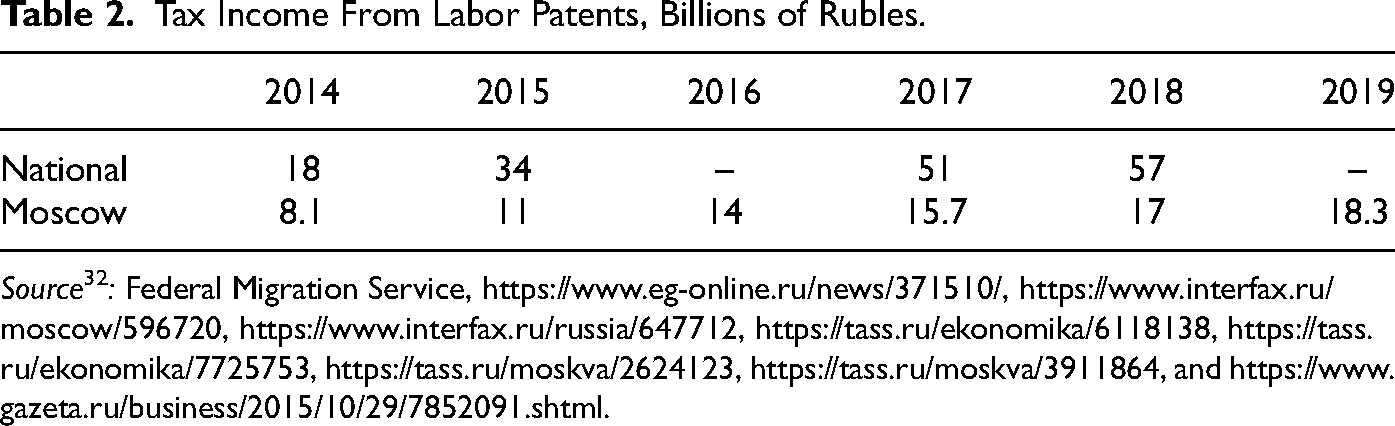
Since 2015, the Russian state has successfully increased tax revenue collected from migrants (Kakaulina 2019). Data on revenue (Table 2) from patent holders’ monthly income taxes (independent of other fees collected by the PVS or GUVM for document services in the migration center) demonstrate that despite an overall decrease in the number of official labor migrants after 2014, tax revenues increased. These data show a trend that began much earlier; the increase in tax revenue from patent-holding migrants from 3 billion rubles in 2011 to 34 billion rubles in 2015 marks an 850 percent increase (Schenk 2018a). This increase was largely due to legislative changes that took effect in 2015, making patents not only more complex but also more expensive (Ivanova and Varshaver 2018). Monthly tax payments have steadily increased since the patent reform was enacted in 2015 (Kakaulina 2019). While the new system has brought more revenue into state budgets (in terms of both taxes and payments for services in migration centers) and systematized the process of issuing documents through migration centers, overall access to migrant documents has not kept pace with the number of migrants working in the Russian labor market, as suggested by the gap between patent-eligible and patent-receiving migrants in Table 1. The migrant population in Russia has been resilient, despite exogenous shocks such as economic crises and policy changes, meaning there is a steady population of undocumented migrants who cannot access patent documents (Chudinovskikh and Denisenko 2020; Demintseva 2017; Urinboyev 2020).
Tax Income From Labor Patents, Billions of Rubles.
Source 32 : Federal Migration Service, https://www.eg-online.ru/news/371510/, https://www.interfax.ru/moscow/596720, https://www.interfax.ru/russia/647712, https://tass.ru/ekonomika/6118138, https://tass.ru/ekonomika/7725753, https://tass.ru/moskva/2624123, https://tass.ru/moskva/3911864, and https://www.gazeta.ru/business/2015/10/29/7852091.shtml.
That these tax data are reported in the Russian press suggests that there is value in projecting budgetary gains to the Russian public, who may be concerned about migration being a net cost to Russian society. Combined with the data output of official labor migration statistics, the Russian state can project a win-win situation, both to itself and to the public, where the number of documented labor migrants are decreasing while revenues are increasing. Yet these data reflect only those migrants who can successfully complete all bureaucratic procedures and receive a patent. In this way, evidence from Russia demonstrates the consequences that can occur when states define demographic categories too narrowly, causing cases or people that fall outside boundary lines defined by policy to disappear from official statistics. In the Russian case, those that fall outside the category of labor migrants are those who cannot, for whatever reason, obtain a patent.
Federally imposed rules in Russia ensure that the data produced through interactions between migrants and local state agents in the migration center miss entire groups of migrants. In some cases, migrants may not be counted out of a certain privilege (e.g., the preferential access that Kyrgyz or Armenian labor migrants have as a part of their membership in the EAEU), while in other cases, migrant precarity is the reason for not being counted (e.g., not having sufficient Russian language skills to navigate the patent process). The final data are presented by the Russian federal government as an accounting of state effectiveness without a wider discussion of how these data hinge on locally embedded processes that are relationally negotiated. This omission obscures the fact that official migration data in Russia are a product of interactions between migrants and local state agents and are limited by constraints imposed by the federal government.
The Migration Center: Agency and Institutions
This article argues that the agency of local actors, both state officials and migrants, are central to the process of generating migration documents and state statistics in Russia, calling for a more detailed understanding of the social contexts that affect how official data are produced. As I show in this section, migration data are not simply revealed or discovered but, instead, performed, or relationed to being. The relational environment that produces migration data displays multiple incentives and motivations for both migrants and state agents that have important implications for numerical data. Because of the visa-free entry to Russia for citizens of CIS countries, migrants must volunteer to be counted by applying for a patent in the migration center after they arrive in Russia, despite evidence that documents provide only thin and fleeting legal protection and that even minor violations can result in deportation and a ban on re-entry for several years (Kubal 2019; Kuznetsova and Round 2019; Urinboyev 2020). State agencies at the local level must attract migrants while preserving the integrity of the pre-defined rules and incentives handed down from the federal government.
The agency of migrants and state workers exists in tension with other forces: for migrants, with precarity, and for center workers, with state obligations. Migrants display agency, first, by physically coming to the migration center to be documented. Because this action is marked by both risk and choice, migrants engage several strategies to reduce precarity, such as paying for PVS services, to decrease their chances of making a mistake on their patent application. Likewise, migration center workers exercise agency when they create a customer service environment that facilitates migrant documentation. There is also a clear profit motive, as the more migrants the PVS attracts, the more profit it makes from fees and the more taxpayers it creates. Increased profit also allows the PVS to attract better workers and pay for promotional materials, contributing to a customer service atmosphere. The ensuing interactions between migrants and state officials, thus, give us a view “behind the curtain of everyday data work” (Porter 2020), demonstrating both the incentives of actors and the constraints under which they operate. Analyzing the social field of data production provides insights into the limits of relationally produced data and the consequences for migrants and governments alike.
Migrant Agency and Precarity
Because Central Asian migrants come to Russia visa-free and can only obtain a patent once they have arrived, the Russian state's ability to produce data on migrants depends on migrants’ willingness to enter the migration center and apply for a patent. Given migrants’ well-documented encounters with police and tax inspectors during raids, street checks, and inspections in Russia (Kuznetsova and Round 2019; Turaeva 2020; Urinboyev 2020), it is reasonable to assume that fear shapes a migrant's willingness to cross into state spaces like the migration center. If a typical encounter with a state agent involves a police officer on the street scrutinizing documents and threatening migrants with fines, arrest, and/or deportation, why should a migrant not expect the same of state officials inside the migration center?
I observed migrants utilizing several strategies to mitigate some of the fear or risk they might expect to encounter in the migration center. Paying for commercial services, arriving with every document imaginable, showing strong Russian language skills, relying on previous experience, or bringing a friend or paid intermediary to help allowed migrants to navigate a process otherwise marked by risk and uncertainty. These strategies demonstrate the lengths to which migrants must go as they seek official documents, suggesting that becoming documented and counted is possible but arduous. While migrants find numerous strategies to increase their chances of successfully applying for a patent, implicit in these findings is that many other migrants do not have these options available to them and, therefore, are not counted in official labor migration data.
While migrants could submit their documents for a patent directly to the GUVM, at the time of my observation, the wait for an appointment was four weeks, at which point they could potentially be sent away to start anew if a document was missing, damaged, or incorrect. According to the PVS director, around two-thirds of migrants who applied for a patent used the PVS commercial services to help them prepare their application, verify that their documents were in order, and have their application submitted to the GUVM for processing. For 11,000 rubles ($170, at the time) in cash, a PVS worker compiled a packet of the migrant's documents, generated a computer-printed application, paid the first month’s tax payment, and provided a medical insurance policy. Migrants were, then, sent from the PVS worker to a PVS inspector in a different section of the center, who verified the packet of documents and forwarded it to the GUVM for processing. While a PVS-generated application packet did not guarantee that the GUVM would issue a patent, the process was intended to make sure that applications were successful. 27
Another strategy used by migrants to assure a successful patent was to bring every document imaginable to support their applications. Beyond the required documents (migration card, passport, residence registration, medical certificate, and language exam certificate), migrants often came with previous patents, tax receipts from previous patents, tax identification certificates, and marriage certificates. This kind of over-preparing is common in Russia, where documents can be an obsessive focus of migrants (Reeves 2013), despite their fragile connection to durable legal status.
In some cases, migrants’ language skills and previous experience greatly facilitated the application process. Apart from one worker who spoke occasional Tajik and Uzbek with clients, the language of business in the center was Russian. The following conversation occurred between a migrant with fluent Russian and the PVS worker as she scrutinized a document with a magnifying glass and asked:
Was your patent last year issued on this [document]?
Yes.
A letter has been changed. I see it, it's clear. You have a 50–50 chance. Do you want to risk it? If they don't give the patent, you can't get your money back.
It's okay. I used the same [document] for the last 2–3 years.
In this case, the migrant was confident that his document would be accepted, based on his own personal experience, and he was able to communicate this assurance to the PVS worker in Russian. Although passing a Russian language exam is a requirement for the patent, migrants’ everyday language skills vary. I observed many visibly nervous migrants who spoke little Russian, suggesting that Russian language fluency remained a barrier to navigating the migration bureaucracy and becoming documented and counted.
Because of language and bureaucratic barriers, some migrants came to the center with a friend or a paid intermediary. Of the 370 interactions I observed, 50 (14 percent) arrived with a helper of some sort. Moreover, the neighborhood near the migration center hosted several businesses advertising help with migrant documents, suggesting that migrants relied on intermediary services enough to keep them in business. In certain cases, it was clear that the migrant was paying the intermediary to guide them through the process, as in one case when a migrant shared the list of how much he had paid his intermediary (an additional 8,900 rubles, or $140, above the PVS fees). In some cases, several migrants came with one intermediary facilitating the process for the whole group. In other cases, the relationship between the migrant and helper was more intimate, sometimes a wife, employer, or friend.
The variety of strategies that migrants used to help them navigate the patent application procedure demonstrates agency but also suggests that becoming documented was a burdensome process. The fact that official migration data in Russia hinge on the participation of this precarious group raises the stakes for PVS workers, who must facilitate migration documentation to do their work effectively.
Customer Service-Oriented State Agents
While similar centers throughout Russia offer migrants a one-stop service, the center I observed made a concerted effort to reach out to clients. They advertised on social media, distributed gifts, such as branded folders and stickers, to clients, and offered discounts for repeat customers. When I asked the PVS director if his workers were given any formal customer service training, he answered that there was no specific training but that they were all young and energetic. PVS workers were mostly under 40, mostly women, and generally had degrees in law or social science. They had a mix of personalities and ethnic backgrounds that came together under the leadership of a director who created an empowering team atmosphere among workers. Many extended that positive atmosphere by building a good rapport with migrants as they sat together to fill out patent applications. At the same time, PVS workers were resolute in complying with the rules that would produce a successful patent application. Out of these dueling imperatives — facilitating documentation and upholding the letter of the law, a tension arose between efforts to make the space modern and customer service oriented and the gatekeeping that prioritized federally defined rules.
The first gatekeeping barrier migrants encountered in the center was the administration desk, where two young PVS workers distributed computer-generated tickets for services or appointments. Airport-style queue dividers and a security guard worked to keep the line of clients in check. The pace of interactions between PVS workers and clients was frenetic, and the atmosphere was intense. The administrators’ gatekeeping role was both high-tech and impersonal, filtering clients into the electronic system on a first-come-first-served basis, and low-tech and interpersonal, requiring that clients explained what services they wanted to get a ticket to the correct section of the migration center. Those who did not know exactly what they wanted were met with rapid-fire questions and instructions that left them walking away with bewildered expressions on their faces.
By contrast, when a migrant passed the administration desk's gatekeeping step, received a ticket, and sat with a PVS worker to complete a patent application, the advice the PVS worker gave was important for helping migrants understand the documentation process and completing it successfully. Although there was occasional ambiguity about when an application might be accepted, so long as supporting documents were present and valid, PVS workers delivered applications to the GUVM. If supporting documents were not present or valid, migrants likely needed to provide an additional document, go to the border and re-enter the country to reset their legal status, or go home for a period of time before they could return to Russia and reapply for a patent. These options often only became clear to migrants through their interactions with migration center workers. Many times, if a document was missing, the PVS worker allowed the migrant to return directly to their window, after running to make a copy, get a photo, or get a document translated. These interactions demonstrated how the PVS workers could both uphold federal rules and facilitate a migrant's patent at the same time.
One set of rules that frequently guided interactions in the migration center concerned migration cards received on the border. 28 A valid migration card that specified work as the purpose of visit, issued within the previous 30 days, was an essential component of a patent application. The advice given to migrants about managing migration cards is an important example of how PVS workers facilitated documentation. During my observations, I heard PVS workers regularly advise migrants to go to the border and get a new migration card, a solution that does not appear in any official written law or administrative instructions. Migrants were most often advised to cross the border, return, and obtain a new migration card in one of three circumstances: if they were not able to successfully submit their application for a patent within 30 days of arriving in Russia; if the purpose of visit on their migration card was anything other than work; or if they wanted to renew their patent for another year but did not have an official contract with their employer. While going to the border was not a simple solution, PVS workers’ advice for getting a new migration card offered a way for migrants to reset their status and eventually become documented and counted.
Despite giving various types of advice, PVS workers also watched migrants either follow procedures or leave undocumented and uncounted in migration data. As the following encounter shows, workers seemed not to give much thought to what happened in cases where migrants did not follow their advice, since it was outside the scope of their work. In this case, a migrant came to a PVS inspector one day before his residence registration expired. Often, the administrators sent difficult cases like this one directly to the PVS inspectors. Inspectors were much tougher than the other PVS workers, as they were the last line of defense screening out any possibly weak applications that might not be approved by the GUVM.
I need a consultation. All my documents are ready. I’ve done everything.
You need to go home for three months. 29
I want to get a patent today so I can prolong my [registration].
A patent takes ten days. You should know this; it's not your first time in Russia. Your registration is until tomorrow; after that, it's a violation.
In the ensuing conversation, the migrant pleaded his case, eagerly seeking a way to stay in Russia. I later asked the inspector what the migrant would likely do. She said simply that he would go home. I asked if she thought he would really go home. She was very matter of fact, saying if he became undocumented, sought false documents, or found any “other solution,” it would be dangerous because Russian police were vigilantly checking documents on the street as the World Cup was getting under way. She did not speculate further, presenting the case as a black and white matter of either following the law or eventually getting in trouble, and did not have any thoughts toward the potentially nebulous existence undocumented migrants might have. Migrants that were not successfully documented simply floated off into the uncounted population, becoming invisible to the state from the perspective of official migration data.
We know from research outside the migration center that migrants in Russia often work without a patent or other documents, uncounted in official statistics (Kuznetsova and Round 2019; Urinboyev and Eraliev 2022). While the migration center's efforts to create a streamlined customer service-oriented operation increased the chances that migrants would be successfully documented, the same actors’ gatekeeping behaviors limited migrants’ access to patents if they did not have Russian language skills, previous success in procuring documents, or the assistance of friends to guide them through the process. As a result, the Russian state only saw where it was succeeding; nonparticipation (those migrants not coming to be documented) and failed attempts at documentation were not recorded. This partial view of the migration population, which ignores large numbers of migrants, has important implications for migration statistics.
Conclusion
Prior to my observations in the migration center, my understanding of street-level migration regulation in Russia came from a literature focused on how the state fails to create effective procedures to document migrants (Light 2016; Kubal 2019; Reeves 2013; Urinboyev 2020). While these studies chronicle important aspects of migrant experiences in Russia, this article shows a state space that works effectively to document migrants without corruption. 30 I was astonished to find that state procedures actually worked, producing authentic data through human interactions, although I came to understand that the documenting and counting of migrants in this migration center represented a limited view of the overall migrant population, one based on federally defined rules about who was eligible for a patent. It is further important to note that these official data produced in the migration center were not concretely connected to robust or enduring legal status for migrants. In the end, the data were more durable than any benefits to migrants who had volunteered to be counted. These findings demonstrate the important limits of official migration data in Russia. Because these limits are not generated by those aspects of migration policy and practice that make Russia different from most major migrant-receiving countries (e.g., authoritarianism, corruption, etc.), state migration data in other countries should likewise be interrogated.
By defining who was eligible for a patent and what bureaucratic procedures were necessary to receive a patent, the Russian state narrowed the category of eligible migrants and, thereby, depressed the number of migrants in the official federal migration statistics. The final published statistics miss a great many things. Much of the human-generated knowledge in the migration center was filtered out as irrelevant for state data production. How to navigate the patent process, reduce risk, increase chances of a successful application, and make sure documents were accurate were not captured in the data, which omit migrants who came for a patent but did not have “work” written on their migration card, who did not have a valid residence registration, who could not pass the language or medical exams, or who could not pay for an insurance policy and taxes. These migrants, along with EAEU citizens working in Russia, simply did not appear in Russian labor migration statistics.
Nevertheless, once migration data were created in Russia, they became authoritative symbols of state effectiveness that were recorded in official publications publicly issued by the State Statistical Services, shared with international agencies, and analyzed by scholars and in the media (Denisenko and Chernina 2017). These data are also crucial for internal accounting to demonstrate the ongoing effectiveness of local and federal agencies (Schenk 2021). 31 However, because the Russian federal government takes the data it has created at face value, they can avoid any pressure for reform that might come from a fuller accounting of the migrant population. In the end, the migration center's work generated a self-reinforcing view that migrants could be successfully documented in Russia while helping the state achieve its goals of revenue generation and overall low migrant numbers.
The Russian state's limited view of its migration population also ignores problems that migrants may encounter once they are counted in the statistics. I observed many interactions where PVS workers were honest with clients when their patent applications would be unsuccessful due to irregularities in their supporting documents. In these cases, the PVS merely sent the migrants away to fix their documents. If these same migrants walked out the door and encountered a police officer, many could be arrested and deported.
Thus, when a migrant is issued a patent and counted in labor migration statistics, it only represents a snapshot of migrant legality. Even when a migrant steps out the door of the migration center with a valid patent in hand, the delicate balance of keeping all documents up to date, from tax payments to employment contracts to residence registrations, becomes a complex task in need of constant attention (Kubal 2019). As a result, the official migration data in Russia do not reflect the number of migrants experiencing durable legal status, since they may fall out of legal status but still be recorded in the statistics on patents.
The rather-obvious conclusion that statistics do not reflect the actual number of migrants is nothing peculiar to Russia, as all immigrant-receiving countries contain undocumented and uncounted populations (Inglis, Li and Khadria 2019). This article has, instead, shown who goes uncounted and why, even when the state makes legitimate efforts to count migrants. Interrogating the social environments in which data are produced offers an important corrective to studies that take data at face value (Breunig, Cao and Luedtke 2012; Mirilovic 2010). Understanding these social environments is crucial for evaluating what is missing from the data and how that absence limits the claims we can make.
I have demonstrated that the Russian federal government limits who can be counted in the category of patent holders, reducing the number of eligible migrants while increasing the bureaucratic burden they face. This artificial narrowing of statistics occurs on the foundation of the structural contradictions Russia faces: its economy depends on migrant workers, the native population has high anxiety about migrants, and the government needs to increase tax revenue and appear in control of the migration situation by producing a plausible account of the number of migrants in the country. Amid these structural contradictions, the state generates official data as a symbol of effective immigration policy. These data are constructed through interactions between local state actors and migrants guided by federally defined rules and interests. This human component of data construction remains crucially important, even in an increasingly technological and automated big ata world.
Footnotes
Declaration of Conflicting Interests
The author(s) declared no potential conflicts of interest with respect to the research, authorship, and/or publication of this article.
Funding
The author(s) disclosed receipt of the following financial support for the research, authorship, and/or publication of this article: This work was supported by the Nazarbayev University.
