



Abstract
Japan has the most rapidly aging society in the world, with the fastest rate of population contraction. However, Japan has yet to embrace using international migration as a solution to these long-term problems. Successive governments have launched programs to alleviate labor shortages via migration, but these governments have also consistently resisted accepting that Japan is becoming an immigration country. Japan's restrictive migration policies, despite critical demographic challenges, have remained a central puzzle for migration scholars. This article addresses this puzzle by demystifying the hitherto-underexplored policy-making processes in Japan. Central to its analysis is Japan's “golden rule” to accept only highly skilled migrants, which has long grounded successive government policy orientations. The qualitative analysis presented here shows that self-constrained bureaucrats in Japan depend on temporary solutions to migration issues without tackling fundamental reforms, due to the country's compartmentalized government structure. Shedding light on policy-making processes within the Japanese government, this article highlights the need to examine bureaucrats’ role in migration policy-making so that we can review the policies more carefully to improve migration governance.
Introduction—The Land of No Immigrants?
The parliament has just passed the amendment of the Immigration Act… I have reiterated that the reform is not so-called immigration policy.We have introduced the quota. We have limited the length of stay. This is not the so-called immigration policy you are worrying about. ( Abe 2018 ) 1
In April 2019, Japan's Immigration Act was amended, establishing new visa categories with the aim of increasing the number of migrants working in Japan (Wakisaka and Cardwell 2021). In concluding the Parliamentary session, then Prime Minister Shinzo Abe delivered a speech at his press conference recapitulating that the reform would not lead to massive influxes of migrants. The reform, instead, would enable less-skilled labor migrants to work for a longer period in Japan than before (Immigration Services Agency 2021a). For example, foreign technical interns who could previously work in Japan for a maximum of 5 years could now use the new scheme (specified skilled worker) to prolong their stay for an additional 5 years 2 and ultimately work in Japan for 10 years total (Ibid.). However, these migrants were not eligible for permanent residency; since a migrant must stay in Japan for more than 10 years consecutively to apply for permanent residency, specified skilled worker 1, whose residential period is limited to 5 years, is not eligible for settlement (Immigration Services Agency 2021b). If a migrant is allowed to upgrade their visa category to “specified skilled worker 2,” who can stay for over 10 years consecutively, they will be eligible for settlement (Ibid.). As such, the Japanese government aimed to alleviate severe labor shortages in areas including care, agriculture, and construction; nevertheless, the Prime Minister consistently claimed that the new program was not an “immigration policy” (imin seisaku in Japanese) and that Japan would never become an “immigration state” (Abe 2018).
In this context, an “immigration state” refers to a settler state. Abe argued that Japan would not emulate countries like the United States, where an explicit link between immigration and population is made (Okamura 2018). In this way, the policy emphasis related only to migrants’ legal entry and period of stay in Japan, not a route to settlement. In short, Japan is not a settler state and the Japanese government insists it does not have an immigration policy through which settlers come. However, this is just political rhetoric to eschew a series of controversial debates regarding whether Japan should accept a large number of migrants (Surak 2018; Roberts 2012, 2017).
Japan is predicted to lose a quarter of its population—30 million people—over the next four decades (2016–2055), with the percentage of the elderly (those over 65) rising from 27.3 to 38.0%, which will be one of the highest percentages in the world (Cabinet Ministry 2017). Despite being the world's fastest-aging and shrinking society, Japan has never embraced migration as a means to address the declining population (Wakisaka and Cardwell 2021). Whereas other industrialized Asian economies, such as Singapore, South Korea, and Taiwan, have introduced formal schemes to accept unskilled migrants, Japan has officially kept a restrictive stance on unskilled migration (Vogt 2014; Hollifield and Sharpe 2017; Lee 2018). Its policies under drastic demographic change have remained a central puzzle for migration scholars (Seol and Skrentny 2009; FitzGerald 2014; Tian 2018). This article aims to address this puzzle by demystifying the hitherto-underexplored policy-making processes in Japan.
To comprehend the puzzle of Japan's migration policy orientation, this article focuses on a 1988 Cabinet order to accept only highly skilled migrants (HSMs) (Japanese government 1988). This policy approach—described here as the “golden rule”—has played a crucial role in shaping Japan's migration policies, despite changes in government since 1988 (Wakisaka and Cardwell 2021). Based on the framework of a discursive gap which Czaika and de Haas (2013) conceptualized as a difference between political rhetoric and actual policies (see also Acosta Arcarazo and Freier 2015), the golden rule is regarded as a discursive gap widely observed in other countries. The discursive gap is a useful concept in analyzing migration governance as it reflects how a government eventually forms migration policies (Acosta Arcarazo and Freier 2015). This article develops the lens of the discursive gap by answering the question, “What makes a discursive gap?”
In so doing, this article advances existing knowledge on the institutional constraints of migration policy-making (Joppke 1998; Boswell 2007; Ruhs 2013; Lee 2018) by redefining the role of policy-makers to understand policy-making processes within a government. The existing literature on migration governance has identified interest groups (Freeman 1995, 2000), human rights advocates (Hollifield 1992, 2008), and judiciary/norms (Joppke 1998; Bonjour 2011) as the causes of the discursive gap. In other words, classic theories on migration governance posit that nongovernmental actors define the migration policies (Boswell 2007; Bonjour 2011). Instead, I argue that self-constrained bureaucrats can be a hidden cause of the discursive gap. Shedding light on policy-making processes within the government, rather than focusing on nongovernmental actors, I highlight the importance of examining bureaucrats’ role in forming migration policies.
Theoretical Framework
Discursive Gap
The aforementioned Abe (2018)'s political rhetoric that does not include an “immigration policy” contradicts the series of admission policies which have been introduced in Japan (Tian 2018). Nevertheless, this kind of rhetoric emphasizing a restrictive stance toward immigration, while keeping admissive policies, also prevails in other countries (e.g., US, UK, and Germany), which Czaika and de Haas (2013) conceptualized as the discursive gap. Drawing on the disparity between political discourse and actual policy, the discursive gap underlines that remarks made by policy-makers do not necessarily translate into migration policies (Boswell 2007; Geddes 2008).
Czaika and de Haas (2013) have categorized three gaps based on the phases of policy-making: (1) the discursive gap (a difference between public policy discourses and laws), (2) the implementation gap (a disparity between laws and implemented measures), and (3) the efficacy gap (a gap between implemented measures and migration outcomes). Applying this concept, Acosta Arcarazo and Freier (2015) insist that the discursive gap should be central to analyzing the migration-policy nexus, as it embodies the nature of migration policy-making, rather than merely discussing unclear implementations and subjective outcomes. Building on this point, this article spells out two puzzles that are key to analyzing the discursive gap: (1) why the gap occurs, a basic question frequently asked by scholars (e.g., Freeman 1995, 2000; Hollifield 2004, 2008), and (2) who creates the gap, a significantly overlooked question in the migration governance literature (see Czaika and de Haas 2013).
Regarding the first question, the literature on migration governance has focused on why governments introduce open-border policies that contradict their stated mission, identifying various factors across countries (Martin, Abella and Kuptsch 2008; Ruhs 2013). For example, Freeman's (1995, 2000) clientelist model explains that political decisions are affected by a handful of vocal lobbies (e.g., from agricultural sectors) who are motivated by their own interests, while Hollifield (2004, 2008) points to liberal democracy that promotes admissive policies despite official restrictive stances.
Both Freeman (1995, 2000) and Hollifield (2004, 2008) regard an administrative agency as a passive policy actor while politicians and nongovernmental actors such as interest groups and courts play a vital role in migration policy-making. For instance, Freeman (2000: 20) claims In the United States, immigration policy is made either in the White House or in the Congress. Typically, the INS (Immigration and Naturalization Service) plays a marginal role of providing data…The agency is a unit within the Justice Department. The Attorney General has many other matters to deal with and unless there is a crisis pays little heed to immigration.
Hollifield (2004: 895) also articulates that “administrative authorities were hampered by legal/constitutional constraints in their quest to reverse the migration flows.”
Given that there is no one factor causing the discursive gap, Joppke (1998) contended that judicial decisions, policy-makers’ moral constraints, and a state's historical background (e.g., a colonial legacy) tend to define how it eventually implements pro-immigration policies. Bonjour (2011) advances Joppke's arguments by putting a greater store in ideology and moral considerations in the policy-making process. Criticizing existing research as a US settler model which crucially underestimates state power and intentions, she shows that Dutch policy-makers do not lose their power to control migration but that their ideology and morals (e.g., social norms upholding equal treatment and family unity) result in liberal policies, despite restrictive public discourse. Bonjour's (2011) model of morals and power offers two important implications for this article. First, the scholarly arguments on migration governance have been western dominated; thus, more variations are required to comprehend the patterns of discursive gaps, especially from nonsettler societies like Japan. Second, if Bonjour's (2011) model is helpful in distinguishing among variations in the patterns of discursive gaps, it is worth testing whether Japanese policy-makers have morals and power as Bonjour (2011) tested in the Dutch case, and analyzing how these factors influence the discursive gap.
In testing Bonjour's (2011) model, it is imperative to identify policy-makers because there is no common understanding in scholarship as to which actors are defined within the scope of “policy-makers” as a category. In fact, scholarly debate over the discursive gap rarely differentiates among the policy actors who are typically defined as civil servants and politicians, with no clear distinction between them (e.g., Bonjour 2011; Czaika and de Haas 2013; Acosta Arcarazo and Freier 2015). If we postulate that politicians define policy orientations and civil servants implement policy (Nishio 2006), then the discursive gap can be interpreted as the gap between politicians’ discourses and civil servants’ implementations.
Nevertheless, politicians may be extremely varied, even within the same party (Wakisaka 2018), and civil servants also have different missions, interests, and tenets across ministries (Boswell 2007; Czaika and de Haas 2013). Ruhs (2013: 34) suggests that
different government departments have varying responsibilities, interests, and capacities in the making and implementation of public policies. Policy decisions thus can be significantly influenced by negotiations, power struggles, and compromises made within the state bureaucracy.
Since institutional constraints might be different among the specific actors (e.g., politicians and civil servants), more careful research distinguishing among policy actors is needed vis-à-vis the policy-making process. In this regard, this article sheds light on bureaucrats’ role in migration policy-making in Japan.
Kasumigaseki Bureaucracy
Japanese bureaucrats are lifetime-appointed civil servants who are metaphorically and collectively called Kasumigaseki, named after the location of their offices (in a similar vein to “No 10” for British Prime Ministers) (Wakisaka 2018). Kasumigaseki bureaucrats’ strategic importance and power have been recognized by a substantial body of political literature (Johnson 1982; Mabuchi 1994, 2010; Imamura 2006). Although they are not elected, these bureaucrats are the main actors in both administration and legislation in Japan (Muramatsu 1994; Nishio 2006; Soga 2016), whose Constitution of 1947 clearly separates state authorities into three spheres: the government's executive power (defined as the Cabinet in Article 65), legislation by the parliament (Article 41 et seq.), and the judiciary (Article 76 et seq.). Bureaucrats work under the supervision of the Cabinet, which is charged with administrative governance, and are expected to draft legislation, as House members (politicians) usually do not have practical skills to write laws (Wakisaka 2018). A substantial body of research on Japanese bureaucracy has mainly focused on economic policy-making (Soga 2016), with very little known about bureaucrats’ role in migration governance (Tarumoto 2012).
Among the limited studies on migration governance and bureaucracy in Japan, Bartram (2000, 2004, 2005) presents an original analytical approach in comparing Japan's migration governance with that of Israel. He contends that Japan's bureaucracy, which took a leading role in the migration policy-making, functioned effectively in the 1960s and 1970s, allowing the country to keep the migrant flow at a low level. It deserves scrutiny whether Bartram's claim on functional bureaucracy is still valid to date, given the numerous policy inconsistencies in Japan's migration policies (Mori 1997; Sellek 2001; Roberts 2012; Tian 2018).
Regarding policy-making, scholars have argued that multilayered governance and compartmentalized central government cause Japan's ad-hoc policies (Yamawaki 2002; Mizukami 2012). For instance, Vogt (2011, 217) claims that the Japanese “culture of migration politics” is characterized as “tardy single-level policy-making that suffers from a lack of inspiration” leading to any policy changes ad-hoc (see also Kingston 2014; Surak 2018). This article examines the causes of ad-hoc policies through two recent policy cases: the “golden rule” and the points-based system (PBS).
Research Design
Two Cases Underpinning the Research
The “golden rule” and the PBS show how Japanese bureaucrats have kept up the discursive policies, overlooking the reforms that would appear to be necessary to confront other challenges in society, beyond population decline. Since migration policies are related to a wide range of public policies, including those related to the labor market and education (Czaika and de Haas 2013), it is indispensable to pinpoint the scope of the policy on which this analysis is focused. In this regard, this article focuses on the legal entry/stay system that constitutes the heart of Japanese migration governance. The two cases, the golden rule and the PBS, were chosen because they are recent enough to explain the current migration regime and have had significant impacts on Japanese industry/society (Wakisaka 2018). Above all, skill definitions have been central to migration policy debates in Japan since the late 2000s (Oishi 2020).
The golden rule is the principle guiding Japan's migration regime and an official document, stipulated as secondary legislation,
3
prescribing that Japan accepts highly skilled migrants, but not unskilled workers (Japanese government 1988). This principle was first agreed upon in 1988, in the form of a Cabinet decision, and has remained a principle found almost everywhere in the government's basic documents on foreign labor (e.g., MOJ [Ministry of Justice] 2015; Ministry of Foreign Affairs 2004)
4
. All Ministry Ordinances and notifications should be in line with this rule (Teduka 2005), which declares that
Japan accepts foreign labor from the expert/technical sectors more proactively than ever to revitalize the socioeconomy and promote internationalization… Regarding unskilled labor… it is essential to cope with the issue with thorough deliberation based on a consensus among the Japanese people. (Japanese Government 1988)
It is an open secret that part of this golden rule has been invalid, since there are many side doors to bringing in unskilled migrants, such as technical trainees 5 and Nikkeijin 6 (Tsuda and Cornelius 2004; Liu-Farrer 2011). Roberts (2012) insists that the policy of not accepting unskilled labor migrants and the reality of creating several side doors to accept unskilled migrants are inconsistent and that the policy should be updated to accommodate the reality. The US Department of State (2020) has also urged Japan to address human trafficking caused by its technical trainee program. Still, a fundamental solution requires abolishing the golden rule restraining unskilled migration.
Another policy case is the PBS, launched in 2012 to attract HSMs (Immigration Services Agency 2021a). This scheme identifies highly skilled foreign professionals based on points. It provides them with preferential treatment in immigration laws (e.g., a fast track to permanent residency) (Immigration Bureau 2017). Points are calculated on the basis of attributes such as academic background, professional career, annual salary, and age (Ibid.). The number of HSMs who benefitted from the scheme in the first 11 months was just 434, far fewer than the government expected and only 0.2% of all HSMs (Oishi, 2014). The advisory board for the Minister of Justice, therefore, urged for reforms in 2013:
Under the status quo, it is pointed out that there are some groups of people who should be deservedly recognized as a highly skilled professional that are not approved in the system. Against this background, it is necessary to reform the points system urgently
(Dai 6ji shutsunyukoku kanri seisaku kondankai gaikokujin ukeire seido kento bunkakai, 2013: 5).
As a result, PBS has been reformed several times since December 2013 (Immigration Bureau 2017). For instance, the minimum salary was abolished for advanced academic research activities, regardless of age (Ibid.). Consequently, the number of highly skilled professionals increased remarkably, from 434 to 29,084, as of June 2021 (Immigration Services Agency 2021a).
Methods
This article employs qualitative analysis of semistructured interviews and a series of public documents (e.g., MOJ's advisory board meetings). Nineteen interviews with migration policy experts were conducted in Tokyo in 2015, in compliance with the ethical guidelines of the University of Bristol (UK). Interviews were mainly conducted in Japanese, but English was also used in some cases. Interviews focused on respondents’ views on “the golden rule” (i.e., only accepting the HSMs) and why the initial PBS scheme had not worked.
Participants were reached through the author's personal network and direct contact, such as email. They were mainly recruited from the government (i.e., bureaucrats) but also included various stakeholders, such as people from the business sectors, immigration lawyers, researchers, and staff at nonprofit organizations, all of whom had been involved in Japan's migration debate. Although the data collected from bureaucrats were used to analyze the policy processes within the government, arguments presented here are also based on interviews with nongovernmental actors (i.e., outsiders). Among other criteria, all policy-makers 7 interviewed were high-ranking officers across Ministries (higher than the director level 8 ). As policy-making involves legislative decisions, accessing high-level officers who had gone through the entire decision-making process was crucial to demystify how migration policies are formed within the government. Interviewees also needed to be experienced in public governance so that they could compare the migration governance with other policies.
At the time of interviews, there were only 13 director posts in the Immigration Bureau, alongside 4,614 administrative officials (Immigration Bureau 2017). Hence, directors were hard to reach. Instead of merely increasing the number of interviews, I attempted to ensure the quality of the sample, as Sato (2015) claims that if the quality of the sample is ensured, the sample size itself can be small. For example, I did not use “snowballing,” which can undermine data quality by only covering specific groups (Bryman 2016), notwithstanding that many migration scholars use snowballing, due to the challenging nature of identifying relevant participants (Atkinson and Flint 2001).
A challenge I had expected at the outset of data collection was to glean enough data from bureaucrats. As a Ph.D. student researching the hidden processes of migration policy-making in Japan and an outsider who had not been a bureaucrat, I needed access to insiders’ views. Nevertheless, the boundary between insider and outsider was not so obvious or fixed during interviews, since each person has a different background, as Ganga and Scott (2006) discussed. For instance, a director interviewed had conducted academic research on migration, and she sympathized with my research aims, while another director seemed to have little interest in scholarly arguments.
Compartmentalized Governance Structure
Equally Distributed Vetoes and Nonexistent Leadership
Japan's Immigration Control and Refugee Recognition Act (hereafter Immigration Act) was effective in 1981 as the primary legislation of migration governance (Teduka 2005; Wakisaka and Cardwell 2021). According to the Immigration Act, the primary authority in charge of labor immigration control is the MOJ (Ibid.). However, the Act prescribes a consultation process among the Ministries (akin to Departments of the US federal government); thus, the main players of migration governance equally and horizontally join in the decision-making process. If just one player rejects a policy change, the policy cannot be implemented, as is stipulated in the Immigration Act Article 7 (3): “the Minister of Justice shall consult with the heads of the relevant administrative organs in prescribing the Ordinance of the Ministry of Justice.” This state of affairs encapsulates the intricacy of labor migration governance in Japan: all relevant Ministries (i.e., the relevant administrative organs) have vetoes, and therefore, should reach a consensus in order to change policies (i.e., the Ordinance of the Ministry of Justice).
The Japanese government has 12 Ministries (Cabinet Secretariat 2022) that have their own individual missions and assignments (Imamura 2006). These missions and assignments are prescribed in the Acts for Establishment of Ministry based on the Parliamentary ratification (Nishio 2006). For instance, MOJ is tasked with immigration control (Article 4, Act for Establishment of the Ministry of Justice), while MOL (Ministry of Health, Labor and Welfare) is in charge of labor policies including migrants’ employment (Article 4, Act for Establishment of the Ministry of Health, Labor and Welfare). Therefore, MOJ and MOL should work together through a consultation process with regard to labor migration policies.
In my interview, former policy-maker 2 told that there is no driving force or leadership in the consultation process among Ministries. As evidence, Japan’s Immigration Act does not prescribe a leadership role to initiate migration policy reforms while stipulating a consultation process across the government in Article 7(3), which confers vetoes to all relevant Ministries. Therefore, a slow and unproductive consultation process is required to reach a consensus, as Vogt (2011) discusses. For instance, the PBS was first proposed in 2009 by the council
9
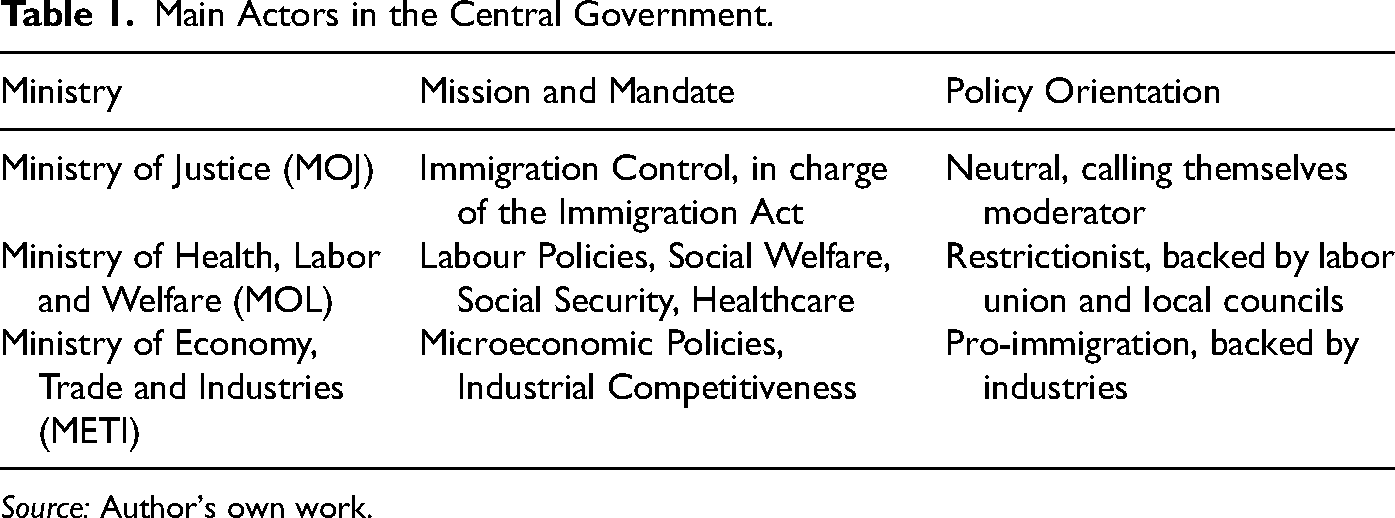
but not introduced until 2012, even though the council urged prompt action, given the fierce global competition over talent (Kodo jinzai ukeire suishin kaigi 2009). Furthermore, most bureaucrats interviewed expect it will take time to negotiate and conclude a decision and act accordingly. In a sense, it is de rigueur that they hold full discussions at the expense of time and costs, as a former policy-maker suggested: There are necessary discussions, indeed. So it is unfair to give it up just to save time. Ministry of Economy and Industry (METI) considers policies from business perspectives, and Ministry of Health, Labor and Welfare (MOL) does from workers’ perspectives. MOJ reflects on their opinions as a moderator. I can't say that's good or bad. But it is significant to find a point of compromise through consultation even if it takes time and is inefficient. (former policy-maker 1)
Former policy-maker 1 points to two critical clues in deciphering the enigmatic fabric of bureaucracy in Japan: one is the main actor in the government, and the other is their attitudes toward forming policies. Multiple actors in the central government control labor migration policies. Still, the main actors are the MOJ, MOL, and METI (Table 1). These three Ministries have different missions and sometimes hold different policy direction stance consequently. As the above citation from the interview suggests, the MOJ positions itself as “neutral” in accepting foreign labor. At the same time, the MOL is restrictionist, while the METI is pro-immigration. 10 Division within a government is quite common in migration policy-making (Boswell 2007; Bonjour 2011), but what is unique in Japan is that bureaucrats take slow decision-making for granted.
Main Actors in the Central Government.
Source: Author's own work.
Former policy-maker 1 acknowledged the necessity to undergo a stagnant consultation process among these Ministries because migration policies should be examined from multiperspectives. Indeed, labor migration policies can influence all the areas where people live and work (Czaika and de Haas 2013). Therefore, the government must consider a policy from every aspect, such as society, industry, the labor market, social security, and welfare. As the MOJ covers only immigration control, they must involve policy examination from other perspectives with other Ministries. Consultations across authorities are not rare in other industrialized countries (Boswell 2007; Rhodes 2011); nonetheless, in Japan's case, reaching a consensus takes an incredibly long time, as the respondent admitted.
Another issue that arises from the absence of leadership among Ministries is the lack of strategies. Japan's business and public sectors have long called for national strategies across Ministries to attract skilled labor migrants (Keidanren 2004) with a long-term perspective based on cross-Mministerial policies to address various issues, such as visa screening and social cohesion (Kodo jinzai ukeire suishin kaigi 2009). Former policy-maker 2 said that such strategies should be beyond immigration control and involve the comprehensive package that the government and business sectors can provide HSMs, such as special treatment in terms of tax, labor conditions, and children's education. In general, no Ministries will pose strong objections to these strategies, but it is also true that no Ministries will initiate the debate, inviting all relevant Ministries, simply because this leadership is beyond their role (Wakisaka 2018). Japan's administrative laws only endow each Ministry with specified authority, not cross-Ministerial leadership. For instance, the Act for Establishment of the Ministry of Justice endows MOJ with the detailed authority of immigration control (Article 4). Still, that authority does not include the leading role in coordinating policies for social cohesion or attracting migrants (see Gaikokujin shuju toshi kaigi [Council of Municipalities of Concentrated Foreign Residents] 2009; Yamawaki 2002; Keidanren 2004).
Causes of the Discursive Gap
The fact that there is no driving force to coordinate the direction of policies demonstrates that challenging reforms have been left untouched for decades. A good example is the golden rule, which has been the root cause of numerous contradictions, leading to “side doors” through which unskilled migrants enter the country. However, most policy-makers suggest that abolishing the golden rule was unlikely. Changing it (the golden rule) takes lots of energy, in my view. So I think we can take another measure without changing it. We have actually taken a lot of measures. For example, (unskilled foreign) people work in the construction industry. It is not well-deserved to discuss the principle (i.e., the golden rule), even though it takes lots more energy than tackling individual policy issues because there are various opinions. For instance, in the Liberal Democratic Party (the ruling party), there are politicians who are cautious (in accepting unskilled migrants) while some politicians insist we cannot manage without foreign workers in the declining population. It is difficult to coordinate these views into one. It's the reality that we have made up for a weakness (of the policy) using a temporary solution. (former policy-maker 3)
This testimony couches bureaucrats’ position and the consequent (but easy) counter-measures that policy-makers shared: bureaucrats can keep the status quo without amending the golden rule. Japan introduced a new policy to accept guest workers in the construction industries to address the labor shortage for the Tokyo Olympics in 2020 and for reconstruction from the 2011 Great Earthquake (Immigration Services Agency 2021a). The government did not need to change the golden rule to accept unskilled workers in the construction industries, since the government claims that foreign builders were not allowed to reside beyond 2020. 11 In short, bureaucrats preferred temporary solutions to alleviate labor shortage, rather than reforming the golden rule.
Former policy-maker 3 used the expression “energy” twice—for instance, changing it (the golden rule) takes lots of energy. “Energy” means that reforming the rule would be incredibly arduous. The rule prescribes a nationwide consensus when Japan decides to accept unskilled immigrants, saying “Regarding unskilled labour… it is essential to cope with the issue with thorough deliberation based on a consensus among the Japanese people” (Japanese Government 1988, emphasis made by the author). Reaching a nationwide consensus is quite difficult, considering that there are various views, from positive to negative, as the respondent put. For bureaucrats, changing the golden rule is almost unrealistic.
In sum, then, bureaucrats believed that they had no alternative but to create side doors to respond to Japan's labor needs. Therefore, the overall picture of migration policy is distorted and filled with contradictions (Roberts 2012), consequently leading to the discursive gap. The important implication of my findings is that the discursive gap is caused by interministerial negotiating processes, such as equally distributed vetoes and nonleadership, which jeopardize decision-making among bureaucrats, who leave the discursive gap untouched while working out temporary solutions. Thus, administrators themselves, to the contrary of external lobbies underlined by Freeman (1995, 2000) and Hollifield (1992, 2008), can be a main actor to cause the discursive gap.
Risk Averse and Homogeneous Society
Bureaucrats’ culture could also be spotted in their perfectionism and homogeneity. The findings identified that the Japanese government always seeks a no-fail system—a perfect policy rendering everyone happy, which is unfortunately a dream. A migration expert who had served as a member of the Advisory Board for the Minister of Justice stated that there was no such thing as a perfect system.
People (in the government) are always asking me, “OK, if we have a free change of immigration system, what about the risk?” They say there are gonna be risks involved. Anything is gonna have risks, and migration will never be 100% successful, whether it's US or Europe or wherever you are looking at. I don't know any cases always successful, and everybody has a happy time and nobody has any problems. (Minister's Advisory Board member)
Apart from this risk-averse behavior, it is also worth looking at the unbalanced composition of bureaucrats’ closed society. For instance, no foreigners 12 can be bureaucrats working in the policy-making process, and only 6.4% of management positions were filled by females in 2021 (Cabinet Bureau of Personnel Affairs 2021). Given the fact that 51.3% of Japan's population are females, the Japanese government acknowledges the urgent need of addressing the unbalanced composition of policy-makers to avoid one-sided policy formation by Japanese men (Japanese government 2021). As this fact suggests, Kasumigaseki is so homogeneous that the policy design (not limited to migration governance) does not incorporate the wide varieties of views, such as those of migrants and women.
To make matters worse, the Kasumigaseki “guild” is based on lifetime employment within each Ministry, resulting in little worker turnover. Except for a few opportunities for interministerial transfers, Japanese bureaucrats spend their entire careers in the same Ministry. In more mobile economies, such as Anglo-American ones, high-ranking officials in the civil service often bring professional experience from the private sector (Etzion and Davis 2008). By contrast, the Japanese elite bureaucracy tends to develop and retain human resources exclusively within each Ministry (Soga 2016). There are few political appointees or mid-career recruitments: the vast majority of bureaucrats were recruited through the Tier 1 recruitment examination, which is considered one of the three most strenuous national examinations in Japan (Wakisaka 2018). In addition, the positions are occupied by graduates from a handful of top institutions, such as Tokyo University (Colignon and Usui 2003). As a consequence, bureaucrats share a special sense of elite belonging (Koh 1989). In this way, the Kasumigaseki circle is not open, creating a homogeneous environment where innovative ideas stemming from diversity are almost absent. It is, thus, no wonder that drastic migration reform does not emerge in such a monoculture.
Policy Implications to Improve Migration Governance in Japan
Based on the findings of migration policy-making in Japan, this section argues for a possible solution to improve Japan's migration governance which is stuck because of the compartmentalized governance structure. As described above, the problems with Japan's migration administration emerge for the following reasons:
a compartmentalized government structure in which different Ministries have different authorities regarding migration policies; a decision-making system in which each Ministry has veto power on future migration schemes and consultations among Ministries are endless; the absence of administrative leaders to coordinate policies or discussions among Ministries.
To counter these issues, a so-called “Migration Agency” (Gaikokujin-cho in Japanese) has been proposed by local governments, researchers, and business sectors (Gaikokujin shuju toshi kaigi [Council of Municipalities of Concentrated Foreign Residents] 2009; Yamawaki 2002; Keidanren 2004). Although there is no universal definition of a Migration Agency, Gaikokujin shuju toshi kaigi [Council of Municipalities of Concentrated Foreign Residents] (2009: 1) regarded it as a governmental body akin to a Ministry that is “comprehensively planning and governing all the policy areas concerning foreign residents with a strong cross Ministerial leadership.”
Creating a Migration Agency seems like a good idea to realize cross-Ministerial leadership, but the detailed design for the Agency is not shared by those who propose it. For example, it is not clear whether migration policies would become the new Agency's remit or whether existing Ministries would have further responsibility: in the former case, the Agency would become a very big organization ruling various policies, from immigration control to the education of migrants’ children; in the latter case, the Agency would just be a policy coordinator and each Ministry would retain its authority. The former idea is unrealistic since it would eventually categorize a policy by nationalities and lead to further compartmentalized governance (e.g., the education of non-Japanese children is governed by the Migration Agency, and that for Japanese citizens is governed by the Ministry of Education, Culture, Sports, Science and Technology). Therefore, I would argue that the latter idea, Agency as a policy coordinator, 13 is more realistic and workable.
Among policy-makers interviewed, opinions on creating the Agency were markedly divided. The group in favor of the Agency suggested that on the condition that Japan proactively takes pro-immigration policies, something like the Agency would be a sine qua non for coordinating and leading policy reforms. In particular, they approved of its advantage in promoting social cohesion, policies for which were dispersed across Ministries. On the contrary, the party against the Agency insisted that so long as Japan maintained its current policies (i.e., keeping the golden rule), creating such an agency was not an urgent matter. This group also argued that the coordinator was just a coordinator, not a practitioner. So long as the Agency was confined to the central government as a coordinator, the agency would not be able to engage with practice. This claim is plausible because MOJ was just a moderator while the MOL or METI were practitioners in labor or industrial affairs. Establishing a new agency would replicate another MOJ.
This criticism concerning a new agency has turned out to be correct. The Japanese government created an administrative division coordinating policies for Nikkeijin in 2009 within the Cabinet Ministry (Cabinet Ministry 2012). Although its role focuses only on Nikkeijin, it is expected to coordinate policies across Ministries (Ibid.). Nonetheless, the organization does not take a leading role, and their activities seem to be stagnant, as evidenced by the fact that the Orientation Guide Book on their website has not been updated since 2012, leaving the explanation for the outdated system unchanged (see Council of Local Authorities for International Relations 2012). Considering this fact, it is questionable whether the Migration Agency as a coordinator could be a driving force for reforming cross-Ministerial policies.
An intrinsic problem with the Migration Agency is that the arguments on Migration Agency mainly focus on “establishing a new organisation.” In other words, in discussing the Migration Agency as a means to improve migration governance in Japan, we should examine how the Agency functions rather than its creation. In fact, the Agency should be given superior authority to exert leadership and give directions to other Ministries: otherwise, the Ministries and Agency would repeat the “horizontal” consultations. The key is to transform the consultation process from horizontal to vertical so that someone can lead and coordinate the negotiations among Ministries (see Figure 1).
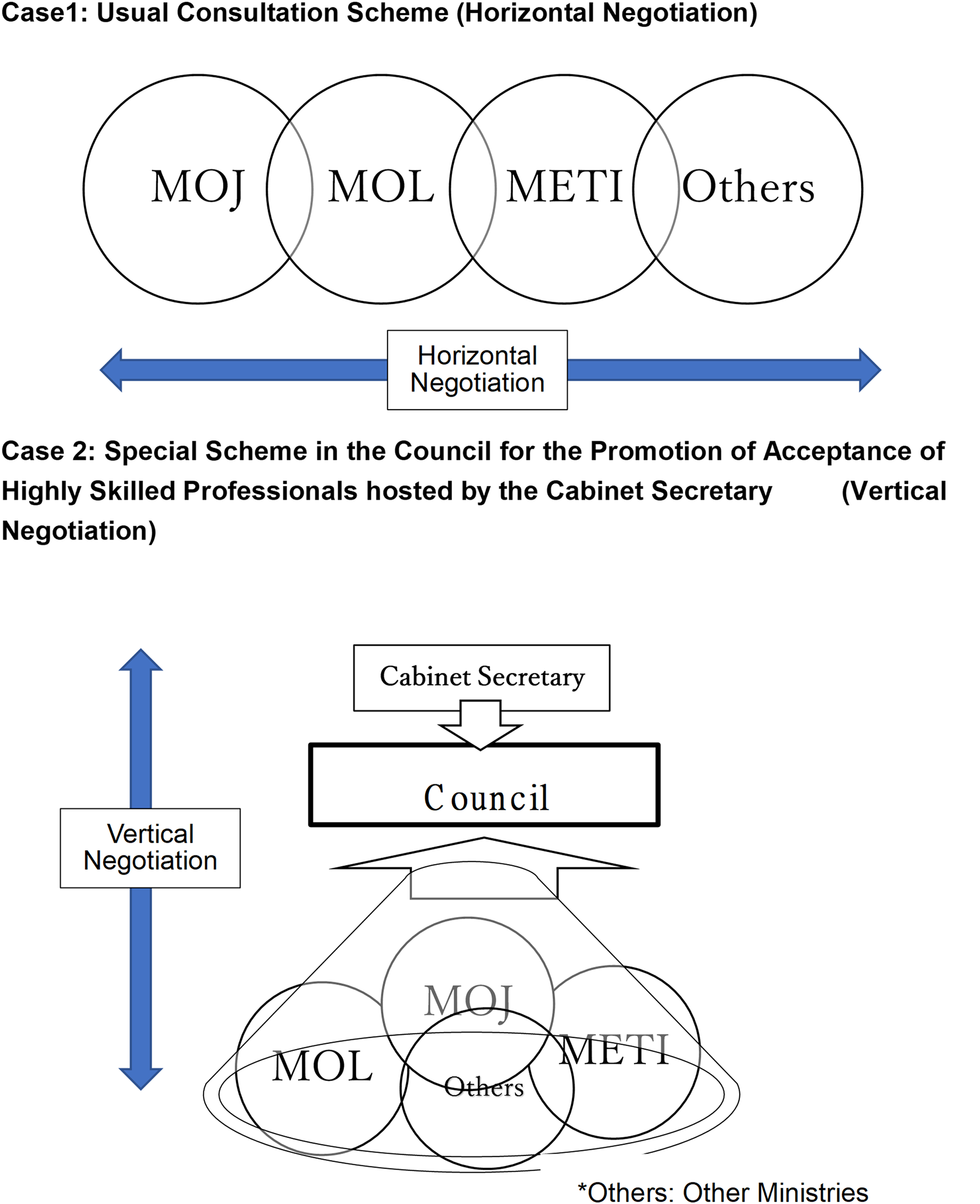
Horizontal and vertical negotiation.
However, this transformation requires political decisions because bureaucrats are to design migration policies under political directions (Nishio 2006). A policy expert who had been involved in the Advisory Board for the Minister of Justice stated: Basically, the problems with the decision-making arise because there's no political direction. Since MOJ consults other Ministries without any direction, it takes time to reach a consensus with all the Ministries. As all the Ministries have equal power to decide the policies, they can't conclude the consultations. So someone with superior power, if any, will make a difference. (Employers’ organisation)
So, who is someone with “superior power” that can lead the discussion and give an appropriate direction? Here, all interviewees agreed on the answer: a politician who was given the mandate to direct migration policies, ideally from the Cabinet, the supreme administrative organ.
In this sense, I would argue that government strategies to promote tourism can be a best practice to refer to. Until the 2000s, Japan was a small magnet for foreign tourists (Japanese government 2015). However, as the tourism industry was recognized as a potential measure to boost the economy, the Japanese government began to work seriously to attract foreign tourists in the early 2010s (Japanese Government 2013). In 2013, the government launched the Ministerial Council, which is hosted by the Prime Minister, comprises all Ministers, and devises cross-ministerial strategies (Kanko rikkoku suishin kakuryo kaigi [Ministerial Council on Tourism Promotion] 2013) to increase the number of foreign tourists. The strategies stretch from enhancing tourism infrastructures in local communities to relaxing visa conditions and are carried out by multiple actors in the public sector (Ibid.). As a result, the number of foreign tourists more than doubled from 8.37 million in 2012 to 19.74 million in 2015, after the Council was established (Japanese Government 2015).
The Ministerial Council for tourism gives us a useful lesson in cross-Ministerial negotiations, suggesting that establishing a cross-cutting body for better migration policies, headed by the Prime Minister with all Ministers involved, could be a good idea. In this Council, the necessary direction for migration policies would be decided, and one Council member would be endowed with the authority to enforce the reforms as the Minister for Migration. If the Minister needed administrative support, such as holding meetings, a division in the Cabinet Ministry could be established. In sum, there are three significant points:
The Council for migration would be led by the Prime Minister whose initiative represents strong political will; All Ministers would be involved so that all Ministers could engage with the policies’ direction; The Minister for Migration would be assigned to clarify who is responsible for implementing the policies agreed upon in the Council. The council was not under the Cabinet Ministry. Precisely speaking, it was designed to be established by the Chief Cabinet Secretary… If it was under the Cabinet Ministry, there may be some Ministries which did not join the Council. But the important point is it was hosted by the Chief Cabinet Secretary. Therefore, there was no Ministry which did not participate in the Council. All the Ministries agreed to join it, and the high officials such as Deputy Director General of a Bureau from each Ministry came to the meetings. (former policy-maker 2)
In fact, fieldwork identified a successful case using a similar scheme. In 2009, Kodo jinzai ukeire suishin kaigi (Council for the Promotion of Acceptance of Highly Skilled Professionals) proposed the PBS (Kodo jinzai ukeire suishin kaigi [Council for the Promotion of Acceptance of Highly Skilled Professionals] 2009). This council was hosted by the Chief Cabinet Secretary, who is generally the second most important position after the Prime Minister, and was joined by all relevant Ministries (Ibid.). An informant engaged in the Council articulated that this structure made the Council function to negotiate the PBS.
Normally, this kind of meeting is headed by the Cabinet Ministry, which is on a par with other Ministries, such as the MOJ, MOL, and METI. If it is led by the Cabinet Ministry, other Ministries may interrupt the policy reforms, exploiting their vetoes. Therefore, it was designed such that the Chief Cabinet Secretary, who has superior authority compared to other politicians, hosted the Council. Consequently, it achieved a breakthrough.
Conclusion
Bringing a non-Western perspective to the global migration debate, this article has provided an empirical study of Japan's migration governance with a focus on bureaucrats as hidden actors of migration policy-making. As theories of policy-making have relied mainly on European and North American case studies (Bonjour 2011; Acosta Arcarazo and Freier 2015), scholars have long called for work that theorizes the migration-policy nexus outside a Western context (Joppke 1998; Lee 2018). The Japanese case, which is a highly restrictive but exponentially shrinking society, helps illuminate the cause of the discursive gap as the least likely location of massive immigration (c.f., Bonjour 2011). Shedding light on an overlooked factor in discussions of the discursive gap, I argue that one institutional factor in Japan is a self-constrained bureaucracy bounded by an unrealistic national consensus which has resulted in a series of side doors as the products of a compromise. My findings imply that administrators themselves, in addition to the external lobbies underlined by Freeman (1995, 2000) and Hollifield (1992, 2008), can be a main actor to cause the discursive gap.
It is particularly noteworthy that Bonjour's (2011) model of morals and power can explain the Japanese case in a way Bonjour (2011) does not assume. I have shown that Japanese bureaucrats have morals and power, albeit different qualities from what Bonjour (2011) posits: the Japanese bureaucratic morals observed in the policy-making process uphold the time-consuming negotiations and normative acclaim of incrementalism. These exhaustive negotiations may hinder extreme clientelist policies, as Bartram (2000) claims; however, the exhaustive negotiations do not lead to migration policy reforms while facing serious demographic challenges. Indeed, bureaucrats have the power to design immigration control, but this power is not enough to initiate fundamental reform of the golden rule. The golden rule implicitly has a mechanism to preserve vested interests by prioritizing skilled migrants, who enjoy greater mobility and a series of privileges, instead of restraining guest workers, who are not granted rights such as permanent residency and family reunification. In other words, bureaucrats boast skewed power, which protects haves but leaves have-nots, as well as skewed morals generated from the closed circle of Kasumigaseki.
The findings also point to the necessity of breaking down policy-makers into subactors (i.e., bureaucrats and politicians) for more diligent investigations. The Japanese government is compartmentalized into multiple Ministries with different missions, and such a structure creates administrative impediments to reform migration policies. Equally problematic are vetoes, conferred to each Ministry, which makes only minimal reforms possible. In this compartmentalized governance structure, bureaucrats go through endless horizontal negotiations without any driving force concluding the discussion. Accelerated by their risk-averse nature, no bureaucrats initiate the discussion since the administrative laws endow each Ministry with only compartmentalized authority, not leadership.
Whereas this article focuses on bureaucrats’ role and behavior in migration policy-making, examining political role will further understandings of migration governance. As discussed, the discursive gap partly embodies the disparity between politicians and bureaucrats in Japan. To bridge the gap, this article proposed cross-Ministerial leadership to progress with migration policies. Referring to successful cases such as tourism promotion, I have argued that creating the Ministerial Council/Minister for Migration would help exert political leadership and promote negotiations across Ministries.
In conclusion, this article reveals that bureaucrats, often overlooked and hidden behind political actors (e.g., Freeman 1995, 2000; Hollifield 1992, 2008; Joppke 1998; Bonjour 2011), are in fact important players in forming migration policies. Although based on Japan, the findings presented here may offer broader insight. Much of the literature on migration governance, for example, features a political game to explain the discursive gap (Freeman, 1995, 2000; Hollifield, 1992, 2008). However, we may be able to review migration policies more carefully by understanding the policy-making processes within the government, shedding light on bureaucrats’ practices. For instance, not only Japan but other countries also face difficulties in interministerial negotiations because different Ministries have their own stakes (Boswell 2007; Ruhs 2013; Acosta Arcarazo and Freier 2015). The issues related to interministerial negotiations are often rooted in the practices and culture of administrative elites managing each Ministry (Boswell 2007; Rhodes 2011). Therefore, unraveling the policy-making processes from bureaucratic perspectives can be useful to improve migration governance in other countries as well.
Footnotes
Acknowledgements
The author is grateful to Paul James Cardwell, Ann Singleton, Kristin Surak and Diego Acosta Arcarazo, the anonymous reviewers and Editors for their constructive comments. The views expressed here are the author’s own.
Declaration of Conflicting Interests
The author declared no potential conflicts of interest with respect to the research, authorship, and/or publication of this article.
Funding
The author disclosed receipt of the following financial support for the research, authorship, and/or publication of this article: The Nippon Foundation International Fellowship.
