




Abstract
Despite Ecuadorians’ own extensive experiences as international migrants, as Venezuelan migration into Ecuador has increased sharply in the last five years, the Ecuadorian government has enacted a barrage of restrictive and exclusionary policies at and within the country's borders. Consequently, Venezuelans in Ecuador are forced into illegality, a spatialized social condition that entails simultaneous marginalization and inclusion in the contemporary socioeconomic order. This paper draws on theorizations of governmentality, destitution economies, and status value to argue that the illegalization of migrants produces various forms of value for the government and broader public. First, illegality works as a governmental mechanism to reconcile neoliberal capitalism with the inequalities it exacerbates. At the national scale, illegalization of Venezuelan migrants facilitates political legitimation for the Ecuadorian government, and at the local scale, illegality makes migrants hyper-visible in ways that obscure the negative consequences of neoliberal economic strategies. Second, illegality facilitates strategies for economic exploitation of migrants by private actors at the local scale. Exploring how illegality produces value in Ecuador is useful for understanding other cases of South–South migration and draws attention to the disciplinary functions of migration management outside the Global North. This article provides a case study of multiple mobilities in the context of growing poverty, historical inequalities, and the entrenchment of neoliberal capitalism.
Introduction
Over seven million Venezuelans have left their country since 2017, fleeing dire conditions of hunger, poverty, and health accompanying Venezuela's abrupt political and economic decline. Nearly six million of these migrants are now living in Latin America and the Caribbean (R4V 2022, 12). As numbers of Venezuelans seeking assistance and a new home in nearby countries have grown, most governments have hardened their borders, and general publics have become increasingly unsympathetic. Around 500,000 Venezuelans are currently in Ecuador (R4V 2022, 134), a country that initially appeared poised to offer a different, more compassionate response. Approximately 10 percent of the Ecuadorian population has migrated internationally in the last 25 years, and Ecuadorians continue to migrate today. As recently as five years ago, the Ecuadorian government vocally supported the right to migrate, even promoting the idea of “universal citizenship.” Since large numbers of Venezuelans began arriving in 2017, however, any guise of a more welcoming approach has disintegrated rapidly. Instead, public opinion has shifted to largely view Venezuelan migration negatively, and Ecuadorian political leaders have adopted the playbook of countries around the world in their use of border and immigration policies to restrict Venezuelan immigration into Ecuador and marginalize Venezuelans within its borders.
This paper examines the maze of legal, economic, and social obstacles that pushes Venezuelan migrants in Ecuador into a state of illegality, a sociospatial marginalization that fundamentally shapes their daily life. 1 I find it significant that actions to illegalize Venezuelan migrants have increased in tandem with the re-centering of neoliberal capitalist logics in Ecuador's government, economy, and public discourse. I draw on and expand theorizations of migrant illegality, pulling in scholarship on the creation of value in neoliberal capitalism as well as governmentality. Through this case study, I argue that the illegalization of migrants creates various forms of value for the host country government and population, showing how illegality is central to neoliberal capitalist political and economic systems. I distinguish between the value generated through economic exploitation at the local scale and value generated through sociopolitical legitimation of neoliberal economic policies and discourses at both national and local scales.
In addition to expanding knowledge of the rapidly shifting patterns of Venezuelan migration, this article makes several important contributions to existing scholarship. First, identifying multiple forms of value generated by marginalizing Venezuelans in Ecuador deepens conceptualizations of migrant illegality, and facilitates understanding illegality as a flexible tool of capitalism that operates simultaneously at multiple scales. Second, by framing political legitimation as a form of value produced by illegality, this analysis expands theorizations of neoliberal governmentality. Third, this article employs conceptual tools previously applied primarily to US and European regimes of border and immigration control to the South American context, pushing consideration of Global South–Global South migration into the scholarly mainstream.
The article proceeds as follows. First, I review existing literature on migrant illegality, governmentality of migration management, and how value is created through legal status. Second, I provide background information on the migrant exodus from Venezuela, Ecuador's own recent history of out-migration, and this project's research methodology. Third, I review Ecuador's policy approaches to international migration in the last 25 years, from President Rafael Correa's (never fully realized) idea of universal citizenship to the clearly restrictionist response to Venezuelan migration today. My analysis draws out how illegalization generates various forms of value for Ecuador and Ecuadorians at national and local scales.
Illegality and the Creation of Value
In this section, I assemble a theoretical framework for understanding how migrant illegality works as a mechanism for generating economic and social value in capitalist economic systems. I explain the conceptualization of illegality and review existing scholarship on how illegality contributes to the marginalization and control of migrants. Then, I draw on theorizations of governmentality and recent scholarship developing the concepts of destitution economies and status value to explore how migrant illegalization creates various forms of economic and sociopolitical value in neoliberal capitalist states.
Critical migration scholars developed the concept of migrant illegality to better understand the importance of legal status for immigrants in destination countries. De Genova (2002; 2005) explains illegality as a racialized, spatialized social condition tied to migrant legal status. Nation-states’ laws about immigration, residency, and citizenship determine legal status. Within a state, ideas of who should belong to the nation, based on race, class, and/or culture, shape laws and policies determining which groups can and cannot achieve full legal status. As Martin (2021, 747) writes, “legal status decisions do the work of differentiating between various forms of deserving, vulnerable, criminalized, and excludable migrations.” Laws and policies that prohibit full legal status, or lead to hierarchized categories of legal status, create illegality. Flores and Schachter (2018) argue that illegality is not only produced by laws and consequent legal status; illegality is also socially constructed and attributed to bodies based on assumed characteristics, such as ethnicity, occupation, use of government benefits, criminality, and class. They define “social illegality” as “the condition likely experienced by individuals who are believed to be illegal based on stereotypes rather than legal status” (Flores and Schachter 2018, 840), pointing out that social illegality negatively impacts people perceived to be illegal, regardless of actual status. The reverberations of illegality also influence broader policy approaches to immigration. A single-minded focus on legal status (and assumptions that most immigrants are undocumented), what Jones-Correa and de Graauw (2013) call the “illegality trap,” leads to an over-emphasis on enforcement, a tendency to treat all immigrants as criminals, and a lack of policies promoting integration.
Illegality fundamentally shapes migrants’ experiences by limiting their economic standing, the rights to which they are entitled, and spaces through which they move. First, illegality limits the type of employment migrants can find, their wages, and protections available for them in the labor market (De Genova 2002, 2005; Hiemstra 2010). De Genova (2002, 439) explains, “the legal production of ‘illegality’ as a distinctly spatialized and typically racialized social condition for undocumented migrants provides an apparatus for sustaining their vulnerability and tractability as workers.” Second, illegality contributes to migrants’ sociospatial marginalization, by forcing them to the lower rungs of society as workers and relegating them to a condition of economic precarity (Burridge and Gill 2017; Flores and Schachter 2018; Lewis et al. 2015). Then, uncertain legal status places migrants in a liminal sociolegal position (Menjívar 2006), illegalized but not fully excluded. Their lower economic, legal, and social status prohibits them from living and moving through spaces that require a certain level of economic resources (Hiemstra 2010). Migrants’ fears of policing, harassment, or violence may also lead them to remain in or avoid certain spaces (De Genova 2005; Hiemstra 2010). Illegality, therefore, critically impacts migrants’ economic, social, and spatial realities in destination countries.
Critical migration studies scholars have considered broader societal impacts of illegality, beyond the marginalization of illegalized migrants. Some have drawn on Foucauldian ideas of governmentality, which theorize how states employ an assemblage of disciplinary mechanisms to govern populations (Foucault 1991), to understand how illegality (or — if they do not use the term illegality — the sociospatial marginalization of migrants through legal and social mechanisms) affects the behaviors of both migrants and non-migrants (Walters 2010). 2 Beyers and Nichols (2020, 635) argue that a state's seemingly chaotic and insufficient policies in response to the presence of particular migrant groups can be viewed as “strategic inaction” that works as a “particular form of governmentality” by discouraging migrant settlement. Scholars have also linked illegality to the governmentality of neoliberal capitalism. Ruiz Muriel and Álvarez Velasco (2019) contend that apparently paradoxical tensions within states’ approaches to migration, when state actors discuss migration as both a human rights concern and a security risk, have a governmental effect within global neoliberal capitalism, animating and justifying state control of individuals. In previous work (Hiemstra 2010), I explore how illegality can work as a technique of neoliberal governmentality by turning migrants into scapegoats for negative economic consequences of neoliberal policies and rationalizing non-migrants’ acceptance of inequalities engendered by neoliberalism. Neoliberalism puts emphasis on individual responsibility, linking personal value to economic participation and contributions (Larner 2000). Instead of recognizing the good intentions and hard work of immigrants, non-migrants see migrant marginalization, poverty, and precarity — which result from illegality — as evidence of lack of personal responsibility and work ethic. In other words, non-migrants see impoverished migrants as proof of migrants’ incompatibility with the local economy, not inevitable casualties of neoliberal capitalist economics (Hiemstra 2010). Illegality thus extends to society more broadly, permeating political discourse and solidifying neoliberal logics.
In this paper, I expand theorizations of illegality to consider how the illegalization of migrants — in addition to marginalizing migrants and disciplining migrants and non-migrants — creates value at multiple scales in neoliberal capitalist socioeconomic systems. I contend that illegality produces value in two broad forms: economic exploitation and sociopolitical legitimation.
Scholars have identified different types of economic value tied to migrant settlement. One type of economic value relates not to exploitation, but to migrants’ asset-based integration and contributions. Jacobsen (2005) shows that refugees are economic actors themselves, fully capable of making important economic contributions to their host country in the form of resources, skills, and networks, and in ways from which both migrants and non-migrants mutually benefit. In contrast, another type of value is connected to migrants’ sociolegal liminality (Menjívar 2006), which makes them economically and socially valuable in ways that are, I argue, particularly salient for neoliberal capitalism. The liminality facilitates economic exploitation and extraction by rendering migrants as cheap and flexible workers (De Genova 2002; 2005; McGuirk and Pine 2020). We can think of illegality as an additional strategy for capitalist accumulation, nested within Harvey's (2004) theorization of capitalist accumulation by dispossession, in which some individuals profit through the removal (or transfer) of resources from other individuals. As Sassen (2014) argues, neoliberal capitalism not only incentivizes the exploitation of vulnerable migrant (and other) workers by private actors, but such exploitation is required for the rest of the system to flourish. Borders together with immigration enforcement buttress the neoliberal system by creating opportunities for non-migrants to profit from migrant hardship (Mezzadra and Neilson 2013).
Recent scholarship develops additional frameworks for understanding how migrant illegality, and specifically the sociolegal processes of illegalization tied to states’ border and immigration enforcement approaches, generates new economic value in neoliberal capitalist destination countries. For example, McGuirk and Pine (2020) argue that immigration enforcement itself can create literal and figurative space for extracting profit directly from migrants, suggesting that the worldwide asylum management industry is tied to the growth of neoliberal capitalism. Conlon and Hiemstra (2014; Hiemstra and Conlon 2016) show how immigration detention centers in the US generate opportunities for myriad entities — both private and public — to profit from detained migrants’ daily needs. Coddington, Conlon and Martin (2020) propose the concept of destitution economies to understand how processes of illegalization make migrants and refugees valuable. 3 They explain, “It is through their uncertain status, dependence, and extreme impoverishments that migrants become translated as differently valuable, as a form of surplus value that can be capitalized on” (1439). Migrants’ legal categorization not only induces poverty for them but also inserts migrants into economic circuits in which they contribute to the creation of value for others. State laws and practices are fundamental to migrants’ position in these circuits, and sociolegal liminality facilitates economic exploitation.
The second broad form of value I attribute to illegality is the legitimation of neoliberal economic and political systems. Agamben (1998) has argued that the maintenance of modern state power is dependent on the marginalization — but not exclusion — of certain groups. I understand the illegalization of migrants as one manner of such marginalization. Then, as established above, illegality can work as a mechanism of neoliberal governmentality, by critically shaping non-migrants’ perceptions and acceptance of capitalist economic systems. Drawing on the work of Martin (2021), I assert that this disciplining, marginalizing function of illegality creates value that extends beyond the economic. Martin suggests legal status decisions that exclude and marginalize racialized immigrants create status value that pulls together diverse actors — from states to service providers — to create circuits of value. She explains, “These regimes of value are always more than economic and inherently political” (2021, 746). Martin's intervention enables a shift to considering value in more than economic terms. I contend that processes of illegalization push migrants into a sociolegal liminality that not only inserts them into economic circuits (to the benefit of others) but also gives them an important legitimating role in the social and political systems sustaining those economic circuits (systems that, paradoxically, propel and depend on human mobility). In neoliberal capitalist systems, then, migrants’ sociolegal liminality not only facilitates the creation of value from economic exploitation but also enables the creation of value in the form of sociopolitical legitimation.
These two forms of value link local-scale economic benefits from migrant exploitation to national-scale processes of political legitimation, revealing illegality as central to the operation and maintenance of neoliberal capitalist systems. This article applies this theoretical framing to the experience of Venezuelan migrants in Ecuador. The next section provides additional background information about Venezuelan migrants, Ecuador's history as a sender and receiver of migrants, and research methodology.
Contextualizing the Case Study of Venezuelans in Ecuador
The recent and rapid migrant exodus from Venezuela has garnered worldwide attention. The country's economic decline and near-collapse of critical institutions was precipitous. Venezuela, with abundant oil reserves, had benefitted from high oil prices for decades and was one of the wealthiest countries in South America (Phillips 2018). Amid the overall wealth, however, there was tremendous social and economic inequality. Populist President Hugo Chávez, elected in 1998 on a socialist platform, instituted revenue-consuming social programs to address this inequality, but Chávez's government simultaneously mismanaged oil resources, corruption increased, and international debt hobbled the Venezuelan economy. After Chávez died in 2013, his successor Nicolás Maduro continued Chávez's socialist programs, despite falling oil prices and decreasing revenue, escalating the downward spiral of the Venezuelan economy (Hernández and Zuñiga 2019; Phillips 2018). Political opposition mounted, and head of the National Assembly, Juan Guaidó, established an “interim government” that was recognized by many states around the world. Maduro responded by crushing protest and consolidating power (Herrero, Schmidt and DeYoung 2022). The economic and social situation in Venezuela deteriorated swiftly along with the political turmoil, entailing hyperinflation, severe shortages of food, water, and medicine, and rampant unemployment. Many schools have closed, health care systems have failed, and crime and violence have soared (Hernández and Zuñiga 2019; Phillips 2018). The COVID-19 pandemic further exacerbated all these issues (Plan Internacional 2021; R4V 2022). Though Maduro remains in power and Guaidó's interim government has been dissolved, the Venezuelan government remains unable to provide a stable economy and basic services to most citizens (Herrero, Schmidt and DeYoung 2022).
Consequently, roughly 20 percent of the country's total population (of 30 million in 2014) have fled (Wyss 2019). While out-migration slowed temporarily in early months of the pandemic, it has again risen to pre-pandemic levels (Plan Internacional 2021; R4V 2022). Wealthier Venezuelans left first, using previously obtained visas, traveling by plane, and drawing on savings to establish lives elsewhere. As the situation worsened, however, Venezuelans from across the economic spectrum fled by any means necessary (Herrera y Gálvez 2019). Most Venezuelans have migrated within Latin America and the Caribbean, the rest heading to Southern Europe and North America, with a sharp increase in Venezuelans attempting to migrate to the United States in 2022 (R4V 2022). Approximately 57 percent of Venezuelan migrants are now in Colombia, Peru, and Ecuador (Plan Internacional 2021). Colombia, the primary destination, hosts nearly 2.5 million Venezuelans, and Peru almost 1.5 million. At least 1.7 million Venezuelans have entered Ecuador since 2017, many intending to reach Chile or Peru (“El camino de luces” 2021), with an estimated 502,000 currently settled in Ecuador (R4V 2022, 134).
As stated in the introduction, while many neighboring countries were initially sympathetic to the plight of Venezuelans, most hardened border and immigration policies against Venezuelans as numbers grew. Migrants have had to travel by land, often on foot, following routes where they are at risk of violence or robbery. Many have felt compelled to hire smugglers, exposing them to additional risk (Plan Internacional 2021). The COVID-19 pandemic provided another justification for countries to close their borders and tighten immigration policies (Álvarez Velasco 2021; Vera Espinoza et al. 2021); even as borders have re-opened, requirements for COVID tests and vaccination proof act as barriers to legal migration (R4V 2022, 22). Many of the 5.96 million Venezuelan migrants in Latin America and the Caribbean live in a state of legal limbo in their destination (R4V 2022; UNHCR 2021). 4 While some countries, in particular Colombia, have worked to regularize Venezuelans, most others have not, or steps taken have been slow and ineffective (Álvarez Velasco 2021; R4V 2022; Vera Espinoza et al. 2021).
There was significant potential for Ecuador to respond differently to Venezuelan migration, due to its own migration history and Ecuadorians’ awareness of the harms caused by restrictive migration policies. Ecuador has the distinction in South America of long being both a sender and receiver of migrants. Oil was discovered in Ecuador in 1968. In the 1970s, Ecuador — like many countries following neoliberal capitalist logic — took loans from the International Monetary Fund (IMF) to develop infrastructure and pay for other expenditures. When global oil markets crashed in 1982, Ecuador was forced to impose “structural adjustment” programs, slashing social programs and subsidies, cutting infrastructure development and maintenance, and opening the economy to foreign investors and privatization. As elsewhere, these measures contributed to impoverishment, rising public discontent, and increasing government instability throughout the 1990s (Hiemstra 2019). International migration, which had been increasing gradually since the 1950s, surged. Between 1999 and 2005, as many as 1.6 million Ecuadorians (of total population of 14 million) left for the United States and Europe (Herrera, Moncayo and Escobar García 2012, 35). Migrant remittances became Ecuador's second source of income, after oil (Herrera 2008). Migration rates have since slowed, but Ecuadorians continue to emigrate, primarily to the United States, to ameliorate poverty, improve opportunities, and reunite families. While some Ecuadorians have migrated through legal channels, many have pursued extra-legal and often dangerous migration strategies (Herrera 2008; Hiemstra 2019).
Additionally, Ecuador was one of several South American countries whose leaders promised an opening of migration policies as part of populist liberalism platforms and appeared to champion an alternative model for receiving migrants in the early 2000s (Arcarazo and Freier 2015; Herrera 2021; Ruiz Muriel and Álvarez Velasco 2019). Given their own familiarity with migration, Ecuadorians generally adopted a critical stance toward the illegalizing consequences of other countries’ migration policies. Ecuadorians were aware of strategies that determined migrants employ to get around border restrictions. Furthermore, Ecuador had experience with small yet significant patterns of in-migration before the Venezuelan surge. Ecuador's 2010 census reported around 180,000 foreign born, roughly 1.3 percent of its total population (Jokisch 2014, n.p.); this grew to 2.4 percent by 2015 (Pugh, Jiménez and Latuff 2020, n.p.). Colombians, many fleeing violence related to armed conflict between the Colombian military and rebel Revolutionary Armed Forces of Colombia (FARC) group, made up nearly 50 percent of the foreign-born (Jokisch 2014; Pugh, Jiménez and Latuff 2020). Other migrant groups were attracted to Ecuador after its currency switch to the US dollar in 2000, especially Peruvians (over 8 percent of the foreign-born in Ecuador in 2010) (Jokisch 2014, n.p.). Migrants from the United States and Canada came in third (Jokisch 2014). Often referred to as “ex-pats,” these “lifestyle migrants” relocated to Ecuador where they could stretch their dollars to achieve an upper-class lifestyle out of reach in their country of origin (Hayes 2018). Additionally, small but publicly noted numbers of migrants had arrived from Haiti, Cuba, and several countries in Asia and Africa (Arcarazo and Freier 2015; Herrera 2021).
However, despite their own migration experiences and Ecuadorian leaders’ proclamations of an alternative approach, Ecuadorians increasingly reacted to the large numbers of Venezuelans entering Ecuador beginning in 2017 with alarm. The government quickly put in place numerous material and political barriers that collectively illegalize Venezuelan migrants, demonstrating “substantial gaps between liberal discourses and their translation into laws and policies” pertaining to migration (Arcarazo and Freier 2015, 661; Herrera 2021; Pugh 2017; Ruiz Muriel and Álvarez Velasco 2019). One survey found that 73 percent of Venezuelans in Ecuador do not have legal status (R4V 2022, 137).
In the remaining sections, I more closely trace policy and discursive responses to immigration in Ecuador in the last 25 years, arguing that these responses illustrate the value derived from illegality, not just in terms of economic exploitation but also for sociopolitical legitimation. Ecuador's approach to migration, especially Venezuelan migration, demonstrates the importance of migrant illegality in neoliberal capitalism.
I provide evidence to support this argument through qualitative, multi-method research conducted since 2007. An earlier research project, including over 40 interviews and participant observation carried out in 2008–2009, and document and media review, explored the geopolitical reverberations of US immigration enforcement measures in Ecuador alongside Ecuadorians’ migration decisions (Hiemstra 2019). A current research project, initiated in 2019, examines Ecuador's role as a concurrent sender and receiver of immigrants in South America. The project aims to assess how Ecuador's own history of out-migration influences policy responses to in-migration, and local scale consequences of these policies for Venezuelan migrants and Ecuadorians. In-person ethnographic research took place in Cuenca, Ecuador's third biggest city with a population of around 450,000. Cuenca currently hosts the fourth largest population of Venezuelans in the country, after Quito, Guayaquil, and Manta (Vargha 2022). Cuenca is a particularly interesting site to study local responses to Venezuelan immigration due to the area's historical role as a leading point of origin for Ecuadorian emigrants, prior to the national surge in out-migration in the late 1990s to the present day (Hiemstra 2019). In the summer of 2019, I conducted 17 semi-structured interviews with employees of migrant assistance organizations, immigration lawyers, Ecuadorian national and local government officials, and Venezuelan migrants. Interviewees were contacted due to their positions in migration-related work and through snowball sampling; the number of interviewees was limited by the length of the research trip. 5 Interviews were conducted in Spanish, and questions focused on state, civil society, and broader public responses to Venezuelan migration, Venezuelans’ experiences in Cuenca, and recent trends in Ecuadorian out-migration. My positionality as an American, white, cisgender, hyper-mobile female academic undoubtedly facilitated access to research spaces and participants and influenced responses, as well as my analysis. Back in the United States, I have remained in contact with approximately one-third of interviewees through email and WhatsApp, communicating periodically regarding interview topics. Research has also involved review of media reports, policy documents, and reports by international organizations.
Illegality and Value in Ecuador
This article now examines how migrants in Ecuador are politically, socially, economically, and spatially marginalized. I show that migrant illegalization creates value critical to the country's neoliberal capitalist systems. I extend understanding of the neoliberal governmentality of migration by recognizing that, in addition to making migrants economically exploitable, illegality makes migrants valuable for political legitimation. I use scale to facilitate analysis of these two forms of value. First, political legitimation is fleshed out at the national scale, and then political legitimation and economic exploitation are traced at the local scale. While this article's focus is contemporary Venezuelan migration, Ecuador's current response has important precedents in the previous government's approach to in-migration prior to the increase in Venezuelan migration.
Rafael Correa and the Guise of “Universal Citizenship”
Rafael Correa, President of Ecuador from 2007 to 2017, openly chastised the United States and other countries for anti-migrant policies (Arcarazo and Freier 2015; Hiemstra 2012; Pugh 2017). 6 Correa put forward the idea of “universal citizenship,” stated that all persons have the right to international mobility, and declared, “We are on a campaign to dismantle that twentieth-century invention of passports and visas” (Hiemstra 2012, 22; Arcarazo and Freier 2015; Margheritis 2011). In 2008, Correa removed visa requirements for foreign visitors, and Ecuador adopted a new Constitution that (among other progressive changes) affirmed the rights to migrate and asylum, and disallowed discrimination based on nationality or legal status (Arcarazo and Freier 2015; Margheritis 2011; Ramírez 2016). 7 In 2009–2010, Ecuador worked with the United Nations High Commissioner for Refugees to register nearly 30,000 Colombians as refugees (almost 50 percent of those in Ecuador at the time) (Herrera and Gálvez 2019; Pugh, Jiménez and Latuff 2020), and the country was praised as host to the most refugees in the region.
Considering the full range of Correa's migration policies, however, it is apparent that “universal citizenship” was largely a discursive veneer concealing entrenched nativism and the embeddedness of a capitalist economic system that relies on division, inequality, and hierarchy. Margheritis (2011, 210) notes, “the official migration discourse [was] inconsistent and not honored in practice.” In 1971, Ecuador had passed a sweeping migration law that permitted discrimination against immigrant groups, and this law remained throughout Correa's Presidency, providing a generally restrictionist policy frame (Álvarez Velasco 2020; Arcarazo and Freier 2015; Herrera 2019; Herrera and Gálvez 2019). There remained a deep distrust and dislike of foreigners in the broader Ecuadorian public, and immigration policies continued to display selectivity regarding income, country of origin, and race (Arcarazo and Freier 2015; Herrera 2019). Anti-immigrant sentiment in Ecuador is tied closely to national identity stereotypes (Herrera 2019; Margheritis 2011; Pugh 2021), and it can be triggered by appearance and skin color, even accent (Álvarez Velasco 2020). While wealthy North American migrants encountered openness and navigable Ecuadorian visa and residency requirements, other migrant groups found it difficult to meet admission criteria and build lives in Ecuador (Arcarazo and Freier 2015; Herrera and Gálvez 2019; Pugh 2021).
Scholars point to the Correa government's policy responses to new migrant groups, especially after 2010, as important precursors for the government's later approach toward Venezuelan migrants (Álvarez Velasco 2020; Herrera 2019; Herrera and Gálvez 2019). Correa re-instated visa requirements for select nationalities, beginning with Chinese nationals in 2009, in 2010 for people from 10 Asian and African countries, and in 2015 for Cubans (Arcarazo and Freier 2015). In 2012, Ecuador added new restrictions on obtaining refugee status, with immediate effects for Colombian migrants (Human Rights Watch 2013; Pugh 2021), and established a pattern of near blanket denials of asylum (Arcarazo and Freier 2015; Herrera 2019). Additionally, high fees for visas and other paperwork made it difficult for South–South migrants to regularize their legal status (Herrera 2021; Herrera and Gálvez 2019; Ruiz Muriel and Álvarez Velasco 2019). In response to the growing numbers of Cuban migrants, the government also conducted raids and detentions, even deporting 121 Cubans in 2016 (actions against the 2008 Constitution but legal according to the 1971 law) (Álvarez Velasco 2020; Herrera 2019). Finally, the Human Mobility Law, passed in 2017 near the end of Correa's presidency to replace the 1971 law, was largely restrictive in practice. Though it contained the language of universal citizenship and simplified the process for obtaining legal status, it simultaneously contained possibilities for restricting entry, deporting foreigners on a wide range of grounds, and fines for working without or overstaying a visa (Herrera and Gálvez 2019; Pugh 2017).
Correa's adherence to exclusionary policies — despite promising otherwise — can be attributed to a variety of factors, including nativism and economic recession. One critically important factor, I contend, is the fact that migrant illegality ultimately generates more value than migrant legality in a neoliberal capitalist regime, particularly value in the form of political legitimation. Correa's discursive defense of the right to migrate was initially politically expedient, and central to his efforts to garner public support and build his political party (Arcarazo and Freier 2015; Margheritis 2011; Pugh 2017). The idea of “universal citizenship” went hand in hand with Correa's promise to shift Ecuador away from neoliberal capitalism toward a more socialist system (including his refusal to pay IMF loans and discontinuation of structural adjustment programs) (Pugh 2017). Ultimately, however, the country's economic and political systems retained their neoliberal capitalist foundations, including orientation to international markets and unequal wealth distribution (Margheritis 2011). For example, Ecuador's economic dependence on international oil revenue was unchanged, and migrant remittances continued to be a vital contribution to the economy. Furthermore, drawing on ideas of governmentality, Ruiz Muriel and Álvarez Velasco (2019) argue that Correa's manipulation of the appearance of crisis and discourses of migrant responsibility produced migrant illegality in ways that led non-migrants to perceive in-migration as an individual, irrational, risky choice, instead of as a product of larger globalized, neoliberal, capitalist structures, and to justify extreme policy measures. Correa's deployment of the discourse of “universal citizenship,” while he simultaneously implemented restrictionist immigration policies, obscured inherent flaws of neoliberal capitalism. In this milieu, the illegalization of immigrants in Ecuador had more value than incorporation.
Venezuelan Migration, Illegality, and Political Legitimation
Ecuador's response to Venezuelan migration was shaped at the continuing confluence of these factors, all of which are tied to the value produced by illegality: opportunistic political strategies, nativism amid economic hardship, and the continued embeddedness of neoliberal capitalism. Venezuelan migration began to surge in 2017 as President Correa left office and Lenín Moreno took office. Though Moreno campaigned as Correa's handpicked successor, he was never as popular as his predecessor. While Moreno did not want to lose the support of Correa's base, he needed to form alliances with more conservative supporters — who, among other things, supported neoliberal economic and social policies — and stabilize the economy (Beyers and Nicholls 2020). He rebuilt relationships with business elites, acquired new IMF loans, re-imposed austerity measures, and dismantled social programs (Resmini 2019; Vásquez 2021). At the same time, with rapidly increasing in-migration, Ecuadorians progressively viewed migrants negatively. Specific incidents received significant media attention and stoked xenophobia, spurred calls for more restrictive policies, and led to political abandonment of discourses of migrant inclusion. 8
I suggest that in this context, aggressive, visible restriction of immigrant entry and access to rights was the most politically expedient — and valuable — response. Despite the immigration law of 2017 granting immigrants an impressive array of rights, the Ecuadorian government put in new barriers to accessing those rights (Beyers and Nicholls 2020). Ecuador has resisted granting asylum to Venezuelan applicants; as of December 2022, Venezuelans in Ecuador had filed nearly 50,000 refugee status applications, but only 1,171 of these had been given refugee status (R4V 2022, 146). Until mid-2018, Venezuelans could enter and reside in Ecuador with just a national identification card (Freier and Jara 2020; Herrera 2019). Beginning in August 2018, however, to obtain temporary legal residency, Venezuelans at the border had to show a passport, a document certified in Venezuela attesting to no criminal record, and apply for a two-year humanitarian visa. Because of the largely dysfunctional Venezuelan government and civil society, obtaining these documents could be nearly impossible. Still, Venezuelans could enter the country without those documents and Ecuador put into place a “humanitarian corridor” to allow Venezuelans to pass through Ecuador (Freier and Jara 2020). Then, in July 2019, President Moreno signed a decree requiring Venezuelans to obtain a visa prior to arriving at the border (Wolfe 2021). Given the near unattainability of the documents required, this action amounted to the closing of the Ecuadorian border to Venezuelans (Freier and Jara 2020; Pugh, Jiménez and Latuff 2020). The fees for visas have also been prohibitive (the impacts of fees will be discussed more in the next section). 9 Consequently, more Venezuelans have used extra-legal methods to cross Ecuador's borders, including remote paths and hiring smugglers (Collins 2019; Plan Internacional 2021).
Like President Correa, Moreno gained value, in the form of political legitimation, from migrant illegality. For Moreno, the illegalization of Venezuelan migrants became a valuable political strategy. He leveraged anti-immigrant sentiment together with fears of an economic crisis to justify the shift away from Correa-era populism and a re-centering of neoliberal economic policies (Vásquez 2021). Illegalization also helped mask the embodied consequences of these shifting economic strategies, including public indebtedness and privatization, and unite Ecuadorians around a rejection of the foreign other (Vásquez 2021). As Mountz and Hiemstra (2014) argue, the language of chaos and crisis is used by leaders in the neoliberal era to justify extreme policy shifts and extend power. Regarding Ecuador's Correa era, Ruiz Muriel and Álvarez Velasco (2019) argue that spectacles of mayhem at the border and narratives about migrant criminality and irresponsibility conceal the role of neoliberal capitalism in exacerbating inequalities, including factors that drive migration. The value of illegality for Moreno in the context of renewed neoliberal economic policies was evident in his response to a massive national strike in October 2019. An executive decree removing government subsidies for fuel (per IMF directives) sparked an 11-day national strike, organized by a coalition of indigenous leaders, labor groups, student organizations, and a feminist collective. Moreno, however, repeatedly claimed that the strike was the work of Correa and foreign actors, including Venezuelan President Maduro, Venezuelan immigrants, and former members of Colombian guerrilla group FARC (Resmini 2019; Vásquez 2021). After failing to squash the protests with violent means, Moreno repealed the fuel subsidy cut that had sparked them, but he continued with the general neoliberalization of Ecuador's economy, even framing new neoliberal policies as necessary to avoid the “Venezuelanization” of Ecuador (Vásquez 2021). 10
Additionally, the general approach taken by the Ecuadorian government to Venezuelan migration is steeped in neoliberal logics of less state involvement. By framing Venezuelan migration as a short-term humanitarian crisis, the government rationalizes handing off the provision of migrant aid to international and civil society organizations (Vera Espinoza et al. 2021) and avoids expanding the role of the state in the provision of migrant care. The limited services that the state does offer (food, transportation, and short-term medical care) are to mobile Venezuelans migrants taking advantage of the “humanitarian corridor” (Beyers and Nicholls 2020). Beyers and Nicholls (2020, 638) view the government's lack of coordinated policies and refusal to extend state services through a governmentality lens, positing that the cumulative effect of government “inaction” is to funnel Venezuelans through and out of Ecuador, “particularly at a juncture where the state is seeking to reduce public spending and adopt neoliberal economic restructuring policies.” To Beyers and Nicholls’ discussion, I add that in this government inaction and consequent production of migrant illegality, value is created: value in the legitimation of political regimes and policy choices, in the rationalization of neoliberal capitalist frameworks, and (as discussed below) economic exploitation.
The onset of the COVID-19 pandemic in early 2020 exacerbated conditions in which migrant illegality generates value, in terms of the reinforcement of borders, national identity, and neoliberal logics. As in other South American countries, anti-immigrant sentiment and policy intensified in Ecuador (Álvarez Velasco 2021; Herrera 2021; R4V 2022). Ecuador made the same policy choices as most immigrant destination countries and closed its land borders to foreigners (Álvarez Velasco 2021; Freier and Jara 2020; Herrera 2021). In December 2020, Ecuador's National Assembly passed changes to national immigration law to make it easier to deport foreigners (Álvarez Velasco 2021). The national Ecuadorian government largely excluded migrants from pandemic-related support; international organizations, migrant-led organizations, and local governments provided limited emergency assistance (Álvarez Velasco 2021; Herrera 2021; Vera Espinoza et al. 2021).
The Ecuadorian government has continued to re-commit to neoliberal capitalism. In May 2021, Guillermo Lasso became President. Lasso, a center right conservative and a longtime supporter of neoliberal economic policies, immediately took steps to more firmly re-insert Ecuador into the international neoliberal regime. Ecuador re-joined World Bank committees, re-opened mechanisms for privatization of state assets, sought new IMF loans, and imposed new structural adjustment programs (Orinoco Tribune 2021; Osborn 2021). Lasso faced increasing resistance as these shifting policies worsened daily life for many Ecuadorians, and in June 2022, the country was brought to a standstill by another indigenous-led national strike, with protestors demanding the rollback of neoliberal policies such as reduction of fuel prices, more public funds for education and health care, and a halt to privatization of public service companies. After initially responding with repressive tactics, Lasso eventually rescinded some of his most neoliberal policies (AP 2022; Wadhwa 2022). Still, there are increasing income disparities, further reduction of government support, and more people experiencing poverty and hunger, compounded by economic reverberations of the pandemic. In trends reminiscent of the late 1990s, Ecuadorian migration — especially to the United States — is once again surging (TRAC 2021). Estimates suggest that in September 2022, over 21,000 left Ecuador, an increase of 1,000 percent since January 2022 (Ramírez 2022, n.p.). Meanwhile, government policies continue to illegalize Venezuelan migrants. In June 2022, Lasso's government announced plans to regularize the status of Venezuelans, but the proposed program has been slow to start, with indications that related costs, such as fees and transportation, could be prohibitive for many (R4V 2022, 146).
Illegality and Value at the Local Scale
Attention to the local scale shows that in addition to political legitimation, illegality produces value in the form of economic exploitation. Refugees in urban areas typically confront the same problems as the urban poor, such as finding decent housing, obtaining employment, and discrimination (Jacobsen 2005). Scholars have documented how Venezuelan migrants in South American destinations have also faced difficulties with regularizing status, finding adequate-paying work and growing xenophobia (Álvarez Velasco 2021; Herrera 2021; R4V 2022). The research discussed here, conducted in the city of Cuenca, provides fine-grained examples of how the illegalization of Venezuelan migrants shapes daily life and interactions in South–South migration destinations. Even in Cuenca, an important point of origin (historically and today) for Ecuadorian out-migrants, migrant illegality is spatialized and made visible in ways that both demonstrate and add to the value produced by illegality. First, I examine how national scale policies play out at the local scale to shape Venezuelans’ experiences, opportunities, and access to rights in ways that facilitate their economic exploitation. Then, I contend that the resulting economic, social, and spatial marginalization makes migrants hyper-visible. 11 This recognition of hyper-visibility is significant; while illegality is typically regarded as a condition that forces migrants “into the shadows” and out of mainstream society, I show that illegality can also make migrants conspicuous in ways that contribute to their political utility, particularly in the context of neoliberal capitalism.
National laws and policies regarding legal status shape lived realities at the local scale, both immigrants’ experiences and non-immigrants’ perceptions of them. As described above, most Venezuelans arriving at Ecuador's borders recently do not have the documents and money required to enter legally. Once inside Ecuador, Venezuelans face additional hurdles to obtain or maintain legal status, such as acquiring documents from Venezuela and prohibitively high fees. For example, Carmen (Venezuelan), a nurse at a clinic providing healthcare to migrants when I met her, had a Venezuelan passport and obtained a humanitarian visa valid for two years when she arrived in Ecuador. But the fee for a more permanent visa was $350; Carmen earned $8 per day, and she lamented, “How can one put together that amount? It's ridiculous.” If a migrant's temporary visa expires, the fine is over $750. Juan Pablo (Venezuelan), leader of a Venezuelan migrant association, explained that for most Venezuelan migrants with families, the fees and fines “condemn him to not regularize his status, because for a family of four people we are talking about $4000 to be able to regularize. He doesn’t have that and he has no way to get it.”
Another common issue for Venezuelans is recognition of educational and professional documents. Existing bilateral agreements provide a framework for such recognition, but it is extremely difficult to obtain the required certification (from Venezuela) of these documents as required by Ecuador (Herrera and Gálvez 2019). Eliseo (Venezuelan), leader of a Venezuelan migrant organization, arrived in 2016 and described himself as a middle-class professional. He explained: “For two years I couldn’t get a job… I am a professional, it was really complicated, even though there still wasn’t the intense migration like we’re seeing now… the most difficult thing was the issue of papers, the university papers, certifying them…so that was a limiting factor.” After working for nearly a year in the clinic, the nurse Carmen lost the job because she could not obtain a professional license in Ecuador; she began working as a street vendor. I encountered two Venezuelans who had been practicing lawyers in Venezuela but had been unable to get their professional licenses recognized in Ecuador. For income, one was selling artwork and the other was waiting tables and teaching English classes.
Migrant workers in Ecuador (as in many places) are also vulnerable to employment discrimination and exploitation (Álvarez Velasco 2020; Herrera and Gálvez 2019; Pugh 2021; R4V 2022). If an employer requires migrants without legal status to work in unsafe conditions, for illegally low pay, abuses them, or refuses to pay wages owed, they have no recourse (Beyers and Nicholls 2020; R4V 2022). Nurse Carmen reported that often, Venezuelans came to the clinic, and told her “I can’t pay, I’m working but they didn’t pay me.” Rolando (Ecuadorian), leader of a non-governmental migrant assistance organization, explained, “There are employers who exploit [the Venezuelans]. They pay them less than the minimum as established by law, or they make them work and at the end of the month they report them to the authorities.” A recent survey found that the salaries of employed Venezuelans in Ecuador were 41 percent less than those of Ecuadorians, and they worked five hours more each week (R4V 2022, 143). Even migrants able to get degrees and titles recognized have experienced downward employment and underpayment in the Ecuadorian labor market (Herrera and Gálvez 2019). Some Ecuadorian business owners refuse to hire migrant employees. For example, in Cuenca, it is common to see job announcements plainly stating that foreigners need not apply (see Figure 1).
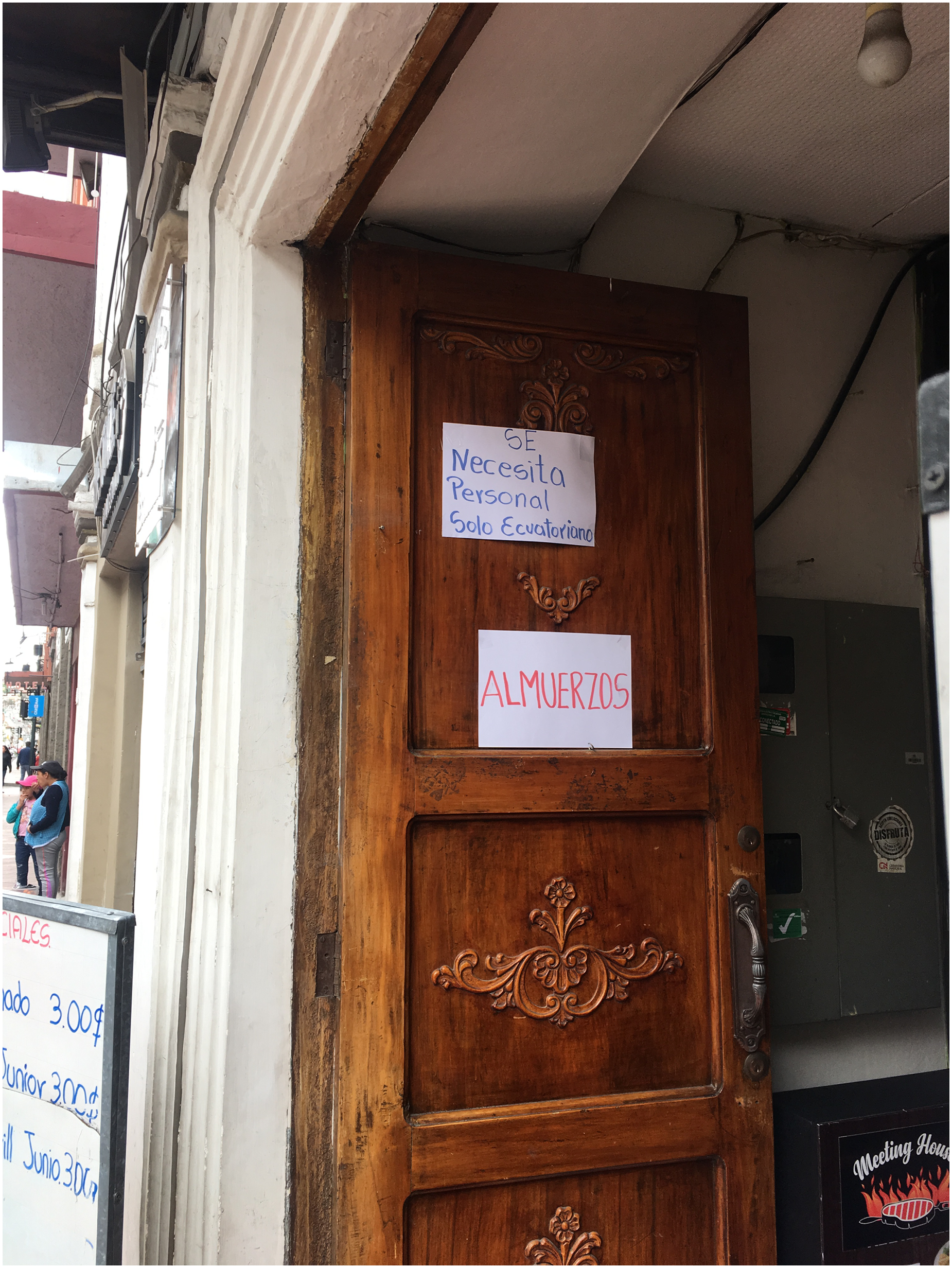
Top sign at entrance for a Cuenca restaurant reads “Employees wanted. Only Ecuadorians.”
Due to the difficulty of obtaining formal employment, many Venezuelans work illegally. A recent survey found 79 percent of Venezuelans working in Ecuador participated in the informal economy (R4V 2022, 143), in comparison to roughly half of Ecuadorian workers, for example as street vendors, in domestic work, and as day laborers (Herrera 2019). Migrants without a visa are not supposed to earn money in Ecuador, and they are fined nearly $400 for a first offense. This conundrum can throw migrants into what interviewee Luis (Ecuadorian), leader of a county-run migrant assistance organization, described as a “vicious cycle” in which they are slapped with impossibly high fines: “I don’t have work, I don’t have papers; I don’t have papers, I don’t have work.” Additionally, at the onset of the COVID-19 pandemic, the types of work that immigrants commonly do were immediately disrupted (except for jobs considered “essential”) (Herrera 2021).
Because of these multiple legal, bureaucratic, economic and social barriers, many Venezuelan migrants experience extreme financial precarity. A recent survey found that 73 percent of Venezuelan households earn $85 or less per month (Ecuador's stated minimum wage is $420), and 44 percent earn less than the “extreme poverty line” of $48 per month (R4V 2022, 143). Eighty-six percent of Venezuelans in Ecuador report insufficient income to support basic needs (R4V 2022, 41). Food insecurity is the number one concern for Venezuelan migrants in Ecuador, with 57.5 percent of those surveyed reporting inadequate access to food (R4V 2022, 137). As Coddington, Conlon and Martin (2020, 1438) found, “the legal othering of migrants creates the conditions for their destitution.”
The impoverishment of Venezuelan migrants forces them socially and economically to the margins of society, but spatially it makes them hyper-visible in public settings, in ways that, I argue, feed into narratives that bolster Ecuador's neoliberal economic and political system. Destitute migrants often have few options except to participate in illicit and charity economies taking place in public spaces around the city. By 2019, the sight of Venezuelans begging had become common around Cuenca. Venezuelans were typically stationed on sidewalks and corners in the historic downtown area of Cuenca, offering Venezuelan currency (bolívar bills) in exchange for however many dollars or coins one was willing to give. Migrants were often in public parks and at busy intersections soliciting money from sympathetic Ecuadorians, tourists, and North American immigrants (see Figure 2).
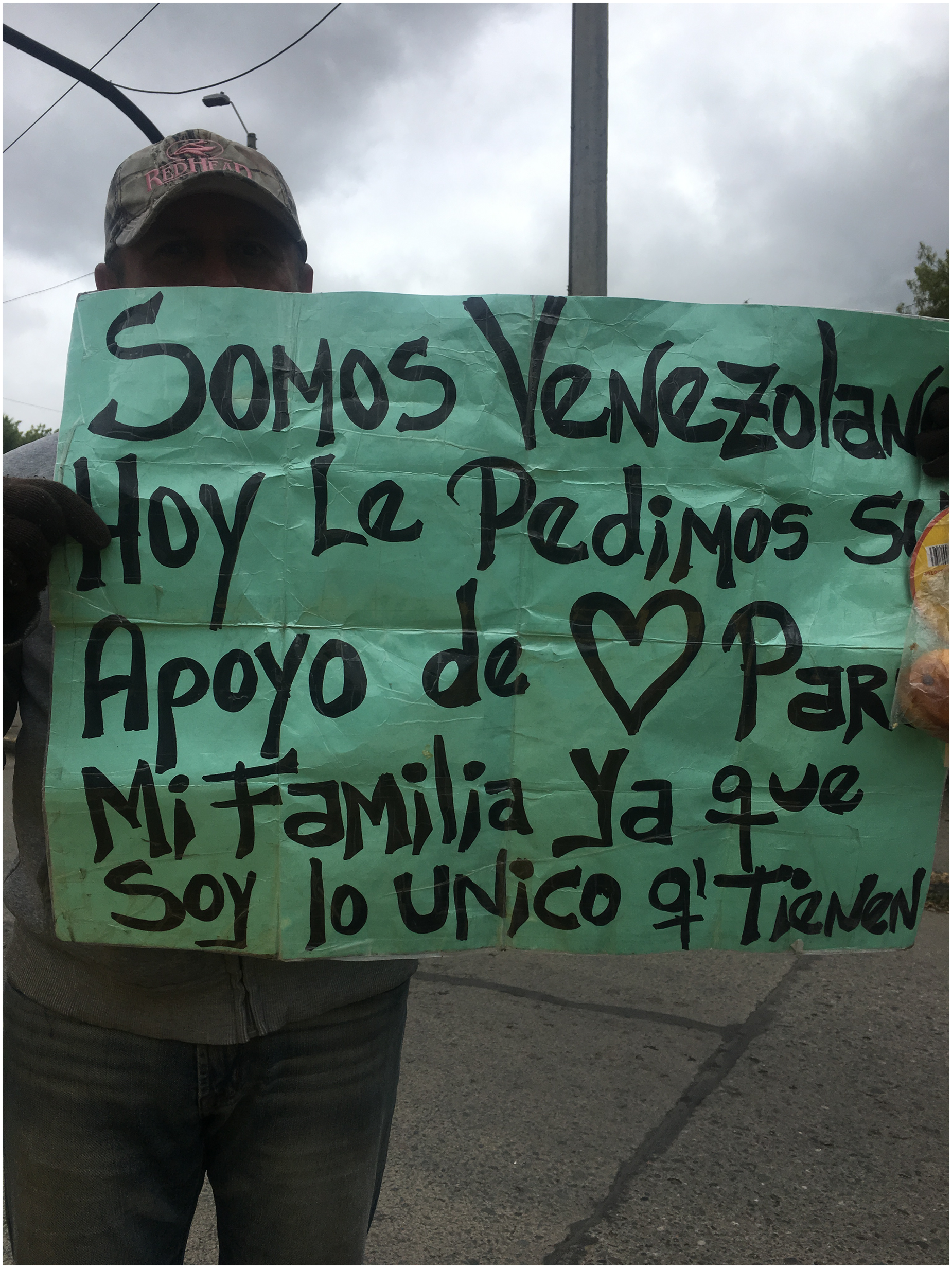
Venezuelan soliciting money at a busy intersection in Cuenca. Translated, the sign reads “We are Venezuelan. Today we ask from our hearts for your support for my family since I’m all they have.”
The sight of unhoused Venezuelans has also become common in Cuenca. Rental costs in Cuenca are generally high, and interviewees claimed that landlords raised prices when renting to migrants or refused to rent to Venezuelans entirely. Venezuelan migrants often live in crowded conditions; 35 percent state they must share their housing with non-family members (R4V 2022, 150). For example, the nurse Carmen shared a room rented for $200 per month. Milagros (Ecuadorian), director of a Catholic assistance organization, elaborated, “They’re living in houses that have been converted into tenement-style dwellings, where a lot of families are living, with one bathroom for twenty families, so that type of precariousness is terrible.” Homelessness is thus a huge problem; 47 percent of Venezuelans surveyed reported themselves homeless or in an unstable housing situation (R4V 2022, 150). Every night, groups of Venezuelans can be seen sleeping in parks around the city.
The resulting hyper-visibility of Venezuelans on the streets and asking for money around the city has evoked increasingly negative reactions from Ecuadorians, as worries about criminality, trafficking, and manipulation replace sympathy. Rolando explained, “[the Venezuelan migrants] have become very visible, and the combination of indigence with begging for charity in the streets, that situation mixes with feelings about migration. And it has led to a lot of groups raising their voices in protest, to say ‘Get them out.’ Instead of ‘Let's support them and change this situation,’ just ask [migrants] to leave.” Luis stated, “Begging has given a negative side to human mobility and created resistance around this population.” Additionally, there have been reports of Venezuelan children hired out by parents to criminal organizations to beg. Andrés (Ecuadorian), an immigration lawyer, said, “Before if you saw [a beggar] you helped, you supported…because you sensed real need, but now you see how they use children.” The visibility links to larger national discourses that Venezuelans have brought huge increases in crime and delinquency — despite statistics showing this to be untrue (“El camino de luces” 2021). Milagros tied the rise in begging to fears about immigrants as vectors of insecurity: At first people felt a sense of solidarity, understanding something of the reality, of what Venezuelans were living, so they gave, they helped them. But now certain situations have come up of delinquency, so they are saddling them with that, that maybe they could be or not, that there are Venezuelans who had assaulted people, have robbed ... but because of that people have started to generalize these situations and there started to be xenophobia, thinking that they have come to create insecurity, they are coming to create chaos.
Venezuelan migrants have been denied rights theoretically guaranteed by Ecuadorian law and received little government support. Coddington (2023, 288) argues that negative perceptions of migrants erode any sense that refugees deserve assistance, showing how “stories of doubt chip away at categories in geopolitically significant ways.” As explained above, there is a serious lack of resources provided by the national government (Beyers and Nicholls 2020; R4V 2022). The rights promised in Ecuadorian law are severely limited by tying access to legal status. Discrimination and misinformation also curtail migrants’ access to services. For example, the Ecuadorian Constitution guarantees education and access to medical care for all, but migrants must show proof of legal employment to receive certain services (Beyers and Nicholls 2020). A 2022 survey found that 53 percent of Venezuelans had been denied treatment at a medical facility (R4V 2022, 137). Interviewees shared accounts of Venezuelan children being prohibited from enrolling in schools, as well as experiences of discrimination by administrators and teachers. Children are also unable to attend school due to insufficient money for costs such as uniforms and supplies (R4V 2022, 137). Non-governmental and local civil service organizations have provided some services to Venezuelans (Beyers and Nicholls 2020), but Cuenca's limited infrastructure has been overwhelmed by the number of Venezuelans. As stated above, in Ecuador (as in many other Latin American countries) national government programs to mitigate the social and economic impacts of the pandemic have often excluded migrants (Álvarez Velasco 2021; R4V 2022). Illegality rationalizes the selective distribution of government resources, in line with neoliberal logics.
Negative perceptions also suffocate remaining understandings of Venezuelans as “universal citizens.” Andrés noted his sense that a safe and secure Ecuador was not compatible with an Ecuador that welcomed all migrants: “…as a lawyer I would love to live in the country imagined in my Constitution [the 2008 Constitution that deployed the language of universal citizens],” but “we cannot establish that all people are citizens of the world because there has to be restrictions or it will become like Sodom and Gomorrah.” 13 Similarly, Luis opined, “Cuenca has to receive and accommodate everyone who comes here, obviously, but at the same time we have to differentiate: the good people are welcome and people that came in other negative conditions simply have to follow the law.” Even for sympathetic Ecuadorians, the perception that some migrants pose risks or are undeserving means that migration restrictions are necessary.
Finally, I suggest that these hyper-visible, local-scale manifestations of illegality ideologically bolster the government's re-investment in neoliberal capitalism. Unemployment in Ecuador has been high for decades, and the renewed sense of economic crisis — deepened by the re-implementation of neoliberal economic policies and now the pandemic — is amplified by the visibility of Venezuelans and perceived competition between Ecuadorian and Venezuelan workers. Francisco (Ecuadorian), leader of an organization of returned Ecuadorian migrants, explained that he related to why Venezuelans were migrating to Ecuador, “but you can’t give them a lot of space because if there isn’t bread for the owner of the house, worse for the one from afar.” What's more, Ecuadorians may view Venezuelan migration as a consequence of the failure of Venezuelan socialism. Andrés suggested that Ecuadorians had tired of helping Venezuelans partly due to their grounding in socialist ideals: “One thing is the help offered, and another thing is the attitude of people receiving the help, and really the Venezuelans’ attitude—and I don’t blame them because they come from that modus vivendi for years, because they’ve had twenty years of socialism and they are used to having everything given to them—but it's really a remarkable thing that a foreigner comes and demands rights here that they don’t have there.” Precisely as the Ecuadorian government publicly embraces neoliberal economic principles, the spatial visibility of impoverished Venezuelans links to larger neoliberal narratives of individual work ethic, responsibility, and success to reinforce the idea that Ecuadorian systems and national identity are superior.
Conclusions
This article has explored how Ecuadorian policies and social practices work to marginalize Venezuelan migrants, forcing them into illegality, a spatialized social condition. My analysis advances understanding of how illegality creates economic, social, and political value through migrants’ simultaneous marginalization and inclusion in neoliberal capitalist systems. I suggest it is no coincidence that discard of the discourse of universal citizenship and implementation of strong anti-immigrant policies in Ecuador occurred at the same time as the government veered from a more socialist frame to re-commit to neoliberal policies. I draw on work on governmentality, destitution economies, and status value to argue that the illegalization of Venezuelans in Ecuador produces various forms of value for the Ecuadorian government and broader public. This analysis builds on and expands understandings of the governmentality of migration governance by showing that in addition to disciplinary control functions, governmentality can contribute to the creation of value.
First, illegality produces public value in the form of political legitimation of individual state governments and reinforcement of neoliberal structures and systems. Within nation-states, in which individual rights are tied to membership within a bordered geographic area, immigrants are easy targets for those in power, and political leaders can leverage immigrants by turning them into scapegoats. Border and immigration policies are ready tools to protect the existing socioeconomic order. Instead of adopting policies for governing Venezuelan migration in line with the idea of “universal citizenship” and more open borders, Ecuador followed the well-trod path of most migrant destination countries: hardening territorial borders and creating internal experiential borders. The resulting marginalization forces Venezuelans to be hyper-visible in public spaces in ways that link to fears of economic decline, criminality, and insecurity, and devalues Venezuelans’ national identity such that it can be politically manipulated. Illegality therefore works as a governmental mechanism to reconcile neoliberal capitalism with the inequalities it exacerbates in a world of national borders, as well as with the human mobility that results from these inequalities. My analysis illuminates the relationship between increasing xenophobic narratives against Venezuelan migrants in South America and neoliberal economic policies.
Second, illegality enables more strategies for private capitalist accumulation, as Ecuadorian businesses and individuals economically exploit marginalized and vulnerable migrants. Illegality becomes a de facto mechanism of value creation amid relentless extraction, extreme inequalities, and borders open to “free” trade but not all bodies. Migrants are produced as excludable, yet valuable in different ways — not as potential neighbors, or community members, but as exploitable. Illegality thus creates space for Venezuelans in neoliberal capitalism, at the bottom of the socioeconomic hierarchy. To be clear, the value created by illegality is not part of some intentional anti-immigrant scheme. Instead, it occurs in the routine operation of neoliberal capitalist systems, which are set up to accumulate wealth for some by removing it from others.
In addition to generally adding to knowledge about Venezuelan migration, this article's examination of Ecuador's political and social responses to Venezuelan migration is useful for understanding other patterns of South–South migration. Ecuador offers a case study of multiple mobilities in the context of growing poverty, historical inequalities, and the entrenchment of neoliberal capitalism. In critical migration scholarship, studies of immigration policies and their consequences have shown a clear “geographical bias” toward states of the Global North (Arcarazo and Freier 2015, 661). Exploring how illegality produces value in Ecuador draws attention to the disciplinary functions of migration management outside the Global North.
Finally, this article deepens understanding of the contemporary rise of anti-immigrant sentiment and the spread of restrictionist, punitive, and discriminatory policies in immigrant destinations around the world. At local to national scales, the illegalization of migrants creates forms of value that fortify existing socioeconomic systems. Illegality is thus integral to the co-existence of the nation-state system, constructed national borders, and neoliberal capitalism, which relies on and will always generate inequalities.
Footnotes
Acknowledgements
I first want to acknowledge the participation of research participants in Cuenca, Ecuador, for generously taking the time to communicate with me amid the many stresses in their daily lives and work. Huge thanks to Kate Coddington and Deirdre Conlon, who each read the manuscript at critical points and made important suggestions regarding how to connect empirics to theory, including some key phrasing incorporated into the manuscript. I am grateful to Mary Jo Bona and Kristina Lucenko for writing support and always thoughtful comments, and to Jenny Strandberg for consistent mini-writing retreats. Thank you to Gioconda Herrera for valuable literature suggestions. Finally, thank you to the editors at IMR and three anonymous reviewers for their detailed constructive comments.
(Manuscript: The Value of Illegality)
Declaration of Conflicting Interests
The author declared no potential conflicts of interest with respect to the research, authorship, and/or publication of this article.
Funding
The author received financial support for the research, authorship, and/or publication of this article: The research for this project was partially funded by a Stony Brook University Faculty of Arts, Humanities, and Social Sciences Individual Grant.
