




Abstract
Asylum is widely associated with humanitarian norms and domestic laws in liberal democracies. Reflecting this assumption, systematic information on the evolution of asylum provisions in national constitutions remains limited, and comparative analyses of the motives behind the legal codification of refugee protection in autocracies are even scarcer. This research note addresses these gaps by introducing the Constitutional Asylum (COAS) dataset, which captures asylum provisions in the constitutions of all 193 UN member states from 1789 to 2023. The findings challenge conventional wisdom, revealing that autocracies, not democracies, have been the main adopters of constitutional asylum. While both regime types have used constitutional asylum to spread ideologies abroad, autocracies have done so more extensively and additionally leveraged it to strengthen presidential power. These results show that asylum is not merely a humanitarian norm but also a strategic instrument of statecraft, used to consolidate power within states and advance geopolitical agendas abroad.
Introduction
In December 2024, Bashar al-Assad arrived in Moscow, seeking refuge after a quarter-century of autocratic rule in Syria, a period defined by a brutal civil war and the forced displacement of millions. In Russia, the former autocratic ruler of Syria was granted asylum on humanitarian grounds (Stanley-Smith 2024)—a right enshrined in the Russian constitution. Viewed through the lens of the 1951 Refugee Convention, this act may appear to invert the intent of asylum: to shield victims, not perpetrators. From the perspective of the current Russian regime, however, asylum may be seen as a strategic tool that serves to reinforce solidarity with ideological allies or the enemies of its enemies. While the Assad case may seem exceptional, it raises broader questions related to the legal codification of refugee protection in autocratic states and the geopolitics of asylum: To what extent and for what purposes have autocratic states enshrined refugee protection in their constitutions? Is asylum primarily a humanitarian instrument or a tool of geopolitical signaling?
An extensive body of research has examined the growing prominence and dilemmas of migration policy in the domestic politics of liberal democracies in the Global North (e.g., Freeman 1995; Gibney 2004; Hollifield 2004; FitzGerald 2019; Rausis 2025). More recent work has broadened the analytical lens to investigate the drivers and dynamics of migration policy in autocratic states and the Global South (e.g., Abdelaaty 2021; Betts 2021; Fakhoury and Chatty 2025; Maple 2024; Stel 2021). Adamson and Tsourapas (2020) and Natter (2024) developed conceptual frameworks that better capture the forces shaping policies and practices beyond liberal democracies in the Global North. Empirically, Blair, Grossman and Weinstein (2022) and Hammoud-Gallego (2022) trace the evolution of asylum policies in the Global South and identify a trend toward liberalization. Natter, Norman and Stel (2023) highlight strategic non-regulation in Middle Eastern and North African states, while also stressing that legislative inaction and ambivalence cut across both the Global South and North.
However, scholars advocating for the de-centering of migration studies have also highlighted the geopolitical dimension of migration governance (Triandafyllidou 2022). Recent work argues that the ability of states and non-state actors to control or influence cross-border mobility constitutes migration power that can be strategically deployed in international relations (Fernández-Molina and Tsourapas 2024; Saltalamacchia and Urzúa 2024; Tsourapas, 2025). This perspective builds on a research tradition showing that refugee protection is not confined to domestic politics but also serves as a tool of foreign policy (Mitchell 1989; Teitelbaum 1984). A prominent example is the admission of refugees by Western democracies during the Cold War, which served to signal the ideological superiority of the capitalist West over the communist East (Chimni 1998). Beyond ideological signaling, states have instrumentalized refugee flows to pursue a wide range of political, economic, and military objectives (Greenhill 2010).
While these research strands have expanded our understanding of asylum policies beyond liberal democracies and their traditional understanding as instruments in domestic politics, important gaps remain. For instance, most research focuses on the evolution or (non-)use of asylum laws since the end of World War II. By contrast, we still lack a nuanced and historically grounded account of how asylum has been codified in national constitutions—one that enables comparison across regime types, time periods, and world regions. Furthermore, while some scholars have pointed to the use of asylum as a geopolitical instrument, it remains unclear whether such use is the exception or the rule, and there is a lack of systematic comparative analysis exploring what motivates autocratic states to codify refugee protection.
Against this backdrop, this research note introduces the Constitutional Asylum (COAS) dataset (Rausis and Di Giuseppe 2025). The COAS dataset systematically tracks the adoption and characteristics of asylum provisions in the national constitutions of all 193 UN member states from 1789 to 2023. Spanning from the French Revolution to the present day, it allows us to challenge and nuance existing assumptions and deepen our understanding of the political dynamics underpinning refugee protection worldwide. By shedding light on asylum provisions in national constitutions, the COAS dataset offers insights into a fundamental yet often overlooked legal layer (but see e.g., Ghezelbash 2024; Meili 2018). Distinguishing whether asylum provisions protect people based on their individual attributes or because of their fight for a political ideology or their involvement in national liberation reveals the extent to which asylum functions as a foreign-policy tool. Analyzing their legal nature—such as whether they are designed as an individual right or as a presidential power—provides insight into whether they aim to strengthen executive authority within the state.
This research note offers three key insights. First, it shows that the rise and fall of constitutional asylum is intimately linked with key shifts in the liberal international order. Second, it finds that autocratic states, rather than liberal democracies, have disproportionately driven the spread of constitutional asylum. Third, it demonstrates that while both regime types have used asylum to signal ideological values, autocracies have done so more extensively and additionally employed it to consolidate presidential power. Far from being an outlier, the Assad case thereby exemplifies a broader pattern in which asylum is entangled with the pursuit of power both within and beyond national borders.
The COAS Dataset
The COAS dataset offers comprehensive and systematic information on the adoption and content of asylum-related legal codifications in the constitutions of all 193 UN member states from 1789 to 2023. It includes 49 variables spanning 235 years, resulting in 45,355 country-year observations and more than 2.2 million individual data points. 1
The COAS dataset is structured around five primary variable groups: 1. General country information; 2. Constitutional asylum (existence and main attributes of constitutional asylum, including whether it is formulated as an individual right or as a presidential power); 3. Legal nature of constitutional asylum (categorizing constitutional asylum as a positive right, qualitative right, negative right, or discretionary power); 4. Types of constitutional asylum (distinguishing between asylum based on political persecution, socialist ideology, the criteria set out in the 1951 Refugee Convention, and other types of constitutional asylum); and 5. Grounds for protection (e.g., persecution due to political engagement, religion, or fight for ideology). The dataset also provides the exact wording of all constitutional asylum provisions.
Two comprehensive data collections of national constitutions form the most important sources for the COAS dataset. The collection “World Constitutions Illustrated” (by HeinOnline) constitutes arguably the most complete collection of national constitutions and serves as the main source. The source covers 756 national constitutions of all UN member states from 1789 to 2023, all of which have been consulted, including their amendments. In addition, the “Oxford Constitutions of the World” (by Oxford Constitutional Law) was systematically consulted for all countries. Supplementary sources were consulted to ensure the completeness of the dataset, especially in cases of non-functioning links to national constitutions or missing or incomplete text in the primary sources. These supplementary sources include the “Comparative Constitutions Project” (by Elkins, Ginsburg, and Melton), the “Refworld” database (by UNHCR), and the data collection on the right of asylum by Kowalczyk and Versteeg (2017).
Most comparative research on constitutional asylum to date has relied on relatively small country samples and has primarily focused on classifying and analyzing existing asylum provisions (e.g., Foster and Klaaren 2013; Lambert, Messineo and Tiedemann 2008). To our knowledge, the article by Kowalczyk and Versteeg (2017), drawing on sources from the Cline Center for Democracy at the University of Illinois, represents the only prior attempt to systematically compile an encompassing dataset on constitutional asylum in all world regions. While the aggregated data is not publicly available, it is seemingly organized in two variables, distinguishing whether a state has adopted constitutional asylum and whether the right is framed as a broad human right or tied to specific ideological commitments.
Building on this important groundwork, the COAS dataset significantly expands the scope and depth of available data on constitutional asylum. It draws on a wider range of constitutional sources, covers a longer historical period, and employs a substantially more detailed coding scheme comprising 49 variables. This allows for a fine-grained analysis of the legal nature, functional type, and ideological content of constitutional asylum provisions. For instance, while Kowalczyk and Versteeg (2017, 1260–61) identified asylum provisions in roughly one-third of states, constitutional asylum reveals that more than half of UN member states have included such provisions at some point.
Figure 1 presents an overview of the temporal and geographical adoption of constitutional asylum provisions worldwide. Furthermore, it highlights the countries that have adopted a national constitution without an asylum provision and those states that generally lack a national constitution altogether. 2
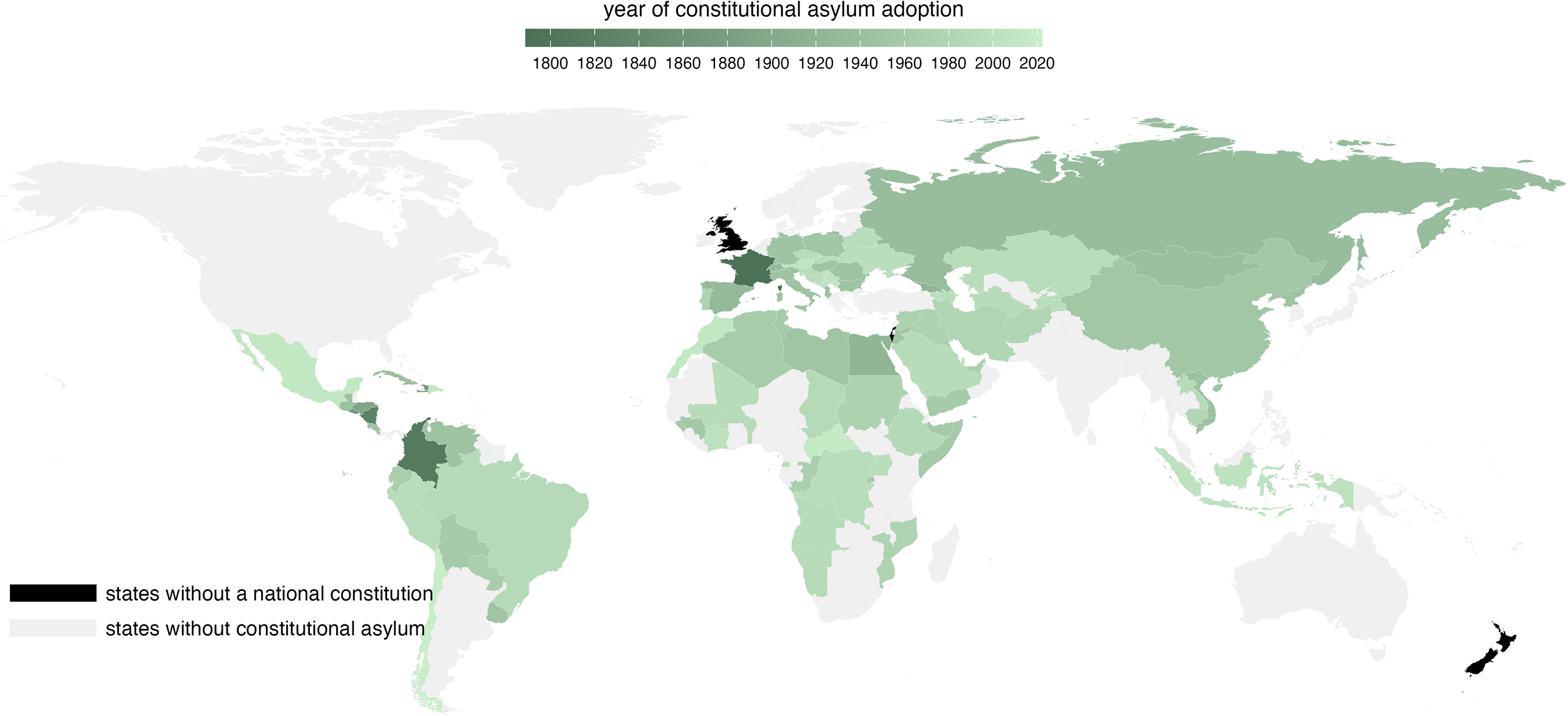
Worldwide geographical adoption patterns of constitutional asylum (as of 2023).
The figure illustrates that constitutional asylum has spread globally and has become the norm in most world regions. Specifically, 99 out of 193 UN member states (51.3%) have incorporated constitutional asylum provisions at least at some point in time. The non-adopters of constitutional asylum constitute a rather diverse group of states, including small island states, pioneers in refugee protection such as the Scandinavian countries, middle powers like India or Turkey, and, finally, the United States.
The Adoption of Constitutional Asylum Over Time and Across States
This section shows to what extent the adoption patterns of constitutional asylum coincide with broader shifts in the international order and identifies which regime types have driven their spread.
State control over human mobility has been described as a critical feature of state sovereignty (Zolberg 1983) or even declared to represent the “last bastion of sovereignty” (Dauvergne 2004, 588). It requires at least some degree of independence in the way in which states formulate migration policies, both from migration policies employed in other countries and from exogenous events. Yet, scholars have also emphasized the moral obligation of liberal democracies to protect refugees (Gibney 2004; Freeman 1995) or pointed to the diffusion of migration policies (e.g., Cook-Martín and FitzGerald 2019; Rausis 2022a). Furthermore, recent research suggests that national asylum policies are not only deeply intertwined with the international refugee regime but also with the emergence and contestation of the liberal international order (Lavenex 2024).
Börzel and Zürn (2021) distinguish between two main stages in the development of the liberal international order (LIO). Following the end of World War II, they identify the emergence of a thin liberal international order (LIO I), which was limited in scope, rooted in the rule of law, and characterized as “liberal multilateralism.” In the 1990s, this thin order developed into a thick liberal international order (LIO II), driven by the deepening of liberal values across policy fields and an increasing number of states joining international institutions, described as “postnational liberalism” (Börzel and Zürn, 282). To assess whether the proliferation of constitutional asylum coincides with broader shifts in the international order, we compare the potential temporal overlap between adoption patterns of constitutional asylum worldwide and the period that was decisive for the emergence of the LIO I and the transition period toward LIO II.
Figure 2 reveals that the adoption pattern of constitutional asylum resembles a double S-curve, reflecting the main boom periods: 1945–1955 and 1990–2000. Notably, both boom periods of constitutional asylum perfectly align with the decades crucial for the emergence of the LIO I and its transition into the LIO II (see Börzel and Zürn 2021). The first period also coincides with the emergence of the international refugee regime. However, the period often associated with the beginning of an illiberal turn in asylum policy—the transition into the LIO II at the beginning of the 1990s (see e.g., Gammeltoft-Hansen and Tan 2017)—marks a surge in constitutional asylum. Thereby, the increase in constitutional asylum is at least partly synchronized with the adoption patterns of national constitutions. Overall, the findings provide strong empirical evidence for those suggesting that asylum policy is not only a matter of state sovereignty but is deeply embedded in shifts in the global order.
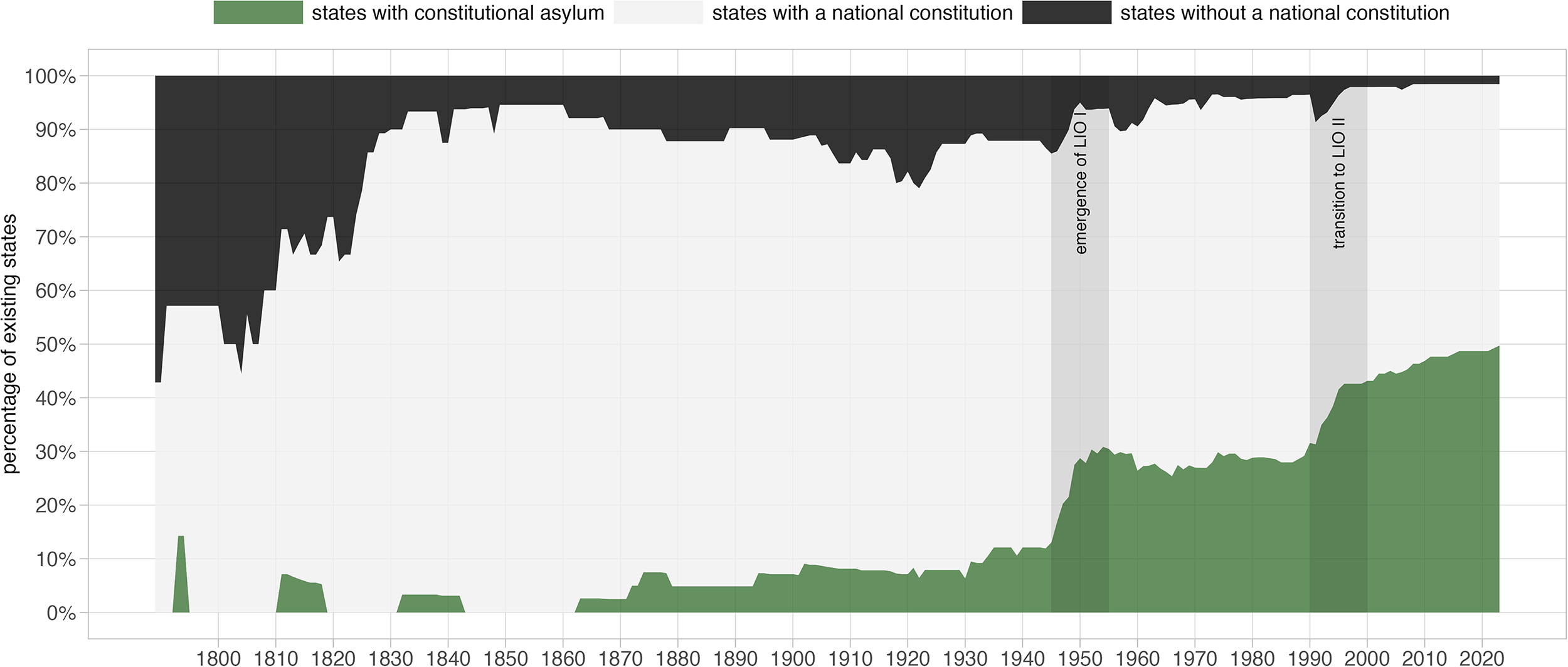
Temporal adoption patterns of constitutional asylum worldwide as a percentage of existing states (1789–2023)
Conventional wisdom suggests that the legal codification of refugee protection has predominantly been driven by liberal democracies. A prime example is the 1951 Refugee Convention, which remains a cornerstone of the international refugee regime. Because it applies only to people fleeing the atrocities of World War II in Europe, it has been described as ‘decidedly Eurocentric’ (Hathaway 2021, 172)—and shaped by liberal democracies. Even today, most non-signatory states to the 1951 Refugee Convention and the 1967 Protocol are non-European and non-liberal states from the Middle East, South Asia, and Southeast Asia (Janmyr 2021). Liberal democracies also appear as frontrunners in the codification of national asylum laws, whereas closed autocracies represent the largest group of states without comprehensive asylum laws (Rausis 2022b; 2023). The temporal overlap between the emergence of the LIO I and the transition into LIO II coincided temporally with the second and third waves of democratization (Peters et al. 2024), which could be read as another indication suggesting that the proliferation of constitutional asylum was mostly driven by democracies.
However, contrary to conventional wisdom, the COAS dataset reveals an inverse relationship between democratization and the legal codification of asylum at the constitutional level. Applying the regime types based on the V-Dem Dataset (version 14, variable v2x_regime; Coppedge et al. 2024)—distinguishing liberal democracies, electoral democracies, electoral autocracies, and closed autocracies—Figure 3 shows that closed autocracies have even recorded the highest percentage of constitutional asylum adoptions among all regime types.
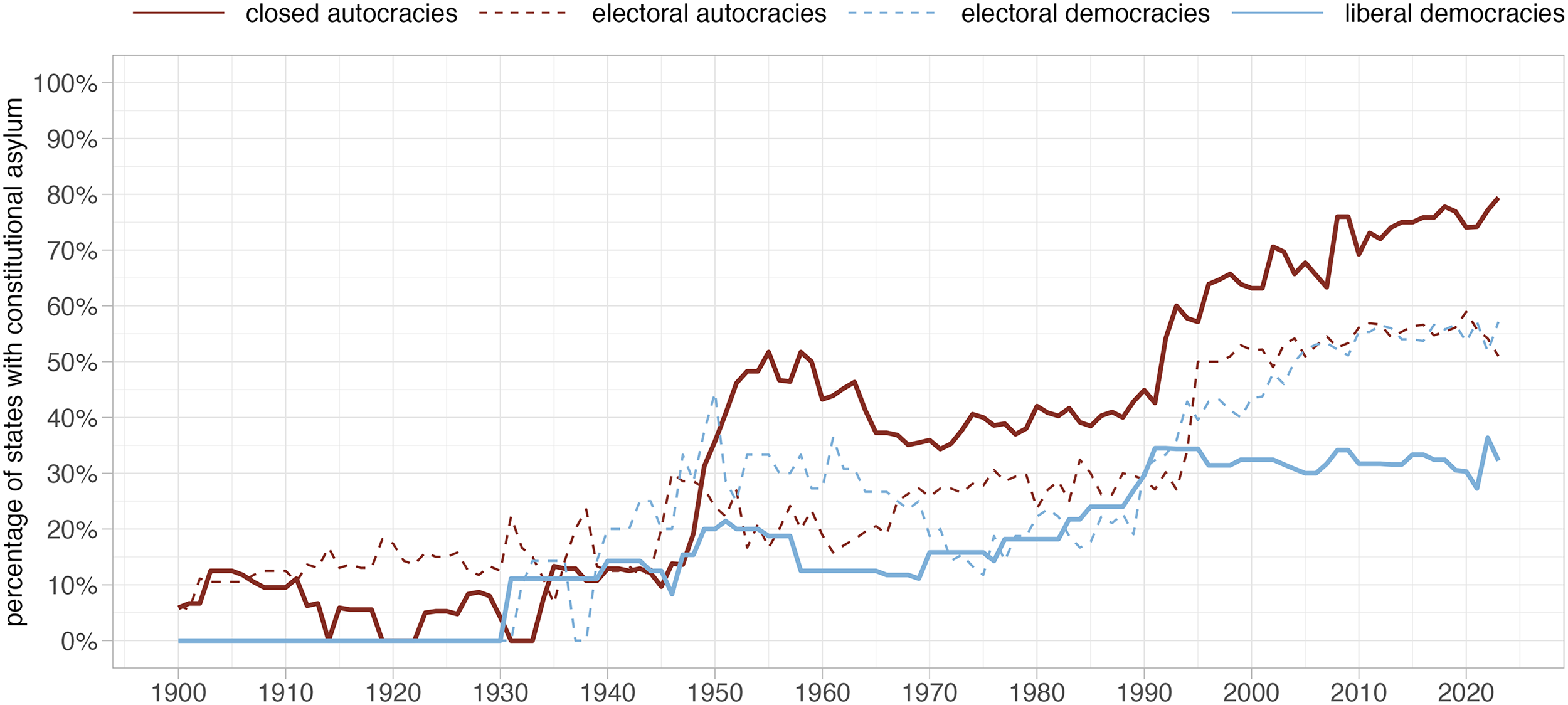
Share of states with constitutional asylum across regime types in percent of existing states (1900–2023).
Already at the beginning of the twentieth century, autocracies had codified refugee protection more extensively in their national constitutions than democracies. This trend continued for most of the time, with a steady increase of constitutional asylum provisions in closed autocracies in the 1940s and 1950s, as exemplified by Cuba (1940), Venezuela (1947), and China (1954). In the early 1990s, the second boom period of constitutional asylum was driven by all regime sub-types—except liberal democracies. As of 2023, more than three-quarters of all closed autocracies have incorporated refugee protection into their constitutions. In contrast, only about one-third of liberal democracies have adopted constitutional asylum as of 2023. 3
Paradoxically, autocratic states, not democracies, have driven the proliferation of constitutional asylum—during the expansion of the LIO and waves of democratization. While electoral democracies have shown a similar level of enshrining refugee protection in constitutions, liberal democracies have generally refrained from doing so. These findings show that legal codification in national constitutions appears to follow a different logic from the adherence to international protection frameworks and the adoption of national asylum frameworks (see Supplemental Appendix C). While migration scholars have generally studied liberal democracies as being at the forefront of legal codification and closed autocracies as strategic non-regulators, the findings from the COAS dataset show the need for a more nuanced perspective.
The Motives Behind the Adoption of Constitutional Asylum
This section tackles the puzzling finding of the autocratic lead in constitutional asylum by shedding light on the potential purposes behind the formal alignment of illiberal states with liberal norms. By identifying which types of constitutional asylum have driven their proliferation—political asylum, socialist protection, and 1951 Refugee Convention—and by analyzing the protection grounds, we can assess whether constitutional asylum has been used as a tool of foreign policy or as a means to promote particular ideologies. Examining the legal nature of these provisions further reveals whether constitutional asylum also serves to consolidate internal power.
The type political asylum originated during the French Revolution and refers exclusively to the protection of individuals fleeing political persecution. A typical example is article 32 of Egypt's 1964 constitution, which states: “The extradition of political refugees is prohibited.”
The type socialist protection covers individuals persecuted because of their fight for socialist ideology or the working class. An example is article 64 of Albania's 1976 constitution: “The right of sanctuary in the People's Socialist Republic of Albania can be granted to foreign citizens who are persecuted on account of their activity in favour of the revolution and socialism, of democracy and national liberation, or the progress of science and culture.”
The type 1951 Refugee Convention reflects the broader, universalist definition of a refugee, covering persecution on grounds such as race, religion, nationality, membership of a particular social group, and political opinion. For coding purposes, any provision mentioning at least race/ethnicity, religion, and political opinion, or referring to protection under an international treaty applying these criteria, was classified under this type. A case in point is article 97 of Namibia's 1990 constitution: “The State shall, where it is reasonable to do so, grant asylum to persons who reasonably fear persecution on the ground of their political beliefs, race, religion or membership of a particular social group.”
The type other is a residual category that includes those codifications of refugee protection that do not fit into any of the other three categories. Typically, this type only references the right to seek or the power to grant asylum without providing any information on the protection grounds. An example can be found in article 5 of the Central African Republic's 2016 constitution: “The Republic guarantees to persecuted persons the right to asylum.”
Figure 4 shows that the concept of political asylum has been by far the most widespread type, followed by forms of constitutional asylum that have not specified protection grounds. While France was the first to introduce the type political asylum in 1793, it was later taken up by states across all regime types and has spread broadly across the Global North and South. Socialist protection rose in the aftermath of World War II but became marginalized with the fall of the Iron Curtain. As of 2023, Cuba, North Korea, and Vietnam remain the only countries that uphold the socialist type of constitutional asylum. Remarkably, only a relatively small number of states have introduced the type 1951 Refugee Convention. It has been adopted equally by democracies and autocracies alike across different world regions, including Croatia, Ecuador, Guinea, and Turkmenistan. Strikingly, liberal democracies have been among the least likely to adopt the type reflecting the definition enshrined in the Refugee Convention.
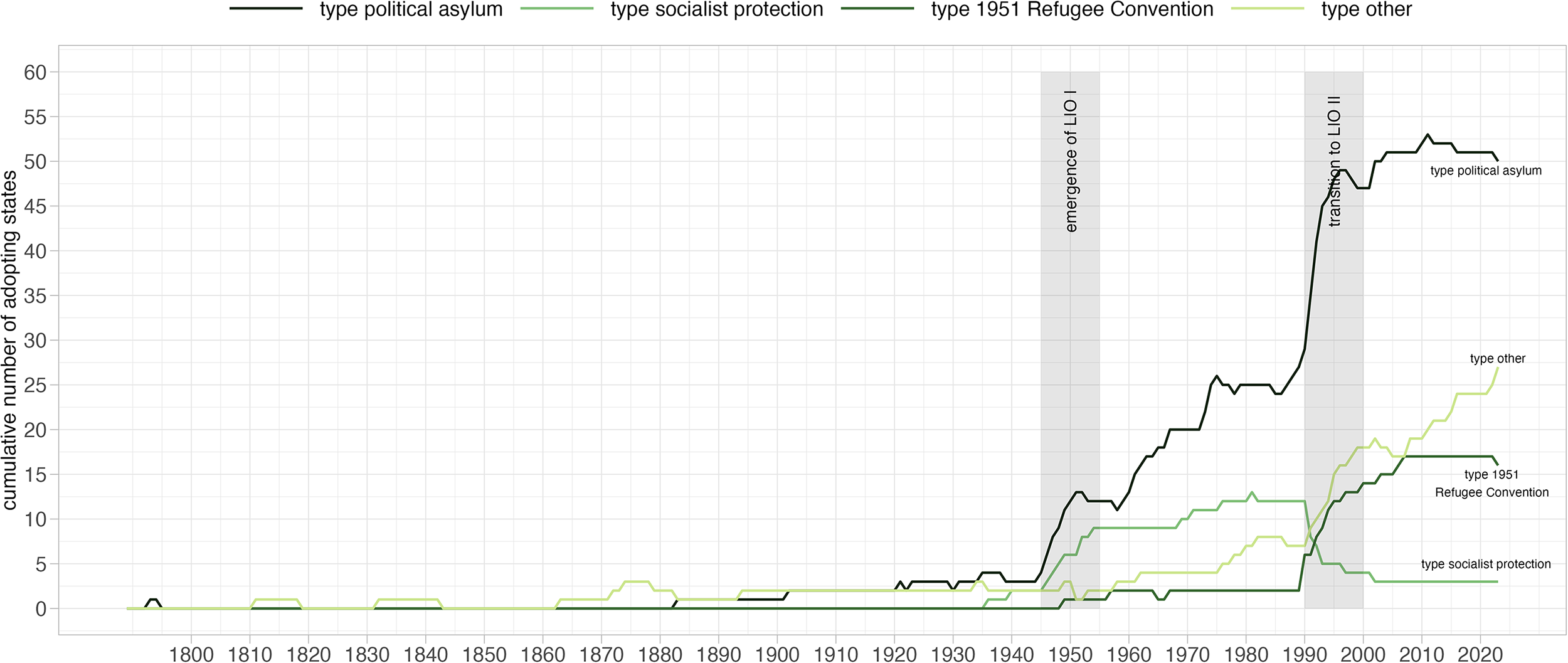
Temporal adoption patterns regarding the types of constitutional asylum worldwide in cumulative numbers of adopting states (1789–2023).
An analysis of all specified protection grounds also reveals that constitutional asylum provisions generally tend to protect individuals persecuted for political engagement and fight for ideology, rather than for their individual attributes (see Supplemental Appendix C2). Nonetheless, we can observe a decline in provisions that prioritize those openly engaged in potentially violent struggles, such as national liberation or revolution (see Supplemental Appendix C3). While the results highlight the supreme importance of constitutional asylum as a tool to boost state ideology, the analysis also indicates a change towards a more subtle and indirect use of asylum as a geopolitical instrument.
Figure 5 illustrates how different regime types support the fight for their respective ideologies. Liberal democracies have most prominently emphasized the defense of human rights and offered protection to those engaged in such struggles. Remarkably, however, closed autocracies also score at similar levels to liberal and electoral democracies in protecting individuals who have fought for democracy. Overall, however, closed autocracies have most frequently codified asylum to protect individuals aligned with ideological causes. They have also been the most inclined to frame constitutional asylum as a means of supporting national liberation movements abroad.
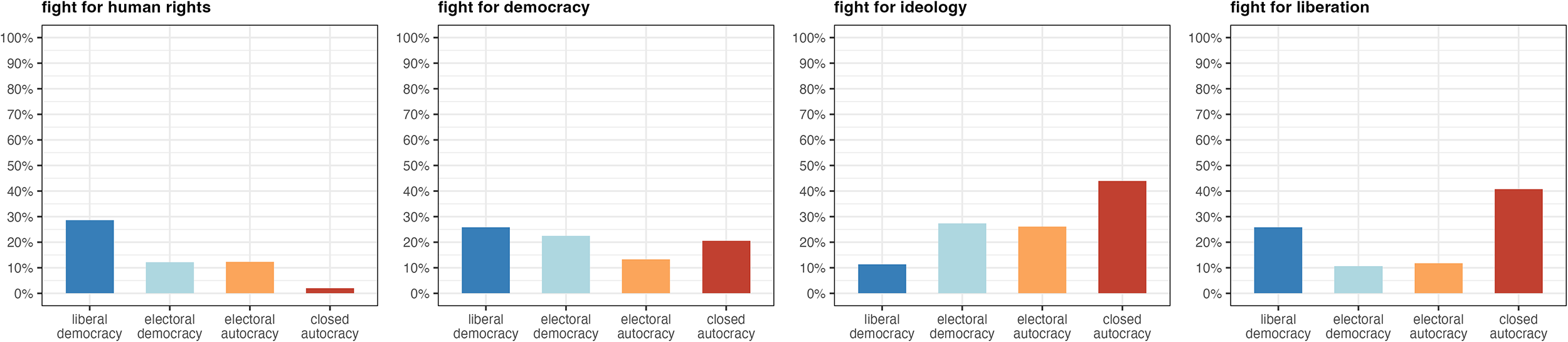
Fight for human rights, democracy, ideology, and liberation as asylum grounds by regime type: Aggregated percentages for states with constitutional asylum and specified grounds (1900–2023).
While these findings provide broader empirical support for researchers who view refugee protection as a tool for projecting national influence abroad (Mitchell 1989; Teitelbaum 1984), they do not indicate whether constitutional asylum also serves to consolidate power within states. Thiollet (2022, 1646), for example, shows that migration policies and practices can form part of a broader “survival strategy,” enabling regimes to manipulate power relations between migrants, citizens, and the state. By contrast, scholars studying the motivations behind the adoption of human rights in national constitutions argue that both autocratic and democratic regimes may use national constitutions primarily as a form of “window dressing” to present a favorable image on the global stage (Lutz 1994, 355).
The analysis of the legal nature of constitutional asylum —for example, whether it is designed as an individual right or presidential discretion—helps determine whether it serves only to cultivate a favorable image abroad or also to reshape power structures within the state. From a legal perspective, constitutional asylum provisions can be categorized as positive, negative, or qualitative rights, and as discretionary power (see Foster and Klaaren 2013).
Establishing asylum as a qualitative right involves references to national or international laws, which detail procedures and criteria that minimize state discretion and bolster individual protection. One illustration is paragraph 3 of article 27 in Bulgaria's 1991 constitution: “The conditions and procedures for granting asylum are established by law.”
Defining constitutional asylum as a positive right affirms the right to seek asylum without linking it to additional legal frameworks. An example is article 46 in Guinea's 1958 constitution: “The Republic of Guinea shall grant the right of asylum to foreign citizens persecuted for having fought to defend a just cause, or for their scientific or cultural activities.”
constitutional asylum as a negative right only references the interdiction to expel people facing persecution, without mentioning their right to seek asylum, the process for granting protection, or further legal frameworks that must be respected. A case in point is article 21 of Bahrain's 2002 constitution: “The extradition of political refugees is prohibited.”
Finally, constitutional asylum as a discretionary power allocates all authority to the state leader. A representative case is paragraph 19 of article 93 in Uzbekistan's 1992 constitution: “The President of the Republic of Uzbekistan shall: (…) rule on the matters of citizenship of the Republic of Uzbekistan and on granting political asylum.”
Designing constitutional asylum as a qualitative right, and to a lesser extent as a positive right, designs asylum as an individual right and, at least on paper, limits discretionary power. At the other end of the spectrum, framing asylum as a negative right or, in particular, as a discretionary power weakens individual protection while primarily reinforcing executive authority and expanding presidential power.
Figure 6 illustrates the preferences of liberal and electoral democracies, as well as electoral and closed autocracies, for the four ways of legal codification of constitutional asylum over time.
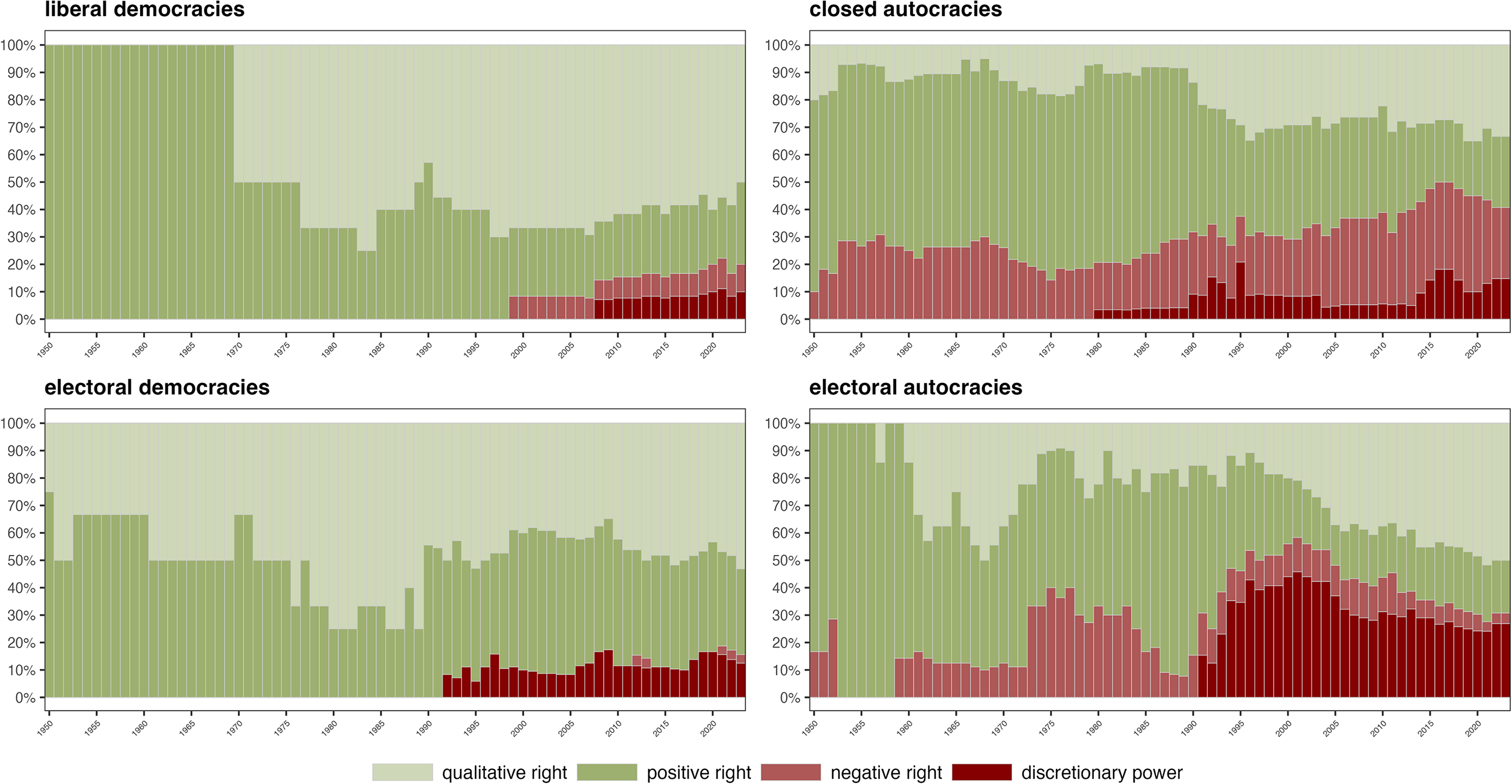
Legal codification of constitutional asylum across regime types (1950–2023).
The figure shows that more than 80% of all democratic states have consistently enshrined asylum in their constitutions as a qualitative or positive right. In doing so, democracies strengthen the rights of individuals seeking protection while simultaneously limiting executive authority. Autocratic states, by contrast, are more often codifying constitutional asylum as a negative right or discretionary power. While closed autocracies often design constitutional asylum as a negative right, it is electoral autocracies that most frequently use it as a means of strengthening presidential power.
Overall, the findings show that both democracies and autocracies have used constitutional asylum strategically to pursue objectives beyond refugee protection. However, autocracies have most prominently employed it to support the fight for particular ideologies beyond national borders and additionally employ it to expand presidential power within the country.
Using the COAS Dataset
The COAS dataset can be used in both quantitative and qualitative research, with constitutional asylum serving as either an independent or dependent variable. For quantitative analysis, the variable con_right, indicating whether a country has codified the right to seek asylum in its constitution, can be particularly useful. Combined with the measurement of asylum laws and adherence to international protection frameworks (e.g., Blair, Grossman and Weinstein 2024; Rausis 2022b), measures from the dataset can provide a robust indication of countries’ de jure openness or restrictiveness.
However, researchers can also focus on specific countries, tracing how the text of constitutional asylum has evolved over time. A relevant example is Albania, where the country initially adopted a socialist form of asylum to protect socialist ideologies, the working class, and to support revolutionary movements. After transitioning from socialism to capitalism, Albania adopted a different type of asylum that aligned with its new political landscape. In its pursuit of EU membership, the country harmonized its asylum policy with EU rules and embraced the 1951 Refugee Convention definition.
Lastly, the COAS dataset holds value for practitioners and individuals seeking protection, especially as the global landscape faces increasing challenges to national asylum frameworks and threats to withdraw from international protection frameworks and human rights conventions. As national asylum laws become more restrictive, constitutional provisions may gain importance since they are harder to amend, both legally and symbolically, and can therefore offer a more stable basis for refugee protection.
Conclusion
The COAS dataset illuminates a legal dimension often overlooked in migration studies—constitutions—providing new insights with broader implications for the field. It offers empirical evidence supporting the connection between the liberal international order and the international refugee regime (Börzel and Zürn 2021; Lavenex 2024). However, the data also highlights the complex entanglement between shifts in the international order and national asylum policies.
The COAS dataset reveals the puzzling finding that autocratic states have disproportionately driven the proliferation of constitutional asylum. While asylum provisions in the constitutions of autocratic states could be interpreted solely as an effort to present a favorable image abroad, the analysis shows that constitutional asylum is not merely “window dressing.” Autocratic states, in particular, have used these provisions as a strategic tool to extend ideological influence beyond their borders. In addition to employing asylum for geopolitical purposes, autocracies also use it to expand presidential power.
Ultimately, this study seemingly reveals a paradox: while scholars frequently highlight the decline of refugee protection, the COAS dataset shows a continued expansion of formal protection. However, the spread of constitutional asylum has coincided with the spread of policies that reduce or shift the protection obligations of states (Rausis 2022a). It is therefore crucial to underscore that de jure provisions do not necessarily translate into de facto protection. Further research is needed to examine how constitutional asylum is implemented in practice and how it interacts with other legal layers (Blair, Grossman and Weinstein 2024).
The simultaneous expansion of formal protection provisions and the erosion of actual protection practices should not be viewed as a contradiction but rather as an expression of a broader use of “organized hypocrisy” (Lavenex 2018, 1196). Yet, this pattern also highlights a deeper irony: as liberal asylum policies face growing contestation within democracies, liberal norms are increasingly disseminated by illiberal regimes.
Supplemental Material
sj-pdf-1-mrx-10.1177_01979183251409789 - Supplemental material for Protecting People or Promoting Ideologies? Insights From the Constitutional Asylum Dataset
Supplemental material, sj-pdf-1-mrx-10.1177_01979183251409789 for Protecting People or Promoting Ideologies? Insights From the Constitutional Asylum Dataset by Frowin Rausis and Marco Di Giuseppe in International Migration Review
Footnotes
Acknowledgments
We thank Noral Stel and Philipp Lutz for their thoughtful and encouraging feedback on earlier versions of this contribution, the three anonymous reviewers for their precise recommendations, and the editorial team of International Migration Review, especially Dr Holly Reed, for their generous support.

Funding
The authors disclosed receipt of the following financial support for the research, authorship, and/or publication of this article: This research was supported by the nccr – on the move funded by the Swiss National Science Foundation grant 51NF40–205605 and the Horizon Europe Project “Finding Agreement in Return (FAiR)”/Swiss State Secretariat for Education, Research and Innovation (contract 22.00569).
Declaration of Conflicting Interests
The authors declared no potential conflicts of interest with respect to the research, authorship, and/or publication of this article.
Notes
References
Supplementary Material
Please find the following supplemental material available below.
For Open Access articles published under a Creative Commons License, all supplemental material carries the same license as the article it is associated with.
For non-Open Access articles published, all supplemental material carries a non-exclusive license, and permission requests for re-use of supplemental material or any part of supplemental material shall be sent directly to the copyright owner as specified in the copyright notice associated with the article.
