




Abstract
How experience of migration affects the labor market outcome after remigration is difficult to examine because both migration and remigration processes are driven by various mechanisms of selection. In this study, we investigate the labor market outcomes of return migration in Finland in the late 20th and early 21st centuries. With Finnish register data covering the period 1987–2019, we use a counterfactual sibling fixed-effects design that compares the return migrants to their siblings of the same sex who have not migrated, and controls for the influence of family background and pre-adolescent experience. We show that, compared to their same-sex siblings who have no migration experience, return migrants have slightly lower employment rates, particularly men, for whom the gap does not recover over time. Return migrants are overrepresented at both the lower and the upper ends of the income distribution and enjoy substantial income advantages at the higher end. We argue that the labor market disadvantages of return migrants to Finland is likely due to the disruption of social networks during the years spent abroad. However, the disadvantage can be overcome over time and with reintegration to the Finnish labor market.
Keywords
Introduction
International migration is a complex phenomenon shaped by an interplay of economic opportunities, family ties, life course transitions, and personal aspirations (de Haas 2010; King 2012). While labor market considerations often feature prominently in migration decisions, research has increasingly emphasized that migration is rarely reducible to a single motive, but that it rather reflects multiple factors that evolve over time and across the life course (Carling and Collins 2018). Moreover, while international migration is often considered to be a long-term decision, a sizeable share of immigrants’ tenures in the host society are short-lived or characterized by irregular patterns such as circular or temporary migration. It has been estimated that roughly 20‒50 percent of immigrants leave within 5 years after their arrival and either return home or migrate to a third country (OECD 2008). Although much research has focused on how factors in the host society affect return migration decisions, less research has examined how individuals fare after they have returned to their home country, particularly with respect to labor market reintegration, which remains a critical dimension of the return experience. Our study aims to examine this process by focusing on the labor market outcomes of Finnish working-age return migrants from Nordic countries, mainly Sweden, once they return to Finland. We do so by comparing siblings, which is an approach that, to the best of our knowledge, has not previously been applied within this specific research field.
For many migrants, returning to their home country is embedded in broader life course planning and shaped by a combination of economic considerations, family obligations, and a sense of belonging to the origin country (Cassarino 2004; King and Christou 2011). Return migration is thus not merely a reversal of the initial move, but a distinct transition that carries its own opportunities and challenges. However, existing research has shown mixed findings with respect to the labor market outcomes of return migrants in the country of origin. On the one hand, working abroad may enable migrants to acquire new skills that enhance their employability upon return. Additionally, return migrants may accumulate savings while living abroad, which can provide a foundation for self-employment or other investments once they return to the home country (Dustmann and Weiss 2007). On the other hand, return migrants may experience disadvantages for various reasons once they return to their home country. Return migration is not always a voluntary or well-prepared decision; some migrants return due to unsuccessful labor market integration abroad, family emergencies, or expiring visas, with limited time to plan or accumulate resources (Monti and Serrano 2022). Furthermore, the dichotomy between “voluntary” and “involuntary” return is itself contested, as most return decisions involve a mix of constraints and choices (Erdal and Oeppen 2013). Importantly, leaving the home country for several years may result in a loss or reconfiguration of social networks and local knowledge that are critical for labor market reintegration, as migrants’ ties to the origin country weaken or are transformed through prolonged transnational engagement (Carling and Erdal 2014; Piracha 2015).
Like disadvantages faced by migrants in the host country, the human capital accumulated abroad may also differ from those demanded by the home country's labor market. Importantly, however, the returns of return migration are difficult to causally examine, since both migration and remigration processes are selected by the individual's background characteristics (Constant and Massey 2003). Only comparing return migrants and average fellow nonmigrants cannot allow us to observe the counterfactual scenario.
A central aim in research on migration and return migration has been to understand how selection processes shape who moves and who returns. Within economics, the dominant framework for analyzing migrant selection is the model proposed by Borjas (1987), which builds on the classic self-selection framework by Roy (1951). The model provides predictions about the skill composition of labor migrants based on expected economic gains and the relative returns to skill in source and destination countries. While this framework has been influential, it captures only one dimension of the selection process—namely, selection on economic prospects. Sociological perspectives emphasize that selection also operates through social networks, migration-specific capital, and the resources migrants can mobilize to prepare for return (Cassarino 2004; Faist 2000). In this study, we draw primarily on the economic selection framework because our outcome variables concern labor market reintegration, while acknowledging that the migrants in our study population likely moved and returned for a range of reasons beyond wage differentials alone.
The overall prediction of the selection model is that immigrants will be positively selected if the destination country offers higher returns to skills than the source country. Conversely, migrants will be negatively selected if source country offers higher returns to skills. In both scenarios, people who move themselves determine that the economic benefits outweigh the costs from migrating as opposed to remaining in the source country. The return migration selection model builds upon the former by positing that selection into return migration can accentuate the selection from the initial migration flows (Borjas and Bratsberg 1996). As such, naively comparing the labor market outcomes of return migrants and stayers in the origin country is likely to misrepresent the returns to returning.
In the current study, we examine the labor market outcomes of Finnish return migrants from other Nordic countries, mainly Sweden. The Finland‒Sweden migration corridor offers a particularly unique context for studying return migration. We find that returners experience lower levels of employment relative to stayers initially upon arrival, but that this gap narrows over time. However, for men, returners never reach the same level of employment as stayers, not even 10 years after having returned to Finland. With respect to income, return migrants experience a disadvantage initially upon return but quickly catch up with the stayers. Once employed, the returners are more likely to earn higher levels of income. Thus, the returners group is highly varied with some, on the one hand, having trouble with being employed and others, on the other hand, realizing high income relative to the stayers. Compared to women, male return migrants are more likely to surpass stayers in income.
The study makes several contributions to research on the labor market outcomes of return migrants. First, we examine employment and income trajectories 10 years after the return migrants settle in Finland. This allows us to measure not only how return migrants fare initially upon arrival, but also whether their conditions improve or worsen over time. Second, we compare siblings. This allows us to more accurately estimate the returns to returning. Issues related to selection into migration and return migration have consistently been acknowledged in the literature as major challenges to conduct research on the outcomes of return migration. Although our strategy does not account for all forms of selection, we are able to provide an improved set of estimates for this body of research. Third, we use total population data, which allows us to measure the outcomes of all return migrants during the study window. Most research in this field has relied on survey data, which often introduce survey response bias, in addition to the selection issues. Finally, we provide a case of migrant integration and reintegration between economically advanced countries. This is a scenario that generally differs much from that of migration between developing and developed countries, and enquiries on the economic returns for migrants between advanced economies have been rather scarce (Monti and Tønnessen 2024; Witte and Guedes Auditor 2021).
Research Context
Sweden has long been a prominent destination for Finnish labor migrants and, in fact, Finns were the largest immigrant group in Sweden until 2020. Migration between the two countries has historically been driven by a range of factors, including labor market opportunities, family ties, linguistic and cultural connections among Swedish-speaking Finns, and the ease of mobility afforded by Nordic free movement agreements (Saarela and Scott 2020). This diversity of migration motives provides a useful setting in which to examine labor market outcomes, as it allows us to assess how return migrants fare across a heterogeneous population rather than one selected solely on economic criteria.
The structural similarities and low institutional barriers between Sweden and Finland have helped to facilitate large-scale labor migration. Both countries share comparable labor market structures, educational systems, and social benefit systems (Saarela and Scott 2020; Weber and Saarela 2023), and open borders allow for free mobility of residents between the countries. Similarly, there are relatively low migration costs since the countries are in close geographic proximity and even share a land border. Despite being characterized as a favorable set of conditions to facilitate migration flows between countries, research has shown that migrants and returners are selected on various dimensions. Rooth and Saarela (2007) examined the return migration selection model among Finnish migrants in Sweden and found support for the predictions set forth by Borjas and Bratsberg (1996). It was found that emigrants from Finland were negatively selected, while those who returned from Sweden to Finland were positively selected.
Another reason to why this context is highly useful for studying the returns to return migration is the high-quality register data that exist in Finland, and which allow us to compare siblings. Specifically, we compare the labor market outcomes of return migrants to their same-sex siblings who remained in Finland. In doing so, we can account for all factors that are shared between siblings that would affect their labor market outcomes, for example parental socioeconomic status or shared networks. This is particularly useful because the sibling who remained in Finland represents the “counterfactual” scenario representing the expected labor market outcome of an individual had he or she remained in Finland. Importantly, by comparing siblings, we are to account for some of the selection effects associated with out migration and subsequent return migration.
Review of Previous Research
Return migration has gained increasing attention in migration scholarship as researchers have recognized that migration is often not a one-way movement, but part of an ongoing process of mobility, circulation, and connection across borders (King 2012; Carling and Erdal 2014). While much research has focused on the initial migration decision and integration into host societies, the experience of returning and its consequences for economic and social reintegration, remains comparatively underexplored. Understanding return migration requires attention to both the structural conditions that shape return decisions and the resources migrants bring with them, including human capital, savings, and social ties (Cassarino 2004). This review synthesizes findings from a range of studies on return migration, with a special emphasis on Finnish return migrants and their labor market trajectories upon returning to Finland.
Selection into Return Migration
A fundamental question in return migration research is who decides to return and why. Selection theory posits that migrants are not randomly distributed across populations, but rather self-select based on economic prospects, personal circumstances, and institutional conditions in both sending and receiving countries (Borjas and Bratsberg 1996). These arguments have also received some empirical support. Return migrants in Albania have been found negatively selected (de Coulon and Piracha 2005), meaning that those who return are, on average, less skilled or have lower earning potential than those who remain abroad. Also supporting the predictions of migrant selection theory, Rooth and Saarela (2007) found that Finnish migrants in Sweden are negatively selected compared to those who remain in Finland, but those who return to Finland are positively selected. Return migrants may thus have economic or social capital that distinguishes them from both nonmigrants and emigrants who remain abroad.
Weber and Saarela (2023) further examine selection into return migration by analyzing linked register data covering Finnish migrants. They find that return migration is shaped by initial migration motives and integration experiences. For instance, student migrants and labor migrants exhibit different return migration risks based on their income and career trajectories in Sweden. Similarly, Saarela and Rooth (2006) highlight the role of uncertainty in migration decisions, arguing that those who return do so partly because their experiences abroad did not meet expectations. These studies underscore the importance of considering pre-migration characteristics and migration experiences in analyzing return migration patterns.
Complementing economic selection models, Cassarino (2004) proposes a “preparedness” framework that emphasizes the resources and readiness migrants have when they return. According to this perspective, return outcomes depend not only on who selects into return (as emphasized by Borjas and Bratsberg), but also on whether migrants have had sufficient time and opportunity to prepare for reintegration—including accumulating savings, maintaining social networks in the origin country, and gathering information about opportunities at home. This framework helps explain why seemingly similar return migrants may experience divergent outcomes: those who return under favorable conditions, with adequate preparation, tend to fare better than those who return abruptly or under duress.
The literature also indicates that return migration selection is influenced by the economic conditions in both host and home countries. When economic downturns occur in the host country, migrants who had not planned to return may do so due to job losses or unfavorable labor market conditions. Further, Monti and Serrano (2022) find that return migrants who were forced to return due to external pressures, such as lack of work opportunities or deportation, face significantly greater economic difficulties upon return. Migrants with more time to prepare for their return, to accumulate savings, and to leverage transnational networks experienced fewer economic difficulties. Therefore, voluntary return migration should be associated with more positive outcomes compared to involuntary return, since the involuntary return migrants are unable to return fully on their own terms with resources and planning.
Labor Market Reintegration and Employment Outcomes
One of the key concerns in return migration research is whether returnees are able to reintegrate successfully into the labor market. Some studies suggest that return migrants may face challenges in reentering the job market, particularly if they have been absent for an extended period, or if their skills are not directly transferable to the home country labor market. In a qualitative study of Polish return migrants from the United Kingdom, Karolak (2020) show that their acquired skills were not always valued in the Polish labor market, and that employers often viewed time abroad skeptically, assuming migrants had lost touch with local work practices. Saarela and Finnäs (2009) find that Finnish return migrants have significantly lower employment rates compared to nonmigrants, with the employment gap remaining stable over time. These findings demonstrate that return migrants face structural barriers that hinder their reintegration, such as weak social networks, difficulties in having foreign-acquired qualifications recognized, or discrimination in hiring practices.
In contrast, Koikkalainen, Linnakangas and Suikkanen (2016, 2023) take a more optimistic view of labor market reintegration, arguing that return migration does not necessarily lead to labor market disadvantages. The studies use longitudinal register data but suffer from small sample sizes that represent either migrants who had returned a specific year, or those who had lived abroad in some specific years. Even more important is that no direct comparison group was utilized or any counterfactual scenario applied. The discrepancy in these findings as related to much other research still highlights the need to consider the specific migration context and labor market conditions when evaluating return migration outcomes.
The role of employment sectors is also important in understanding labor market reintegration. The sectoral composition of employment prior to migration and the ability to translate foreign work experience into local labor market value are critical in determining employment outcomes. Studies have shown that return migrants with professional experience in high-demand industries, such as information technology, finance, and healthcare, are more likely to reintegrate successfully compared to those in declining or highly localized industries (Wahba 2015).
The Wage Effects of Return Migration
Another critical aspect of return migration concerns its impact on earnings. While some studies find that return migrants experience wage premiums due to skills and experience gained abroad (Piracha 2015; Wahba 2015), others suggest that return migrants may suffer wage penalties if their skills are not valued in the home labor market. Reinhold and Thom (2013) examine migration experience and earnings in Mexico, finding that migrants who return after acquiring occupation-specific work experience in the US benefit from an earnings boost upon return. However, the extent of the wage premium varies depending on factors such as skill transferability and the specific job sector. Using linked census data, Abramitzky, Boustan and Eriksson (2019) show that Norwegian migrants returning from the United States historically were advantaged in obtaining higher-paid occupations and acquiring land compared to those who had not left, despite that the migrants tend to have come from lower socioeconomic backgrounds.
Monti and Tønnessen (2024) contribute to this discussion by exploring the income trajectories of young Swedish return migrants from Norway relative to their pre-migration situation. They find that, while migrants may experience temporary income gains while abroad, these advantages often do not persist upon return. Such cases indicate that return migration may not always be an economically advantageous decision, particularly for young, short-term migrants who lack strong professional networks in their home country.
Evidence from Finland (Saarela and Finnäs 2009) indicate that return migrants have lower employment rates compared to nonmigrants, which may be attributed to difficulties in matching with appropriate jobs upon return. Earnings subsequent to return migration also seem strongly dependent on uncertainty in the initial migration decision (Saarela 2015). Finnish migrants to Sweden who missed their supposed income target when being in Sweden have been found to have 10–25% lower earnings back in Finland, as compared to return migrants at their expected earnings levels. These findings highlight the heterogeneity of return migration outcomes and the importance of considering factors such as education level, migration duration, and industry-specific demand.
Another factor influencing wage outcomes is the extent to which return migrants engage in self-employment or entrepreneurship. Studies have shown that return migrants are more likely to start businesses than nonmigrants, as they may have accumulated financial capital abroad or acquired entrepreneurial skills during migration (Hagan and Wassink 2020). For example, Hamdouch and Wahba (2015) find that Moroccan return migrants who had invested overseas were more likely to become entrepreneurs, but those without prior business experience struggled to establish successful enterprises.
The labor market outcomes of return migrations may also be dependent on the business cycle of the home and host countries, and thus the time of the moves. During an economic recession, the demand for extra labor force would be low. Studies show that during times of economic downturn, immigrants face stronger deterioration in terms of labor market outcomes compared to the natives (Barrett and Kelly 2012; Inwood, Minns and Summerfield 2016; Orrenius and Zavodny 2010), but findings are mixed regarding the issue of whether the penalty is long-term (Chiswick, Cohen and Zach 1997). The labor market outcomes of migrants arriving during a recession also depends on their human capital sets (Chiswick and Miller 2002) and the local labor market and integration policies (Åslund and Rooth 2007).
Individual Factors Shaping Return Migration Outcomes
Research on return migration consistently shows that postreturn labor market outcomes are shaped by a combination of individual characteristics related to life course position, human capital, and migration experience. Rather than operating in isolation, these factors interact with selection processes and institutional contexts to produce heterogeneous trajectories after return.
A large body of research shows that male and female return migrants experience different patterns of labor market reintegration, both in terms of employment and earnings. Studies on Finnish return migrants indicate that return is often associated with employment disadvantages for both men and women, but that these disadvantages tend to be more persistent among women (Saarela and Finnäs 2009). Other research suggests that men are more likely to translate migration experience into income gains upon return, while women face greater challenges in converting foreign work experience into labor market advantages (Hazans and Philips 2011; Reinhold and Thom 2013; Wahba 2007). At the same time, evidence from the European context indicates that women's return migration is often more closely linked to family considerations and educational trajectories, which may delay or reshape labor market integration after return (Karolak 2020; Monti and Tønnessen 2024). These findings underscore the importance of treating gender not merely as a control variable, but as a key structuring factor in return migration outcomes.
Beyond gender, life course characteristics such as age, family status, and the presence of children play an important role in shaping reintegration trajectories (Weber and Saarela 2023). Younger return migrants may experience smoother labor market transitions due to greater flexibility and fewer family constraints, whereas older return migrants may face difficulties related to occupational mismatch or weaker attachment to the home country labor market. Family formation and childrearing can further constrain labor supply and mobility, particularly for women, thereby influencing post-return employment and income trajectories (Saarela and Finnäs 2009).
Human capital, particularly education and occupational skills, is another central determinant of labor market outcomes after return. Higher education and professional experience abroad have been associated with better employment prospects and higher earnings among return migrants, provided that acquired skills are transferable to the home country labor market (Wahba 2015). However, several studies show that foreign-acquired human capital does not always translate into advantages upon return, especially when qualifications are poorly matched to domestic labor market demand or when employers discount experience gained abroad (Karolak 2020; Monti and Tønnessen 2024; Saarela and Finnäs 2009). These mixed findings highlight the importance of considering not only the level but also the relevance and context of human capital accumulation.
Migration experience, including duration of stay abroad and age at migration, may further affect return outcomes. Longer periods abroad may allow for greater accumulation of skills and savings, but they may also increase the risk of social and professional detachment from the home country (Saarela 2015). Migrants who return after relatively short stays may retain stronger domestic networks, but they may also have accumulated fewer economic resources when being abroad. Age at migration and return interacts with these processes, shaping both expectations and opportunities upon reintegration.
Finally, migration motives and social networks play a crucial role in understanding heterogeneity among return migrants. Research shows that migrants who return following unmet expectations or adverse labor market experiences abroad tend to face poorer economic outcomes upon return (Monti and Tønnessen 2024; Saarela and Rooth 2012). In contrast, migrants who return after achieving intended goals, such as education or savings accumulation, often experience more favorable reintegration (Weber and Saarela 2023). Social networks in the home country are particularly important in this regard, as time spent abroad may weaken ties that facilitate job matching and career advancement upon return (Saarela and Scott 2017). Disruption of social capital thus represents a key mechanism through which return migration may generate temporary or persistent labor market disadvantages.
Taken together, the literature highlights that return migration outcomes are shaped by a constellation of individual-level factors that align closely with the empirical specification used in this study. By integrating gender, life course, human capital, and migration experience within a single analytical framework, the present study is well positioned to provide a more coherent and comprehensive assessment of labor market outcomes after return migration. To sum up, the existing literature suggests that return migration is a very heterogeneous process, driven by premigration societal, community, family and individual characteristics. While return migrants often plan to gain human capital for advancing their labor market performance in the home country, the goal could be undermined by failure of integration in the host country, and loss of social connections in the home country when returning. In the current study, we offer a unique design and context to minimize the complexity of the process, for more accurately estimating the labor market returns of return migration. First, we focus on migration between Finland and other Nordic countries, mostly Sweden. The strong historical connection, high cultural proximity and similar welfare states arrangement largely reduce the institutional and cultural barriers, including discrimination, that Finnish migrant could face in the host countries. Second, we use a counterfactual sibling comparison design, comparing same-sex siblings who have or have not migrated and returner, to rule out the pre-migration family- and community-related background factors that may contribute to inequality in labor market performance.
Data and Methodology
Description of Data and Analytic Population
We use longitudinal population register data from Finland. These data are provided and collected by Statistics Finland and keep track of all individuals in the country. From 1970 onwards, at the end of each year, individuals are documented if they were living in Finland or had moved abroad. Individuals’ immigration and emigration activities, as well as the sending and receiving countries, have been recorded since 1987. The data also contain rich information also about each individual's employment status, income, educational level, family relations, and other basic demographic and socioeconomic characteristics, which are available quinquennially from 1970 to 1985, and annually from 1987 onwards. The present study concerns the period 1970–2019.
The aim is to estimate differences in labor market outcomes between return migrants and nonmigrants using a sibling comparison design. We define returners as those who had moved abroad and then returned to Finland. We restrict the data to the first migration observed, at age 18 years or higher. We also require the analyzed return migrants to have stayed abroad for at least two calendar years before returning, so that they would have enough time abroad to gain skills and experience.
We link all individuals to their parents in order to create same-sex sibling groups and drop those who do not have same-sex siblings. Stayers are defined as individuals without migration experience, who share the same sex and same parents with the returners. In this way, we can control for sibling fixed effects when estimating the difference in labor market outcomes between returners and stayers. Sibling groups without individuals that fulfill the requirements for either returner or stayer are excluded. A same-sex sibling group can contain multiple returners and/or stayers. The data are restricted to native-born individuals, cohorts born after 1953 (to obtain accurate information of parents for the sibling comparison), and individuals at prime working age (18–55 years old) at the time outcomes are measured. The returners and stayers in the same-sex sibling group enter the observation plan in the year that the returners are back in Finland. Individuals are censored when they die, retire, or migrate (again).
Since there will be large variation in returners’ labor market trajectories depending on the migration destination, and the majority of Finns who migrated abroad went to Sweden and other Nordic countries, we focus on returners whose emigration destination was Sweden or any other Nordic country (Norway, Denmark, or Iceland). They account for 29% of all return migrants during the study period.
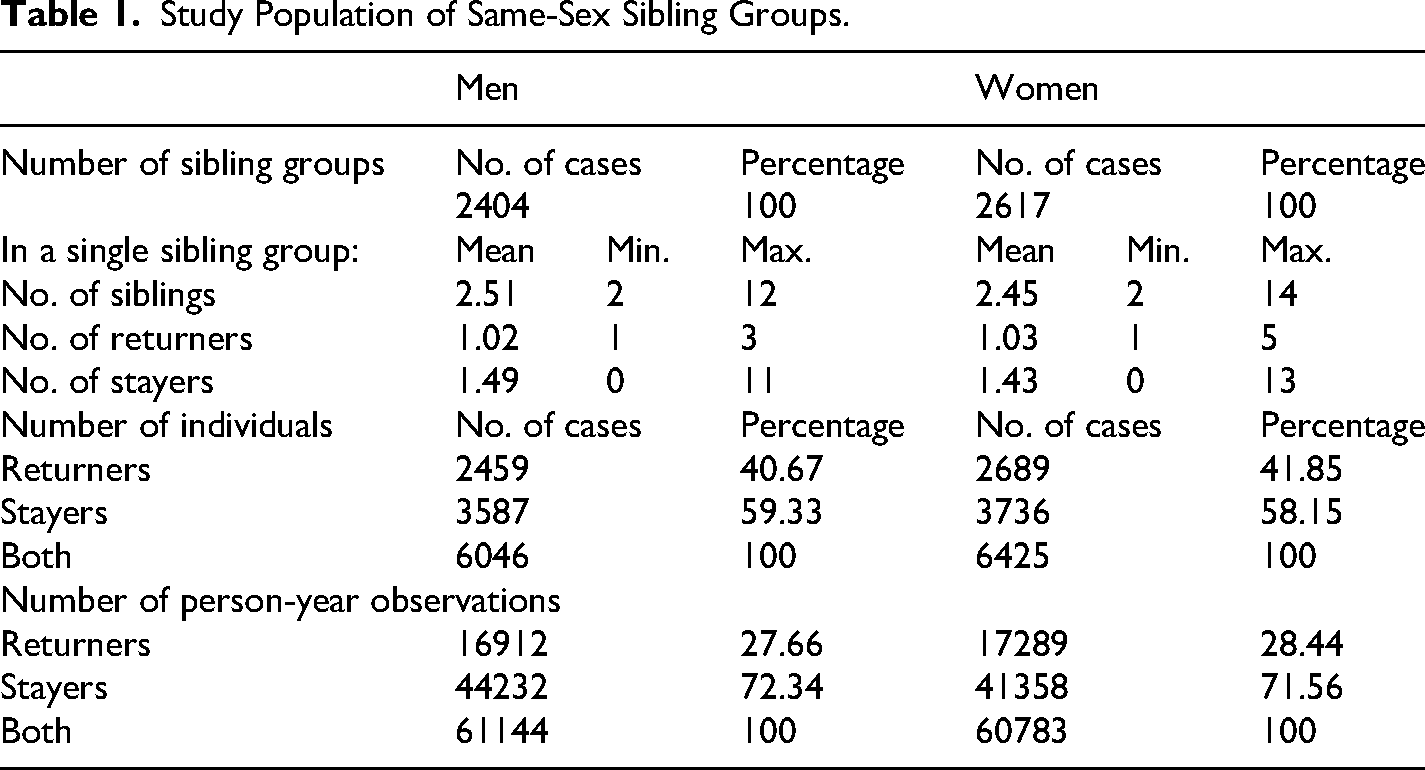
Figure 1 illustrates some hypothetical scenarios for returners and stayers in a single same-sex sibling group. Individual A is a stayer, and individual B is a returner, and they enter the observation window when B returns to Finland. Individual C is as a stayer from 2007 to 2014 but censored when he/she migrated out in 2015. Similarly, individual D is a returner throughout the observed period from 2007 to 2014 and is censored upon second migration in 2015. Individual E represents a scenario where the person had been in Finland until 2009, been abroad in 2010–2011, and returned in 2012. Therefore, compared to a same-sex sibling, this person is coded as a stayer in 2007–2009, unobserved in 2010–2011, and as a returner from 2012 onwards. A descriptive summary of the study population is shown in Table 1. Women are overrepresented in our sample. On average, within a sibling cluster, there are more stayers than returners. Note that some sibling groups do not contain a “pure stayer,” if a staying sibling eventually had moved out, like individual E in Figure 1.
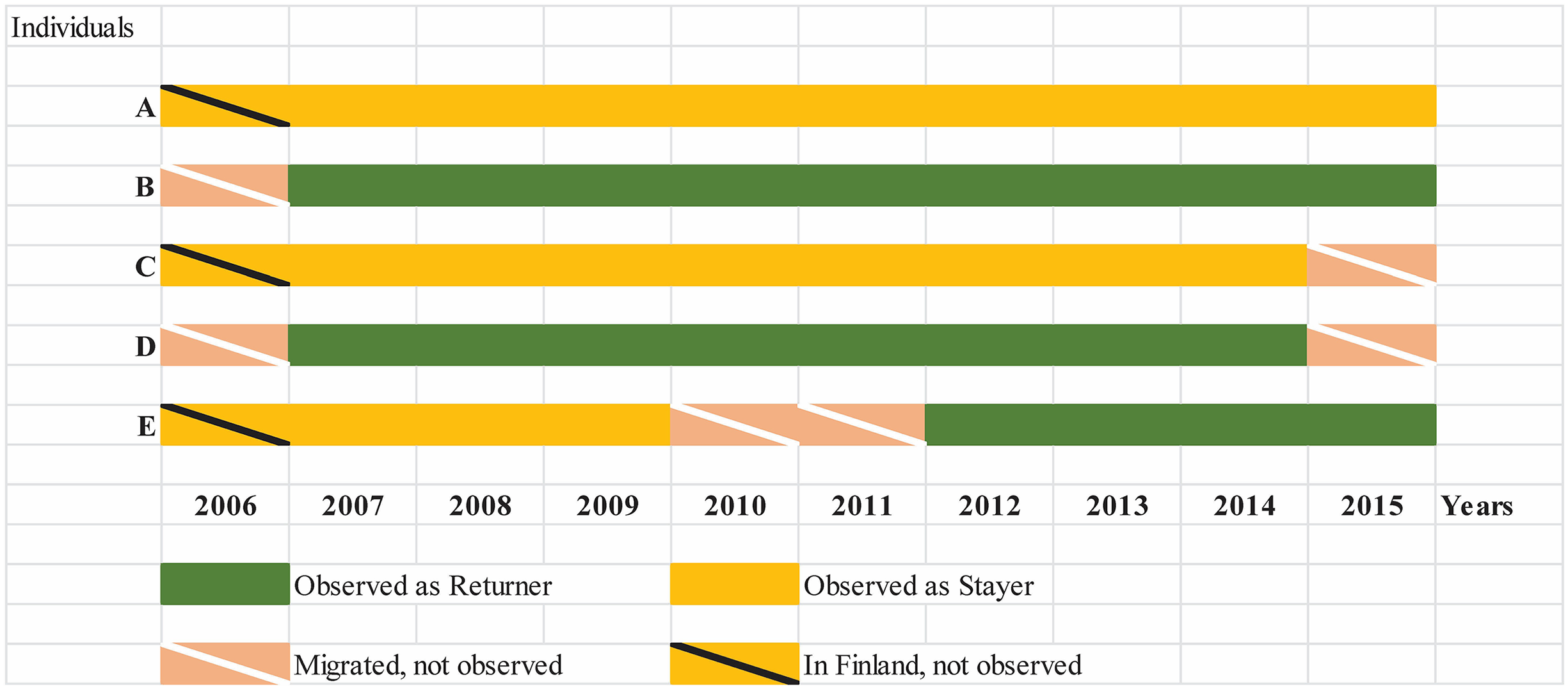
Examples of possible scenarios of returners and stayers in a same-sex sibling group.
Study Population of Same-Sex Sibling Groups.
Measurement
We focus on two labor market outcomes: employment and income. Employment refers to the individual's labor market status at the end of each calendar year. It is coded as 1 if the individual is employed, and 0 if unemployed or outside the labor force. Income combines labor earnings and entrepreneurial income for each calendar year and is adjusted with the consumer price index to 2018 prices. By the time of the study, employment information was available for the period 1987–2019, and income was available for the period 1987–2018.
Basic demographic and socioeconomic controls include educational level (primary, secondary, or tertiary), family composition (living with partner, children, or parents), and rural/urban division. These sociodemographic factors are measured at the year before the returners moved out, or the earlier most recent year, in the corresponding same-sex sibling group. We account for the influence of economic cycle and other period-related social factors by controlling 5-year intervals for the year of observation. Whether the individual still lives in the municipality of birth is controlled for, because those who return to their home community may gain better access to local network and labor market. For models without sibling fixed effects, we additionally control for age groups and mother tongue at the time of observation, for which there is no variation within same-sex sibling groups. Descriptive statistics of the control variables are shown in Supplemental Table A1.
Modelling Strategy
Different analytical strategies are applied to the two outcome variables due to their different nature and patterns of distribution. For employment, we estimate the likelihood of being employed using linear probability models based on ordinary least-squared (OLS) regression. For income, we apply two specifications. First, we use OLS to estimate the average income. However, as will be shown in the following section, income is distributed nonmonotonously, so applying a simple OLS model may be biased of extreme values, especially those of the very high end of the income spectrum. Therefore, we also estimate quantile regression models (Machado and Santos Silva 2019), so that the returner-stayer difference can be flexibly analyzed across the various percentiles of the income distribution. In line with the data setup, and because men and women generally differ in labor market and life course patterns, regressions are estimated separately by gender. We first estimate a model with demographic control variables, without sibling fixed effects. Then we proceed to estimating models that include fixed effects of same-sex sibling groups. We can thereby compare results where the variation observed is only between same-sex siblings with results from standard models where the variation includes also differences across people in different sibling groups. Additionally, we test the contribution of social networks by interacting stayer/returner status and living in the municipality of birth. For all models, we use robust standard errors clustered by same-sex sibling group.
Results
Descriptive Findings
First, we present descriptive patterns of the labor market outcomes for returners and stayers. In Figure 2, we plot, for each sex, the trajectories of the returners’ relative employment level by years after returning, compared to the correspondent same-sex siblings who stayed (pooled average for all in the same-sex sibling group for each sex in the same year, fixed as one for reference). In the first year after having returned, female return migrants seem to be at parity with stayers, while male return migrants have a strong employment disadvantage. The employment level of male return migrants recovers somewhat over time, but fluctuates and never reaches that of the stayers, not even 10 years after return migration. For women, the employment level of return migrants fluctuates, though in most year after returning it is at a lower level than that of stayers.
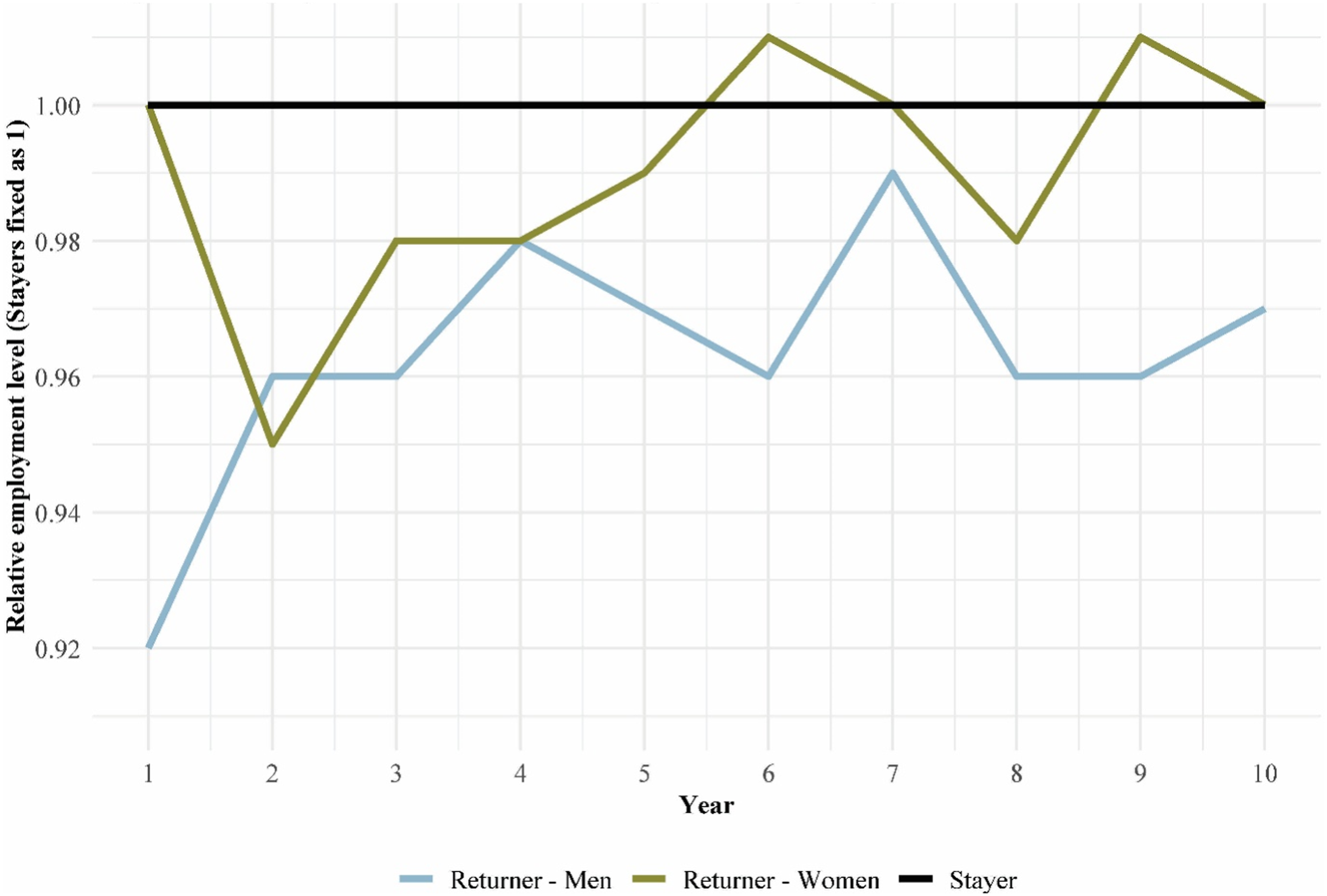
Employment rate of returners compared to stayers by years after return.
In terms of income (Figure 3), returners also have a substantial disadvantage compared to stayers in the first year after return migration, but the differences are quickly caught up. In the second year and thereafter, male return migrants outperform their staying counterparts, while female return migrants are found at roughly the same level as their staying counterpart. In Supplemental Figures A1‒A2, we present, for the same comparisons, predicted values from OLS models that control sociodemographic and period factors. The patterns stay similar, with the employment and income levels of returners slightly reduced compared to stayers.
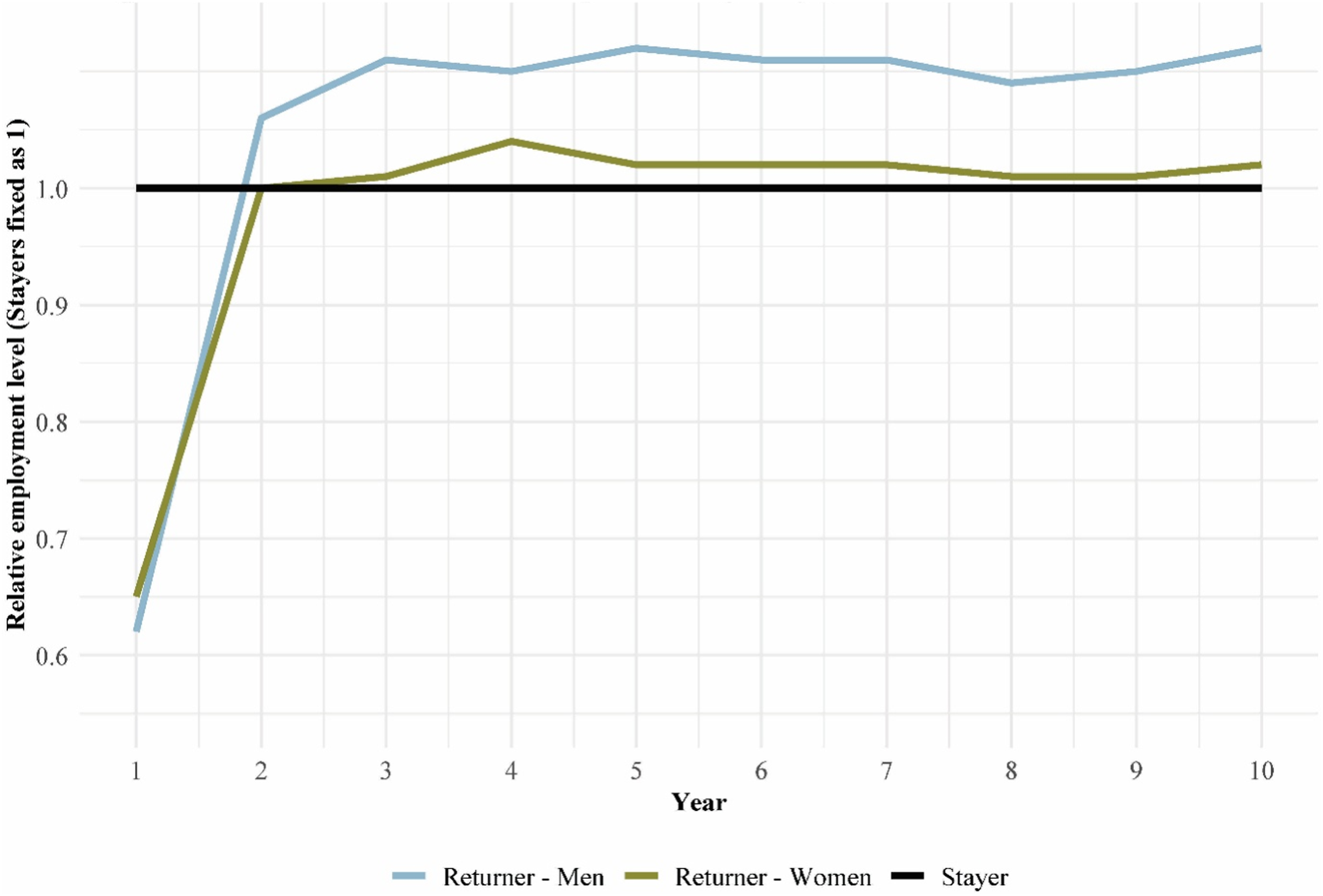
Income levels of returners compared to stayers by years after return.
Related to the trajectories for employment, these patterns suggest that returners who managed to gain employment also received a relatively high income, and particularly so among men. As a further exercise, we therefore plot the income distribution over all person-year observations by returner/stayer status in the analytical data (Figure 4), also distinguishing between all persons and employed persons in the study population. Among men (panel a of Figure 4), the proportion with no income is clearly larger among returners than stayers. However, returners are also overrepresented among high-income individuals, including the range of extremely high incomes of around 400,000 euro per year. Stayers are overrepresented in the middle-range income levels. When non-employed individuals have been excluded (panel b of Figure 4), it is even more obvious that the income distribution of male returners is further right-skewed compared to male stayers. The income distributions for women (panels c and d of Figure 4) resemble those for men, but the differences between returners and stayers and by employment status are less emphasized. Differences in labor market outcomes between returners and stayers are consequently not monotonous. Returners are both more likely to be nonemployed, thus, to have no income, but also to have higher income once employed, and particularly so among men.
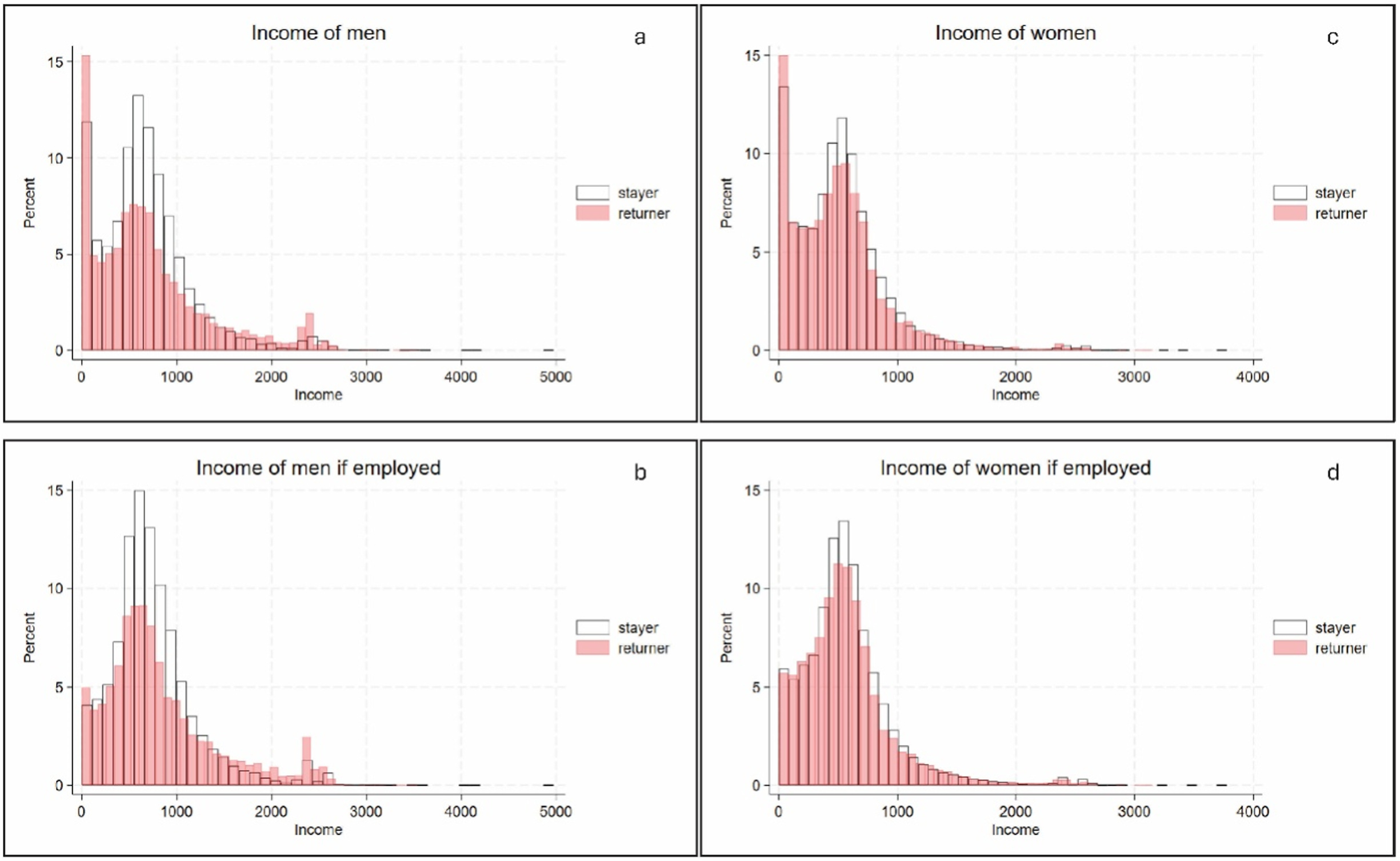
Distributions of income (in 100 Euros) for returners and stayers.
We additionally demonstrate that return migrants’ labor market outcomes are not penalized by length of stay abroad (Figures A3‒A4). For both men and women, the employment rate and the income level are stable by time spent abroad, and fluctuate primarily for returners with many years abroad, for whom the number of observations become small. Men retain a clear income advantage over women.
Results of Regression Models
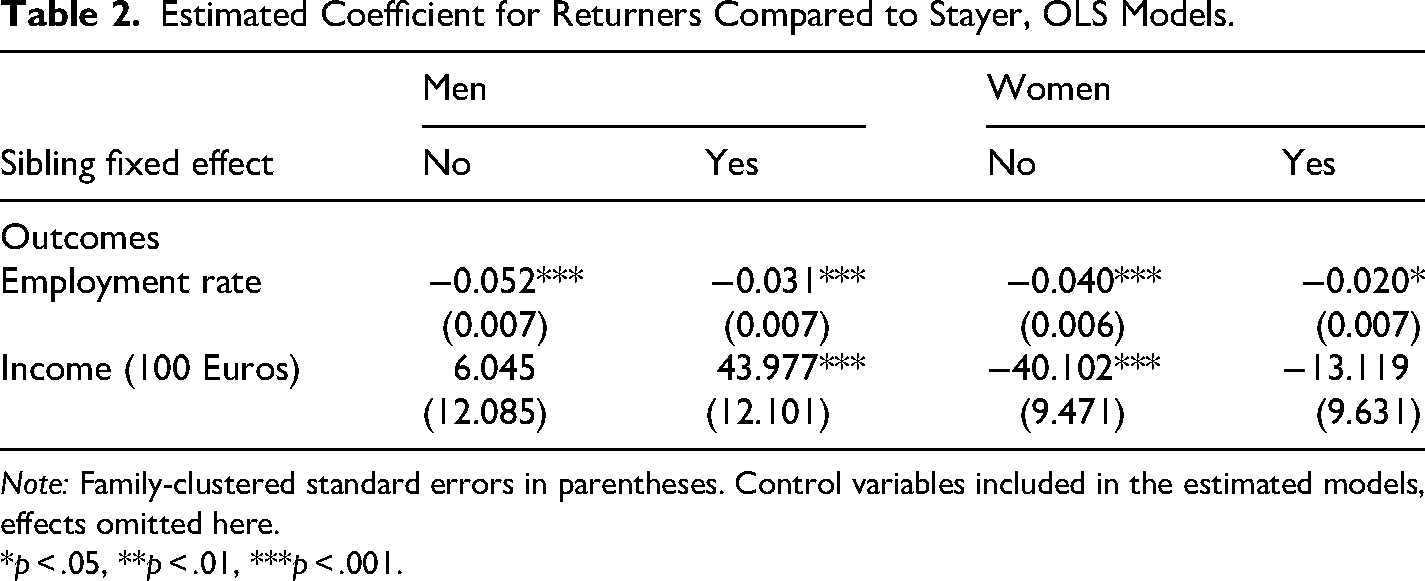
We proceed with formally testing the differences in labor market outcomes between returners and stayers. First, we estimate OLS models predicting employment and average income (Table 2; full regression tables are found in Supplemental Tables A2‒A3). For both sexes, we see that returners are clearly disadvantaged in terms of employment as compared to stayers. When comparing same-sex siblings, the disadvantage reduces. With sibling fixed effects and control variables included, male returners are 3.1 percentage points less likely to be employed than male stayers. Without sibling-fixed effects, the difference would be 5.2 percentage points. For women, the corresponding numbers are 2 and 4 percentage points, respectively. The predicted employment rates at means are plotted in Supplemental Figure A5. There is consequently a notable gap in the probability of employment between stayers and returners, and it cannot be substantially explained by family, community, personality, socioeconomic origin, and pre-adolescent life course factors, which we largely control for. This is consistent with previous findings on return migrants’ disadvantaged employment situation (Saarela 2015; Saarela and Finnäs 2009), although here we have applied a much more rigorous design in terms of the same-sex fixed effect sibling comparison.
Estimated Coefficient for Returners Compared to Stayer, OLS Models.
Note: Family-clustered standard errors in parentheses. Control variables included in the estimated models, effects omitted here.
*p < .05, **p < .01, ***p < .001.
For income, results are starkly different. For men, we do not find a significant difference between stayers and returners in a model without sibling fixed effects. However, when comparing same-sex siblings, returners earn on average almost 4,400 euro more per year than stayers. For women, returners earn about 4,000 euros less than stayers when no sibling comparison is made. This difference is much smaller and statistically not significant when siblings are compared. Results for predicted income levels are presented in Supplemental Figure A6. Findings from the OLS models again imply that returners may be disadvantaged in employment but may earn more than stayers if employed.
The great heterogeneity in income among return migrants imply that the difference as compared to stayers cannot be appropriately estimated using conventional linear regression methods. Therefore, we use quantile regression, which can quantify the group difference across percentile levels throughout the income distribution. We estimate the returner-stayer income difference at the 0.20, 0.40, 0.60 and 0.80 quantiles, and additionally at the 0.90, 0.95 and 0.975 quartiles, as the income distribution of male returners is highly right skewed, with some extremely high values. Results are presented as predicted values at means. The application of sibling fixed effects in quantile regressions follows the method developed by Machado and Santos Silva (2019).
At the 0.20 and 0.40 quantiles, there are only small differences in income between returners and stayers when we control for socioeconomic factors and same-sex siblings fixed effects (panel a of Figure 5 ). At the higher end of the income distribution, men returners earn substantially more than stayers, and the gap enlarges with the quantile. At the 0.975 quantile, male returners earn on average almost 22,000 euro more per year than male stayers. This is a striking pattern when considering the overall lower employment rate of returners as compared to stayers, but fully consistent with patterns observed for the income distribution. We additionally control employment (whether or not employed) to assess whether the relatively large share of nonemployed returners is important (In panel b of Figure 5). Then we see that, at the 0.20 quantile, male stayers still earn more than men returners, but the gap is small. At the 0.40 quantile, male returners have higher income than male stayers, which is at an even lower income level than in models that do not control for employment. As before, the group difference in income is larger at higher quartiles.
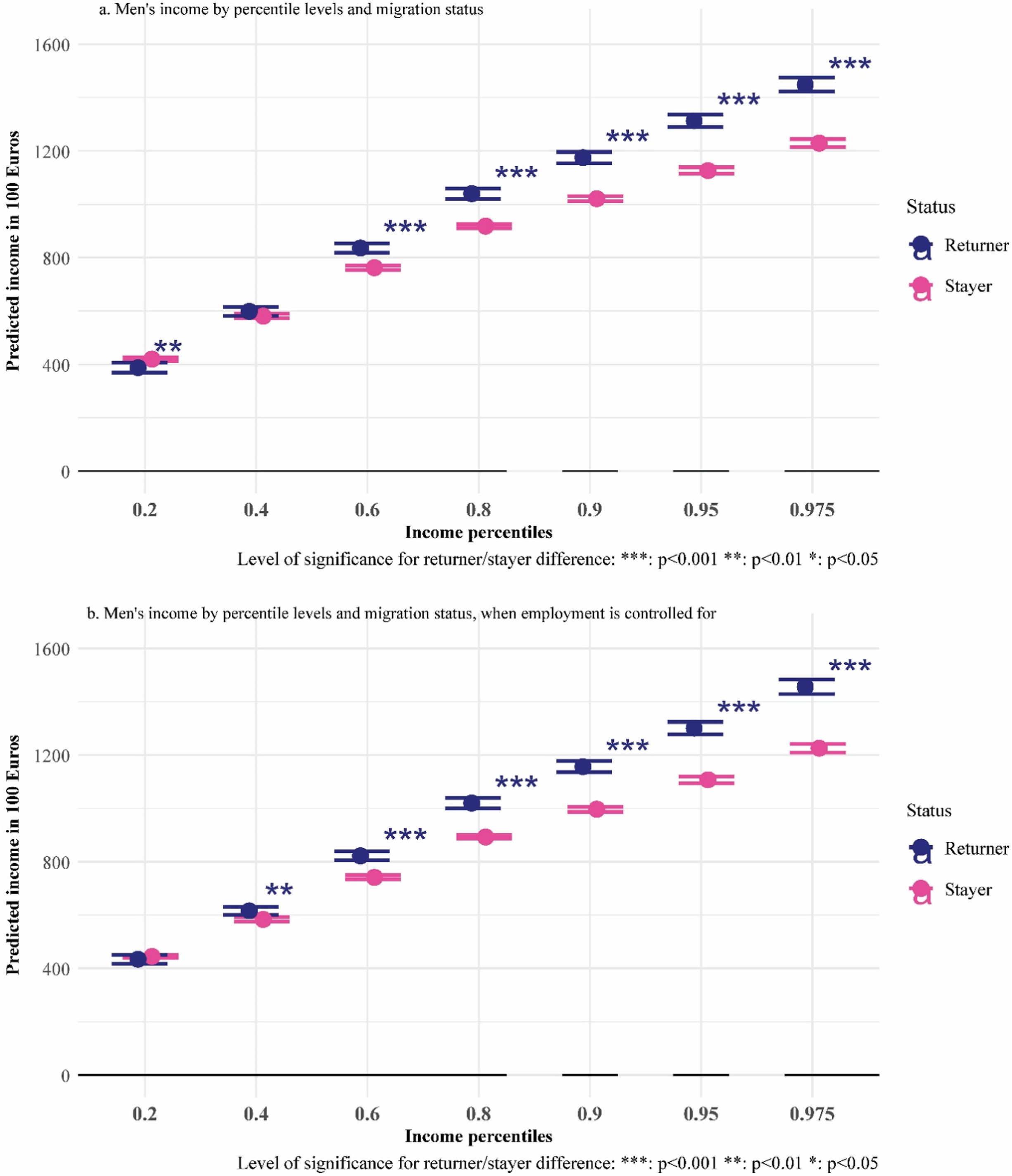
Predicted average income at means by percentiles and migration status, for men.
Patterns for women are not equally emphasized, but they tell a similar story (Figure 6). Up to the 0.40 quantile, female returns have lower income than stayers, though the gaps are small. Thereafter, and at the higher end of the income distribution, returners start to overtake stayers (panel a of Figure 6). The difference becomes larger at higher quantiles, and at the 0.975 quantile, returners earn on average over 7,800 euro more per year than stayers. When employment status is being controlled for (In panel b of Figure 6), these patterns remain almost the same. The quantile threshold for returners to surpass stayers is thus higher for women than for men, and the returner income premium at the highest end of the distribution is smaller for women than for men.
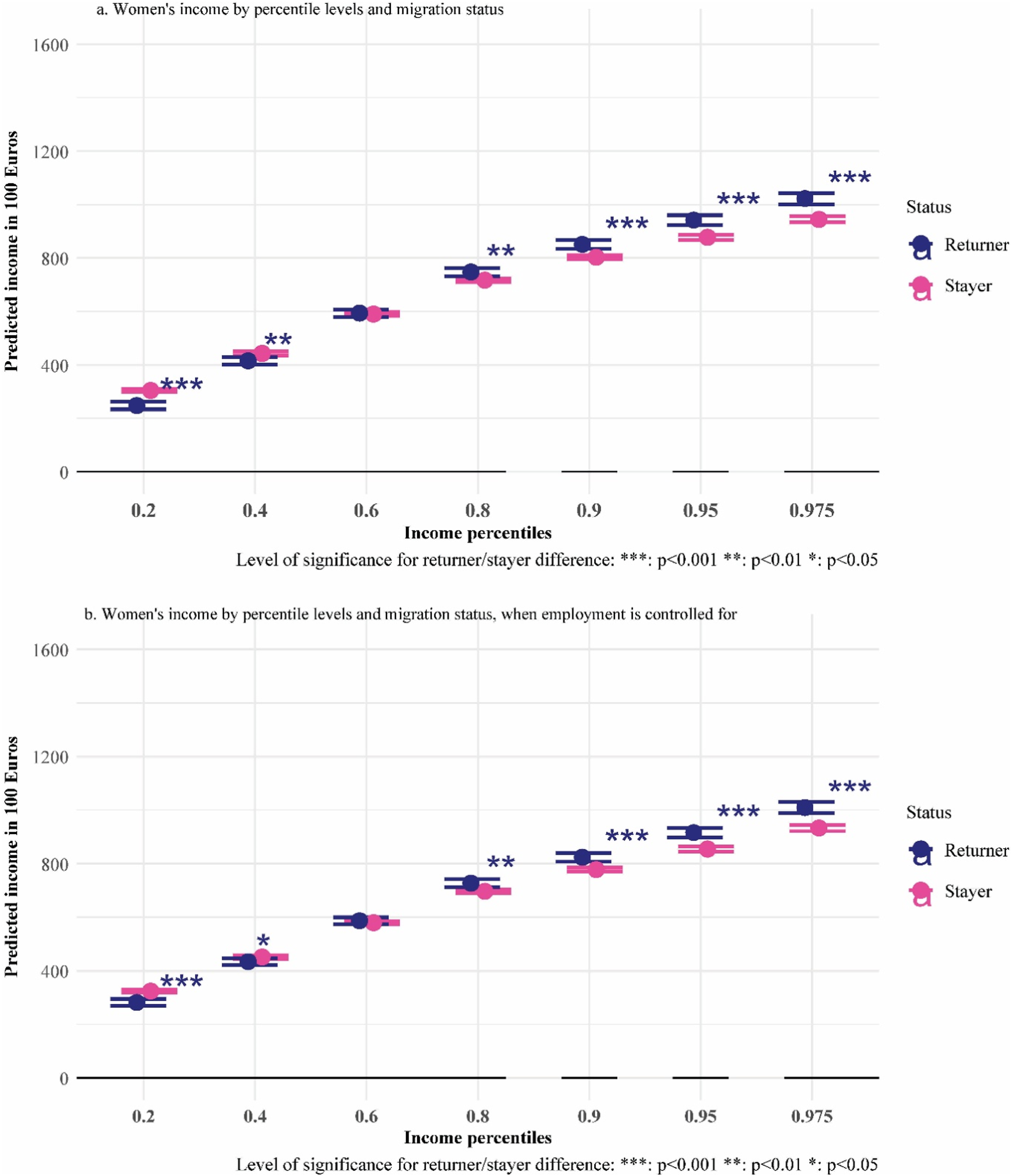
Predicted average income at means by percentiles and migration status, for women.
Results for both men and women are similar when not applying sibling fixed effects (see Supplemental Tables A4‒A5). These findings point to the previously documented double mechanism that drives migration and return migration (Rooth and Saarela 2007; Saarela 2015; Saarela and Rooth 2012). Return migrants consist of those who have been unsuccessful abroad, and those who have successfully capitalized the experience and skills from working abroad, which greatly benefit their further careers after returning home (Saarela 2015; Saarela and Rooth 2012). Here, we have confirmed those findings by comparing same-sex siblings, thus netted out effects related to pre-migration family- and community-related background. Using quantile regressions, we avoid the fallacy that the income level of returners can be underestimated if one assumes that is monotonously distributed. The returners are in fact overrepresented both at the low end of the income distribution, not being successfully employed, and at the higher end of the income distribution.
As for the network effects, we surprisingly find that across models (Tables A2-A5), living in the municipality of birth is generally negatively associated with better labor market outcomes. We do not find significant interaction effects between being a returner and returning to the home municipality. A possible explanation is that those who return to their home municipality are selected on some latent characteristics that affect their labor market outcomes in a negative manner. We also show that individuals are worse off in terms of both employment and income during the early 1990s, when an economic crisis harshly struck the Nordic countries. Yet, the crisis does not seem to affect the migration flows as observed here (Table A14).
Robustness Checks
To further evaluate our findings, we have conducted a number of additional analyses (Supplemental Tables A6‒A12, full results available upon request). First, we have restricted the analysis to same-sex sibling groups to pairs where both have tertiary-level education, and to pairs with an age gap of at most 3 years. Second, we have expanded the data and included migrants returning from all destination countries, and their same-sex stayer siblings. We have also tried to include individuals above prime working age, including those who are retired, and prolonged the observation window to follow returners for more than 10 years after return migration. Third, we have rerun the models restricting the age of migration to ages 25 years and over. This is because we do not know the reason for migration. Some individuals might thus have migrated with their parents, even if they were adults. There could also be student migrants, who face double burdens abroad of both studying and job hunting. Some individuals might also exhibit entirely different labor market trajectories abroad, if they have been working in several countries. We have used proxies to find cases that potentially reflect migration concerning more than two countries, migration for education, and migration with the parents. These amount to a small share of the returners (Table A13), and we have performed analysis that excludes them. Finally, we have incorporated data from the quinquennial censuses from 1970 to 1985 and performed similar analysis for the period 1975–2015. The results are largely robust across all these alternative specifications, except for that in analysis with tertiary-educated individuals only, male returners have an employment advantage over male stayers.
Conclusion and Discussion
In the current study, we deploy comprehensive population register from Finland, and use a sibling comparison approach, to examine the economic returns for return migrants in relation to their same-sex sibling who had not migrated. Our analysis shows complex patterns of return migrants’ labor market trajectories once they have returned to Finland. Overall, return migrants are disadvantaged in obtaining employment compared to nonmigrants, with a 2–3 percentage points difference in the employment rate for both men and women. The disadvantage is stronger recently after return migration and recovers gradually with time spent in the home country labor market, but it barely reaches the level of stayers. The employment gaps between returners and stayers are generally modest.
At first glance it seems that the return migrants also have substantially lower income than their staying same-sex siblings. However, the returners are overrepresented at both the lower and upper ends of the income distribution. Some are consequently likely to have lower income compared to nonmigrant siblings, while others may have higher income. We observe a strong premium for returners at the high percentiles of income distribution. The higher segment of the income distribution we observe, the larger is the returners’ advantage against stayers, and this applies to both men and women. When we account for employment, the income disadvantage of returners at the lower end slightly shrinks, suggesting that the difficulty for being employed is a main obstacle for return migrants when they move back to Finland. Yet, if successfully employed, they are likely to earn more than their nonmigrating counterparts.
Our study has two methodological merits that strengthen our contribution to the literature on labor market reintegration for return migrants. First, with the help of high-quality population register data, we link return migrants to their siblings of the same sex who have not migrated and perform analysis with sibling fixed effects. In this way, we tease out confounding factors that may affect both the decision to migrate and the labor market achievement, including socioeconomic background, family and neighborhood characteristics, and early adolescent experience. We can then assess the difference between returners and stayers more accurately and causally. To the best of our knowledge, this is a seldom adopted approach in this research area, primarily because of data limitations (see Abramitzky, Boustan and Eriksson 2012, for an exception). Second, for the analysis of income, we use quantile regressions instead of conventional linear models. We reveal that the income difference between returners and stayers varies greatly over the income distribution. The return migrants are more likely to end up in the very bottom of the income distribution, and they are also more likely than stayers to be nonemployed. However, the returners are also more likely to earn a notably higher income than otherwise comparable stayers.
Our study has focused on Finnish migrants who have returned from other Nordic countries, mostly Sweden, which posits an important case to the literature. Unlike the majority of studies in this research field, we have investigated migration between two high-income countries. In a broad perspective, we reach similar conclusions as Monti and Tønnessen (2024), who studied Swedish migrants who return migrated from Norway. Due to historical reasons and cultural proximity, we can assume that the Finnish migrants in our case do not face systematic language and institutional barriers and discrimination while they are abroad, like return migrants studied in many other contexts. Therefore, they should have a much smoother adaption in the foreign labor market, and should be more conveniently gaining human capital, which should benefit their careers once returning to Finland.
However, we still find that the return migrants face substantial challenges, mainly for employment, when they return to Finland. Two major explanations are proposed. First, even though they could have had a rather positive experience abroad, years of absence from the home country can make them lose contact, knowledge and networks in the Finnish labor market, which damage their opportunities for employment in the beginning years after return. It may take several years for them to regain familiarity with the local labor market and catch up. However, we do not find that returning to the home municipality, which could possibly strengthen local networks, improves the labor maker conditions for the returners. The reason might be that these individuals are negatively selected on some characteristics that impede their labor market performance.
Second, there is a strong possibility that the migrants are highly selected from both ends of the ability and skills distribution (cf. Rooth and Saarela 2007; Weber and Saarela 2023). For individuals who initially were disadvantaged, and for those with unsuccessful experience from abroad, moving back may not be a remedy to their later career trajectories. Yet, there could be individuals who have a relatively advantaged position in Finland before moving, and even those who were posted abroad by the international companies they work for. Among this group, experience abroad is likely to bring obvious employment and income benefits after having returned to Finland.
Finally, we would like to address the limitations of our study. First, although we use sibling fixed effects to tease out time-invariant confounding factors related to the family, community and upbringing, we cannot claim our findings to be causal. There can be latent time-invariant factors that we cannot control for, and intra-sibling differences. Beyond factors such as differences in personality, educational and occupational experiences, we note that a person's birth order within the sibling group may also affect the decision to migrate. Different migration decisions among siblings may be the family's strategy for risk diversification, and we have been unable to examine this issue with the current design. However, for the current study context of migration between Nordic countries, the role of birth order and other characteristics related to upbringing seems to be fairly modest (Saarela and Turunen 2024). Second, our design restricts the study population to families that have both returner and stayer siblings, which could have unique unobserved characteristics. We have achieved high internal validity with the sibling comparison design. However, we admit that our stringent restrictions on the analytical population may have resulted in a situation where the study might suffer from problems with lack of external validity to the general population. Finally, it needs to stress that we have not been able to investigate experiences abroad, which thus may constitute a “black box” for interpreting the results. Unpacking such mechanisms can only be realized by using linked data with information from both the host country and the country of origin.
Supplemental Material
sj-docx-1-mrx-10.1177_01979183261454067 - Supplemental material for Returns to Returning with Sibling Comparisons: Register-Based Evidence from Finland
Supplemental material, sj-docx-1-mrx-10.1177_01979183261454067 for Returns to Returning with Sibling Comparisons: Register-Based Evidence from Finland by Weiqian Xia, Jani Turunen, Siddartha Aradhya, and Jan Saarela in International Migration Review
Footnotes

Funding
The authors disclosed receipt of the following financial support for the research, authorship, and/or publication of this article: the Foundation for Baltic and East European Studies (S2-20-0026), Stiftelsen för Åbo Akademi, the Swedish Research Council (2020-01285), Centre for Baltic and East European Studies (1086-3.1.1-2023), and Helge Ax:son Johnsons Stiftelse (Nr F23-0292).
Declaration of Conflicting Interests
The authors declared no potential conflicts of interest with respect to the research, authorship, and/or publication of this article.
Supplemental Material
Supplemental material for this article is available online.
References
Supplementary Material
Please find the following supplemental material available below.
For Open Access articles published under a Creative Commons License, all supplemental material carries the same license as the article it is associated with.
For non-Open Access articles published, all supplemental material carries a non-exclusive license, and permission requests for re-use of supplemental material or any part of supplemental material shall be sent directly to the copyright owner as specified in the copyright notice associated with the article.
