



Abstract
Recent research has highlighted the distinct position of migrant women in host labor markets, showing they face a “double disadvantage” due to the intersection of gender and migrant status. However, evidence remains limited on the relative weight of these two sources of disadvantage and how they vary across origins and destinations. This research note examines the labor market outcomes of migrant women in Western Europe, asking whether they face disadvantages compared to migrant men (gender penalty) and native women (ethnic penalty), and whether these two penalties are comparable in magnitude. It also explores how this double disadvantage varies by women's macro-area of origin and destination country. Using Heckman selection models on European Labor Force Survey data (2015–2019), our study confirms that in most countries migrant women experience significant penalties relative to both native women and migrant men, in employment and occupational status. Findings indicate that the ethnic penalty is generally more pronounced than the gender penalty in occupational status, while the employment gender penalty exceeds the ethnic penalty only in Mediterranean countries. Important differences also emerge by origin: African women are the most penalized, Eastern European women the least, and the only group experiencing a larger gender than ethnic employment penalty. These results highlight the importance of considering multiple outcomes and comparison groups when studying the labor market integration of migrant women. Understanding the labor market position of reference groups is crucial, as the relative status of native women and migrant men varies significantly by destination and origin.
Introduction
In recent decades, a growing body of research has examined the processes through which immigrant populations integrate into European labor markets. While early studies predominantly focused on male immigrants, more recent scholarship has increasingly addressed the labor market position of migrant women, highlighting their distinct patterns of participation and disadvantage (Khoudja and Fleischmann 2015; Ballarino and Panichella 2018; Schieckoff and Sprengholz 2021). According to the double disadvantage perspective (Boyd 1984; Donato, Piya, and Jacobs 2014), migrant women have been found to be doubly disadvantaged compared to both native women and migrant men, as a result of the interaction between gender and migrant status. This double disadvantage — interpreted as an empirical application of the intersectionality framework, whereby multiple social positions intersect to produce specific constraints and opportunities (Browne and Misra 2003) — is reflected in lower employment levels, fewer working hours, lower occupational prestige, and reduced earnings. In this sense, migrant women constitute a disadvantaged group (women) within another disadvantaged group (migrants), often encountering specific barriers that neither native women nor migrant men experience (Oso and Ribas-Mateos 2013).
A central explanatory mechanism highlighted in the literature concerns women's roles within the family. Migrant women's labor market outcomes are shaped not only by barriers common to migrants more generally, but also by gender-specific constraints, most notably childcare responsibilities (Greenlees and Saenz 1999). These constraints are often intensified by the limited availability of informal support networks that many native families rely on, particularly the assistance of extended family members such as maternal grandmothers, who play a key role in facilitating the reconciliation of paid work and family obligations (Schieckoff and Sprengholz 2021). Moreover, persistent gendered divisions of labor within households — which are more prevalent in some origin contexts characterized by traditional gender norms (Kesler 2018; Kanas and Müller 2021) — make migrant women more likely to be tied movers (Boyle et al. 2002), migrating primarily for family-related reasons, such as accompanying a partner or through family reunification, often at the expense of their own career opportunities (Ballarino and Panichella 2018).
Although some empirical studies have engaged with the double disadvantage argument (Raijman and Semyonov 1997; Haque and Haque 2020; Chaudhry, Crick, and Crick 2023; Grönlund and Öun 2025), limited evidence exists on the differences between the dual sources of disadvantage experienced by migrant women — attributable to their gender and migrant status — and their variations across diverse origins and destinations (see Kanas and Steinmetz 2021). Concerning the role of the origin, research on migrant men in Western Europe consistently finds that the most penalized groups are those from non-Western regions, particularly Africa and the Near Middle East (Koopmans 2016). Similar patterns appear to characterize migrant women, who may face disadvantages not only relative to native women but also relative to their male counterparts, especially given the persistence of traditional gender norms and the higher prevalence of family-driven migration among these groups (Ballarino and Panichella 2018; Kesler 2018).
Concerning the role of the destination, the literature shows that the labor market inclusion of non-Western migrant men in Western Europe typically follows a trade-off between employment and job quality (Ballarino and Panichella 2015; Cantalini, Guetto, and Panichella 2023), which varies depending on the host country's institutional context (Kogan 2006). In Mediterranean countries, migrants tend to have employment rates similar to natives but are overrepresented in unskilled and precarious jobs (Reyneri and Fullin 2011). In contrast, in Continental and Northern Europe, migrants face greater difficulties accessing employment but are less concentrated in the lowest occupational tiers compared to their counterparts in the South (Ballarino and Panichella 2015). A similar pattern is observed among immigrants in the United Kingdom and Ireland, though some scholars position it somewhat between Continental and Mediterranean countries (Guetto 2018).
Although cross-country studies including women have suggested that migrant women also follow such trade-off patterns (Ballarino and Panichella 2018), these dynamics appear less clear-cut than for men. Some groups of women face significant disadvantages in both employment and job quality, while others appear more successfully integrated (Cantalini, Guetto, and Panichella 2022; Birgier and Cantalini 2025). This heterogeneity may reflect, among other factors, cross-national variation in female labor force participation rates among both migrants and natives, as well as differences in gender norms and institutional arrangements for women's employment, which shape both gender and ethnic inequalities experienced by migrant women. In this regard, comparative research has shown that generous family policies and gender-egalitarian climates reduce gender inequalities but may simultaneously widen ethnic penalties (Kanas and Steinmetz 2021). In addition, receiving-country gender norms can interact with individual attitudes to further stratify migrant women's labor market outcomes (Kanas and Müller 2021), while institutional barriers such as delayed credential recognition and limited childcare availability can further exacerbate their penalties (Udayanga 2024).
This research note contributes to these strands of literature in two main ways. First, it investigates whether migrant women in Western European labor markets experience disadvantages in terms of employment and job quality relative to both native women (ethnic penalty) and migrant men (gender penalty). By explicitly comparing migrant women not only with native women but also with migrant men, the analysis allows for a direct assessment of whether migrant women face a double disadvantage and of whether its two components are comparable in magnitude. While the comparison with native women is well established in research on migrant women's labor market integration, the comparison with migrant men is less common, despite being essential to fully capturing the intersection of gender and migrant status. Second, the research note examines how this double disadvantage varies across macro-areas of origin and destination-country contexts. Specifically, it asks whether gender and ethnic penalties are more pronounced among women originating from Africa and the Near Middle East compared to women from other macro-regions, such as Eastern Europe, and whether patterns of disadvantage in employment and job quality vary across host countries characterized by distinct labor market structures and welfare regimes.
Data and Methods
We use data from the European Labor Force Survey (EU-LFS) for the years 2015–2019. The analytical sample includes individuals aged 25–64 and is restricted to natives and “recent” migrants, defined as those who moved to the destination countries within 10 years preceding the survey. The analysis includes 13 Western European countries, grouped into four broad welfare and labor market regimes: Continental (Austria, Belgium, France, the Netherlands, and Switzerland), Nordic (Denmark, Norway, and Sweden), Southern or Mediterranean (Italy and Spain), and Anglo-Saxon or Liberal (Ireland and the United Kingdom). The final sample consists of 2,387,807 men (including 206,925 migrants) and 2,481,969 women (of whom 245,429 are migrants).
Labor market inclusion is analyzed through two outcomes: employment status and occupational status. Employment is measured on the whole analytical sample with a binary indicator distinguishing between employed and unemployed/inactive individuals. Occupational status, observed only among the employed, is captured by the International Socio-Economic Index of Occupational Status (ISEI), a widely used measure of job quality (Ganzeboom, De Graaf, and Treiman 1992).
The main independent variable combines gender and migrant status, distinguishing four groups: native men, migrant men, native women, and migrant women. This classification allows us to examine migrant women's outcomes relative to both (i) native women and (ii) migrant men, in line with the “double disadvantage” framework. As a preliminary step, we also compare all groups to native men — the theoretically most advantaged category — to establish a hierarchy of labor market outcomes and to better contextualize the position of migrant women's two main comparison groups. Our primary focus is on non-Western migrant women, further disaggregated by region of origin: (a) Africa and the Near Middle East, (b) Asia, (c) Latin America, and (d) Eastern Europe.
All models control for age, educational attainment (lower secondary, upper secondary, and tertiary or higher), survey year, and degree of urbanization of the area of residence (cities; towns and suburbs; and rural areas). Models predicting employment also include marital status, while those predicting occupational status additionally account for part-time employment.
We estimate Heckman selection models (Heckman 1979) separately by country to account for selection into employment. This approach jointly models a binary employment selection equation and a continuous occupational status equation, addressing potential bias due to non-random selection into employment among migrants and natives, as well as among men and women. Marital status is included in the selection equation as an exclusion restriction, following previous research (Cantalini, Guetto, and Panichella 2022; Birgier and Cantalini 2025).
Finally, we conduct two sets of additional analyses, not shown for reasons of space but available upon request. First, we examine the role of parenthood, which is crucial when studying labor market outcomes for both native and migrant women (see the Introduction section). Because information on children is unavailable for Nordic countries and Switzerland, parenthood cannot be included in the main models. However, for countries where this information is available, we estimate alternative specifications that include the number of children in the household as an additional exclusion restriction, which largely confirm the results presented in the text. We also estimate models interacting gender and migrant status with the number of children. These analyses consistently show that parenthood penalizes women's employment, particularly among migrants, regardless of origin or destination context.
Second, we distinguish between unemployment and inactivity, a distinction that is particularly salient for (migrant) women's labor market outcomes, as inactivity — rather than unemployment — often reflects childcare responsibilities and family-related constraints. In the main analysis, these two states are combined in order to capture the effect of inactivity driven by such constraints in shaping the (potential) double disadvantage of migrant women. As a robustness check, however, we estimate sensitivity analyses that separately model (i) the probability of being active (versus inactive) and (ii), conditional on activity, the probability of being employed (versus unemployed). The first set of models closely mirrors the results presented in the text, whereas the second reveals substantially smaller penalties for migrant women, especially when compared to migrant men. Taken together, these findings indicate that, across origins and destination contexts, migrant women's employment penalties are largely driven by inactivity, consistent with the role of gender norms and family responsibilities.
Findings
Labor Market Hierarchies Relative to Native Men: Native Women, Migrant Men, and Migrant Women
Figure 1 presents the employment and ISEI gaps for native women, migrant men, and migrant women, compared to the theoretically most advantaged group — native men. The figure displays the results of our models through four scatterplots, each representing a different destination cluster. Each point in the plots reflects the combination of the employment probability gap (y-axis) and the occupational status gap (x-axis) relative to native men. Crosses represent native women, hollow markers indicate migrant men, and filled markers denote migrant women, while macro-areas of origin are distinguished by marker shape. The figure clearly illustrates differences among these groups, revealing the following hierarchy in labor market outcomes: native men, native women, migrant men, and, lastly, migrant women. Native women emerge as the least disadvantaged group relative to native men, especially in Continental and Nordic countries. The largest gender gap among natives appears in Southern European countries, especially in terms of employment. To illustrate, the predicted probability of employment among native women is 78.5 percent in Germany — 5.9 percentage points (p.p.) lower than among native men — whereas in Italy it drops to 52.2 percent, corresponding to a much larger gap of 19.2 p.p.
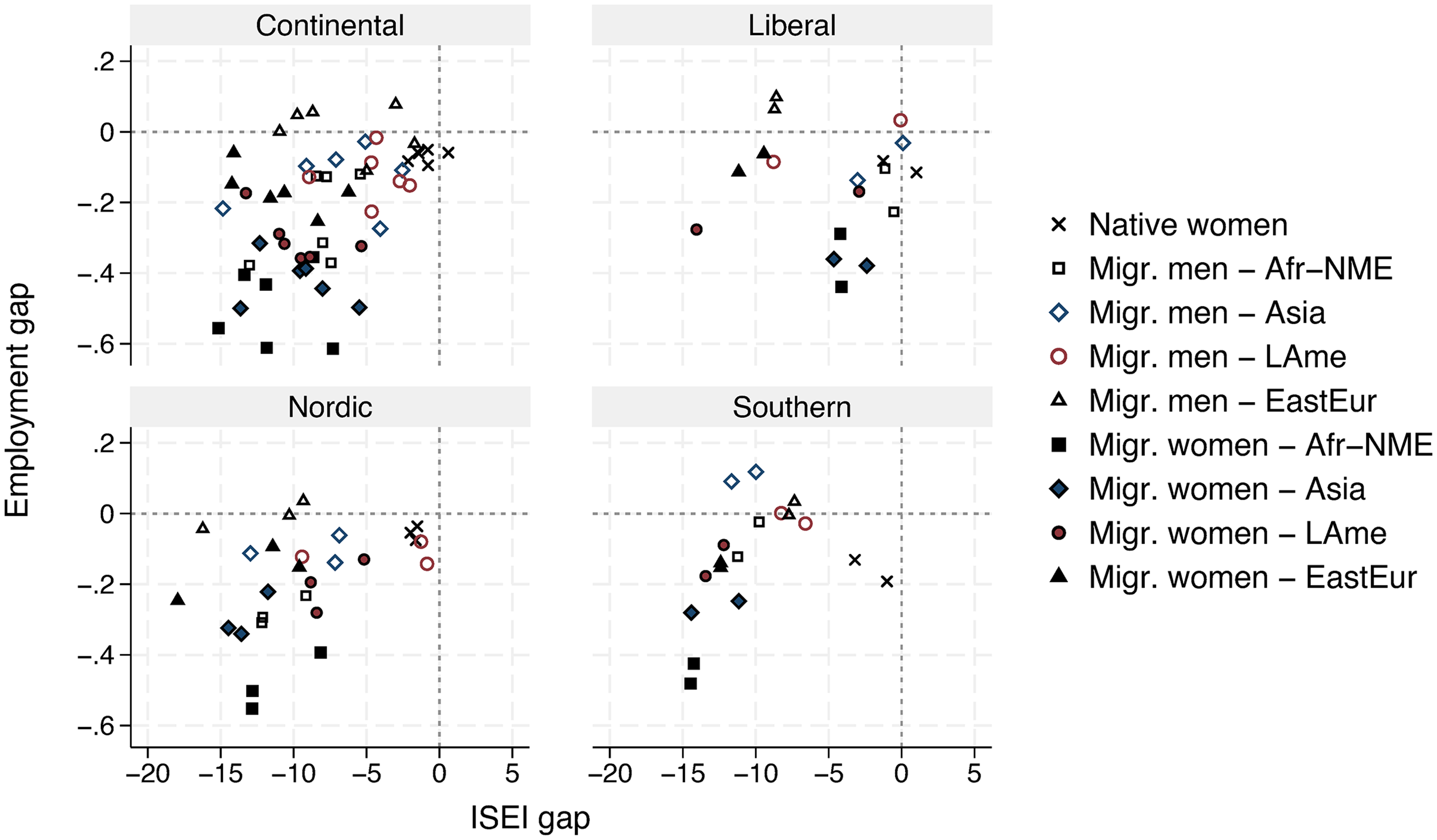
Employment and ISEI gap for native women, migrant men and migrant women compared to native men, by country cluster and migrants’ macroarea of origin. Heckman selection models. Average marginal effects.
On average, migrant men are more disadvantaged than native women but less so than migrant women, when compared to native men. Cross-country differences among migrant men reproduce the well-documented trade-off between employment and job quality. In Southern Europe, migrant men face relatively small employment penalties but substantial occupational status penalties, particularly those from Asia and Africa, whereas in Continental Europe, the opposite pattern prevails. For example, African migrant men have an employment probability that is 37.1 p.p. lower than that of native men in Germany, but only 2.3 p.p. lower in Italy; at the same time, their occupational status penalty amounts to 7.4 ISEI points in Germany and 9.8 points in Italy. Nordic and Anglo-Saxon countries display significantly higher heterogeneity, both across countries and among migrants from different macro-areas of origin.
Migrant women represent the most disadvantaged group — especially those from Africa and the Near Middle East (filled squares) — experiencing substantial penalties in both employment and occupational status across all countries, with particularly severe disadvantages in Continental, Nordic, and Southern Europe. For instance, their employment gap relative to native men reaches 61.3 p.p. in Germany, 42.4 p.p. in Italy, and 50.2 p.p. in Sweden, while the corresponding ISEI gaps amount to 7.3, 14.2, and 12.8 p.p., respectively.
Eastern European women (filled triangles) exhibit relatively small employment gaps but sizeable occupational status penalties. Owing to their comparatively limited employment disadvantage, cross-country variation for this group is less marked: for example, employment gaps range from 15 to 19 p.p. across Germany, Italy, and Sweden.
Among Asian women (filled diamonds), occupational status penalties are most pronounced in Nordic and Mediterranean countries, while employment penalties are greater in Continental Europe, as well as in the United Kingdom and Ireland. Latin American women (filled circles) tend to face smaller employment penalties than African and Asian women, but larger ones than Eastern Europeans, particularly in Continental, Liberal and Nordic countries. In Southern Europe, their employment and occupational status gaps closely resemble those of Eastern Europeans.
Labor Market Outcomes of Migrant Women: Gender and Ethnic Penalties
Figure 2 shows the employment and ISEI gaps by origin group and destination cluster, comparing migrant women with native women (left panel) and with migrant men (right panel). The figure is intended to examine both ethnic and gender penalties experienced by migrant women, as well as their variation by origin and country of destination. The results largely support the concept of “double disadvantage”: in most countries, migrant women are disadvantaged relative to both native women and migrant men. Overall, ethnic penalties (left panel) tend to be more pronounced than gender penalties, as migrant women are generally more disadvantaged in comparison to native women than to migrant men, particularly with respect to occupational status.
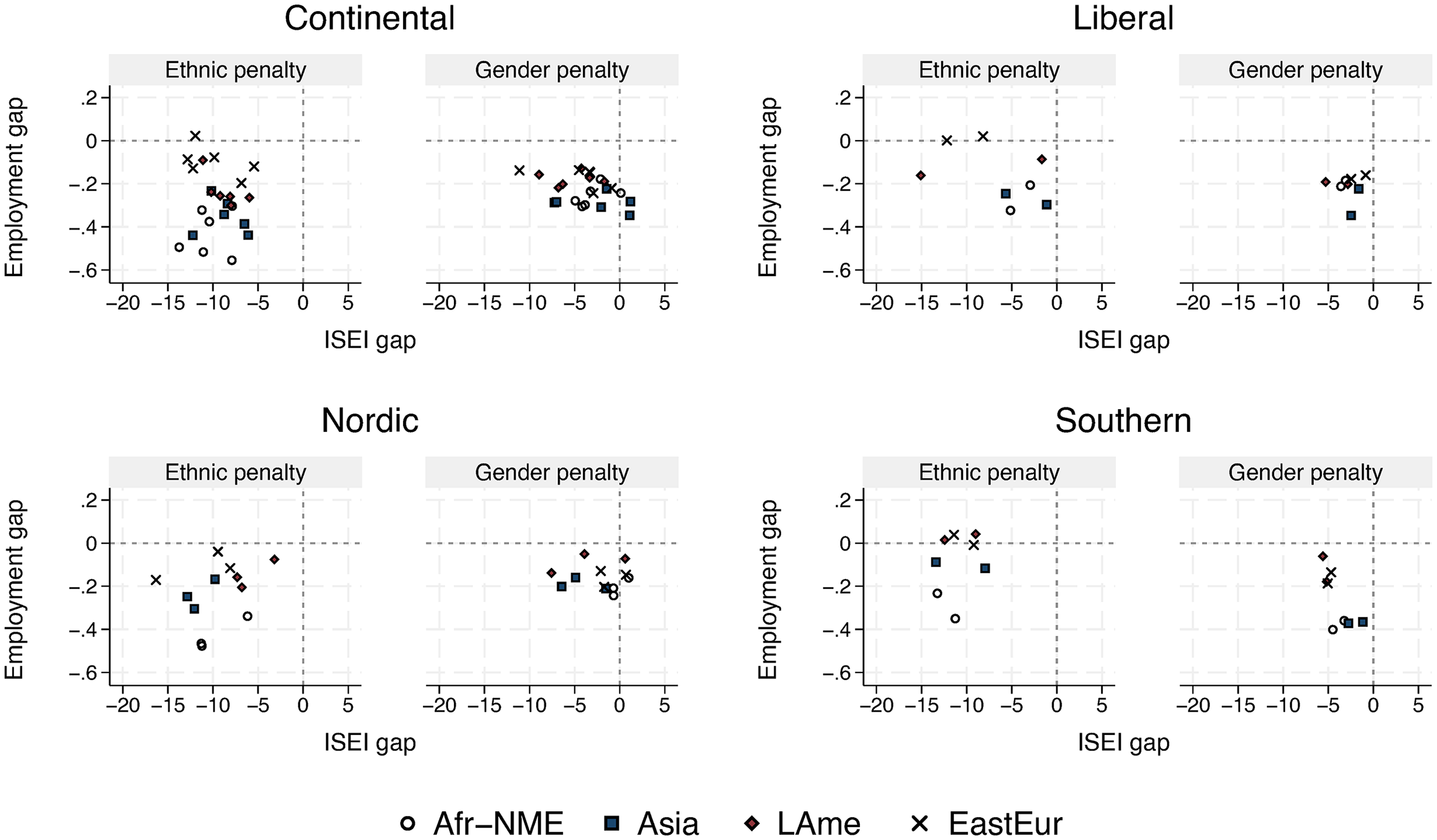
Employment and ISEI gap for migrant women compared to native women (ethnic penalty) and migrant men (gender penalty), by country cluster and migrants’ macroarea of origin. Heckman selection models. Average marginal effects.
Starting with women from Africa and the Near Middle East (circles), they face larger ethnic penalties in terms of employment in Continental and Nordic countries (e.g., −55.5 p.p. in Germany and −46.6 in Sweden) compared to Southern European and Liberal contexts (e.g., −23.3 p.p. in Italy and −20.6 in the United Kingdom). Regarding occupational status, the ethnic penalty is lowest in Liberal countries — which exhibit the least disadvantage for this group of migrant women — and highest in Southern Europe (e.g., −2.9 ISEI points in the United Kingdom versus −13.3 in Italy). These findings confirm a trade-off pattern in Mediterranean countries, characterized by relatively small employment gaps but large occupational status gaps. In contrast, substantial heterogeneity is observed across Continental and Nordic countries, where, in some cases, African and Near Middle Eastern women are significantly disadvantaged in both employment and occupational status compared to native women. In countries such as Austria, the Netherlands, Denmark, and Sweden, correcting for selection into employment reveals occupational status gaps that would otherwise remain hidden.
Gender penalties for this group, although generally smaller than ethnic penalties, remain sizeable in many countries, especially in Southern Europe. For instance, African and Near Middle Eastern women are 40.1 p.p. less likely to be employed than their male counterparts in Italy, compared to gaps of 24.3 p.p. in Germany and 20.9 in Sweden. Interestingly, only in Mediterranean countries do gender employment penalties exceed ethnic ones. This pattern — also observed for other origin groups — reflects, on one hand, the low employment levels of the reference group in the ethnic penalty comparison (i.e., native women in Southern Europe), and on the other, the relatively high employment levels of the reference group in the gender penalty comparison (i.e., migrant men in the same destinations). In Nordic countries, gender penalties are the lowest: although African and Near Middle Eastern women are less likely to be employed than their male counterparts, the employment gap is narrower than elsewhere, and their occupational status is comparable to — or even slightly higher than — that of their male counterparts.
Asian women (squares) generally experience smaller ethnic penalties than African women across most destination countries, particularly in terms of employment. Cross-country comparisons reveal that the ethnic employment penalty is more pronounced in most Continental countries (e.g., −43.8 p.p. in Germany) than in Nordic, Liberal, and especially Mediterranean countries (e.g., −30.4 in Sweden, −29.6 in the United Kingdom, and −8.8 in Italy). Regarding occupational status, ethnic penalties are lowest in Liberal countries, especially in the United Kingdom (–1.1 ISEI points). Overall, Asian women are the group for whom the trade-off between employment and job quality is most evident: in countries where the employment gap is wider, the ISEI gap tends to be narrower, and vice versa.
When examining gender penalties, the pattern diverges from that observed among women from Africa and the Near Middle East. For the latter group, countries with high gender penalties in employment also tend to exhibit substantial penalties in occupational status. In contrast, among Asian women, a trade-off is evident even in relation to migrant men: in Southern Europe, larger employment gaps correspond to smaller occupational status gaps (e.g., −37.2 p.p. in employment and −2.8 ISEI points in Italy), whereas in Nordic countries, the reverse pattern emerges (e.g., −20.2 p.p. in employment and −6.4 ISEI points in Sweden).
Latin American women (diamonds), on average, face lower ethnic penalties than their African and Asian counterparts. Their ethnic employment penalty is most pronounced in Continental countries (e.g., −26.5 p.p. in Germany) and virtually nonexistent in Southern Europe (e.g., +1.5 in Italy). However, it is precisely in Southern Europe that Latin American women experience their largest disadvantages in occupational status, with an ISEI gap of −12.4 points in Italy, compared to much smaller penalties in countries such as Norway (−3.2) and the United Kingdom (−1.7), where their occupational outcomes closely resemble those of native women. Regarding gender penalties, Latin American women exhibit smaller employment gaps relative to migrant men in the Nordic countries than in other contexts, a pattern that is consistent across all origin groups. Overall, these employment gaps are generally smaller than those experienced by African and Asian women. By contrast, Latin American women face more substantial ISEI gaps. These are particularly notable in Southern Europe (e.g., −5.2 ISEI points in Italy) and in some Continental and Nordic countries, including Belgium (−8.9), France (−6.8), Switzerland (−6.3), and Denmark (−7.6).
Finally, Eastern European migrant women (crosses) constitute the only group for which gender penalties in employment exceed ethnic penalties, a pattern partly driven by the exceptionally high employment rates of Eastern European migrant men (see Figure 1). In terms of ethnic penalties, these women show the smallest employment gaps but the largest gaps in occupational status compared to native women, particularly in Southern Europe (e.g., +3.9 p.p. in employment and −11.4 ISEI points in Italy). As with Asian women — and with the exception of Denmark, where penalties are substantial in both dimensions — a trade-off pattern emerges: countries with large employment gaps tend to show smaller occupational status gaps, and vice versa.
Regarding gender penalties, although higher than ethnic penalties in terms of employment, they remain significantly lower than those faced by African, Near Middle Eastern, and Asian women. Furthermore, apart from Belgium, cross-country variation is limited for this group, as they tend to experience relatively low gender penalties in occupational status as well.
Conclusion
This study has provided descriptive evidence on the distinctive labor market position of non-Western migrant women in Western Europe. It contributes to the literature on international migration and labor markets by systematically assessing and comparing the magnitude of ethnic and gender penalties experienced by migrant women, and by examining how these penalties vary across regions of origin and destination contexts. Overall, the findings largely confirm the “double disadvantage” argument advanced in previous research (Boyd 1984; Donato, Piya, and Jacobs 2014; Kanas and Steinmetz 2021), showing that migrant women face significant penalties relative not only to native women — typically considered the primary reference group in the literature on migrant women's labor market integration — but also to migrant men and native men, in both employment and occupational status.
Our results further indicate that, with respect to occupational status, ethnic penalties tend to be more pronounced than gender penalties. In most countries, migrant women experience greater occupational disadvantage relative to native women than to migrant men. This result partly reflects the labor market position of the comparison groups: while native women's occupational status varies considerably across Western European countries, non-Western migrant men are mostly concentrated in the lower tiers of the occupational hierarchy (Reyneri and Fullin 2011), leading to relatively smaller gaps with migrant women. More broadly, this finding reinforces the notion that, regardless of gender, non-Western migrants tend to occupy the most disadvantaged positions in European labor markets.
Importantly, the relative prominence of ethnic over gender penalties in occupational status contrasts with earlier research that has assessed the double disadvantage of migrant women using different outcomes, most notably labor force participation. For instance, focusing on participation in the United States, Donato, Piya, and Jacobs (2014) document larger gender penalties than ethnic penalties. Moving from labor force participation to occupational status thus leads to a different assessment of the relative weight of gender and ethnic disadvantage, with ethnic penalties emerging as more salient across most origins and Western European contexts. At the same time, our results indicate that the pattern documented in earlier research is not universal when considering employment — and, similarly, labor force participation, as confirmed by our (not shown) additional analyses. In this case, gender penalties exceed ethnic penalties systematically only in Mediterranean countries. In these contexts, migrant women — regardless of origin — are more disadvantaged in relation to migrant men than to native women. This outcome likely stems from the low employment (and activity) levels of native women in Southern European countries, which mechanically limit the migrant–native female gap. Conversely, labor markets in these countries tend to be more segmented, with a high demand for low-skilled labor that is often filled by migrants (Fullin and Reyneri 2011), facilitating the labor market entry of migrant men and thus widening the gender gap within migrant populations.
Less generous family policies — particularly in terms of limited public childcare provision — and the prevalence of traditional gender norms can also contribute to explaining the large gender employment gap in Mediterranean countries, which is substantially higher than in contexts with more generous policies and more gender-egalitarian norms (e.g., Nordic countries), in line with previous literature (Kanas and Steinmetz 2021). These institutional factors thus help contextualizing the observed cross-country variation in gender penalties.
Cross-country differences are even more evident when considering the ethnic penalty — that is, the gap between migrant and native women. The destination country appears especially relevant in shaping ethnic employment penalties: with few exceptions, migrant women are more disadvantaged in Continental Europe and less so in Southern Europe, with Liberal and Nordic countries falling in between. In this regard, it might be somewhat unexpected to observe that ethnic employment gaps are wider in Continental countries than in Nordic ones, given the comparatively high employment rates of native women in the latter, which could mechanically amplify migrant–native gaps. Nevertheless, this finding is consistent with previous research (Kanas and Steinmetz 2021).
Moreover, cross-country differences in the ethnic penalty only partially align with the trade-off model previously identified for non-Western migrant men, confirming existing research on migrant women (Cantalini, Guetto, and Panichella 2022). While migrant women generally face smaller employment gaps and larger ISEI gaps in Mediterranean countries — and the opposite pattern in Continental and Nordic countries — some deviations from this trend are observed, shedding light on the importance of the interplay between individual characteristics and the institutional and policy context of a country (Ivory, Chihaya, and Takenoshita 2024).
Our analysis also underscores the importance of migrants’ origin in shaping labor market outcomes. First, with regard to patterns of labor market inclusion, Asian women — and, to a lesser extent, Eastern European women — display the clearest trade-off between employment and job quality: in countries where their employment gap (relative to both native women and migrant men) is large, the ISEI gap tends to be small, and vice versa. Second, regarding the magnitude of the ethnic and gender penalty, African and Near Middle Eastern women emerge as the most disadvantaged group across all dimensions. This ranking is largely consistent with previous research pointing to the persistence of traditional gender norms within these groups (Kanas and Müller 2021; Lee 2024), which increase women's likelihood of assuming primary responsibility for family and childcare, as well as their probability of migrating through family reunification channels (Ballarino and Panichella 2018). Additionally, for this group, the ethnic penalty exceeds the gender penalty not only in occupational status but also in employment. In many cases, these women face larger employment penalties relative to native women than to men from the same regions — likely because the latter also face high barriers to labor market entry, thereby narrowing the gender gap among migrants.
In contrast, Eastern European women are the only group consistently facing a higher gender penalty than an ethnic penalty in employment across destination countries. In other words, Eastern European women are disadvantaged solely in comparison to their male counterparts in terms of employment — a penalty significantly less pronounced than that experienced by other migrant groups. When compared to native women, Eastern European women generally do not face employment penalties. Once again, the characteristics of the comparison group are crucial for interpreting this pattern: Eastern European migrant men display exceptionally high employment rates, often exceeding those of both native women and, in some cases, native men. Eastern European women also tend to access the labor market relatively easily, although they are overrepresented in low-skilled jobs, particularly in the care sector. In addition, compared to other groups like African women, often being family reunification migrants, Eastern European women are more likely to migrate for labor market reasons, which may select positively on employment motivation and job-finding ability, also due to the high demand for labor in the care sector across most destination countries. Moreover, Eastern European women generally have lower fertility rates than other groups like African women (Mussino and Cantalini 2024), which may reduce work–family tensions and enable higher employment continuity. These findings further underscore that the relative magnitude of ethnic and gender penalties is not universal but varies systematically by both origin and destination.
In conclusion, this study highlights the importance of analyzing migrant women as a distinct group within the labor market integration literature. Two key directions should guide future research. First, it is essential to explore different types of penalties by using multiple points of comparison — specifically, comparing migrant women simultaneously with native women and migrant men (as well as native men) — as well as multiple labor market outcomes. This approach acknowledges that gender and ethnic penalties may follow different logics depending on both the country of origin and destination. Second, understanding the labor market status of the comparison groups is critical to interpreting the double disadvantage migrant women face. This is especially true because the relative positions of native women and migrant men vary substantially by destination (for ethnic penalties) and origin (for gender penalties).
Of course, due to its descriptive nature, this article could not delve into the multifaceted mechanisms underpinning the double disadvantage faced by migrant women. Future studies should aim to elucidate those mechanisms explaining the arguments of “double disadvantage” and their differences across origins and destinations. This exploration should encompass both micro-level factors — such as family migration strategies, intra-household gender relations, parenthood and childcare — and macro-level elements, delving into the impact of host countries’ structural and cultural characteristics on both the ethnic penalty and the gender penalty experienced by migrant women.
Footnotes

Funding
The authors disclosed receipt of the following financial support for the research, authorship, and/or publication of this article: This work was supported by the Swedish Research Council for Health, Forskningsrådet om Hälsa, Arbetsliv och Välfärd, and Israel Science Foundation (grant numbers 2016-07105 and 80/20).
Declaration of Conflicting Interests
The authors declared no potential conflicts of interest with respect to the research, authorship, and/or publication of this article.