



Abstract
Although global associations between language and behavioral development are well established, relations among components and subgroups within these disorders remain unclear. The primary aim of this study was to explore whether language components differed by behavioral subtypes: internalizing only, externalizing only, or both. To control for confounding factors identified in prior studies related to sampling and measurement, we conducted profile analyses of receptive, expressive, pragmatic, semantic, syntactic, or higher order language skills in 46 boys with emotional disturbance (ED) using one comprehensive language measure. On average, the internalizing-only group outperformed all other behavioral subgroups. Absence of interaction effects indicated similar patterns of performance, with all groups performing lowest in pragmatic language. We also report prevalence rates of language deficits in the sample and analyze results using two different grouping strategies. Discussion includes the importance of considering comorbidity and establishing independent behavioral subgroups in research, as well as implications for assessment and intervention in practice.
Keywords
Language impairment (LI) and emotional and behavioral disorders (EBD) are known to co-occur at high rates (Benner, Nelson, & Epstein, 2002). Individually, either language or behavioral problems are likely to hinder achievement, but together, these dual deficits often have devastating effects on school success (Im-Bolter & Cohen, 2007). It is difficult to overstate the importance of interrupting the negative trajectory of maladaptive behavior, school failure, substance abuse, unemployment, and contact with mental health or criminal justice systems so often realized by children with EBD (Bradley, Doolittle, & Bartolotta, 2008). Unfortunately, although LI is common in students with EBD, it is also commonly overlooked (Hollo, Wehby, & Oliver, 2014). Therefore, educators must be able to identify and address students’ deficits in both language and behavior. It is possible that LI presents differently in students with different subtypes of EBD; however, prior studies have produced conflicting accounts of relations among language and behavioral domains. An important precursor to developing appropriate assessment and intervention strategies is first to understand the nature of the problem (Chow, 2018). Therefore, the purpose of the current study was to explore relations among subtypes of LI and EBD and control for or analyze potential confounding factors identified in prior research.
Overview of Language Impairment and Emotional and Behavioral Disorders
Defining what constitutes disordered language (Bishop, 2014) or behavior (Kauffman, 2013) has long been the subject of debate both in the United States and abroad, particularly regarding access to school-based services. Children with either language or behavioral disorders may receive independent medical diagnoses or educational labels that differ in both definition and purpose. Therefore, we begin with an overview of characteristics and terms relevant to identification of children with varying types of LI and EBD.
For the current discussion, we use the term LI to indicate “poor performance on a measure of language skill” (Bishop, 2014, p. 391) that is unexplained by known intellectual or neurological disability and places the student at risk of diagnosis for language disorder by a qualified clinician. Children may experience deficits in expressive skills, referencing language production and use, in receptive skills affecting understanding or listening comprehension, or in both modalities. Within each of these domains, problems may occur with components of language including semantics, or the lexical meaning of vocabulary words and phrases, and syntax, or grammatical rules governing word order. Each of these components plays a role in developing complex or higher order language. Complexity extends beyond word meanings or sentence constructions, requiring rich lexical and grammatical knowledge to support skills such as comprehension and use of abstract, figurative, or nonliteral language (Hollo & Wehby, 2017). Finally, pragmatics references functional or social use of language in interpersonal interactions, for example, maintaining the topic of conversation or adapting language for specific purposes (e.g., greeting, requesting, protesting) or in different situations (e.g., talking to adults or peers).
In the United States, the term emotional disturbance (ED) is the federal special education label for students who qualify for services due to emotional or behavioral difficulties in the absence of developmental or sensory disabilities. Throughout this article, we use the term ED to reference samples of students receiving services under this educational category, although in practice terms vary from state to state (Wery & Cullinan, 2011). We use the term EBD specifically to denote broadly defined samples of children with chronic and severe problem behavior, regardless of special education identification. Children with ED or EBD may exhibit internalizing disorders, with symptoms related to affect or mood such as social withdrawal, anxiety, or depression. Conversely, externalizing disorders are characterized by disruptive, defiant, antisocial, or aggressive behaviors. Externalizing students may be referred to as having conduct or behavioral disorders and are far more likely to be identified by teachers and served in special education than those with internalizing disorders (Forness, 2011; Gage, 2013; Kerr & Nelson, 2010). However, it is essential to recognize that internalizing and externalizing behaviors may not be independent. In fact, underlying attention, depression, mood, or anxiety disorders often co-occur with and may be partially responsible for much of students’ externalizing behavior (Forness, 2011). Relations of these three behavioral subgroups to prevalence and type of LI remain unclear.
Interrelations of Language and Behavior
The body of extant literature examining language and behavior is extensive and complex. Perhaps most commonly researchers have examined prevalence of comorbidity, or presence of both EBD and LI. In a meta-analysis examining prevalence and severity of unidentified LI in students with EBD, Hollo et al. (2014) synthesized 22 primary studies in which researchers specified that study samples included students with EBD and no prior history of LI. Results indicated 81% of participants with EBD had below average language skills, and 46% had previously unidentified LI in the moderate to severe range. Additional meta-analyses have confirmed concurrent and predictive associations of language and behavior in samples of children with LI exclusively (Yew & O’Kearney, 2013) and those with and without language, learning, and behavioral disorders (Chow, Ekholm, & Coleman, 2018; Chow & Wehby, 2018).
Although these quantitative reviews clearly show global relations are stable over time and across samples, results of specific language and behavioral subtypes within individual studies have been less consistent and even contradictory. Generally, studies including children with EBD have linked receptive language and externalizing behaviors (Cohen, Barwick, Horodezky, & Isaacson, 1996; Cohen, Davine, Horodezky, Lipsett, & Isaacson, 1993; Hooper, Roberts, Zeisel, & Poe, 2003) and internalizing behavior with expressive language (Cohen et al., 1998). For example, Cohen et al. (1993) found referrals to outpatient mental health clinics varied according to both language and behavioral characteristics: Children with EBD and LI were more likely to be referred for externalizing behaviors, whereas children with EBD without LI were significantly more likely to be referred for internalizing behaviors.
Despite this apparent link between receptive language and externalizing behavior across varying samples, the reverse effect also has been demonstrated in individual studies: In a sample of typically developing children, Bornstein, Hahn, and Suwalsky (2013) reported that early language deficits predicted later internalizing, but not externalizing behavioral problems. In addition, Hollo et al. (2014) found expressive deficits were more prevalent and more severe than receptive deficits among students with EBD and no history of LI: Across 22 study samples, 86% of students were classified as having generally low expressive skills, compared with 65% with receptive deficits; mean standard scores were 75.9 and 82.2, respectively. Cohen et al. (1998) also noted differences in prevalence, severity, and type of LI across their own studies sampling from child psychiatric clinics.
Characteristics of Prior Studies
Several possible explanations are offered for such differences in outcomes across studies. These include differences in study participants, settings, measures, and analyses. Specifically, we hypothesized such disparate results may be attributable to heterogeneity within samples of students with EBD (participant characteristics and composition of behavioral subgroups) as well as variations in the number and type of language measures and analytic procedures used to assess prevalence and type of LI in samples of students with EBD.
Benner et al. (2002) proposed that participant characteristics such as gender or type of problem behavior may explain varied outcomes across studies. More recent analyses provide support for these assumptions but have not yet resolved questions about student characteristics as potential moderators of associations between LI and EBD. For example, Chow et al. (2018) found a statistically significant inverse correlation between early language skill and later development of behavioral problems. Although controlling for demographic variables did not alter the strength of the correlation, exploratory moderator analyses identified participants’ gender as a significant predictor of the association. Specifically, outcomes differed among studies with different proportions of males and females. Yew and O’Kearney (2013) also noted differences between girls and boys in both relative risk and standardized mean difference of behavior disorder in children with and without LI.
Language outcomes have been analyzed in students characterized as exhibiting either internalizing or externalizing behaviors. Although too few studies were available to assess whether prevalence of LI differed between internalizing or externalizing subgroups, Hollo et al. (2014) conducted moderator analyses showing that students in school settings were more likely to have previously unidentified LI than students assessed in clinical settings. Differences in measurement may have been responsible for this finding; however, it is equally plausible that the samples represented distinct behavioral subtypes. That is, because students with internalizing disorders are identified in schools at a lower rate than those with externalizing or comorbid (both) disorders, school samples may have included fewer internalizing students than clinical samples. In theory then, prevalence of LI may have been lower in the internalizing group; however, this assumption could not be tested. It is also important to consider that these types of behaviors are not mutually exclusive and in fact commonly co-occur (Forness, 2011). Therefore, it is vital to consider how researchers have described samples and defined behavioral subgroups in extant studies.
A common way to assess problem behaviors in a research sample is via rating scales completed by parents or teachers. Such measures typically combine several subscales (e.g., anxiety, withdrawal, attention, rule breaking) to produce three scores for each student: internalizing broadband score, externalizing broadband score, and a total problem behavior score. Researchers commonly report these three scores as sample means and standard deviations. However, this practice implies the scores are independent, which likely obscures meaningful differences in behaviorally heterogeneous samples. That is, students with internalizing-only, externalizing-only, or combined behavioral profiles may have identical total problem scores yet may behave very differently in the classroom and may have different underlying characteristics (Gage, 2013; Hollo et al., 2014). Furthermore, studies reporting identical mean scores could include students with widely different behavioral characteristics.
Alternatively, researchers may report the percent of participants scoring above a clinical cutoff on broadband and total scales; however, reported groups may not be mutually exclusive. For example, Cohen et al. (1993) examined LI in children with psychiatric disorders and previously unidentified LI, reporting that 66% and 56% of the sample met the clinical cutoffs for externalizing and internalizing disorders, respectively. Nelson, Benner, and Cheney (2005) also examined language skills in 166 students with special education labels of ED. They reported only 50% of the sample met borderline or clinical cut scores for total problems, and twice as many (50%) met criteria for externalizing as internalizing (21%) problems. The extent to which subgroups overlapped in these studies was unspecified, but clearly some students scored in the clinical range on both broadband scales. Again, results of language assessments may differ among students with primarily internalizing, externalizing, or combined types of behavior, but prior studies have not accounted for within-sample differences.
Finally, outcomes of studies of LI and EBD have varied depending on the type and number of assessments used (Hollo et al., 2014). Also confounding comparisons across studies, researchers have used varied statistical procedures to analyze scores derived from these measures. A solution to this problem is to examine all of these variables in a narrowly defined sample using a single standardized measure and directly comparing scores of clinical subgroups.
To our knowledge, the current exploratory investigation is the first direct analysis of multifaceted profiles of language and behavioral performance in a sample of students receiving special education for ED. In this preliminary effort to explore potential relations among these variables in the absence of potentially confounding sampling, measures, and analyses, we also add to the literature on prevalence of unidentified LI in students with ED and highlight the importance of accurately classifying subgroups within the larger population of students with EBD. The specific research questions were as follows:
Method
Participants and Settings
All male native English speakers aged 7 to 17 years with educational labels of ED in two rural and two urban southeastern school districts were eligible to participate regardless of educational placement. About 80% of children with ED are males (Bradley et al., 2008); thus, although it may be important to analyze gender differences in language development (Chow et al., 2018; Yew & O’Kearney, 2013), we controlled for potenital differences in this initial effort by including only boys. Consistent with our definition of LI, students with secondary high incidence (e.g., speech, attention, learning) disabilities were included, but those with low incidence disabilities (e.g., intellectual, neurodevelopmental, hearing, or other known sources of LI) were excluded. Teachers who had daily contact with the students for more than 2 months were recruited as informants.
Measures
Teachers
Each teacher completed the Teacher Report Form (TRF) of the Achenbach System of Empirically Based Assessment (Achenbach & Rescorla, 2001). The TRF is generally regarded as a technically sound, empirically validated measure that produces standardized scores for several dimensions of behavior (Flanagan, 2005; Watson, 2005). The normative group was a nationally representative sample of 4,437 referred and nonreferred children aged 6 to 18 years. Alpha coefficients for the current sample ranged from .77 to .84. A computerized scoring system was used to generate t scores (M = 50; SD = 10) for the internalizing, externalizing, and total problem behavior scales.
Students
The Comprehensive Assessment of Spoken Language (CASL; Carrow-Woolfolk, 1999) was the dependent measure. The CASL battery consists of 15 subtests assessing semantics, syntax, pragmatics, and higher order language and requires examinees to engage both expressive and receptive modalities. The administration of subtests is determined by the child’s age: Antonyms, Synonyms, Sentence Completion, Grammatical Morphemes, Nonliteral Language, Inference, and Pragmatic Judgment scales were administered to all students; Syntax Construction and Paragraph Comprehension was given to students aged 7 to 10 years; and Sentence Comprehension and Ambiguous Sentences was used for students aged 11 to 17 years. Alpha coefficients for these subtests for the current sample ranged from .80 to 95.
Procedures and Procedural Fidelity
Trained doctoral and master’s level research assistants administered all assessments. Research assistants (RAs) practiced administering the language assessment independently to adults and nonproject children; procedural fidelity and scoring accuracy was assessed via a checklist developed by the authors. Procedural fidelity assessed adherence to 10 steps outlined in the training protocol for setting up each test session (e.g., arranging materials correctly, getting child assent, following established time limits). To ensure correct test administration and scoring procedures, a second rater listened to recordings of randomly selected 25% of assessments throughout the study and (a) re-scored all CASL subtests as a measure of interrater reliability and (b) counted any deviations from required administration procedures detailed in the training manual (e.g., correct use of prompts, basals, and ceilings for each subtest). Fidelity for scoring the CASL was 99% (range = 98.5%–100%) and for administration procedures was 99% (range = 97.5%–100%).
Data Analysis
Sample characteristics and subgroup formation
We used an informal measure to collect demographic information for all participants. We used the TRF (Achenbach & Rescorla, 2001) to categorize students into independent behavioral subgroups, defined as presenting a t score at or above 60 on the Internalizing scale only (INT), the externalizing scale only (EXT), or both internalizing and externalizing (BOTH). For comparison, we also analyzed CASL scores and prevalence rates for nonindependent groups (i.e., students with broadband scores ⩾ 60 for internalizing and/or externalizing regardless of co-occurrence).
Profile analyses
We used profile analysis to answer the primary research question. Profile analysis is a form of MANOVA that examines three possible effects (Tabachnick & Fidell, 2007). A main effect of level is analogous to repeated-measures ANOVA and represents mean between-group differences across all dependent measures. Flatness is a within-subjects effect testing the slopes of adjacent dependent variables to determine whether each elicits the same average responses. Finally, a significant interaction between group membership and dependent variables (i.e., parallelism or shape effect) would suggest the language profiles differ by group membership. The independent variable was behavior (EXT vs. INT vs. BOTH). The six dependent variables were assessed via the CASL, producing composite scores for semantics, syntax, complex (analysis 1a), receptive, expressive, and pragmatic language (analysis 1b).
We selected this model because it provides within-subjects and between-subjects information as well as an interaction. Although perhaps underpowered to detect small effects, this study met assumptions of the model regarding sample size given that the number of cases in the smallest group (INT; n = 8) exceeded the number of dependent variables (n = 3) in each analysis (Tabachnick & Fidell, 2007). Profile analysis is relatively insensitive to differences in sample size and violation of the assumption of normality; however, it is possible that small and highly unequal groups may require application of some normalizing transformation (Tabachnick & Fidell, 2007). Therefore, all data were examined for normality, outliers, homogeneity of variance–covariance matrices, and linearity of relationships among outcome measures. All assumptions were met prior to statistical analysis (homogeneity, normality, absence of multivariate outliers, and multicollinearity); thus, no transformations were performed.
Results
Sample Characteristics and Subgroup Formation
The present sample included 46 boys with ED with an average age of 12.2 years (SD = 2.5) and average grade level of 5.75 (SD = 2.0). Demographics for teachers and students are presented in Table 1, and behavioral subgroups are included in Table 2. Of the 46 boys with ED included in the study, eight (17.39%) of the sample was categorized as INT, or internalizing only, and 11 (23.91%) met criteria for EXT, or externalizing only. The largest category was BOTH: Approximately half of the sample (n = 24; 52.17%) scored in the clinical range for internalizing and externalizing behaviors. Despite the fact that all participants had Individuals With Disabilities Education Act (IDEA) labels of ED, teachers rated three (6.52%) students’ behavior at below clinical levels. These three students formed a fourth category (NONE) and were excluded from statistical analyses as this small sample did not meet the assumption that the number of cases in each cell exceeds the number of dependent variables.
Sample Demographics.
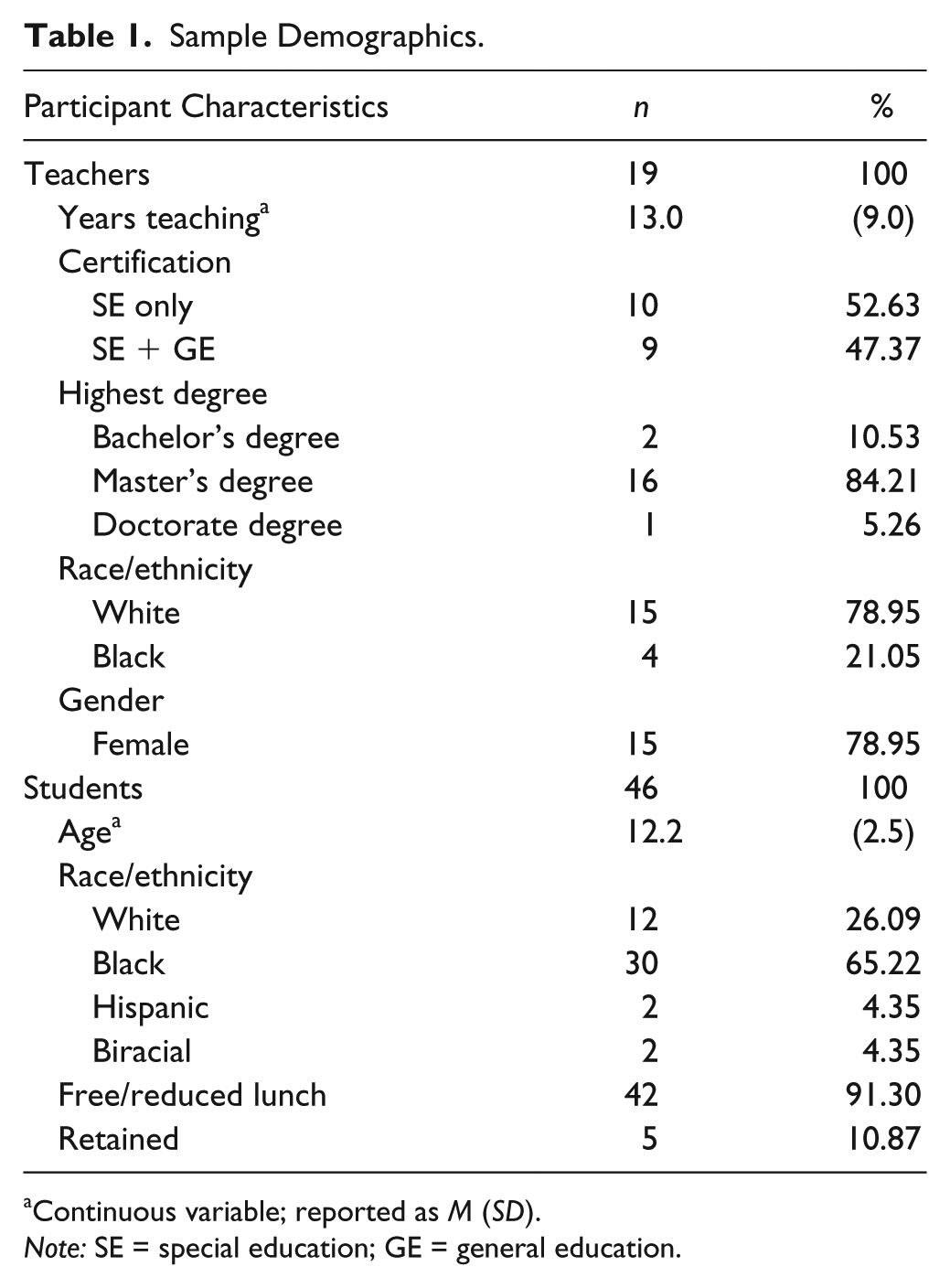
Continuous variable; reported as M (SD).
Note: SE = special education; GE = general education.
Mean Language Scores and Prevalence of Mild LI by Behavioral Subgroups.

Note. Independent groups are mutually exclusive categories of students with scores >60 on specific broadband scales: Internalizing only, Externalizing only, both, or none. Nonindependent subgroups include every student who scored above the clinical cut score on either of the broadband or total scales without regard to co-occurrence. t scores are continuous scales, M = 50, SD = 10. TRF = Teacher Report Form (Achenbach & Rescorla, 2001); CASL = Comprehensive Assessment of Spoken Language (Carrow-Woolfolk, 1999); LI = language Impairment.
Profiles of Language by Behavioral Groups
First, we examined students’ receptive, expressive, and pragmatic language by behavioral subgroup membership. A profile analysis yielded no statistically significant effects for level, F(2, 40) = 1.93,
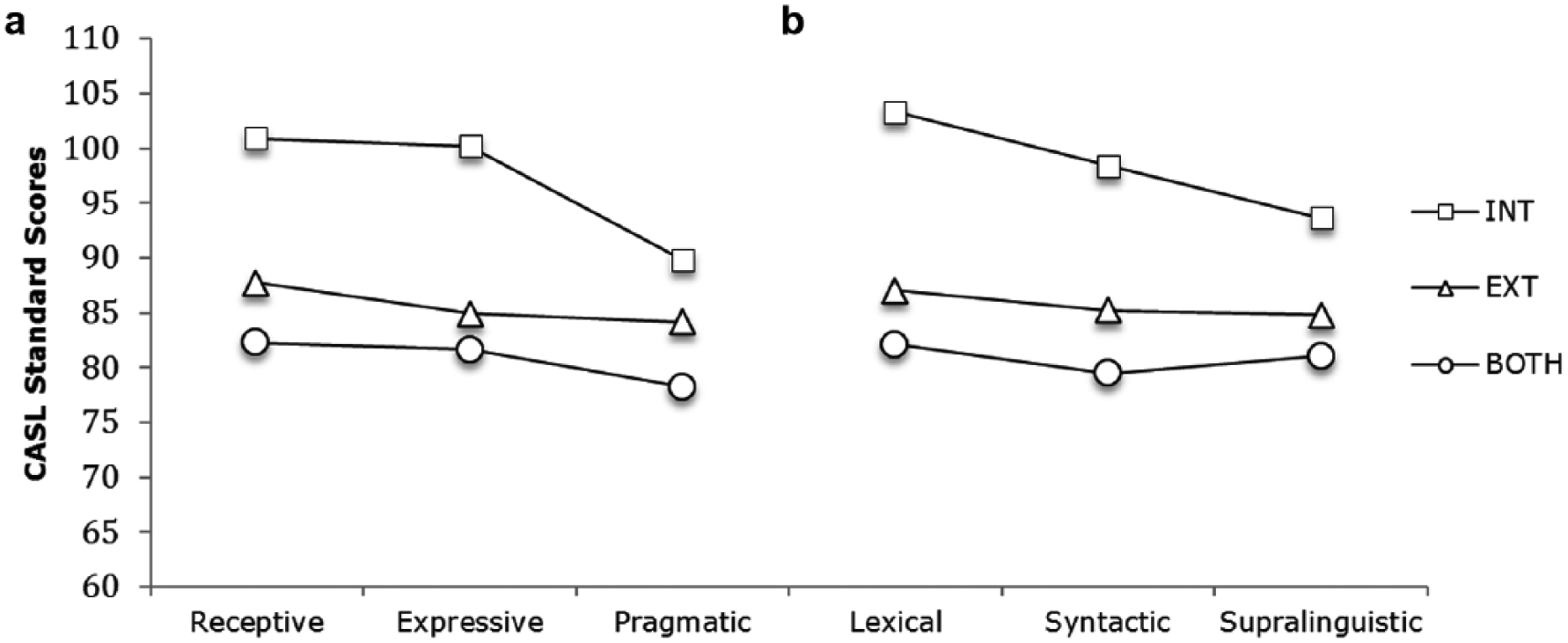
Language profiles by behavioral subgroups. Groups were determined according to clinical t scores on the TRF (60 or above; Achenbach & Rescorla, 2001).
Next, we examined semantic, syntactic, and complex skills by behavioral subgroups and found the reverse pattern. That is, on average, level of structural language scores differed significantly based on group membership, F(2, 40) = 2.38,
Prevalence and Types of LI by Independent and Nonindependent Subgroups
As shown in Table 2, prevalence of mild LI (score 70–85) in independent behavioral subgroups was 41.30%, and moderate to severe LI (score >70) was 7%. In addition, prevalence was unequally distributed across categories: Only one student in the INT category (12.5%) scored below average, compared with six EXT (55.54%) and 16 (66.67%) with clinical TRF scores on BOTH broadband scales. Mean scores also were highest for the INT group (M = 97.23), followed by EXT (M = 85.31), and BOTH (M = 81.20). Finally, all three students in the NONE group (100%) scored well below average (M = 72.33). For reference, TRF and CASL component mean scores are provided for independent subgroups and the sample as a whole.
For comparison, prevalence and means also are presented in Table 2 for students grouped by nonindependent clinical cut scores (t score = 60 or above on internalizing or externalizing broadband scales without regard for co-occurrence). Using CASL scores (1 SD below the mean), the distribution of prevalence rates across behavioral categories changed dramatically: Prevalence of LI in students with internalizing (52.12%) and externalizing disorders (61.11%) was inflated in comparison to the independent groups (INT = 12.5%, EXT = 55.54%), and the difference in prevalence rates between internalizing and externalizing students was diminished (a difference of 9% in nonindependent groups vs. 43% in independent groups). Clearly, the group of students with BOTH types of problem behavior was highly influential in determining prevalence and severity of LI in the sample.
Discussion
Reviews of the literature have confirmed that language and behavioral disorders are highly comorbid (Benner et al., 2002; Hollo et al., 2014; Yew & O’Kearney, 2013), and low language is significantly associated with development of later behavioral problems (Bornstein et al., 2013; Chow et al., 2018; Yew & O’Kearney, 2013). However, differences in measurement and sampling across studies have prevented precise analysis of how these disorders interact in students with EBD (Benner et al., 2002; Chow & Wehby, 2018, Hollo et al., 2014). The current study was designed to explore this gap in the literature and address limitations noted in extant studies by using a single measure to examine multiple subtypes of LI in direct relation to well-defined behavioral subgroups in a sample of students identified as ED. To highlight the importance of considering behavioral subtypes within the larger population of students with EBD, we also report prevalence and means within independent subgroups and compare outcomes with nonindependent groups.
When considering the sample as a whole, average composite scores for all language outcomes were approximately one SD below the mean (range = 80.5–86.7). This result indicated most students had functional but low language skills across all domains (expressive, receptive, pragmatic, semantic, syntactic, and higher order skills). Prevalence of mild LI, defined as scoring below 85 on a standardized measure, was 57%, with 15% of students scoring below 70 or two SD below normative means. However, as hypothesized, there were significant differences in level of performance between students grouped by behavioral profiles. Specifically, the INT group was clearly superior in every area of performance. Indeed, this group scored at or near the norm on every language composite, with the lowest scores (M = 89.9, range = 40–113) in pragmatic language used in social interactions. Prevalence of mild LI varied by subgroup, with 13% of INT, 55% of EXT, 67% of BOTH, and 100% of students in the NONE group scoring in the below average range.
If INT students were the highest performers, it might be expected that the EXT students would be lowest. That is, if INT students have relatively higher language skills, presence of internalizing symptoms may mitigate low language skills for those with combined symptoms. However, this was not the case in this sample: of the three groups rated as having clinical levels of problem behavior, the BOTH group exhibiting co-occurring internalizing and externalizing behaviors had the lowest scores on every outcome.
A possible interpretation of these finding is that not only the type but also the substantive nature of behavioral symptoms interacts with language development. These results must be interpreted with caution due to the small sample size, particularly, in the INT and EXT groups. Still, this preliminary finding supports the hypothesis that it is valuable to consider forms of problem behavior when analyzing language skills of students with EBD. In addition, treating samples as homogeneous in terms of behavioral subtypes or failing to consider co-occurrence may produce unexpected or even spurious results. In the current study, the number of students with LI was inflated in both the internalizing (n = 17) and externalizing (n = 22) nonindependent groups relative to independent groups of INT (n = 1), EXT (n = 6), and BOTH (n = 16). These differences may explain conflicting results of prior studies and certainly indicate a need for further research regarding analytical methods appropriate for this population.
One additional finding regarding subgroup classification was the need to establish a fourth group of students rated as having subclinical levels of internalizing, externalizing, or total problem behavior. In the current study, the students in the NONE group not only had low TRF t scores but also scored the absolute lowest on all language components. It is possible that these students differ from other students with ED in meaningful ways or perhaps share characteristics with students in other disability categories known to explain LI (e.g., developmental disabilities); however, we were unable to analyze this finding. Previous studies also have included students with EBD and subclinical behavior rating scores (Nelson et al., 2005) or have identified four behavioral subgroups within samples of students with ED labels (e.g., Gage, 2013); a finding with important practical implications that warrants additional research.
Limitations
The primary limitation of this study was the sample size overall and particularly in the INT group. Although not unexpected because externalizing students are more likely to receive ED labels, having so few students in one group limits the power to detect small effects as well as the ability to generalize the results. A larger sample also may have allowed for analysis of the NONE group. Also, instrumentation was both a strength and a limitation in this study. Although the CASL (Carrow-Woolfolk, 1999) is a well-known and technically sound instrument, it is somewhat outdated. Furthermore, assessments of concurrent validity indicate students tend to score 2 to 7 points higher on the CASL than on other standardized measures (Carrow-Woolfolk, 1999). This effect is likely due to procedural differences: The CASL protocol is unusual in that it avoids testing working memory by allowing administrators to repeat test questions. Still, using a single measure to compare all outcomes of interest was critical to the design and analysis of this study and contributes to confidence in the validity of the results. Furthermore, the sample in this study limits our interpretations to boys with ED across a wide range of ages. This exploratory work should be extended to include more homogeneous age groups and girls across varying settings (e.g., juvenile justice settings, mental health clinics).
Conclusions and Recommendations
Despite these limitations, this study has potential implications for research and practice. Results of this exploratory analysis indicated that students meeting clinical criteria for a single dimension of problem behavior may differ in practical and meaningful ways from those with more complex behavioral profiles. Therefore, it may be important to treat research samples of students with EBD as heterogeneous in terms of behavioral subtypes and to consider co-occurrence of internalizing and externalizing symptoms. Currently, lack of consistency in reporting within-sample behavioral characteristics prevents meta-analysis of extant literature in this field (Hollo et al., 2014). Researchers are encouraged to report clearly how they define internalizing and externalizing subgroups in statistical analyses and to consider ways to address potential heterogeneity within samples of students labeled as ED or EBD.
Regardless of behavioral profiles, performance on the pragmatics assessment was consistently low among all participants in this study. Surprisingly, however, only one known study has examined the effects of pragmatic language interventions for students with EBD. Although Hyter, Rogers-Adkinson, Self, Simmons, and Jantz (2001) demonstrated that a classroom-based pragmatic language intervention was effective in improving four specific outcomes, the study employed a group design with only six students. Kaiser and Roberts (2011) also noted few social skills intervention studies have included language skills as either an intervention component or potential moderator variable. Clearly, this is an area that warrants attention from the research community. Studies should be designed to assess whether teaching pragmatic skills directly results in improved social interactions and behavioral outcomes, and perhaps even prevents placement in more restrictive settings. Because there is considerable overlap between pragmatic and social skills (Im-Bolter & Cohen, 2007), it may be reasonable to incorporate elements of pragmatics into existing social skills interventions, drawing attention to the language demands of social skills such as cooperation, assertion, and self-control that enable school success and are considered important by teachers (Lane, Wehby, & Cooley, 2006).
Complex language skills (inferencing, nonliteral language) also were consistently low. Unlike analyses of language modality, these findings have been reported consistently throughout the literature on LI and EBD (e.g., Im-Bolter & Cohen, 2007). In particular, interactions of structural language and pragmatics (Law, Rush, & McBean, 2014) and social cognition (Zadeh, Im-Bolter, & Cohen, 2007) have important implications for practice. Interventionists must recognize that basic language skills such as word knowledge and grammar contribute to both academic achievement and social behavior. Therefore, academic and social skills interventions must match the level of instruction to students’ current language ability (Harrison, Gunter, Reed, & Lee, 1996; Hollo & Wehby, 2017) or focus intervention efforts on improving structural and functional language skills to support communication in context.
To deliver effective interventions, teachers first must identify students’ language deficits; however, teachers often do not have accurate perceptions of the language skills of students with EBD (Antoniazzi, Snow, & Dickson-Swift, 2010; Chow & Hollo, 2017). Researchers have suggested that externalizing problem behavior may mask or overshadow more subtle language deficits (Cohen et al., 1993; Hollo et al., 2014) but that drawing attention to students’ linguistic limitations has helped adults become “less likely to fault the children for their misbehavior” (Cohen et al., 1993, p. 600) and more likely to perceive the child “in a more positive light” (Gallagher, 1999, p. 7). Thus, emphasizing how LI relates to behavioral development may contribute to improved identification and services in classroom settings.
Conversely, when adults do not recognize how LI contributes to behavioral difficulties, communication failures may increase negative and coercive teacher–student interactions that create social conflict and impede instruction (Harrison et al., 1996; Hollo & Chow, 2015). Problem behavior has been characterized as a form of functional communication for individuals with limited communication skills: If a student cannot request or protest verbally, acting out will function to access reinforcers or escape aversive situations. Functional communication training can be an efficient and effective means of decreasing problem behavior, although these studies have been conducted primarily with individuals with intellectual or developmental disabilities (Hollo & Burt, 2018). As this and other studies have confirmed, students with EBD are likely to have functional but relatively poor communication skills; therefore, interventions to improve functional communication may prove fruitful. Some evidence supports this likelihood (Hollo & Burt, 2018); however, additional research is needed to establish best practices in this arena.
Language references the ability to process verbal and nonverbal signals used in communication, which only occurs when shared meaning is achieved. A two-prong approach is therefore recommended. Intervention efforts must address students’ underlying language needs directly, for example, improving structural and pragmatic skills. It is also imperative to implement interventions for communication partners such as teachers, for example, teaching ways to recognize and repair communication breakdowns that interfere with successful social and instructional communication. Currently, evidence regarding interventions affecting both language and behavior for students with or at risk for high-incidence disabilities is lacking. Collaborating with school-based speech–language pathologists will be an invaluable step in identifying and supporting students with dual deficits in language and behavior regardless of educational labels. Together, researchers and practitioners must work to understand the nature of language skills and deficits in students with EBD and establish interventions to promote communication in the classroom.
Footnotes
Declaration of Conflicting Interests
The author(s) declared no potential conflicts of interest with respect to the research, authorship, and/or publication of this article.
Funding
The author(s) received no financial support for the research, authorship, and/or publication of this article.
