



Abstract
Effective strategies to address communication and behavior challenges are critical in early intervention programs. The purpose of this study was to investigate the effects of the Picture Exchange Communication System (PECS) on vocal mands and aggressive behavior displayed by a child with autism in China. One 4-year-old boy with autism participated in this study. The experimental design was a multiple baseline across three settings. The PECS intervention involved the first three phases described in the PECS manual. The results indicated that PECS effectively increased vocal mands and decreased aggressive behavior maintained by access to preferred items in all three settings. The results also suggested that vocal mands were potentially controlled by pictures in the PECS book. One week following the completion of the intervention, the child maintained the PECS exchanges at a high level with increased vocal mands. His aggressive behavior remained at almost zero occurrences. Results of this study have important implications to early intervention educators working with children with autism.
The Picture Exchange Communication System (PECS) developed by Frost and Bondy (1994) is a manualized pictorial exchange-based communication system originally designed to facilitate request initiations for individuals lacking appropriate spoken language or communication skills. It is based on the framework of Skinner’s (1957) Verbal Behavior, emphasizing the three-term contingencies in elementary verbal operants: mands, tacts, and intraverbal. It also provides training specifically to establish and expand a child’s existing language repertoire in early intervention (Bondy, 2012; Frost & Bondy, 2002). It became a widely used treatment option for early intervention with children with autism spectrum disorders (ASD) and other developmental disabilities (DD), many of whom are severely delayed in language development, impaired in social communication skills, and display problem behaviors. The PECS comprises six phases. Phase I instruction involves physically teaching children to exchange a picture or line drawing with the communicative partner for a preferred item. Phase II expands children’s spontaneity and generalization by providing children with a variety of communicative partners and settings to make picture exchanges. In Phase III, children are taught discrimination training to choose between preferred and nonpreferred items and eventually among preferred items. In Phase IV, children are taught to place an “I want” symbol with PECS pictures on a sentence strip to make requests. Phase V instruction involves answering the verbal prompt “what do you want?” and Phase VI involves instruction on responding to a question.
Empirical support that PECS intervention improves communication is strong. Research consistently shows that PECS is highly effective in teaching requests to children with ASD/DD (Flippin, Reszka, & Watson, 2010; Ganz, Davis, Lund, Goodwyn, & Simpson, 2012; Preston & Carter, 2009; Schlossor & Wendt, 2008; Sulzer-Azaroff, Hoffman, Horton, Bondy, & Frost, 2009; Tien, 2008; Tincani & Devis, 2011). Vocal speech and problem behavior are often included as collateral outcome variables in PECS research. Reviews suggest that PECS has mixed results in vocal speech (Flippin et al., 2010; Ganz et al., 2012; Preston & Carter, 2009; Schlossor & Wendt, 2008) and problem behavior (Ganz et al., 2012; Preston & Carter, 2009).
Some studies indicating PECS is effective in establishing nonvocal picture exchanges for preferred items or activities for individuals with limited verbal repertoires also showed the emergence of vocal speech occurs concurrently with PECS exchanges in some participants (Bondy & Frost, 1994; Charlop-Christy, Carpenter, Le, LeBlanc, & Kellet, 2002; Frea, Arnold, & Vittimberga, 2001; Ganz, Parker, & Benson, 2009; Ganz & Simpson, 2004; Greenberg, Tomaino, & Charlop, 2014; Tincani, Crozier, & Alazett, 2006). In these studies, most children’s vocal speech emerges and increases in Phase IV (Bondy & Frost, 1994; Charlop-Christy et al., 2002; Ganz & Simpson, 2004; Tincani et al., 2006). Greenberg et al. (2014) found that PECS in conjunction with vocal mand training was effective in increasing functional vocal mands for two children with limited echoic repertoire in early intervention. Ganz et al. (2009) reported that two of three participants showed an increase in spontaneous vocal speech concurrently with Phase I PECS training for two children, one of which already had spoken words whereas the other had limited vocalization prior to the intervention.
In contrast, some research indicates limited or no gains in participants’ vocal speech associate with PECS (Boesch, Wendt, Subramanian, & Hsu, 2013; Ganz, Simpson, & Corbin-Newsome, 2008; Park, Alber-Morgan, Cannella-Malone, 2011). In Ganz et al. (2008), children’s vocal speech was not affected after the first four phases of PECS were implemented. All three children in their study were severely delayed in development with limited vocalizations prior to the intervention. Boesch et al. (2013) and Park et al. (2011) implemented the first three phases and did not report any gains in children’s vocal speech. Boesch et al. (2013) speculated that no improvement in vocal speech was probably associated with participants’ characteristics, such as no spoken words for all three children prior to the intervention and the older age (7 and 10 years) of two children passing the critical period for language acquisition. The three children in Park et al. (2011) were 2 years old: one had a limited echoic repertoire, whereas the other two had no speech prior to the intervention. The researchers believed that the child who had echoic skills might have improved his or her vocal speech if PECS progressed beyond Phase III. As discussed above, it remains unclear whether PECS is helpful to improve vocal speech for children with limited vocalizations or echoics.
Mands are usually taught as a functional communication skill to obtain functionally equivalent reinforcement in the treatment of problem behavior for individuals with ASD/DD. Such individuals’ problem behavior can be reduced by learning to mand preferred items/activities (Carr & Durand, 1985; Durand & Carr, 1991; Hagopian, Fisher, Sullivan, Acquisto, & LeBlanc, 1998). The card exchange procedures used in functional communication training are similar to initial phases of PECS. However, such card exchanges are taught primarily to obtain functionally equivalent reinforcement as opposed to systematically expanding the individual’s language repertoire by progressing through PECS phases with specific goals (Bondy, 2012). Although PECS research indicates improvements in individuals’ communicative repertoires, the relation between PECS and problem behavior remains unclear and is in need of more research (Ganz et al., 2012).
Investigations pertaining to the effect of PECS on problem behavior also have mixed results. Ganz et al. (2009) reported a variable pattern of problem behavior displayed by three children across baseline, PECS training, and follow-up conditions. Other researchers found decreased problem behavior associated with PECS training (Charlop-Christy et al., 2002; Frea et al., 2001). It is possible that PECS worked as a means of functional communication that enabled the children with ASD to express their needs or make requests with minimal effort. However, the function of problem behavior was not identified prior to the PECS intervention in these studies. The inconsistent results could be attributed to the unknown function of problem behavior. If PECS does not address the potential function of problem behavior, it is unlikely that PECS will have an effect. Therefore, a hypothesized function or an experimental functional analysis to identify potential reinforcement for problem behavior is imperative when investigating the effect of PECS on problem behavior.
Consistent with the PECS guidelines, Tincani and Devis (2011) also emphasized the need for program generalization of PECS from a researcher-implemented experimental setting (e.g., a clinic) to other settings that were relevant to the individuals (e.g., home). Research shows that parents can be trained to use PECS reliably and effectively at home (Chaabane, Alber-Morgan, & DeBar, 2009; Park et al., 2011), and children with ASD/DD who acquire PECS at school also use PECS effectively in other settings without additional training (Greenberg, Tomaino, & Charlop, 2012; Jurgens, Anderson, & Moore, 2009). These studies suggest that PECS training generalizes across settings, people, and new PECS icons. Thus, it is important to train schoolteachers or caregivers to implement PECS in school or home settings.
In China, evidence-based interventions for individuals with ASD are not common due to the lack of qualified professionals (McCabe, 2012). It is very important to use resources efficiently by training less-qualified individuals to implement evidence-based practices. Interventions for children with limited communication skills or problem behavior require highly qualified professionals and are usually labor-intensive. As indicated in the PECS literature, teachers, staff, and parents can be trained to implement PECS with positive generalization effects. If these individuals are trained to use PECS reliably, PECS may be one evidence-based intervention option for children with limited communication skills and problem behavior in a low-resource setting.
Current available research suggests that PECS has the potential ability to establish vocal mands. The review of PECS studies also indicates a paucity of PECS research pertaining to problem behavior displayed by children with ASD/DD and limited verbal repertoires (Ganz et al., 2009). To fill this gap, the purpose of the present study was to examine the effects of PECS on the emergence of vocal mands and the reduction of problem behavior for a child with ASD/DD in China. We also trained teachers and parents to implement PECS. Although PECS has gained worldwide popularity (Sulzer-Azaroff et al., 2009), to our knowledge this study was the first PECS study conducted in China. The following research questions were addressed:
Method
Participant
One 4-year-old boy, Coco, participated in this study. During this study, Coco attended an early intervention center for 3 hr per day, 5 days per week. Treatments received included dance therapy, occupational therapy, and one-to-one applied behavior analysis (ABA) therapy. Coco received 1 hr of ABA therapy per day with individualized programs in gross motor imitation, matching objects and pictures, receptive object identification, and following one-step directions. For the remainder of the day during weekdays, he stayed home with his mother who taught Coco self-help skills. Coco’s mother was trained by the ABA instructor to use task analysis, graduated physical guidance, prompt fading, and positive reinforcement to teach Coco self-help skills.
Coco was diagnosed with ASD using the Chinese version of the Childhood Autism Rating Scale (CARS; Lu, Yang, Shu, & Su, 2004; Schopler, Reichler, & Renner, 2002) with a score of 36.5, in the range of severe autism. His IQ score was 43, as assessed on the Chinese version of the Wechsler Preschool and Primary Scale of Intelligence–Revised (WPPSI-R; Wechsler, 1989; Zhang, 2009), with a subscore of 27 in receptive language. The results from the Chinese version of Psychoeducation Profile–Third Edition (PEP-3; Schopler, Lansing, Reichler, & Marcus, 2005; Sun, 2000) indicated that his mental age was 2 to 2.5 years old.
Coco had very limited receptive and expressive language. He did not follow verbal directions unless visual cues were provided. He could match pictures and corresponding nonidentical items. Direct observations suggested that Coco did not have an echoic repertoire but could imitate one-syllable approximations recognized by familiar people only when specific establishing operations were present (e.g., when he could see the preferred items—such as candy, cookies, LEGO®, eyeglasses, apples, mom, and dad—but could not reach them). At the early intervention center, he was often observed to engage in aggressive behavior (e.g., hitting, pushing, kicking, or biting others) when others were in his way to obtaining preferred items. He was occasionally observed to use eye contact and pointing to his preferred items. As a result of his aggressive behavior, Coco’s therapy was often interrupted, and some teachers gave Coco preferred items in an attempt to decrease aggressive behavior. At home, Coco’s parents also reported that they could only stop Coco’s aggressive behavior by giving him what he wanted. They also noticed that Coco infrequently used vocalizations paired with pointing to make requests.
Natural observations and anecdotal reports suggested that Coco’s aggressive behavior was associated with his limited verbal repertoire and a history of reinforcement. Formal observations with descriptive data (e.g., the antecedent, behavior, and consequence) also indicated that Coco’s aggressive behavior was related to obtaining preferred items. We also conducted the Chinese version of Functional Assessment Interview Form (O’Neill, Albin, Storey, Horner, & Sprague, 2014), which included a parental interview with open-ended questions and observations. Due to the strong association between aggressive behavior and obtaining tangible items having been established, a functional analysis was not conducted to further confirm this hypothesis. Coco’s parents, his teachers, and parents of other children in the center were concerned about Coco’s aggressive behavior due to its severity and intensity. It was deemed necessary to intervene immediately.
Settings and Materials
This study took place in a major city of northeastern China and, therefore, the entire study was conducted in Mandarin. The settings for the study included the individual therapy room, the playground of the early intervention center, and Coco’s home. The individual therapy room was 3 by 4 m in size and contained a table and two chairs for one-to-one therapy as well as shelves on the side to place instructional materials. The playground was a fenced area 10 by 6 m in size and had a play structure with slides and a small house with children’s toys. The study was conducted in the living room at Coco’s home. The living room was 5 by 6 m in size and had a sofa, a recliner, and a TV.
We prepared the materials based on the Chinese version of the PECS manual (Frost & Bondy, 2014). The materials included a PECS communication book (25 cm × 23 cm) with strips of Velcro® on the front and inside of the cover page, as well as page inserts (20 cm × 15 cm) with strips of Velcro® on both sides. Each picture contained a picture or drawing of the item and its name written in Chinese characters. The individual pictures comprised 13 actual images of preferred items for Phase I training, 19 line drawings of the preferred items for Phase II training, and 32 line drawings of preferred items and eight line drawings of nonpreferred items for Phase III training. The pictures of actual images (e.g., LEGO® blocks) were taken from Coco’s preferred items by his mother, and the line drawings were downloaded from websites (e.g., yogurt). We changed actual images to line drawings because Coco’s preferred items kept increasing and changing frequently, and the images of actual items were not readily available. This change is justified based on the manual stating that “the style of pictures is not limited to a specific type during Phase I and Phase II” (Frost & Bondy, 2014, p. 61). The size of the pictures and drawing were 5 cm × 5 cm and 2.5 × 2.5 cm, respectively.
Experimental Design
The study employed a multiple baseline design across three settings for vocal mands and aggression and a multiple probe design across three settings for PECS exchanges (Gast, Lloyd, & Ledford, 2014) to examine the effects of PECS on Coco’s vocal mands and aggressive behavior in the therapy room, on the playground, and in the home. The choice of a multiple baseline design over a reversal design was based on ethical concerns given the severity and high frequency of problem behavior displayed by Coco during baseline. We also selected three settings where Coco was present most of the time and was observed to engage in aggressive behavior frequently to demonstrate the intervention effects.
Dependent Measures
The dependent variables included PECS exchanges, vocal mands, and aggressive behavior. One instance of a PECS exchange was defined as Coco independently taking one correct picture/drawing from the communication book to an adult and using it in exchange for a preferred item when presented with an opportunity to mand. An opportunity to mand was defined as the teacher presenting a preferred item within Coco’s eyesight as a motivating operation for a PECS exchange. The percentage of PECS exchanges was calculated by dividing the total opportunities to mand by the correct PECS exchanges. The picture Coco selected had to correspond to the item he requested to be scored as correct for each exchange. If Coco did not pick a picture corresponding to his preferred item, it was scored as incorrect for this trial. For example, when the instructor delivered an item corresponding to the picture picked, if Coco pushed it away, attempted to grab another item, or took it but discarded it immediately, this trial was scored as an incorrect exchange.
A vocal mand was defined as Coco requesting a preferred item with at least a one-word approximation or a spoken intelligible word with or without a corresponding PECS picture or gestural pointing. A word approximation was defined as an utterance close to one syllable in the name of a target item (e.g., a “pi” or “pin” sound is an approximation for “pingguo,” meaning “apple” in Mandarin Chinese). When Coco used both a vocalization along with a PECS picture to request, it was coded as one vocal mand and one PECS exchange (e.g., saying “pin” and taking the picture of an apple at the same time). Whereas the PECS exchange behavior was measured as the percentage of trials, vocal mands were measured using a frequency count. One instance of aggressive behavior was defined as one push, hit, kick, bite, or throwing objects toward others (e.g., a hit was scored as one instance per hand). All training and probe sessions were videotaped. Data were recorded using paper and pencil via videotapes.
Procedure
Preference assessment
Prior to the PECS intervention, the experimenter conducted preference assessments based on the protocol suggested in the PECS manual (Frost & Bondy, 2014). We first asked the parents and teachers to list Coco’s preferred items/activities. Next, we conducted three 15-min sessions of observation in a free play setting with these items available to Coco. The duration of Coco’s contact with each item was recorded. If Coco reached for an item and consumed it or played with it for more than 3 s, it was identified as a possible preferred item. All possible preferred items were sequenced from the longest to the shortest duration with which Coco had contact. A total of 56 items were identified as Coco’s preferred items and eight items as nonpreferred items.
Prior to each training session, the experimenter conducted a multiple stimulus without replacement assessment (DeLeon & Iwata, 1996) to identify Coco’s preferred items for that training session. Specifically, 10 to 12 preferred items from the pool of preferred items identified earlier were randomly selected and presented. Coco was allowed to select one of the items at a time and interact with it for 30 s to 1 min. The selected item was not presented again in the subsequent trials. The assessment ended when Coco refused to select any items or until no items were left. The assessment session ended within 10 min. The first five frequently selected items were considered highly preferred and were used for that training session.
Preexperimental probe
Prior to the experiment, Coco was probed to determine whether he could exchange pictures for preferred items in three 15-min sessions in the therapy room. One picture of a preferred item was displayed on a table against the wall approximately 1 m away from Coco. The instructor sat at the table and held the corresponding preferred item. If Coco exchanged the picture for a preferred item within 10 s, he was given access to the item for approximately 30 s or a small amount of that item for consumption. If he used pointing, a word approximation of the item, or a spoken word to request for a preferred item, he was also allowed to obtain the item. The next trial began when the instructor arranged the display to a picture of another preferred item. If Coco displayed any aggressive behavior, the instructor ignored his behavior by turning away and did not give the item to him. During preexperimental probe sessions, Coco did not use pictures to exchange for preferred items.
Baseline
The baseline condition simulated Coco’s daily routines in the natural environment. During baseline probes, no PECS pictures were presented. Data were recorded from 15-min natural observations across three settings. In all three settings, Coco was allowed to play freely with any available toy items or play structures either individually or by interacting naturally with his peers, teachers, or parents. Although Coco’s access to any item was not restricted, other children might engage in playing with Coco’s preferred toys, attempt to take Coco’s preferred toys when he had them, or appear in front of Coco’s preferred items to block Coco’s access to them. If Coco used pointing, word approximations, or spoken words to request items, the experimenter would immediately give him the item with praise. During the baseline, Coco only had a total of four word approximations or intelligible spoken words to request his preferred items across three settings. Whenever Coco became aggressive toward a peer or a teacher, the experimenter blocked Coco by stepping between him and the other person, and no attention was given to Coco. The aggressive behavior Coco had during baseline included hitting, kicking, and throwing objects toward others.
PECS intervention
The PECS intervention condition comprised a 15-min training session followed by a 15-min probe session in each setting. The PECS training followed the protocol of the first three phases in the PECS training manual. During Phase I, sessions were conducted in an individual therapy room with Coco, one experimenter, and a teacher. The experimenter served as the communicative partner, and the teacher served as the physical prompter. They switched roles in Phase II. Phase III sessions were conducted following mastery of Phase II in the therapy room.
Before the intervention was introduced on the playground, two Phase II probe sessions and one Phase III probe session were conducted. Coco’s PECS exchanges were 100% and 20% for Phase II and Phase III probes, respectively. Thus, the intervention on the playground began with Phase III. The role of the communicative partner was randomly rotated between the experimenter and two of Coco’s teachers. Before the home session began, two Phase II probe sessions and one Phase III session were conducted. Coco’s PECS exchanges were 90% and 95% for Phase II, and 30% for Phase III. Home sessions also began with Phase III and were conducted in the living room. The experimenter and Coco’s mother rotated the roles of the communicative partner and the physical prompter. All the training and probe sessions from the home and playground were videotaped and analyzed.
Mastery criterion for each phase was at least 80% accurate PECS exchanges during probe sessions for three consecutive days. Throughout the study, PECS was implemented by four adults (the experimenter, two teachers, and Coco’s mother) across three settings for the purpose of promoting generalization. The experimenter, teachers, and Coco’s mother attended the PECS training in China provided by Frost and Bondy in 2015. The teachers and Coco’s mother read the Chinese PECS manual and had role-play practices with the experimenter until they demonstrated 100% accuracy for three role-play sessions in each phase until criterion was achieved in all six phases. The experimenter and two teachers conducted all the intervention sessions in the individual therapy room and on the playground. Coco’s mother conducted all the intervention sessions and probe sessions in the home.
During Phase I, one picture of a preferred item was placed on the table. Coco was taught to use a corresponding picture to exchange for a preferred item. The experimenter created the motivating operation by presenting the preferred item within Coco’s eyesight but out of his reach. The experimenter then presented an open palm as a gestural prompt to ask for a corresponding picture. Graduated physical guidance from most to least was used to assist Coco in picture exchanges. When Coco reached for the preferred item, the physical prompter sitting behind Coco assisted him in picking up the picture and handing it to the communicative partner by providing full physical prompts (i.e., hand over hand) from reaching for the picture, picking up the picture, to releasing the picture. Immediately upon releasing the picture to the communicative partner’s hand, the communicative partner provided Coco with access to the item and simultaneously named the item. Once Coco could independently release the picture into the communicator’s palm, partial physical prompts (i.e., gently holding hands) were provided for Coco to reach and then pick up the picture. The communicative partner also gradually faded the open-hand cues by moving the open hand further from Coco with a partially closed palm, and then finally placed both hands in natural positions. Once Coco released the picture into the communicative partner’s hand, the corresponding preferred item was delivered immediately, and the communicative partner simultaneously named the item.
During Phase II, the PECS book was introduced with one picture of a preferred item placed on the cover. The purpose of Phase II was to increase Coco’s spontaneity and generalization of the picture exchange. We moved from 13 pictures in Phase I to 19 different pictures presenting Coco’s highly desired items. The communicative partner holding the PECS book initially sat next to Coco and gradually increased the distance to approximately 5 m away from Coco. As the training progressed, the communicative partner started the session by placing the PECS book at a distance and gradually increased the distance to approximately 5 m from Coco so that Coco had to move to access the PECS book. The physical prompter shifted eye contact between Coco and the PECS book along with partial physical prompts to facilitate initiations when Coco began to navigate the distance but removed physical prompts as soon as Coco began to reach for the picture.
During Phase IIIa, one picture of a preferred item and another picture of a nonpreferred item were placed on the cover of the book. The communicative partner immediately provided access to the preferred item if Coco picked up the corresponding picture and released the picture into the communicative partner’s hand. If Coco did not pick any picture or picked the nonpreferred picture, he was provided with full physical prompts as an error correction by the physical prompter. The prompt procedure was identical to Phase I described above. When Coco reached the criterion on discriminating between one picture of a preferred item and another picture of a nonpreferred item, Phase IIIb began with two pictures of preferred items placed on the cover of the PECS book. Correspondence checks were conducted to ensure the accuracy of Coco’s requests with PECS exchanges. The communicative partner presented two preferred items and had both pictures available on the cover of the PECS book. When Coco presented the communication partner with one picture, the instructor offered both items and said “Go ahead,” or “Show me.” If Coco took the item that corresponded with the picture exchanged, the communicative partner would allow access, provide praise, and name the item. If Coco reached for the other item, the physical prompter blocked access and the communicative partner began an error correction sequence for the picture that corresponded to the item reached for by Coco. The error correction procedure involved four steps: (a) model—presenting the correct picture to Coco and pointing to the correct picture to obtain his eye contact with the picture, (b) practice—manually prompting Coco to exchange the preferred item with the corresponding picture, (c) switch—moving the PECS book away from Coco and switching to the imitation tasks (e.g., “Do this.”) that Coco demonstrated mastery, and (d) repeat—presenting the two items again.
When Coco reached the criterion on discriminating between two pictures of preferred items, the number of pictures placed on the cover increased to three pictures. The same instructional sequence was implemented to criterion with up to five pictures on the cover. Next, all pictures were moved to the inside of the PECS book. Coco had to open the book and find the corresponding picture to request the preferred item. Generalization sessions were added until the criterion was achieved. A new teacher implemented PECS training with new pictures of preferred items in these generalization sessions. The same instructional procedure for Phase III was followed on the playground and in the home, where the book was presented at a fixed location in the living room of the home and on a chair near the basketball hoop. If Coco demonstrated aggressive behavior during the PECS intervention sessions, he was blocked and redirected to the picture or the PECS book.
Intervention probe
The probe sessions conducted under the intervention condition were close to the preexperimental probe sessions. The PECS book was presented 1 m away from Coco, and the instructor had Coco’s preferred items. Coco had to use a picture exchange, a vocal mand, or both, to obtain a preferred item. The instructor ignored Coco’s aggressive behavior by turning away and not delivering any preferred item. The intervention probe data were graphed and counted toward the criterion. The procedure for aggressive behavior was consistent between PECS intervention sessions and probe sessions.
Maintenance probe
Maintenance probe sessions were conducted 1 week after the mastery criterion was achieved for Phase III in each setting. The procedure was identical to the probe sessions conducted under the intervention condition.
Social Validity
After the intervention was completed, the experimenter conducted a teacher/parent survey regarding the acceptability, feasibility, and satisfaction of the PECS intervention. Of the total 15 items in the questionnaire, items 1 to 5 were related to the intervention acceptability (needs, PECS materials, setting, format, and cultural aspect), items 6 to 10 assessed the feasibility (time periods, locations, instructors, procedure), and items 11 to 14 measured teachers’ and parents’ satisfaction of the intervention and perceived helpfulness of the target skills. Each item was rated on a 5-point Likert-type scale (1 = not satisfied or not helpful to 5 = very satisfied or very helpful). The last question was an open question inviting parents and teachers to provide their overall perceived helpfulness, suggestions, and experiences of receiving the intervention.
Interobserver Agreement and Procedural Fidelity
To assess interobserver agreement (IOA) and procedural fidelity, a second observer (a graduate student) who was ignorant of the purpose of the study was trained to collect data from the videotapes independently and separately from the experimenter. IOA data were collected for 50% of the training sessions and 50% of the probe sessions across conditions and settings. IOA was assessed by dividing the number of agreements by the number of agreements plus disagreements and multiplying by 100. The agreement on the percentage of PECS exchanges averaged 94% with a range from 92% to 98%, the frequency of vocal mands averaged 95% with a range from 89% to 100%, and the frequency of aggressive behavior averaged 94% with a range from 92% to 95%.
To assure procedural fidelity, the researchers used the PECS Implementer Skills Assessment and the Fidelity Checklist of PECS Procedures (Frost & Bondy, 2002). Procedural fidelity was evaluated in 50% of the training sessions and 50% of the probe sessions across conditions and settings. The percentage of procedural fidelity was calculated by dividing the number of correct steps by the total steps and multiplying by 100. The data on procedural fidelity ranged from 96% to 99%, with an average of 98% across all implementers for all sessions observed.
Results
Figure 1 represents the percentage of independent PECS exchanges, vocal mands, and aggressive behavior during probe sessions under all conditions across three settings. The frequency of vocal mands and aggressive behavior is depicted by the left y-axis, and the percentage of independent PECS exchanges is depicted by the right y-axis. During preexperimental probe sessions, Coco did not use pictures to exchange for any items.
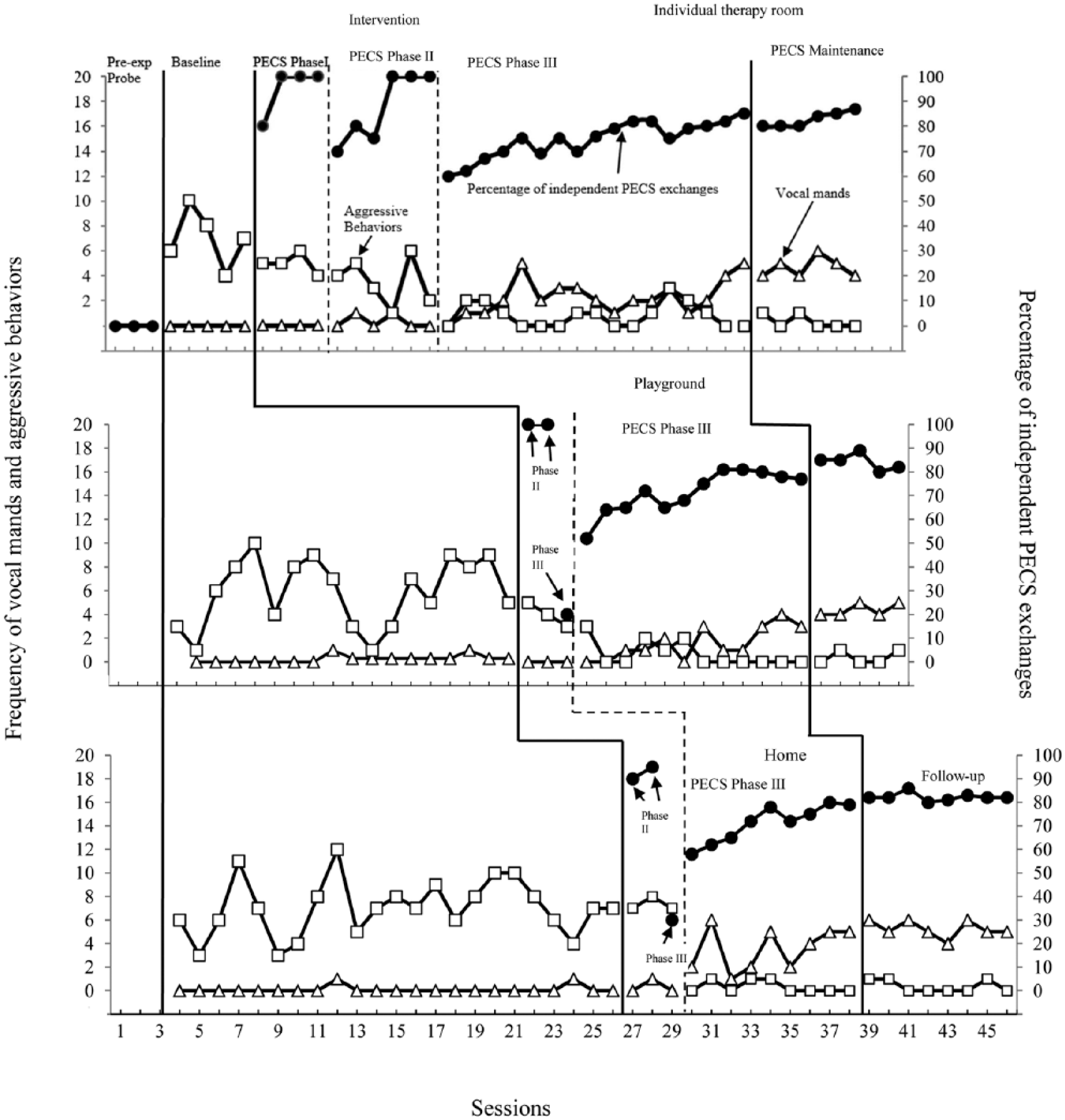
The frequencies of vocal mands, aggressive behaviors, and percentage of independent PECS exchanges during probe sessions across three settings.
PECS Exchanges
As the PECS training was introduced in the therapy room, Coco’s independent PECS exchanges immediately increased to a high level of 80% (M = 95%, range = 80%–100%) in Phase I and continued a rapid ascending trend to reach 100% accuracy (M = 88%; range = 70%–100%) in Phase II. Coco’s PECS exchanges were maintained at a high level with a steady ascending trend in Phase III (M = 75%; range = 60%–85%) in the therapy room. Coco independently exchanged 12 different pictures in Phase I, 17 different pictures in Phase II, and 27 different pictures in Phase III.
Under the intervention condition in the therapy room, Coco achieved mastery criterion (80% accuracy or better in PECS exchanges for three consecutive probe sessions) with a total of 75 trials in four PECS training sessions for Phase I and a total of 68 trials in six PECS training sessions for Phase II. He reached the criterion in 14 training sessions with a total of 259 trials for Phase III. After reaching the criterion for Phase III, training sessions continued for three sessions (52 trials) with the addition of five new pictures and a new communicative partner for generalization purposes. Overall, Coco required 27 training sessions (436 trials) to achieve criterion performance on PECS exchanges for the first three PECS phases in the individual therapy room.
The PECS intervention started with Phase III on the playground and in the home. The percentage of accurate PECS exchanges initially started at 52% with a gradual ascending trend to 89% at the end of the PECS intervention (M = 74%; range = 52%–89%). PECS exchanges data in the home setting displayed a similar pattern as on the playground (M = 74%; range = 58%–86%).
Coco reached criterion performance for Phase III within 11 sessions (187 trials) on the playground with five new pictures of the preferred items. The generalization training sessions with a new teacher and new pictures continued through the 15th session with an additional 66 trials. He reached the criterion for Phase III in nine training sessions (116 trials) and continued generalization training sessions with another five new pictures through the 12th session with an additional 34 trials in the home.
During 1-week maintenance probe sessions, Coco maintained high levels of PECS exchanges across all three settings. The average percentages of accurate PECS exchanges were 83% (range = 80%–87%) in the therapy room, 82% (range = 80%–84%) on the playground, and 82% (range = 80%–83%) in the home.
Vocal Mands
Coco used word approximations and intelligible spoken words as vocal mands to request his preferred items. He had four instances of vocal mands during baseline across three settings without the presentation of the PECS book. In the therapy room, Coco did not emit any vocal mands during probe sessions in Phase I. However, he emitted two mands in Phase II, 39 mands in Phase III (M = 2.29, range = 0–5), and 28 mands in maintenance (M = 4.67, range = 4–6) during probe sessions. In the playground setting, Coco emitted 32 mands in Phase III (M = 2.13, range = 0–5) and 24 mands in maintenance (M = 4.80, range = 4–6) during probe sessions. In the home, he had 49 mands in Phase III (M = 4.08, range = 1–6) and 25 mands in maintenance (M = 5, range = 4–6) during probe sessions.
Aggressive Behavior
The occurrences of aggressive behavior were variable at a relatively high level with no trend during baseline across three settings (M = 7.00; range = 4–10 in the therapy room; M = 5.88, range = 2–10 on the playground; M = 7.04; range = 3–12 in the home). As PECS was introduced in the therapy room, the frequency of aggressive behavior was at a slightly lower level than baseline in Phase I (M = 5.00, range = 4–6) and Phase II (M = 3.33, range = 1–6). The frequency of aggressive behavior decreased to a low level in Phase III (M = 0.78, range = 0–3) in the therapy room. When PECS was introduced in the playground and home settings, Coco’s aggressive behavior immediately decreased to low levels of occurrences (M = 0.60, range = 0–3 on the playground; M = 0.42, range = 0–1 in the home). Coco’s aggressive behavior remained low during maintenance probe sessions across all three settings (M = 0.33, range = 0–1 in the therapy room; M = 0.20, range = 0–1 in the playground; M = 0.20, range = 0–2 in the home).
Social Validity
The average ratings were 4.75 (SD = 0.47) on the intervention acceptability, 4.85 (SD = 0.41) on the feasibility, 4.78 (SD = 0.42) for the satisfaction, and 4.62 (SD = 0.37) on the perceived helpfulness of the intervention. The parents and teachers reported their observations of positive changes in Coco’s PECS exchanges, vocal mands, and the reduction in aggressive behaviors in the school and home settings.
Discussion
This study provides preliminary evidence that PECS facilitated the emergence of vocal mands and reduced aggressive behavior with a hypothesized function of obtaining tangible items. Such effects were maintained during 1-week probe sessions across all three settings following the completion of the PECS intervention. In addition, this is the first PECS study supporting cultural adaptability of PECS in Chinese culture.
We observed that Coco’s vocal mands increased as he acquired PECS. The results indicated that vocal mands increased in Phase III without progressing to Phase IV, whereas vocal mands did not increase until Phase IV in previous studies (Bondy & Frost, 1994; Charlop-Christy et al., 2002; Ganz & Simpson, 2004; Tincani et al., 2006). It is possible that Coco’s verbal mands might have increased to a higher level than in Phase III should PECS training have continued to later phases. Prior to the intervention, Coco had no echoics and only vocalized when his motivation was strong. During baseline, he had a total of only four instances of spontaneous vocal mands on the playground and in the home. As suggested in previous research, children who had limited echoic or spoken words before the PECS intervention were more likely to increase their vocal speech (Charlop-Christy et al., 2002; Ganz & Simpson, 2004), whereas children who did not have these verbal skills had limited or no improvement in speech (Boesch et al., 2013; Ganz et al., 2008; Park et al., 2011).
In addition to Coco’s preintervention verbal skills, the emergence of vocal mands without direct training may be associated with the stimulus control (e.g., the PECS book), the delivery of preferred items paired with the names of the items (e.g., “You want ____.”), and the discrimination training in Phase III. Coco did not have any vocal mands in preexperimental probe sessions during which the pictures of preferred items were available within his eyesight. During baseline where the PECS book was absent, Coco had extremely low occurrences of vocal mands. His vocal mands increased in the intervention and maintenance conditions across settings. This pattern suggests that the presence of the PECS book might serve as a discriminative stimulus to evoke vocal mands associated with PECS exchanges. It is also possible that because the PECS book acts as a mediator for reinforcement delivery, it would acquire some reinforcing properties, thus signaling that reinforcement would be available through emitting a mand response using the PECS book.
During the intervention, the instructor paired the name with the delivery of the item requested by the child. Pairing the name with the corresponding item or activity desired by the child was associated with the increase in vocalizations that could potentially lead to vocal mands (Yoon & Bennett, 2000; Yoon & Feliciano, 2007). Thus, the pairing procedure in PECS may be one of the critical components that facilitated the emergence of vocal mands. To verify this speculation, it is necessary to conduct a component analysis in future PECS research to compare whether the picture exchange procedure is more efficacious with or without pairing vocal words. Coco’s vocal mands increased to a noticeable level in Phase III, suggesting a possible relation between the discrimination training and the emergence of vocal mands. Although the emergence of expressive language (e.g., vocal mands) after receptive training (e.g., discrimination) has not been empirically supported (Petursdottir & Carr, 2011), discrimination training in Phase III designed to teach the connection between the picture and the actual items delivered may be an important step for effective communication. However, vocal modeling was also in place at the time of PECS training. Coco’s average number of vocal mands per session ranged from 2.13 to 4.08 in Phase III across three settings. During maintenance, his average vocal mands was maintained at a relatively high level with an average of 4.67 to 5.00 vocal mands per session across settings. Therefore, vocal mands may have increased as a result of vocal procedures being in place for an extended period of time as well as the strength of the motivation operation for specific items. It is possible that Coco’s vocal mands emerged while the connection between the picture and the actual item delivered was established through discrimination training in Phase III. However, this assertion warrants further research, as previous PECS research indicates that an increase in vocal mands starts in Phase IV (Bondy & Frost, 1994; Charlop-Christy et al., 2002; Ganz & Simpson, 2004; Tincani et al., 2006).
Coco’s spontaneous pictorial exchanges increased whereas his aggressive behavior was reduced and eventually eliminated, suggesting that PECS effectively served as an alternative to replace aggressive behavior displayed across all three settings. Although a functional analysis was not conducted, our descriptive data consistently suggested that Coco’s aggressive behavior was associated with access to preferred items. Previous studies examining the effects of PECS on problem behavior did not have consistent results. One possible reason for the inconsistent results may be the lack of descriptive data or functional analysis to determine the potential function of the problem behavior. That is, if the skills acquired through PECS do not align with potential reinforcement of problem behavior, it is unlikely that PECS will have an effect on problem behavior. For example, Ganz et al. (2009) implemented PECS Phase I training and did not find any effect on the participants’ problem behavior. Given the emphasis of Phase I training on physically assisted exchanges, PECS may not fully address the functions of problem behavior maintained by positive or negative social reinforcement and automatic reinforcement.
Although the aggressive behavior decreased in the intervention condition in the therapy room, Coco maintained relatively high levels of aggressive behavior in other settings where the PECS book was not presented. This result suggested that Coco’s requesting behavior was under the stimulus control of the PECS book. That is, he continued using aggressive behavior as a means of communication when the book was not present.
We also trained teachers and parents to implement PECS on the playground and in the home for the purpose of promoting generalization. Coco was successfully taught to use PECS to request preferred items in three different settings with four people. In addition to generalization, this result has an important implication in low-resource settings, such as China. Our results suggest that teachers and parents can be trained to implement PECS reliably in other settings, and therefore professional resources are used with relative efficiency. Thus, the PECS intervention can be incorporated as part of the instructional routine in early language training for individuals with communication and behavior challenges.
Limitations and Directions for Future Research
Due to the limited availability of qualified participants at the local agency, there was only one participant. In addition, we were limited to implementing PECS up to Phase III. Therefore, the results of this study should be interpreted with caution. It is necessary to replicate this intervention with all six PECS phases and with more participants in future studies. An additional limitation is that the study was implemented by four adults in settings without peers. We recommend that future researchers examine whether peers mediate the effects of PECS on communication and behavior difficulties. Another limitation of the study concerns the absence of pictures or the PECS book during baseline in all settings. The lack of experimental control was mitigated by the preexperimental probes during which Coco did not display pictorial exchanges albeit pictures were available. Although such an arrangement did not demonstrate the effect of PECS on pictorial exchanges across settings, it allowed for the interpretation of the PECS book as a potential stimulus control to account for the occurrences and absence of vocal mands. The lack of an experimental functional analysis also limited our interpretation in regard to the intervention effect on aggressive behavior. However, given the consistent results obtained from descriptive and indirect assessments, it may not be necessary to verify the hypothesized function experimentally. In addition, a functional analysis requiring additional professional efforts in a low-resource setting may make an efficient change in Coco’s aggressive behavior more difficult. Finally, due to Coco’s family relocation, the maintenance session was conducted only at 1 week after the intervention. Maintenance sessions beyond 1 week were necessary to evaluate the long-term maintenance following the PECS intervention.
Despite the limitations, this study extends current literature on the relations between PECS and spontaneous vocal mands and problem behavior. The results of the study indicated that PECS increased spontaneous vocal mands and decreased aggressive behavior possibly maintained by access to tangible items. This study also has important implications for educators, teachers, and parents providing interventions for children with ASD, especially in China. Our findings suggest that PECS is a promising approach to teach initiations of requests to children with limited verbal repertoires. PECS may also serve as an alternative means of functional communication to decrease problem behavior, which is maintained by access to preferred items. It is possible to train teachers and parents to implement this procedure in school and home settings. This is important to promote generalization but is also necessary in low-resource settings such as China, where professionals who can provide quality services to children with ASD are rare.
Footnotes
Declaration of Conflicting Interests
The author(s) declared no potential conflicts of interest with respect to the research, authorship, and/or publication of this article.
Funding
The author(s) disclosed receipt of the following financial support for the research, authorship, and/or publication of this article: This project was supported by the Faculty of Education, Beijing Normal University, China (Principal Investigator: Dr. Xiaoyi Hu 2018 Comprehensive Discipline Construction Fund).