



Abstract
The purpose of this study was to better understand the association between teachers’ incoming classroom management skills and end-of-year literacy skills of preschool children with or at risk of emotional and behavioral disorders. Furthermore, we explored the contribution of students’ incoming engagement and communication skills to end-of-year literacy skills. A series of multilevel models revealed that teacher classroom management predicted end-of-year letter sound fluency, but not letter naming fluency, after controlling for other factors. We conclude with a discussion of these preliminary findings and provide suggestions for future research and practice in early intervention settings.
Schools in the United States are charged with reducing the opportunity gap between subgroups of students and responsible for providing safe and supportive environments that promote student’s academic trajectories and well-being. Creating a supportive environment is particularly critical for students with emotional and behavioral disorders (EBD), who are at a much higher risk for negative educational and social outcomes than students from other disability categories and their peers without disabilities (Wagner & Cameto, 2004). Indeed, the academic struggles of children and youth with EBD are well documented (Chow & Wehby, 2018; Conroy et al., 2004; Wehby et al., 2003) and these struggles likely appear early for many children. A particularly salient struggle for students with and at risk of EBD is challenges with literacy development (Vaughn et al., 2002). These challenges tend to worsen over time due to reciprocal relations between problem behavior and literacy challenges (Chow et al., 2018).
Teachers of Students With EBD
Teachers report that students with and at risk of EBD exhibit challenging behavior in classrooms that influences the school and classroom climate while also impeding learning and instruction. They also report that students with EBD present consistent challenges on a daily basis and therefore spend a large portion of their time and attention managing disruptive behavior often in place of academic instruction (Levy & Chard, 2001). For instance, observational research estimates teachers of students with EBD devote approximately 30% of their time in school to academic instruction (Wehby et al., 2003). This cost in instructional time may be one underlying reason why students with disabilities consistently underperform in academics (e.g., literacy skills) compared with their peers without disabilities (Gilmour et al., 2018). As such, proactive, solution-focused efforts to support teachers in both reducing problem behavior and increasing instructional time are warranted.
Another need for proactive and preventive teacher-focused solutions are related to the high rates of teacher attrition, burnout, and shortage of general and special educators equipped to effectively support the needs of students with EBD (Gable et al., 2012; Simpson et al., 2011; Stormont et al., 2011). As special education teachers and general education teachers collaborate to support students with EBD in general education classrooms, they will likely need components of effective instruction that address both the behavioral and the academic needs of their students. Identifying components of effective instruction that are associated with positive literacy outcomes for students who display challenging behaviors is a continual area of need.
Ecological–Transactional Framework
This study is situated in an ecological–transactional framework (Bronfenbrenner, 1994; Chow et al., 2018; Sameroff, 2009) where students’ learning occurs within complex and nested systems. This framework focuses on both the classroom environment as an important influence, the larger organizational and societal systems in which classrooms exist, while highlighting how these influences have a direct influence on the transactional relationship between individuals in the classroom. Within these systems, specific to student–teacher interactions, important and complex dyadic relationships develop in the context of the classroom and these relationships can be crucial to supporting the learning and development of children. We also draw from interaction-centered models of development (Chow et al., 2020a) where high-quality classroom management is theorized to be a fundamental precursor to effective instruction. Teachers need to be able to set the stage for an optimal learning environment in which effective, evidence-based literacy instruction can be delivered. In the present study, we conceptualize classroom management as a potential gateway to effective instruction. Because it has been identified as an effective, high-leverage practice for improving student outcomes (see McLeskey et al., 2017), we view classroom management as an important potentially malleable, teacher-level factor in the context of dynamic classroom ecologies.
In the context of child-level factors, two important characteristics that are essential for accessing teacher instruction are engagement and communication skills. In the context of a well-managed classroom, teachers talk to children at variable levels (Hollo et al., 2020) and communication skills are necessary for the uptake of instructional learning environments. Furthermore, children need to exhibit levels of interest and engagement to profit from instruction (Roorda et al., 2017). Next, we overview these important teacher- and child-level factors that contribute to student achievement in the context of our ecological–transactional framework.
Classroom Management
Positive teacher–child interactions and relationships are consistently tied to positive academic and social outcomes for students (National Institute of Child Health and Human Development, & Early Child Care Research Network, 2002; O’Connor et al., 2011). Day-to-day interactions may be especially important for literacy development in early childhood settings, as adult–child interactions are considered to be key to the development of language and literacy (Pentimonti et al., 2017; Powell et al., 2010). However, children who exhibit challenging behavior from a young age often experience negative interactions and conflict with their teachers (Shores & Wehby, 1999), and as children get older, these behavioral challenges may lead to fewer learning opportunities and access to academic instruction (Sutherland & Oswald, 2005; Wehby et al., 2003).
Instruction and pedagogical practices are influenced by interactions between teachers and students and the ability to manage and organize a classroom. And it is well documented that classroom management strategies can positively and preventatively support appropriate behavior, influence teacher–child relationships, and promote positive academic and social outcomes (Chow & Gilmour, 2016; Maggin et al., 2017; Moore et al., 2017; Simonsen et al., 2008). Much of the empirical research supporting the benefits of classroom management practices provide teachers with ample time for establishing classroom management practices, some with intensive coaching and feedback (Kamps et al., 2015; Sutherland et al., 2020). This is important because coaching can lead to increases in classroom management efficacy, which is associated with children’s literacy growth (Varghese et al., 2016). This body of research aims to enable teachers to effectively reduce challenging behavior in the classroom through effective implementation of evidence-based practices. However, insight into whether lower levels of behavior problems due to a well-managed classroom have benefits in terms of learning and instruction may provide evidence that classroom management is an essential skill that all preservice teachers must acquire. Given that children and youth with EBD are well behind their peers in academics, it is important to examine potential cross-over effects of evidence-based classroom management practices on achievement.
There is some emerging evidence that classroom management strategies predict academic outcomes. For example, higher quality classroom management pre-K contexts predict language skills in kindergarten (Carr et al., 2019), and children who experience higher levels of classroom quality in the early elementary years develop stronger reading comprehension skills in third grade (Vernon-Feagans et al., 2019). Furthermore, children who enter formal schooling with lower emergent literacy skills profit more from longer exposure to high-quality classroom quality than their peers who present adequate literacy skills (Vernon-Feagans et al., 2019). For students with EBD, exposure to higher levels of classroom management quality in early elementary school predicted standardized reading scores in third grade for boys with EBD, but not for girls with EBD. Cameron et al. (2008) also reported that levels and change in teachers’ classroom management predicted literacy scores in first grade. Given the poor literacy outcomes of children with EBD (Chow & Wehby, 2019), and that classroom management predicts positive outcomes in elementary school, this study extends this linkage to preschool children.
Relative to other areas of classroom support, observations assessing the quality of a teacher’s emotional and instructional interactions with students (i.e., use of student support strategies that exhibit warmth, interest, and high expectations) have been linked to growth in reading achievement (Pianta et al., 2008), and growth was only observed in this analysis in classrooms who had teachers that provided high levels of emotional support. These findings suggest that how a teacher organizes and approaches their classroom is meaningful not only in terms of supporting the behavior of students but also for students’ achievement. However, little is known about the impact of teachers’ classroom organization and management on academic achievement in the preschool years with children with and at risk of EBD.
Child Engagement and Communication
In addition to classroom management, children’s characteristics contribute to their academic experiences and success. Specially, preschool children’s communication skills and patterns of engagement have been linked to literacy development. Evidence suggests that the emergent literacy skills that are developed during preschool are strong predictors of reading achievement during later years (Muter et al., 2004; Storch & Whitehurst, 2002). There is substantial evidence of the connection between behavior problems and reading development (Hinshaw, 1992), specifically, behaviors related to inattention (Rabiner & Coie, 2000). Inattention in preschool is also a predictor of emergent literacy skills in early elementary school (Walcott et al., 2010). These findings suggest that lower levels of engagement or attention in the early years critical can affect their long-term reading achievement. For example, a student who is engaging in challenging behavior may be less engaged in reading instruction that may influence literacy development.
Communication, specifically oral language, has been linked to literacy development (Catts et al., 2002). Stronger language skills predict their ability to improve their reading over time (Spira et al., 2005), which may be of particular interest to students who underachieve in early years. Relatedly, a strong body of literature exists to support the comorbidity of language deficits and behavior problems as well as the significant association between low language skills and higher levels of problem behavior (Chow et al., 2018; Curtis et al., 2018). This study aims to provide more data on the relation between communication and behavior in the preschool setting.
Given the importance of early literacy and child behavior to children’s school readiness (Duncan et al., 2007), classroom management may be a particularly important environmental support for children during these earlier years of development (Chow et al., 2020a). Furthermore, for young children who are already at risk of EBD, who may also struggle with communication and engagement, we must determine the most effective ways to proactively provide a safe and supportive environment that promotes positive behavior at the critical juncture.
Although research efforts aimed at supporting the needs of students with EBD as well as providing practitioners with access to evidence-based practices has increased (Lloyd et al., 2019), evidence reveals that students with EBD continue to struggle. Therefore, the goal of this article is to examine the extent to which early childhood teachers’ classroom management is related to children’s end of the year literacy scores in a sample of children with and at risk of EBD. As a secondary goal, we also examine the extent to which two child characteristics, engagement and communication, are related to children’s end of the year literacy scores.
The Present Study
The purpose of this study is to better understand the association between teachers’ incoming classroom management skills and end-of-year literacy scores of children with or at risk of EBD. Furthermore, we explore the contribution of student engagement and communication skills to literacy scores. Our specific research questions are as follows: (a) Does teacher beginning-of-year classroom management skill predict the end-of-year literacy scores of pre-K children with or at risk of EBD? (b) To what extent does child communication skill or engagement predict end-of-year literacy scores of pre-K children with or at risk of EBD?
Method
Procedures and Sample
The sample for this study comes from the last year of a comparison group that was part of a multisite cluster-randomized trial testing the efficacy of a teacher coaching program in two large school districts in the Mid-Atlantic and Southeastern United States. Children were nested in teachers’ classrooms, and teachers were randomly assigned to the treatment program or to a business-as-usual comparison condition. Teachers were randomly assigned to condition from within their school site and to minimize contamination across conditions, teachers were provided information about their roles in the study and the importance of not discussing participation with any other teachers in their school. For teachers in this study, no intervention took place.
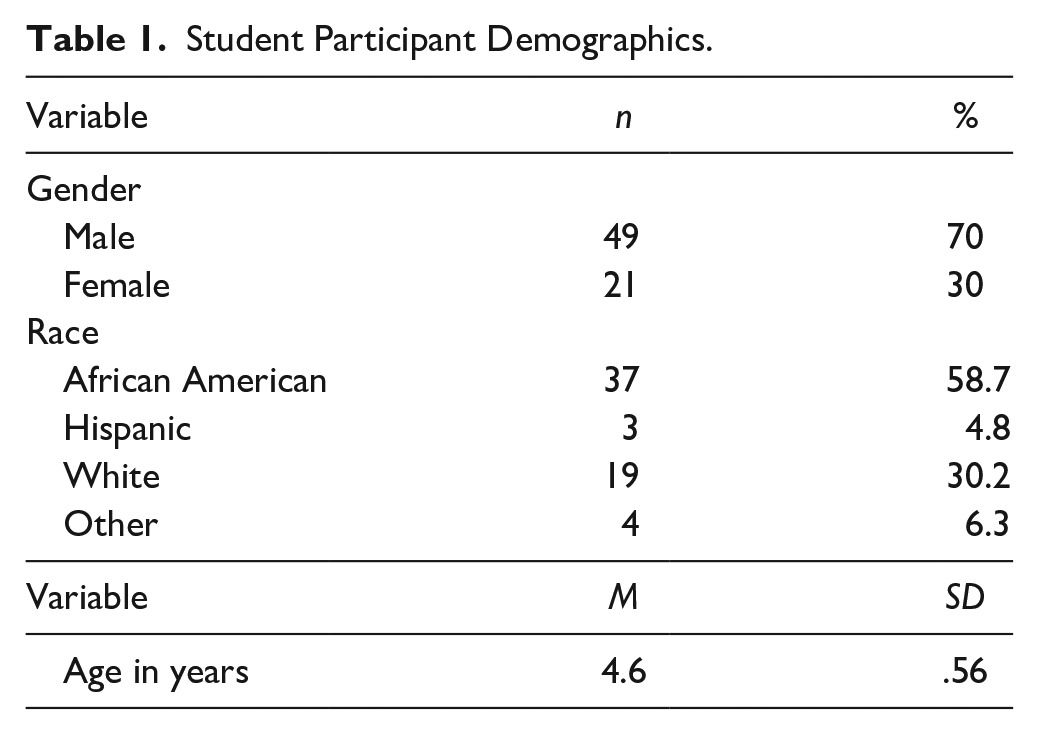
All study activities were approved by respective university and school-district human subjects protection boards. Obtaining teacher consent and screening of student participants began approximately 1 month after the beginning of school to allow teachers to familiarize themselves with the students in their classrooms. Once teacher consent was obtained, students were screened to determine eligibility for participation and caregiver consent was received. Subsequently, pretest measures were completed. Following completion of pretest measures, teachers (and their target students) were randomized to either treatment or control. In April, posttest measures were completed with all participating teachers and students. In each classroom, only the lead teacher’s participation in the study was required and all teachers and children only participated for 1 year. To recruit teacher participants into the parent study, researchers approached early childhood programs and all programs agreed to participate. The majority of programs participating in the study were federally or state funded, serving children who were from under-represented populations and income eligible. We report descriptive statistics for demographic variables for teacher and student participants in Tables 1 and 2.
Student Participant Demographics.
Teacher Participant Demographics.

Teachers
A total of 27 teachers participated as part of the control condition and served as the present study teacher sample. Teachers were eligible for inclusion if they met the following criteria: (a) taught in an early childhood classroom serving children ages 3–5 years, (b) served at least one child identified as being at risk of EBD, and (c) consented to participate.
Students
A total of 70 children participated as part of the comparison condition in the last year of the study. Children who met the following criteria were eligible for participation: (a) enrolled in a participating teacher’s classroom, (b) identified as at risk of an EBD through the Early Screening Project (ESP), (c) identified as functioning within the normal range in cognition according to the Battelle Developmental Inventory (BDI II Screener; Newborg, 2005), (d) proficient in English, and (e) had caregiver consent.
To determine whether children were at risk of EBD and therefore eligible for participation, teachers nominated five children in their classroom who engaged in chronic problem behavior. Caregiver consent was then obtained and systematic screening to confirm the risk for EBD took place using the ESP Stages 1 and 2. In addition, the BDI II Screener was administered at that time. Finally, children were screened and excluded if they were not English proficient using a program designed language screener composed of adapted elements from Gutierrez-Clennen and Kreiter (2003). English proficiency was included in the criteria to increase the overall validity of the assessment measures utilized as well as the coaching intervention used in the parent study.
Measures
ESP
The ESP is a teacher report screening tool designed to identify young children at risk of EBD (Feil et al., 1995). The ESP uses a multiple gating format; in Stage 1 teachers rank the top 5 children in their classroom by externalizing behaviors. After receiving caregiver consent, teachers rate children identified in Stage 1 in four subscale areas (i.e., Critical Events Index, Aggressive Behavior Scale, Adaptive Behavior, and Maladaptive Behavior). A 6-month test–retest for reliability revealed coefficients for the four subscales ranging from 0.74 to 0.90. The Stage 2 subscale also displayed concurrent validity, correlating with the externalizing scale of the Caregiver–Teacher Report Form (correlations ranged from .44 to .88; C-TRF; Achenbach & Rescorla, 2000). Based on a rating classifying as at risk on the ESP, the top 3 consented children who had the highest risk scores on the Stage 2 subscales were eligible for and participated in the study.
Social Skills Improvement System-Rating Scale (SSIS-RS)
The SSIS-RS is a 76-item teacher-report measure, allowing for the evaluation of social skills and problem behaviors of children (Gresham & Elliott, 2008). Each item on the SSIS-RS is rated on a 4-point frequency scale, with responses ranging from 0 (never) to 3 (almost always). Items are grouped into two three subscales: communication (e.g., responds well when others start a conversation or activity), problem behaviors (e.g., talks back to adults), and engagement (e.g., interacts well with other children). For the current sample, internal consistency was acceptable with Cronbach’s alpha equal to .85 for student engagement, .93 for student problem behavior, and .71 for student communication at pretest.
Dynamic Indicators of Basic Early Literacy Skills (DIBELS)
We used the Letter-Name Fluency (LNF) and Letter-Sound Fluency (LSF) assessments from the DIBELS as our measures of early literacy. Both assessments were individually administered to each student by a member of our research team. LNF is a standardized assessment of student accuracy and fluency of naming upper and lowercase letters. Students have 1 min to name the letters presented on the stimuli and are scored as the number of correctly named letters in the 1 min. LSF is a measure of phonological awareness that assesses a student’s ability to recognize and produce initial word sounds. Research assistants pointed to a series of letters and asked students what sound each letter made. Students had 1 min to produce the sounds of the letters in the series as the research assistant pointed at each letter. Although we do not have item-level data for this measure (and cannot calculate alphas), technical adequacy of the DIBELS has previously been established (Good et al., 2004). These measures also provide practical relevance as they are widely used progress monitoring measures in current classroom practice.
Classroom Assessment Scoring System (CLASS)
The CLASS is an observational instrument designed to evaluate classroom quality (Pianta et al., 2008). It addresses 10 separate dimensions of classroom experiences over three broad domains, including Emotional Support, Classroom Organization, and Instructional Support. Of interest in the present study is the Classroom Organization subscale. This subscale encompasses observations of a teachers’ classroom management approach, which includes an assessment of the quality of behavior management practices (i.e., clear expectations, proactiveness, and redirection), productivity (i.e., maximized time use, efficient routines and transitions), and use of instructional learning formats (i.e., variety, promotion of student interest, clarity, and engaging approach).
Trained observers scored each of the dimensions supporting the broad domain using a 1–7 scale with three categories—low (1, 2), mid (3, 4, 5), and high (6, 7). A minimum of four observation cycles were completed in each classroom and dimension scores were averaged across cycles to create broad domain scores. Certified observers conducted observations using the CLASS. Observers participated in a 2-day training led by a certified CLASS trainer and passed the reliability test to achieve initial certification. For the current sample, internal consistency was acceptable with Cronbach’s alpha equal to .94 for Classroom Organization. Correlations between included measures are presented in Table 3.
Bivariate Correlations Between Included Variables.
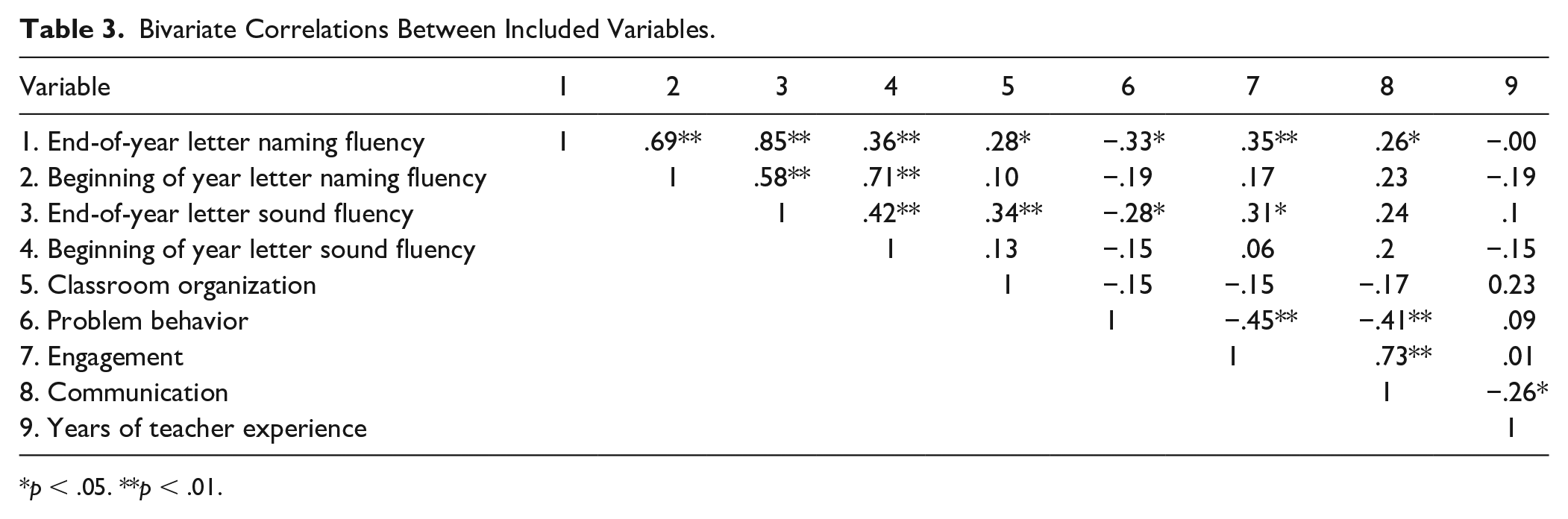
p < .05. **p < .01.
Data Analysis
The present study used data from the business-as-usual condition of a parent cluster-randomized control trial aimed at evaluating the efficacy of an intervention designed to improve teaching practices, student classroom behavior, teacher–student relationships. We used multilevel regression models (MLMs) to analyze the data in Mplus Version 8 (Muthén & Muthén, 1998-2017) and accounted for missing data with full maximum likelihood estimation (FIML). Our data structure required a two-level model with students nested within teachers and required MLM because we fit models with Level 2 variables (classroom organization) predicting Level 1 outcomes (student communication, engagement, and problem behavior scores). In all models, we controlled for student problem behavior, communication, and pretest DIBELS scores. All models included a random intercept for the outcome. Random slopes for Level 1 predictors were not included, given the limited number of Level 2 units (n = 27) and the increased complexity in model estimation and interpretation when adding additional random effects.
Given the small number of Level 2 units, we also compared the results of this MLM model (our preferred structure) to an alternative specification, the same model fit as a linear regression with cluster–robust standard errors via the “Type = Complex” option in MPlus, which makes use of the sandwich estimator of variance (Huber, 1967). This alternative model accounts for the nonindependence of children nested within teachers by adjusting the standard error estimates and therefore removes variance due to the repetition of children across teachers (Stapleton, 2006). Without accounting for the nonindependence in the data, the standard errors (particularly for any classroom-level predictors) would be underestimated resulting in a greater chance of committing a Type II error (Huang, 2018). In addition to predictor estimates and standard errors, we also include several measures of model and predictor effect size. These include multilevel R2 estimates for our preferred model, and standardized (beta) coefficients and model R2 (Rights & Sterba, 2019) estimates for the model using linear regression with cluster-robust standard errors.
Missing data
Missing data patterns revealed one teacher was missing data on classroom organization, one student was missing pretest SSIS scores and 10 students were missing posttest DIBELS scores. In all models, we used FIML to account for missing data, which retains the statistical power of the full analytic sample while minimizing bias in parameter estimates when data cannot be presumed to be missing completely at random (Enders, 2001).
Results
Preliminary analyses were conducted to examine the descriptive pertaining to all study variables. Means and SDs of study variables are presented in Table 1. LNF at the beginning of the year was slightly skewed (skew = 2.15) and LSF at the beginning of the year was skewed (skew = 4.43). In addition, LSF at the beginning of the year exceeded recommended cutoff scores for kurtosis (kurtosis = 22.34; Curran et al., 1996). As a result, we used MLR to correct for multivariate nonnormality in the data.
The first goal was to examine the extent to which a teacher’s beginning of the year classroom management was associated with their students’ end-of-year LSF and LNF. Results revealed that while estimates were similar in magnitude for both outcomes, teacher classroom management was a significant positive predictor end-of-year LSF (B = 2.34; p < .05), but not LNF (B = 2.19; p = .14). For letter sound fluency, a one-unit increase in classroom management score (suggesting a higher quality classroom environment) was associated with a two-point increase in students’ end-of-year sound fluency score, after controlling for student-level measures of prior sound fluency and naming fluency, problem behavior, communication, engagement, as well as child gender race/ethnicity, and teachers’ years of teaching experience. The second goal was to examine the extent to which student engagement and student communication predicted the end-of-year sound fluency and letter naming. Student engagement was not a statistically significant predictor of end-of-year LNF (B = 0.51, p = .14) or of year LSF (B = .37, p = .23). Student communication was not a statistically significant predictor of either LNF (B = −.15, p = .73) or LSF (B = .05, p = .88). Given the small sample in the present study, as a robustness check, we also analyzed these models using linear regression, adjusting for nesting within teachers by using cluster-robust standard errors. Results revealed findings consistent with the multilevel models. All model results are presented in Table 4.
Parameter Estimates for Multilevel and Single-Level Model Specifications.
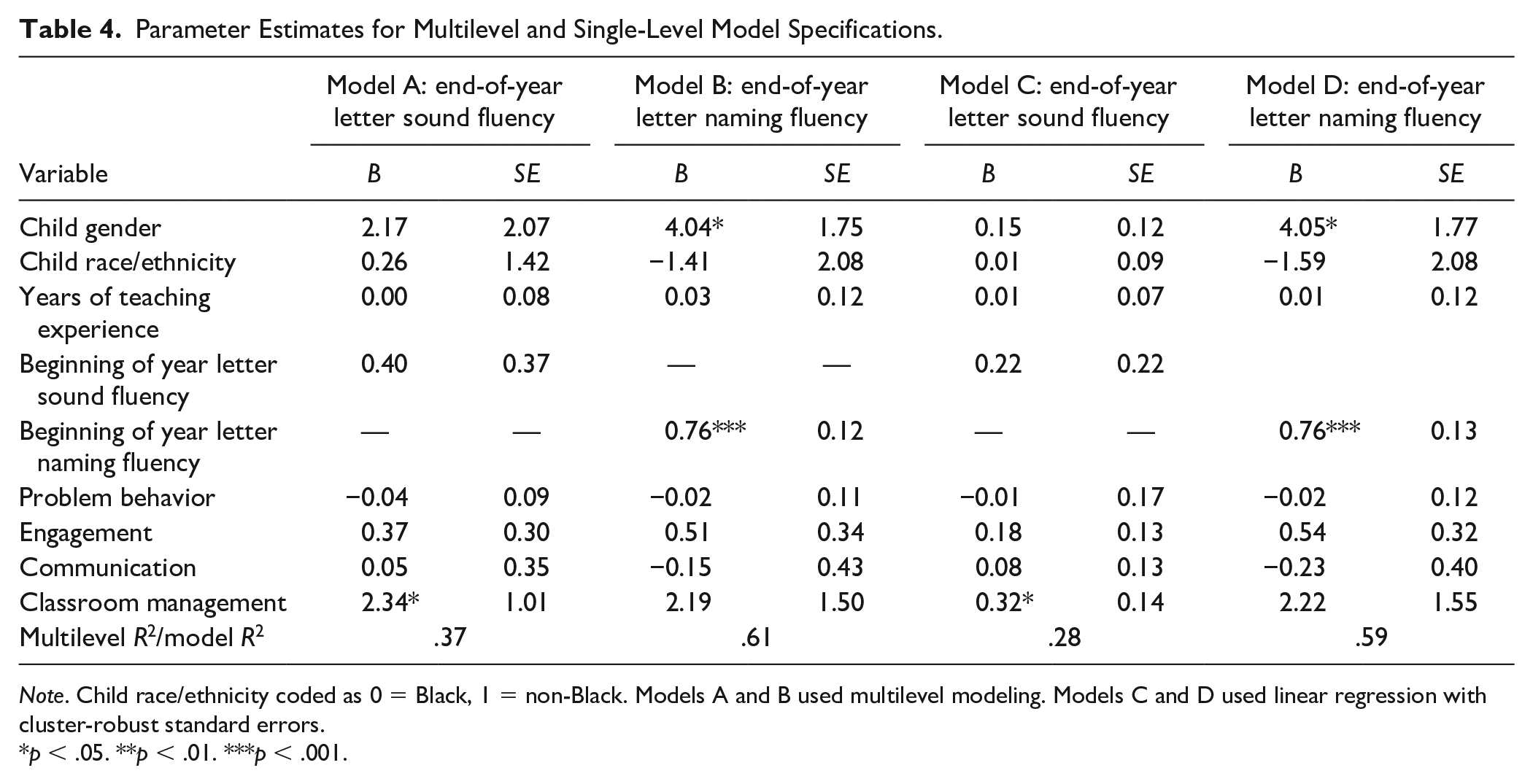
Note. Child race/ethnicity coded as 0 = Black, 1 = non-Black. Models A and B used multilevel modeling. Models C and D used linear regression with cluster-robust standard errors.
p < .05. **p < .01. ***p < .001.
Discussion
The purpose of this study was to examine the extent to which classroom management predicted literacy development in a sample of pre-kindergarten children with and at risk of EBD. After controlling for students’ levels of problem behavior, our analyses revealed that teacher classroom management predicted students’ letter sound fluency at the end of the school year, but not students’ letter naming fluency. Our findings partially converge with previous research demonstrating the contribution of teacher’s classroom management to student literacy development. Carr et al. (2019) reported significant main effects of pre-kindergarten teacher classroom management on a composite score of kindergarten literacy. Our models included individual indicators of literacy at the end of pre-K with classroom management predicting just one of the two literacy measures. It is possible that the substantive nature of the DIBELS, which is more proximal than other standardized measures in the literature, affected our findings. A more sensitive measure like letter naming may tax different skills than a broad measure of comprehensive reading. For example, retrieving the name of letters or sounds of letters may rely on different cognitive resources than more complex language tasks (Chow et al., 2020b). We also did not aggregate these standardized assessments as in other studies (Carr et al., 2019). Other studies that have used standardized measures did not find significant main effects of classroom management on literacy outcomes (passage comprehension, letter–word identification), but were substantially different because they estimated the cumulative effect of classroom management quality from kindergarten on third-grade literacy of children with EBD. However, in a similar analysis, Vernon-Feagans et al. (2019) reported that cumulative quality from kindergarten to third-grade predicted literacy scores in a sample of children from low-income households.
Our findings, in conjunction with other studies, support the practical need for additional training on classroom management, particularly for early childhood educators. Preservice programs as well as targeted professional development in this area may provide a foundation that is potentially missing from some teachers’ skill sets. These foundational behavior management skills may, in turn, set the stage for higher quality and consistent instruction that can then be used to improve literacy outcomes for young children with or at risk of EBD (Chow et al., 2020c). For example, our measure of classroom organization includes subdomains of behavior management (e.g., teacher effectiveness in monitoring, preventing, and redirecting problem behavior), productivity (e.g., consistency in how teachers maximize learning via clear routines, teacher preparation, use of effective transitions), and learning formats (e.g., how effective materials and modes of instruction promote student engagement). These factors should be explicitly taught in preservice preparation programs as well as professional development content, and this content may be particularly important for the success of children at risk for developing behavior problems by providing the structure, consistency, and preventive programming that has a rich evidence base in the field (see Korpershoek et al., 2016; McLeod et al., 2017).
In terms of research, future studies should study the intersection of evidence-based behavior supports and evidence-based language and literacy instruction for young children, particularly for students at risk of EBD. Many foundational principles of early learning can have additive, complementary, and sequenced effects. More research is needed on how we can best sequence and tailor intervention development to most effectively implement early supports of language, behavior, and social development, and this may be most important for children who are at risk for delays (Chow et al., 2020; Chow & Hampton, 2019).
Interestingly, neither engagement nor child communication skills were related to the end of the year literacy scores. This was particularly surprising for communication given that prior work that shows communication ability is linked to the development of literacy skills (Catts et al., 2002; Chow, 2018) and a comorbidity of language and behavior problems exists (Chow & Wehby, 2019). This relation may not be present in the current study due to the type of literacy assessment (DIBELS), which were likely taxing child memory (letter naming and sounds) versus communication skills more broadly. Discrepancies exist between types of measures of language and communication (i.e., rating scales and direct assessment; Chow & Hollo, 2018), which could potentially have influenced our findings. Alternatively, controlling for problem behavior may have accounted for some of the variance in the relationship between communication and literacy. There is, however, a limitation in our measurement of engagement and communication in this study because they are both teacher ratings. Given teacher perceptions and bias influence ratings, findings should be interpreted with this in mind.
Also of interest from these data are the gender differences that emerged in the models. We included gender as a covariate and did not have any specific hypotheses for gender differences. However, we recognize previous research that reported boys being associated with poorer literacy outcomes in early elementary and preschool (Arnold, 1997). Our data reveal that gender was associated with LNF but not LSF, where being female was associated with higher LNF performance at the end of the year. This pattern converges with previous studies that have reported lower literacy performance for boys than girls with EBD. However, measurement may play an important role, as teachers have demonstrated bias in favor of boys in ratings of social skills and achievement in samples of students with or at risk of EBD (Sheaffer et al., 2020). This has implications for research, as future studies that prospectively aim to study gender differences in literacy outcomes should include multiple measures of literacy that have been shown to be associated (or not associated) with gender in previous studies.
Limitations
Although this study provides meaningful information about children’s literacy and classroom experience of children at risk of EBD, it is not without limitations. Although this study includes data from a small sample of teachers, we have confidence in presenting these exploratory findings as models were consistent across multilevel and single-level specifications. Related to the limited sample size, we only included the classroom organization scale and did not include additional subscales from the CLASS. Although worth noting given the sample size, this did not depart from our original planned analyses, given that our rationale and corresponding research questions did not include emotional or instructional support.
In addition, both the teacher and student samples have selection parameters that may influence study findings. Teachers self-selected into a larger intervention study and students were only included if they screened in under study criteria, including demonstrating proficiency in English. Related generally to intervention studies, there is a possibility of contamination across conditions. To increase study generalizability future work should include a larger set of teachers and students in both general and special education classroom populations and include students who are English learners. In addition, teachers reported on both student behaviors to be screened into the study as well as on engagement, problem behavior, and communication. Future work should include measures from multiple reporters on student characteristics (e.g., observational data) as well as multiple indicators of early literacy and school readiness. Early intervention practices should focus on the proactive development of teacher’s classroom management skills as a priority in the profession. Interventions should focus on this specific skill as a protective factor that helps set the stage for high-quality instruction (Chow et al., 2020).
Conclusion
This study provides insight into the role of preschool teacher’s classroom management in young children’s performance on commonly used measures of literacy. We extend previous work in this area to early childhood settings. This preliminary investigation suggests that a teacher’s ability to organize and manage their classroom settings may be an important malleable characteristic associated with the learning and literacy of young children.
Footnotes
Declaration of Conflicting Interests
The author(s) disclosed receipt of the following financial support for the research, authorship, and/or publication of this article: This research was supported, in part, by a grant from the U.S. Department of Education’s Institute for Education Sciences (R305A140487). The opinions expressed by the authors are not necessarily reflective of the position of or endorsed by the U.S. Department of Education.
Funding
The author(s) received no financial support for the research, authorship, and/or publication of this article.
