



Abstract
A large body of research has reported a positive relation between participation in extracurricular activities (ECA) and improved academic performance, social competence, and school engagement. This study explored the relation between ECA, social competence, and school engagement for students with and at risk of emotional and behavioral disorders (EBD). Specifically, the study addressed three research questions: (a) Is there a relation between participation in ECA and high school students with EBD’s social competence and school engagement? (b) Is the relation moderated by EBD status, race, gender, or special education status? And, (c) is there a direct link between participation in ECA and students’ social competence and school engagement for youth with EBD? Eighty students with EBD and 21 typically developing students were included based on their participation in a larger study examining interventions for U.S. high school students with EBD. Participants were administered a battery of assessments at the end of the school year measuring ECA participation, social competence, and school engagement. We used regression and instrumental variable analyses to address the research questions. Results indicated statistically significant, positive relations between participation in ECA, social competence, and school engagement. Implications for research and practice are discussed.
Keywords
Students with and at risk of emotional and behavioral disorders (EBD) experience among the worst educational outcomes when compared with students with other disabilities (Lipscomb et al., 2017; Mitchell et al., 2019). By students with EBD, we mean both those receiving special education services for emotional disturbance and those who may have or be at risk of emotional and behavioral challenges but do not receive special education services (Forness et al., 2012). Students with EBD have poor attendance, low academic achievement, failing grades, conflicts with adults and peers, excessive disruptive behavior, and experience numerous mental health issues (Kauffman & Landrum, 2018; Lane et al., 2006). Nearly half of students with EBD report being teased at school and fewer report being happy at school when compared with students in other disability categories (Mitchell et al., 2019). During the 2015–2016 school year, 35% of students with EBD dropped out of school before graduation (U.S. Department of Education, Office of Special Education and Rehabilitative Services, Office of Special Education Programs, 2017). These challenges present a barrier to academic and social success and can lead to disengagement from school (Reschly & Christenson, 2004). One possible avenue to foster school engagement and improve social competence for students with EBD is to promote and support participation in extracurricular activities (ECA) like team sports, clubs, and other highly structured activities. Nearly 60% of students with EBD report participation in some sort of ECA (Lipscomb et al., 2017; Wagner et al., 2004). The impact of this participation on school engagement and social competence, two predictors of success in school, is not known. To address this gap, we examined the relation between participation in ECA, school engagement, and social competence of adolescents with EBD.
School Engagement and Social Competence
Students with EBD are less engaged in school than their peers (Gage et al., 2021) and demonstrate poor social competence (Gresham, 2015). As such, practices associated with increased performance in these domains for students with EBD may hold promise for improving concomitant short-term outcomes (e.g., academic performance) and reduce long-term negative consequences (e.g., school dropout). School engagement is related to a host of positive outcomes, including decreased dropout rates and improved academic performance and positive interactions with adults and peers (Fall & Roberts, 2012; Finn & Owings, 2006; Loehmeier & Lee, 2011). There is a significant body of research examining the connection between increasing school engagement and improved outcomes for students with EBD. The Check and Connect program, an intervention focusing on improving student engagement through mentoring, has demonstrated improved outcomes for students with EBD in the form of decreased dropout rates (Christenson & Pohl, 2020; Sinclair et al., 2005). In addition, several studies have demonstrated increased academic engagement for students with EBD through classroom-based interventions such as increasing opportunities to respond to instruction (Adamson & Lewis, 2017; Didion et al., 2020; MacSuga-Gage & Simonsen, 2015). Both academic and social engagement are important elements of overall school engagement (Janosz et al., 2008). Academic engagement refers to student interaction with and responsiveness to classroom instruction. Social engagement includes positive interactions with peers and adults at school. Loehmeier and Lee (2011) defined engagement in terms of school connectedness across three domains: belongingness, relatedness, and engagement. Belongingness is the perception of general support in the school setting, including a feeling of membership and acceptance by peers and adults. Relatedness is the perception of specific support from teachers, peers, and friends. This support is acknowledged, but the student does not directly seek it out. Finally, engagement involves actively enjoying school-related activities such as schoolwork and ECA and seeking out support from others at school.
Social competence is a broad adaptive characteristic that captures a student’s awareness of how one’s behavior affects their surroundings and sensitivity to the needs of others, resulting in friendship, popularity with peers, and positive self-concept (Hukkelberg et al., 2019). Socially competent students interact appropriately with adults and peers and, in turn, tend to be more academically engaged and experience improved academic outcomes (Gresham, 2015). Students with social competence deficits, including students with EBD, exhibit more delinquent behaviors, experience higher rates of depression and social withdrawal, and poor academic performance compared with socially competent students (Cook et al., 2008; Hukkelberg et al., 2019). Socially competent students demonstrate social skills, defined as the specific behaviors a student engages in to interact effectively with others (Gresham, 2002). Improving social skills can be especially important for adolescents with EBD given the increasing social demands of middle and high schools. Students in high school who lack social competence fall short of teacher behavioral demands and fail to develop important social relations with peers (Cook et al., 2008). These social failures have been shown to lead to a myriad of negative outcomes, including academic failure, disengagement from school, and eventual dropout (Cook et al., 2008).
Extracurricular Activities Participation
Extracurricular activities are highly structured student activities requiring an adherence to a schedule and rules. Mahoney and Stattin (2000) define highly structured activities as including “regular participation schedules, rule-guided engagement, direction by one or more adult activity leaders, an emphasis on skill development that is continually increasing in complexity and challenge, activity performance that requires sustained active attention, and clear feedback on performance” (pp. 114–115). Extracurricular activities can include school-based activities such as team and individual sports, theater, dance, student government, band, choir, and vocational or special interest clubs. Extracurricular activities can also be community-based and include such activities as Scouts BSA, Girl Scouts, community theater, and sports teams like USA Hockey and Little League Baseball.
Capital theory (Liu et al., 2004) and social control theory (Hirschi, 1969) have been used to elucidate the mechanisms by which ECA can improve social competence, and increase school engagement. Capital theory, specifically social capital, provides a rationale for the social benefits of ECA participation. Broh (2002) used Capital theory to hypothesize ECA participation may serve as a vehicle for social capital acquisition through greater interactions with peers and school personnel. Students with EBD who lack social competence and have few opportunities to acquire social capital may benefit from the peer interaction opportunities available through ECA participation. Social control theory states an individual who bonds with an institution is less likely to exhibit deviant behavior (Hirschi, 1969). Finn (1989) discussed the potential for ECA to serve as a vehicle for increasing a student’s sense of belonging and identification with the school and peers. This sense of belonging and identification, also known as school engagement (Loehmeier & Lee, 2011), has the potential to lead to decreases in problem behaviors and lower dropout rates for students with EBD.
Research suggests there is a positive association between adolescents’ ECA participation and improved social and educational outcomes (Vandell et al., 2022). Early research drew a clear link between ECA participation and increased academic performance (Otto, 1975) with subsequent research supporting these early claims (Abruzzo et al., 2016; Bedard et al., 2020; Darling et al., 2005; Denault & Poulin, 2009; Eccles & Templeton, 2002; Fredricks & Eccles, 2005; Marsh & Kleitman, 2002; Zaff et al., 2003). See Supplemental Table S1 for a summary of ECA research.
Several studies have also examined the effects of ECA participation on risky and antisocial behaviors of adolescents. Students who participate in some sort of ECA report fewer behavior problems, exhibit fewer risky behaviors (Eccles et al., 2003; Guèvremont et al., 2014; Harrison & Narayan, 2003; Mahoney & Stattin, 2000), experience lower rates of mental health problems (e.g., depression; Bartko & Eccles, 2003; Bohnert et al., 2008; Guilmette et al., 2019; Mahoney et al., 2005), and are less likely to drop out of school (Mahoney, 2014; McNeal, 1999). A logical extension of these findings is to study the effects of participation on students with EBD.
Although a large body of evidence exists demonstrating a positive association between ECA participation and social and educational outcomes, none focused exclusively on students with EBD or compared differences in associations for students with and without EBD. Furthermore, few studies explore potential causal pathways between ECA participation and school engagement and social competence. Carbonaro and Maloney (2019) analyzed data from six waves of the Early Childhood Longitudinal Study–Kindergarten Class of 1998–1999 using structural equation modeling to construct a cross-lagged panel model with student fixed effects. Their findings suggest a small, but slightly increasing, direct relation may be present between ECA participation and academic ability from third to eighth grade. They also found a small direct relation between ECA participation and socioemotional skills across the grades. Thus, there may be a promising direct link between ECA participation and positive outcomes.
Present Study and Research Questions
The persistent challenges and poor outcomes experienced by students with EBD necessitate the exploration of new opportunities to improve social competence and increase school engagement (Gage et al., 2010). Research has clearly demonstrated a relation between participation in highly structured ECA and improved outcomes for typically developing adolescents; thus, ECA could benefit students with EBD. The purpose of this study was to explore patterns of social competence and school engagement for students with and without EBD participating in ECA and the direct effect of ECA on social competence and school engagement for students with EBD. Specifically, this study was guided by four research questions:
We hypothesized students with EBD would have less ECA participation than their peers because their behaviors may impede access and sustained participation in ECA (Kauffman & Landrum, 2018). We also hypothesized students with EBD with more social competence and school engagement would be more likely to participate in ECA because social competence is important for remaining in ECA and feeling connected to the school may increase a student’s interest in school-based ECA (Bedard et al., 2020). We examined different moderators of the relation between social competence, school engagement, and ECA because we hypothesized females would have more social competence than males (Novak et al., 2020), White students would be more connected to school (Joyce & Early, 2014), and students receiving special education services with EBD would have lower social competence and school engagement (Kauffman & Landrum, 2018; Marsh et al., 2019). Last, we hypothesized increased participation in ECA can increase students’ social competence and school engagement through opportunities to be part of a team and work together toward common goals, among other noted benefits of ECA (Bedard et al., 2020).
Method
Participants and Setting
All students were part of a larger multistate, multisite randomized controlled trial (RCT) examining a multicomponent intervention package to improve academic, social, and behavioral outcomes for high school students with EBD (see Kern et al., 2015, 2021). First, schools were asked to nominate students who received special education services for emotional disturbance or exhibited serious social, emotional, and/or behavioral problems. Each nominated student was screened by project staff and excluded if they had an intelligence quotient (IQ) of 75 or lower (i.e., cognitive impairment), an autism spectrum disorder, or attended an alternative school. Then, each students’ parent/guardian, a school staff member most familiar with the student, and the student themselves completed a series of measures to confirm serious social, emotional, and/or behavioral problems. Students were included if they had a t score of 60 or higher on either the internalizing or externalizing composites of the Behavior Assessment System for Children–Teacher or Parent Version (BASC; C. R. Reynolds & Kamphaus, 2004), a t score of 60 or higher on the Multidimensional Anxiety Scale for Children (MASC; March et al., 1997), or a t score of 60 or higher on the Reynolds Adolescent Depression Scale–2 (RADS-2; Reynolds, 2002). As a result, the study included students receiving special education services for emotional disturbance, but also students receiving services for other disabilities, but considered as having EBD based on the assessment scores (see Kern et al., 2021, for more details). For this study, we only included students at two of the five study sites in the larger RCT because only students at those sites completed the measures used in this study (described below). A total of 80 students in 12 high schools in two U.S. states in the Midwest were eligible for participation based on the above criteria and completed all measures.
Sixty-two percent of the students with EBD were male. Eleven percent were in ninth grade, 48% were in 10th grade, 45% were in 11th grade, and 4% were in 12th grade. Sixty-eight percent received free or reduced lunch, 56% were White, 34% were Black, and 4% were Hispanic. Seventy-one percent of the students received Individualized Education Program (IEP) services, and, of those, 41% received IEP services for learning disabilities, 38% for Emotional Disturbance, 17% for other health impairments, and 4% for other disabilities (e.g., speech and language disorder). We also collected the study measures (described below) from a sample of 41 typically developing students. Unfortunately, no demographic data were available for these students. Thus, the full study sample included 121 students, 80 with EBD and 41 typically developing students.
Measures
A battery of assessments was conducted with all participants at the end of the school year in April and May. For this study, we administered a survey of ECA participation (independent variable), a measure of social competence and school engagement (dependent variables), and examined subscale scores from a measure of emotional and behavioral traits as an instrumental variable.
Extracurricular activities
The first author developed a brief ECA participation survey based on Denault and Poulin’s (2009) study of breadth and depth of ECA participation. Most ECA research has focused on school-sponsored activities; however, in their review of ECA research, Farb and Matjasko (2012) discussed the difficulty of disentangling community-based activities and their effect on students from school-based activities. Therefore, we included community-based activities. Extracurricular activities were divided into seven categories: (a) individual sports such as martial arts, gymnastics, swimming, and wrestling; (b) team sports such as baseball, football, volleyball, soccer, hockey, and basketball; (c) fine arts activity such as drama, dance, art, band, and choir; (d) academic clubs such as math club, chess club, computer club, newspaper, radio, and student government; (e) community-oriented activity such as Scouts BSA, Girl Scouts, and 4-H; (f) organized service activity such as volunteer experience, teacher assistant, and special Olympics coach/assistant; and (g) faith-based youth groups (Denault & Poulin, 2009).
The ECA survey consisted of 21 questions. Each category of ECA made up a cluster of three questions. The first question in each cluster required a yes/no response regarding student participation in the ECA category. The second and third questions asked about depth of participation (i.e., hours per week and months). Each cluster of questions was given two scores, the first question in the cluster was scored as 1 if the answer was yes meaning the participant did participate in the category of ECA in the present school year and a 2 if the participant did not participate in the category of ECA in the present school year. The second two questions in the cluster regarding intensity of participation were scored by first assigning a value to each possible response. The two values were then multiplied together to give an intensity of participation score for each cluster. After scoring each cluster, a total breadth score was calculated by adding all the 1s together. The total intensity score was calculated by adding all the cluster intensity scores together. Rate of participation is calculated in terms of intensity and breadth. Intensity of participation was determined by multiplying the hours of participation per week (less than 1 hr per week = 1, 1–2 hr per week = 2, 2–3 hr per week = 3, 3–4 hr per week = 4, 4–5 hr per week = 5, more than 5 hr per week =6) by the number of months of participation (less than 1 month = 1, 1–2 months = 2, 3–4 months = 3, and more than 4 months = 4) for each activity and summing the product of each activity the student participated in. We did not collect the number of weeks, only months; therefore, the intensity score does not represent the total time, but instead the overall intensity of participation. Breadth of participation was determined by adding the total number of activities students reported participating in during the current school year. The ECA participation was simply the sum of activities reported, whereas the intensity score was calculated from Likert scale-like items. Therefore, we calculated Cronbach’s alpha for the ECA Intensity score, finding an alpha of .73, suggesting adequate internal consistency.
Social skills
We used the student report form of the secondary-level Social Skills Rating System (SSRS; Gresham & Elliott, 1990) to evaluate social competence. The SSRS is a 39-item broad-based assessment of students’ social behavior across four areas, namely, cooperation (helping others, sharing, complying with rules and directions), assertion (asking for help, responding to others), empathy (showing concern and respect for others feeling and viewpoints), and self-control (responding to teasing, turn taking, compromising). The secondary version of SSRS is designed for students in Grades 7 to 12. It focuses on a comprehensive assessment of social skills, but also includes problem behaviors that compete with the acquisition or performance of socially skilled behaviors (see the appendix for subscale details). Prior research found that the secondary SRSS has acceptable reliability, with an alpha value of .83 (Gresham et al., 2011). We also found an alpha of .83 for the SRSS scores from our data.
School engagement
We measured school engagement with the School Connectedness Scale (SCS; Loehmeier & Lee, 2011). The SCS is a 54-item measure that uses 5-point Likert scaling to assess school connectedness across three levels (general, specific, and engagement) and three sources (school, teachers/adults, and peers). Each of the three sources is subscales measuring connectedness at the school, teacher/adult, and peer levels while also combining for a total school connectedness score (see the appendix for subscale details). Prior research found acceptable reliability with alpha of .78 (Loehmeier & Lee, 2011). We found an alpha of .83 for the total engagement score from our data.
Emotional and behavioral traits
As part of the larger study, students completed the Behavior Assessment System for Children–2 (BASC-2) Student Report of Personality (SRP) and one of their parents or caregivers completed the BASC-2 Parent Report Form (PRF). The BASC-2 is a multidimensional assessment of emotional and behavioral problems for children ages 2 to 25 years. Each measure included more than 100 items rated on a 4-point Likert-type scale and scores were reported on the following subscales: SRP included Internalizing, Inattention, Personal Adjustment, Emotional, and Symptoms; the TRS included Internalizing and Externalizing. Reliability coefficients for BASC-2 SRP and TRS subscales were evaluated during the norming process, with alpha values exceeding .80 across all subscales. Item-level data were not available for this study; therefore, alpha for our sample could not be estimated.
Data Analysis
We used a series of ordinary least squares (OLS) regression models to examine the relation between ECA participation and students’ social competence and school engagement. First, we regressed ECA participation and intensity on EBD status to determine whether or not students with EBD participated in ECA at different rates than typically developing students. Next, we examined the relation between ECA and social competence and school engagement, controlling for all available student characteristics and study site. Given students attended 12 different schools, we conducted a robustness check of the OLS results using a mixed-effects model and compared results. Given the small sample size and small intraclass correlation coefficient (reported below), we focus our results on the OLS outcomes. However, the mixed-effects model results were congruent with the OLS results.
Next, we examined whether or not EBD status (i.e., EBD and typically developing students) moderated the relation to determine whether the relation between ECA participation and the dependent variables was the same for each group. We then explored whether or not special education status, race (White and not White), and gender moderated the relation between ECA and social competence and school engagement. Moderation models included an interaction term between the moderator and ECA and available covariates when possible. As no demographic characteristics were available for the typically developing students, no covariates were included in those models.
Last, we conducted an instrumental variables analysis (Stock & Watson, 2015) to address endogeneity of ECA to evaluate the potential causal link between ECA and social competence and school engagement. Ideally, we would conduct an experiment wherein we randomly assign high school students with EBD to participate in ECA or not participate. Unfortunately, we must rely on observation data to identify the effect of ECA for students with EBD, but observation data are confounded by unmeasured or omitted variables. These variables are considered endogenous as they are correlated with the error term in a regression model. An instrumental variable is a variable correlated with the independent variable (Assumption 1), ECA in this study, but not correlated with the dependent variable (Assumption 2). Thus, the effect of the instrumental variable on the dependent variable is entirely mediated through its effect on the independent variable. In this study, we explored emotional and behavioral traits as the instrumental variable to estimate instrumental variable models. Specifically, we correlated the ECA survey with BASC-2 SRP, TRS, and PRF subscales to identify a potential instrumental variable. We then used the identified variable in an instrumental variable model and examined model diagnostic results to evaluate the instrument. We used the MM-estimator for the instrumental variable models because the covariates had very little impact on R2 change between the models with and without covariates and there were a few students with outlier values on ECA participation and intensity (two students had a score of 5 on the ECA Participation scale, while the mean was 1.10 and one student had a score of 89 on the ECA Intensity scale, while the mean was 13.51). This approach is more robust to outliers (Davidson & MacKinnon, 2004). All data analyses were conducted in R (R Core Team, 2021). Regression models were estimated in base R. Mixed-effect models (not reported) were estimated using lme4 (Bates et al., 2015). Instrumental variable analyses were estimated using ivreg (Fox et al., 2021). The MM-estimator in ivreg does not allow for covariates, only the independent variable, dependent variable, and instrumental variable.
Results
First, we examined whether or not there were differences in ECA participation rates and intensity of participation between students with and without EBD. As noted, we were unable to collect any demographic characteristics for typically developing students. Students with EBD had an average participation score of 1.10 (SD = 1.19) and an average intensity score of 13.51 (SD = 18.17). Typically developing students had an average participation score of 2.46 (SD = 1.47) and an average intensity score of 29.41 (SD = 18.98). The results in Supplemental Table S2 indicate typically developing students are significantly more likely to participate in ECA and have higher participation intensity scores. The standardized mean difference between students with EBD and typically developing students was g = 1.05 for participation and g = 0.86 for intensity.
Next, we examined the relation between ECA participation and intensity and social competence and school engagement for students with EBD. The average SSRS total score for students with EBD was 45.84 (SD = 11.78), whereas the SCS total score was 179.51 (SD = 29.95). For context, the average SSRS total score for the typically developing students was 90.24 (SD = 8.68) and 201.85 (SD = 28.01) for the SCS total score. We examined the relation between ECA participation and intensity and social competence and school engagement with a model without covariates (Model 1) and a model with all available covariates (Model 2). Table 1 provides the results for ECA participation.
Relation Between Extracurricular Participation and Social Skills and School Connectedness for Students With EBD
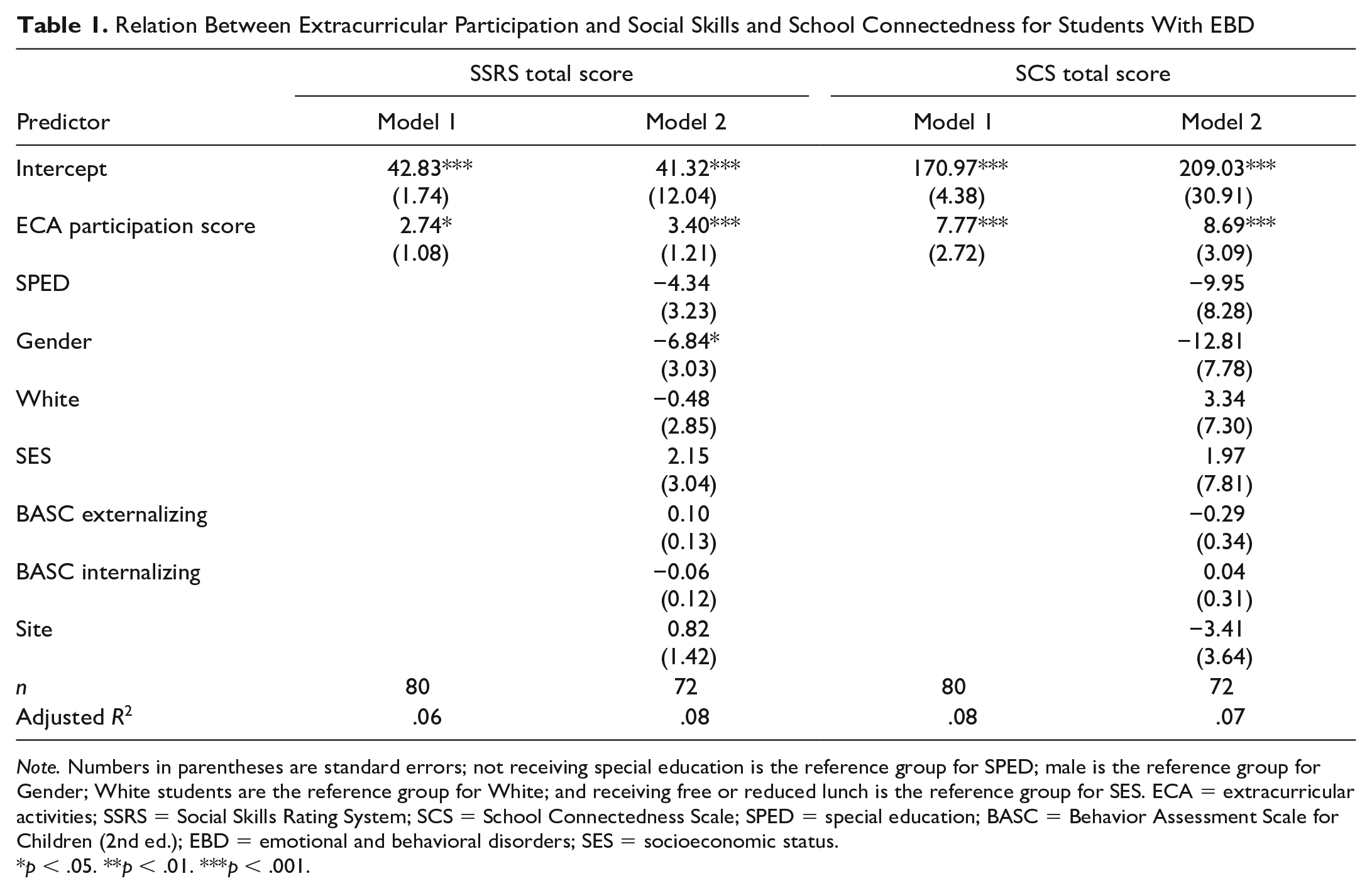
Note. Numbers in parentheses are standard errors; not receiving special education is the reference group for SPED; male is the reference group for Gender; White students are the reference group for White; and receiving free or reduced lunch is the reference group for SES. ECA = extracurricular activities; SSRS = Social Skills Rating System; SCS = School Connectedness Scale; SPED = special education; BASC = Behavior Assessment Scale for Children (2nd ed.); EBD = emotional and behavioral disorders; SES = socioeconomic status.
p < .05. **p < .01. ***p < .001.
Overall, we found ECA participation had a positive and statistically significant relation to both social competence and school engagement, suggesting as ECA participation and intensity increased, social competence and school engagement increased. The only covariate that significantly predicted differences was gender, with results suggesting females with EBD had lower social competence and school engagement than males after controlling for all other predictors. Although the ECA predictors were significant, the R2 values were less than 10% for all models. We converted the ECA predictors to standardized beta coefficients for comparison and interpretation. We found β = .34 for both social competence and school engagement (differences were noted at the fourth decimal place), suggesting a standard deviation unit increase in ECA participation is associated with a 0.34 standard deviation increase in social competence and school engagement. Table 2 provides the results for the relation between ECA intensity and social competence and school engagement. The results were similar to the results for ECA participation, with positive relations between ECA intensity and social competence and school engagement. Again, we found gender was the only significant predictor. The standardized beta coefficients for ECA intensity were β = .30 for social competence and β = .44 for school engagement, suggesting the strongest relation was between ECA intensity and school engagement.
Relation Between Extracurricular Intensity and Social Skills and School Connectedness for Students With EBD
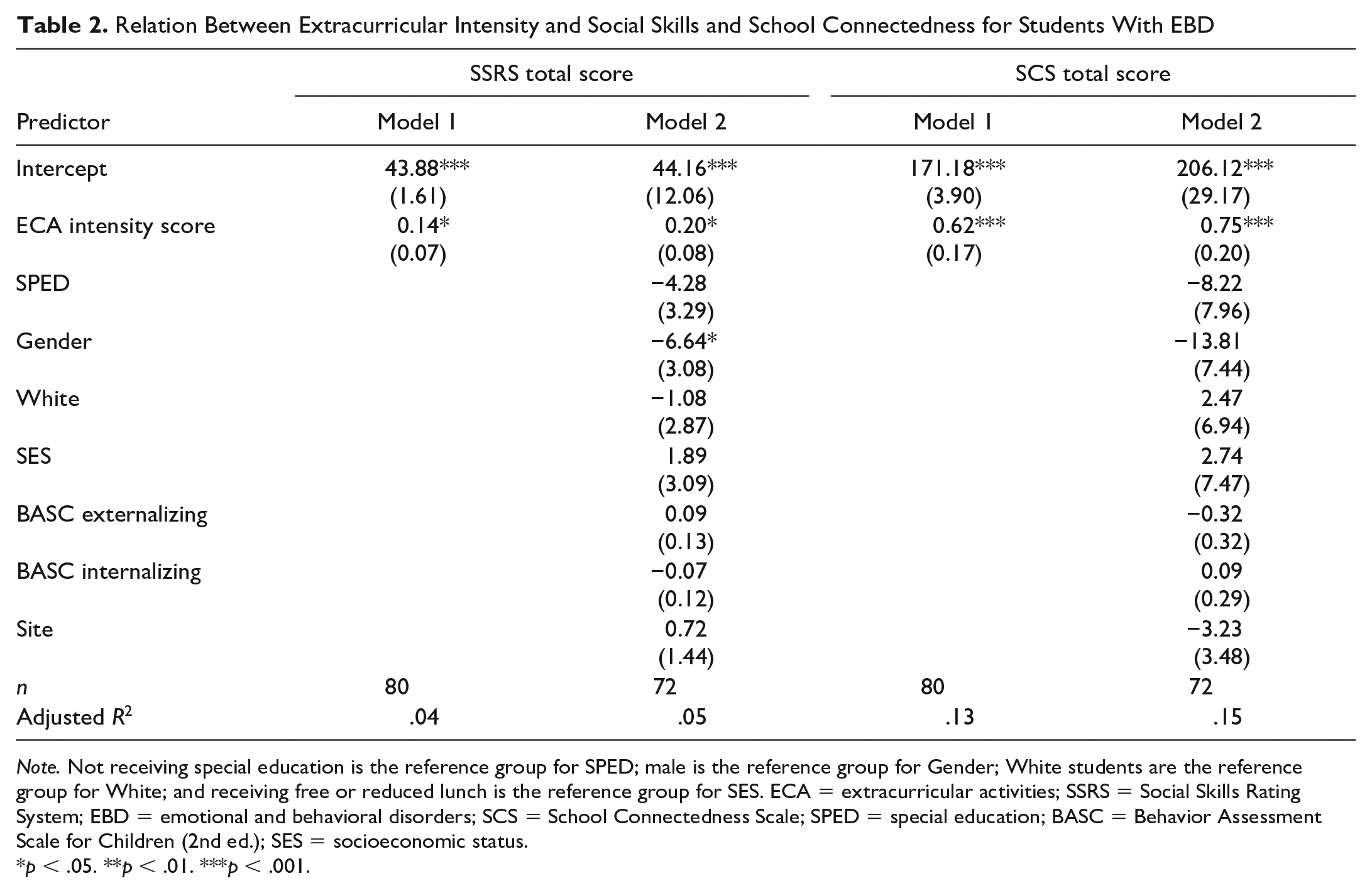
Note. Not receiving special education is the reference group for SPED; male is the reference group for Gender; White students are the reference group for White; and receiving free or reduced lunch is the reference group for SES. ECA = extracurricular activities; SSRS = Social Skills Rating System; EBD = emotional and behavioral disorders; SCS = School Connectedness Scale; SPED = special education; BASC = Behavior Assessment Scale for Children (2nd ed.); SES = socioeconomic status.
p < .05. **p < .01. ***p < .001.
Next, we conducted a series of models to determine whether or not student characteristics moderated the relation between ECA participation and intensity and social competence and school engagement. We modeled interaction terms between ECA participation and intensity and special education status, gender, race, and EBD status. All models included all other demographic covariates, except the models for EBD status as no demographics were available for the typically developing group. We found no significant interactions for special education status, gender, or race for any of the models. We also found no significant interaction terms for models comparing typically developing students and students with EBD. We also conducted a sensitivity analysis to determine whether the intervention students received had any effect on the model results. The sample of students with or at risk of EBD included students in both the treatment and control condition of the larger study. We replicated all of the models that included student characteristics described above and included the treatment condition as an additional predictor. Overall, we found the treatment condition was not significant in any of the models and all of the coefficients for the other predictors were unchanged. Therefore, we are confident the treatment condition had no impact on any of the findings in this study.
Last, we explored an instrumental variable analysis approach to model the potential causal pathway between ECA participation and intensity and social competence and school engagement. First, we examined the available BASC subscale scores representing EBD traits for an appropriate instrumental variable. We created a correlation matrix between the variables to identify BASC subscale scores correlated with the independent variables (ECA participation and intensity) and not correlated with the dependent variables (social competence and school engagement). Table 3 presents the correlation matrix between all ECA, social competence, school engagement, and EBD trait scores. First, we found significant correlations between all ECA, social competence, and school engagement scores, confirming the regression model results. For BASC scores, we found BASC Personal Adjustment subscales were correlated with both ECA participation and intensity, but not with social competence or school engagement, suggesting the BASC Personal Adjustment subscale may be an appropriate instrumental variable.
Correlation Matrix for ECA, Social Skills and School Connectedness States, and Emotional and Behavioral Traits.
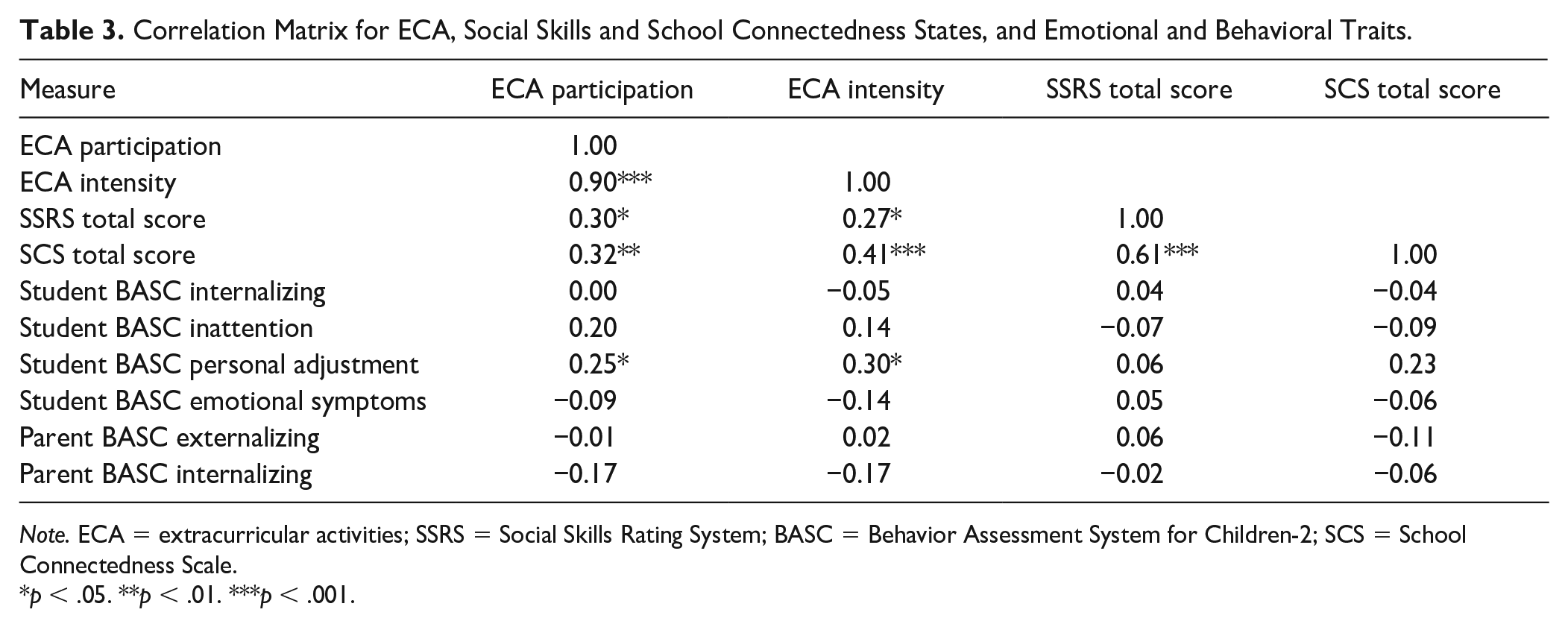
Note. ECA = extracurricular activities; SSRS = Social Skills Rating System; BASC = Behavior Assessment System for Children-2; SCS = School Connectedness Scale.
p < .05. **p < .01. ***p < .001.
Table 4 presents the results of the instrumental variable regression models. First, we examined the model diagnostic test and found the BASC-2 Personal Adjustment subscale was a strong instrument in all four models based on the correlation with the endogenous explanatory variable. The results suggest that after controlling for the instrumental variable, there is no significant effect for ECA participation or intensity on social competence. However, the results for school engagement were significant, suggesting there is a link between ECA participation and intensity and students’ reported school engagement.
Instrumental Variables Analysis
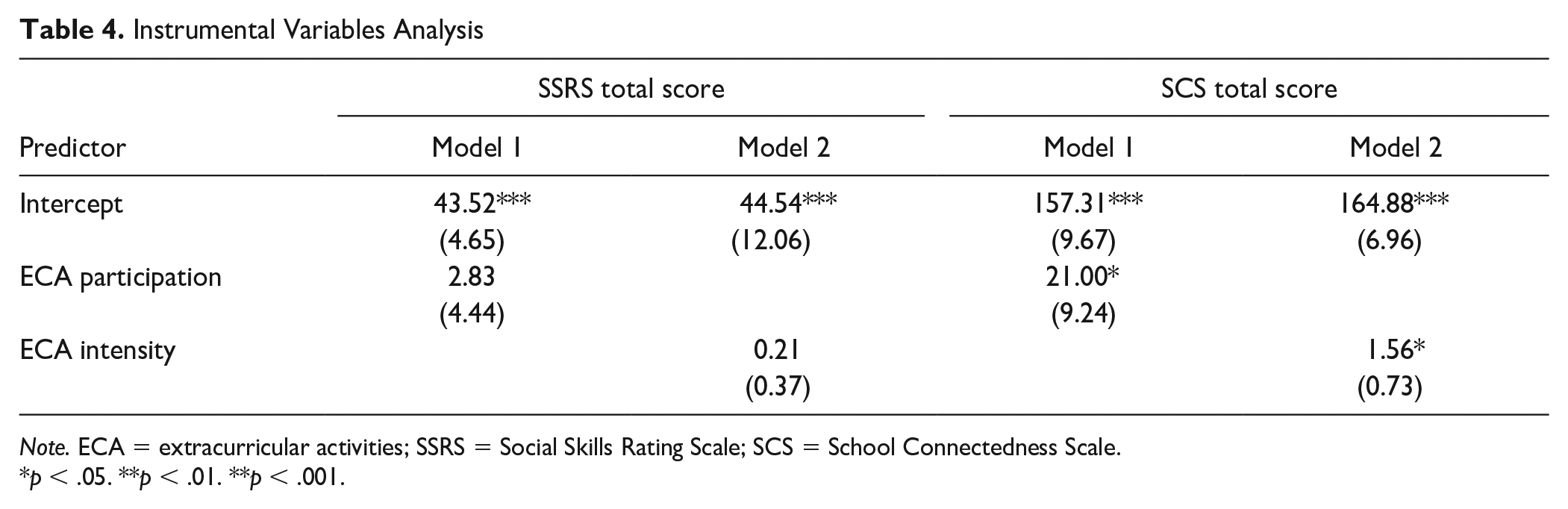
Note. ECA = extracurricular activities; SSRS = Social Skills Rating Scale; SCS = School Connectedness Scale.
p < .05. **p < .01. **p < .001.
Discussion
Students with EBD experience a host of negative outcomes ranging from poor peer and adult interactions to high rates of school dropout (Mitchell et al., 2019). Deficits in social competence and lower rates of school engagement play a role in these outcomes and have been the target of school-based interventions for decades. Programs like Check and Connect (Sinclair et al., 1998) and social skills training (Cook et al., 2008) have been shown to be effective in the research (What Works Clearinghouse, 2013, 2015), yet outcomes for students with EBD remain poor. Given the challenges these students present for teachers, it is important to refine and improve existing interventions while seeking new avenues to improve outcomes.
The present study examined the relation between ECA participation, school engagement, and social competence for students with EBD. Findings indicate students who report participation in ECA also reported higher levels of school engagement and social competence. These results provide initial evidence supporting and promoting participation in ECA by students with EBD appears to be associated with improved outcomes in the areas of social competence and school engagement. The benefits of ECA participation have been well established for typically developing students (Allen et al., 2018) and ECA may serve as a supplement to existing interventions for students with EBD addressing student engagement and social competence (e.g., Check and Connect).
In the present study, 60% of subjects reported some sort of participation in ECA with 55% of these students reporting participation in more than one activity. These rates of participation are comparable with those reported by Larson and Verma (1999) for the general population of students (between 50% and 70%) and aligned with data from the NLTS2 (57%; Wagner et al., 2004) and NLTS3 (59%; Lipscomb et al., 2017) regarding rates of participation in organized group activities of students with EBD. More subjects reported participating in team sports than any other type of activity followed by performance or fine arts activities and organized service activities. One possible explanation for ECA participation by students with EBD is that clear performance feedback is a basic tenet of ECA (Mahoney & Stattin, 2000). This means participants are likely to receive both praise and corrective feedback from adult coaches or sponsors as well as participating peers. Students who are motivated by peer and/or adult attention may be reinforced by these interactions. Furthermore, students with EBD who possess valued skill sets such as athletic ability are likely to increase their levels of social status if they experience success in their sport (Liu et al., 2004). It is also possible that students with EBD with higher levels of skill sets, like athletic ability, are granted more latitude regarding social behaviors and academic performance. This latitude may lead to higher rates of participation despite poor academic and social competence.
Although it is encouraging that students with EBD are participating in ECA, their rate and intensity of participation are much lower than the comparison sample of typically developing peers. One possible explanation is the social and academic deficits common among students with EBD (e.g., poor attendance, low academic achievement, failing grades, conflicts with adults and peers, and excessive disruptive behavior) may make participation more difficult (Kauffman & Landrum, 2018; Lane et al., 2006). Many schools require passing grades to be eligible for participation and an ability to interact positively with peers and adults to maintain participation, both hallmark struggles for students with EBD (Meier et al., 2018). Still, over half of this sample was able to meet minimum requirements to actively participate in at least some ECA. This encouraging finding indicates there are activities available for students with academic and behavioral problems.
The present study supports and extends previous research related to the positive effects of ECA on important outcomes to students with EBD. The results demonstrate that as the rate of participation in ECA increases, there is a positive and statistically significant change in social competence and school engagement (engagement). While this study utilized a relatively small sample, the results are strong, and compared with most intervention research requiring an intensive investment of time and funding, it can be assumed these results occurred naturally. That is, participation in ECA is voluntary and students self-select into an activity of their choosing. Furthermore, these ECA would exist regardless of the presence of students with or at risk of social competence deficits or low rates of school engagement unlike typical interventions that only exist when there is a need. This supports the notion ECA may serve as a readily available value-add to existing evidence-based interventions such as social skills training and Check and Connect. Encouraging and supporting ECA participation provide students with EBD important opportunities to practice skills learned through social skills instruction with peers and adults in authentic settings. Given the highly structured nature of ECA and the presence of performance feedback (Mahoney & Stattin, 2000), this may be one opportunity to program for maintenance and generalization, a deficiency of many social skills training programs (Maag, 2006).
The strongest relation was found between ECA intensity and school engagement (β = 0.44). This extends similar findings related to typically developing students (Denault & Poulin, 2009; Fredricks & Eccles, 2006; Martinez et al., 2016). Higher intensity of participation means students spend more hours per week participating in ECA. As intensity of participation increased, so did self-reported school engagement. This result is significant given the consistent challenges faced by students with EBD, particularly regarding dropout (Mitchell et al., 2019). Increasing school engagement has been described as an important factor in reducing dropout rates among high school students (Archambault et al., 2009; Reschly & Christenson, 2004). Finn’s (1989) participation-identification model illustrates that as students increase involvement in classroom and ECA, they are more likely to develop a sense of identification with the school and reduce their likelihood of dropout. Given ECA are readily available in schools and throughout most communities, supporting and promoting involvement in ECA may also serve as a value-add to existing interventions designed to increase school engagement.
The present study also found the relation between ECA participation, school engagement, and social competence is not moderated by EBD status, special education status, gender, or race in any of the models. While 71% of the sample received special education services, only 38% were specifically identified for Emotional Disturbance (ED), with the remaining identified in other special education categories like specific learning disability (SLD) and other health impairment (OHI). Identifying students for special education services is the responsibility of the IEP team, and given the established challenges with the federal definition of ED and underidentification (Mitchell et al., 2019), it is not surprising many students in this study were not labeled as ED. Regardless, even after controlling for these factors, ECA participation had a significant effect on the social competence and school engagement for students in this study. This finding indicates participation was not limited only to students without the ED label who may, despite meeting all inclusion criteria, possess a skill set better suited to ECA participation.
As noted, the relation between ECA participation and positive outcomes has been well established, but little research has examined the direct pathways between ECA participation and these positive outcomes. Carbonaro and Maloney (2019) reported a small and but increasing direct relation between participation and academic and socioemotional skills in students from third to eighth grade, but their study did not extend to high school students. The present study found no significant direct relation between ECA participation and increases in social competence, which may indicate students who report participation already possessed the minimum requisite social skills needed to participate in their chosen ECA. Furthermore, the study included students with both internalizing and externalizing behaviors, so it is possible that significant social competence deficits were not present in all the included students. These results suggest ECA may not be effective as a stand-alone intervention to improve social competence for students with EBD. However, utilizing ECA participation in conjunction with evidence-based social skills training to provide students with opportunities to practice learned skills in an authentic environment with peers may still benefit students with EBD. Future research should examine the effects of combining ECA with social skills training in high schools.
The present study did find a statistically significant direct link between ECA participation and reported school engagement for high school students with EBD. This important finding provides initial evidence promoting and supporting ECA involvement may result in increased engagement and these increases are not necessarily limited to students who would have reported higher levels of engagement regardless of participation. This finding is especially significant for students with EBD who are at a greater risk of decreased engagement and eventual drop out than any other group of students. It provides initial evidence that using ECA as a supplement to existing engagement interventions may serve to enhance those interventions and lead to improved outcomes for high school students with EBD.
Implications for Practice
Most children, including students with EBD, have unique talents and interests that go unnoticed in school. Promoting and supporting ECA participation involves explicitly making students with EBD aware of opportunities to get involved and then teaching the skills necessary for successful participation in ECA. Teachers and staff need to explain available opportunities and encourage participation beyond the usual student-initiated process of “sign up and show up.” Students with EBD who lack social competence and may have compromised peer and adult relationships at school will likely require assistance and support when choosing and starting an ECA. Another important consideration when promoting and supporting ECA is the human capital (e.g., athletic ability, intelligence, coordination, and singing ability) required for participation in a given activity. Students with little athletic ability may not realize the benefits of ECA through participation in sports. Exposing students to ECA requiring a level of human capital the student does not possess may lead to failure resulting in loss of precious social capital and further disengagement from school. Failed attempts at participation may also compromise future opportunities and desire to participate in ECA. Furthermore, students with social competence deficits may need to be taught skills related to asking for information, clarifying instructions, seeking performance feedback, expressing frustration, working with others, and being part of a team. Teachers and staff may benefit from observing practices or meetings and determining important skills required for success. These specific skills may then become a focus during training.
Promoting and supporting ECA participation can benefit students with behavioral challenges who either do not qualify for special education services and/or are receiving support through a school-wide positive behavior interventions and supports (SWPBIS) framework. The implementation of SWPBIS Tier 2 interventions like social skills training in high schools is challenging for a myriad of reasons including the focus on content instruction and a shifting schedule (Meyer et al., 2021). ECA of all varieties are a familiar and well-established part of high schools and can serve as a supplement to existing Tier 2 interventions without adding complexity or additional duties to already busy teachers and school staff.
School personnel implementing social skills training programs for high school students with EBD should consider including some sort of ECA participation as a goal of the program. School-based ECA present the opportunity for the social skills trainer and ECA coach/sponsor to communicate about the needs of the student and the social goals of participation. This communication can help the coach/sponsor facilitate opportunities for the student to practice learned social skills and serve as a prompt to deliver appropriate performance feedback on the student’s social interactions. In addition, open lines of communication between the social skills trainer and coach/sponsor may lead to information about social deficits not addressed during social skills training. These deficits can then be addressed during future social skills lessons and may ensure continued successful participation by the student.
Finally, the circular relation between academic performance, social behavior, and ECA participation should encourage schools to reevaluate policies limiting involvement in ECA based on grades and discipline referrals. Policies like “no pass-no play” are rooted in the idea that participation in ECA is reinforcing and removing or withholding this activity when students receive a discipline referral or fail a class will lead to reductions in problem behavior and/or poor academic performance. This system is likely effective for students without academic or behavioral problems. However, for students with EBD who struggle academically and behaviorally, these types of policies may act as a barrier to participation in ECA. Instead of “zero tolerance” policies limiting participation by students who may benefit the most from ECA, schools should investigate policies encouraging participation and use student behavioral and academic improvement as a factor in determining eligibility for participation. Implementing “participate to pass” policies have the potential to leverage the benefits of ECA while maintaining the important connection between academic and behavioral progress and ECA participation. Such a policy would shift the connection between ECA and school performance away from the exclusionary approach currently in place and embrace an inclusionary mindset fostering growth instead of punishing failure.
Limitations
The results of this study are promising, but not without limitation. First, data are from a larger study focused on intervention effects on high school students with EBD and we used a statistical procedure designed for exploring potential causal pathways with observational data. Future studies should manipulate access to and involvement in ECA. Relatedly, our sample included students from both treatment and control conditions from the larger study. Although we found no treatment effects on the dependent variables in this study and no impact on the coefficients of interest, future studies should include samples of students who all receive business-as-usual if comparing ECA participation as was done here. Second, there were a number of data limitations, namely, the lack of demographic variables for the typically developing students and limited sample size. Future research should collect larger samples of both typically developing students and students EBD and ensure complete demographic records. Relatedly, additional covariates should be explored, including history of suspensions, attendance, and other variables that may be correlated with ECA participation. Last, future studies should explore longitudinal connections between ECA, social competence, and school engagement, and the distal effects of these on academic achievement for students with EBD.
Conclusion
Extracurricular activities are prevalent in high schools and communities across America and the benefits associated with them make participation a potentially valuable addition to current interventions for students with EBD. Extracurricular activity participation may provide an avenue for students with EBD to improve behaviors related to academic performance, generalize and maintain skills they learn through social skills training programs, and increase their engagement with school, which is a key component in reducing dropout. Results of this study indicated participation in ECA by students with EBD is related to improved levels of reported social competence and school engagement. These results are encouraging and open the door to future research into new ways to improve the outcomes for this population of students.
Supplemental Material
sj-docx-1-bhd-10.1177_01987429231166675 – Supplemental material for Exploring Extracurricular Activity Participation, School Engagement, and Social Competence for Students With Emotional and Behavioral Disorders
Supplemental material, sj-docx-1-bhd-10.1177_01987429231166675 for Exploring Extracurricular Activity Participation, School Engagement, and Social Competence for Students With Emotional and Behavioral Disorders by Sean T. Wachsmuth, Timothy J. Lewis and Nicholas A. Gage in Behavioral Disorders
Supplemental Material
sj-docx-2-bhd-10.1177_01987429231166675 – Supplemental material for Exploring Extracurricular Activity Participation, School Engagement, and Social Competence for Students With Emotional and Behavioral Disorders
Supplemental material, sj-docx-2-bhd-10.1177_01987429231166675 for Exploring Extracurricular Activity Participation, School Engagement, and Social Competence for Students With Emotional and Behavioral Disorders by Sean T. Wachsmuth, Timothy J. Lewis and Nicholas A. Gage in Behavioral Disorders
Footnotes
Appendix
Author’s Note
Sean T. Wachsmuth is now affiliated with Bemidji State University, USA.
Declaration of Conflicting Interests
The author(s) declared no potential conflicts of interest with respect to the research, authorship, and/or publication of this article.
Funding
The research reported in this manuscript was supported by the Institute for Education Sciences, U.S. Department of Education, through Grant R324C080006 to Lehigh University. The opinions expressed are those of the authors and do not represent views of the Institute of the U.S. Department of Education.
Supplemental Material
Supplemental material for this article is available on the Behavioral Disorders website with the online version of this article.
References
Supplementary Material
Please find the following supplemental material available below.
For Open Access articles published under a Creative Commons License, all supplemental material carries the same license as the article it is associated with.
For non-Open Access articles published, all supplemental material carries a non-exclusive license, and permission requests for re-use of supplemental material or any part of supplemental material shall be sent directly to the copyright owner as specified in the copyright notice associated with the article.
