



Abstract
Across Australia, early childhood (EC) teachers can work in a variety of settings in the prior-to-school sector (profit and not for profit). The EC teacher qualification must be recognised by the Australian Children’s Education and Care Quality Authority. The settings are governed by differing enterprise bargaining agreements (EBAs) that oversee salaries and conditions. The literature reveals that gender, socioeconomic status and diversity underpin the experiences of the early childhood education and care (ECEC) workforce, yet the impacts of these dynamics are largely silent in the policy discourse. This article provides a snapshot of EBA variations for early childhood teachers by looking at salaries and conditions across the different settings and states. Drawing on EBAs that are publicly available, a content analysis was conducted to determine salary and condition variation. Findings show strong variation across settings, state and qualification, suggesting EC teachers need to be aware of the variation when they are applying for positions and engaged in enterprise bargaining with their employer. Questions must also be raised with the sector, however, on why there is strong variation for the same qualification, especially given the current shortage of EC teachers across Australia.
Introduction
In Australia, around 337,305 children aged four and five years attended an EC programme for at least 15 hours a week (Australian Bureau of Statistics, 2024). These particular programmes are expected to be delivered by a qualified EC teacher across all states and territories in Australia as per the National Quality Framework for Australia (Australian Children’s Education and Care Quality Authority [ACECQA], 2018). EC services that cannot find a qualified early childhood teacher can apply for a waiver.
Findings from Australian Institute for Teaching and School Leadership (AITSL, 2024) show emerging trends with the EC teacher workforce that show problems with sustainability, with around 31% of EC teachers wanting to leave the profession before retirement and 36% of EC teachers unsure around career intentions. Furthermore, EC teachers completing EC and/or primary qualification have declined by an average of 4.9% per year since 2018 (AITSL, 2024).
The Australian Children’s Education and Care Quality Authority (ACECQA) oversees EC teacher education and EC teacher qualifications. As such, bachelor degrees deemed suitable can be 3–4 years’ duration and postgraduate qualifications (graduate diploma or master) can be 1–2 years’ duration. All EC teacher education programmes are assessed to include key knowledge areas as well as supervised placement days under the direction of a supervising EC teacher (80 days for bachelor qualification and 60 days for postgraduate qualification).
While EC teachers can graduate from the same programme, their salary and working conditions can vary depending on the enterprise bargaining agreement (EBA) that is in place with the employer. This is dependent on the type of settings. The different types of settings also have different management structures. Examples of different types of settings include:
private for profit;
private not-for-profit community managed;
private not-for-profit other organisations;
state/territory and local government managed;
state/territory government schools;
independent school;
Catholic schools; and
not stated/other.
As such, there is no standard agreement for EC teachers in Australia which describes salary and working conditions. In this article, we provide a snapshot of the variation in salary and working conditions across the service types and states in Australia. Our aim is to explore the variation of salary and working conditions of EC teachers within the same sector who are undertaking the same type of paid work. We begin with an overview of the literature and explore notions of class, gender and migration as characteristics of the workforce. Our article is based within the postulations of Bourdieu, where we explore cultural capital and cultural reproduction within the field of early childhood education. The article concludes with key implications for teacher education programmes and current EC teachers.
Literature Review
Within Australia, there are early childhood education (ECE) workforce issues where ‘accessing a consistent supply of high quality, job-ready educators remains a challenge across all service types’ (ACECQA, 2021, p. 27). While it is acknowledged that ECE education plays an important role in supporting economically productive societies (ACECQA, 2021), how the actual workforce can be supported has been problematic within Australia. While ECE has requirements around staffing qualifications and ratios to support EC quality, actions to ensure a sustained workforce have stalled within Australia (Gibbs et al., 2024). Furthermore, the staffing crisis is nothing new and has shaped the landscape since the 1980s. As Elliott suggested in 2006, ‘the crisis in EC staffing predicted since the 1980s has arrived’ (p. 35).
Findings show that respect for EC teachers in society is low, where there is a view that any real learning only begins at school (Boyd & Newman, 2019; Liu & Boyd, 2018). The low status and poor working conditions (including low pay) for ECEC have also been reported in Australia for over 14 years with the Productivity Commission reports (Australian Government Productivity Commission, 2011, 2014) and the National ECEC Workforce Survey (Irvine et al., 2016), and more recently Nutbrown (2021). A similar scenario has also played out in the United Kingdom, where staff in 2017 were expected to have higher levels of qualification but salaries and working conditions were poor (Payler & Davis, 2017). In 2024, a publication by the Independent Education Union in Australia highlighted a $30,000 (AUD) difference in wage between a four-year primary school–trained teacher and a four-year early childhood–trained teacher (Independent Education Union of Australia NSW/ACT Branch, 2024). It can be noted that in 2025, the Australian government did fund a wage increase (15% above the modern awards) where providers opt in by applying for the payment (Australian Government Department of Education, 2025). According to media reports, however, the wage increase has not been passed on because of application difficulties to the government, which has led to a significant portion of the allocated funds remaining undistributed (A Current Affair, 2025). Furthermore, the United Workers Union set up a website where educators can report if the wage increase has been received and issues of understaffing (earlyedqualitycheck.org.au; United Workers Union, 2025). Without adequate consideration of better salaries and working conditions of EC teachers, the investment in ECE to improve children’s learning and futures is not possible (Jackson, 2021; Thorpe et al., 2023). The success of ECE initiatives in the main relies on the quality and stability of the workforce, yet persistent issues of low pay, limited professional recognition and challenging work environments continue to affect EC teachers. These conditions not only impact teacher retention and morale but also compromise the consistency and quality of care and education provided to young children. Previous research has shown that bachelor-qualified early childhood teachers have the potential to enhance the quality of early childhood education and support better outcomes for children (Manning et al., 2019). Research from Australia also shows that those working in the ECEC sector undertake teacher education qualifications to take up positions in schools where wages, conditions and community perceptions are better (Thorpe et al., 2020).
The low pay remains problematic in Australia. Thorpe et al. (2020) also suggest that small wage increases are less likely to be effective than structural reform. In such a low pay sector, the support in the workplace becomes highly important for retention (Thorpe et al., 2020). Without support, attrition is likely. EC educators may also rely on others for financial support to support their financial costs to be able to continue to work in ECE (McDonald et al., 2018). As McKinlay et al. (2024) acknowledge, it is important that EC educators can see investment in their qualifications to also assist and ‘sustain the quality of provision for the benefit of all children and the nation’ (p. 17).
Gender, Socio-Economics and Diversity in the ECEC Workforce
Gender, socio-economics and the migrant status of the ECEC workforce have been given scant attention in research and policy (Gide et al., 2022). Osgood (2005) suggests that it is not desirable to view gender and class structures in isolation when engaging in debate about the status of the ECEC workforce. Yet, it is challenging to find official statistics that give credence to the intersectional aspects of the Australian ECEC workforce. As such, aspects of gender and class may be silenced within the professionalisation of workforce structures and policy in early childhood.
Dynamics of gender, socio-economic and diversity impact the everyday experiences of the ECEC workforce (Andrew, 2016). In 2007, UNESCO claimed that ‘[c]arers and educators working in ECEC programmes and institutions [are] almost uniformly female’. In current times, despite efforts to shift the gendered nature of the ECEC workforce, whether conducted in the home or in institutional settings, ECEC labour continues to be highly gendered worldwide. Socio-economic inequalities also shape this gendered workforce due to the low wages and poor status. ECEC anecdotally is often delivered by migrant women from culturally and linguistically diverse backgrounds (CALD; Gide et al., 2022) whose socio-economic status is not known.
The National Early Childhood Education and Care Workforce Census collects information about the ECEC workforce, including age, gender, qualification and longevity of work, but information about socio-economics and CALD is not available. This leads to absence of data about the CALD workforce, and the Australian Bureau of Statistics data about the overseas-born ECEC workforce is ambiguous (Gide et al., 2022). A deeper understanding of the makeup of the workforce could support ways of tapping into potential benefits of such a diverse workforce. It is also important to note that the devaluing of ECEC does not preclude workers finding it enriching and meaningful (Boyer et al., 2013).
Postgender conceptualisations contest the binarist gender model associated with the ECEC workforce and question the unrepresentative nature of the workforce and the very logic of childcare. Andrew (2016) argues that a gender-specific view does not see caring responsibilities as human tasks positioned within structural problems. This leads to ongoing societal devaluation of ECEC work. Andrew goes on to contend that researchers need to shift the lens from the ‘missing men’ discourse, ‘to understand how and why feminized occupations generally are so poorly valued’ (p. 1747).
Emotional Labour and Capital
Emotional labour involves the everyday emotional performances of EC educators. In contrast, emotional capital described by Andrew (2015) encompasses skills and dispositions that can be embodied through practice of emotional labour. Unlike emotional labour, emotional capital is viewed as an embodied resource. It goes beyond mere performance and becomes a form of capital that EC educators can draw upon. Emotional capital represents a valuable resource shaped by experience and reflection.
Emotional capital is used to explore gendered educator practices implicated in ECEC. To do this, we refer to Reay’s (2000) study on mothers’ involvement in their children’s schooling. Reay employs the concept of emotional capital to describe this work drawing on Bourdieu’s concept of capital. Bourdieu does not use the notion of ‘emotional capital’ in his work but does foreground affective relationships. Bourdieu (1998) writes about the practical and symbolic work of mothers, suggesting that ‘this work falls more particularly to women who are responsible for maintaining relationships’ (p. 68). Within the Australian ECEC professional context, the emotional capital that educators mobilise can be demonstrated through the strong, nurturing relationships they establish with children, alongside the consistent emotional support (AGDE, 2022).
Emotional stress is of concern to the ECEC workforce. Andrew (2015) interviewed Australian childcare educators and examined how everyday emotional work becomes embodied ‘and the role that this emotional capital plays in moderating workforce issues such as burnout or low morale’ (p. 351). They foreground three aspects of emotional capital – empathy, insight and resilience – that educators employ to respond to the complexities associated with their ECEC work. They show how these aspects are of value to the work of EC educators. Therefore, the complex emotional work of EC educators’ needs to be acknowledged and valued. As Andrew (2015) contends, ‘rather than simply exploiting its exchange value within the wider systems of early childhood education and care’ (p. 362), the use-value of emotional capital requires mobilising. Rather than blaming conditions at the service level for the stress and burnout associated with intense emotional work, it needs to be understood at a systematic level as requiring more than temporary solutions.
Mental Health and Professional Well-Being
ECEC quality is impacted by educator capacity. As noted above, the working conditions of ECEC educators have implications for mental health and well-being. Corr et al. (2015) conducted a survey study with 366 family day care (FDC) educators. They found that while they experienced low psychological stress and moderate well-being, 41.7% reported psychological distress. Corr et al. (2015) write that ‘Effort and overcommitment were significantly related to increased odds of psychological distress, where social support was associated with higher mental health wellbeing’ (p. 70). The authors advocate for promotion of mental health and well-being in FDC. This research underscores the importance of supporting EC educators’ mental health and well-being to enhance overall quality of care for children. Early educators who feel valued and have balanced work conditions are better equipped to provide quality education and care for young children and their families.
The literature reports that levels of emotional exhaustion and issues associated with well-being were of concern prior to the COVID-19 pandemic (Thorpe et al., 2020) and intensified during pandemic times. The COVID-19 pandemic posed challenges for families and the ECEC workforce but also emphasised the crucial role of ECEC in young children’s lives. In 2021, Murray et al. (2025) conducted survey research with 104 ECEC centre directors/educators and 102 families, exploring well-being and educator–family relationships. The authors found that robust professional well-being and resilience contribute to strong family engagement. Prioritising regular communication with families and fostering a sense of community and continuity also supported the growth of family relationships. Nurturing collaborative relationships with families involved providing individual assistance and connecting families with each other. These findings provide insight into the importance of ECEC directors’/educators’ well-being for supporting strong family collaborations, emphasising that facilitating family engagement in ECEC needs to consider educator well-being, especially in the post-pandemic context (Hine et al., 2022; Jackson, 2020).
Poor educator well-being can lead to high turnover rates, affecting both quality practice and educator–family relationships (Thorpe et al., 2020). The Early Childhood Professional Well-Being Questionnaire (ECPW-Q) is a tool designed to assess the well-being of EC educators. The tool was completed online by 368 Australian EC educators (McMullen et al., 2020). Canobi et al. (2024) examined the educators’ scores on three factors of this tool, Belonging and Connection, Impact Evaluation, and Safety, identifying five professional well-being subgroups. These subgroups varied in terms of job satisfaction, consideration of resigning and intention to leave the field. These authors found that decreased safety perceptions and below-average belonging, connection and safety contribute to turnover intentions. EC educators with low professional well-being experience poor belonging, connection, negative views of their impact and weak job satisfaction. These findings have implications for developing policies and practices that address educators’ multifaceted well-being and feelings of overall satisfaction, factors which directly impact their retention in the profession.
EC educators often face emotional burnout, heightened stress and diminished well-being (Irvine et al., 2016). Compared to many other professions, educators in this field report significantly higher levels of stress and depression (Reupert, 2022). The emotionally and physically demanding nature of caring for and teaching young children places a considerable strain on educators, making them especially susceptible to burnout and emotional fatigue (Herman et al., 2018). This vulnerability affects not only the educators themselves but also the quality of their interactions with children. It is suggested that there are implications for educators experiencing stress, depression or burnout and a reduced ability to provide responsive, high-quality teaching.
Leadership and Retention
Recent Australian research highlights leadership as a pivotal factor in fostering work environments that promote educator well-being and support staff retention (Jones et al., 2019). Although low pay continues to challenge the ECEC sector, studies indicate that strong leadership can help offset the issues by cultivating positive and supportive workplace cultures (Ciuciu, 2024). Berger et al. (2022) explored job satisfaction among EC educators to uncover reasons behind high attrition and early retirement. The study revealed that the leadership style of centre directors significantly influenced overall staff satisfaction. Similarly, Thorpe et al. (2020) reported that leaders who encourage autonomy, articulate a shared vision, communicate transparently and ensure access to adequate resources can improve retention, even when salaries are less than ideal. Conversely, research by Logan et al. (2020) found that ineffective leadership creates environments marked by unmet needs, power struggles and interpersonal tensions – factors that diminish job satisfaction and increase staff turnover.
Nevertheless, Alchin et al. (2019) emphasise that many leaders face difficulties in retaining educators, often due to a lack of formal training in leadership and the dual demands of teaching and administrative responsibilities. This underscores the need for more robust leadership development initiatives and stronger support systems to help build positive workplace environments and enhance retention. These challenges are not unique to Australia but are seen globally. In countries such as the United States and the United Kingdom, education leaders continue to grapple with leadership responsibilities amidst limited resources and minimal support. Budget constraints frequently hinder efforts to offer competitive salaries and continuous professional development opportunities (Organisation for Economic, Co-operation and Development [OECD], 2019). Even in well-funded Nordic nations, where government investment in early education is high, maintaining fair compensation and career growth prospects for educators remains an ongoing issue (Broström et al., 2018).
National Workforce Strategy and Professional Capital
The National Workforce Strategy (Education Services Australia, 2021) provides an agenda for ECEC in Australia for 10 years. The intention is that it leads to significant benefits for the ECEC sector and its workforce, including ‘improved and more equitable educational and developmental outcomes for children, increased intergenerational mobility; and higher female labour market participation’ (p. 4). However, Nolan (2023) argues that the strategy eschews the professional capital of EC educators. She writes: ‘All educators are expected to engage with policy documents that guide practice and achieve national standards for service provision regardless of qualification or experience’ (p. 220). Also given the complex and often under-acknowledged professional status of ECEC (Fenech & King, 2022), it is of value to consider the volume and composition of the professional capital that EC educators have and bring to the field.
Professional capital supports educators to be professionals and is embedded in the ‘professional work, professional capacity and professional effectiveness’ of educators (Hargreaves & Fullan, 2012, p. 1). Professional capital involves skills and knowledge (human capital), working with colleagues (social capital) and the capacity to ‘make wise judgements and decisions that are at the heart of all professionals’ actions’ (decisional capital; Hargreaves & Fullan, 2012, pp. 5–6). Professional capital, then, includes ‘the resources, investments, and assets that make up, define, and develop a profession and its practice’ and are intricately connected to teaching standards (Hargreaves & Fullan, 2012, p. 92).
Professional capital is complex and linked to ideas about professionalism. Nolan (2023), in her study with certificate-III qualified educators from three locations in Victoria, Australia, found that differences were apparent in how the study participants were informed and supported in building and enacting professional capital within a ‘managerial professionalism discourse’ (p. 228). Themes across the data spoke to inequity in ‘access to professional learning opportunities to further develop their knowledge and skills, the valuing of life experiences as pertinent to being an effective EC professional, clear divisions of labour determined by level of qualification that influenced what knowledge was valued, and differences in educator agency in the decision-making process’ (p. 228).
The study showed that the workplace for some of these certificate-qualified educators had a deficit view of their professional competence and did not recognise their collaborative knowledge and skills. Nolan (2023) wrote:
This renders the educator with little professional agency to put into practice what they value being and doing (Sen, 1999). This can be seen as a missed opportunity to harness the human capital of colleagues to enhance programme provision for young children attending ECEC services and to build their confidence to push back against externally imposed discourses of professionalism. (p. 229)
As such, Nolan (2023) advocates for broader conceptualisations of professionalism that account for more than a managerial lens externally imposed. Within this perspective, it also acknowledges the nuanced roles of EC teachers.
Theoretical Framework
In terms of professionalism, Bourdieu (1984) argues that the common image of a professional does not only take into account the job and income but also invisible secondary characteristics, such as gender, class, age and cultural backgrounds. Secondary characteristics are usually perceived as the foundational social values of the job in terms of prestige and professional status in the society (Bourdieu, 1984). As Andrew (2015) suggests, ‘professionalism, in being defined according to traditionally male workforce values, may never allow those working in childcare to realise any exchange value for the complex emotional work that they undertake’ (p. 316). The higher ranked a profession is in occupational hierarchy, the less emphasis is placed on direct involvement and practical skills as part of its socially endorsed definition of professional competence (Bourdieu & Passeron, 1990). In the field of ECEC, being a highly feminine profession where there is a strong emphasis on direct involvement in children’s learning and development, the recognition of these practical skills becomes less prominent in the professional hierarchy.
According to Bourdieu and Wacquant (1992), the field can be conceptualised ‘as a network, or a configuration, of objective relations between positions’ (p. 97). These positions are determined by the agents’ situations, their possession of power (capital) as well as their other positions within the field (Bourdieu & Wacquant, 1992). Since every field is shaped differently based on the game played on it (Thomson, 2014), it is important for agents to strategically develop the realisation of the schemes of perception (habitus) and accumulate field-recognised resources (capital) to compete for power within a field.
Capital exists in various forms such as economic, cultural and symbolic (Bourdieu, 1977, 1986). Under specific conditions, these forms of capital can be converted into one another. In Bourdieu’s theory, economic capital holds significant importance since it possesses monetary value and can act as the foundation for other forms of capital (Bourdieu, 1986).
Cultural capital, as another important type of capital, exists in three states: an embodied state of disposition, an objectified state of cultural goods and an institutionalised state such as qualifications (Bourdieu, 1986). As Andrew (2015) observed, EC professionals who are degree-qualified as teachers are more impacted by the professionalisation processes compared to their colleagues who have fewer credentials. This is observed as EC educators who have lower qualifications are more likely to have lower economic capital including reduced income (Jackson, 2022). The possession of this institutionalised cultural capital can transform into economic capital despite the risk of entrenching inequality in the EC field (Andrew, 2015).
Symbolic capital, as defined by Bourdieu and Wacquant (2013), encompasses various forms of capital that signify a sense of distinction. Symbolic capital, along with the associated profits and power, is contingent upon the relationship between distinct and distinctive characteristics, manifested as status, prestige and social recognition (Bourdieu & Wacquant, 2013). As Schinkel and Noordegraaf (2011) note, professionalism can be conceptualised as a form of symbolic capital, encompassing a struggle over the legitimate definition that reflects the historically constructed field of power. This explains why professions that are traditionally highly regarded are still more visible and vice versa.
Focus of Study
This study explores current salaries and conditions of EC teachers across Australia in four states in metropolitan areas. The states selected as part of the snapshot were New South Wales, Queensland, Victoria and South Australia. Four different early childhood settings were also reviewed to explore variation across salary and conditions. These settings included: (1) long day care for profit; (2) long day care not for profit; (3) community kindergarten; (4) private school kindergarten. In this profiling, kindergarten is taken as the year before formal schooling, even though the terminology may vary across the states reviewed. We then review these findings through a Bourdieusian lens to explore notions of capital.
Method
A content analysis was conducted for this study with a focus on salary and conditions within enterprise bargaining agreements. Krippendorff (2004) describes content analysis as ‘a research technique for making replicable and valid inferences from texts (or other meaningful matter) to the context of their use’ (pp. 23–28). This includes ‘two domains, the texts and the context, are logically independent, and the researcher draws conclusions from one independent domain (the texts) to the other (context)’ (p. 27). In this way, the researchers can also create constructions based on existing theories and practices. In this case, we draw upon Bourdieu’s perspectives to inform our data.
A screening sample was conducted of 49 enterprise bargaining agreements available for public viewing on the Australian Fair Work Commission (FWC). A selection of agreements was made based on the identification of a service within an identified postcode within a state. The postcode was based in a metropolitan area and represented mid to high Socio-Economic Indexes for Areas (SEIFA) – Index of Relative Socio-economic Advantage and Disadvantage (IRSAD) Quintiles for all local government areas (LGAs). Across the agreements, data on salary and extra conditions were collected. The service type was also collected. Manifest coding was implemented (what was directly written in the agreement) with no latent coding conducted. All information was placed into an Excel file for consideration and comparison by one of the members of the research team. Another member of the research team also created an Excel file and compared data to ensure consistency in the identification of data and allow a form of interrater reliability across two researchers. The agreements were screened twice to ensure reliability and validity from within the research team. This resulted in close to 100% agreement in the data collected within the Excel sheets from the 49 agreements.
Once interrater reliability had been established, other members of the research team also reviewed the data as a form of member checking. The variation within the content collected in the Excel file was also discussed within the research team across multiple meetings to discuss and contextualise the existent variation across locations and service type. The research team had prior experience on working conditions and salaries across states and were able to confirm the context with insider perspectives. The overall findings were then discussed in terms of cultural capital.
Findings
A summary of the salary amounts is shown in Table 1, with categories of service type and state. From the table, long day care for profit providers appear to receive the lowest remuneration for their work compared to the other sectors. Community kindergartens and private school kindergartens appear to have the highest remuneration for EC teachers across the four states.
Variation in salaries across states and settings from 49 agreements.
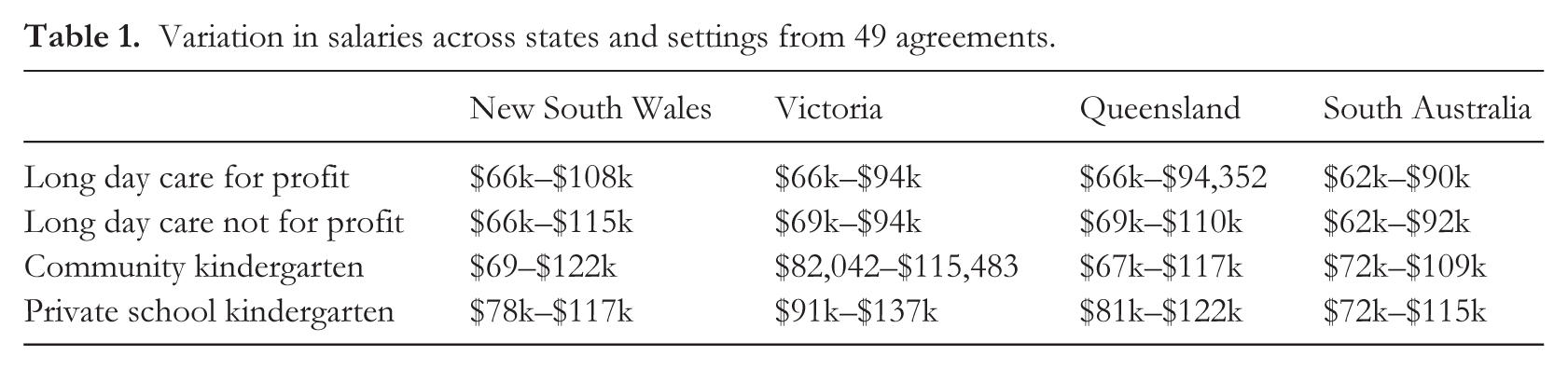
Table 1: Further analysis of 49 enterprise agreements indicates substantial disparities in remuneration for early childhood educators across Australian states and service types. Salaries range from $62,000 in South Australian long day care (not for profit) to $137,000 in Victorian private school kindergartens, representing more than a twofold difference nationally. Private school kindergartens consistently offer the highest remuneration in each state, while long day care, particularly in South Australia, records the lowest. Community kindergarten salaries generally exceed those in long day care, with notable variation between for-profit and not-for-profit services that is not uniform across states and territories. These differences are influenced by enterprise agreement coverage, state funding models, employer type and other contextual factors.
Many of the enterprise bargaining agreements (EBAs) were based on years of experience, with some EBAs having higher payment levels for classifications of senior or expert teacher. Sometimes there would be other formal processes or conditions for these classifications (such as supervision of preservice teachers). Some EBAs also paid differences between a three- and four-year qualification and whether the candidate held a master’s or doctoral qualification (i.e., higher payment for a four-year qualification and a higher payment for extra qualifications).
Within the EBAs, allowances were also given for extra leadership responsibilities. For example, if the teacher was the educational leader or director, there was an extra allowance given. Often the allowance was based on the number of children as a scaled-up amount.
Some EBAs also provided school fee discounts if a teacher’s children attended the private school, or allowances for professional learning as part of keeping up registration requirements. This would be considered a benefit of working within that particular school setting. Beyond pay, other important conditions were described in the EBAs.
Time working away from children that may include planning of a pedagogical programme was another significant variable between enterprise agreements. The Victorian Early Childhood Teachers and Educators Agreement 2020 (Fair Work Commission [FWC], 2021a) provides for a full-time teacher to be engaged in non-teaching tasks for 12.5 hours a week. This multi-employer agreement covers the working conditions for teachers and educators within 383 different community-based providers of kindergarten programmes in the Australian state of Victoria (FWC, 2021a); 12.5 hours is far above the minimum two hours dictated within the Education Services (Teachers) Award 2020 (Fair Work Ombudsman [FWO], 2024). In Queensland, more than 280 kindergartens are managed by a community organisation: Creche & Kindergarten Early Learning (C&K, 2025). Under their EBA, 7.5 hours a week is considered the minimum non-contact time for a teacher (FWC, 2022). In New South Wales, a medium-sized community organisation, SDN Children’s Services, which manages 27 preschool services (SDN Children’s Services, 2025), provides a minimum of four hours’ non-contact time (FWC, 2025).
In South Australia, the majority of kindergartens are part of the state government education department (Department of Education South Australia, 2025). Staff are employed under the same agreement as teachers in the government school sector (South Australian Employment Tribunal, 2024). Their agreement describes a maximum face-to-face teaching time as 24 hours, allowing for 13.5 hours spent on other tasks, labelled non-instruction time (South Australian Employment Tribunal, 2024).
With the Education Services (Teachers) Award 2020 (FWO, 2024) setting that minimum requirement of two hours a week of non-contact time, there are enterprise agreements that do not provide above that minimum standard. As an example, the multi-employer enterprise bargaining agreement provides for significant wage increases without lifting the two-hour award minimum non-contact time. That agreement covers a range of not-for-profit and for-profit long day care centres (FWC, 2024; Hegarty, 2024; Lucas, 2024). The 2021 Goodstart Agreement (FWC, 2021b) mirrors the two-hour award minimum for non-contact time, with more time guaranteed as group size increases. Similarly, the Presbyterian Ladies College Agreement (FWC, 2023) covers teachers in a Melbourne Private School’s early learning centre and does not specify a minimum non-contact time for them. Instead, the award minimum represents their entitlement due to time not being defined in the agreement itself.
These agreements vary, too, on annual leave. Goodstart offers the award minimum of four weeks to teachers in long day care with an option to purchase more (FWC, 2021b; FWO, 2024). SDN also allows the purchase of up to two weeks of additional leave on top of the four provided by their agreement for the long day care services (FWC, 2025). However, they do not expect attendance during school term breaks for their preschools (FWC, 2025). The C&K agreement has four weeks’ leave, plus additional hours for ‘non rostered relief time’ of between 62 and 70 hours a year (FWC, 2022). On top of that, services in ‘regional, rural and remote areas’ allow school holidays to be counted as non-contact time (FWC, 2022, p. 6). The Presbyterian Ladies College Agreement (FWC, 2023) does not require attendance during school term breaks. Rather than just non-attendance, the Victorian Early Childhood Teachers and Educators Agreement 2020 (VECTEA, 2020) provides for school holidays as periods of leave (FWC, 2021a).
Differences exist, too, between these agreements on the provision of sick (often referred to as ‘personal’) leave. In a full-time role, VECTEA 2020 grants 15 days to a staff member per year (FWC, 2021a). The Presbyterian Ladies College Agreement (FWC, 2023) has 12.5 days. The SDN Children’s Services agreement allows for 12 days (FWC, 2025). The C&K agreement and the Goodstart agreement allow only for the Award minimum of 10 days (FWC, 2021b, 2022; FWO, 2024).
While informal arrangements or organisational policy may grant extra non-contact time, sick/personal leave and annual leave to teachers employed under the award or under a workplace agreement, the minimums within an enterprise agreement or award are enforceable (Hamberger, 2020). In this sense, they represent a true minimum with policy or informal arrangements being an ‘extra’.
Discussion
The findings from this study have highlighted significant disparities and variation in the salaries and working conditions of EC teachers across Australia. It should be noted that variation occurs across service type as well as state. While it can be assumed that EC teachers are undertaking the same role within the sector of educating and caring for young children, how they are reimbursed for that varies significantly. This article has shown that there is no common standard across the sector.
Private school kindergartens appear to have high starting salaries and working conditions, and this may be because the EBA covers all teachers within the school and provides parity for the kindergarten teacher with the primary and secondary school teacher. In other settings, however, this opportunity for parity with a primary or secondary teacher is reduced because of the structure of the EC settings. Community kindergartens also appeared to have strong salaries for EC teachers across the states explored.
Variation also emerges between three-year and four-year EC teacher qualifications within the EBAs. This is interesting to note, since EC teacher education in some states appears to be moving towards three-year qualifications from a four-year qualification. As such, this provides problems for graduates who need to be aware that they will have a reduced salary with a three-year qualification compared to a four-year qualification. A three-year qualification may also be difficult for paid parity with primary and secondary teachers who complete four-year qualifications.
Implications for Workforce Sustainability
The literature echoes the findings of this study, highlighting long-standing workforce issues. ACECQA (2021) recognises the challenges in maintaining a consistent supply of high-quality, job-ready EC educators across all service types. Despite the well-documented importance of EC education in supporting economically productive societies, actions to sustain the workforce have stalled (Gibbs et al., 2024). The staffing crisis in ECE is not new, with Elliott (2006) emphasising that this crisis had been predicted since the 1980s. Our findings align with these observations, showing that the lack of standardisation in pay and conditions exacerbates the existing workforce challenges.
Furthermore, poor working conditions, including low pay, have been identified as key reasons educators leave the sector (Thorpe et al., 2020). This study suggests that the inconsistency in EBAs only serves to perpetuate the financial instability many EC educators face, leading to career dissatisfaction and early exit from the profession. As McDonald et al. (2018) noted, some educators rely on external financial support to remain in the field, which is not a sustainable solution.
These findings underscore the critical role of organisational leadership in translating high-level policy goals into everyday practices and dynamics that directly impact employee retention (Thorpe et al., 2023). Effective leadership acts as a vital conduit, aligning strategic objectives with the practical realities of the workforce to support long-term engagement and retention.
Gender, Socio-Economic Inequity, and Migration in the Workforce
The variation in salaries and working conditions also reflects broader socio-economic inequalities and gendered workforce dynamics. EC education remains a highly feminine profession, with UNESCO (2007) noting that the sector is almost entirely female. This gendered nature of the profession is compounded by socio-economic inequalities, with low wages being a defining characteristic of the sector. As our study shows, the disparity in pay across different service types only deepens these inequalities.
The intersection of gender, class and migration status as the invisible characteristics of the profession (Bourdieu, 1984) further complicates the landscape. Migrant women from culturally and linguistically diverse backgrounds often constitute a significant portion of the EC workforce in Australia (Gide et al., 2022). However, the lack of data on the socio-economic status and diversity of this workforce leads to the silencing of these important factors in policy discussions. The absence of authentic data also hinders the ability to address the unique challenges faced by these educators.
This points to a critical gap in research and policy – without acknowledging the intersectional dimensions of the EC workforce, meaningful reforms in pay and working conditions may remain elusive.
Emotional Labour and Capital
The literature also highlights the significant emotional labour undertaken by EC educators. Andrew (2015) introduces the concept of emotional capital to describe the embodied skills and dispositions that educators develop through their work. Emotional capital, including empathy, insight and resilience, becomes a valuable resource for educators, allowing them to navigate the emotional demands of their roles. However, as Andrew (2015) contends, this emotional work often goes unrecognised and unremunerated, contributing to burnout and low morale. In Bourdieu’s works, caring labour is often viewed in relation to femininity which ‘is misrecognized as a natural, essentialized personality disposition’ (Skeggs, 2004, p. 23). The values attributed to the caring practices, including the emotional labour, result in a gendered form of cultural capital, which contributes to the symbolic violence. Bourdieu and Wacquant (1992) argue that symbolic violence is a ‘violence which is exercised upon a social agent with his or her complicity’ (p. 167). The dominated class actively produces and reproduces the rules of the game, establishing which forms of capital are privileged or undervalued.
Our findings suggest that the variation in working conditions across different service types likely exacerbates the emotional strain on educators. Those working in lower-paying, less secure settings may experience greater emotional stress due to financial instability, lack of support and undervaluation of their work. This highlights the need for policies that not only address financial compensation but also recognise and support the emotional demands placed on EC educators.
Mental Health and Professional Well-Being
The findings indicate the significant impact of emotional labour on EC educators and its impact on burnout and retention. This situation is exacerbated by poor leadership, which fosters environments where staff needs go unmet, power imbalances emerge and interpersonal tensions escalate. These types of conditions undermine job satisfaction and drive higher turnover (Logan et al., 2020). Thorpe et al. (2020), in contrast, contend that leaders who promote autonomy, articulate a shared vision, communicate openly and provide sufficient resources can enhance staff retention, even in the context of low salaries.
The variation in working conditions also has implications for the mental health and professional well-being of EC educators. Previous studies (Corr et al., 2015; Thorpe et al., 2020) highlight the high levels of emotional exhaustion and psychological distress experienced by educators, which have been further distinguished by the COVID-19 pandemic. Our findings suggest that inconsistent salaries and benefits across different EBAs may contribute to poor mental health outcomes, particularly in service types where working conditions are less favourable.
As the Early Childhood Professional Well-Being Questionnaire (ECPW-Q) findings suggest, low perceptions of safety belonging and connection contribute to higher turnover rates (McMullen et al., 2020). This study supports the notion that better pay and working conditions can lead to improved well-being and retention, allowing educators to provide higher-quality education and care.
Implications for Policy and Workforce Reform
Addressing the variation in salaries and working conditions for EC teachers requires comprehensive policy reform. The National Workforce Strategy (Education Services Australia, 2021) provides a framework for supporting the ECE sector, but, as Nolan (2023) argues, it overlooks the professional capital of educators. Our study identifies the need for a national framework that standardises EBAs across service types, ensuring that all EC teachers are compensated fairly and have access to professional development opportunities regardless of their employment setting.
A focus on building and supporting educators’ professional capital – including their human, social and decisional capital (Hargreaves & Fullan, 2012) – is essential for the long-term sustainability of the ECE workforce. Without such reforms, the sector will continue to struggle with high turnover, low morale and declining interest in EC teaching qualifications.
Conclusion and Implications
Across the sector, there appears strong variation in wage and working conditions for EC teachers who are delivering the same type of educational programmes. While variation across states and territories is perhaps part of the usually identified differences for most wages and conditions in Australia, the strong variation across setting types appears extreme. As such, it is important that EC teachers are aware of this variation in wage and working conditions when they are applying for EC teacher positions as well as negotiating future enterprise bargaining agreements. It is also important that future EC teachers are made aware of variation in wage and working conditions during their teacher education training to become fully aware of the EC sector.
Maintaining a stable ECEC workforce is essential to delivering high-quality services both in Australia and globally. Despite ongoing systemic issues – such as inadequate pay, low professional status and high stress levels – leadership consistently emerges as a key factor in shaping educator well-being and retention. Leadership approaches that emphasise clear communication, a shared vision and both emotional and professional support can help alleviate some of the sector’s structural challenges. Yet, many ECEC leaders are under-prepared, lacking the necessary training, resources and time to meet these expectations effectively. This highlights the urgent need for greater investment in leadership development and the creation of supportive organisational frameworks.
Despite the challenges posed by workforce instability, it is clear that many educators are deeply passionate about their profession. Rather than leaving the field, they at times seek support systems, indicating a desire to stay if fair compensation and working conditions are provided (McDonald et al., 2018). This contrast between educators’ dedication and the systemic issues contributing to turnover highlights both a significant challenge and a crucial opportunity for meaningful intervention.
Further attention could also be given in the policy discourse to the interrelationship between gender, socio-economic status and diversity in the ECEC workforce, and how this dynamic is shaped by, and shapes, the working conditions and wages of the ECEC workforce.
This study is limited in that services were only selected based on postcode screening in metropolitan areas in the states selected. Thus, a complete scope of the sector was not conducted on variations. It may be that variation in regional or rural areas is different to variation in metropolitan regions. It is important that future studies engage in a greater scope of EBAs to review. Future studies could also build on the scoping work by interviewing EC teachers around their choices for certain settings and also around EBAs. This includes how enterprise agreements are discussed and implemented with EC teachers in Australian contexts. This study starts to build research in this area, helping to reduce the current void in research in Australia.