




Abstract
Many authors view manuscript rejection as editorial bias, especially when it is before peer review. Often, the real reason is simple: basic journal instructions are not followed. Common problems include missing ethical declarations, absent checklists, improper formatting, and failure to follow journal-specific guidelines. These requirements are not arbitrary. They are based on frameworks such as ICMJE, CONSORT, PRISMA, and STROBE, which promote transparency, reproducibility, and efficiency. When authors do not comply, peer review slows, research is wasted, and scientific communication weakens. Good publishing starts before peer review, with close attention to journal instructions.
Keywords
Authors often think that rejection means editors are biased, especially if it happens before peer review. In fact, many papers are rejected simply because they do not meet basic submission standards, not because of their scientific quality.
The first editorial check assesses basic technical and ethical requirements before peer review. Often, papers are returned not for poor science but for missed submission steps. This is critical in low-resource settings, where limited staff and resources mean avoidable mistakes waste time and effort. 1 A systematic scoping review found that adherence to healthcare reporting guidelines remains inconsistent and often inadequate.²
Submission requirements are not just formalities. They put essential publishing standards into action. For instance, the ICMJE gives guidance on authorship, conflicts of interest, ethical approval, trial registration, and related duties.³ Reporting frameworks such as CONSORT for randomized trials, 4 PRISMA for systematic reviews, 5 and STROBE for observational studies, 6 help make sure research is complete, clear, and easy to understand.
Evidence consistently shows that using these frameworks improves reporting quality, enhances reproducibility, and makes research findings more useful to clinicians, researchers, and policymakers. 7 Given the widespread availability of journal instructions and reporting guidelines, compliance should be routine. Yet many manuscripts still fail editorial screening for a simple reason: the instructions were not followed.
Editors see recurring avoidable problems: manuscripts formatted as theses or for other journals, missing ethical statements, incomplete title pages, ignored word limits, missing checklists, and off-style references. These are not minor; they determine if a manuscript proceeds to peer review.
The first editorial check makes sure submissions meet basic standards before reviewers spend time on them. If something is missing, editors send the manuscript back for corrections. This is not meant to block authors, but to keep the process fair, transparent, and efficient. Despite these measures, editorial experience shows that authors often do not comply with the editor’s instructions and submission requirements.
The impact is not just formatting. Poor reporting wastes research, slows use in clinical practice, and erodes trust in evidence. In low-resource areas, these mistakes waste more scientific and public health resources.8–10 Adherence to reporting standards is not just a technical step; it is about research integrity, fairness, and the wise use of resources.
Pressure to publish for career advancement, grants, or visibility leads authors to rush their submissions. Some reuse manuscripts from other journals without updating, leading to incorrect formatting, missing declarations, and outdated references. While journals should strive for clarity and consistency, some journals also contribute to the problem by maintaining excessively complex, repetitive, or poorly designed submission systems that increase administrative burden without improving reporting quality. Simplifying these processes would improve compliance. Nevertheless, authors should ensure submissions meet the required standards.
Research clearly demonstrates that adherence to reporting frameworks remains inconsistent, even after many years of guidance. 11 Journals should set clear expectations, editors need to rigorously enforce them, and authors are obligated to act responsibly to ensure transparency and reliability in health research. 12 Initiatives such as the EQUATOR Network play a crucial role in strengthening reporting standards worldwide. 13
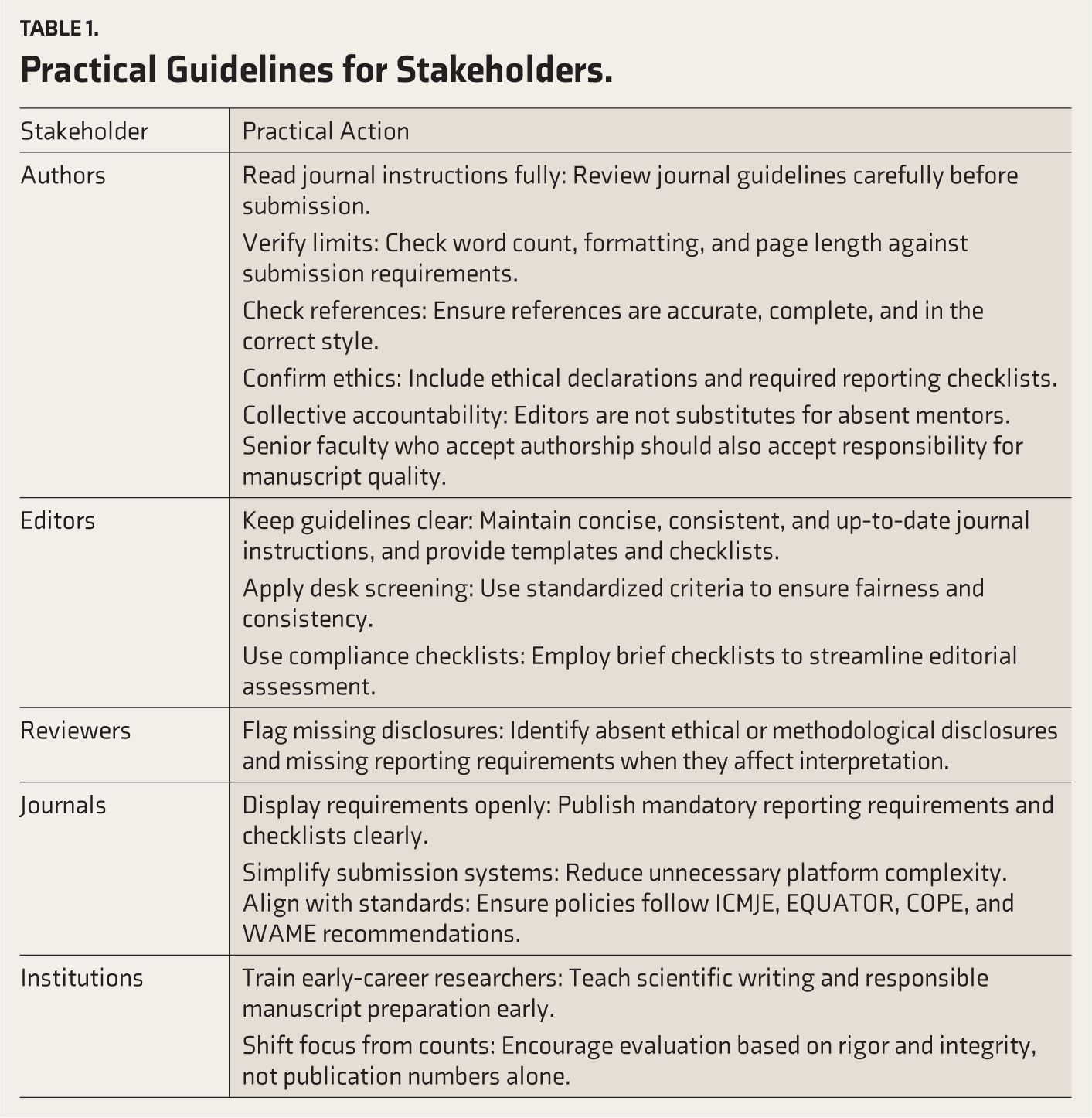
To avoid delays and maintain trust in research, all parties must follow journal instructions. Table 1 gives practical steps for authors, editors, reviewers, journals, and institutions.
Practical Guidelines for Stakeholders.
Submission guidelines are not obstacles for authors. They protect the quality, reliability, and trustworthiness of scientific evidence.
Conclusions
Scientific publishing demands shared responsibility from all participants. When authors neglect instructions, editors, reviewers, and readers face the consequences. Editorial decisions are debatable, but guidelines are not. Instructions are essential for responsible communication. Before questioning an editorial decision, authors should first check whether they actually read the instructions.
Footnotes
Acknowledgements
Nil.
Declaration of Conflicting Interests
The author declared no potential conflicts of interest with respect to the research, authorship, and/or publication of this article.
Declaration Regarding the Use of Generative AI
The author used the AI tools (ChatGPT and Microsoft Copilot) only for language editing and formatting. Grammarly was also used to improve grammar and language. The author reviewed all content and takes full responsibility for the final manuscript.
Funding
The author received no financial support for the research, authorship, and/or publication of this article.
Citation Diversity Statement
The author is committed to equitable citation practices and has made conscious efforts to include work from authors of diverse genders, geographic regions (including the Global South), career stages, and historically marginalized groups. The aim is to support a more inclusive and representative scholarly record.