




Abstract
Based on theories that low self-esteem is related to criminal activity (Oser, 2006) and high self-esteem derives from competence and worthiness (Harter, 1985; Mruk, 2006), this study measured changes in community singers’ attitudes toward prisoners and documented changes in prisoner singers’ perceptions of their social competence. Participants included 22 prisoners and 22 community members over a 12-week choral program in a medium-security Midwest state prison. Community members completed an Attitudes Toward Prisoners Scale (ATPS) before meeting the prisoners and after the group’s concert. All answered open-ended questions summarizing the choir experience. Results indicated a significant difference (p < .01) between pre- and post-measurements on the community singers’ ATPS. Two categories emerged from the open-ended answers: relationships with others and self-gratification. Five subcategories under relationships with others emerged from prisoner singers’ data: feeling respected, getting along with others, making friends, connecting to something outside prison, and improving family relationships.
The US criminal justice system incarcerates more prisoners than any other nation in the world (Gallagher, 2008; Walmsley, 2009). The population of incarcerated persons in the USA grew at an average annual rate of 3.4% in the decade between 1995 and 2005 (Bureau of Justice Statistics, 2005). Such facts about the US prison population are particularly troubling with respect to public attitudes. Tonry (2009) suggests that harsh public attitudes toward criminals in the USA have affected US punishment policies. According to Roberts and Hough (2005), people have high levels of misunderstanding and misperceptions and low levels of knowledge about the criminal justice system that directly affect attitudes toward prison issues.
Research has indicated that prisoner involvement in education programs results in reduced recidivism (e.g., Anderson, 1995; Steurer, Smith, & Tracy, 2001). Batiuk, Lahm, McKeever, Wilcox, and Wilcox (2005) compared post-secondary educational programs with pre-college and vocational education programs and found that post-secondary programs more consistently reduced recidivism. According to Oser (2006), participation in educational programming while incarcerated was associated with raised self-esteem levels. This finding was of interest because research has also indicated a correlation between crime and low self-esteem (Oser, 2006). However, definitions of self-esteem have varied. Some have defined self-esteem as competence (White, 1959; James, 1983; Crocker & Park, 2003, 2004). A problem with this approach is that it presents self-esteem as dependent only on one’s successes and failures, which is a tenuous base on which to build identity. Harter (1985) maintained that ‘perceived competence or adequacy in domains rated as important is strongly predictive of self-worth’ (p. 7). Others defined self-esteem as worthiness (Rosenberg, 1965; Epstein, 1980; Baumeister, Campbell, Krueger, & Vohs, 2003), but this approach also has its flaws. Baumeister, Smart, and Boden (1996) suggested that a sense of high self-esteem or inflated worthiness may actually be associated with increased criminal activity. It is problematic to define self-esteem in a one-dimensional way as either worthiness or competence, particularly in the context of prisoners. Worthiness without competence can lead to over-inflated egos and narcissistic traits, while competence without worthiness can result in failure and possible hostile responses to such disappointments. Mruk (2006) tried to overcome these shortcomings by defining self-esteem with a two-factor theory: ‘the lived status of one’s competence at dealing with the challenges of living in a worthy way over time’ (p. 28), a definition that also includes both competence and worthiness.
Research in music has indicated that choral singing has positive benefits for diverse populations. Nelson (1997) examined the role of a choral program for males, aged 11 to 17, living in a residential facility. These youths reported that their performance in choir was special to them, the relationships they developed in choir were different from those with other residents, and some moments in choir were wonderful, difficult to verbalize, and deeply personal. Bailey and Davidson (2002) examined homeless men’s perceptions of participation in a choir and indicated that group singing positively influences emotional, cognitive, and social processes. Faulkner and Davidson (2006), who investigated the role of singing for male members of a large men’s choir in a remote rural area in the northeastern part of Iceland, found that men perceived singing in harmony as both a metaphor for human relationships and as an enriching and essential way to relate to others.
Richmiller (1992) examined former members of a prison choir 27 years after they had participated in a choir program between 1963 and 1966 in Moberly, Missouri. She found that the prison choir program had a remarkable influence on the rehabilitation and self-esteem of inmate singers. Participants stayed goal-oriented and learned life skills such as self-discipline, socialization, and communication. Silber (2005) reported that female choristers (N = 7) in an Israeli prison choir created an ‘alternative community’ within the prison. Her choir members formed positive bonds and learned to accept criticism, to express feelings, and to listen with greater skill. Elvera Voth founded and directed a prison choir in Kansas between 1995 and 2007. Through a generous donation of his time and talent, Robert Shaw led a sing-along to fund this choir and initiate a non-profit organization, Arts in Prison, Inc. that has continued support of this choir and other arts programs in prisons (Cohen, 2008).
Cohen (2009) examined well-being measurements before and after two performances of a group of prison inmates singing in a choir with prison inmates not singing in a choir. Results indicated significant differences on four subscales: emotional stability, sociability, happiness, and joviality between the prisoner singers and the control group. Cohen (2007) investigated the experiences of singing in a joint inmate–volunteer prison choir. Findings indicated that participation in choir helped inmates develop a sense of group responsibility, improve their self-esteem, and cultivate feelings of accomplishment. Additionally, volunteer singers formed positive opinions of inmates as they worked together to prepare and perform concerts, although this finding was not the result of a specific measurement tool designed to examine attitudes toward prisoners, and these volunteers had previously participated in this prison choir prior to data collection. The minority of non-prisoners in this choir, only between 2 to 12 out of 30 community members, attended weekly rehearsals inside the prison. Most of these people interacted with the prisoners on concert days – being involved in one two-hour rehearsal, a one-hour break, the concert performance, and informal interactions after the performance. Major contextual differences in prisons and choirs exist. Repeated studies to confirm or refute findings are warranted.
In these examples, choral singing in a variety of contexts has provided opportunities for building meaningful human relationships among participants within those particular ensembles. Such findings suggest the possibility that the music education profession and what we do as music educators is much broader than just focusing on sonic dimensions of music making and understanding. A sole focus on a choir’s sonic dimensions may hinder the rich possibilities for developing human relationships and complex aspects of self-knowledge that choral singing has the potential to cultivate. The words sung, the embodied aspects of choral singing, and the group processes are all tools for expanding participants’ social awareness, provided the choir director purposefully facilitates communal growth among the members. With respect to participants’ self-knowledge, members may develop a heightened internal awareness of their bodily use in singing (i.e., alignment, breath, and phonation). Potential for participants to develop self-esteem is possible through choral singing; however, as mentioned above, if not balanced between worthiness and competence, increased self-esteem might be harmful to the individual’s psyche.
Because research has indicated that participation in an educational activity raises prisoners’ self-esteem levels and choral singing appears to be a natural means to develop social relationships and experience social acceptance, I reasoned that participation in a prison choir comprised also of community members would positively change their attitudes toward prisoners, which would, in turn, affect the prisoner singers’ perceptions of worthiness and competence. The purpose of this study was to measure changes in community members’ attitudes toward prisoners using the Attitudes Toward Prisoners Scale (Melvin, Gramling, & Gardner, 1985) and to document changes in prisoner singers’ perceptions of their social competence through open-ended survey items. To this end, the following research questions were investigated: (a) What changes will occur in volunteers’ responses to the Attitudes Toward Prisoners Scale before and after participating in a prison choir project? (b) How will prisoners self-report their experiences after their first three months of participation in a combined community–prisoner choir?
Method
Participants
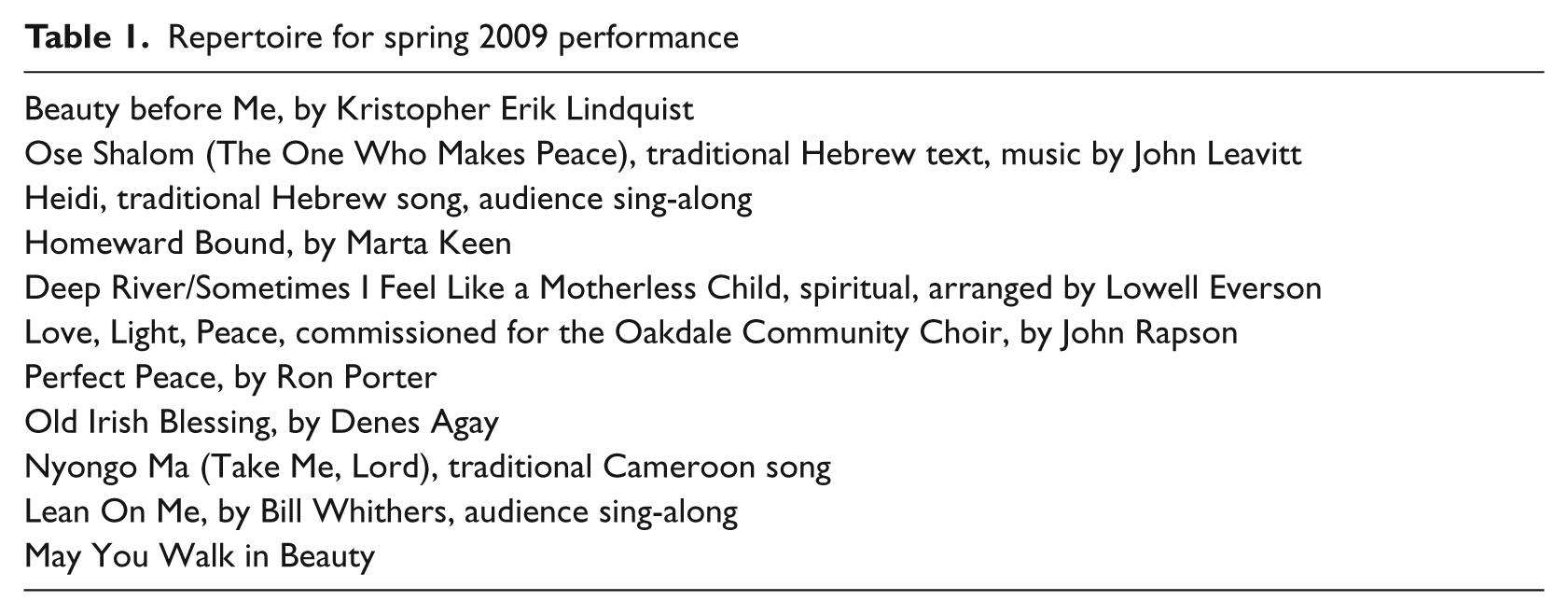
The prisoner singers’ ages at the time of the final performance ranged from 20 to 70 years (M = 40.36; median age = 39). The community singers’ ages at the time of the final performance ranged from 20 to 64 (M = 41.00; median age = 52). Self-reported ethnic identities among community singers were 100% Caucasian. Self-reported ethnic identities of prisoner singers were 9.09% (n = 2) African American and 4.55% (n = 1) Hispanic, while the majority (86.36%) self-reported that they were Caucasian. Ethnic identities of the entire prison population were slightly different than the prisoners in this study: 72.13% Caucasian, 18.84% African American, 7.36% Hispanic, 1.34% American Indian or Alaska Native, 0.003% Asian or Pacific Islander. These differences in ethnic representation of prisoner singers may have been because the literature performed was not appealing to African Americans (see Table 1 for a list of literature performed), lack of effective recruitment efforts geared toward African American prisoners, and/or the intense racial boundaries evident in prison life.
Repertoire for spring 2009 performance
Procedures
This project occurred during the inaugural season of a joint community–prisoner choir (n = 44) in a medium-security state prison in the Midwest. The choir met weekly for 12 consecutive Tuesday evenings. These 90-minute practices began and concluded with two different a capella ‘anchoring songs’ and included vocal warm-ups, pitch-matching activities, and rehearsal of choral arrangements accompanied by a volunteer pianist. Anchoring songs served as a sense of ritual and consistency for the choir. The choir performed the same two anchoring songs at the beginning and end of the concert. See Table 1 for the names of these anchoring songs and the list of the concert repertoire. The conductor, who held a PhD in music education, had 15 years of experience in directing choirs, three years in assisting a prison choir, and six months in directing a prison choir. Her approach to rehearsals was positive, energetic, and enthusiastic. Although the choir membership included vast differences in musical and vocal backgrounds (a university voice professor, community members with lots of choral experience, and a number of individuals who had never been in a choir previously), in the 12-week season, the group developed a fine sense of musicianship, vocal expression, and choral tone. In addition to the choral activities, about half of the choir members participated in a writing component. Although this component was not examined systematically as a part of this investigation, it is introduced here because its purpose was to build camaraderie among the members and offer an opportunity for participants to communicate directly with the conductor. The director deemed this opportunity important because personal conversation was restricted by the guidelines established by the prison. The interactions between the inside and outside singers occurred within the context of the rehearsal: informally for roughly 3–5 minutes before and after rehearsals, and a short time in between selections during practice. The choir season concluded with two performances in the prison’s gymnasium. For security reasons, the prison administration requested one concert for prisoners and staff members and a separate concert for outside guests. The second performance was audio recorded and CDs from the concert were mailed to prisoner family members who were on their visiting lists.
Some might argue that quantitative and qualitative approaches are incompatible. Johnson and Onwuegbuzie (2004) recommend what they call ‘contingency theory’ (p. 22) where researchers choose either one of these approaches or a mixed methods approach, depending upon what method will best answer the research question(s) and be most appropriate for the specific circumstances surrounding the investigation. The research questions in this study examine volunteers’ attitudes toward prisoners and prisoners’ self-reports regarding their participation in a combined prisoner–community member choir. Quantitative data were collected through the Attitudes Toward Prisoners Scale (Melvin et al., 1985), designed to measure individuals’ feelings about prisoners to volunteer singers (n = 12), twice, once at a volunteer training session prior to the initial visit to the prison, and again after the choir’s first concert. This 36-item Likert scale has a moderate to high split-half (r = .84 to .92) and test–retest (r = .82) reliability. Melvin et al. reported no evidence of response distortion and considerable evidence of validity through comparisons between selected groups. Examples of scale items include: ‘Prisoners are different from most people,’ ‘In general, prisoners think and act alike,’ and ‘Most prisoners can be rehabilitated.’ Data were collected after I received approval from the affiliated university’s Institutional Review Board. This approval was sufficient for the warden of this correctional facility.
Qualitative data were collected through a seven-item open-ended questionnaire completed by prisoner singers and volunteer singers after the concert. These items included: (1) Think back to when the project started to now. What have you noticed about yourself? How has the experience affected you? Any surprises? (2) What has this prison choir experience meant to you? (3) What does singing in this chorus do for you, in terms of memories, pleasure, or pain? (4) (for prisoners only) Has this experience affected your life in prison? If so, in what ways? If not, why not? (5) In what ways, if any, has this experience affected important people in your life? (6) Have your relationships with people changed since you’ve been in this chorus? (7) Any other comments you wish to share? I then analyzed answers to these items following an open-coding, axial coding, and selective coding process (Charmaz, 2006).
Results
Comparison of pre and post Attitudes Toward Prisoners Scale data by means of a Wilcoxon signed-rank test indicated that there was a significant difference from beginning to end (z = 2.82, p < .01, two-tailed). The pretest mean was 105.92, with a standard deviation of 11.45, while the posttest mean was 119.33, with a standard deviation of 9.97. These data indicate that the choir had a positive effect on community members’ attitudes toward prisoners.
After analyzing the prisoner singers’ and volunteers’ open-ended answers, two primary categories emerged from the data: self-gratification and relationships with others. For the prisoner singers, four subcategories were linked to self-gratification: self-confidence, enjoyment, self-expression, and a realization that they can contribute positively to the outside world. Prisoners repeatedly mentioned that after participating in the choir, they perceived themselves as more confident: ‘Since joining the choir I’ve noticed more self-confidence around other people. At first I was scared thinking I might not be good enough or maybe looked down upon. As the practices went on, I felt more confident of myself.’ Enjoyment was linked to learning songs from different languages and cultures, performing for an audience, seeing smiles at the rehearsals, conversing with volunteers, and singing. Volunteers’ subcategories linked to self-gratification included enjoyment and gratitude for their own lives: ‘It gave me a new perspective on being grateful for the things in my life.’ ‘Now I see my ability to come and go as I please as a privilege.’
With respect to the category of relationships with others, five subcategories emerged from prisoner singers’ data: feeling respected, getting along with others better, making new friends, connecting to something outside prison, and improving family relationships. One remarked: ‘The way we were treated . . . was like meeting a family I haven’t seen for years.’ Some prisoners remarked that relating to others is difficult in prison. One stated that he was surprised that he can ‘relate to normal people without apprehension’ after 40 years of incarceration. Another prisoner stated: ‘It has changed the way that I view other inmates.’ Others remarked: ‘I’ve noticed myself becoming more outgoing and communicative’ and ‘I’ve made a lot of friends since joining the choir.’ The relationships created with community singers have given the prisoners a connection to life outside the institution. One described the community singers as ‘a bit of fresh air every Tuesday.’ Some prisoner singers noted that their family members were happy they were in choir and that being in the choir provided more topics to talk about during visiting time or on the phone.
Community members stated that the experience shattered their stereotypes of prisoners: ‘I expected them to be in shackles and not interested in singing. I quickly learned that they were human beings, had feelings, and wanted to sing.’ Some mentioned that they had developed a new awareness of issues related to prisons, prisoners, and the criminal justice system: ‘I pay more attention to news stories relating to trials/imprisonment, and wonder what kind of experiences the perpetrator will encounter. Prisoners have taken on personalities instead of being faceless.’ One volunteer singer noted that in the context of the choir, relationships with prisoners was limited and that there was a certain ‘lack of authenticity about relationships,’ which is particularly evident in that the volunteers are trained by the prison not to share personal information. Similar to the prisoner singers, community members remarked on how they enjoyed meeting new people, both prisoners and other community singers.
Discussion
The purpose of this study was to measure changes in community singers’ attitudes toward prisoners and to document changes in prisoner singers’ social competence as a result of singing in a prisoner–community choir. Findings from this study suggested that this type of choral activity, bringing a group of over 20 people into a medium-security prison to sing with prisoners, was a new and positive experience for both groups. The data from the Attitudes Toward Prisoners Scale indicated that the community members changed their previously held stereotypes about prisoners through the process of preparing for a choral performance together. The prisoners in the choir, removed from their regular lives due to their incarceration in a correctional institution, were nervous about how the volunteers would view them, whether they would feel accepted, and whether they would be found worthy in the eyes of the outside guests. Many community singers were also nervous and uncertain about what to expect with respect to the prison and the prisoners. The opportunities to build relationships and develop social acceptance between individuals were limited because of the prison context, as one outside member remarked that the relationships ‘lacked a certain authenticity.’ He was referring to the fact that we were not allowed to discuss certain aspects of one another’s lives – outside members did not ask prisoners about their crimes, prisoners did not ask the community guests about their personal lives. Nevertheless, open-ended comments indicated that both groups appeared to value coming together to achieve a common goal. Furthermore, that common goal of choral singing provided a shared musical expression stemming from the combined contribution of their individual voices. One volunteer described it as ‘articulating beauty together.’ Many prisoners and outsiders were surprised that the group was able to develop musical competence as well as it did.
As the prisoners began to realize how much the volunteers enjoyed the opportunity to sing with them, they shifted their self-perceptions and began to realize they were ‘accepted’ by the people from outside the prison. In turn, prisoners began to build their internal social networks with other prisoners who shared their interest in choral singing and they also found new friends among the volunteer singers. Two prisoners, who perceived that their ability to relate to others had diminished considerably after years spent in prison, realized they could relate easily to people who shared an interest in music and singing. One wrote that his sanity was ‘slipping away’ the longer he was incarcerated and found choir to be an activity he valued. Another noted that he was surprised he could interact with outside people during the choral program without apprehension, particularly because he had spent 40 years in prison. According to these comments, it appeared that the choir afforded a means for prisoners to interact positively with others, that is, to feel worthy in the eyes of people they admired, as well as to provide a sense of self-gratification.
In their open-ended answers, volunteers repeatedly remarked on how much they noticed that the prisoners enjoyed the experience. Likewise, the prisoners remarked on how much they perceived the community members enjoyed the choir. An in-depth collective case study would provide a clearer understanding of these experiences. An examination of the long-term effects of a prison choir on current and ex-prisoners’ lives, in addition to how such experiences affect prisoners’ family relationships, would add to the limited research in this field.
Not all experiences in the choir are deemed positive, however. One prisoner reflected on the challenge of narcissistic personalities:
The biggest downside to the choir, as far as I'm concerned, is that I see men who are in prison basically because of behaviors dictated by overinflated egos continue to feed their self centeredness. I see this because it is something that I have to combat in myself. How do you balance efforts to lift up self-esteem against the possibility of enabling a person to stay stuck in a narcissistic delusional world where the wants and needs of others are always subservient or non-existent? Encouraging someone to step up and perform may be forcing them out of a shell of shyness or self pity. It may also, in his mind, validate his belief that he is better than those around him. It’s a swampy mess that I think needs to be in the back of our minds.
As described in the descriptions of self-esteem in the literature review, efforts toward developing participants’ self-esteem, particularly in a prison context, must be balanced by cultivating a sense of worthiness and competence.
Because prisoners have been removed from society, their self-perceptions of social acceptance and of how non-prisoners view them are restricted. In this way, incarceration may have a direct and negative bearing on their perceptions of self-worth. Conversely, if prisoners are allowed an opportunity to interact with others who share their interests, value their competence, and regard them positively, their self-perceptions of competence and worthiness will increase.
Goffman’s (1961) descriptions of inmates in total institutions, places where all parts of life of individuals under the institution are dependent upon and subordinated to the organization’s authorities, suggest that prisoners may choose to restrict their interactions with other prisoners in the facility to prevent potential misconduct. However, such forced isolation may negatively affect their emotional adjustment to life in prison. The results from this study suggest that a formal program such as a choir may provide opportunities for prisoners to meet others with similar interests who want to do something positive during their incarceration time. According to data gathered in this study, prisoners develop a sense of worthiness through their relationships with volunteers and a sense of social competence through their successful choral performances, thereby realizing the two components of Mruk’s (2006) definition of self-esteem: worthiness and competence.
These findings about the choir’s role in developing participants’ sociability may be associated with discoveries in the burgeoning field of social neuroscience. Using fMRI imaging studies, researchers contend that the human skills necessary to engage in social behavior may require a distinct set of mental processes (Mitchell, Mason, MaCrae, & Banaji, 2006). Questions arise with respect to what mental processes occur when one is singing with others. Variables such as the quality and variety of social aspects of group singing, the quality and quantity of an individual’s previous singing experiences, and whether the group singing occurs primarily by rote or note may have direct bearing on the learners’ mental processes. Perhaps people can develop these mental processes through choral singing in ways different from other social learning activities. According to Mayes, Magidson, Lejuez, and Nichols (2006), social relationships are critical to adaptive, healthy emotional regulation. In light of the importance of social relationships, findings from neuroscience, and data from this study, implications include a reevaluation of both US criminal justice practices and structured learning activities within prison systems.
These findings inform music educators, especially those who lead choral singing, in that the group interactions that we facilitate have important implications for those who participate. We need to be ‘active anthropologists’ (Sangiorgio, 2010, p. 10), paying close attention to the social relationships created within the group activities, and shaping these interactions in ways that allow individuals to develop a sense of worthiness and competence and the group to feel satisfied with their musical accomplishments and communal identity.