




Abstract
The purpose of the study was to determine Canadian secondary school choral students’ skill in singing the national anthem. The sample (N = 275) consisted of students from 12 schools, representing six provinces in Canada. Students were audio taped singing ‘O Canada’ in English, French, or in a combination of both languages and subsequently completed a questionnaire. Results indicated that few students could sing the national anthem perfectly. Although students were significantly more accurate in remembering the lyrics than in singing the melody (p < .0001), only 67% were judged proficient in lyrics whereas a mere 46% were judged proficient in melody. Possible reasons for these poor results include the frequency with which students sing the anthem in secondary schools, the fact that three-quarters named a classroom teacher in the early/elementary years as being the one responsible for teaching them the anthem, the shift to solo versus group singing in public events, and the inconsistency with which music education is delivered in elementary schools. Implications for practice indicate that more emphasis be placed on assisting choir members to sing the anthem accurately, more opportunities be provided in secondary schools for students to sing the anthem, and more curricular attention be placed on teaching students both English and French versions.
Introduction
The topics of patriotism, nationalism, and national identity in music education have been the subject of recent scholarly inquiry (Abril, 2007; Bartel, Dollof, & Shand, 1999; Beegle, 2004; Bodnar & Gilboa, 2009; Brand, 2003; Hebert, 2006; Ho & Law, 2003, 2009; Hollington, 2005; Jorgensen, 2007; Veblen, in press). Issues addressed are the connections between patriotism, nationalism, and globalization in music education (Hebert, 2006; Ho & Law, 2003, 2009), the role played by the content of music education curricula in cultivating patriotism and/or a sense of national identity (Bartel et al., 1999; Brand, 2003; Ho & Law, 2003; Hollington, 2005), the connection between the national anthem and national identity (Bodnar & Gilboa, 2009; Veblen, in press), and critique of the use of the national anthem in schools in one jurisdiction (Abril, 2007; Beegle, 2004; Jorgensen, 2007).
Hebert (2006) and Ho and Law (2003, 2009) investigated issues of patriotism and music education in Asia-Pacific countries. Ho and Law (2003, 2009) examined music education in contemporary Taiwan and Hong Kong, discussing the impact of globalization and nationalism on countries where Confucian moral values are strong, in the case of Taiwan, and where Western values were formerly dominant, in the case of Hong Kong. The authors concluded that the interplay between former ideologies and 21st-century government and global influences present a unique challenge for music educators in these two countries. Hebert (2006) reported on the first international panel on patriotism in music education convened in Seattle in 2005. Panel members noted a recent increase in patriotic content in the music education curricula of Japan and the United States. Reasons for this change are not clear; however, there is a sense that factors such as funding from corporations could influence such a change.
Brand (2003) examined song lyrics in the most widely-used music textbook series in China in terms of Confucian ideals, nationalistic content, and communist ideology employing a semiotics methodology. Results indicated that Chinese national education goals of patriotism, socialism, unity, and a strong work ethic are fostered through the music education curriculum. Bartel and colleagues (1999) reported on an on-going Canadian national research project focused on music curriculum as actual practice. The authors posit that ‘the arts can be one of our strongest expressions of culture . . . and can, in theory, help to bring us together’ (p. 13). They investigated the ‘degree to which Canadian content has been included in elementary and secondary music curricula’ (p. 13). The authors report that ‘teachers surveyed give priority to and use Canadian music to a high degree’ although they caution an attempt to generalize from these results due to the small sample of 55 participants. Adopting a different approach, Hollington (2005) explored the ‘relationships between music teachers’ sense of Canadian identity and their attitude toward Canadian music in the classroom’ (p. 10) by means of an interview study. Although, once again, one must be careful about generalizing from her results, Hollington found that all three southern Ontario teachers interviewed had a strong sense of Canadian identity and all felt that there should be more Canadian music in their curricula.
Turning to researchers who focused their attention on the connection between the national anthem and national identity, Bodnar and Gilboa (2009) conducted three experiments with Israeli subjects who were exposed to their national anthem and other stimuli and directed to write down associations that came to mind. In all three cases, Bodnar and Gilboa found that the anthem evoked feelings of nationalism. Of particular interest is an investigation by Veblen (in press) who examined the ‘multiple and contested Canadian national identity through the lens of “O Canada,” the national anthem written by a French Canadian music pedagogue’ (p. 1). Veblen contends that:
there is no doubt that a country’s national anthem indicates what is important to that society and that . . . this choice illuminates values, traditions, history, cultural context(s) and ideologies of the dominant culture in that society – and serves to highlight the struggles the dominant culture has in maintaining position and power. (p. 2)
Positing a critical view, Abril (2007), Beegle (2004) and Jorgensen (2007) question the use of patriotic music in general and the national anthem in particular in United States schools, albeit from different viewpoints. Beegle (2004) adopts an historical lens as she examines American music education during World War II and the goal to achieve American unity through music. She questions the return to this tactic in the wake of terrorist events in the 21st century. Abril (2007) takes a sociocultural approach as he examines functions of the American national anthem in society and education. He recommends an approach that allows for a variety of responses to the singing/performing of the national anthem, allowing students the freedom of individual rather than prescribed reactions. Jorgensen (2007) considers the songs that every child should learn to sing in American schools and repudiates the notion that the ‘Star-Spangled Banner,’ promoted by the Music Educators National Conference (MENC) National Anthem Project and supported by corporate interests, should be the only patriotic song children learn in school.
Acknowledging the possible detriments to teaching patriotic music in schools, we contend that one way for people to demonstrate their national identity is to know and sing the national anthem
1
and one place where the singing of the national anthem occurs is in public schools. In Canada, the frequency with which the anthem is sung differs from province to province.
2
We are interested in the singing of ‘O Canada’ in secondary schools, in particular the accuracy with which a sample of secondary school
3
choral students drawn from across the country can perform the anthem a cappella one at a time. The impetus for the investigation arose from a previous study conducted by Guerrini and Kennedy (2009) in which the researchers compared Canadian and American secondary school choral students’ skills in singing their respective patriotic songs. This study used a sample of approximately 50 students from one jurisdiction in each of the two countries (n = 102). In the conclusion to the study, the authors stated that:
While it is heartening to know that the majority of American high school students (77%) in this sample can sing their respective national anthem accurately, we are more concerned that less than half (41%) of Canadian high school students are able to sing their anthem with proficiency. (p. 37)
Guerrini and Kennedy (2009) suggested that, ‘follow-up studies that draw samples from a variety of regions within each country would provide a greater sense of the knowledge of patriotic songs across the breadth of our two countries’ (p. 38). The present investigation addresses this issue from the perspective of one of the two countries.
‘O Canada’ in Canadian schools
The anthem ‘O Canada,’ composed by French Canadians Calixa Lavellée (melody) and Adolphe-Basile Routier (lyrics), had its premiere performance in Quebec City in 1880. Various English lyrics were used with Lavallée’s melody until those written by Robert Weir for the British Diamond Jubilee in 1908 captured the imagination of the populace and became the version of choice. In 1967, Canada’s centenary year, ‘O Canada’ was approved as a national song. Official parliamentary approval followed in 1980 (Kallman, Poitvin, & Winters, 1992). Since then, the English lyrics have been altered slightly; however, the French words have remained in their original version (see Appendix 1).
As one condition of the British North America Act, which created the fledgling country of Canada in 1867, education was relegated to provincial jurisdiction. This means that, while there is considerable cooperation among jurisdictions with respect to educational standards and curriculum, each jurisdiction has a department of education which generates school policy. As a result, provinces and territories vary widely with respect to the mandated singing of ‘O Canada’ in their schools. Provincial law dictates that the national anthem be sung daily in schools in Manitoba, Ontario, New Brunswick, Nova Scotia, and Prince Edward Island. In British Columbia the anthem is to be sung at least three times a year at school assemblies and it is the principal’s duty to ensure that this policy is followed. In Saskatchewan every school is to make provision for instruction in Canadian citizenship and participation in patriotic observances and exercises; however, the practice of using the national anthem in schools varies from district to district. In the Northwest Territories (NWT), all schools have been provided with a CD where the national anthem is sung in four of the NWT’s official languages – a suggested aid rather than a dictum (Veblen, in press). In contrast, Alberta, Quebec, and Newfoundland/Labrador have no provincial regulation regarding the singing of the national anthem in schools. 4
Due to the 2010 Winter Olympics, which took place in Vancouver, British Columbia, the time to take a more comprehensive look at how well Canadian students know the national anthem seemed opportune. Schools are where we expect national identity and pride to be fostered, whether in social studies classes, civics classes, or school assemblies. 5 We reasoned that secondary school choral students would be more apt to volunteer to sing unaccompanied and alone than would elementary students or secondary students selected from academic classes and therefore we chose this age group for the study.
Six provinces representing the Canadian population from coast to coast, and including Quebec where French is the official language, were selected. Since Canada is a bilingual country, it was important to consider this aspect in the study. We decided that student volunteers could elect to sing the anthem in English, French, or in a combination of both languages. 6 Knowing that French nationalist sentiment is strong in the province of Quebec, we were particularly interested in discovering how well a sample of students in this province would perform. We conjectured that, because the national anthem is sung at the beginning of every hockey game, students in Quebec might learn the anthem by osmosis even if they do not hear it performed often at civic ceremonies.
Guerrini and Kennedy’s (2009) study did not gather any contextual or background information on participating schools, teachers, or students. In this study, background information on the national anthem and its use by participants seemed key and so we devised a questionnaire that would gather information concerning when, where, and by whom participants learned the national anthem and at what occasions they sing it currently. We also created a short questionnaire for participating teachers, asking them to tell us how often and by whom the anthem was performed in their schools each year.
Therefore the purpose of the study was to determine Canadian secondary school choral students’ skills in singing the national anthem. The questions of the study were the following: (1) do students in Canada sing accurately their national anthem relative to melody and lyrics?; (2) is there a difference between the students’ knowledge of the lyrics and melody?; (3) is there a difference among the six provinces of students’ knowledge of their national anthem?; (4) when, where, and by whom is the anthem taught to school students?; (5) at what occasions do students sing their national anthem?; and (6) how often and by whom is the national anthem performed each year in secondary schools?
Method
Participants
Secondary school students aged 13–18 enrolled in school vocal/choral classes and/or school choirs were selected for the study (N = 275). Students came from 12 schools, two each in six cities representing six provinces in Canada: Vancouver, British Columbia (n = 39); Edmonton, Alberta (n = 45): Winnipeg, Manitoba (n = 45); London, Ontario (n = 47); Montreal, Quebec (n = 52); and St. John’s, Newfoundland and Labrador (n = 47). Grades 10, 11, and 12 had the largest number of participants with 68, 81, and 69 students respectively. Grades 8 and 9 had a smaller representation with 21 and 36 student participants. These numbers have direct bearing on school grade configurations, which vary considerably from province to province. The Quebec schools enroll students from grades 7–11 and one Manitoba school enrolls students from grades 7–12. The British Columbia schools enroll students from grades 8–12, the Ontario schools and one Manitoba school enroll students from grades 9–12, while the Alberta and Newfoundland/Labrador schools enroll students from grades 10–12.
Other differences concerned school size, demographics, and language of instruction. Seven schools were small in size, registering between 200 and 930 students, while five were large, housing over 1,000 students. With respect to demographics, there were among the group three rural schools, three suburban schools, four city schools, one sectarian school, one fine arts school, and one private girls’ school. The rationale for choosing the wide range of schools was to present a sample as realistic as possible of the secondary school choral student population in Canada. Regarding language, all schools except for the fine arts school in Montreal used English as the primary language of instruction. Several of these English schools have French immersion classes; however, the majority of the students are educated in English. Fine Arts Core Education (FACE), the fine arts school in Montreal is an interesting phenomenon. Straddling the divide between the English and French language public schools in the city, FACE began its existence as half English and half French. Currently it is three-quarters French and one-quarter English, but that means only that 75% of the students are educated in French. It is a common occurrence for English-speaking parents in Quebec to elect to educate their children in French. From the sample of students who volunteered for the study, it was evident that several of the students in the French stream were English speaking.
Procedures
The primary researcher, with the assistance of music education colleagues across the country, contacted secondary choral teachers in the six sites selected for the study to secure their interest in and willingness to participate in the study. After teachers agreed in principle to participate, permission was sought for and obtained from the various administrative bodies required. In some cases, only the principal’s consent was necessary whereas, in others, a full research proposal was submitted for approval to the school board research committee. Once all official permissions were granted, the primary researcher sent each of the 12 participating teachers an informed consent form for students and parents to sign. Potential student volunteers were told that they would be asked to sing the national anthem a cappella to the best of their ability and, subsequently, to complete a short questionnaire. Participating teachers secured the permission of student volunteers in advance of the researcher’s visit. Participating teachers were asked to complete a short questionnaire also. Two points need to be made concerning the participants. First, since the research task was to sing the anthem unaccompanied and alone, it is possible that the more competent and confident students agreed to participate in the study. Second, since students needed to be made aware of the task ahead of time, they had time to practice if they chose to do so.
A testing schedule was drawn up and the primary researcher travelled across the country (5 January–9 February 2010) to test the 275 students. Students entered the testing room one by one. The interview protocol was recorded in both English and French on a CD by the primary researcher and played using iTunes. Students chose their language of preference for the protocol and were directed to sing ‘O Canada’ in English, French, or in a combination of both languages. Students were encouraged to sing on ‘la’ if they didn’t know the words. The CD established the tonality of the song (C major) and then gave the first three notes in rhythm. Students were recorded using a Roland Edirol R-09HR WAVE MP3 Recorder. Recordings were downloaded to iTunes and subsequently transferred to 12 CDs – one for each school.
Evaluation
Three qualified judges rated all the performances, with their reliability determined by calculating Pearson correlations among the ratings of the judges. High inter-judge reliability coefficients ranged from .868–.895 for melody sung and from .975–.977 for lyrics. The judges rated the students in the accuracy of pitch and lyrics separately, generating two scores per student. The judges’ task was to determine whether a phrase of the song was correct or incorrect in melody and lyrics. ‘O Canada’ was divided into nine phrases and the rating scale ranged from zero correct to nine correct.
While it is relatively easy to score lyrics as correct or incorrect, scoring of a melody is more difficult. In this study, melodic accuracy was defined as pitches and intervals that are sung in tune. If students modulated to a different key at the beginning of or during a phrase, that phrase was scored as incorrect. If the subsequent phrase (or phrases) remained in the new key then (those) phrase(s) was (were) correct. In other words, the wandering or change of tonality was the error. Inaccurate melody tones or inaccurately-executed intervals were scored as incorrect. However, slight stylistic variations – for example going up the octave in the two penultimate notes as opposed to going down or scooping up (or down) to notes – were not judged inaccurate. Judge training occurred prior to the judging itself.
Results
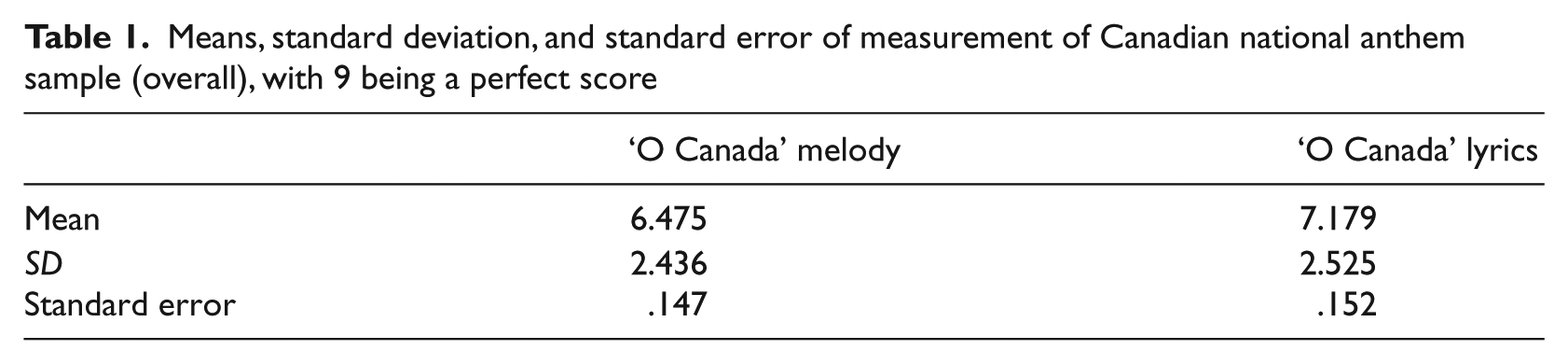
The means and standard deviation of both melody and lyrics for the entire sample are reported in Table 1 and the means and standard deviation for the six provinces are reported in Table 2. The standard deviations reported are relatively high in relation to the means in some of the provinces and occur mostly in the melody, indicating a wider lack of agreement in scores among the singers.
Means, standard deviation, and standard error of measurement of Canadian national anthem sample (overall), with 9 being a perfect score
Means, standard deviation, and standard error of measurement of Canadian national anthem by province, with 9 being a perfect score
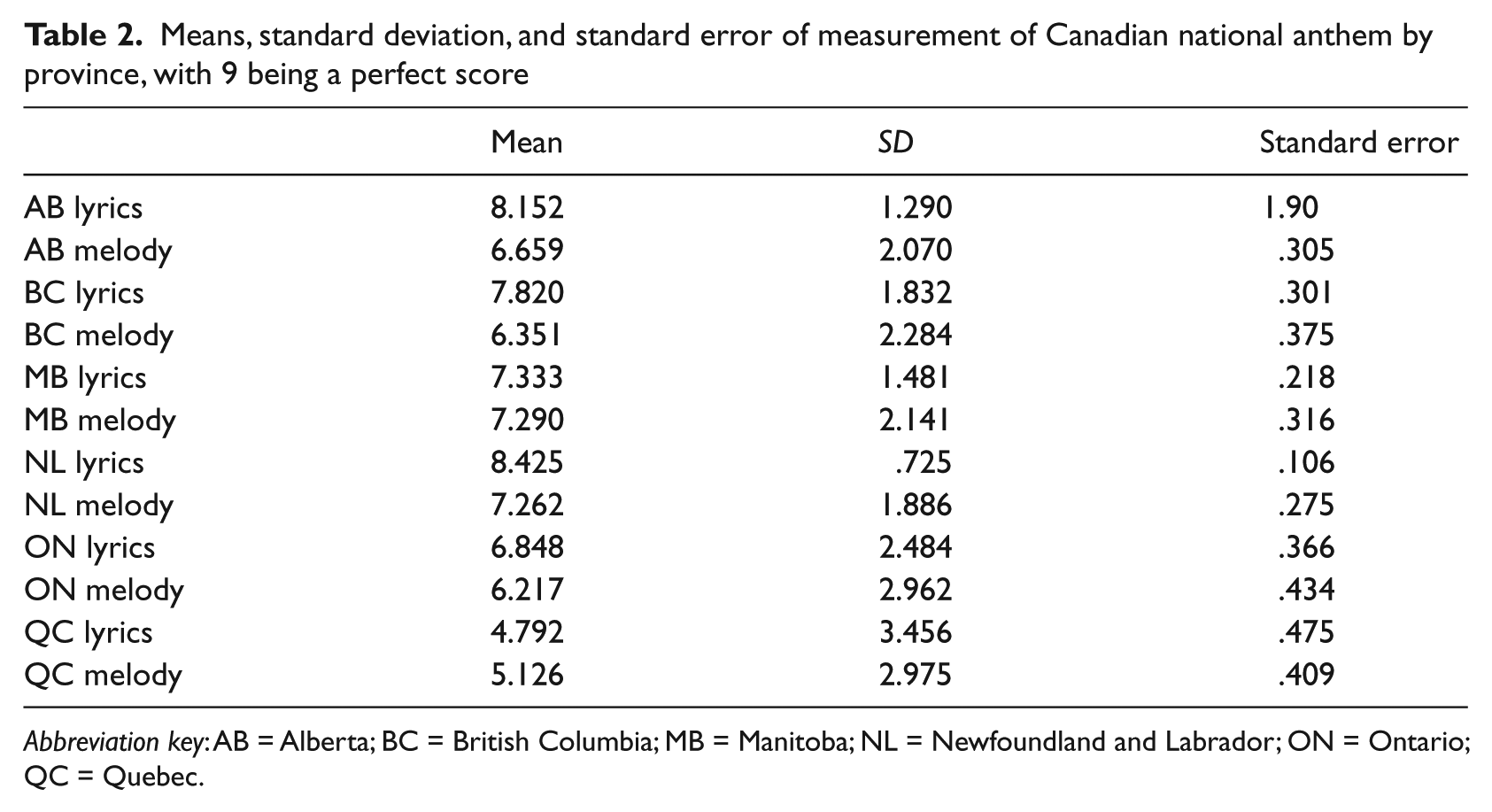
Abbreviation key: AB = Alberta; BC = British Columbia; MB = Manitoba; NL = Newfoundland and Labrador; ON = Ontario; QC = Quebec.
Alberta and Newfoundland students had the highest means in lyrics with 8.425 and 8.152 respectively, while Manitoba and Newfoundland students had the highest means on the melody with 7.290 and 7.262 respectively. At the other end of the spectrum, Quebec students received the lowest means on both lyrics (4.792) and melody (5.126).
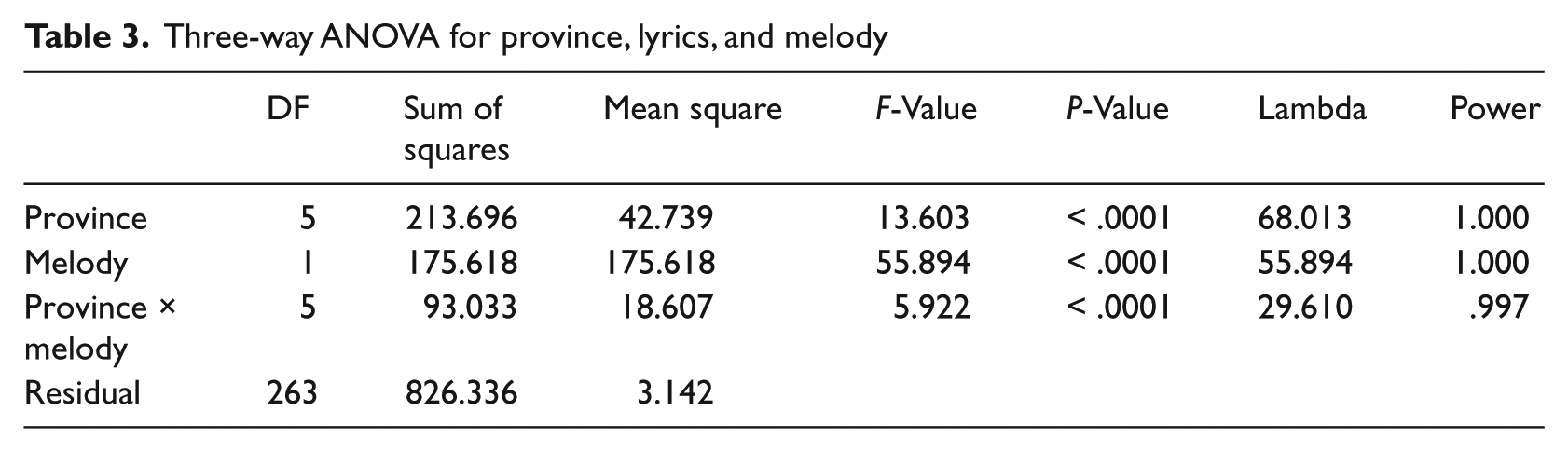
It was determined to run a three-way analysis of variance (ANOVA) with two repeated measures, lyrics and melody, and one factorial independent variable to measure the differences. When an ANOVA test was conducted, p values of < .0001 indicated that there were significant differences between lyrics and melody in all the provinces (see Table 3). Overall, students consistently were more accurate with lyrics than melody. Because there was a significant difference found in the ANOVA, a Fisher’s post-hoc test was administered. This test revealed a number of significant differences – 10 for lyrics and eight for melody. Regarding both lyrics and melody, all students in the five other provinces were significantly more accurate than the province of Quebec. Alberta and Newfoundland were significantly better at lyrics than the other four provinces.
Three-way ANOVA for province, lyrics, and melody
Questionnaire
Three of the research questions relate to where and when the national anthem is taught and sung. In reporting the responses to the question, ‘When, where, and from whom did you learn the national anthem?’ (Table 4), we should clarify that some students gave more than one answer and some did not give any.
Where, when, and from whom did you learn the national anthem? (N = 217)*
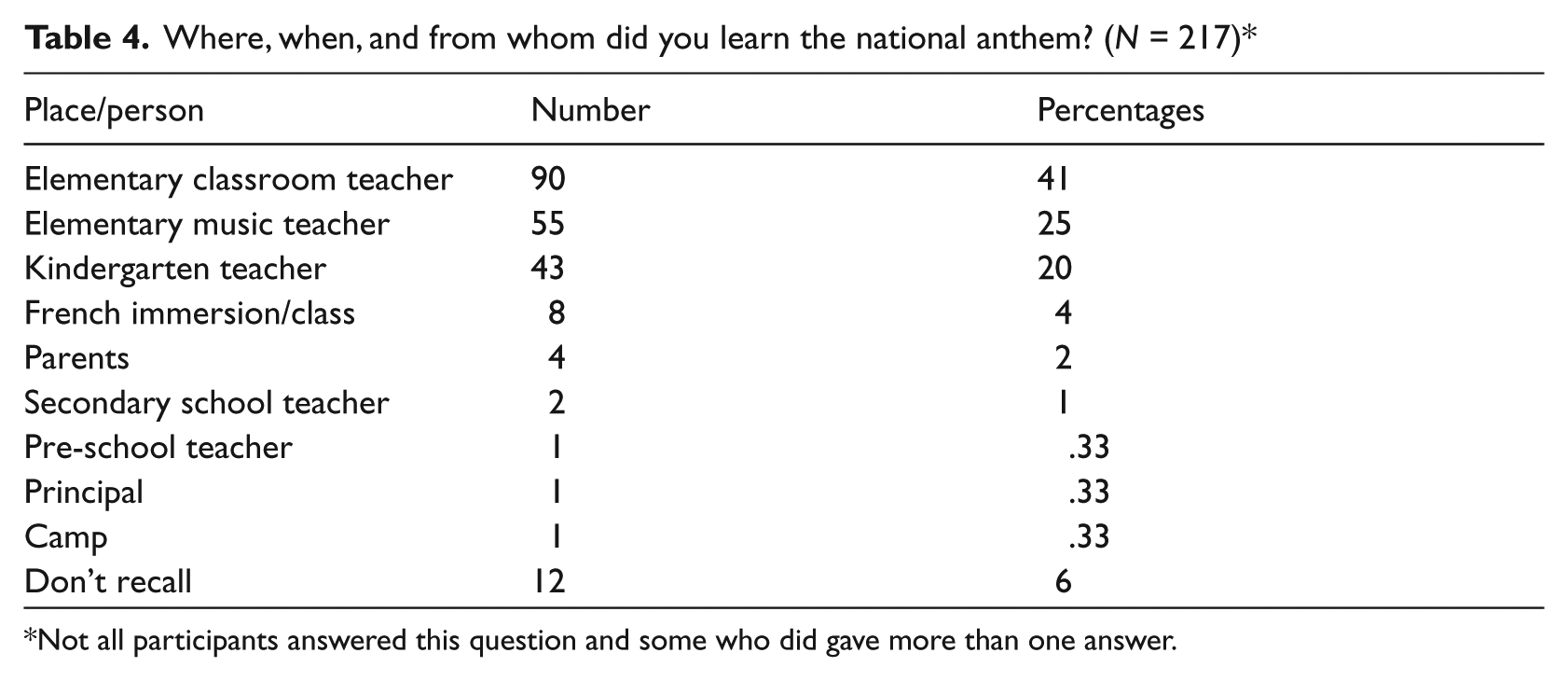
Not all participants answered this question and some who did gave more than one answer.
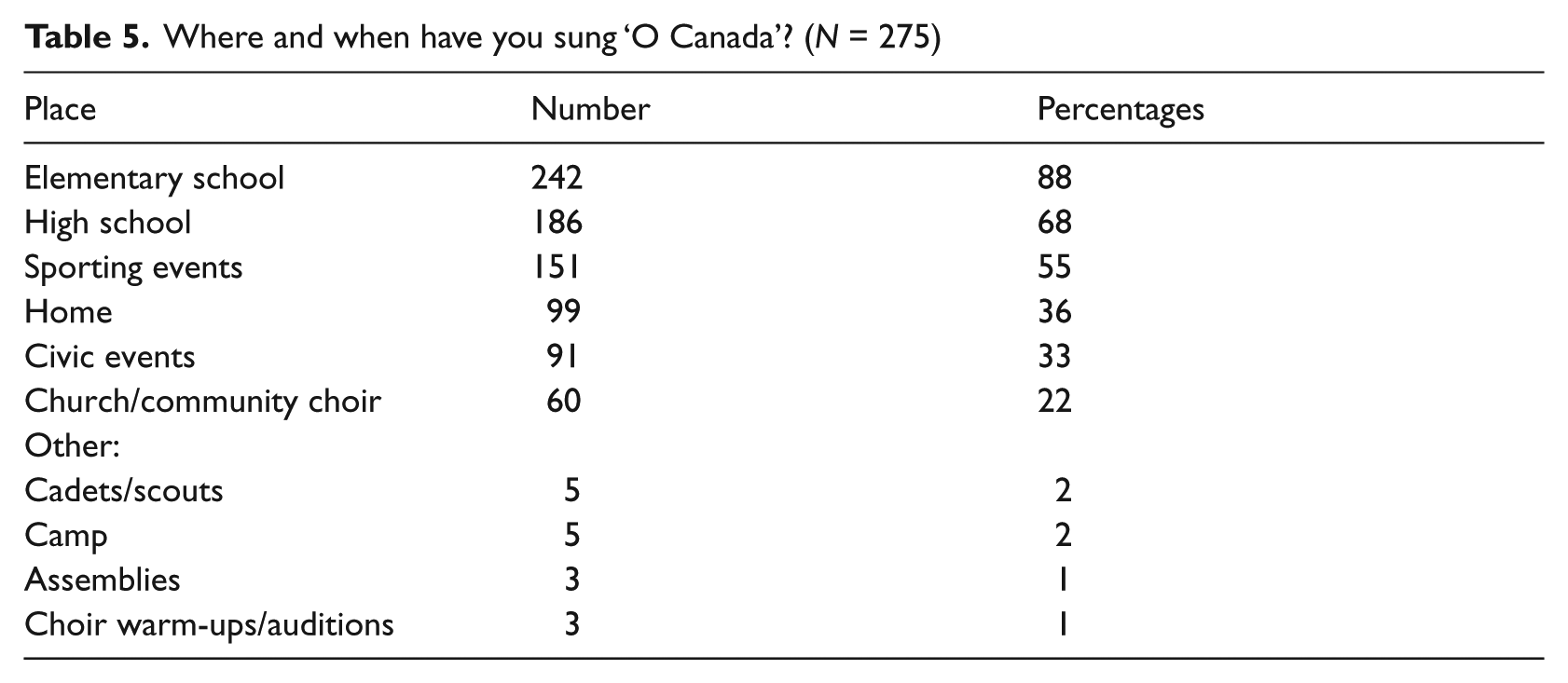
The largest number of students who recall being taught the national anthem name the pre-school and elementary years as the time they learned the anthem (41%). Roughly 60% of this number name their elementary classroom teacher (25%) while half single out the kindergarten teacher (20%), which brings to mind the famous book of essays, All I Really Need to Know, I Learned in Kindergarten (Fulghum, 1988). A sizable number listed the elementary music teacher (4%); however, one must be cautious about reading too much into this result as provinces vary with respect to the employment of music specialists at the elementary level. Considering the question, ‘Where and when have you sung “O Canada?”’ (Table 5), participants were given the following choices: elementary school; church/community choir; high school; home; sporting events; civic events; and other. Overwhelmingly, respondents listed elementary school (88%) followed by high school (68%) and sporting events (55%) as the venues where they sing the national anthem. The ‘other’ responses were sparse and highly individual. In addition to those listed above, single students named a ‘hockey game solo,’ ‘immigration,’ ‘academic gatherings,’ and ‘funerals.’
Where and when have you sung ‘O Canada’? (N = 275)
We asked participating teachers to report how many times the anthem was sung/performed at school each year. These results were perhaps the most revealing of all. Two teachers reported that it was sung/played/performed every day before morning announcements and two said that is was never performed. The rest varied between one and five times per year, stating that sometimes it was sung by a soloist, sometimes by the choir a cappella, sometimes by the choir accompanied, and other times played by the school band.
Discussion
In reviewing the results, we learned that few students could sing the national anthem perfectly. Converting the means to percentages, we found that 67% made an average of two errors or less in lyrics and were judged proficient, whereas only 46% made an average of two melodic errors or less and were judged proficient. These results are all the more alarming due to the fact that students in the sample were enrolled in secondary choral classes where they receive regular instruction in singing.
Regarding the third research question we found stark differences among the six provinces with respect to students’ knowledge of their national anthem (see Table 6 for percentages by province). Newfoundland and Manitoba students demonstrated the most accurate singing of the melody, achieving 62% and 60% respectively, and Newfoundland and Alberta students executed the lyrics with fewest errors (87% and 83%). While the percentages for the lyrics in Newfoundland and Alberta are relatively high, the percentages for melody are unacceptably low. We were not surprised by the results in Quebec as students in one of the schools never sing the anthem at all and students in the English private girls’ school sing it rarely.
Percentages of proficiency of lyrics and melody of Canadian national anthem
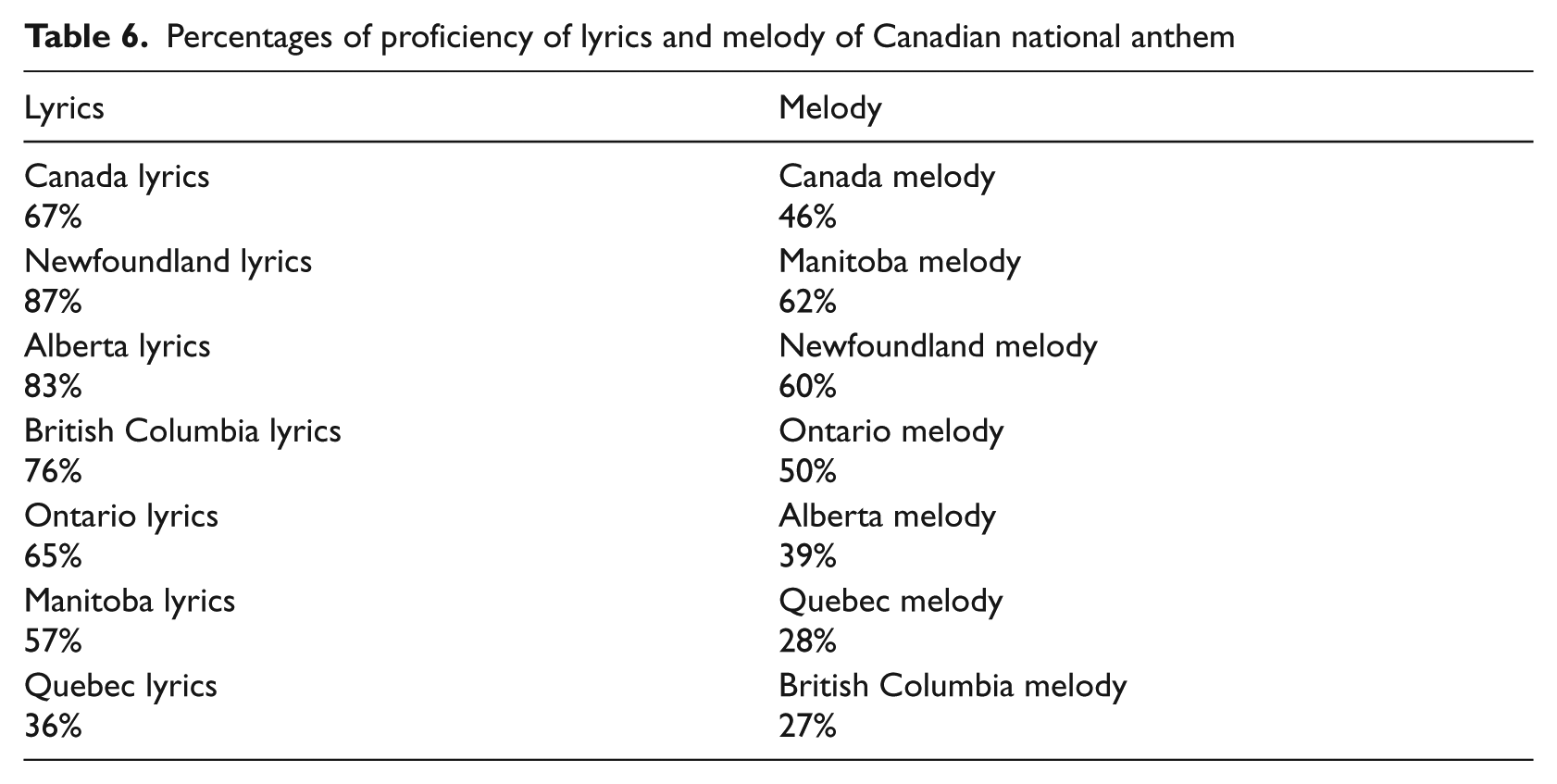
More than half of all the subjects in our study (54%) could not sing the Canadian anthem melody accurately. This lack is not confined to only one or two provinces. We have presented compelling evidence that this is a nationwide problem. It is disturbing to realize that, even in the ‘good’ provinces of Manitoba and Newfoundland, there were still large percentages of students, 38% and 40% respectively, who could not sing the tune. When we examined the other three provinces, the data became even more alarming, with half the population in Alberta deficit in their singing and in Quebec and British Columbia the number approaches 75% of students who could not sing the tune accurately.
In taking a closer look at errors in the English lyrics, we found four that were common: (1) substituting ‘our’ for ‘thy’ at the end of phrase two; (2) substituting ‘with’ for ‘in’ in phrase two; (3) substituting ‘the’ for ‘thee’ at the end of phrase three; and (4) substituting ‘our’ for ‘the’ at the beginning of phrase four. Other errors that occurred occasionally were ‘nature’ instead of ‘native’ in phrase one and ‘God save our land’ in place of ‘God keep our land’ in phrase seven. There were not many students who chose to sing the anthem in French, and of those 20 or so who did, most sang it in combination with English. Errors here were a mispronunciation of ‘brilliants’ and singing ‘des’ instead of ‘de’ in phrase two.
Examining the melodic errors, we found that incorrectly-executed intervals, often the descending fifths in ‘God keep our land’ and ‘Glorious and free,’ which were sung sharp, and changes of tonality in phrase eight, were the most common. Wandering tonality was also a frequent problem. Many singers could not maintain the original tonality of C major, instead moving to other keys for a phrase or two, sometimes higher and sometimes lower, sometimes returning to the original key for the final phrase. We are confident that this was not caused by the set tonality of C because we offered students the opportunity to begin in a key other than C, if that tonality did not seem comfortable. What surprised us the most is that the modulation in phrase two, which we expected to be a challenge for singers, was handled well by most.
What is most disappointing is that, across the board, students in this sample do not know the anthem well. In searching for the reasons to explain these poor results one must first consider the frequency with which students have the opportunity to sing the anthem in their respective high schools. Frequency rates ranged from never to one to five times, to hearing it over the intercom every day. Even in the third condition students hear it, but do they sing along? The choral teacher in this school said that, when the anthem was played each morning, he insists that his first period class, which rotates throughout the week, sing along. But that is just one teacher with a commitment to the singing of the anthem. Do the rest of the choral students or the rest of the student body sing along with the recording? One can only conjecture.
Second, of those students who recalled having been taught the national anthem in school, three-quarters mentioned a classroom teacher in the early or elementary years as being the one responsible for teaching them. Because students performed significantly better at the lyrics than at the melody, could it be that teaching students words is easier for a classroom teacher to achieve than teaching students to sing the melody accurately? Again the answer to this question is beyond the scope of the present study.
Third, might the shift to solo singing versus group singing in public events – for example hockey games and civic ceremonies – be a cause? Sometimes the soloist sings in a style that invites the assembled crowd to join in, and sometimes he/she sings in a style that inhibits audience participation. 7
Finally, might the inconsistency with which music education is delivered in elementary schools across the country play a part? If in fact elementary school is where students are introduced to the national anthem (and the majority of the sample said this was so), perhaps the lack of consistent musical training guided by a specialist teacher could be a factor in students’ inability to sing the anthem with accuracy. We can see that, in Newfoundland and Manitoba, where there are more music specialists in elementary school, proficiency rates were higher. We strongly encourage music teachers across the country to spend more time assisting students to sing the anthem with accuracy. Common word errors can be easily corrected once identified.
However, the difficulties students experienced in executing the melody will require serious attention. Students need practice singing descending intervals, and they need practice singing the anthem a cappella and alone. They need to listen to examples of in-tune singing and they need to hear examples of wandering tonality. It is practice for some teachers to use the national anthem as an audition piece for advanced or festival choirs, precisely because of the modulations and intervals contained in the melody. We encourage all teachers to adopt this practice, thus motivating students to improve their ability to sing the anthem with accuracy. Furthermore, we suggest that high schools increase the number of times the anthem is used during the school year and that music teachers play a leadership role in these occasions by teaching and encouraging all students to sing the anthem. Civic and social studies teachers could assist by taking some class time to review the history of the anthem and the French and English versions. While we acknowledge that the teaching of the national anthem in schools can turn into an unhealthy type of patriotism (Abril, 2007; Beegle, 2004; Jorgensen, 2007), we also know that citizenship education is mandated in Canadian schools and teaching the national anthem is part and parcel of this education. We contend that all students in Canadian schools should be capable of executing both sets of words from memory. We suggest the following criterion: 80% of Canadian choral students should be able to sing the anthem with 90% accuracy of words (in both official languages) and 80% accuracy of melody. The melodic criterion is lower to allow for the range of singing experience and skill of secondary school choral students.
Because the majority of students in this sample recall learning the national anthem in the elementary years, first, we suggest a follow-up study using students at the upper end of this age group to allow for the child voice to mature and settle (Guerrini, 2006; Levinowitz et al., 1998; Rutkowski & Miller, 2003). Second, to probe the connection between the anthem and national identity, we suggest a study designed for both elementary and secondary school students where participants are asked to describe the meanings they ascribe to the national anthem. Third, it would be interesting to replicate this study with a similar sample post-Vancouver 2010 Olympics to see if there has been any significant improvement in secondary choral students’ skill in singing the Canadian national anthem. Finally, we suggest follow-up studies be conducted in other countries to see if students from around the world fare any better when singing the national anthems from their own countries.