




Abstract
This paper examines my role as supervisor of research higher degree music students. Within this dyad, the pedagogical design has centred on conventional delivery, conceptualized in terms of the time-honoured top–down, supervisor–candidate interaction rather than exploration of a co-mentoring collaboration. Many doctoral candidates in music perceive this merely as an extension of the one-to-one instrumental or vocal tuition from their pre-tertiary and undergraduate learning experiences. This can serve to perpetuate over-reliance on the supervisor as master to provide the student as apprentice with technical work (researching and writing skills); repertoire (literature); and stylistic input (writing genre). Compared with undergraduate approaches, these aspects of learning may be often cobbled together in a haphazard fashion where an understanding of the overall project is somewhat fragmented. Consequently, the particular nature of pedagogy in research higher degrees in music remains under-developed and in need of reconceptualization or the development of an enlightened eye.
This paper will review and explore this pedagogy, drawing on narratives presented from my perspectives as supervisor. My role is explored through an autoethnographic account of my experiences as a teacher of groups and individuals, and this is interwoven with references to the projects of candidates at various stages in their programme. In my self-study, I will consider some of my emerging themes, including confidence, project design and management, academic writing, teaching preparation and multi-exegetical formats.
Preliminary thoughts
It’s Monday morning, 7am. I brew the coffee and open the laptop. There is an email from Ivan: ‘I have uploaded the completed chapters of my thesis to the supervision wiki. This document is getting frightfully large, so the culling process now starts in earnest’. There is a much shorter message from Rita: ‘Supervision documents attached.’ I’ll read these later. Moving through the inbox, there is one from Mary (she’s arriving from Singapore next Monday, could we meet to discuss the direction of her literature review?) and another from David (his survey closed on Friday, now what?). By mid-morning I’m in the office and another two students have forwarded documents or queries about their research projects. By lunchtime there is a request for me to meet another remote student via the web.
‘Manic Monday’ I think, the lyrics of the Bangles song running through my head. ‘Just another Manic Monday, I wish it were Sunday . . .’ I lurch back to the present, my internal jukebox momentarily on pause. With about 20 research students, I hear from one or more of them each day. Mondays are always busier than other weekdays. Most students are part-time and devote evenings and weekends to working on their doctoral projects and Monday is often the day when they have questions about their projects.
Leaving my desk and associated email, I go to the lecture room next door for my curriculum class with final year music education students. Today’s class is on planning. ‘Be organized, be prepared, expect the unexpected . . .’ I hear myself say. ‘Plan your lessons, structure your time carefully; take students from the known to unknown . . .’ I go on. Students take notes and vacillate between nodding in agreement and nodding off to sleep. ‘Questions?’ I ask. We all know that signals ‘class dismissed’.
Later in the day, I work with one of my singing students. We greet each other, catch up on the events of the past week, and begin with some technical work: alignment, breathing, articulation and connection through registers followed by some florid work before moving on to repertoire. Today we are working on Handel. I’d finished the technical work with the some exercises to get the voice moving with deliberate intent but we encounter some rhythmic difficulties, and this derails the lesson momentarily. We clap the rhythm; say the French time names and overcome these minor hiccups. Breathing is also problematic in the long phrases, so we return to the earlier exercises and incorporate them into the song. We finish by working through a duet she will perform for a master class later that day.
Back in the office, I return to thinking about my research students. In stark contrast to my other teaching, my pedagogical approach to teaching doctoral candidates could be described as ad hoc and reactive. I consider what other approaches I could take. Employing reflective practice, and using various students as case studies, I reflect on the literature and consider what I can borrow from other pedagogies to re-shape my approach to research higher degree teaching. How can it all become more musical and artful? I need to find time to read Langer’s (1987) work on how music is so close to feeling and emotion, including growth and attenuation, flowing and slowing, conflict and resolution, speed and arrest, excitement and calm, energy and dreaming.
Method
As I muse on my interactions with research students, I am drawn to the notions of reflective practice. I remember Boud and Lee (2005) suggested that ‘an expanded conception of research education pedagogy [and] the need for more distributed and horizontalized conceptions of pedagogy which pay attention both to the actual material practices and relationships deployed by students’ (p. 514). I consider the possibilities for a more collaborative, mutually supportive, and co-constructive approach. I could study my supervisory practices in a number of ways, such as through narrative inquiry. Salmon (1992) and Vilkinas (2005), for example, draw on the stories and voices of students to highlight the pedagogical and personal interactions as a means to improve the research training experience. Manathunga (2005) advocated building on practitioner prior knowledge and understanding to open up the private space of research practice. This mention of ‘private space’ immediately suggests to me overlapping spaces, parallels with my pedagogical approaches to one-to-one music teaching, and the possibility of finding alignment with my work there. In earlier papers (Barrett, Harrison, Ballantyne & Temmermann, 2009; Draper & Harrison, 2011) I have explored, with colleagues, the notion of reflective practice as a way of representing and reflecting on the pedagogy of my other role, as a pre-service teacher educator. This reflexive approach to investigating the research supervision experience is supported by Zhao (2003) who notes:
. . . reflective practice helps them [research supervisors] to think back on their supervisory experiences and to adjust and extend their supervision to their students in subsequent sessions. In this regard, reflective practice promotes continuous improvement in the quality and effectiveness of research supervision. Research supervisors should be going through, intentionally or unintentionally, a reflection process in which they reflect on their own current and past experiences in undertaking research when providing students with research advice. (p. 189)
Using Schön’s (1983) notions of the reflective practitioner as a starting point, I will examine my pedagogical practices, seeking to find what parallels there might with other aspects of my teaching in studios and lecture rooms. I use Cowan’s (1997) extension of Schön’s work to encompass a third reflective loop: reflection-for-action (see Figure 1).
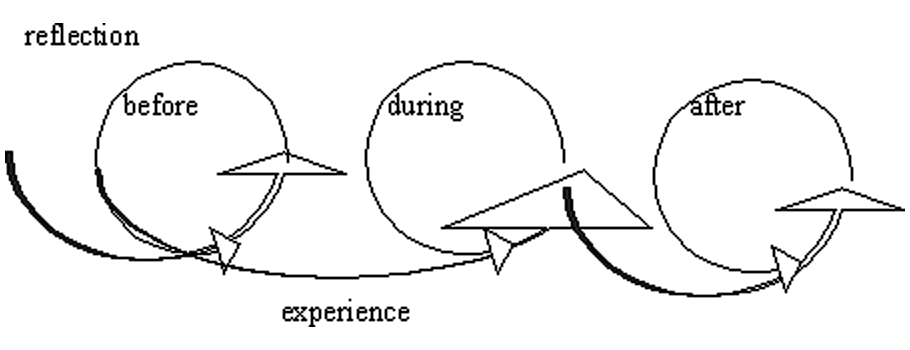
Cowan’s (1997) reflective loop
Cowan explains that the purpose of the third loop is so the learner can ‘define their aspirations . . . [and] . . . establish priorities for subsequent learning’ (Cowan, 1997, p. 7). In a more inclusive move I consider both the doctoral candidates and myself as the learners. I employ ‘insider ethnography’ or autoethnography, a form of autobiographical, self-narrative in which the writer explores his or her experience (Diamond, 1992; Ellis & Bochner, 2006). It differs fundamentally from the qualitative research method of ethnography in which a researcher uses participant observation and interviews informants in order to gain a deeper understanding of that group’s culture. In contrast, autoethnography focuses on the writer’s own subjective experiences rather than those of others. It and self-study approaches are becoming more widely used in performance studies and in education – especially in the development of an enlightened eye (Eisner, 1991).
To explore my pedagogy through this lens, I will use an illuminative case study approach (Stake, 1995) and through an ‘interpersonal perspective [that] describes and analyzes supervision in terms of the relationship between the supervisor and the doctoral student’ (Mainhard, Roeland, Tarwijk, & Wubbels, 2009). I reflect on the students’ projects and my own hopes for their development as beginning researchers. I have selected these cases to elaborate on three broad themes found in my prior experiences and documented research (Draper & Harrison, 2011; Harrison, Draper, Barrett, Burnard, & McPherson, 2010; Harrison & Emmerson, 2009) and in the literature (which will be interwoven throughout the cases). The three themes include: technical work (in this instance, the development of skills in researching and writing); repertoire (literature in relation to both content and method); and style (in this case such elements as writing genre and project design). I will use these cases to illuminate the practices of research supervision in music higher degrees for the benefit of both students and supervisors.
Illuminative case studies
These cases are drawn from my current research higher degree cohort. I currently supervise over 20 student projects and, in some instances, the cases are made up of an amalgam of several students with similar needs and/or subject matter. All cases have been allocated a pseudonym, and the accounts are reconstructions based on real life experiences including supervision notes, emails and recollections. I present these using my author’s voice.
Case 1: Ivan
We all have them, I suspect. The ones who come into the research programme who are already independent thinkers, practitioners who appear to have it together. Take Ivan, for example. When we first meet, he has transferred from an interstate university after his first year and is already well on the way to confirmation. His ideas are well formed; his and oral written expression are crystal clear. In our first meeting he confidently states:
I understand how this works. I’m pretty much on my own – if I get help from my supervisors, that’s a bonus. I need to do my reading, establish a theoretical framework, work on my method, generate and analyze my data. Every now and then I’ll send you my work and a few days later we’ll meet for a chat.
At the time of writing we are well into his project. He has written papers along the way; presents at conferences; organizes activities for other students; and stays in touch. He lectures part-time. He is a dream student. But teaching preparation for Ivan is a nightmare. I compare it with my experiences as a singing teacher. These supervision sessions are like teaching the near perfect voice. The student walks in. S/he sings. I am so taken with the beauty of the sound, the ease of delivery, the strong connection with text. I think ‘what can I do to teach this student; how can I prepare?’. We do extensive preparation for any other form of music learning. I liken this kind of preparation to my studio teaching in some respects: there is an expectation that I will know the repertoire and/or literature: it doesn’t help, of course, that Ivan’s project has a literary component and this makes for a lot of background reading for me as the supervisor. Keeping in time.
Despite the strength of the project and the student’s capabilities, there is a question of confidence. ‘Am I on the right track?’ he sometimes asks. ‘Am I on the right track?’ I often ask. ‘Do you think this is a worthwhile project?’ he says. ‘Am I the right supervisor?’: the question gnaws away at me. ‘Will I have sufficient data?’ he asks. ‘Will I have sufficient resources to support this candidate?’ I think.
For Ivan’s project the key lesson for me was to know the repertoire in advance: to ask him to provide work beforehand for me to read and reflect on. By working in this way, I am more able to work with him on his project and bring it towards a timely completion. My reflection for action, in this instance, is akin to repertoire preparation in the one-to-one teaching setting and, to a lesser extent, content preparation for lectures. There is a substantial amount of reading to be undertaken and, while this is time consuming, it makes for an improved overall experience for Ivan and for me. I am conscious, in my interactions with Ivan, that ‘research supervision [is] the most advanced level of teaching in the educational system’ (Connell, 1985, p. 39). Ivan is on a fast track for a career in academia and I have an increasing awareness of my need to develop his repertoire and broaden its scope.
Case 2: David
David and I have a system. Together with his other supervisor, we have established a wiki on the university’s staff-student intranet. All the documents are uploaded to the wiki. It is a fabulous way to keep track of the project, manage version control, and track contributions each of us have made in the course of the project. We also meet through virtual supervision meetings. Many of the students with whom I work with are situated out-of-town, so this is ideal. This approach finds support in the comment of Parker (2009) that there is the need for a flexible approach to the creation of learning communities in doctoral education. This is confirmed by the diversity of the doctoral student population, as exemplified even in the few cases studies described here. David, for example, lives and works in a suburb near the university but we still find it easier to meet online. Other students are in rural and remote locations, while some are international. In David’s case, we record these virtual sessions so we can watch them again. Sometimes, as supervisors, we can give contradictory advice. This is a healthy way to challenge the students’ thinking but, like many busy academics with conflicting teaching, research and administrative demands, sometimes I may not have accurately recalled my previous advice. The wiki and virtual supervision help to overcome this by providing a record of the process.
David worries most about his writing. By tracking back through the documentation on the web, we can reflect on his development as a writer. The challenges we have shared in this domain are not uncommon. Kamler and Thomson (2004) suggest:
Like many doctoral supervisors, we have noticed that some of our students are not only reluctant writers, but also express a range of other emotions associated with the requirement to write – agitation, resentment, despair and fear. Often they engage in counter-productive delaying tactics, which can jeopardize their work, and sometimes their capacity to complete their projects and programmes. (p. 516)
They are not alone in their observations. This description aptly captures my interactions with David, and several other doctoral candidates. To overcome their reluctance, we begin to write articles and book chapters together. This collaborative approach is like working on a duet with a student: we learn the repertoire separately, then read it through together, shape it to ensure we are of one mind in the interpretation, rehearse, trial it in front of an audience and release it to the public as a performance. At each stage we reflect, revise and reshape in the light of our experiences and feedback. When we consciously employ this process in the writing, it becomes more finely crafted, more suitable for the target audience and produces a more polished result. This is not unlike Diamond and Mullen’s (1999) concept of being ‘roped together’: taking turns either to lead, take the strain, or hold the line.
In David’s programme, students also take courses in the use of information technologies to shape and disseminate their work. David was initially reluctant to engage in this process, even though his project originally had a strong technological component. One of David’s assessment tasks was to undertake the writing of a blog. In reflecting on his blog later in his candidature, he states:
It was originally developed to fulfil a component of my doctoral course work . . . I had only intended to write a few entries, achieve a good mark and move onto more pressing concerns. Many of you have encouraged me to continue the writing and I hope that as [this blog] remains with me into my post-doctoral life that it will continue to educate, inspire and challenge all of us.
David’s writing has improved as result of his engagement with this aspect of his course work but, more significantly, he has felt supported by a broader cooperative community of practitioners and researchers. For David this has been the equivalent of giving a live performance, or posting a video online and using the reviews, comments and feedback to reshape ideas. Like our writing together, the net result was a higher level of engagement with the core components of the project. There was an additional advantage to this process. Isolation is a common theme of the learning experience of music students and doctoral candidates. Colloquia in the local setting, university-wide sessions and online writing opportunities through blogs provide a way of connecting students. Music candidates can separate themselves from other students, even those involved in other arts-based projects. University sponsored workshops often provide the generic skills required for students, and online environments also actively encourage networking and collaborative thinking. In a similar vein to challenges of concealment found in one-to-one instrumental and vocal pedagogy, Pearson and Brew (2002) contend that a strong and ‘highly visible community of learning’ (p. 141) is required for research, in which students interact with their peers around the university through seminars and discussion groups, in professional and community contexts and in disciplinary networks.
In David’s case, reflecting on the technical process of writing and understanding the genre, and style of academic writing were critical milestones in his development. His confidence soared when he received his first positive peer review and, together with his engagement with the community of researchers across the university, he now stands as a positive and enthusiastic role model for other student researchers. Unlike Ivan, David is not destined for an academic career. His example is that of a useful practitioner whose case provides specific recommendations for this type of project.
Case 3: Rita
Like David, Rita and I also have a system. I set it this up for all my students, but Rita is the only one who uses it consistently. We meet every month for one hour. About a week before our meeting, I receive a report via email. It explains Rita’s progress, has a list of questions to work through in the meeting and includes any relevant documents.
I read the documents ahead of time. We meet, discuss progress, answer the list of questions, and work through my comments on the drafts. The meetings are highly structured but also casual at the same time. Preparation is very straightforward. As a supervisor, Rita provides me with time, structure and content. Our system is born of necessity. Rita is the mother of four children under 10 so we have to work out the best way to manage the project to ensure the most efficient use of time. While preparation and academic writing are manageable for this candidate, as a time-poor mother the data generation process is particularly problematic. The question for Rita is: ‘How can we generate and analyze data when there are such intense child care responsibilities?’. The research design calls for a survey in phase 1 and interviews in phase 2. At the beginning of the second year of the project, the question of administering the survey comes up. I draw on David’s experience and on the recent project of Jenny, another of my students. In one sense we workshop the possibilities together, working through the potential solutions as one would with students’ songs in an open forum. After this process, we decided on an online survey, using a statistical analysis package to make sense of the data.
For the interview phase, the project focused on significant findings from the first phase. The analysis package delivered a large corpus of data and the email for Rita that day reads: ‘Over the last two days, I have gone through my interview questions over and over again trying to hone them and make sure I’m eliciting what I need . . .’
For the second time in her project, I set Rita up with students who had recent experience of analyzing interviews using a software package. The peer interaction proved fruitful in this phase of her study. Rita is now our resident student expert in the use of this software, and the cycle of peer learning continues. This is akin to the peer learning processes described by Green (2001), Lebler (2008) and others in relation to the learning of popular music. The knowledge resides with the learners themselves, and they are better positioned and more adept at communicating the knowledge and ideas to each other than any supervisor imposing the ideas on them.
Rita’s case also raises another important issue. Life and doctoral studies are not mutually exclusive. Families and friends are implicated in and affected by the doctoral experience. Bennett (2010) provides this advice for music students undertaking doctoral studies:
It is very hard to balance work, doctoral studies and family. You [also] need to have the support of your close friends, so find the time to explain to them what it is you are doing and why it is important to you. In many ways, families earn your doctorate with you. (p. 29)
In Rita’s case, the impact of family on her candidature was closely aligned with the design of the data generation and it wasn’t possible or desirable to separate the personal from the academic concerns. Rita’s project design and analysis were largely driven by consideration of other aspects of life prior to and during her candidacy. Our reflection for action in her instance consciously took into account these factors in both the project itself and the way in which the structured pedagogical approaches were implemented.
Case 4: Mary
Mary is in her first year of the doctorate. Mary has some concerns about her project design, and particularly about the format of the final product. She would like to do a performance as part of her exegesis. My traditional PhD and background makes me bristle at the thought. ‘What! A performance? How is that going to answer a research question?’ (My inner thoughts suggest it may be my own anxiety at the potential risk involved). Mary thinks about this for a very long time. She asks other students and other supervisors. Like David, she is also enrolled in a doctorate that has a coursework component so she asks the teaching team what they think. She gets mixed responses but we find a way through, using other students’ work from art, design and composition as non-empirical exemplars. Through this process, together with a few colleagues of similar mind, I started to realize the importance of artful exemplars and begin to set up a repository of student and staff works: both completed and, with their permission, works in progress.
As an institution, we also record and podcast sessions for students in coursework and colloquia about various aspects of the research degree experience. Our level of web engagement with these materials has become significant. In one year, there were over 4,000 hits as demonstrated in Table 1.
Engagement with aspects of university intranet for HDR students
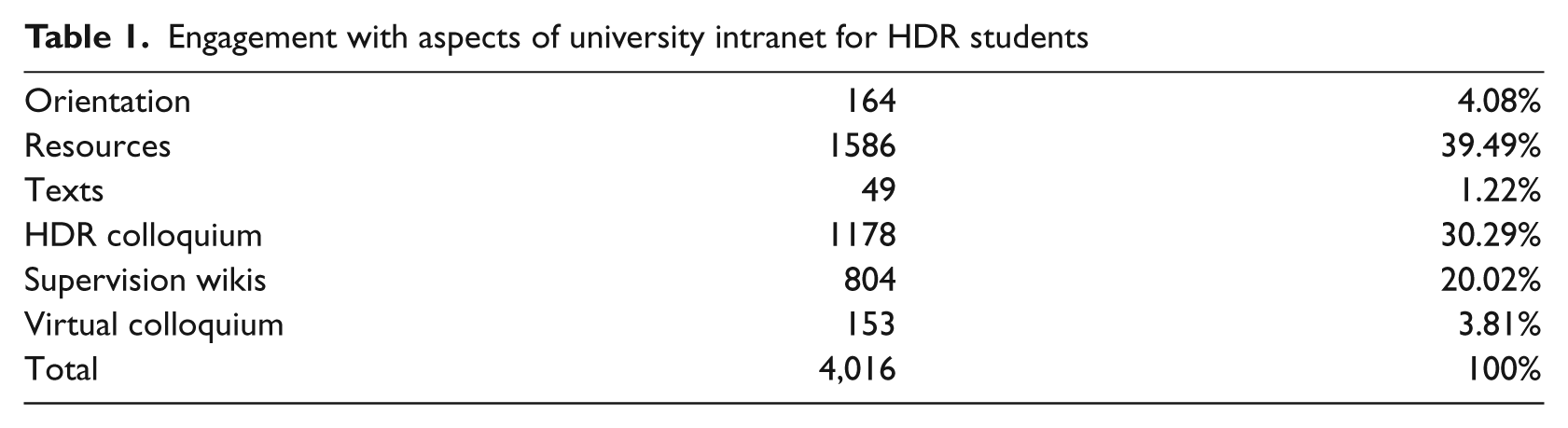
The Higher Degrees Research (HDR) Colloquium and Resources feature podcasts of each session, and this is the medium through which many students are choosing to interact, as opposed to text-based options. As someone who undertook a more conventional, logocentric PhD, largely in isolation, I was surprised at this high level of engagement. Perhaps more importantly, the low percentages registered on texts sends a message to us supervisors. Recent literature supports the indication that a largely supervisor-dominated model of graduate research training is no longer sufficient or authentic (see Johnson, Lee & Green, 2000; Rowland, 2002; Manathunga, 2007). This web-based community draws together the disparate elements of supervision and demonstrates the advantages of reciprocal peer teaching for both supervisor and student. Through these activities, we have developed distributed supervisory teams in which supervisors worked together with higher degree students in coursework, colloquia and different modes of communication through a blended learning approach. In an evaluation of leveraged technology and blended learning, Delahaye, Choy, Sarojni and Saggers (2010) found that, while some participants appreciated the freedom of e-learning, others felt lonely and disconnected. They advocated a ‘learning cohort approach’ to developing research skills and knowledge in a research higher degree. This type of pedagogy is worthy of further exploration, though university strictures around supervisor allocation in the context of the site under investigation currently prevent implementation of a learning cohort approach.
Mary’s case highlights the importance of cohort interaction in all three domains: technical work, repertoire and style. As a commencing doctoral candidate, she needed to develop technical skills involved in undertaking research, and this was accomplished largely through her coursework. Her repertoire was developed as she drew on the work of other colleagues in devising a method that used performance to answer her research question. Similarly, those in her cohort, the teaching team directing her coursework and my role as supervisor influenced the style of her design. Mary’s final submission will likely have a multi-exegetical or mixed mode format, incorporating text, performance and other elements. This will further stretch the boundaries of traditional approaches to both the pedagogy and the disseminating format of her project. Perhaps more than any other case in the study, Mary’s work has challenged my thinking about supervisor practice and the blinkered views I frequently impose on student projects. I am now curious about how Diamond and Mullen (1999) managed to explore and implement a more unfettered, reciprocal, and co-equal view of an artistic form of co-mentoring in higher education that they describe as being ‘roped together’ like Picasso and Braque.
Reflection for action
I return to the desk and think about their/my confidence; about their project design and management and mine. I consider their academic writing and mine, teaching preparation and multi-exegetical or arts-informed formats.
The issue of confidence is a perennial one, exacerbated to some degree by candidates’ lack of experience with the university setting and strictures around practice-based work in the creative and performing arts. Students (and sometimes academics) feel inadequate in the university setting, in answering their research questions in written form, using academic jargon. Creativity is constrained by agents of limitation. My reading reminds me that Richardson (1997) has described just these kinds of experiences:
We are restrained and limited by the kinds of cultural stories available to us. Academics are given the ‘story line’ that the ‘I’ should be suppressed in their writing, that they should accept homogenization and adopt the all-knowing, all-powerful voice of the academy. But contemporary philosophical thought raises problems that exceed and undermine the academic story line. We are always present in our texts, no matter how we try to suppress ourselves. (p. 2)
Lack of confidence is also related to the issue of project design where there is often a lack of justification, evidential warrant, or contemporary theorizing. The question of balance frequently arises at milestones in the journey, where candidates and supervisors are at their most vulnerable. Overly complicated methodology sometimes clouds student projects at the expense of epistemology and imaginatively pursuing their topic.
As a result of almost non-existent approaches to the assessment of time-based, ephemeral work with an essentially temporal quality, such as those that occur in dance and music, questions remain about the necessity for text-based work. Like paper-based playwriting and musical composition, the nature, genre and style of writing requires considerable coaching from the supervisory team. For projects with multi-exegetical formats, a balanced approach to inquiring into the research problem is required so that students can honour the art form and also meet the requirements for qualification at a doctoral level.
Accordingly, I remind myself that, as Mullins and Kiley (2002) note, the successful doctorate is ‘not a Nobel Prize’ but the result of an opportunity to shape the pedagogical experience. For each student this enables them to ensure they can own their project and become the independent researchers who will one day play their part in replacing us. Research training is, after all, the point at which as Lumadi (2008) comments ‘the academic system reproduces itself’.
For musicians undertaking practice-based work, I remind myself that ‘musicians make great researchers because we creative apply investigative, expansive thinking on a day-to-day basis’ (Bennett, 2010, p. 32). For me, it has been a case of ‘letting go’. Of recognizing that the traditional ways of working are outmoded: that projects will not always need to be couched in the form of a paper-based 80,000 word document; that students can and will learn independently, through peer learning and through engagement with web-based materials. As Eisner (1997) showed, the forms we use to represent what we think (literal language, visual images, number, or poetry) have a huge impact on how we think and what we can think about. The development of a community of practice and parallels with research into one-to-one music pedagogy also require further exploration with a larger cohort, but some of the principles and alignments explored here provide a starting point for this exploration. For now, it is a case of allowing students to take flight as beginning academics. A case of ‘letting go’.
Footnotes
Acknowledgements
An earlier version of this paper was presented at the third Narrative Enquiry in Music Education Conference in Brisbane in November 2010.