



Abstract
As people age, they naturally experience sensory, perceptual, and cognitive changes. Many of these changes necessitate adaptations in designing programs for older adults. Choral singing is an activity that has many potential benefits for older adults, yet the rehearsal environment, presentation style, and content of material presented may need to be modified in order for older adults to participate to their fullest. The purpose of this article is to discuss sensory, perceptual, and cognitive changes that may occur in old age and, based on the implications of these changes, provide recommendations on designing a choral singing experience for older adults. I offer suggestions for adapting choral singing experiences based on empirical evidence as well as my own experience leading a choir for mature singers with Parkinson’s disease. Adaptive strategies are given so those working with older adults might help mature singers more fully participate when engaging in choral singing.
Older adults, defined as those over age 65 (Hooyman & Kiyak, 2008), can benefit greatly from participation in musical activities (Coffman, 2002). Benefits of music-making may even include increased life expectancy. A study by Bygren, Konlaan, and Johansson (1996) followed 13,000 adults for 8 years and found that those who made music or sang in a choir had a lower mortality rate. Improved quality of life is also an important benefit of musical participation for older adults. The majority of older adults who participated in a study by Clift and Hancox (2001) reported social, emotional, and physical benefits of singing in a choral society. VanderArk, Newman, and Bell (1983) found that residents of a nursing home who sang familiar songs within a music program reported significantly improved life satisfaction compared to age-matched residents of another nursing home with no music program.
In spite of the numerous benefits of singing for older adults, it appears that relatively few older adults continue to participate in choral experiences. In a 2002 study by Cohen, Bailey, and Nilsson, only 6% of the more than 300 older adults surveyed reported that they continued to sing in a choir, although 39% had done so previously, and 43% judged music to be very important to them. The number of older adults who reported singing in a choir in Cohen et al.’s study may have been low in part because of a lack of appropriate opportunities for choral singing designed to meet the needs of older adults when the study took place. The past decade has seen a growth in the number of musical experiences designed for older adults.
In recent years, the New Horizons International Music Association (NHIMA, 2013) has worked diligently to help establish music programs to engage adult learners. There are now more than 200 New Horizons ensembles in North America, while NHIMA is working to form new ensembles internationally. The growth in New Horizons ensembles indicates that more opportunities for older adults to participate in musical experiences exist now than in the past. Given the growing number of musical experiences for older adults, it is important for music educators to be aware of sensory, perceptual, and cognitive changes that tend to occur with age so that they may make appropriate adaptations. Several resources exist for music educators and music therapists working with older adults that describe specific needs of this population.
In her article, Roulston (2010) discussed differences between the needs, motivations, and abilities of children and adult learners. She pointed out that age-related physiological changes may necessitate adaptations to music instruction for older adults. As people age, they tend to experience decreased vital capacity and calcification of laryngeal cartilage (Saxon, Etten, & Perkins, 2010), which may affect their ability to sing. Bruhn (2002) provided a discussion of the vocal changes of older adults, such as decreased vocal range, as well as a description of changes in hearing, motor skills, and memory that occur as people age. Prickett (2000) has published a thorough synthesis of the literature on other age-related issues, including physical strength and coordination, aptitude and preference, socialization and community integration, and depression, as well as the implications of these factors for musical participation. The aforementioned works by Roulston (2010), Bruhn (2002), and Prickett (2000) are recommended resources for music educators and music therapists desiring to work with older adults.
The purpose of this article is to translate research on age-related sensory, perceptual, and cognitive changes into practice for music educators working with older adults by providing evidence-based methods of adapting musical instruction for older adults. I describe age-related changes in sensation and perception related to vision, haptic sensitivity, and hearing; and cognitive changes in the domains of memory, language comprehension, learning new symbols and vocabulary, visual attention, spatial cognition, and multi-tasking. Within each section, I provide a brief summary of domain-specific compensatory strategies (see Figures 1 through 6). When discussing age-related changes and compensatory strategies, I draw heavily on research conducted by the Center for Research and Education on Aging and Technology Enhancement (CREATE), published by Fisk, Rogers, Charness, Czaja, and Sharit (2009), as well as a recent text on physical aging (Saxon et al., 2010) and a text on social gerontology (Hooyman & Kiyak, 2008). I also offer evidence-based compensatory strategies for designing musical experiences for older adults which are drawn from the literature and my experiences leading a choir for older adults with Parkinson’s disease.

Compensatory strategies for changes in vision.

Compensatory strategies for changes in haptic sensitivity and motor control.

Compensatory strategies for changes in hearing.
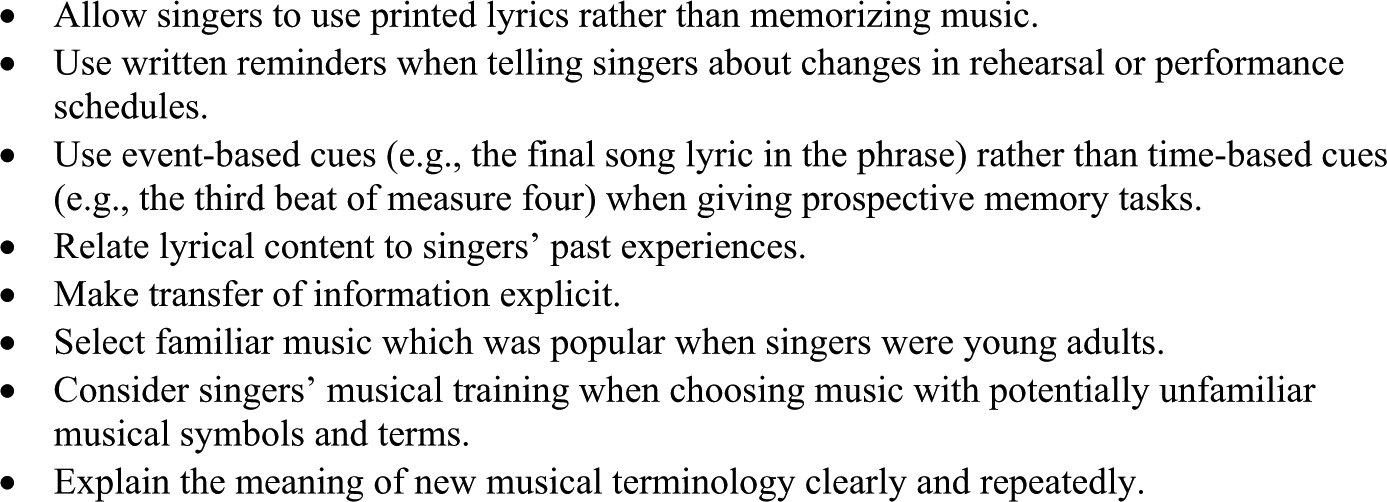
Compensatory strategies for changes in memory, language comprehension, and the ability to learn new symbols and vocabulary.
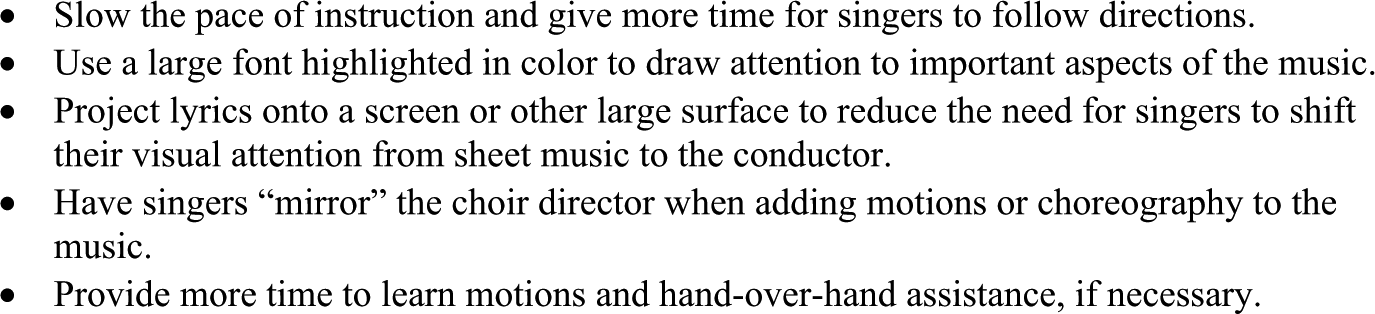
Compensatory strategies for changes in visual attention and spatial cognition.

Compensatory strategies for changes in multi-tasking abilities.
In 2007, I became the director of a choir designed to help adults with Parkinson’s disease maintain vocal functioning, which might otherwise be impaired, through the use of singing and vocal exercises. I came to work with this choir having primarily worked as a music therapist and music educator with children and adolescents in school settings. I realized very quickly the need to adapt my presentation style and instructional methods in order to provide a better musical experience for the choir. By consulting the research literature and seeking input from choir members, I was able to modify rehearsals so each person could participate as fully as possible.
Although my recommendations are geared toward adapting a choral singing experience for older adults with Parkinson’s disease, many of the suggestions outlined here also benefit older adults without Parkinson’s disease through the principle of universal design. Universal design is the concept that products and environments may be designed in a way that they are usable by people with no limitations as well as those with age- or disability-related limitations (Fisk et al., 2009). Many of the recommendations that I offer for choral ensembles could also be employed by those working with older adults in other musical settings, such as instrumental ensembles or private music studios. Understanding the changes that tend to occur with old age will help music educators working with diverse older adult populations provide better musical experiences for their adult learners.
Sensory and perceptual changes of old age
Sensation is defined as “the process of taking in information through the sense organs” (Hooyman & Kiyak, 2008, p. 93). Aging affects all five senses (vision, hearing, touch, taste, and smell), although an individual’s senses may be affected to varying degrees and each person experiences these changes differently. Age-related changes in taste and smell tend to be minimal (Fisk et al., 2009) and will not be discussed here since only visual, auditory, and haptic (touch-related) sensitivity are likely to have a direct impact on one’s participation in a choral experience. Perceptual changes, which alter the way in which sensory information is processed by the brain, also occur as people age (Hooyman & Kiyak, 2008). Appropriate modifications to the environment and the method of instruction can make it possible for older adults to participate in a choir in spite of sensory and perceptual changes to the visual, haptic, and auditory systems.
Visual changes
As people age, the likelihood of experiencing visual impairments increases (Fisk et al., 2009). In old age, the maximum opening of the pupil is reduced to two-thirds its original maximum, making it less able to dilate or open to the extent needed to react to low light levels (Hooyman & Kiyak, 2008). There is also a slower shift from cones (visual receptors in the retina which facilitate day vision and color vision) to rods (visual receptors which respond to dim light, night vision, and are responsible for peripheral vision) under low-light conditions, resulting in trouble functioning in low-light situations or adjusting to large changes in ambient light (Saxon et al., 2010). This means that older adults may need three times more light than younger individuals in order to function effectively (Hooyman & Kiyak, 2008). However, having a bright light source positioned in the wrong place can create more problems that impede vision, including glare reflected off of shiny surfaces. Having several smaller light sources, such as lamps, which can be repositioned to decrease glare, is one possible solution to this problem. Avoiding shiny surfaces will also help eliminate glare (Fisk et al., 2009).
Age-related changes in vision may also make it difficult to read small print. Older adults benefit from large print and high contrast when reading text (Fisk et al., 2009; Hooyman & Kiyak, 2008). While corrective lenses and surgery may help improve the vision of older adults, the severity of certain visual impairments as well as changes that occur in the visual cortex make it impossible to correct visual acuity to 20/20 for all older adults (Fisk et al., 2009). When conducting a group of mature singers, it can be helpful to make conducting gestures larger than normal to increase their likelihood of being seen in spite of choir members’ visual impairments. When arranging seating, using fewer rows with more chairs per row rather than many rows with fewer chairs will allow singers to be closer to the conductor and decrease their likelihood of being behind other singers who may block their view. Choir directors can also accommodate visual impairments by providing opportunities for older singers to learn new music aurally, giving ample musical modeling during rehearsal and creating rehearsal CDs for participants to listen to outside of choir rehearsal.
When working with the Parkinson’s choir, finding the best method of presenting the lyrics to accommodate the visual changes of choir members presented a challenge. Ultimately, I purchased a small, portable overhead projector and projected large-print lyrics from transparencies onto a large screen. This adaptation allowed choir members to look at me and the lyrics without shifting their gaze, produced large-print lyrics without creating glare, and eliminated the need for choir members to hold sheet music in their hands, which often shook because of their Parkinsonian tremor.
Haptic changes
Changes in haptic, or touch-related, sensitivity which occur with age tend to decrease stability of movement and increase the risk of falls in older adults (Fisk et al., 2009). This is due in part to the fact that sensory receptors in the vestibular system, which provide information about the body’s orientation in space, decrease in number as people age, which can impair equilibrium and balance. In addition, touch receptors on the soles of the feet may cease to function effectively as one ages, causing falls to occur before a person is aware that their foot is not on a solid surface (Saxon et al., 2010). Older adults may adapt to these changes by moving more slowly and walking with a wide-stance gait. Moving objects such as wires, floor mats, tables, chairs, or other furniture out of the traffic flow and defining the edges and corners of obstacles such as stairs, walls, and doors with contrasting colors or textures are ways to help create a safe physical environment for older adults (Fisk et al., 2009). In addition, older adult learners should be encouraged to use assistive devices such as glasses, canes, and walkers when appropriate to ensure their safety.
Changes in motor control also contribute to older adults’ increased risk of falling. The ability to control movements becomes more difficult with age and older adults may move more slowly and with less precision, so it takes them one and a half to two times longer than younger adults to perform movements (Fisk et al., 2009). This implies that the choir director should allow more time for any task that requires movement, including moving from a seated position to standing during rehearsal, turning pages, and performing choreography. Age-related declines in movement control may also necessitate decreasing the tempo of music with fast passages, since rapid articulation could be difficult for older singers.
In an attempt to decrease the risk of choir members falling as the result of changes in haptic sensitivity and motor control, I gave members of the Parkinson’s choir the option to sit or stand during performances, with those who were seated positioned in one or two rows of chairs in front and those who preferred to stand positioned behind the chairs. For those who chose to stand, I encouraged them to use the back of the chair in front of them for support if necessary, and placed a row of chairs behind them in case they felt the need to sit down at any point. I also encouraged choir members to take a wide stance while standing, with one foot slightly in front of the other, as this allows them to easily make corrections if they start to lose their balance.
Hearing changes
Approximately 50% of men and 30% of women over the age of 65 suffer from hearing losses which impair social interaction (Fisk et al., 2009). As people age, the pinna loses flexibility, the external ear canal becomes stiffer and drier with a greater build-up of cerumen, the membranes of the middle ear become less flexible, the ossicles may stiffen, and portions of the cochlea deteriorate (Saxon et al., 2010). Presbycusis, the term for an age-related sensori-neural hearing impairment, usually diminishes perception of high frequencies first. Hearing loss, which affects acuity in the range of speech (250 to 3,000 Hz), makes it difficult to distinguish high frequency consonants, but increasing the volume of speech can increase the listener’s recognition of consonants by 50 to 90% (Hooyman & Kiyak, 2008).
Fisk et al. (2009) reported that older adults with hearing losses may rely in part on context as a clue when interpreting speech. This makes it important to structure one’s message in a clear, systematic way, using predictable vocabulary and pausing after important grammatical boundaries to help provide clues about context. Using nonverbal cues (touch, gestures, and body orientation) in conversation with older adults can also help provide clues about meaning. Watching a speaker’s lips and facial expressions can provide visual cues about what the speaker is saying, which can be helpful for older adults with hearing losses. Repeating key points in different ways and with different words can also help in comprehension.
According to Saxon and colleagues (2010), when communicating with older adults, it is helpful to speak slowly and clearly. Exaggerating speech or shouting can be embarrassing for the listener and may make the pitch of one’s voice higher, which decreases intelligibility for someone with a hearing loss. Standing close to the listener, positioning your mouth at the listener’s ear level, and using a lower-pitched, but not monotonous, voice can also help listeners with hearing losses hear what you are saying. Avoid talking for long stretches of time, as it takes deliberate effort and concentration for a person with a hearing loss to attend to conversation and fatigue may decrease their motivation to listen. Fisk et al. (2009) suggested meeting in a soundproof room to help older listeners better hear the choir director and each other, or at the very least, find a quiet room free from environmental noise such as loud air conditioners, radios, or loud conversation.
Finding a quiet room where the Parkinson’s choir could rehearse presented a challenge, since the choir met at a rehabilitation center which did not have a rehearsal space with ideal acoustic properties. The cafeteria, which was empty between lunch and dinner, proved to be the only room big enough to accommodate the choir; however, it contained the double threat of a loud soda machine and a noisy air conditioner. Unplugging the soda machine and turning off the air conditioner while the choir rehearsed helped decrease ambient noise. The fact that choir members preferred, even during summer months, to have the air conditioner turned off during rehearsals if it meant that they could more easily hear each other underscores the importance of having a quiet place for mature singers to rehearse.
Cognitive changes of old age
Cognition relies on sensation and perception, and refers to the way in which the brain takes sensory input and transforms, reduces, elaborates, stores, recovers, and uses it (Fisk et al., 2009). Memory, language comprehension, learning new symbols and vocabulary, visual attention, spatial cognition, and multi-tasking are all areas affected by cognitive changes due to age.
Memory, language comprehension, and vocabulary
Short-term and working memory, a stage where information is held, processed, and organized, but not necessarily stored, tend to decline with age (Hooyman & Kiyak, 2008). Declines in short-term memory may affect other domains, such as language comprehension, reasoning, and problem-solving. Prospective memory, a type of long-term memory which involves remembering to do something in the future, also declines as people age. Prospective memory can be time-based or event based. Age-related declines in time-based memory are greater than declines in event-based tasks (Fisk et al., 2009). For example, remembering to take one’s medicine with breakfast each day (event-based task) may be easier for an older adult than simply remembering to take it at 8:00 am every day (time-based task). During a choral rehearsal, if mature singers are to engage their prospective memory to remember to do something specific within the music (for example, to breathe at the end of a phrase), it may be helpful to use an event-based cue (e.g., the final song lyric in the phrase) rather than a time-based cue (e.g., the third beat of measure four). Changes in memory may make it necessary to repeat instructions and provide written cues and reminders for older singers.
When older adults read text or process speech, they store smaller “chunks” of information, which may be related to impairments in working memory. This can make it more difficult for them to draw inferences from written or spoken language (Fisk et al., 2009). One way to help older adults draw inferences is to make transfer of information explicit. For instance, a choir director asking a choir of older singers to emphasize the initial consonant of a word at a certain point in the music could point out other places in the music where that consonant occurs.
Older adults take longer to learn new written symbols and are less likely to remember them than their younger counterparts. Technical language may be particularly difficult for them to understand and remember (Fisk et al., 2009). Because of this, choir directors should take into account the previous musical training of older singers when considering the type of vocabulary to use in instruction and limit the number of unfamiliar written symbols and technical musical terms if participants have little formal musical training and/or diminished cognitive abilities. If new symbols and vocabulary are to be taught, one should explain their meaning clearly and repeatedly.
Because members of the Parkinson’s choir had difficulty memorizing music, I provided the lyrics for them during rehearsals and performances. I also chose repertoire with which they were familiar. Choosing familiar songs freed choir members from having to memorize or try to read the lyrics to new music. An additional benefit of using familiar music is that choir members tended to make more eye contact when singing songs which were familiar.
Previous musical experience was not a pre-requisite for participation in the Parkinson’s choir, and the music was presented in such a way that participants were not required to read musical notation. For some older adults, learning to read musical notation would be a reasonable goal. Reading traditional musical notation was not a goal for the Parkinson’s choir because of the needs and abilities of choir members and because the main purpose of the choir was to improve vocal functioning to enhance communication abilities while providing a meaningful musical experience in a supportive group setting. Presenting the lyrics to songs and teaching the melodies and rhythms by rote eliminated the need to teach unfamiliar written symbols. When I used musical terminology to discuss aspects of dynamics, tempo, and musical form, I would clarify the meaning of potentially unfamiliar terms. The goals and motivations of older adult musicians should be carefully considered when deciding the extent to which musical notation and terminology should be taught.
Visual attention and spatial cognition
Dynamic visual attention is the way in which people focus attention on one location after another when scanning their environment. This becomes more difficult for older adults since they tend to require more time to orient their attention. Slowing the pacing of instruction and giving older adults more time to follow directions is one strategy to help account for changes in dynamic visual attention. For instance, if the choir director asks singers to turn to a specific page or locate a line in their music, they should give more time for the singers to complete the task because locating the visual aspects of the music may take longer. Using a larger or more colorful font to highlight page numbers or other important features is another strategy that would help mature singers orient their attention more quickly (Fisk et al., 2009).
Visual attention is closely related to spatial cognition, which is a skill requiring the maintenance and manipulation of visual images (Fisk et al., 2009). One instance of a way in which singers use spatial cognition is in learning motions or choreography added to music. Having the group “mirror” the movements of the choir director is one way to accommodate difficulties in spatial cognition, since mirroring does not require one to mentally rotate another person’s gestures in order to understand whether to move to the right or left. If more complicated movements are added to the music, providing more time for learning and possibly hand-over-hand assistance will help older singers better understand how to move.
When they read from sheet music held in their hands, I observed that choir members frequently neglected to look at me while I was conducting, possibly because it was difficult for them to dynamically shift their gaze and maintain their place in the music. Projecting lyrics onto a screen made it easier for choir members to shift their visual attention from the lyrics to the conductor. Having the lyrics projected also freed choir members’ hands, allowing them to add accompaniment through the use of tone chimes, drums, maracas, and claves, as well as choreographed hand motions. Asking choir members to move their hands while singing, either by playing instruments or adding choreography, required spatial cognition skills. I found it helpful to model the motions for participants by mirroring them to accommodate potential difficulties with spatial cognition.
Multi-tasking
Older adults often perform tasks which require multi-tasking more slowly and with less accuracy than younger adults (Fisk et al., 2009). Isolating single aspects of musical performance and working on each one at a time may help older adults sing music that requires multiple-task control. For instance, if a musical passage has a syncopated rhythm and a wide range with large melodic intervals, isolating the rhythm by speaking the words and then practicing each subsequent melodic interval slowly would be one way to help older singers perform this more complicated musical task. Likewise, if choreography is to be added to the music, it would be wise to ensure that singers know the song and the movement separately before putting the two together.
Multi-tasking can be challenging, and even dangerous, for older adults with balance problems, since focusing on two or more tasks at once may increase the risk of falling. With this knowledge, I was cautious when asking choir members to multi-task, and tried to avoid engaging them in multiple-focus tasks while they were walking or shifting their balance. In order to ensure the safety of choir members when asking them to sing while playing instruments or adding hand motions, I had them practice each of these tasks separately while seated before putting them together. Only after participants could perform two tasks simultaneously while seated did I ask them to try this standing and even then, they had the option of sitting down in their chair at any time if they began to lose their balance.
Recommendations for future research
Although the age-related changes in functioning described in this article tend to occur in individuals over age 65, older adults are diverse with regard to sensory, perceptual, and abilities. Not all older adults will require all of these compensatory strategies in order to fully participate in a choral experience; in fact, some may require no modifications whatsoever. On the other hand, older adults tend to experience greater effects from chronic conditions which create impairments beyond those seen in normal aging. These factors make it imperative for those leading group singing experiences for older adults to get to know the specific needs and abilities of the individuals in their choir. Additional accommodations may be necessary to help older adults experiencing the effects of age-related conditions such as Parkinson’s disease, cerebrovascular accidents, and Alzheimer’s disease. Future research should focus on adaptations to musical instruction for older adults with chronic health concerns.
Using the principle of universal design, older adults with chronic health conditions may participate in musical activities alongside healthy older adults. While this article focused on adaptations made for a Parkinson’s choir, many of the adaptations that I implemented would also benefit healthy older adults experiencing age-related changes in sensation, perception, and cognition. The suggestions offered here could also be implemented to meet the needs of older adults in other musical settings, such as instrumental ensembles or private music studios. Future research could describe similarities and differences in adaptations necessary for older adults to participate in various types of musical experiences.
Conclusions
Participating in a choir is a meaningful activity for many older adults and has the potential to greatly enhance their quality of life. Although older adults may experience changes in sensation, perception, and cognition, these changes do not preclude participation in meaningful musical activities. By understanding the changes that occur as people age, music educators and music therapists can enhance the experience of group singing for older adults by making appropriate adaptations. Examining older adults’ responses to adaptations in musical instruction such as those outlined here is an area for future research. In my experience with the Parkinson’s choir, I found it extremely gratifying to see what sensitive musicians the choir members became when I ensured that they could see, hear, move with, and respond to the music in ways that were comfortable for them. Of course, they had been sensitive musicians all along; it just took the right combination of adaptations to showcase their musicality.
Footnotes
Funding
This research received no specific grant from any funding agency in the public, commercial, or not-for-profit sectors.