



Abstract
This case study compares the teaching strategies employed by a novice and an expert instructor of two beginning children’s group-piano classes. In the United States, there is a century-long tradition of teaching piano to children in groups, and group teaching is championed in pedagogy texts and at professional educator conferences throughout the world. However, there are few meaningful formal opportunities for professional development of group-teaching skills or for observation of successful group-piano instruction available to teachers who wish to develop group-teaching skills. This exploratory study seeks to provide some initial data about group-teaching practices of novice and expert teachers. Curricular considerations, teaching techniques, and student engagement and learning emerged as common themes. Analysis highlights how the components of these themes manifested themselves in these novice and expert teachers’ classes and describes how these teaching techniques affected students. It is hoped that future research will include testing new paradigms for training teachers to work effectively with groups of beginning piano students.
Keywords
Context for teaching expertise research and the influence on teacher training programs
In the broader fields of general education and music education, some intriguing research has been undertaken to understand and to explain the complexities of expert teaching. The goal of much of this research has been to develop a model of teacher expertise in the field of education that will inform how preservice teachers are prepared for classroom teaching (Sternberg & Horvath, 1995). Rather than identifying subsets of composite skills and teaching strategies, it has been suggested that developing a coherent prototype of teaching expertise, which will serve as a summary representation of experts in the field, would be beneficial for this purpose (Porter & Brophy, 1988; Sternberg & Horvath, 1995). Smith (2004) used a case study of three classroom teachers with national teaching certification to explore the development of a prototype of teaching expertise. Rather than creating a full-fledged prototype, she identified six central tendencies of the teachers which included approaching learning from a student-centered perspective, developing learning communities within the classroom, and exhibiting mastery in the content area. In music education, Standley and Madsen (1991) suggested that by studying teaching patterns, routines, and classroom management techniques of master music teachers, insight into the differences between knowledge and skills in both performing music and teaching music could be gleaned.
Researchers agree that teaching is a complex skill. Not only are teachers of groups responsible for understanding and conveying the content matter, they must respond to various cues in the classroom as well. Based on a correlation between highly rated teaching samples and high scores on an emotional expressivity scale, Hamann, Lineburgh, and Paul (1998) identified social skills that contributed to preservice teacher effectiveness. These skills included the ability to express oneself non-verbally, the ability to receive and interpret nonverbal communication, and the ability to direct and guide communication. Research in general education suggests that novice and expert instructors experience and process cues in the classroom differently (Carter, Cushing, Sabers, Stein, & Berliner, 1988). Additionally, experts in this study were more confident in their instructional skills, classroom management, knowledge of the subject matter, and were more aware of sequencing of instructional activities. Carter et al. noted that “experts, perhaps by the very nature of acquiring expertise through extensive and varied teaching experiences, have a rich store of knowledge about both students and events, and they use that knowledge to understand and explain classroom phenomena” (1988, p. 31).
Livingston and Borko (1989) explored teaching as a complex cognitive skill. They found that expert teachers had both larger and more integrated schemata (abstract knowledge structures that summarize specific information) than novice teachers whose “schemata for pedagogical content knowledge [was] virtually nonexistent” (p. 37). In this study, novices were less selective when responding to cues in the classroom, were less coherent in their explanations, and were less focused in their subsequent reflections on the lessons. Experts, on the other hand, were able to “improvise” in the classroom, drawing from their vast stores of knowledge to provide pertinent examples and information both quickly and in an appropriately sequenced manner. Livingston and Borko (1989) recommended that educators in teacher training programs structure activities that make demands appropriate to the novice’s level of readiness and explicitly help novice teachers to develop and elaborate upon knowledge structures necessary for teaching and for pedagogical reasoning.
In music, researchers have investigated skills that novices and experts perceive as being important for effective teaching. Teachout (1997) identified 40 skills and behaviors employed by teachers and asked preservice and expert teachers to rank their perceived importance. Significantly, both novices and experts ranked musical skills lower than personal and teaching skills. There is some evidence that novice teachers may not accurately assess or recognize their limitations with respect to teaching skills or teaching effectiveness (Butler, 2001; K. Madsen, 2003; C. K. Madsen, Standley, Byo, & Cassidy, 1992). Novice music teachers have reported feeling “reasonably comfortable with most of the teaching skills” but desired more workshops that would provide practical strategies for the classroom (DeLorenzo, 1992, p. 23). C. K. Madsen and Geringer (1989) identified and defined teacher intensity as the “sustained control of the teacher/student interaction evidenced by efficient, accurate presentation and correction of the subject matter with enthusiastic affect and effective pacing” (p. 90). Unlike the subsets of skills and behaviors identified by Teachout (1997), teacher intensity is a combination of effective musical, personal, and teaching skills. All teachers should develop and refine teacher intensity. Exploration of teacher delivery has been an outgrowth from teacher intensity and perceived teacher-effectiveness research. Several studies (K. Madsen, 2003; Yarbrough & Madsen, 1998) have found that teacher delivery is an important component of perceived effectiveness. Interestingly, Yarbrough and Madsen discovered that inaccuracies during the teaching presentation were “forgiven” by students if the delivery style was “pleasing” (1998, p. 478). It has been found that while experts agree on holistic assessment of teaching expertise, they disagree on specific attributes that contribute to teaching effectiveness (C. K. Madsen et al., 1992).
Since identifying effective teaching attributes based on teachers’ perceptions can be unreliable, teacher trainers must discover actual traits of effective teachers and ascertain differences between novice and expert educators. Shulman (1986) argued that teacher preparation should include subject-matter content knowledge, pedagogical content knowledge, and curricular knowledge if teachers are to develop the requisite skills required for effective teaching. Hattie, Jaeger, Strahan, and Baker (1998) identified four major attributes of expertise in teaching: content knowledge, pedagogical knowledge, affective attributes, and comparative teaching outcomes. Duke (2000) argued that in music education, researchers must take student outcomes into account when studying teacher expertise. K. Madsen and Cassidy (2005) found that even when directed to focus attention on student outcomes, experienced teachers commented more frequently on teacher behaviors, while preservice teachers who had recently completed field experience also commented on classroom management and student behaviors in addition to noticing teacher actions.
Context for children’s group-piano instruction and teacher education
Teaching children beginning piano in groups has been championed throughout the United States for the past century. Inclusion of piano classes in public school curricula in the United States began in the early decades of the 20th century. Class methods and materials (Earhart & Boyd, 1918; Giddings & Gilman, 1919; Kinscella, 1919) and pedagogical instructional materials, most often in the form of instructional manuals for teachers (Giddings & Gilman, 1919; Music Educators National Conference, MENC, 1952; Pace, 1956) are the primary source of information about early group-piano endeavors in the United States (Monsour, 1960).
During the 1960s preparatory piano programs, affiliated with university pedagogy programs, surfaced throughout the United States. Many of these influential early programs, including the New School for Music Study, continue to educate children via group-piano instruction. Typically, master group-piano pedagogues teach these classes, with a small number of teaching interns apprenticing. There are few means for teachers not associated with these institutional programs to gain fundamental experience in group-piano teaching. Frances Clark, founder of the New School for Music Study and a champion of group teaching, wrote a popular column in Clavier for over 20 years. Surprisingly, between 1969 and 1989, Clark only dealt with the topic of teaching children in groups in five of her 180 columns. Notable American piano pedagogues who have written about group-teaching for children include: Bastien (1988), Agay (2004), Baker-Jordan (2003), Chronister (Darling, 2005), Coats (2006), Jacobson (Lancaster, 2006), and Lyke, Haydon, and Rollin (2011). Neither of these authors conducted formal research on group instruction and group teaching occupies only a small portion of their books. Similarly, Pedagogy Saturday III, a pre-conference workshop at the Music Teachers National Association (MTNA) national conference in 1999, was devoted to the topic of group teaching, though the experienced group-teachers who presented only provided anecdotal information about benefits for students. A recent publication (Fisher, 2010) provides concise descriptions of partner activities that can be used when teaching group piano, but does not elucidate why these activities might be effective nor have these activities been proven to work in research studies.
Although there has been some effort during the past several years to encourage pre-college piano teachers to offer beginning group-piano instruction for children, little supporting empirical evidence has been published in the piano or education journals to guide novice group-piano teachers. The purpose of this study was to explore traits of novice and experienced group-piano teachers. By observing two different groups of children studying piano with either a novice or an expert group teacher, the researcher hoped to identify similarities and differences between the novice and expert instructors. Although the primary purpose of this research was to study teacher behaviors, student outcomes exhibited during class were noted and considered during analysis as these reflect teacher effectiveness. While findings of case studies should not be generalized, by conducting a semester-long study of these two groups, the researcher was able to identify varying degrees of expertise between the novice and the expert group teacher with respect to the common themes identified in this research. The novice and expert cases provide a summary representation that may be useful for future research. Beneficial group-pedagogy practices and useful instructional strategies that might be explored in future teacher education research were identified during this case study.
Method
A novice and an expert group piano teacher, teaching at a performing arts academy (PAA) associated with a large doctorate-granting research university in the United States, were identified to participate in this study. Both teachers and all students and parents gave full, informed written consent to participate in this research. This PAA is typical of instructional programs that are associated with music schools and preparatory departments throughout the United States. Teachers who work for the PAA must possess a bachelor degree in music, though the majority of instructors at this particular school hold master of music degrees. The group teaching experience of the novice teacher was 5 years of adult group instruction, with no practice in children’s group-piano teaching prior to this research study. She expected to continue teaching piano in groups throughout the remainder of her career. This novice teacher represented a typical teacher about to embark upon children’s group teaching for the first time: she possessed private teaching experience, had students winning awards in local competitions and was a nationally certified teacher of music (NCTM) as designated by the professional MTNA organization. The expert teacher had 20 years of group-teaching experience, including 12 years of children’s group teaching. She was committed to teaching piano to children in groups throughout her career, though she also taught private piano lessons, was an award-winning teacher, and held NCTM certification.
The two teachers taught in the same digital piano lab which was equipped with 16 Yamaha Clavinova digital pianos with MIDI sequencer and playback modules, a Yamaha LC3-Controller unit, a Keynote Visualizer, an ELMO 3-D projector, an upright acoustic Yamaha Disklavier piano, and whiteboards (see Figure 1 for a depiction of the classroom). Each teacher set the length of the teaching term, the duration of each class period, established age criteria for the class, designed her own curriculum, and chose the methods and materials to be used throughout the semester. The classes were designed for students with no prior experience at the piano, and it was anticipated that students would continue into private lessons through the PAA following the initial semester of group-piano instruction. The only aspect that the teachers did not control was the open admission policy of the PAA, which permitted all age-appropriate students to register for the class without undergoing a piano readiness assessment.
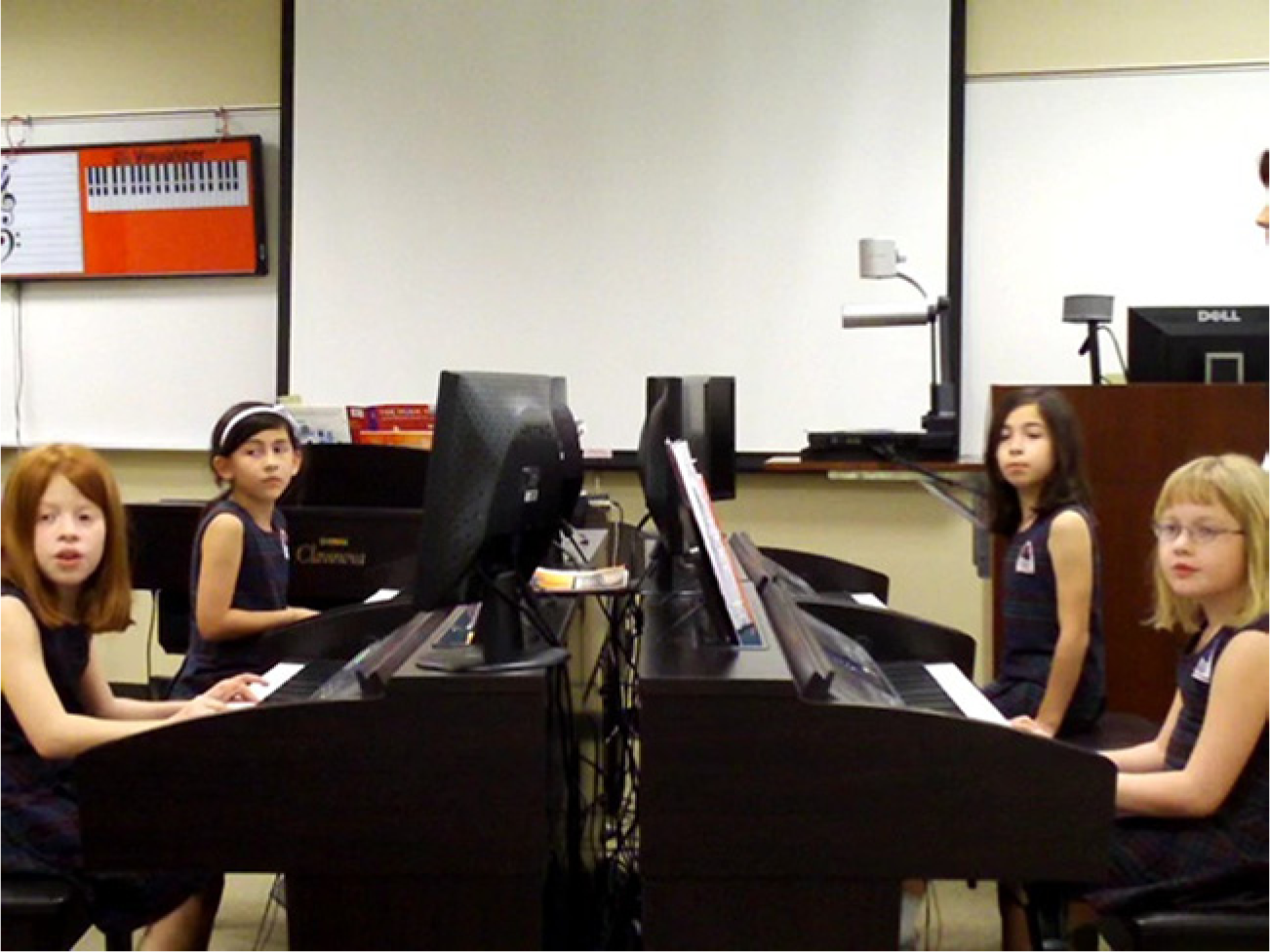
Students in Yamaha piano lab with Visualizer, screen, and ELMO data projector in background (left to right).
Data was gathered and triangulated through weekly in-class observations and video observations of all lessons, teacher questionnaires, analysis of weekly lesson plans, in-depth interviews with the instructors, and member checks. Once data was gathered, the constant-comparison method of analysis (Creswell, 1998) was used to identify common themes, both within each group (novice and expert) and across the two cases. Once no new themes emerged, the data was considered saturated (Creswell, 1998). The resulting data was analyzed to discern whether years of teaching experience impacted the teaching strategies within this particular research sample. Since understanding the context of each case is a critical aspect of the case study, a profile of each group follows so that readers can get a sense of class participants, how the teacher fostered group dynamics within each class, and teaching strategies that were employed by each teacher. Although analysis of student achievement is beyond the scope of this study, student engagement during instructional sessions and the researcher’s evaluations of students’ playing during class will be discussed in the analysis section of this article as these observations address effectiveness of the instructional strategies employed by each teacher.
Group profiles and initial findings
Children’s group A with novice teacher
Overview and logistics of the class
Children’s group A was a 6-week introduction to piano. The instructor chose to teach for a 6-week period as that “fit with [her] schedule” and she believed it would be the “right amount of time to introduce the piano to the students without too much of a time commitment [from the families].” The class was open to any student without prior piano experience between 7 and 9 years of age. There was no syllabus, nor were there written expectations for the students and parents. Although all students had access to a piano or a keyboard at their home, the teacher did not require practice outside of class. Classes were scheduled for an hour, though due to lack of teacher preparation and student tardiness instructional periods typically lasted for only 45 minutes.
The students used My first piano adventures, level A (Faber & Faber, 1995) as their only textbook. The instructor supplied worksheets during class and fabricated her own materials and manipulatives for use during instructional sessions. While there were varied musical activities, the pacing and sequencing of the class did not enable students to discover or master new concepts, nor did the teacher assess student progress during the lesson. Additionally, there were no rules of comportment which led to inattention and off-task behavior during class. Students did not interact with each other through music. A mini-recital took place at the end of the final class session, where each student played one solo piece. There was attrition, from 8 to 6 students, by the fourth class of the semester.
Impressions of instructional sessions
In many respects, the weekly lessons were conceived of and taught as if they were private lessons, without the benefit of student assessment that is integral to private tutelage. The problem with this instructional format is that it did not avail of group dynamics or of group-teaching strategies. There was no ensemble music making. The students operated as individuals and did not develop any rapport with one another throughout the short semester. The greatest asset of the group, participants learning together, was not employed at any point during the term. At any given time, there was at least one student who was not able to complete tasks. The teacher did not have a systematic method for informally assessing student success. Although students were given verbal instructions about what they could practice at home, since each class provided an extensive review of the previous session, students learned that they did not have to practice from one week to the next. As a result, only one of the students practiced between weekly meetings. Most students lacked motivation to play the piano on their own outside of the class meetings. The teacher did have clear lesson plans and activities for each class. However, the instruction was teacher-centered, which is to say that the instructor was more focused on her activities than on what the students were doing. She seemed unable to process various types of student cues in the classroom effectively.
Final in-class mini-recital
During the in-class mini-recital at the end of the semester, students each performed one solo prepared during class. Four out of the six students who attended the final class exhibited poor sitting positions at the piano (i.e., sitting too close, wrists too low, or elbows too high). The performances were rhythmically inaccurate, and unmusical in terms of phrasing or musical expression. Several contained inaccurate pitches and inappropriate fingering choices. Only one of the students demonstrated a basic degree of competency through her performance. This was the student who practiced at home each week. The instructor’s objective with the mini-recital was to “show the parents what their child had learned from the class.” Unfortunately, the children were not adequately prepared for a successful performance experience in this case and mediocrity was exhibited. None of the children enrolled in private piano lessons through the PAA the following semester.
Children’s group B with expert teacher
Overview and logistics of the class
Children’s group-piano class B was a 12-week introduction to the piano. The instructor chose 12 weeks for the semester because she knew that the “beginning students would benefit from three months of consistent instruction … and because this time frame would allow for ample exploration, reinforcement of basic concepts and completion of the curriculum objectives.” The class was open to any beginning student between the ages of 7–8 years, but the instructor conveyed expectations about outside practice and in-class responsibilities to the parents in writing, prior to the first class. These expectations were explained to the students during the first class meeting and reinforced subsequently. Weekly assignment sheets were provided to each student at every class and students remained accountable by checking off what they had practiced each day throughout the week. If a student missed a class due to illness, the parent notified the instructor in advance and assignment sheets were emailed so that the students would not fall behind classmates. Students arrived early for class and the teacher checked each student’s practice assignment, monitoring for problems and concerns, before the formal class began each week.
The students utilized the following materials: The music tree: Time to begin lesson and activity books (Clark, Goss, & Holland, 2000), and Alfred’s Premier Performance book 1A (Alexander, Kowalchyk, Lancaster, MacArthur, & Mier, 2005). Additionally, students were provided with appropriate ensemble music throughout the semester. The teacher supplied her own instructional aids and manipulatives to reinforce concepts. Students participated in well-sequenced musical activities and were accustomed to working together during class. The teacher informally assessed student performance and understanding throughout each instructional period and accommodated musical activities as needed. Much of the classroom technology was employed during each class. The sole purpose of the technology however, was to enhance student learning. There was a mini-recital at the end of the final class of the semester, which consisted of ensemble performances only. There were five students enrolled in the class and they all attended regularly. There was no attrition.
Impressions of instructional sessions
The expert teacher gave much thought to the age and attention span of the students and to the presentation and sequencing of new concepts. Although she had taught similar classes previously, she “always thought about the best approach to use with this particular group of students when preparing lessons.” A critical new concept was introduced, through a group activity, at the beginning of each class when students’ attention was at its peak. New concepts were reinforced at the keyboard, through whole-body experience, through written work, and by linking new material to models that had already been internalized by the students. Students were encouraged to listen critically to the sound they were producing at the keyboard throughout the class and at home.
The method books and music employed were chosen because they were age appropriate, designed for use in groups, and because they adequately reinforced concepts throughout the semester. All students were engaged throughout each class, they knew the expectations for comportment during class time and, because they were motivated to practice outside of class in order to keep up with their peers, concepts were reinforced consistently throughout the week. The students were comfortable working together, both at the piano and during off-bench musical activities, and appeared to enjoy and benefit from the experience of learning in a small group. Ninety percent 1 of class time was focused on group activities (see Figure 2 for in-class activities). Off-bench games, aural skills, and general musicianship activities supported the objectives for performance at the piano.
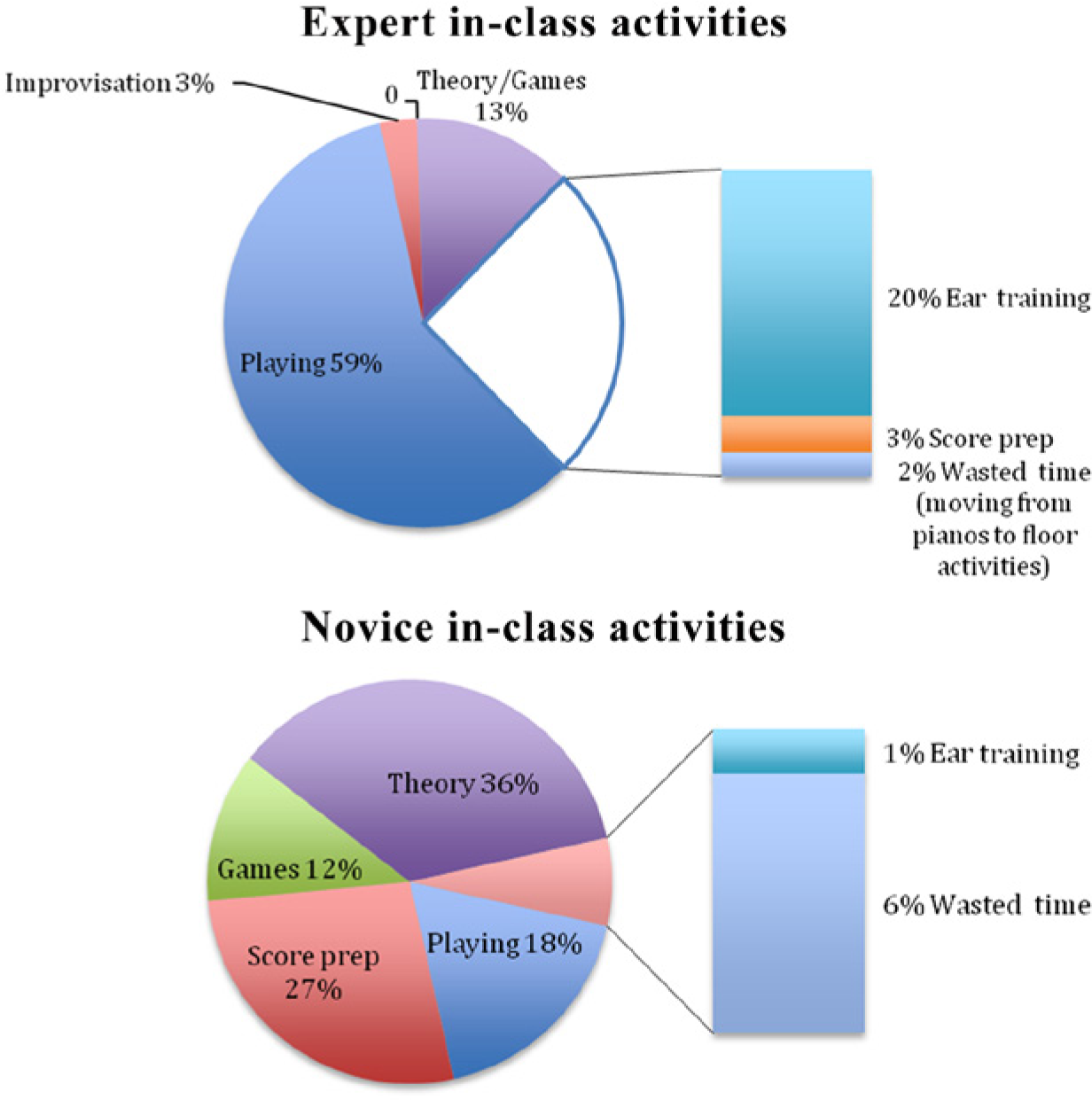
Comparison of expert and novice in-class activities.
These students developed a rapport with one another. They greeted each another upon entering the piano lab, said good-bye to one another at the conclusion of class, and generally worked well together throughout each instructional period. Although they were required to work individually at home, their class time was about communal music exploration and group music-making at the piano. The success in solving musical problems with peers during class appeared to empower these students to learn on their own at home.
Final in-class mini-recital
Since this class was designed as a group lesson, the mini recital at the end of the term included only ensemble performances. The students performed some duets together with accompaniment provided by either MIDI tracks or the instructor, but the majority of the performance consisted of multi-piano ensemble repertoire. These ensembles were designed for digital pianos. The performance was musically secure and satisfying for both the performers and for their parents. According to the teacher, the group performance was set up so that after just “twelve weeks, the students would have a positive experience with performing at the piano. Ensemble music is ideal for this since no one student is on display as a soloist.” The students performed seven pieces at the mini-recital and students, parents, and the teacher all appeared to be enjoying themselves during the performance. Since there was a great deal of focus on aural skills and general musicianship during weekly in-class activities, the students exhibited a level of musicianship that was not heard in group A. These children had learned to listen to and critique musical performances, including their own, and their performance was musical and expressive. All of the students continued with piano study through the PAA during the subsequent semester.
Results
Three broad categories of themes emerged: 1) curricular considerations, 2) teaching techniques, and 3) student engagement and learning. If these themes represent continua, the novice and expert teacher were operating at opposite ends of each continuum. The discussion that follows explores various components that comprise each theme and highlights novice and expert approaches to each. Further synthesis will illustrate why movement toward the more expert-level of operation when teaching children’s group piano is desirable.
Curricular considerations
Components of this broad theme include: clearly articulated goals and objectives; a curriculum designed around these objectives; evaluation and reinforcement of objectives; appropriate length of class sessions and term; appropriate and consistent use of technology; appropriate choice of materials; and, student experience with success. Figure 3 shows the competency exhibited by each teacher for each of these components (novice teacher competencies are listed in black).
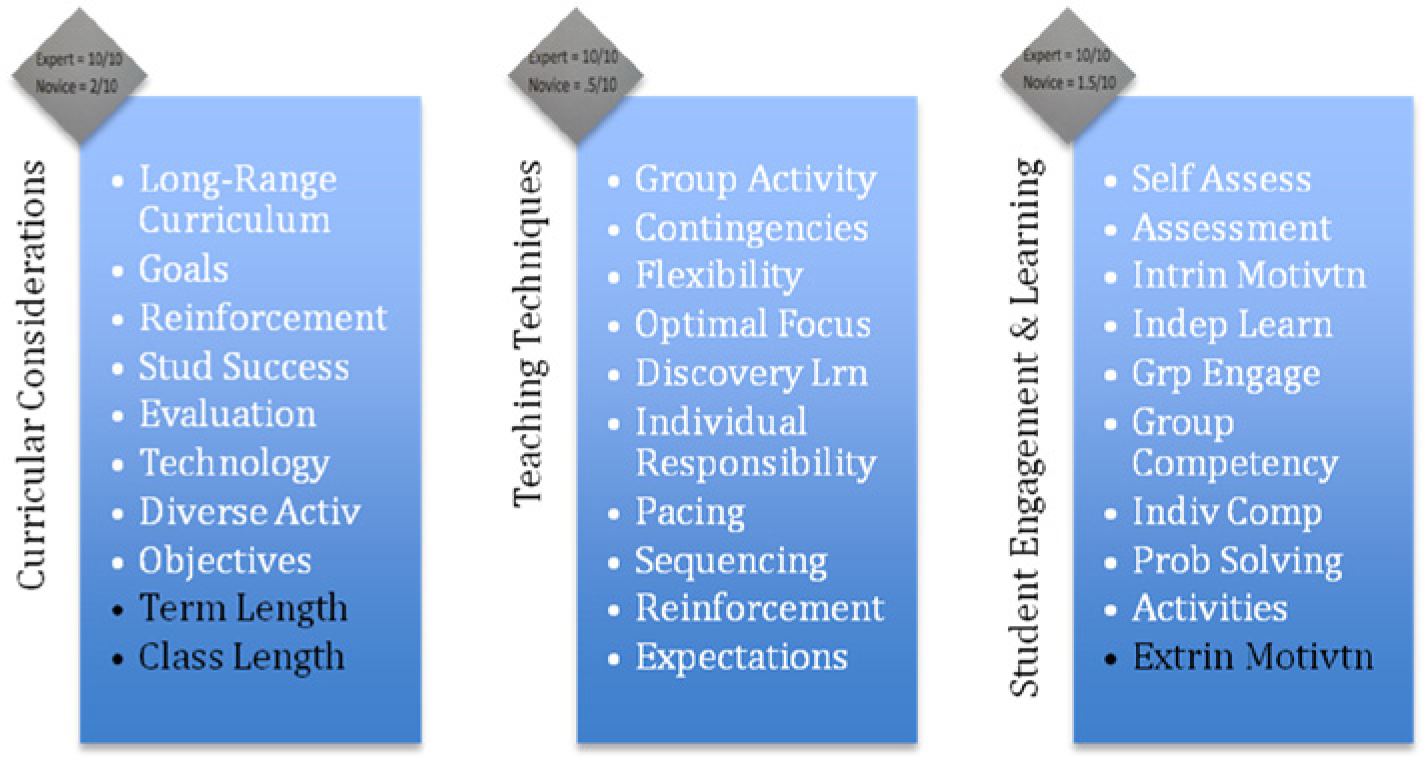
Common theme continua (expert met all component competencies; novice met components listed in black print, at least partially).
Objectives, evaluation, reinforcement, and success
When designing a curriculum for a beginning piano class, the instructor must keep clear, explicit objectives for each week and goals for the semester at the center of all activities (Clark, 1992; Darling, 2005). The expert teacher in this case, listed the objectives for each class at the top of the weekly lesson plan. Analysis of the plan and observation of the classes revealed that the educational objectives informed every decision that was made. Because the expert teacher was evaluating each student’s performance with respect to these objectives, she was able to provide opportunities for ample reinforcement and she provided numerous opportunities for success throughout each instructional period. The novice teacher failed to assess her students during class and instructional decisions were informed by the length of the term rather than by educational objectives. These differences between novice and expert were consistent with other research findings (Butler, 2001; Livingston & Borko, 1989; C. K. Madsen et al., 1992; K. Madsen, 2003).
Technology, materials, and curriculum planning
The expert teacher availed of the technology in the piano lab to help meet the needs of the students. The technology enhanced each student’s experience, becoming transparent, which was not the case for the students studying with the novice group instructor. The choice of materials was critical for meeting the course goals and objectives. Expert-teacher B’s use of technology, lesson activities, and class materials were consistent with the recommendations of piano pedagogues (Clark, 1992; Darling, 2005; Fisher, 2010). The novice instructor used only one method book and chose it solely due to the number of units in the book. While this is an important consideration when choosing materials, it should not be the only one. Factors such as age of the students, strengths and weaknesses of the method, and supplementary materials that will be needed to provide students with a spiraled curriculum must be considered. Materials and activities used by the novice instructor were not appropriate for the age of these children. In fact, the age range of this particular group was too large to accomplish many of the activities attempted during class. The expert teacher had a vision for long-term curriculum planning and the foresight to choose materials based on her prediction about how the instructional sessions would unfold with beginning students whose age-range and problem-solving abilities were more appropriately matched, in spite of the open-enrollment policy of the academy. Again, the expert’s ability to draw from a vast store of knowledge, to accurately reflect upon one’s teaching, and to make appropriate changes (Butler, 2001; Livingston & Borko, 1989; K. Madsen, 2003) was confirmed in this study.
Teaching techniques
Clearly articulated expectations for students (which are reinforced during class), group experiences (with responsibilities for individuals within the group), appropriate sequencing and pacing of the lesson, discovery activities, optimal student engagement, teacher flexibility, and contingencies comprise the teaching techniques theme. See Figure 3 for novice and expert competency for each of these components, as displayed throughout the term.
Group experience, assessment, sequencing, pacing, and flexibility
The primary difference between the teaching techniques employed by the novice and expert during class was that the expert conceived of the class as a “group experience” for the learners. She availed of group learning strategies, group activities, and fostered the group dynamic that emerged among the students throughout the semester, consistent with teaching tendencies of expert teachers identified by Smith (2004). The novice instructor taught the class as she might have taught a private piano lesson. As a result, the children did not work together, they did not develop a rapport with one another, and the experience was not successful. Since the novice teacher did not use informal assessment strategies during instructional sessions she was unable to pace and sequence endeavors appropriately. Similar to preservice teachers in previous studies (Carter et al., 1988; Hamann et al., 1998), the novice in this case did not appear to reflect accurately on her teaching, nor did she detect many student cues during classes. The expert teacher structured activities so that one learning experience led seamlessly to the next. The pacing was always appropriate. Although she had a plan and an idea of how long each activity should take, she was flexible with respect to pacing. She had defined clearly how she would assess student learning and knew how successful students needed to be before commencing the next activity. Successful use of these strategies suggests that expert-teacher B had a vast schematic store from which to draw and she was able to “improvise” to foster students’ understanding during class (Livingston & Borko, 1989).
Contingencies, optimal engagement, discovery learning, and student expectations
The expert teacher exhibited flexibility with respect to contingencies, likely due to her experience and schematic knowledge. If a student was struggling with a new idea or motor skill, the expert teacher had other experiences ready for the student to try. As a result, students did not struggle needlessly nor did they become frustrated or distracted. She had developed the ability to keep the students functioning at the optimal level of performance, based on her teaching experience. The novice teacher, on the other hand, had few contingencies to deal with problems as they arose. Additionally, she tolerated inappropriate behavior such as tardiness, playing while she was talking, student inattentiveness during music-making, and poor posture, which contributed to the lack of structure and student engagement throughout the class period. She may have tolerated some of these in-class student behaviors because she was unable to perceive or accurately interpret student cues.
Student engagement and learning
Components of this theme include: ongoing, informal student assessment; individual and group displays of student competency; problem solving; independent learning within the group; ability of students to assess their own learning; group engagement; and, both extrinsic and intrinsic motivation through suitable in-class activities. Figure 3 provides a breakdown of novice and expert teacher competency in each of these areas.
Activities, reinforcement, assessment, and competency
Students exhibited more engagement throughout each instructional session with the expert teacher. At each class, these students were demonstrating understanding of the material through in-class performance, exemplifying the student outcomes that may be lacking in some research on teaching expertise (Duke, 2000). While working as a group, students in the class taught by the expert group-piano teacher were expected to display a minimal level of competency, which the teacher was assessing informally throughout the class, before the next activity in the planned sequence was undertaken. Due to teaching experience, the teacher planned activities that ensured success within a suitable amount of time. Thought had been given to how much reinforcement and the variety of activities, both on and off bench, would set the students up for success during the class.
Group engagement, independent learning, problem solving, and motivation
At each class, students working with the expert teacher learned how to work through new music, how to problem solve at the piano, and how to practice. Adequate reinforcement and repetition of music during class ensured that students knew how to evaluate their practicing at home. While each of these characteristics has been discussed with respect to the previous themes, they manifested themselves through student engagement and learning when the teacher operated at a more expert level. In the novice setting, much of the student inattention, lack of motivation, lack of student engagement, and lack of demonstrable learning through performance at the piano resulted because the teacher had not employed enough of the expert strategies from the curricular consideration and teaching technique categories.
Discussion and summary
Student outcomes
The stated focus of group A was on general musicianship; providing the students with rudimentary keyboard skills with the expectation that they might continue into private lessons. The novice instructor was not able to articulate clearer or more specific objectives, resulting in an incoherent curriculum. The students learned very little about the piano and developed few keyboard skills. Unfortunately, these children and their parents had no sense of the type of dedication and persistence that it takes to achieve mastery (or even basic competency) on the piano as a result this class. The general musical skills acquired by the students as a result of this class were not universal for all of the children. While the group met in a modern piano lab, the class was conducted much as a private piano lesson would have been.
Group B availed of modern technology, of group dynamics, and cooperative learning strategies to provide the students with a solid foundation of basic piano skills. These students, and their parents, learned how to analyze new music and persist in learning it, they made music with peers, and discovered basic musical concepts through engaging activities. The well-sequenced and diverse learning activities included technique, transposition, theory, sight reading, harmonization, games, and ear training; these supported the musical performance of piano literature.
Students in group B spent a greater percentage of time actually playing the piano during classes (see Figure 2). When playing, more of the students exhibited a basic level of competency than students in group A. Presumably the performance proficiency was higher because group B was expected to practice consistently outside of class. After several weeks, they became better and more efficient at analyzing scores at sight, thus, less time was spent on this during class. The students in group B appeared to be enjoying themselves more during class activities and were more successful at musical games and performances than their peers in group A. Since all students in group B continued with piano lessons, motivation and interest in the piano resulted from this group experience.
Suggestions for group teachers
Beyond having the appropriate physical space and equipment, group-piano teachers may be more successful if they: articulate their goals for students engaged in group piano instruction; and, clearly advise parents of the learning objectives and of practice expectations outside of weekly classes. Teachers should devise carefully sequenced curricula to address each of these goals and objectives, they must be capable of informally assessing whether or not students are meeting these objectives, and be flexible enough to accommodate all students in the group.
If employed, technology should enhance the learning experience. Thought and care should be given to when students will play out loud together or over headphones (while listening to the teacher model) during each instructional period. Ideally, students will play the piano under each of these conditions during class; the teacher’s decision to play out loud or over headphones will be guided by the choice of activities and the learning objectives for the students, as found in the case of expert-teacher B in this study. Varied group and peer activities should provide rich learning experiences that are not possible in a private lesson. Finally, teachers should avail of method books and ensemble music that are age and group appropriate, and which adequately address the teacher’s curricular objectives and goals. Supplementary teaching materials will need to be supplied as no singular method can address each group’s needs.
Teachers interested in teaching piano in groups are likely committed to setting students up for future success as pianists. With this ultimate goal at the forefront, activities should place piano literature and technique at the center of the curriculum. It is suggested that all activities should support the ultimate goal of playing piano repertoire musically and with finesse, regardless of the level of difficulty of the music. Teachers who merely entertain children through activities that require little commitment of time or energy on the part of the students serve no one. As noted in the case of novice-teacher A, neither the parents nor the students are likely to learn about the persistence and dedication that mastery of a musical instrument requires if practice outside of the lesson is not required. If students do not interact in significant and meaningful musical activities during their formative years of piano instruction, it is unlikely that they will become future professional musicians, amateur musicians, or music patrons.
Conclusions
Results of this case study feature the best of group-piano teaching and highlight aspects of curriculum development, teaching techniques, and strategies for student engagement that might be honed by the novice teacher over time. It is beyond the scope of this research to recommend how novice teachers might develop more expert group-teaching strategies. However, novices who systematically address and refine their use of the components identified in the common themes of this research should see movement toward more expert group-piano teaching. Since there is no national curriculum for children’s group piano at present, this study highlights the need for parents to ask insightful questions about the teacher’s goals for the class before enrolling their children in group-piano lessons. Even though the teacher may have outstanding private students who win awards, this does not mean that her group-teaching philosophy is rigorous, or that she is an expert group-piano teacher. The group-piano instructor should be able to articulate clearly her/his expectations for student participation in the class, how he/she will assess individual success within the group, and how he/she will avail of group-teaching techniques to help students attain these goals. More technology does not necessarily mean better piano instruction. However, under the supervision of a skilled group-piano teacher, technology can enhance the student experience.
Future researchers and educators might explore how to train teaching interns and novice teachers to exploit group dynamics and to instruct group-piano using a paradigm that is different from the private lesson. More emphasis on children’s methods and materials that are appropriate for use with various ages and types of groups should be explored during pedagogy classes and professional development conferences. Appropriate sequencing and pacing of materials, including planning for contingencies, must be addressed during the formative years of a group teacher’s development. Framed with this perspective and knowledge, novice teachers need to be able to observe and critique expert group teachers in action.
If, as piano educators, we want the first experience that children have at the piano to be positive, regardless of the teaching environment, we must develop pedagogy curricula and professional training experiences that provide novice group-piano teachers with opportunities to learn from expert instructors. For students, there are many benefits of participating in beginning group instruction. Novice teachers must learn from the experience of expert group instructors and plan carefully when introducing group-piano into their cadre of lesson options, so that students will experience the comprehensive benefits of group-piano study.
Footnotes
Funding
This research received no specific grant from any funding agency in the public, commercial, or not-for-profit sectors.