



Abstract
The ability to read music fluently is fundamental for undergraduate music study yet the training of sight-reading is often neglected. This study compares approaches to sight-reading and accompanying by students with extensive sight-reading experience to those with limited experience, and evaluates the importance of this skill to advanced pianists and the type of strategies they use when sight-reading. Analysis of 74 survey-interviews highlights the importance of sight-reading, and indicates underdeveloped sight-reading skills and a substantial lack of experience in sight-reading and accompanying in advanced pianists. Significant differences in accompanying practice emerged between the groups with no/little and extensive sight-reading experience. The analysis of a number and the type of strategies used during sight-reading suggests individual approaches and distinct paths in the development of the skill. The findings emphasise the need for a new approach in the development of sight-reading curricula for higher education.
Introduction
In higher education, students are expected to be able to read and comprehend vast amounts of text during their study. Similarly, in undergraduate music study the ability to read music fluently is taken for granted. Yet many institutions do not test prospective students’ sight-reading skills during the entry audition process or provide any training in this area. For example, none of the 27 institutions offering undergraduate music degrees in Australia teach sight-reading (Zhukov, 2010). Research has shown that good sight-reading skills accelerate the learning of new repertoire (Lehmann & Ericsson, 1996), which in turn could have a flow-on effect on the entire educational experience, graduate outcomes and preparation for the workforce. In the absence of formal sight-reading training, what do advanced piano students think about the importance of this skill, what is their typical skill level and experience, and what type of strategies do they use during sight-reading? Is there a difference in approach to sight-reading between students with extensive sight-reading skills and/or accompanying experience to those with limited skills/experience?
Background
Sight-reading of music means the performance of music from a score without prior rehearsal of that music (Gabrielsson, 1999). It is a complex skill that relies heavily on reading the score, and generating and executing corresponding motor responses (Lehmann & Ericsson, 1993). Research into sight-reading of music has been fragmented. Hodges (1992) reviewed sight-reading studies conducted mostly in the 1970s and 1980s. There were few new studies on sight-reading in the 1990s, but several recent publications reflect the renewed interest in sight-reading among researchers and educators (Hodges & Nolker, 2011; Kopiez & Lee, 2008; Lehmann & Kopiez, 2009; Lehmann, Slodoba & Woody, 2007, ch. 6).
A model of skills involved in sight-reading (Kopiez & Lee, 2006) suggested that expertise in sight-reading was acquired by the age of 15 and determined by innate ability and practice of specific skills. While skills such as inner hearing (audiation) and visual pattern perception tended to apply to music sight-reading in general (Gromko, 2004; Hayward & Gromko, 2009; Kopiez & Lee, 2008), the best predictors of sight-reading ability for pianists included instrument-specific skills such as speed of trilling (Kopiez & Lee, 2008) and working memory capacity (Meinz & Hambrick, 2010). The pianists found sight-reading particularly challenging: they must read two staves of music simultaneously, in different clefs, and co-ordinate playing different notes in both hands. This uniquely pianistic challenge tended to result in more errors occurring in the left hand (Betts & Cassidy, 2000), which has been recently explained by a longer gaze at the upper staff (right hand) than the lower staff (left hand) during sight-reading (Drai-Zerbib, Baccino & Bigand, 2012).
The existing research on sight-reading tends to focus on three main areas: eye movement, structural perception and teaching strategies (for reviews see Hodges & Nolker (2011), Lehmann & Kopiez (2009) and Wristen (2005)). The eye movement studies used complex equipment to monitor eye movements of expert and novice sight-readers and concluded that good sight-readers look further ahead than poor sight-readers (Goolsby, 1994; Truitt, Clifton, Pollatsek & Rayner, 1997). While this concept appears to be self-evident, teaching is not easily implemented in a typical piano studio: simply encouraging the student to ‘look ahead’ would not necessarily result in improvement in eye-hand span (the distance of looking ahead from the notes being played). Banton’s (1995) experiments established that better sight-readers are less reliant on visual feedback when playing, i.e. they tend to look down at their hands less frequently than weaker sight-readers.
The studies focusing on structural perception when sight-reading reported that good sight-readers tend to see larger ‘chunks’ of music than novices who read individual notes (Goolsby, 1994; Penttinen & Huovinen, 2011). In particular, perception of larger rhythmic structures resulted in better flow of playing (Halsband, Binkofski & Camp, 1994; Waters, Townsend & Underwood, 1998). However, it is still unclear if teaching chunking techniques can have a positive effect on sight-reading: Pike and Carter (2010) reported no significant differences between treatment and control groups in their experiments of teaching pitch and rhythm chunking to enhance sight-reading of undergraduates.
The studies devoted to the teaching of sight-reading were diffused (Gudmundsdottir, 2010; Hodges & Nolker, 2011; Lehmann & Kopiez, 2009). No studies have been replicated and few use similar approaches. For example, Hodges and Nolker (2011) stated that “No specific topic… has an extensive cohort of studies that collectively provide overwhelming support for the usefulness of this approach” (p. 81). Similarly, while Wristen (2005) suggested that pedagogical approaches to improving sight-reading need to include collaborative playing, chunking and systematic study of music theory and history, she reminded that “These approaches have not typically been verified through research” (p. 44). The lack of clear directions in teaching of sight-reading skills tends to result in its absence from a typical piano lesson. Recent research of instrumental teaching in Australian higher education (Zhukov, 2008) found that tertiary music teachers tend to neglect this area, assuming that students either have this ability or they do not. Similar attitudes were reported in a large study of American college pianists (Kornicke, 1995) where sight-reading was included in fewer than half of subjects’ lessons.
Various strategies have been proposed as useful for improving sight-reading skills: looking ahead/reading ahead of playing (Penttinen & Huovinen, 2011), shadowing/silently pressing the keys prior to playing (Kostka, 2000), accompanying experience (Lehmann & Ericsson, 1996), improving rhythmic accuracy (Gudmundsdottir, 2010) and understanding of the musical structure (Thompson & Lehmann, 2004). Three of these strategies (experience in accompanying, rhythm training and knowledge of musical style) appeared to be most promising from a pedagogical perspective.
Accompanying and sight-reading
Accompanying is a specialised skill that requires a synchronisation between perception and production and involves good anticipation of what is to come (Palmer, 1997). Accompanists and répétiteurs tend to have highly developed sight-reading skills because they often have to learn new repertoire in a very short time and to play their own part while scanning another instrumental/vocal part at the same time (Lehmann & Ericsson, 1996). Experience in accompanying and especially the amount of accompanying repertoire have been found to be better indicators of sight-reading ability than the quantity of practice undertaken by students (Lehmann & Ericsson, 1993, 1996). This suggests that providing experience in accompanying and increasing the amount of accompanying repertoire could have a beneficial effect on sight-reading. Such an approach was shown to be effective in a study by Watkins and Hughes (1986) where university non-piano majors improved in rhythmic accuracy of sight-reading after a 10-week experiment that involved accompanying of a tape-recorded soloist.
Rhythm training and sight-reading
The ability to sight-read rhythms has been closely linked to overall sight-reading ability. Research found that rhythmic errors tend to outweigh all other types of errors in sight-reading (Fourie, 2004; McPherson, 1994) and that training produces the greatest improvement in the rhythmic aspect of sight-reading (Kostka, 2000; Smith, 2009). Smith (2009) showed that traditional instruction and computer-assisted instruction produced a similar positive effect on the development of rhythm sight-reading skills. While this study provides evidence that training does improve rhythm in sight-reading, it recommends computer-assisted instruction as supplementary to, and not a replacement for, traditional face-to-face teaching.
Musical style and sight-reading
Musical style is a complex issue that involves analysis of all aspects of the work from historical, structural and performing aspects. Sight-reading ability has been linked to the understanding of musical language, such as the knowledge of style (Thompson & Lehmann, 2004) and the perception of phrase structure (Sloboda, 1984). Research shows that skilled sight-reading requires good pattern recognition and prediction (Waters et al., 1998): familiarity with the formulas characteristic of a particular style assists the player in anticipating the flow of music when sight-reading.
The review of the literature suggests that development of good sight-reading skills in advanced pianists needs to include opportunities for collaborative playing, rhythm-training activities and study of musical styles.
Method
Participants in this study (n = 74) included students from three Australian universities (n = 46), three high schools (n = 20) and a number of private studios (n = 8). There were 54 females (73%) and 20 males (27%), with all subjects falling into the 15–25 age bracket (see Table 1). To achieve a homogenous sample only advanced pianists of 8th Grade level and above were recruited (The Australian Music Examinations Board classifies pianists of Grades 1 to 4 as beginners, Grades 5 to 7 as intermediates, and Grade 8 to Diploma as advanced). Age was not taken into consideration since the study was not focusing on the development of basic music literacy but on exploring differences in approaches to sight-reading among already proficient pianists. The students were randomly placed into one of the three training groups or the control group: each training group focused on one particular strategy as highlighted in the literature review above (accompanying, rhythm training, and style training) and the control group had no additional input.
Participants’ demographics.

Prior to commencing the study students were asked to fill in a background questionnaire that asked them to rate their sight-reading skills (5-point scale: very weak, weak, average, good, excellent) and the importance of sight-reading (4-point scale: not at all important, unimportant, important, very important). Participants were tested on their sight-reading before and after a 10-week training period, and on completion of training interviewed about their sight-reading/accompanying experiences prior to and during their participation in the study. This paper draws on the questionnaire and interview data and explores participants’ approaches to and strategies for sight-reading by comparing those who had extensive sight-reading experience with those who had little such experience.
The questions for student survey-interviews were formulated based on the review of literature. The standardised interviewing approach was used instead of a self-report survey to eliminate typical survey errors, such as accuracy of measurement (Willis, 2005), with the same questions read to every participant (Conrad & Schober, 2008; Stewart & Cash, 2006) (see Appendix 1). If respondents hesitated or appeared unsure, further clarification of questions was offered to provide greater accuracy of responses. If an answer to the question “How much previous experience in accompanying did you have before the program?” was a laconic “A little”, this was followed up with further probing questions, such as “What do you mean by this?” and “What did this involve?” Conrad and Schober (2008) suggested that “standardizing meaning is more effective than standardizing wording in making data comparable” (p. 186). Greater detail provided by the interviewees allowed the author to analyse the data in a consistent manner that was highlighted as a critical factor in interview studies (Hammersley, 2003).
Seventy-four interviews were recorded using a digital recorder (H2 Handy Recorder, Zoom Corporation, Japan), transcribed verbatim and reduced to a short summary prior to analysis (Seidman, 2006). Participants were questioned about their sight-reading and accompanying experiences prior to and during participation in the study, and their sight-reading strategies. The responses ranged from describing total lack of such experiences and/or limited participation to reporting regular and even extensive activities in these areas. The data suggested that the responses could be coded using a scale of 0–3, with 0 representing no experience and 3 extensive experience (see Tables 2 and 3 for examples).
Sight-reading experience coding categories.

Accompanying experience coding categories.

To examine the number and type of strategies used when sight-reading, the subjects’ comments were coded under individual strategy categories and the totals added for each person. The 18 different categories reported in interviews were grouped under five subheadings:
Pitch (key signature, accidentals, clef, tonality/modulations);
Rhythm (time signature, rhythm, counting);
Structure (melody, scanning for difficulties, structure/patterns, harmony/chords);
Motor skills (visualising playing/fingering, shadow playing, separate hands, speed/tempo);
Expression (mood/dynamics, style/title, listen to recordings).
To establish the reliability of the author’s coding process, another researcher from the same university was trained in the usage of codes by listening to several interviews together with the author and discussing the coding of sight-reading and accompanying categories, and of the sight-reading strategies. Student interviews also contained questions on the structure and content of the training programs, student perceptions of progress made and their overall rating of the program in which they participated: these questions were deemed not relevant to the particular focus of this paper. The second researcher was then asked to code alone seven randomly selected interviews (approximately 10% of the total data) by listening to the interviews and entering a number in each variable. The Microsoft Excel file was sent to the author and the numbers correlated to the author’s scores of coding of the same interviews. Spearman’s rho, typically employed for correlation of nonparametric values, was used (Heiman, 2011), with correlations in different categories ranging from .89 to 1.00, ρs < 0.01 (see Table 4). The correlations indicate the high level of agreement between the author’s and the second researcher’s coding of data, and demonstrate the reliability of the coding process (Asmus & Radocy, 2006).
Category-specific inter-rater reliability.

Correlation is significant at the 0.01 level (2-tailed).
Results
Student rating of own sight-reading skill showed normal distribution of skill from very weak to good (see Figure 1), with only one student out of 74 (<1%) rating their skill as excellent. However, the participants were unanimous in rating sight-reading as ‘Important’ (33%) and ‘Very Important’ (67%), with zero scores in the ‘Not at all important’ and ‘Unimportant’ categories.
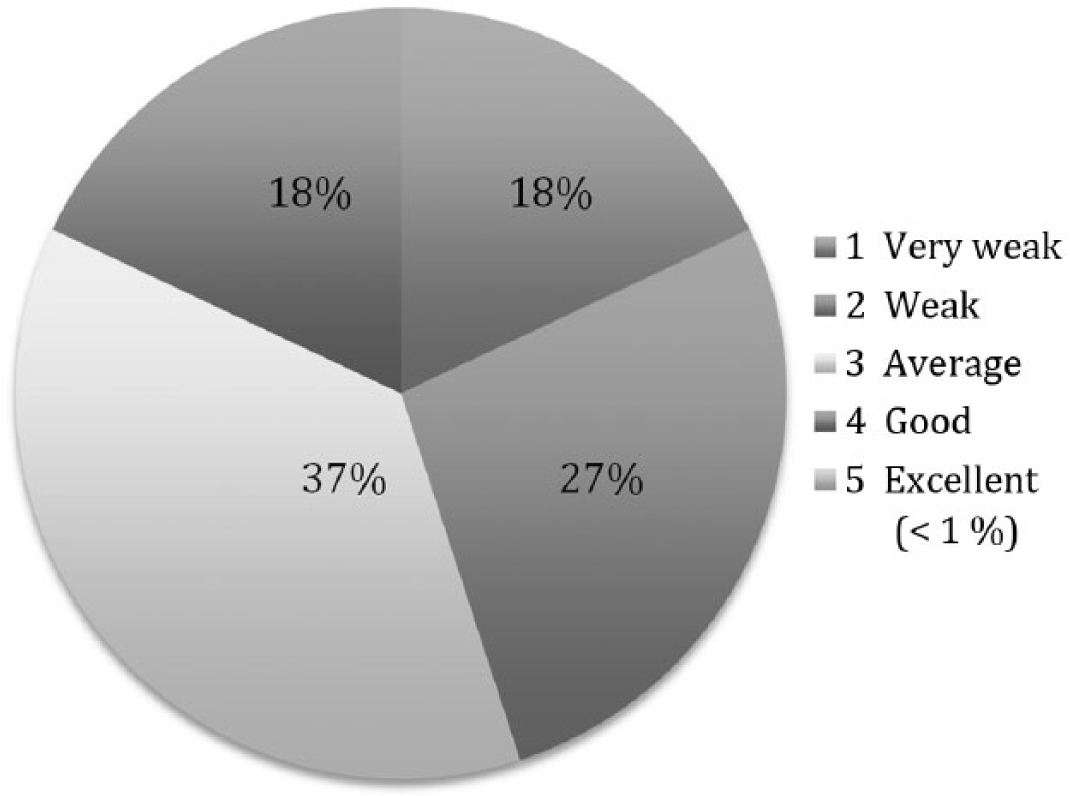
Self-rating of sight-reading skill (n = 74).
SPSS version 18 non-parametric statistical tests were used to analyse the data (Heiman, 2011). In order to obtain an overview of sight-reading and accompanying skills, participants’ responses were initially grouped into two large groups: no and little experience, and moderate and extensive experience. The results indicated that for pianists with advanced playing skills a surprisingly large number of subjects had no or little prior sight-reading and accompanying experience (see Figure 2): 56 out of 74 participants had no or little prior sight-reading experience and only 18 had moderate-extensive experience; 41 had no or little accompanying experience and 33 had a moderate-extensive amount of accompanying experience. While extra sight-reading naturally increased during the participation in the main study with 12 additional pianists sight-reading regularly, this did not translate into increased accompanying activity: in fact, seven fewer participants accompanied regularly during the study than before. This could simply be due to the additional workload associated with participation in the sight-reading study or other circumstantial factors.

Summary of sight-reading and accompanying experience (n = 74). SR, sight-reading; Acc, accompanying.
To investigate differences between the previous sight-reading groups in accompanying experience variables, the Kruskal-Wallis tests were performed. The results indicated significant differences between the groups in prior accompanying experience, H(3) = 16.85, p = .001, and in accompanying during the training, H(3) = 14.11, p = .003. These findings support the hypothesis that the level of prior sight-reading skills affected subjects’ participation in accompanying activities, with better sight-reading skills leading to greater participation in accompanying.
To establish which of the four groups significantly differed on these variables, follow-up Mann-Whitney U tests were performed. The results showed a significant difference in prior accompanying between no prior sight-reading and extensive sight-reading groups (U = 56.00, p < .001), and between little prior sight-reading and extensive sight-reading groups (U = 58.50, p < .001), with more reports of accompanying in the extensive sight-reading group. The findings support the link between sight-reading and accompanying.
While a greater uptake of extra sight-reading was to be expected during participation in the sight-reading training program, it was surprisingly low across the sample. The subjects appeared to continue in their habitual mode: Extensive sight-readers continued to sight-read much new material and little sight-readers to read little. This was supported by the results of a Mann-Whitney U test, with a significant difference between the little sight-reading and extensive sight-reading groups (U = 88.00, p < .001), with more reports of sight-reading during training in the extensive sight-reading group.
The overall participation in accompanying decreased during sight-reading training study; however, subjects with higher prior sight-reading skills continued to be more active in accompanying than subjects with limited sight-reading skills. A Mann-Whitney U test showed significant differences in the amount of accompanying during training between no prior sight-reading and extensive sight-reading groups (U = 61.5, p < .001) and between little sight-reading and extensive sight-reading groups (U = 75.00, p < .001), with more reports of accompanying in extensive sight-reading group.
In terms of strategies used when sight-reading, the subjects’ main focus was on pitch (36%), rhythm (28%) and structure (20%), with less attention to motor skills (11%) and expression (5%) (see Figure 3). While differences between groups in the overall number and the type of strategies used when sight-reading were expected, with extensive sight-readers perhaps utilising fewer strategies overall (more automatic procedures) and paying more attention to structural and expressive elements of music instead of notational basics that weak sight-readers tend to focus on, no statistically significant differences were found across the sample. This suggests that approaches to sight-reading are very individual for pianists, and the lack of formal training in sight-reading reported by many subjects in interviews tends to lead to distinct paths in the development of this skill.

Summary of sight-reading strategies.
Discussion and conclusions
The review of sight-reading literature has provided “less than compelling evidence about how best to assist students in acquiring music-reading skills” (Hodges & Nolker, 2011, p. 81). While theoretical models and predictors of sight-reading skills have been developed recently (Kopiez & Lee, 2006, 2008) and differences in approaches by expert and weak sight-readers identified (Banton, 1995; Goolsby, 1994; Truitt et al., 1997), no proven pedagogical curricula has been developed to date. This typical lack of formal sight-reading training is illustrated by the attitudes and approaches to sight-reading reported by the participants in this study.
The results demonstrate a rather low level of sight-reading skills in advanced pianists: 45% with very weak and weak skills, and 55% with average and good skills. Yet, all students held the view that sight-reading skills were important/very important for their overall musical training. A surprising lack of experience in sight-reading and accompanying among a large number of subjects was found, with habitual attitudes persisting despite active participation in sight-reading training programs. While the literature has highlighted the superior sight-reading skills of experienced accompanists (Lehmann & Ericsson, 1993, 1996), this study has demonstrated a relationship between sight-reading skills and involvement in accompanying activities prior to and during the study.
The survey-interview approach of examining student experiences in the development of sight-reading skills utilised in this study has revealed substantial differences between real life and research recommendations. The students had reported a disappointing lack of sight-reading and accompanying experiences despite generally advanced piano skills. The findings suggest that the take up of accompanying opportunities during degree study is linked to sight-reading skills. While participation in collaborative playing has been proposed as a means of improving sight-reading skills (Wristen, 2005), the examination of students’ experiences has shown that considerable development of sight-reading skills is needed before students will feel comfortable to attempt accompanying in the first place. The ingrained attitudes towards sight-reading and accompanying seemed to persist despite new strategies and skills learnt while participating in sight-reading training programs. This suggest that building students’ confidence in their sight-reading ability might be a long-term process that should include formal training in skills contributing to sight-reading and opportunities for accompanying easy repertoire of beginner instrumentalists.
The lack of consistent trends in number and type of strategies used by different groups when sight-reading emphasises the ad hoc approach to acquisition of sight-reading skills still evident in piano teaching. Student strategies when sight-reading tended to focus on notational basics of pitch and rhythm. While research has shown that perception of larger structures (Goolsby, 1994; Waters et al., 1998) and understanding of musical style (Thompson & Lehmann, 2004) are beneficial to fluent sight-reading, there appears to be little transfer of this knowledge, taught in music history, theory and analysis classes in higher education, to sight-reading at the piano. This gap between the theoretical knowledge and practical application highlights the need to develop new curricula for sight-reading training that will facilitate the transfer by explicitly focusing on specific aspects of pattern recognition in easy quick-study repertoire.
This investigation of student attitudes has highlighted an urgent need for a more holistic view of training of sight-reading skills in pianists: the future development of piano sight-reading curricula for higher education needs to combine collaborative playing activities with training in rhythm and style-specific pattern recognition. Many questions about music sight-reading and how to teach it remain. By combining research recommendations with teaching practice and student feedback we can hope to make sense of complex issues surrounding the development of music sight-reading skills.
Footnotes
Appendix 1
Funding
This research received no specific grant from any funding agency in the public, commercial, or not-for-profit sectors.