



Abstract
Music is increasingly recognised as important in facilitating healthy ageing, yet little is known of what musicians themselves learn when they teach older adults. This article reports the practices of the Rhythm for Life project at the Royal College of Music in the UK, in which conservatoire students taught 10-week programmes of group instrumental music lessons to adult beginners aged between 46 and 90 years. In order to interrogate what four student-teachers learned from their engagement with the project, qualitative data were collected through open-ended questionnaires, diaries and video-stimulated recall interviews. Findings demonstrated that the student-teachers reformulated the ways in which they thought about and taught older adult learners, and developed skills and knowledge relevant to a wide range of educational contexts. The article concludes that models similar to Rhythm for Life, where conservatoires facilitate opportunities for students to teach older adults, may be an effective means of establishing meaningful learning experiences for music students and older adults alike.
Keywords
Introduction
It is well established that those seeking to work in music must prepare for a portfolio career based upon flexibility, diversity and entrepreneurship (Bennett, 2008; Smilde, 2009). Building and sustaining a career in music requires the negotiation of multiple musical fields (Burnard, 2012), with musicians working across traditional career boundaries to construct professional lives that span, among others, musical, educational, technological and community contexts. Conservatoires are increasingly recognising this, not only pursuing performing excellence but also equipping students with the skills, knowledge and attitudes that they will require in lifelong careers as diverse musicians.
Concurrently, conservatoires are achieving closer alignment with local communities, recognising the educational as well as societal imperatives for such partnerships (Cole, 2011; Gregory, 2010). Renshaw (1986), for example, reported on conservatoire students’ responses to a then innovative project designed to connect them with their surrounding social and community contexts. Students reported a tension between “personal and social aspirations, between personal success and social commitment” (p. 84), leading to important processes of reflection and reorientation. More recently, Triantafyllaki, Melissari, and Anagnostopoulou (2012) explored the experiences of musicology students in Greece participating in community outreach placements. Through focus groups and documentary analysis of students’ written work, the researchers uncovered shifts in students’ relationships with others, with their self and with music. Working in educational contexts removed from the conservatoire can offer a forum for music students to engage in “expansive” learning (Fuller & Unwin, 2003); learning that encourages them to step “outside of the box” and to widen their professional possibilities. There is more to discover, however, about what conservatoire students learn when they engage in community-based teaching and, thus, how such endeavour can be most effectively integrated into conservatoire practice.
This article investigates conservatoire students’ community engagement from the perspective of teaching music to beginner older adults. Older adults can be considered a growing and predominantly new audience for most conservatoire student-teachers, presenting them with a largely unfamiliar teaching environment. Indeed, this environment carries with it plentiful challenges, with research indicating that teaching approaches for older adults need to be flexible and individualised (Bowles, 2010), working to dispel myths that older adults have no desire to make music, prefer passive musical experiences, are satisfied with mediocre performances or lack capacity for music making (Dabback, 2005). Further, Hartogh and Wickel (2008) argued that those teaching older adults music must adopt principles including taking a holistic view of human beings, understanding learners’ personal biographies, positioning the learner as a partner in musical dialogue and recognising the competencies and cultures of adult learners. Myers (1992) emphasised the importance of moving away from a “decline mentality” (p. 26) in order to recognise that adult music learners seek to be challenged, to make clear progress and to satisfy particular musical needs.
To teach older adults, then, is a departure from the norm for the majority of conservatoire students, requiring them to step beyond their specialisms and to engage in new practices, with new people and in new spaces. Certainly, it is a new practice at the Royal College of Music, London (RCM), where between 2010 and 2012 students taught older adults as part of the Rhythm for Life project (Perkins & Williamon, 2013). This article introduces the project and its practical implementation, before reflecting – through qualitative research – on what the students learned from their participation as teachers of older adults.
Rhythm for Life
Rhythm for Life aimed to enhance wellbeing among older adults through creative music making. At the project’s core was a series of 10-week programmes, run once in 2010 and once in 2011, for older adults in the local community: (1) a 10-week programme of one-to-one instrumental lessons (recorder, djembe drum, keyboard or guitar), typically conducted in the learner’s home; (2) a 10-week programme of small-group (between 4–8 people) instrumental lessons (recorder, djembe drum, keyboard or guitar), typically conducted in a community venue; (3) a 10-week programme of large-group (20–25 people) creative workshops held at an RCM venue. Older adults aged 50 years and above were eligible to participate (one participant was 46 years old, while the average age of participants was 68 years), and signed up for one of the available programmes. 1 Each programme was free of charge, and instruments were provided by the project for participants to use during the programme and to keep afterwards. All of the programmes were designed for adults with little or no prior experience of playing or learning music.
While the creative workshops were led by an RCM alumnus, the one-to-one and small-group instrumental lessons were taught by current RCM students. Both undergraduate and postgraduate students applied to work on the project, which was not part of their formal course or assessment. Successful applicants were selected by the authors on the basis of their previous teaching and educational experiences as well as their commitment and attitudes toward working with older adults. Each student received a small monthly bursary during their participation in the project to reflect their time and travel commitment. Students typically taught three lessons per week over the 10-week programme; one small-group lesson co-taught with another student, and two one-to-one lessons taught individually. 2
For the majority of the students, this was their first experience teaching beginner older adults. As such, it was essential that a strong programme of training and support was in place before and during each 10-week programme. To this end, each student participated in an interactive training day prior to the commencement of their teaching. Run in collaboration with specialists from the local branch of a charity devoted to older adults (Age UK), topics included: (1) working with older adults, including communication and physical and mental health; (2) health and safety of learners and teachers, including awareness of local health provision for older adults and issues of lone working and safety; (3) teaching music to older adults, building from the students’ existing musical and educational expertise to explore, through role-play and discussion, means to effective teaching and learning. Over the duration of the programme, students also attended an informal mentoring session and received both informal and formal feedback and guidance from the project team.
We have written elsewhere of the impact of learning music on the older adult participants (see Perkins & Williamon, 2013), and, indeed, there is a growing body of literature supporting the role of music making in healthy ageing (see, for example, Clift & Hancox, 2010; Cohen et al., 2006; Hays, 2005; Laukka, 2007; Skingley, Clift, Coulton, & Rodriguez, 2011). Here, however, we aim to understand what participating in the project meant to the conservatoire student-teachers; what they learned from their engagement with older adults and, thus, whether and how the model adopted in Rhythm for Life has a role to play in conservatoires of the 21st century.
Methodology
The study started from the assumption that every learning context reflects the multiple realities of different teachers operating from different backgrounds, in different locations and with different learners (Guba & Lincoln, 1994). Learning was taken to be a social phenomenon (Hodkinson, Biesta, & James, 2008) that involves “becoming a full participant, a member, a kind of person” (Lave & Wenger, 1991, p. 53). Learning was not viewed purely as a process of skill or knowledge acquisition, but also as a process of “developing an identity as a member of a community and becoming knowledgeably skilful” (Lave, 1991, p. 65). This meant that we were interested in the ways that the student-teachers developed, reinforced or changed their practices, attitudes and values to enable them to teach their older adult learners effectively. Working with this conceptualisation of learning meant taking a qualitative approach to the research, making use of multiple sources of data, placing emphasis on the “emic” perspective of participants and seeking for an in-depth and holistic account of learning (Creswell, 2009). The aim of the enquiry was thus to understand what the student-teachers learned, focusing on both the skills and knowledge that they acquired and on the interlinked ways in which they became teachers of older adults.
Participants
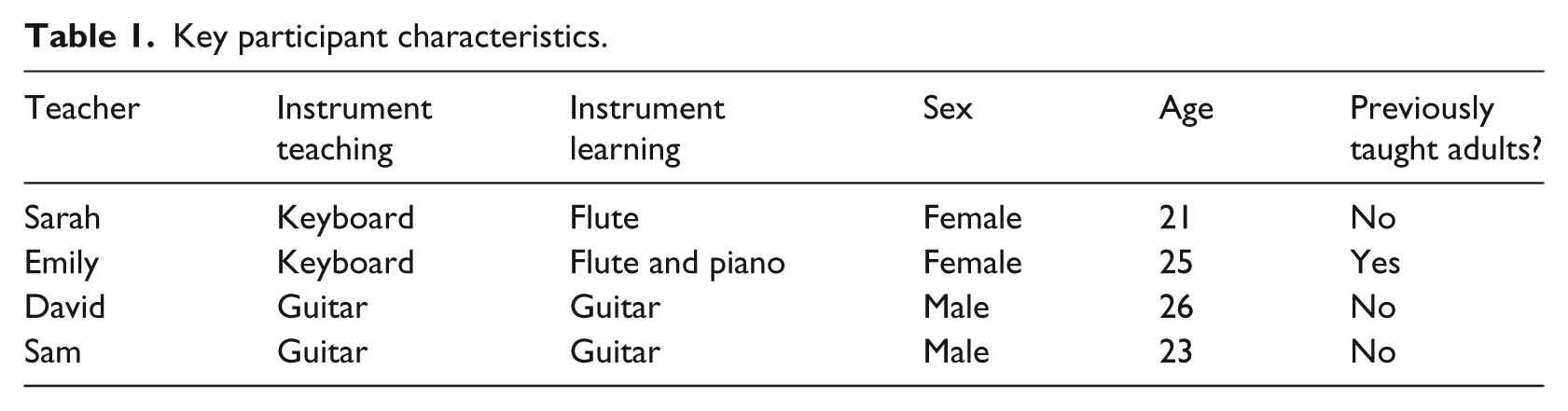
Four student-teachers (hereafter referred to as teachers) participated in the research, which was conducted during a 10-week programme of small-group instrumental lessons held between April and July 2011. Two of the teachers, hereafter known as Sarah and Emily, co-taught a group of seven keyboard learners at a community centre for older adults in West London. The remaining two, David and Sam, co-taught a group of four guitar learners at the conservatoire. Table 1 summarises the key characteristics of the four teachers, all of whom agreed to take part in the research and provided informed written consent.
Key participant characteristics.
Methods
In line with our qualitative approach, multiple methods of data collection were employed. First, teachers completed a questionnaire prior to (pre) and after (post) the 10-week programme. The questionnaire sought information on teachers’ prior experiences of teaching music to older adults (pre), their expectations for what they and their learners will take away from the project (pre), their opinion on the characteristics of an effective instrumental teacher (pre and post), their confidence in teaching older adults (pre and post) and what they felt that they and their learners took away from the project (post). Questions were open-ended, and teachers were encouraged to answer with as much detail as possible.
Second, teachers kept an oral diary over the duration of the programme, guided by a set of four questions posed by the authors: (1) what happened in today’s lesson?; (2) how do you feel about today’s lesson?; (3) what did you learn or take away from today’s lesson?; (4) is there anything else you would like to tell us? Teachers were provided with a portable voice recorder (Olympus VN-3500PC) and asked to respond in detail to each of the questions following every lesson that they taught. In practice, students completed between four and six diary entries each, all of which were fully transcribed. The use of diaries as a methodology for understanding teacher experiences is growing, providing a forum in which the act of data collection is also an opportunity for critical reflection (Wright & Kanellopoulos, 2010). In this way, the teachers were positioned as co-researchers, so that knowledge was constructed by the teachers and authors collaboratively.
Finally, each teacher participated in a video-stimulated recall interview based on one video-recorded lesson. 3 In a manner similar to Rowe (2009), this part of the research continued to position the teachers as co-researchers, offering them the opportunity to stop and start the video as they wished in order to comment upon or elucidate their teaching practices. At the end of the interview, teachers were asked in more general terms to discuss their experiences of working on the project, what they had taken away from it and what it had meant to them. Interviews lasted between 47 and 73 minutes and were fully transcribed.
These methods resulted in four data points for each teacher: responses to the pre questionnaire (week 1), diary entries (weeks 2 to 10), interview transcript (week 10) and post questionnaire (week 10). Taken together, these data provided different “lines of sight” (Berg, 2007, p. 5) on the teachers’ learning, adding validity to the research through the use of different methods at different points in time.
Analysis
Data were analysed thematically in an approach informed by Interpretative Phenomenological Analysis (IPA). IPA recognises a “double hermeneutic”, where “the participants are trying to make sense of their world; the researcher is trying to make sense of the participants trying to make sense of their world” (Smith & Osborne, 2008, p. 53). The analysis proceeded in four stages: first, all data were transcribed and a complete reading made for each teacher, with interesting points noted in the left-hand margin. Second, points of interest for each teacher were translated into emergent themes, noted in the right-hand margin. Third, the emergent themes from across all four teachers were clustered together into subordinate themes before, fourth, subordinate themes were further grouped into the study’s two superordinate themes. Validity of analysis was confirmed by the second author, who reviewed all subordinate and superordinate themes for accuracy and faithfulness to the data.
Results: Learning through teaching
Results are presented in terms of two superordinate themes, each of which is supported by a number of subordinate themes. In what follows, the main features of each subordinate theme are introduced, supported by indicative evidence from the data. Table 2 shows the list of superordinate and subordinate themes.
List of superordinate and subordinate themes.

Theme 1: Becoming a teacher of older adults
The first subordinate theme to emerge within this superordinate category drew attention to the motivation of the teachers to broaden and develop their existing skills: “I am quite an experienced teacher … but I need more teaching experience with older adults, especially older than 50 [years] or when they have physical or health problems” (Emily, pre-questionnaire). This desire for adult-specific teaching experience was echoed by the other three teachers, reflecting proactive recognition of the need for a broad range of teaching skills, as well as a specific interest in expanding teaching repertoires through working with new audiences.
Once teaching was underway, we saw several important ways in which the teachers’ conceptions of what it means to teach older adults shifted over the course of the programme. First, the teachers appeared to recognise adults’ potential for learning: What I have learned is that no one really loses the ability to learn. They [adult learners] have done exams, been to schools etc., and they probably understand more for the guitar that they have to practise, repeat small parts over and over again … Younger children have to be shown how to practice, whereas the older people don’t so much. (David, diary) The older adults, they can actually learn really fast, much faster than I expected. Interviewer: In what way? Understanding things and they could analyse something by themselves. I did think about that before I started a lesson, but actually it was just really impressive. (Emily, VSR interview)
We see evidence here that the teachers were learning about learning; coming to realise that older adults have a lifetime of learning experiences that can and do inform the ways in which they learn music. Realising this is a crucial part of being able to teach older adults effectively, demonstrating how the teachers were becoming part of a community of educators that recognise and celebrate older adults’ learning potential.
Linked with the above, the teachers also came to recognise their learners’ strong motivation for progress and achievement: Working with older adults, I think it is a lot easier than working with children because they [have] so much desire to learn the guitar. (Sam, diary) My students’ abilities were also considerably improved. One learner, in particular, managed to overcome certain physical difficulties and successfully completed the course. This was an eye opening experience for me as it has taught me to never underestimate a student. (Sarah, post-questionnaire)
Both Sam and Sarah here reflect on the determination demonstrated by the older adult learners, manifested in a commitment to practising and learning, as well as a resolve to overcome barriers to progression. Indeed, Sarah explicitly acknowledges the potential vulnerabilities of older adults, both physically but also emotionally: “It is particularly important to be both encouraging yet not patronising when teaching older adults as many students of this demographic can be lacking in confidence” (Sarah, post-questionnaire). Realising that vulnerabilities are not necessarily detrimental to progress, and can often be supported by high levels of motivation, is further evidence of the teachers’ changing views and practices.
Moving to the next subordinate theme, we see the teachers recognising the need to appreciate and start from older adults’ prior experiences. For two of the students in particular, this resulted in a powerful reconsideration of why and how they teach music: I actually realised especially for the older adults, some people they want to study the piano just because they want to play a familiar tune … So actually, what they are trying to do is play some tune, not like recognise notations on the scores, so I am not pushing to read the notes but maybe to teach them some tunes directly and ask them to play directly without too much explanation on the score because there seems less concentration if you talk too much about the notes, key signature, time signature, something like that. (Emily, diary) The main difference I have come to understand in the teaching of elderly learners is that there is more emphasis placed on the enjoyment factor, and the act of playing the instrument being an activity. The lessons aim for playing the instrument to give as great a sense of purpose and satisfaction as possible, rather than all efforts being geared towards technical perfection! This is something that will stay with me for when I next teach under these circumstances in the future. (David, post-questionnaire)
Here, the teachers reflected on the importance of recognising their learners’ motivations and redesigning their teaching in response. For Emily and David, this meant recognising that learning music is not always about mastering how to read notation or to achieve technical perfection; rather, learning music can – and is for these adults – be about being able to make and enjoy music making. This is a fundamental shift in the way that the two teachers think about and facilitate their teaching, demonstrating the ways in which they are becoming experienced and thoughtful teachers of older adults.
Finally, and tying together much of the above, is the sense of satisfaction garnered from teaching older adults: I could tell that most of them [adults] waited to learn music for an extremely long time, and I feel very confident and happy to answer all the questions. I feel complete whenever I see their progressions. (Emily, post-questionnaire) I have come away with a sense of accomplishment. I feel that I have achieved something through making the lives of the elderly learners in some way happier, or at least more enjoyable. (David, post-questionnaire)
As they become “knowledgably skilful” (Lave, 1991, p. 65) as teachers of older adults, the teachers also take personal satisfaction from their engagement with this group of learners. Over the course of the 10 weeks, then, we see the teachers coming to know the ways in which older adults learn, their motivation for progress as well as their potential vulnerabilities and the need to start from and build upon learners’ experiences.
Theme 2: Becoming a music teacher
In addition to developing as teachers of older adults, the teachers also developed as music teachers more broadly, building what Sarah terms a “bag of tricks” (VSR interview). Evidence was found of the teachers developing and refining their teaching practices, including the use of analogy and metaphor (David) as well as a multi-modal approach to instrumental teaching (Sarah and Emily) that includes singing as well as playing (see Lisboa, 2008). More specifically, the teachers appeared to learn how to teach groups of learners, recognising the challenges and possibilities of this teaching context: I have also learned how to approach teaching a group more effectively in the future. It is very important to keep everybody interested and not get too involved with one person as this can de-motivate the rest of the group, and they lose interest. This will definitely help me in similar situations in the future. (Sam, post-questionnaire) Interviewer: You think it is easier for them [learners] in a group? Yeah because they are helping each other. It is not like by yourself. Your mind is kind of open, everyone is playing and if you are going to the wrong way and the other person suddenly says something it helps you back to the right way. (Emily, VSR interview)
Sam’s words echo the other teachers in representing the challenge of maintaining interest and progress across a diverse group, particularly when certain learners – because of their personality or needs – require extra attention. As Emily points out, however, the teachers also began to recognise the potential within groups of peer-learning and peer-support, developing important strategies (“tricks”) for their future teaching.
Furthermore, the teachers recognised the benefits and challenges of co-teaching in a pair. Sarah and Emily developed a pattern of teaching that facilitated group-wide engagement, taking the role of “leader” and “supporter” on alternate weeks. In this way, there was always a teacher to spend time with individuals within the group, so that “the more advanced learners then get to keep occupied whilst the people who struggle still get help” (Sarah, diary). David and Sam, on the other hand, found their co-teaching relationship coming under tension: [There are] differences between me and [David], between what to do and the differences between how fast we do that … It’s been great anyway, I’ve learned a lot from how to work with another person. Interviewer: what kind of things have you learned about working with other people? It’s a nightmare! No, it can be a nightmare at times but it’s good, it’s really good to work together because you get double the input but then if you, especially if you’ve got a group, there needs to be a lot of – you need to be conscious of where the other person’s at, which we weren’t really …We need to be more aware of where we are, where we were. (Sam, VSR interview)
Sam’s reflections here illustrate how he was forced to consider how, and how not to, co-teach. A key part of both his and David’s learning during the project focused on coming to know their own teaching approach – “where we are, where we were” – how and why this differed from their co-teacher and how they could more effectively work together. While arguably a useful learning experience, the tensions that Sam and David experienced as co-teachers should also be considered as potential challenges of this teaching arrangement.
Finally, the teachers learned the need for both detailed planning and flexibility within each lesson: During this project, I learned how important planning each lesson was. This became more important the further we got in to the project, as some adults were improving at a quicker rate than others. The plan made sure that everybody was able to get involved. (Sam, post-questionnaire) Being quite quick minded in the lesson because lots of different things [are] happening … You don’t know what is going to happen in the lesson, so you have to make a clear mind and be patient. (Emily, VSR interview)
Advancing the skill of responding reflexively to the lesson as it happens, in addition to planning in advance, was central to all four teachers. Indeed, the ability also to reflect back was captured in the teachers being, and learning to be, reflective practitioners: It [the lesson] was much better than I thought it was … I’m glad I saw it [the video of his lesson] actually ‘cos, it tells me where we’re going wrong … and what I should do: play less, definitely play less. (Sam, VSR interview) Working with a professional team is always the best way to gain experience, and I have also got a lot of chances to share ideas with people. (Emily, post-questionnaire)
Participating in the project as a teacher and as a co-researcher, then, appeared to provide space in which the teachers could reflect upon their practices, sharing ideas with others in order to develop a “bag of tricks” that they can draw upon in their future teaching roles, both with older adults and learners of other ages.
Discussion
This article has explored what conservatoire students learn when they teach older adults music. Recalling that we viewed learning as a process of becoming, we have seen the different ways in which the student-teachers became “knowledgeably skilful” (Lave, 1991, p. 65) as they acquired new skills and reformulated the ways in which they thought about teaching older adults. Indeed, there is evidence within our data of “transformative learning”; learning that evokes a change in a person’s “frame of reference”, their “meaning perspectives, habits of mind, mind-sets” (Mezirow, 2000, p. 7). Putting this another way, Dirkx (1998) explains that transformative learning reflects “change within the core or central meaning structures … through which we make sense of the day-to-dayness of our experiences” (p. 4). On an albeit very small scale, we can consider the changes in the ways that the student-teachers thought about teaching music, moving away – for example – from starting with notation or focusing on technique, as a fundamental shift in the ways that they know and understand what it means to teach music (Kegan, 2009). Similarly, changing views about older adults and their ability and desire to learn was an important transformation in the ways that these young teachers think, contributing to a process of becoming part of a community that specialises in teaching older adults music.
Shifts of this sort can be fundamental in equipping students for lifelong careers in music, offering the opportunity to step outside of “the box” to encounter new practices with new people. Certainly, knowing as we do that conservatoire cultures can perpetuate something of a focus on specialist performing skills (Perkins, 2013), it is important to continue to find innovative ways of allowing students access to new and potentially transformative, broadening learning experiences. Nonetheless, we remain mindful of Cole’s (2011) concern that conservatoires’ contact with communities – in projects such as Rhythm for Life – is often short-term, relying on one-off initiatives without establishing sustainable connections. While this remains an important concern, the research reported here suggests that the effects of such engagement, even if one-off at the time, may yet have longer-term consequences. To capture students’ interest in and desire to learn about older adults, and to provide a forum in which they can challenge their conceptions of what it means to teach music, can be a powerful tool in preparing a generation of musicians that have the skills and mind-sets to continue engaging with their local communities long after a 10-week conservatoire project. Sustainability of practice of course remains an important goal for conservatoires, but we should also remain mindful of the transformational potential of even one-off initiatives on music students and, therefore, their future engagement with communities. Continuing to provide space in conservatoires for projects such as Rhythm for Life, then, may be an important part of career preparation for 21st-century musicians.
Finally, this article has implications for teaching older adults music. We outlined earlier the need for teaching approaches for older adults to be flexible and individualised (Bowles, 2010), providing adults with meaningful and high-quality music making (Dabback, 2005) and working with a holistic view of human beings that takes learners’ biographies as a starting point (Hartogh & Wickel, 2008). This study corroborates these messages, reinforcing the need to reject a “decline mentality” (Myers, 1992, p. 26) in favour of a mentality that responds to adult learners’ motivations for learning music, as well as recognising their lifelong experiences of, and expertise as, learners. Further, while co-teaching in pairs offers an opportunity for peer-learning among student-teachers, it is important to recognise that this arrangement can lead to interpersonal tensions that have the potential to be detrimental to the experiences of teachers and learners alike. Encouraging student-teachers to think about, articulate and share their teaching approaches and philosophies can be an important tool in not only eliciting self-reflection and reflection, but also in facilitating effective team-working.
To conclude, this article has explored what some conservatoire students in the UK learn through teaching older adults, highlighting the ways in which student-teachers can become “knowledgeably skilful” as music teachers of older adults. In addition to acquiring teaching skills relevant to a wide-range of teaching contexts, engagement with older adults had the potential to offer a transformative learning experience whereby the student-teachers reformulated the ways in which they thought about teaching music. While a small-scale study, with limited participants and limited diary entries for each student-teacher, the article suggests that models similar to Rhythm for Life, where conservatoires facilitate opportunities for students to teach older adults, may be an effective means of establishing meaningful learning experiences for conservatoire students and older adults alike.
Footnotes
Funding
Rhythm for Life was funded by the Esmée Fairbairn Foundation (grant number 09-1722).