




Abstract
This article explores cooperative learning in choral conducting education. The five characteristics of cooperative learning identified by Adams and Hamm ((1996). Cooperative learning: Critical thinking and collaboration across the curriculum (2nd ed.). Springfield, IL: Charles Thomas Publishers): positive interdependence; face-to-face interaction; individual accountability and personal responsibility for reaching groups goals; frequent practice with small-group interpersonal skills; and regular group processing and reflection have been used to structure the discussion on the learners’ perception of their development and their module’s effectiveness. The context in focus was an elective module on choral conducting education at master’s level. Cooperative learning in choral conducting education was shown to support the learners’ motivation for active participation in the teaching and learning process; to increase respect for diversity; to support the learners’ development of interpersonal, communication, leadership and teaching skills at both an individual and at a collective level; and to improve teacher effectiveness.
Introduction
For many years, the training of choral conductors in the UK took place in apprenticeship environments situated in informal (cathedral or school) or formal (conservatoire and university) ‘communities of practice’ (Lave & Wenger, 1991). To begin with, anecdotal evidence suggests that in the UK cathedral choral tradition, choral conductors tend to be males who entered this tradition from an early age as chapel choristers and later started learning the organ. Some of these singers and organists have been participating for years in their communities of choral practice from the periphery and have been observing their choral master(s) carefully (Durrant, 1999). The next stage is to slowly move into full participation as choral conductors themselves without necessarily having any knowledge of the impact of conducting gesture on sound. Durrant (1999, p. 94) recalled a conversation he had with a friend who was a cathedral chorister, who confessed that the choir men had all agreed to trust their innate musicianship instead of the ambiguous gestures of the choirmaster to get through the music. Unfortunately, the lack of choirmasters’ knowledge of and training in singing and choral conducting might be interpreted as a lack of singers’ musical talent. Such misconception might lead to vocal frustration or failures on the part of the singers, who become turned off to singing and choral participation.
As regards formal education, a master–apprentice model of preparing choral conductors is still found in conservatoires (Gaunt, 2006; Polifonia Working Group, 2010), where the master is the ‘omnipotent teacher’ who gives all the answers, whereas the apprentice is an ‘obedient student blindly following the teacher’s instructions’ (Polifonia Working Group, 2010, p. 27). Gaunt’s study (2006), which addressed one-to-one teaching, revealed that in conservatoire environments cooperative learning tends to be dominated by teaching and learning models based on transmission and apprenticeship. She pointed out that it is not clear whether such models could stimulate appropriate and extensive learning in all the learners, or if they can encourage teachers to develop techniques and strategies to match needs of individual learners and prepare them for a professional career as music performers. Ironically, the learners in conservatoires are highly skilled musicians admitted after demanding auditions, who, when given the choice, favour cooperative and participatory education over didactic instruction (Bartleet & Hultgren, 2008; Griffiths, 2009; Jaques, 2000); this is very much the case with choral conductors as well (Varvarigou, 2009).
In contrast, choral conducting education in university contexts in the UK, despite being in short supply, occurs in cohorts of learners (Varvarigou, 2009). Choral conducting education in groups offers learners the chance to ‘try to learn something together’ (Illeris, 2007, p. 121). Griffiths (2009) emphasized that learners in small groups have a dual role; they are students as well as collaborators in their own intellectual, personal and professional development. Some of the benefits from cooperative learning for the participants include high levels of motivation, increased academic performance and retention, increased respect for diversity, development of skills required in a community and the world of work (Bartleet & Hultgren, 2008; Kneale, 2009) and improved teacher effectiveness. This paper examines how collaborative learning was facilitated in a choral conducting education module. The five characteristics of cooperative learning (positive interdependence; face-to-face interaction; individual accountability and personal responsibility for reaching group goals; frequent practice with small-group interpersonal skills; and regular group processing and reflection) identified by Adams and Hamm (1996) provide a structure to the discussion of the process of effective choral conducting education in groups.
Effective models of choral conducting education
There has been a wealth of studies, especially in the USA where choral conducting education is systematic and structured, on the characteristics of effective choral conductors. Particular emphasis has been placed by the literature on the conductor’s gestural competence (Fuelberth, 2003, 2004; Scott, 1996) and ‘intensity’, interpreted as efficient, accurate presentation and enthusiastic affect and pacing (Byo, 1990; Madsen, 1990; Yarbrough & Madsen, 1998); rehearsal approaches (Apfelstadt, 2000; Brunner, 1996; Freer, 2009; Ruocco, 2008; Zielinski, 2005), including verbal communication (Freer, 2009; Goetze, Cooper, & Brown, 1990; Gumm, 2007; Langness, 2000); motivation (Stamer, 2009); and warm-up instruction and repertoire selection (Briggs, 2000; Persellin, 2000; Reames, 2001), to mention a few.
Whilst there is an abundant research literature on the attributes of an effective choral conductor, literature on whether choral conducting is teachable or not is quite small. Effective choral conducting education has troubled researchers who seem to agree that an efficient conductor should possess various attributes, including musical-technical, communication and leadership skills (Apfelstadt, 1997; Durrant, 2003). Apfelstadt (1997) identified key musical (i.e., artistic intuition, musicality/ expressiveness and aural sensitivity) and extra-musical (i.e., articulateness, confidence, effort, enthusiasm and initiative) skills in connection with effective choral leadership, which, she emphasized, can be taught. Durrant (2003) explored ‘deeper choral communication’ (p. 7), by which he referred to communication that encourages responsiveness from the singers, and he proposed a model where the behaviour and general communication skills of a conductor can encourage responsiveness from the students to a higher degree than a satisfactory level of technical and music competence. His model consists of philosophical principles underpinning the conductor’s role (knowledge of choral repertoire and the human voice; an image of the music prior to rehearsal; an awareness of the aesthetic potential of the music; and an understanding of the nature of the conductor’s role), musical-technical skills (aural and error detection skills; clear and appropriate gesture and vocal demonstration; recognition of the important of warming-up voices; and strategies of establishing the character of the music) and interpersonal skills (communication; non-threatening environment; enabling choral and vocal development; making singers feel comfortable and confident; effective pacing; and expectations of the highest standards possible). Durrant (2003) stipulated that these attributes can be taught within a safe and supportive teaching and learning environment.
The literature base on the process of choral conducting education is even smaller. So far, research has explored learners’ self-assessment (Yarbrough, 1987); learners’ self-assessment, peer assessment and instructor feedback (Johnston, 1993); teacher-directed modelling (Grimland, 2005); and a recent doctoral study has proposed a theoretical framework for effective choral conducting education based on Cognitive Apprenticeship (Varvarigou, 2009).
Yarbrough (1987) examined the relationship between self-assessment and post-test conducting achievement scores of 85 students and reported that students were gradually more successful at evaluating and improving their conducting through structured self-assessment. Johnston (1993) investigated the use of video recordings for self- and peer assessment and instructor feedback in evaluating the conducting skills of music student teachers. His findings highlighted that peer evaluation provided ‘a less critical… and often very constructive third opinion’ and that peer involvement ‘maintained an active interest amongst the students in the learning process’ (p. 61). Lastly, Varvarigou (2009) and Varvarigou and Durrant (2010) researched the process of preparing choral conductors in higher education (HE) through the lens of Cognitive Apprenticeship (Collins, Brown, & Newman, 1989). Methods such as modelling (also the focus of Grimland’s study, 2005), scaffolding and fading, reflection and exploration, within an environment that fosters cooperation and situated learning, were perceived by the participants in the study as salient in preparing choral conductors effectively.
Research method
Research context: The choral module
The choral module in focus became part of the MA in Music Education module at a HE institution, which was the subject of this study, in England in 2007. From 2007 to 2011, the learners (N = 89) enrolled in the module were either in training for the Professional Graduate Certificate of Education (PGCE) in Music or in an MA in Music Education, both offered at the same HE institution. All learners had a first degree in music and the majority were females (N = 64). There were no admission requirements to the module and for some learners this was the first formal conducting tuition that they had experienced. Two tutors led the module in focus, the current author being one of them. The data have been collected between 2007 and 2011 from five cohorts of learners. The number of participants each year ranged from 15 to 22. Because all five cohorts of learners were drawn from the same module over five years, the data from the five classes were combined.
The module consisted of five face-to-face day sessions (5 hours each) spread over a period of six months. The face-to-face sessions (see Table 1) contained theoretical sessions on choral conducting education, vocal development and effective teaching and learning, informed by research in music and music education; group practical activities, pair activities, individual conducting podium time, feedback from the tutors and peers and opportunities for reflective practice. The first session focused on the learner as a conductor and explored gestural technique, good posture and other forms of non-verbal communication, such as eye contact. The second session dealt with vocal issues such as awareness of the children’s vocal development, choice of repertoire and warm-ups, whilst the third session was about the conductor as a leader during rehearsals and in performance. The fourth session gave the learners the opportunity to practise the skills and knowledge they acquired during the module and to prepare for their assessed rehearsal on the final day of the module.
Plan of face-to-face sessions and online activities.
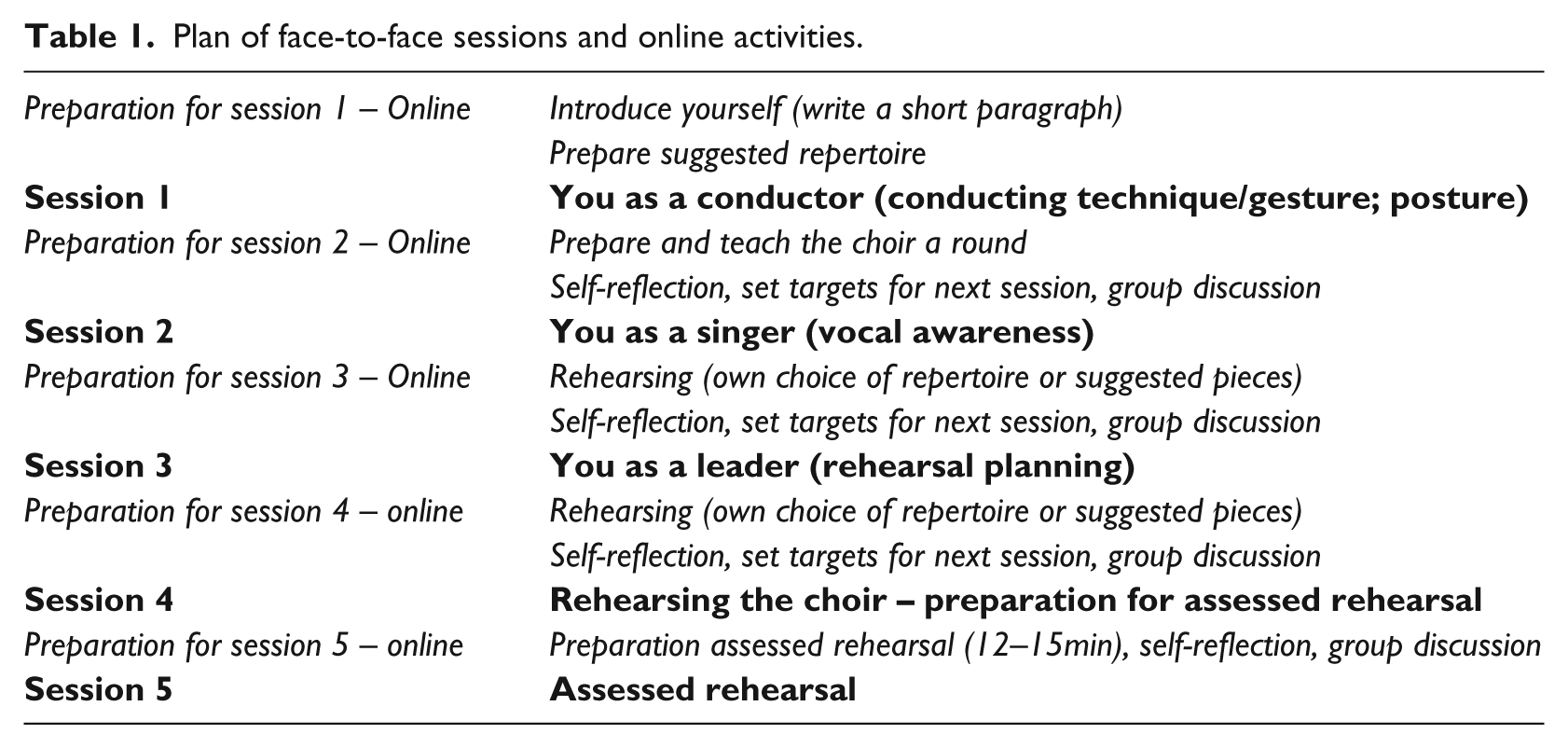
The repertoire used during the first two sessions was common to all and was distributed two weeks before the first session. During sessions three and four the participants were encouraged to use music that they rehearsed with their groups, so, the choir was expected to sight-read the music. In-between the sessions the learners were expected to practise the skills and knowledge that they had acquired from the sessions with their own choral groups in their own environments, their school or community choirs. The intention was that the new skills could be then transferred and realized into effective teaching in a more relaxed atmosphere in the learners’ own environments.
Online group interaction was built into the module from 2008 onwards. The online activities included peer observation, peer feedback and self-reflection. Each individual was video-recorded conducting the group during each session. Then each conductor was expected to watch their video, identify strengths and areas for improvement; set targets for the next face-to-face session; evaluate other colleagues’ videos; and comment on colleagues’ targets for the upcoming face-to-face session. The group activities were carried out amongst small groups of four learners, where they could feel safe enough to be honest about their own and their group members’ practice. It was the tutors’ intention to encourage the learners’ active participation in the professional development of their peers; therefore, although the tutors structured and fostered cooperative learning in the class, they never interfered in online peer feedback amongst the learners. Instead, the learners chose the frequency, significance and role that online interaction could play in their education process. The learners were not expected to video-record rehearsals of their own choirs as part of the module.
Data collection and analysis
Data were collected through video observations (VOs) (2007–2011); questionnaires (Qs) and interviews (Is) (2007 and 2008); reflective logs (RLs) and online group discussions (OGDs) (2008–2011). The questionnaires were administered at the end of each session and inquired into the learners’ expectation from the module, perceived development (e.g., How effective is your general understanding of the voice? The role of the conductor? The relationship between gesture and sound?) and changes in rehearsal approach (e.g., Is there anything that you tried to do differently during choir rehearsal since the previous session? Have the choir or anybody else listening to them noticed any difference?). Interviews were undertaken with a small sample of three or four participants from each cohort, who were asked to elaborate on the questionnaire questions. The key research question that drove this paper was ‘what were the learners’ perceptions of their development and the module’s effectiveness?’
The data were analysed through an iterative process outlined by Cooper and McIntyre (1993). The process involved:
reading a random sample of scripts;
identifying points of similarity and difference among these transcripts in relation to the research question;
generating theories against a new set of transcripts;
testing theories against a new set of transcripts;
testing new theories against transcripts that have already been dealt with;
carrying all existing theories forward to new transcripts;
repeating the above process until all data have been examined and all theories tested against all data (Cooper & McIntyre, 1993).
The qualitative analysis software Atlas.ti was used, allowing the researcher to shift concepts around until an agreed relation of the codes with each other and with the collective dataset was achieved. Two independent researchers looked at samples of the codes and confirmed their agreement with the categorization. In the extracts used in this paper all names have been taken out. T1 and T2 have been used to represent each tutor talking. L1, L2, etc., have been used to represent the learners.
Findings
The themes that emerged from the analysis of the data are presented here under the five characteristics of cooperative learning identified by Adams and Hamm (1996).
Positive interdependence (‘Promoting interdependent goals’)
By positive interdependence Adams and Hamm (1996) referred to individuals realizing that they can achieve their own personal learning goals only when everyone in the group reaches theirs. The learners of the module were at different levels of conducting knowledge and experiences, so positive interdependence was fostered through peer observation and peer feedback (discussed in the next section). Peer observation afforded the less competent and confident learners opportunities to develop a ‘conceptual organizer’ (Collins et al., 1989) for their conducting attempts by imitating their peers and the tutors (Durrant, 2003; Gaunt, 2006). At the same time, the more advanced learners monitored beginners’ progress and also learnt from it. This conceptual organizer was continually updated through further observation and feedback during the face-to-face session and online and it motivated the learners to put more effort into becoming a group where individuals supported each others’ development (see Figure 1).
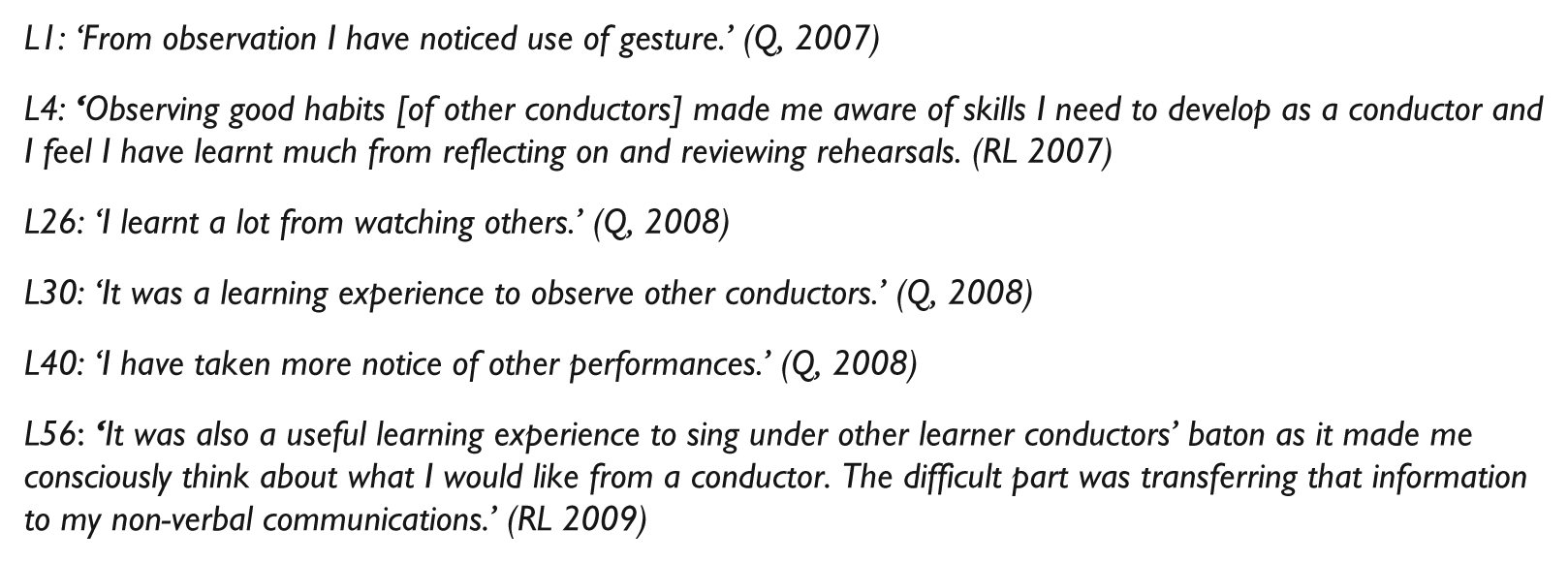
Learners’ perceived development in choral conducting through observing other conductors.
Some students with no prior experience in choral conducting reported that they initially found conducting a mixed-ability group an uncomfortable experience. Some others felt uneasy about allowing personality traits to be revealed on the podium (also in Bartleet & Hultgren, 2008). However, the majority found that the different competence levels of the peers enriched the dynamic of the group. One learner, an already experienced choral conductor, explained that observing novices was beneficial for her because it made her think of ways to deal with particular issues as a potential tutor. She added that observation of other models in practice was an important method towards effective learning. This was also acknowledged by several learners (see Figure 2).
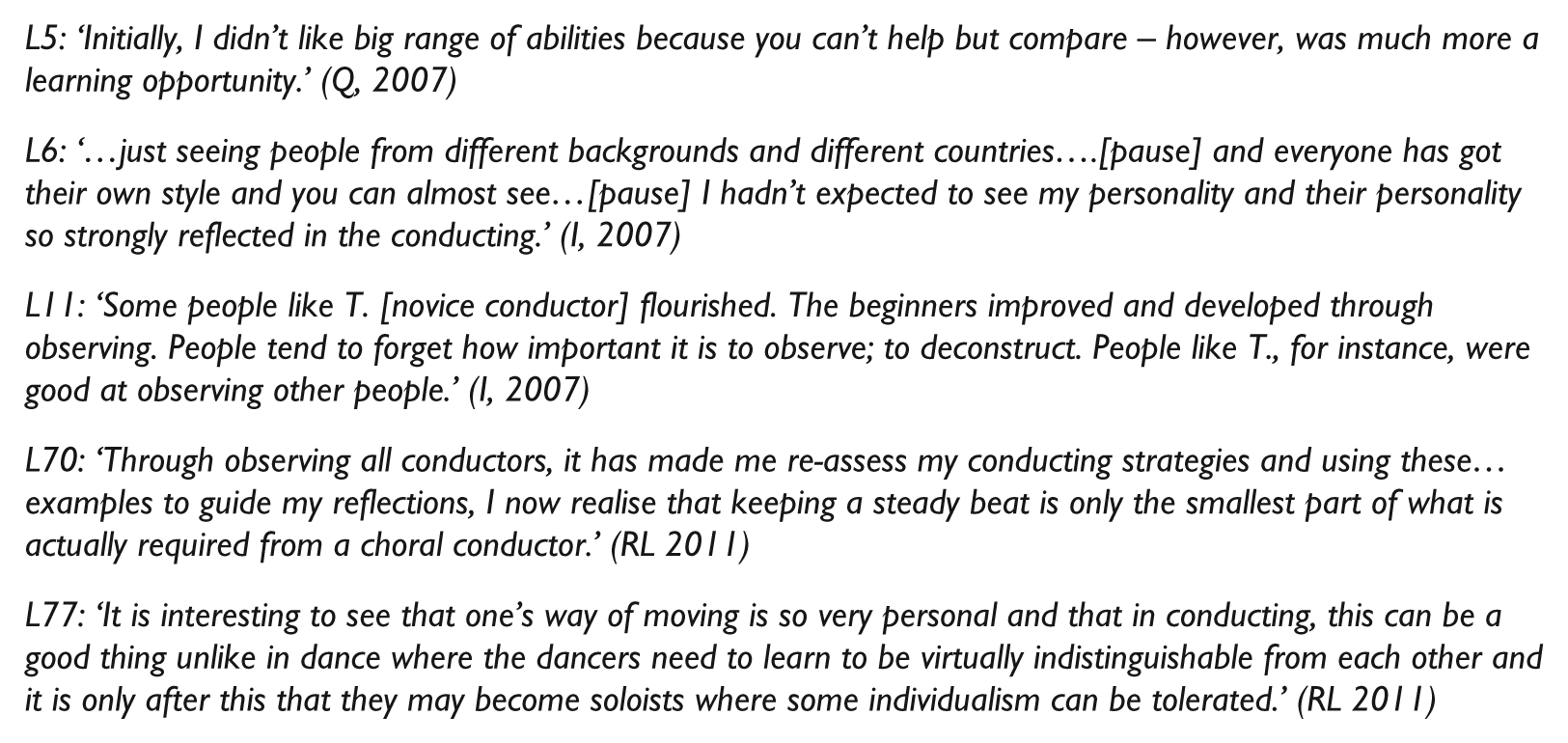
Module’s perceived strength: Observing conductors with diverse conducting expertise.
Through peer observation and peer feedback in a safe, cooperative learning environment the threat to the learners’ self-esteem was minimized, a positive self-image was promoted, confidence levels were raised and, as a result, the learners’ performance was improved (Johnston, 1993).
Face-to-face interaction
In an environment where positive interdependence is encouraged, the learners are expected to work with one another as they try to ‘resolve issues’ through face-to-face interactions. Adams and Hamm (1996) argued that these kind of ‘cooperative learning arrangements encourage pupils to learn by assimilating their ideas and by creating new knowledge through interaction with others’ (p. v). The module in focus offered skills training in choral conducting under simulated conditions (Griffiths, 2009). For example, the choir present in the sessions was made up of fellow learners: each individual had 12–15 minutes to conduct the choir, abundant time for repeated experimentation and constant review of practice through feedback from the peers and the tutors. Group cooperation during face-to-face session occurred for the purpose of collegiality and validation of one’s practice, that is, similarly motivated people supporting one another, and not through sheer practical necessity of the choir being only present in order to sing for the learner conductors. Group work at the level of feedback during the practical sessions was especially valued by the learners (see Figure 3).

Learners’ perceived development in choral conducting through face-to-face feedback.
Peer feedback was viewed as very helpful to many students. Initially the students hesitated to give feedback and seemed to be more interested in their tutors’ than their peers’ feedback (also found by Napoles, 2008, p. 89). Figure 4 (verbatim transcription of the video-taped sessions) offers an insight into how the 2007 cohort of learners gradually became more active in offering feedback to their peers during the face-to-face sessions.

Learners’ gradual development in offering peer feedback.
The significance of quality peer and tutor feedback echoes work by Langness (2000), Goetze et al. (1990) and Gumm (2007), who stressed the importance of children receiving reinforcement and qualitative knowledge of results through verbal and/or visual feedback. Not only children, but also adult learners (Laslett, 1989) are curious about their progress in music. The qualitative knowledge that tutors and peers can offer to the learners promotes acceptance of individual differences in skills and motivates personal skill development. What is more, Stamer (2009) stressed that individual feedback, like the one offered in this module by the tutors and the choir to each learner, has been found to be more important than general ensemble feedback that a conductor might offer to the group (i.e., ‘sopranos you are sharp’) in motivating learning in a choral setting.
Other than peer feedback the learners had the opportunity to work in pairs. Each learner self-selected their partner as this was believed to enhance learners’ willingness to cooperate (Falchikov, 2001). Then, one individual conducted the other and the conducted offered feedback on gesture, facial expression, eye contact or vocal modelling to their conductor. Furthermore, the learners cooperated in devising warm-up exercises for the choir. From a practical perspective, activities such as mirroring in pairs – when half the class was conducting the other half who later commented on the performance of their pair – was a way to save time during the teaching process, especially when working on the same piece of music.
On the whole, no resisting behaviour, such as hostility, lack of interest in the class or the subject or the tutor, and no defensive attitude towards feedback received from either the tutor or the peers (Falchikov, 2001) was observed. On the contrary, activities in pairs, in small groups and peer feedback were identified by the learners as successful elements of the module that could have been expanded further (see Figure 5). For example, had work in pairs been extended to individuals attending their pair’s choral rehearsals in the pair’s own context, it would have supported the learners not only with general feedback on verbal, non-verbal communication and leadership, but also with context-specific issues. Unfortunately, the time limitations of the module did not allow for work in pairs to be extended and monitored outside the face-to-face sessions.

Learners’ perceived development in choral conducting through cooperative activities in pairs and small groups.
Individual accountability and personal responsibility for reaching groups goals
Adams and Hamm (1996) highlighted that in cooperative learning ‘students cluster together, discuss topics and learn to take charge of their own learning; they learn how to learn by participation with a broad range of peers in small group activities’ (p. 8). The participants in the module were, indeed, responsible for their own learning. Firstly, they needed to practise with their own choir outside the face-to-face sessions in order to apply and test the musical/technical, interpersonal and leadership skills that they developed during the face-to-face sessions. In 2009, the participants were so eager to keep the momentum going that they organized a ‘practice choir’ for rehearsing in-between the sessions, especially for those MA overseas students who did not have a choir to practise with. Secondly, the learners were expected to prepare their music pieces before each session, participate in online, peer-cooperative learning activities and contribute to the face-to-face sessions with feedback. Although some learners were more committed than others in engaging in online activities, the majority became very involved in online discussions and feedback recognizing their individual contribution to each others’ development. As the module progressed and through the online group activities the learners increasingly valued their peers’ comments on conducting style, gestures and leadership, which often became an anchor for individual self-reflection (see Figure 6).
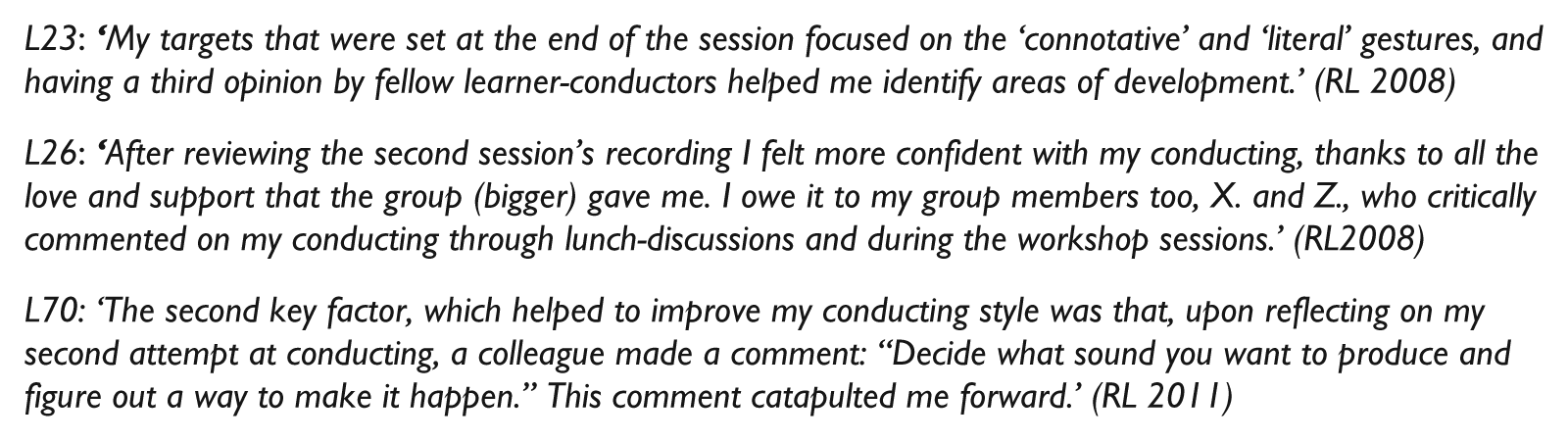
Module’s perceived strength: Peer feedback.
The rapport that was created amongst the learners throughout the module appeared to make each individual accountable to the other members of their peer group. Even though the tutors did not interfere in the online interaction they had access to the comments and it was noted that all learners supported their peers with encouraging feedback and suggestions for improvement. For the learners of the module participation, belonging and being involved were important dimensions of their learning experience.
Frequent practice with small-group interpersonal skills
As discussed earlier, teaching and learning in a small group provides opportunities for trial and error, asking questions, expressing opinions and taking risks. What is more, small-group interpersonal skills, such as providing information, giving feedback, guiding and managing the group can also be practised. Between the face-to-face sessions, it was thought important to develop a mechanism for sharing and discussing problems and successes encountered during the learners’ individual rehearsals. Many learners would be in secondary schools on teaching practice and the benefits of sharing experiences through discussion forums were becoming clear. Through uploaded videos, the learners could observe other learners in action and evaluate their strengths and weaknesses. This has led the tutors to organize smaller groups of three or four learners, where they could feel safe enough to be honest about their own and their group members’ practice. Each learner then had a role to play in the professional development of their peers through observing peers’ videos and commenting on peers’ conducting/rehearsing strengths and weaknesses (Durrant & Varvarigou, 2008). Common issues discussed online were the learners’ lack of confidence in conducting and in singing in front of the choir (see Figure 7).
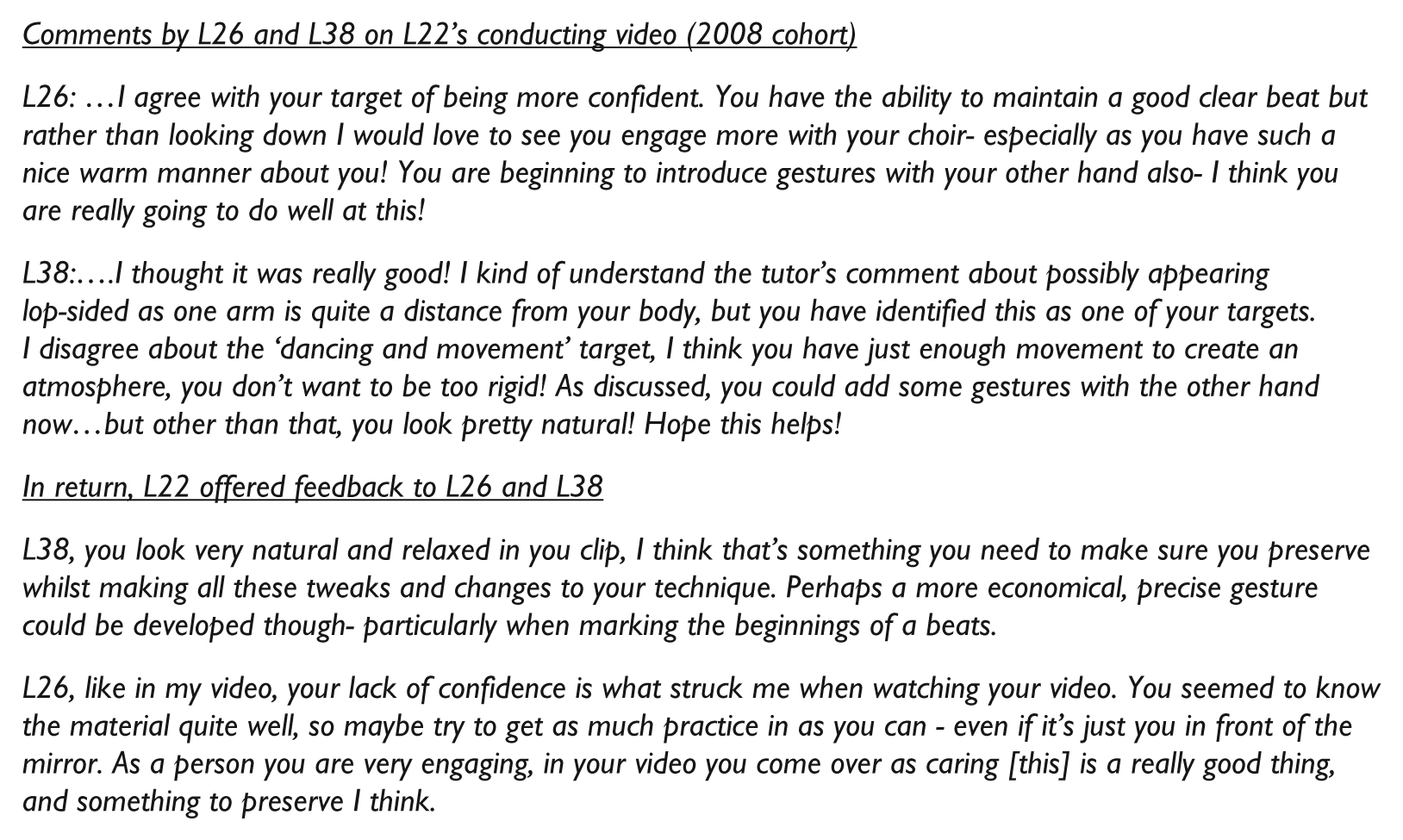
Practising small-group interpersonal skills through offering feedback on video excerpts.
One of the main issues with asking peers to offer feedback to each other is often that they are reluctant to do so, especially when they are also friends (Falchikov, 2001). Thus, it was not surprising that during both the face-to-face sessions and online peer assessment tended to be more positive than either self- or tutor feedback (also in Johnston, 1993). In order for this problem to be tackled the tutors always asked the peers to comment on the strengths of one’s performance before making suggestions for improvement. Through this approach the learners were given opportunities to practise the skill of giving feedback in a constructive, supportive and honest way, which is an essential skill for every music educator (Butke, 2006; Kneale, 2009).
Regular group processing and reflection
Regular group processing and reflection refer to encouraging the learners to rely more heavily upon their classmates for assistance in gate keeping, sharing ideas and evaluating progression (Adams & Hamm, 1996). In that way, cooperative learning becomes more of ‘a culture’ than a technique (Adams & Hamm, 1996, p. 17). The learners who were on their teaching practice in schools seemed to benefit greatly from sharing experiences through discussion forums and self-reflective reports after the sessions. Those MA overseas students who did not have a choir to practise with reflected only on their uploaded videos. The use of video-recordings reportedly made the learners notice what they did in terms of gesture and helped them monitor their development over the course of the module (see Figure 8).
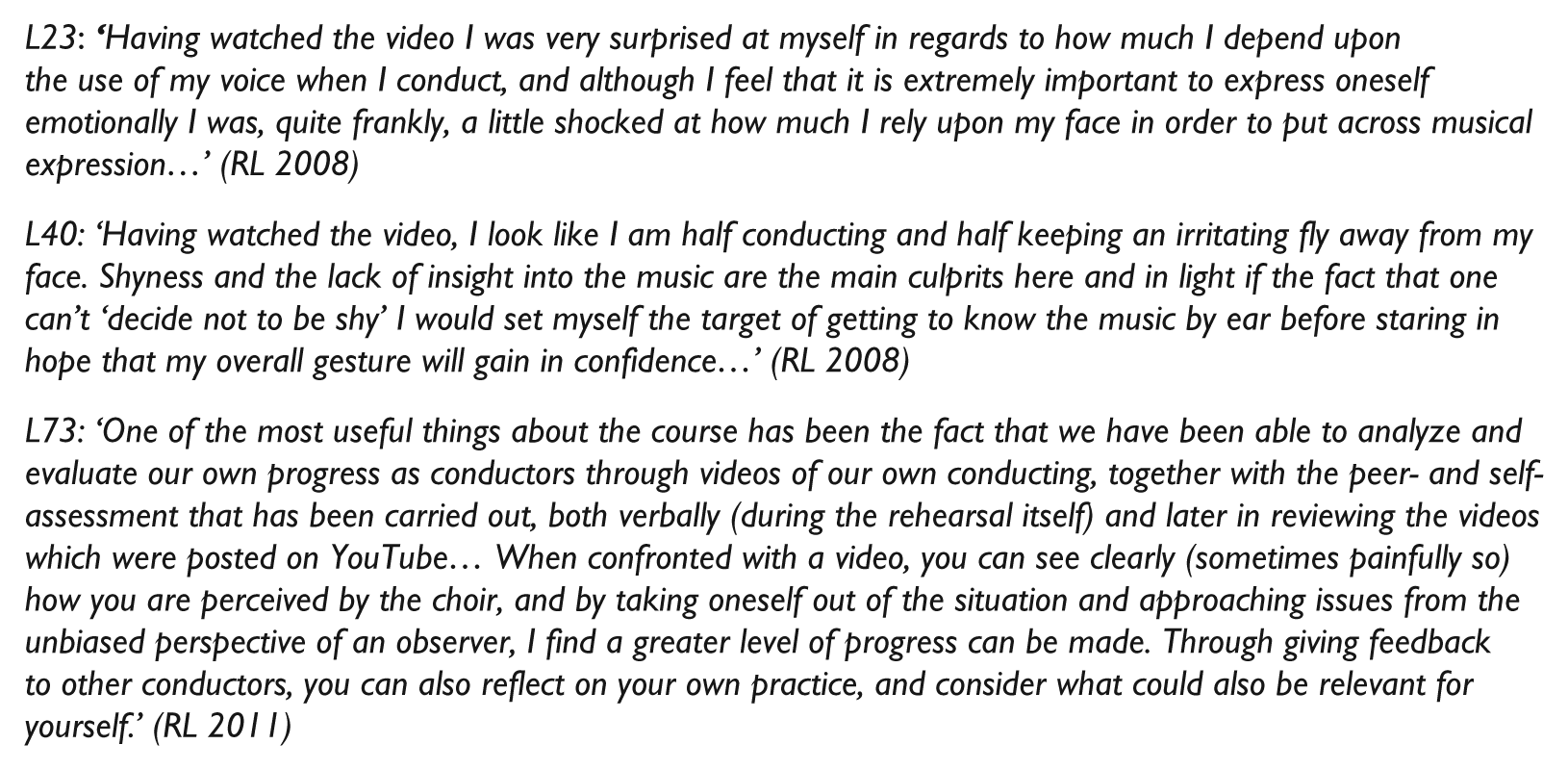
Module’s perceived strength: Reviewing video-recordings from face-to-face sessions.
Reflection ‘on action’ (Schon, 1983, p. 68) appeared to have increased learners’ understanding of self (‘I developed more confidence in trying new skills’), choral practice (‘My targets are: to have a more flowing beat…and remember to breathe with and for my choir members both at the start of a piece and also at the beginning of phrases’) and broader educational issues (‘Some instructors speak too much, it doesn’t add to the quality of information’). Several learners drew parallels between choir and classroom leadership and often stressed how the module helped them improve their skills as music teachers. One learner said:
L59: This module helped to improve my skills as a music teacher as the techniques worked on for rehearsals, such as leadership and clarity of instruction, are very relevant to the classroom. (RL 2010)
However, learners and tutors did not automatically engage in reflective thinking (Leglar & Collay, 2002). Reflective thinking was a learnt process for some, if not all. The tutors who took up the role of facilitators of learning spent a lot of time during the planning phase of the module, making sure that the activities were structured well and the instructions were clear. The tutors also acknowledged that they were not necessarily the only experts in the group; therefore, they organized the sessions as open platforms for artistic and educational research for learners and tutors alike. One of the tutors recognized that the module has been very beneficial for her professional development.
T1: I love teaching on the conducting course basically because it’s the course I want to take. And means that I can keep taking it and taking it, because there are twenty conductors every year that I get to learn something from…If someone does something I will try it out on my own…Or [I observe] the way somebody looks; the way they hold their body and the way they engage the people around them to make the music happen.
Discussion and implications
Pitts (2005) underlined that personal development and social interaction are closely connected in musical experience; individual satisfaction is balanced with group experience communicated through social goals, musical achievements and acceptance of collective responsibility, group coherence, development, friendship and support. This module offers a good example of how these elements have been effectively combined together in a teaching and learning context.
The learners and tutors of the choral module discussed in this paper had ample opportunities for personal development through cooperative activities in whole-class, pair and small-group learning situations that were planned by the tutors. During the sessions, the tutors encouraged learners’ exploration of conducting gestures, non-verbal and verbal communication and rehearsal approaches; they supported learners’ reflection ‘in-action’ and their articulation of thoughts, queries and impressions of their conducting experience in the class; and they encouraged collective responsibility and interdependence through online tasks and group work.
The teaching and learning literature identifies cooperative learning as an important component in rich learning contexts (Biggs, 2003; Moore, 2000). Biggs (2003) highlighted that formally structured and/or spontaneous learner–learner interaction can enrich learning outcomes. He added that when learners work cooperatively and in dialogue with their peers and tutors they could achieve elaborate and deeper understanding of the activities that they undertake. Moore (2000) talked about cooperative learning in relation to Vygotskyan theory and stressed the importance of working towards a learner–teacher relationship that ‘invites and encourages dialogue rather than monologue’ (p. 19) and encourages the facility for learners to alternate between discussion with peers and discussion with the tutor. Data from reflective logs, interviews, questionnaires and video observations have shown that positive interdependence through critical observation of other conductors, face-to-face interactions that promote feedback from the learners and the tutor, individual accountability and personal responsibility in face-to-face practical activities and online, practice of interpersonal skills and regular reflective practice (Adams & Hamm, 1996) have contributed to the learners’ understanding of self, choral practice and broader education issues in relation to choral conducting education.
In particular, it was reported by the learners themselves that cooperative learning increased their levels of motivation in active mutual involvement in group teaching and learning (Johnston, 1993; Stamer, 2009), their respect for diversity (Falchikov, 2001) and the development of skills required in their professional careers, such as structured self-assessment (Yarbrough, 1987) and giving and receiving feedback (Freer, 2009; Goetze et al., 1990). In addition, cooperative learning improved academic performance by supporting the learner conductors in rehearsal planning, choral leadership and general teaching skills (Apfelstadt, 1997; Gumm, 2007; Varvarigou, 2009). Lastly, cooperative learning improved teaching effectiveness as the tutors spent considerable time organizing and structuring the activities in the class and online, recorded the learners’ conducting excerpts during each face-to-face session and uploaded them on Blackboard for the learners to view, monitored the learners’ progress over time at an individual and at a collective level, and through self-reflection of their contribution in the module (Falchikov, 2001; Moore, 2000). It is suggested, therefore, that ample opportunities for cooperative learning should be incorporated in modules of choral conducting education.
The implications for choral conductors that arise from this paper are many. Firstly, having experienced the benefits of cooperative learning as learners themselves could encourage choral conductors to include the singers or other colleagues (i.e., accompanist) into decision-making during rehearsals. For example, one of the learners of the module wrote in her reflective log that she was planning to set up conducting targets for herself and ask her choir to point out when these targets were achieved by encouraging the singers to become active agents in the process of her choral conducting development (also in Stamer, 2009). Secondly, the use of video was perceived by the learners to be an effective teaching and learning tool because it allowed observations of oneself and other conducting models and helped in tracking down individual development over time. Although most learners were initially uncomfortable with the use of video, by the end of their module they praised its positive contribution to their progression. Therefore, more choral conducting preparation modules in HE should combine video-recordings with peer observation, peer feedback and self-reflection during the process of choral conducting preparation. The use of video for learning need not stop after the process of preparation but, instead, it could scaffold continuous professional development (Butke, 2006). It is important, however, to remember that developing skills for offering and receiving feedback and for observing effectively does not happen in a vacuum and requires regular training (Durrant, 2003; Yarbrough, 1987). Therefore, the module possibly needs to consider including more face-to-face sessions and more work in pairs. The learners’ responses have indicated that more in-class time could better support the development of observation and feedback skills. In addition, opportunities for ‘pairing peers’ (Bartleet & Hultgren, 2008, p. 204) in the students’ own choral environments could also contribute towards context-specific feedback and towards combating the ‘isolation conductors often experience in their work’ (Bartleet & Hultgren, 2008, p. 194).
Cooperative learning has shown to sustain singers’ interest, enthusiasm and motivation in choral participation, as well as increase respect for diversity regarding different styles of conducting and leadership. It is hoped that this study will prompt additional research on cooperative learning in choral conducting education for its potential to change conductors’ thinking and practice. In parallel with research on instrumental conducting (Bartleet & Hultgren, 2008; Harrison, O’Bryan, & Lebler, 2013), more research that takes into account the participants’ narratives of experiences, expectations, perceptions and aspirations of their education processes in choral conducting could be further applied and investigated. For example, research on how singers in different contexts and at different levels (as professionals or as amateur singers) experience choral participation could inform our way of understanding, planning and implementing effective and enjoyable choral singing activities. Above all, research into how specialized educational modules on choral conducting could be developed and incorporated into undergraduate (there is no such module in the UK at the moment) and postgraduate HE courses, as well as other independent organizations, would be beneficial. These modules should look into choral conducting education as an interactive and evolving process.
Footnotes
Funding
This research received no specific grant from any funding agency in the public, commercial or not-for-profit sectors.