



Abstract
Studio-based learning in higher education music is held generally to be of central importance and highly effective. Although there are indirect reports of studio apprenticeships that have not proved effective, direct evidence that might support the deliberate investigation of “dissonant” studio practices remains rare. This article takes advantage of an opportunity presented within a broader project to explore the nested case study of a student who, exceptionally, reports that his teacher’s approach is not appropriate for him at his current stage of development. The implied dissonance within the studio is explored through the “rich transcription” of video evidence supported by questionnaire and interview data, highlighting issues of communication and flexibility. If the student’s private dissatisfaction can be considered in terms of dissonance within the studio, what might a dissonant studio lesson look like, and how might the dissonance present itself in the activity of teaching and learning?
Keywords
Introduction
Studio-based learning is held to be of central importance in higher education music (Carey, Bridgstock, Taylor, McWilliam, & Grant, 2013; Gaunt, 2008; Presland, 2005). On the whole, it has been found to be effective, with confidence in the studio system expressed by students (Burwell & Shipton, 2011; Gaunt, 2010; Presland, 2005) and professional bodies (Association of European Conservatoires, Polifonia Profession Working Group, 2007; Music Council of Australia, 2011). Occasionally there are references in the research literature to studio apprenticeships that have not proved effective, though these references tend to be anecdotal or oblique in nature, as participants report their knowledge of other times, or other people who may have had difficulty in their studio experiences. For example, Hays, Minchiello and Wright (2000), interviewing 15 teachers in higher music education about mentoring, referred indirectly to two cases of “negative mentorship” associated with teachers who, in the past or in principle, had mishandled issues of teacher dominance and student independence: the authors linked these “failures” to “poor communication, personal egos, manipulation, private or non-disclosed agendas, and/or professional jealousy” (p. 8). Purser (2005), in an interview study with six conservatoire teachers, reported that previously they had experienced rare cases in which a lack of “personal chemistry” in studio lessons had led to students changing teacher (p. 292). Nerland and Hanken (2004), discussing the need for both trust and authority in apprenticeship situations, reported that music academy students enter into “strongly asymmetrical relationships” with their teachers (p. 6), regarding the formal evaluation of their lessons “irrelevant and disturbing” (p. 7), and criticism of their teachers—again, in principle rather than directly reported instances—a potential “catastrophe” (Hanken, 2011, p. 250).
Taken together, this evidence suggests that difficulties in studio practices may be regarded by participants as a private issue, emerging only after the “failure” of the studio apprenticeship or a change of teacher. Prior to such a “catastrophe” presumably there has been a period of lesser difficulties—problems with communication, mismatched agendas, or personal friction—which might be grouped loosely under the metaphor of “dissonance.” Given the perceived importance of the apprenticeship, and the potentially harmful consequences of its failure, the investigation of dissonance in the studio system would seem an important task for researchers.
Previous research
There is an inherent difficulty for researchers who may wish to investigate “dissonance” in the studio system: how can more direct data be obtained, without contaminating the data in the process? Deliberately setting out to identify instances of student dissatisfaction with studio lessons would seem to be prejudging the situation under investigation. In several case studies, the original data collection has been broad enough to include the potential for identifying evidence of this kind, without having the specific aim of investigating student dissatisfaction. Burland and Davidson (2002) were able to follow up a study of 257 children who were involved in music to varying degrees, by re-interviewing those who had attended a specialist music school; this gave them an opportunity to compare the circumstances of young musicians who had, or had not, continued in pursuit of performing careers. The influence of individual teachers was found to be increasingly important for the developing performers, musically and psychologically, with one participant—no longer pursuing a performing career—reporting resentment over a clash of views. However, the researchers concluded that music as a determinant of self-concept was a better predictor of eventual success than relationships with influential others.
In another broad case study, involving 20 teachers and 20 students reflecting on their current conservatoire lessons, Gaunt (2011) met with isolated instances of dissatisfaction within teacher–student dyads. It is interesting, in the light of Nerland and Hanken’s (2004) remarks about students being reluctant to criticize their teachers, that the participants in Gaunt’s study reported “extremely positive perceptions” of their current work, but were more likely to be critical of past encounters. Twelve of the teachers recalled having had difficulty in the past with studio relationships, and four of the students had changed teacher previously in the course of their studies.
Similarly, the project from which the current study is drawn was based on a broad collection of data, this time with a general intention of exploring the conduct of studio lessons. The data included video observations, questionnaires and interviews with 27 undergraduate music students and their teachers; successive phases of analysis were focused on areas of study (Young, Burwell & Pickup, 2003; Burwell, Young & Pickup, 2004), teacher–student dialogue (Burwell, 2005, 2006), and eventually performance and nonverbal behavior (Burwell, 2010, 2012). In the last of these, two lessons were studied in considerable depth, and although both students spoke of their teacher in positive terms, the close investigation of one of the cases revealed some tension between the attitudes of teacher and student. This was exhibited in lesson behavior and appeared to be affecting long-term success (Burwell, 2012).
For the current study the library of data was reviewed and mined again to seek examples in which the student, for whatever reason, had expressed dissatisfaction with the approach taken by the studio teacher. The starting point was the set of semi-structured interviews with students, conducted shortly after their lessons were filmed. The students had been asked, among other things, to describe the approaches taken by their teachers, and to comment on how appropriate those approaches were for them, at their current stage of development. Of the 27 students interviewed, only two replied negatively to this question. One of these was Sandra, a first-year undergraduate singer whose perspective seemed to be related to an emotional investment in her apprenticeship, touching on issues of maturity and independence; her case is discussed in detail, elsewhere (Burwell, in press). The second student who expressed dissatisfaction with his teacher’s approach was Gavin, a third-year guitarist. His answer was quite different from Sandra’s, resting not on the affective aspects of teaching and learning, but on what appeared to be a more objective evaluation of his teacher’s work.
Gavin’s remarks were hardly a dramatic exposé of “negative mentorship” but they were interesting, and all the more interesting for being exceptional within the broader case study. The research data included filmed observations of three lessons given by Gavin’s teacher, with questionnaires completed by teacher and students before their lessons were filmed, and interviews conducted shortly after. A rare opportunity seemed to present itself. What might be learned from a transcription of rich data representing an approach to teaching that, exceptionally, the student thought inappropriate for him? If the student’s private dissatisfaction can be considered in terms of dissonance within the studio, what might a dissonant studio lesson look like, and how might the dissonance affect teaching and learning?
Procedure
Participants were identified for the broader study through a call for volunteers among performance teachers in a university music department, and these in turn helped to identify students willing to participate. All participants were assured of anonymity in reporting. The teachers in particular welcomed the interest shown in their work, and shared their reflections about their teaching and their students, thoughtfully and indeed enthusiastically.
Lessons were filmed during the final term of the academic year, several weeks before the annual performance examinations. The teacher in this case, known here as Tom, was filmed giving three consecutive lessons. Two of these were for principal-study guitarists, Gavin and Greg; their lessons should have run for 45 minutes each, but Gavin’s lesson was cut five minutes short on this day because he arrived late. The remaining student, Gerry, was a second-study guitarist with a lesson of 30 minutes, though as his principal study was electric guitar, his lesson too was pitched at a relatively advanced level.
As part of the broader study, the participants completed a questionnaire in advance. Given lists of areas of study and teaching strategies, along with descriptors or examples (Young et al., 2003, p. 155), they were asked to rate the importance of each, on a verbal rating scale (crucial; very important; important; quite important; not important) and then their relative frequency in studio lessons (always; often; sometimes; rarely; never). As each filmed lesson was completed, participants were interviewed about what had actually taken place; they were also asked about the context, history and aims of their work in performance studies.
The research tools used at successive phases of the broad study were developed and adapted according to their purpose, and a number of them were employed again in the current study, particularly those involving the “rich transcription” of verbal, performance, and nonverbal behavior (Burwell, 2010, 2012). Some tools seemed more relevant than others, now, while further categories for analysis emerged as the study went on: this reflects a design appropriate for qualitative research, which rather than following a sequential model, becomes an ongoing, reflexive process (Maxwell, 2005). Because the categories were identified during the examination of data rather than being fixed before data was collected, they are identified as they arise in the discussion of findings.
The selection of the current case study within a case study, as previously described, was purposeful. Although a strength of case study research is its scope for addressing contextual conditions (Yin, 1998), the emphasis here would lie on understanding the particular case rather than on generalization: it seemed to offer an opportunity to learn, which is more important in an intrinsic case study than the typicality of the case (Stake, 2005).
The focus of the study would be Gavin—his filmed lesson, and what he and his teacher Tom said about it, in their interviews—while some sense of context for Tom’s approach to studio teaching could be established through reference to data collected from his other students Gerry and Greg.
Findings
Interview evidence
According to his interview, Gavin began to learn “contemporary guitar” aged 9, and took up classical guitar later: “it took over my life. Once I heard the music I loved it and just wanted to play [it].” He had now been studying with Tom for three years. Tom described Gavin as “very motivated and committed,” and suggested that he was capable of going on to do a master’s degree in performance; Gavin, in turn, described Tom as “an extremely nice chap … a splendid chap,” and he thought of him as a friend, who supported him “in a lot of other ways.” Tom was well known within and beyond the institutional setting, as a versatile and engaging performer.
The point of departure for this nested case study, however, is Gavin’s comment that Tom’s approach to studio teaching was not appropriate for him, at his current stage of development: “I want more self-discovery, exploring different ways of doing things; I don’t want to be told that there is a definitive way.” Gavin elaborated on his dissatisfaction at later stages of the interview. At one stage, for example, he was asked to compare the lesson just filmed, with his notion of an ideal lesson, and although the question seemed to take him aback, he gave a thoughtful answer:
Dear oh dear! An ideal lesson? Okay, suppose you are playing to your tutor and they want you to experience playing in a different way, perhaps using different fingering. I would rather that suggestion was made to me and then I was to play it, rather than THEY play it and not give me the opportunity for me to play it afterwards. … A student needs to experience doing certain things IN FRONT of the tutor to get their feedback on that, [rather than a situation where the tutor] picks up the guitar and plays all these weird and wonderful things, but doesn’t really explain why. I am not hearing WHY I should do it.
Later, invited to comment on the importance of performance within the degree program, Gavin said he would like more from his tutor—more “performance-oriented teaching.” He had heard of other students receiving the kind of attention he would like: only the day before the interview, a piano student had told him that she “wouldn’t have felt nearly as good performing, or comfortable about their performance, if it hadn’t been for [their tutor].” Gavin expressed envy, because “I don’t feel I have had that, personally.”
Gavin, like fellow-student Gerry, had already become a guitar teacher himself, and as the interview drew to a close, he made some general remarks about teaching, worth quoting in full:
I am very analytical with my students. I am really intensely listening to what they are doing. I identify not just problems but lots of good things as well, because I feel they need to hear good things about their work. You don’t hear a lot of good stuff with [Tom]. If it’s good, it doesn’t get mentioned. If there is a mistake, let’s mention it. You imagine it—you get three years of that and all you can remember your tutor saying to you is where it went wrong. I think in a sense it has made me a better teacher, because I won’t do that with mine. I am very aware of what they do that is good, and I tell them it is good, and really get excited about the good stuff. They have a great feeling when they leave my lesson. That is important to me, but they are also aware of where they need to pick up. I am very keen on making them aware of their problems so that they can deal with them. And I show them how to practice it at home, how to sort it out. I don’t say “That’s wrong, you need to practice it more”: I show them how to practice it. They feel a lot better about it—I am sure they do.
Tom, for his part, reported that he had been positively influenced by his own guitar teacher, who had “a nice healthy attitude towards the whole thing—not too academic.” As a performer Tom was engaged with a range of musical styles, including rock and flamenco as well as classical, and he felt that he did not “fall into the category” of classical performance: “I don’t really have a lot to do with the classical world because they just seem to be so out of touch with things.” Similarly, perhaps, although Tom had had formal teacher training, he felt that education theory was of little use in lessons: it was in practical situations that he learned “a lot of teaching strategies … certainly in terms of classroom management and discipline, and organizing, and motivating people.” He emphasized the importance in teaching, of developing a sense of humor.
The picture of Tom’s personal attributes was complemented by remarks from interviews with his students: Gavin reported that he was “laid back,” Gerry that he was “relaxed” in temperament, and Greg that he was “very easy-going … very relaxed, and very encouraging as well.” On the other hand, although Gavin acknowledged that Tom was not verbally commanding, in that “he didn’t actually say do it faster there, or don’t do that, or do this,” he created the same effect through demonstration: so in today’s lesson, “his guitar was speaking to me and commanding me.”
Questionnaire evidence
There were few clear trends among the questionnaire responses given by Tom and his three students, but there was a strong agreement between Tom and Gavin, in particular, about the importance of areas of study. Both thought Aural Awareness, Technique and Interpretation crucial, and their ratings of Improvisation, Communication and Critical Awareness were never more than one degree apart. They were two degrees apart in rating the frequency of Improvisation (Tom—sometimes; Gavin—never) and three degrees apart in the frequency of Communication (Tom—always; Gavin—rarely).
In rating the importance and relative frequency of teaching strategies, the salient results came once again from a comparison of the responses from Tom and Gavin, who were two degrees apart in rating the importance of Practice, Self-check and Open-ended strategies (Tom—important; Gavin—crucial). They were also at least two degrees apart in rating the frequency of six out of seven strategies in lessons, shown in Table 1.
Frequency of teaching strategies.
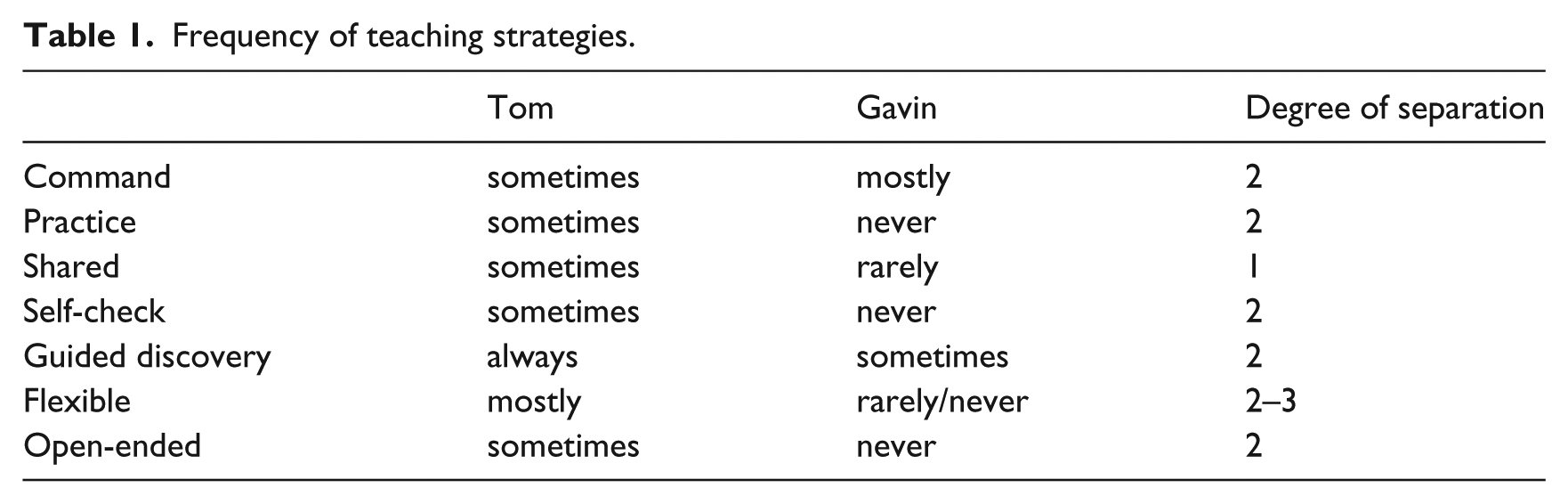
Of the four participants in this case, Gavin was the only respondent to use the rating “never” for the frequency of any teaching strategy. In addition to the contrasting responses of Tom and Gavin, mismatches were noted between Gavin’s ratings of importance and frequency: Practice, Self-check and Open-ended strategies he thought crucial, but he reported that they never occurred in lessons.
Video evidence
The “rich transcription” of video evidence gave rise to an enormous amount of data, which can be reported only selectively. The balance of teacher–student contributions to performance behavior was measured in seconds: the individual contributions are shown in Table 2.
Individual contributions to performance behavior in the three lessons.
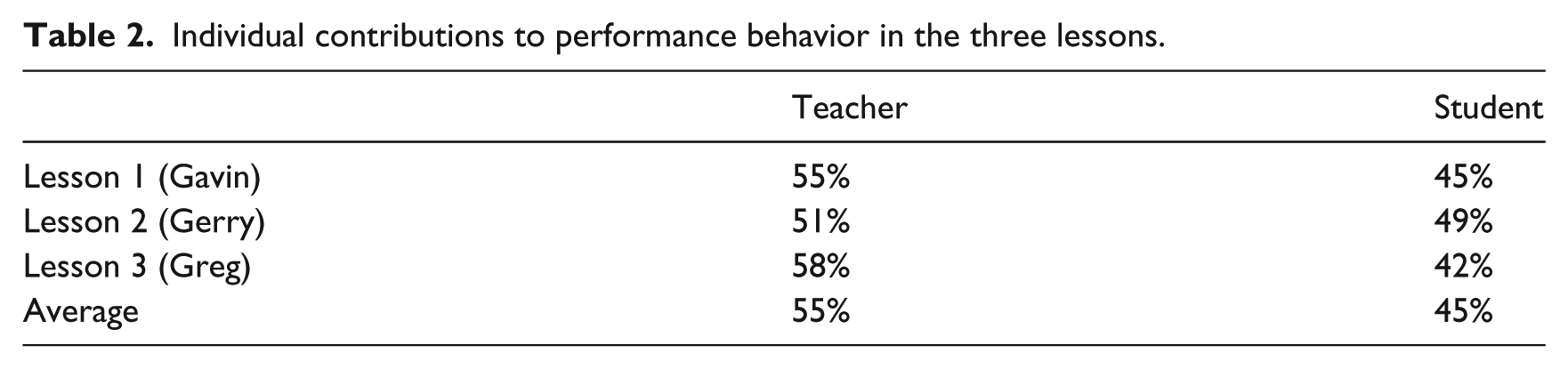
In Gavin’s lesson, Tom played for a total of 880 seconds, while Gavin himself played for 669; they played simultaneously for a total of 69 seconds; and the lesson ran for approximately 40 minutes, specifically 2,346 seconds. This means that for 1,398 seconds, or 60% of the lesson time, guitar playing could be heard. In Gerry’s lesson the two guitars overlapped for a total of 393 seconds, and guitar playing was heard for 57% of the lesson time; in Greg’s lesson the overlap was only 38 seconds, and the proportion of lesson time 48%.
Parallel to the quantification of performance behavior, the balance of teacher–student dialogue was measured in wordage: the individual contributions are shown in Table 3.
Individual contributions to verbal behavior in the three lessons.
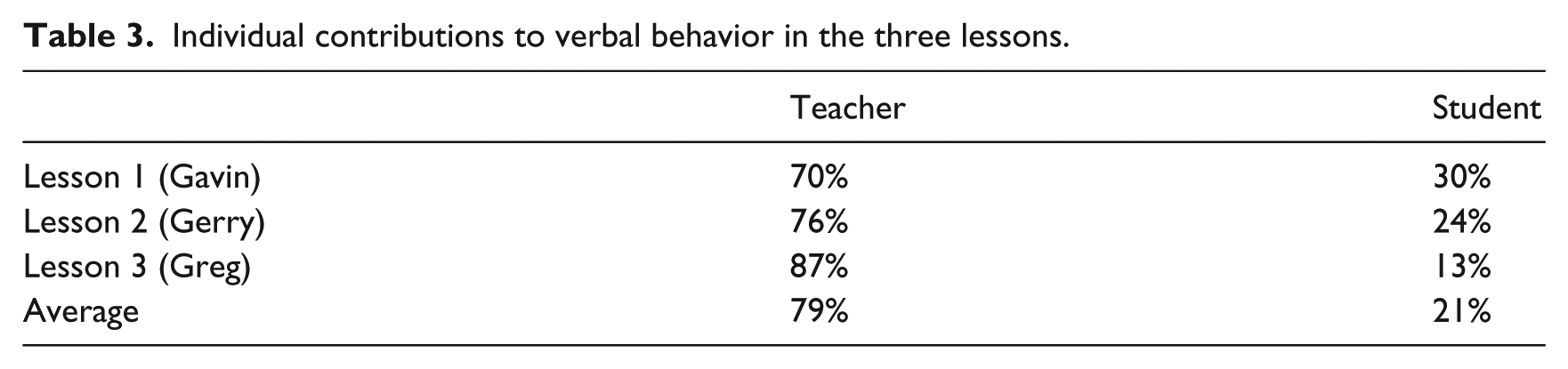
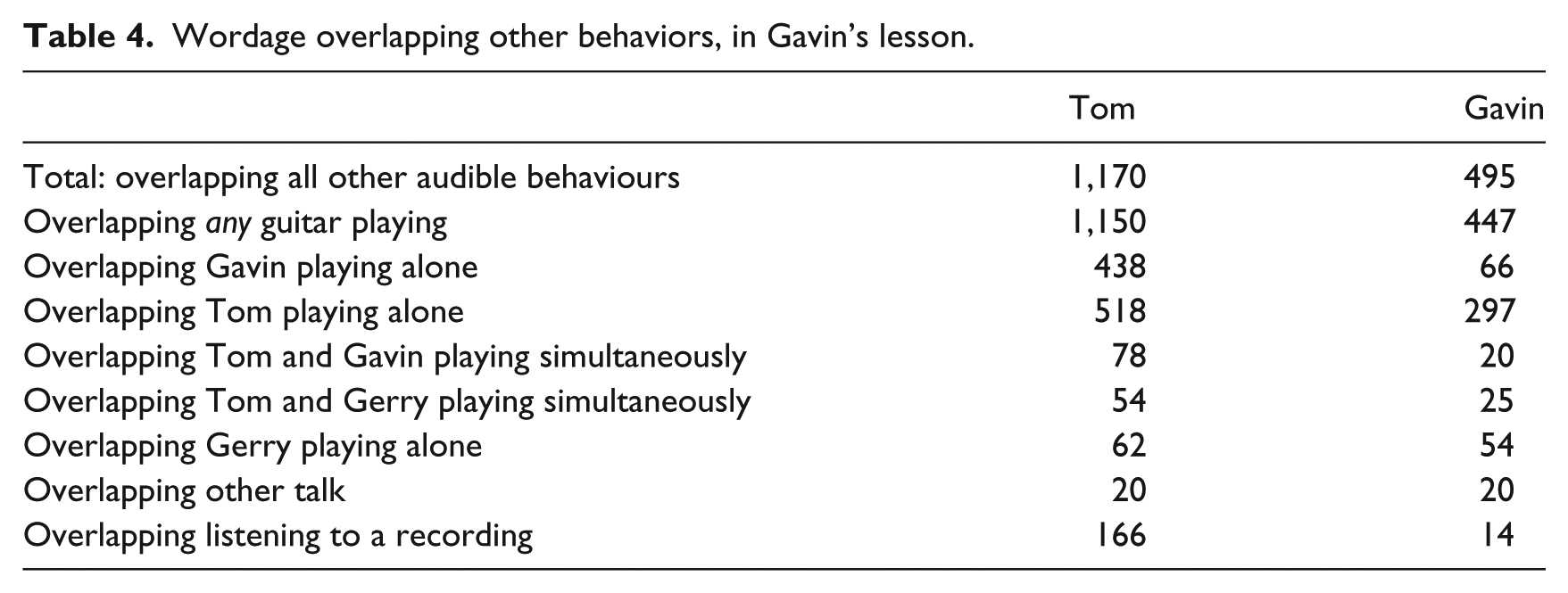
As with performance, there was some overlap of verbal behavior, though this was far rarer. In Gavin’s lesson teacher and student spoke simultaneously, for a total of 20 words only: evidently verbal turn-taking was the normal procedure in this discourse. Interestingly, however, the participants seemed to have no such compunction about playing the guitar while someone was speaking. Indeed, the high proportion of lesson time during which guitar playing was heard may be associated with the fact that a good deal of discussion was conducted over the playing. In Gavin’s lesson, teacher and student were equally likely to talk over other audible behaviors, with the overlap representing 38% of the wordage of each. In the remaining lessons, Tom was more likely than his students to talk over other behaviors: in the second lesson 59% of Tom’s overlapped, but only 36% of Gerry’s; in the third lesson 30% of Tom’s speech overlapped, but only 18% of Greg’s.
The behaviors over which the participants talked included guitar playing, listening to a recording, and other talk, though guitar playing was by far the most common. Table 4 shows how these behaviors broke down, during Gavin’s lesson. Tom and Gavin each played while the other was talking; they talked over their own playing; and sometimes they carried on talking while both of them were playing simultaneously. Further, when Gerry entered the room to set up for his lesson, he began to play before the discussion in the previous lesson had finished, and so indeed did Tom.
Wordage overlapping other behaviors, in Gavin’s lesson.
At times, Tom talked over his own playing, providing a commentary in which talk and demonstration were mingled so closely that they seemed to become a single activity. One such sequence is shown in Table 5, in which notes about performance and nonverbal behavior are mapped against verbal dialogue. Talk overlapping other behaviors is indicated in square brackets.
Excerpt from the transcript of Gavin’s lesson [20:09–21:14].
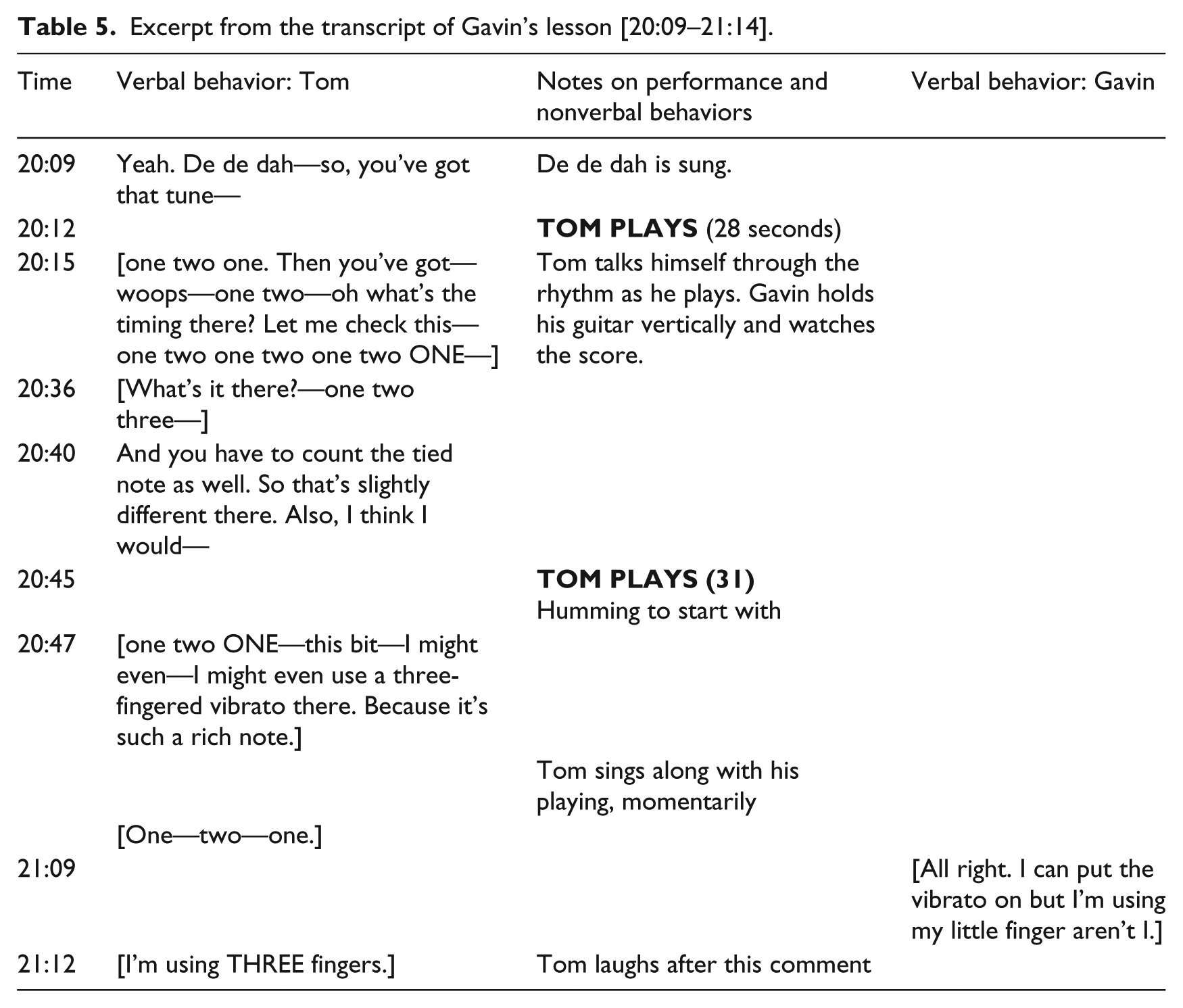
The willingness of all participants to talk over guitar playing, or to play over talk, might be associated with the quality of performance behaviors. There was little that could be described as simulated performance, and a good deal that could be described as idling, as participants shifted smoothly among tuning, strumming, and snippets of what seemed to be improvisation, often merging into recognizable repertoire. Some flavor of this activity is given in Table 6.
Excerpt from the transcript of Gavin’s lesson [10:38–11:36].
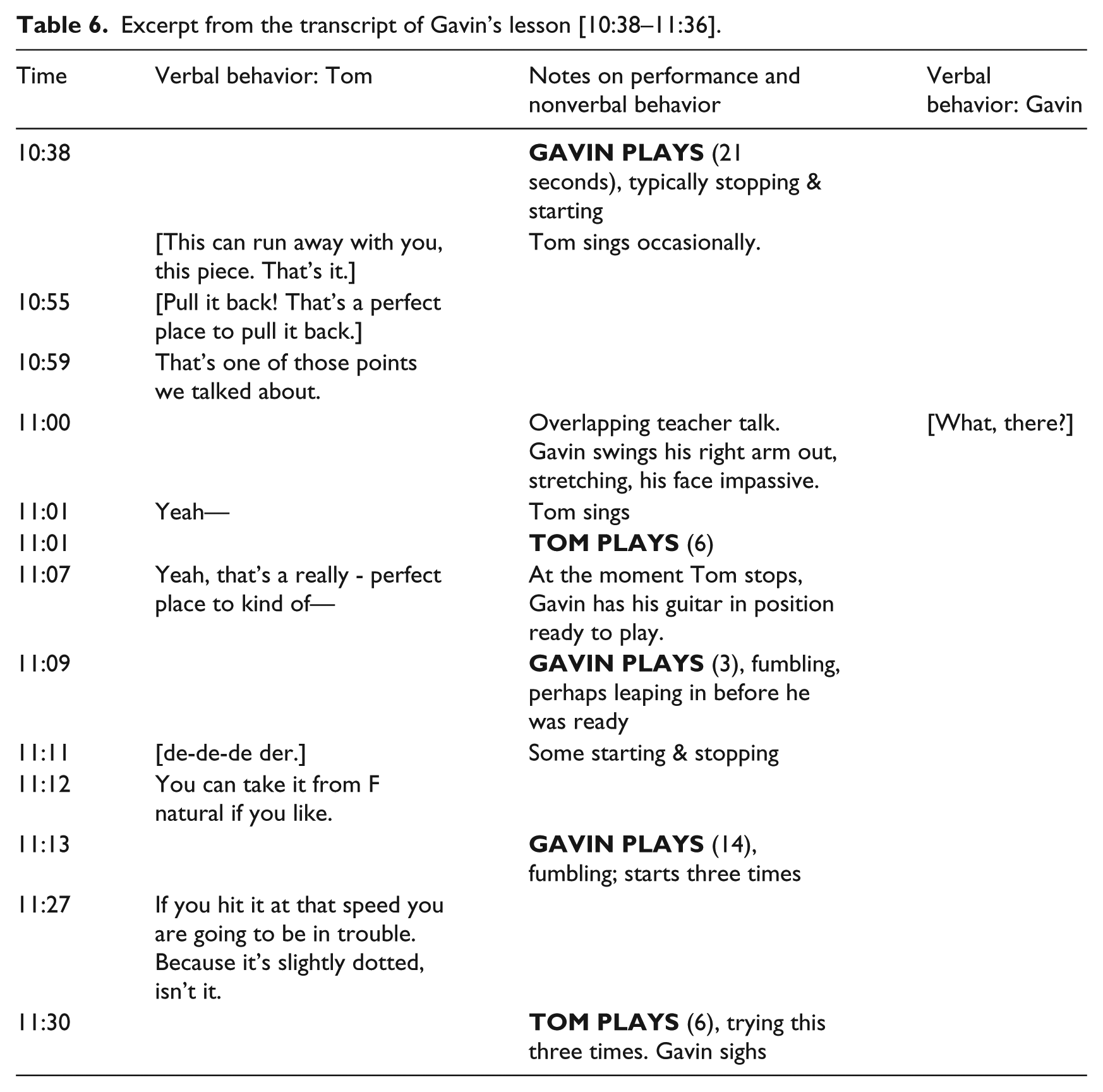
The verbal behavior of the individual participants was analyzed according to its function, largely in keeping with the procedures developed in the previous case study (Burwell, 2012). Within Tom’s contribution to the verbal dialogue, 72% of the wordage was devoted to information, as for example in Table 6 (“This can run away with you, this piece”; “that’s a perfect place to pull it back”; “Yeah, that’s a really—perfect place to kind of—”). Elicitation—asking the student to act, whether by talking, performing or thinking (“You can take it from F natural if you like”)—accounted for 12%. Coaching—uttered during student performance (“That’s it”; “Pull it back”; “de-de-de der”)—accounted for 8%, and feedback—evaluative or critical comments uttered after student performance—for 4%. Unclassified utterances such as the isolated “Yeah” in Table 6 accounted for the remaining 4%.
Within the student’s verbal dialogue, the most interesting aspect of Gavin’s contribution was perhaps his willingness to take the initiative, trying to influence the course of his lesson by raising topics that interrupted the flow of discussion. In one example he drew attention to a problem that he had encountered previously: “I was reading that the other day—and I think I was leaving out this F. I think I left out one of the A to Gs—the A flat to G.” In another example, quoted below, he made an interpretative suggestion. Tom’s speech is shown here in italics, and activity in square brackets.
I could always do it ponticello there. Ah, not ponticello, um
Pizz?
Pizz. [Gavin plays] Ahh—I quite like it with the (unclear) [Tom plays] (unclear)
Quite restful isn’t it.
Yeah. That’s what I was going to say, this is played pizz here, isn’t it, though it doesn’t say so. But everyone seems to play it pizzicato Yeah—[Tom plays] I don’t know if it’s kind of related to that bit— No. I think this is staccato.
In all, Gavin took initiatives on nine occasions during his lesson. Gerry tended not to do so in his lesson, though he did raise the subject of an ongoing problem with neck pain, which had prevented him from practicing normally. Greg, whom Tom described as “the shyest of the lot” and who contributed least to verbal dialogue, took no initiatives in his lesson.
Ethics and validity
The project design and data collection for the broader study met the ethical requirements of the host university. All participation was voluntary, following the principle of informed consent, and participants were assured of anonymity in reporting. The anonymity of participants is assisted by the fact that Tom was not the only guitar teacher involved in data collection, and details that might identify participants, including biographical information, have been omitted.
It should be acknowledged that participants in this study might have been influenced, in their lesson behavior, by the presence of the camera in the studio, with the influence of the researcher on the researched perhaps the chief threat to validity in qualitative studies (Maxwell, 2005, p. 108). The interview schedule invited participants to comment on that influence; in the current case only Gavin reported that it had had an effect, describing his as “a camera lesson” in which they “worked quite hard actually.”
Tom reported that he had played a recording to each student, which “just happened to coincide with today,” though Gerry remarked that this did not happen often. That aside, there is some evidence within the lesson transcripts, suggesting that Tom may have felt the presence of the camera, perhaps symbolizing the presence of the researcher, more than his students did. When Gavin first entered the room Tom offered the friendly greeting “How are you doing mate?” and immediately added, “you’re a star, mate.” At first this might seem to be gentle sarcasm, a reference to the student’s late arrival. However, Tom made a similar reference near the end of Gerry’s lesson, and again near the end of Greg’s lesson. Although the students joined in the joke, at this point, it was Tom in all instances who first drew attention to the camera: perhaps, during the course of his lessons today, he had never really forgotten it.
Of course, the data represented in this case study are mere snapshots of opinion and activity within a long-term and evolving studio apprenticeship, the history and outcomes of which lie beyond the boundaries of the case. Behavior in the filmed lesson observations must have been related more closely to the participants’ normal behavior than to the presence of the camera—an assumption supported by the fact that Tom, Gerry and Greg agreed that these were broadly typical lessons—but it must be possible too that Tom’s evident awareness of the observation might have affected his approach on this day. In addition, it seems likely that Gavin, who was so articulate and reflective in his interview, was conscious during his lesson that he would be discussing it with the researcher, immediately afterwards: it is possible therefore that he might have had his concerns about Tom’s approach, more keenly in mind than usual, and that this may even have affected his lesson behavior.
Discussion
The point of departure for this nested case study was an undergraduate student’s comment that his teacher’s approach to studio lessons was not appropriate for him, at his current stage of development. The student, Gavin, supported this critical assertion with some careful reasoning, and with reference to his own reflections about teaching a musical instrument. The questionnaire evidence does show that Gavin and his teacher, Tom, have divergent views not so much about the importance of areas of study, but about their actual frequency; and a number of the teaching strategies that Gavin thinks crucial are, he feels, lacking in Tom’s approach to his lessons. The video evidence shows that Tom dominates lesson dialogue, though this seems unremarkable in the light of research findings elsewhere (Young et al., 2003); what does seem remarkable is that Tom also dominates performance behavior, and this might have implications for the role of demonstration, and the cultivation of the student’s performing skills.
Insofar as the basis of his claims can be understood, Gavin seems a genuinely critical thinker, and this would seem to be exactly what an institution of higher education would hope for, in its students. In the rather unique setting of studio apprenticeship, however, it gives rise to a paradox: that the development of critical or evaluative thinking would seem to conflict with the trust and authority essential to success (Hanken, 2011). Howard (1992) explains that even as learners consent to be guided by the teacher’s instruction, critical intelligence is required to apply it, and this alerts them to possible options, “even as it trains them to ‘follow the rules’” (pp. 81–82).
Gavin says that he wants more self-discovery in his lessons, and it might be argued that rather than trusting or consenting he chafes against Tom’s instruction: thus he complains that he does not want to be told “that there is a definitive way,” and describes not Tom’s speech but his guitar as being “commanding.” Tom plays a good deal, and the excerpt from the lesson transcription shown in Table 5 shows a fusion of verbal and performance behaviors in which Tom thinks aloud about his playing, offering a live model perhaps more than instruction. In Table 6, Gavin seems so keen to retain or recover the floor that he rushes in to play at any opportunity, sometimes apparently before he is ready, with the resulting performances much undermined by a lack of composure and fluency.
A blend of verbal and performance behaviors would seem to be reasonable and even commendable in the context of studio lessons, which after all are sites of complex skill development. In such a setting, Howard (1982) explains, “samples and demonstrations mark an expansion of the ‘vocabulary’ of craft altogether beyond technical jargon and description to encompass aspects of skilled performances that ‘speak for themselves’ by not speaking at all” (p. 101). At the same time, Howard writes of demonstration as “the best evidence of the onset of understanding” (p. 62; emphasis original) which presumably must come from the student, and it is not clear that the teacher seeks that explicitly or consistently, in Gavin’s lesson.
This might be associated with what seems to be a low proportion, in the analysis of Tom’s verbal behavior, of elicitation: almost three quarters of his speech is devoted to imparting information, but only 12% of it to encouraging the student to act. Conversely, it might be associated with what seems to be a high rate, in the analysis of Gavin’s verbal behavior, of student initiatives. Might a mismatch of personalities be at work here—what Purser (2005) calls a “lack of chemistry”? Tom seems to have a preference for expressing himself through performance as much as verbal explanations, remarking on the influence of his own teacher who had a “nice healthy attitude” that was “not too academic.” Gavin, in contrast, reports being “very analytical’ with his own students, and emphasizes the importance of articulating problems and practice strategies. Some comparison with behavior in Greg’s lesson might shed some light on the teacher–student relationships here. In Gavin’s lesson guitar playing occupies the highest proportion of lesson time (60%) while in Greg’s lesson it occupies least (48%); Gavin contributes the highest proportion of verbal dialogue in his lesson (30%) and Greg—“the shyest of the lot”—the least (13%); and in Gavin’s lesson teacher and student are equally likely to talk over other audible behaviors (38% for each) while in Greg’s lesson there is far less overlapping (teacher 30%, student 18%). Gavin calls for more opportunities to practice in front of his tutor so that he can receive immediate feedback; but Greg says that Tom expects him to correct his mistakes in his own time—“otherwise it would be a waste of a lesson.” Gavin recalls three years without praise, but Greg reports that Tom is very encouraging. Perhaps Tom, whether consciously or not, does not find it congenial to alter his preferred approach for a student who is relatively assertive and perhaps challenging in lessons.
There is little teacher feedback in Gavin’s lesson—comprising only 4% of the teacher’s total wordage—and consistent with Gavin’s remarks, little that could be described as praise, though Greg has recently performed in a concert and Tom tells him it was a “good gig” that he enjoyed. Verbal approval, however, may not be the same issue in studio lessons as it is in classrooms, where it is important in retaining student attention. Thus, Duke and Henniger (1998) report on an experimental study in which student attitudes remained positive in instrumental lessons, whether the teacher’s verbal feedback was positive or deliberately focused on negative correction, and whether the students were undergraduates or schoolchildren. Similarly, undergraduate music students who were asked to evaluate filmed studio lessons were not swayed by the teacher’s use of positive or negative feedback (Duke & Henniger, 2002). The same authors argue that verbal approval is only one way of signaling success, and that it can also be provided, in the lesson, through student performance:
Instructional settings in music performance provide numerous opportunities for students to receive feedback about their progress and accomplishment. This feedback emanates not from the teacher directly, but from students’ perceptions of their own accomplishment of proximal performance goals. This is not a trivial point. (Duke & Henniger, 1998, p. 484)
Significant though that point may be, however, it would be difficult to substantiate it with reference to the current case study. The rushed and fumbling efforts of Gavin, who at times almost seems to compete for the floor, can hardly be the source of immediate encouragement; the lack of simulated rehearsal, of poise or preparation, or even orderly turn-taking seem to obviate anything that might be felt as performance success. Duke and Henniger (1998) assert that teachers can regulate the probability of student success in studio lessons, and perhaps Tom is trying to do this when he repeatedly urges Gavin to “pull it back”; again, however, his propensity to demonstrate this, rather than allowing the student the space he needs to try it for himself, seems to prevent Gavin from feeling that something positive has been achieved.
Contemplating resolution of the dissonance
The findings suggest that dissonance in the studio might be associated, in this particular case, with mismatched perceptions about the content and conduct of lessons; with the balance of both verbal and performance behaviors between teacher and student; and with a blend of verbal instruction with a high degree of demonstration, which might suit some students more than others. The situation has not, apparently, reached the critical point where the Gavin feels compelled to change teacher, but this level of dissonance—of “lesser difficulties”—raises several issues. One is whether we should expect dissonance in the studio to be resolved within the studio. This recalls a challenging discussion of student learning in higher education music, by Jørgensen (2000), who asks whether responsibility should lie with the student, the teacher, or—as he finally emphasizes—the institution itself.
We might ask why Gavin, who has studied with Tom for three years and reports that he is a friend and a “splendid chap,” has not taken this matter into his own hands. He is assertive enough to take initiatives that might alter the course of activity, in his lessons; could he not have asked Tom for a review of their work together, before now? Hanken’s (2011) reflections on the use of formal student evaluations may help to explain why he does not. She asserts that personal expression is “part of the subject” (p. 251) and that institutions exhibit “a collective ‘logic of appropriateness’ regulating the behaviour of members” (p. 245); critical evaluation from students becomes sensitive in that it is influenced “by what each of the partners in the relationship considers appropriate and by what the individual believes (or fears) that the other person will perceive as appropriate” (p. 253).
Alternatively, then, we might ask why Tom has not established a more flexible approach to teaching, according to the needs of individual students. We might also recall, however, that he has developed his teaching practice in the isolation of the studio, depending very much on the influence of his own individual teacher, and not finding his classroom training particularly helpful or relevant. Indeed, this seems to be the situation of the majority of performance teachers in higher education, isolated by a lack of shared performance teacher-training, being engaged on an hourly or part-time basis, and working in a one-to-one setting. The opportunities for such teachers to identify and share good practice remain constrained (Burwell, 2012; Carey et al., 2013; Gaunt, 2011).
Nerland and Hanken (2002) argue that the studio apprenticeship involves long-term developmental processes that may not be grasped easily by the student, and they assert that the teacher is often trusted to provide appropriate guidance, whether their guidance is understood at the time or not. This seems a risky business; and it seems to deny, and overlook the potential of, the development of critical thinking among undergraduates, as exemplified in this case by Gavin.
Rather than leaving the responsibility with student, teacher or both, Jørgensen (2000) insists that educational outcomes cannot be considered a private matter:
Even an institution with the very best of teachers cannot take for granted that every aspect of our difficult job as teachers is covered to its full extent by every teacher. And it cannot take for granted that all students enter a higher institution with self-confidence and an urge to take active possession of their own learning and development. So the institutional leaders are obliged to put student independence and responsibility on the agenda for institutional work. (Jørgensen, 2000, p. 75)
Jørgensen suggests that an important starting point would be to develop a shared understanding of what independence and responsibility mean. To affect behavior in studio lessons, this would seem to call for discussions that include not only academic staff, but specialist performance teachers, and students. Although this research project was not designed with an explicit aim to air student concerns about studio teaching, it is worth observing that prior to their participation, neither Tom nor his students seem to have been invited formally to comment on their work in studio lessons, and that the very formality of the situation seems to have allowed the participants scope to transcend the normal “collective” constraints on their conversation. The potential place of the institution is to establish and cultivate formal conversations that might help teachers and students to identify and work through incidents of studio dissonance, drawing on the development of shared knowledge, and allowing members to contribute, understand and learn from a more deliberately developed “logic of appropriateness” that might benefit them all.
Footnotes
Funding
The broader study was funded by the Performing Arts Learning and Teaching Innovation Network (PALATINE).