



Abstract
The purpose of this study was to explore how highly trained performing musicians, currently working in higher education conservatoires or universities, understand, categorize, and reflect on their identification as a studio music teacher. Using an online survey involving participants (N = 173) across nine western countries, respondents identified how they saw themselves, as performer, teacher, or both. Quantitative items illustrated their beliefs in regard to talent (self-concept) and identification with two domains (teaching and performing), as well as levels of satisfaction in both roles. Results showed that participants held two identities as both teachers and performers, that they felt slightly more talented at teaching, and that they were more satisfied with performing than with teaching. Using regression, the authors documented that identification with being a teacher predicted 41% of the variance in whether studio teachers were satisfied with being a teacher. Performing talent predicted 26% of their satisfaction with being a performer. The findings are significant to music educators because they demonstrate the complexities associated with the interplay between identification with teaching and with performing. Institutional leaders who recruit and employ advanced musicians to teach in the studio should explore this interplay or balance and, where appropriate, put in place mechanisms to support individuals as they navigate through these domains.
The area of studio music instrument teaching at tertiary level is a significant one, given there are conservatoria, universities, and colleges around the world that specialize in the training of advanced musicians. This type of teaching might be called “applied”, “private”, “one-on-one”, or simply “studio” teaching. The instruction and guidance that studio teachers provide is most often in the form of one-to-one lessons (Daniel, 2008; Don, Garvey, & Sadeghpour, 2009), although master-classes and other group performance situations are frequently part of their role. In terms of the specific profile of these studio teachers, it is often the case that they are high level performers, appointed on the basis that they will be able to inspire students and work effectively with the repertoire at this level. The aim of this study was to investigate studio music teachers’ beliefs about the work they do as teachers and performers and how these issues are related to their beliefs about their identification with music performance, identification with instrumental teaching, teaching talent/self-concept, and performance talent/self-concept.
Studio teacher identification: Views from the field
The intensive nature of studio teachers’ work with students is recognized to influence their protégés in deep and profound ways (Frederickson, 2010). While there is a significant body of literature on the formation of teacher identity in education generally as well as music education in school settings (e.g., Bladh, 2004; Bouij, 1998; Harrison, 2004; Regelski, 2007; Welch, Purves, Hargreaves, & Marshall, 2010), there is limited published work specific to studio music teaching (Mills, 2004a, 2004b; Zhukov, 2009). Indeed, there is recognition of the need for studio teachers to establish their own professional identity, although it is acknowledged that this can often involve a dual identity as both teacher and performer, which needs to be carefully understood and managed by individual practitioners and also within institutional frameworks (Polifonia, 2010).
One of the key issues to emerge is that for the majority of developing musicians, social constructions influencing their identity and therefore expectations are built around success in the performance area (Bennett & Stanberg, 2008). Indeed to a large extent, moving into teaching is often seen as a consequence of failing as a performer (Huhtanen, 2004, 2008; Polifonia, 2010). Huhtanen (2008) illustrates the dual identity that some teacher–performers might have, arguing that “one has to go through a two-stage socialization process: first, to become a musician with a performer’s soul and, second, to adopt the role of a teacher” (p. 1).
In a pair of related investigations Mills (2004a, 2004b) introduces the concept of the “performer–teacher”, one for whom “teaching is integral to their professional identity” (Mills, 2004a, p. 245). Mills (2004a) found that all practitioners in her study were active as a “performer–teacher” during their career, although they identified more strongly with the “performer” identity than the base group, some of whom identified as a “teacher” soon after graduation. In the second study, Mills (2004b) looks in more depth at professors working at one British conservatoire. Including the concept of “professional identity” as one of the four dimensions of research inquiry, one of the key findings of the study is within the five-year period immediately after graduation, this group identified as either “performer” or “musician”, with the term “musician” chosen to reflect a broad range of activity or for those who felt their instrument (e.g., recorder and guitar) may be considered negative or trivial. While none identified as a “teacher”, all were actively involved in teaching at the time. Some of the group identified as “teacher” later in their career, which reflects the findings of Huhtanen (2004, 2008). A second finding is all but one participant agreed that, in general, teaching helps improve performance (Mills, 2004b), a view presented by the majority of alumni in the first study (Mills, 2004a) and also referenced in the literature (e.g., Jones, 2004).
While the studies cited above offer some insights into the concept of professional identity for studio teachers, there are a number of areas that are limited in terms of depth or scope of inquiry, for example only reflecting one gender (Huhtanen, 2004, 2008) or one institution (Mills, 2004a, 2004b). There is certainly a need for further research (Froehlich, 2007; Regelski, 2007), hence the basis for this study.
Socialization and identification theoretical frameworks
The socialization framework is useful to consider as a preparatory lens for this study because it relates to the identification framework, in that the key product of socialization in any setting is a sense of self, or identity. Researchers (e.g., Bouij, 2007; Isbell, 2008; Woodford, 2002) have examined the complex nature of socialization in relation to musicians and music teachers, however few studies have explored the dual nature (Bennett & Stanberg, 2008; Don et al., 2009; Mark, 1998; Parkes, 2009) and the potential dual identifications that studio teachers may have.
To further narrow the theoretical lens for this study, we use the identification framework (Eccles et al., 1989; Wigfield & Wagner, 2005). This framework is different to “identity” alone; it represents an identification with a domain and is articulated as the extent to which a person defines themselves through a role or their performance in a particular domain (Osborne & Jones, 2011). For our study, “domain identification” with teaching and performing is used. The forming of identification within a domain (career related or subject oriented) can be seen as the process by which individuals gain a truer, more accurate understanding of their competencies, develop a better understanding of their values, and base their self-esteem on these values (Eccles et al., 1989; Wigfield & Wagner, 2005). Osborne and Jones (2011) suggest the consequences of identification with a domain impact an individual’s motivations; their choices, effort, and persistence, as well as their goals, beliefs, and self-schemas. Jones and Parkes (2010) studied the impact of identification beliefs on music education students and found that one of the reasons students chose a career in music education was that teaching had become part of their identification, a part that was separate from their music performance identification.
Talent (not to be read with the common-use meaning) is used as a label in the current study for self-concept as part of the framework. It is used here specifically in replication of previous studies (Jones & Parkes, 2010; Parkes & Jones, 2011) to examine the extent to which self-perception of musical or teaching self-concept is part of the reasons higher education performers give for staying in their dual career. Talent is an established concept for musicians (McPherson & Hallam, 2009; McPherson & Williamon, 2006), however, used as part of the identification framework here, it is defined as one’s perception of his/her competence in a domain (e.g., “I am good at science”, Bong & Skaalvik, 2003). Parkes and Jones (2011) suggest that it is an important part of the domain identification and decision-making process for musicians in regard to careers in teaching and performing. The present study focuses only on teachers’ perceived level of self-concept, which we label talent; a perception of a combination of their innate abilities, intrapersonal factors, and environmental events, rather than their actual competency in teaching and performing.
For the current study, it was hypothesized that studio teachers’ identification with music performance would predict their level of satisfaction with this aspect of their work. Likewise, identification with teaching would also predict the level to which they were satisfied with their work in studios. We also hypothesized that their perceived levels of talent may impact their level of satisfaction for one over the other. Therefore, in this study, we decided to assess studio teachers’ level of identification within both music performing and instrument teaching, because evidence in the literature suggests that they develop these identities separately (Huhtanen, 2004, 2008) or that, over time, teaching emerges more strongly as identity with performance gradually diminishes (Mills, 2004b). Understanding levels of identification with both music performing and teaching seemed important given that both domains seem necessary in studio teachers’ work and Huhtanen’s comment that one identity may be given up in order to adopt the other (2008, p. 3). We chose to investigate this issue across several countries to examine trends, however our primary purpose was to examine beliefs in general, rather than targeting institutional differences.
The specific research questions that this paper addresses include the following: (1) What are some of the ways studio teachers describe themselves? (2) Are there differences between studio teachers’ beliefs about their identification with teaching, identification with performing, teaching talent, and performing talent, and their level of satisfaction in their career? (3) What is the extent of the relationships between studio teachers’ beliefs about their identification with teaching, identification with performing, talent for teaching, talent for performing, and their career satisfaction? (4) Do studio teachers’ beliefs about their identification with teaching, identification with performing, talent for teaching, talent for performing predict their satisfaction with the dual elements (performing and teaching) of their work?
Method
Participants and procedures
Studio teachers across nine countries participated in this study via an online survey that comprised of items designed to yield qualitative and quantitative data. We purposively selected the countries where the authors lived or that were in close vicinity. The teachers were employed at a variety of tertiary level institutions. They were not compensated for participating in the study. One hundred and seventy three individuals across this sample of countries responded (57% male, 91.1% white/Caucasian) with completed questionnaires for the talent, identification, and career satisfaction measures; however, given that 13 of these did not choose to answer the question about country, we have calculated response rates for 160 participants only.
Participants in each country were identified through either official web pages of all tertiary music institutions or in the case of the United Kingdom and the United States, a sample of institutions was chosen (UK = 8, USA = 80). Where possible, department heads or chairs were also emailed and asked to send the email on to the specified target group, although one problem with this approach was that many of these individuals did not provide detail of how many studio teachers they forwarded the request to. Hence, determining accurate delivery and response rates in some locations was problematic; however, what is known is the following:
Sweden, Denmark, Norway, Finland: 1004 teachers contacted (306 in Denmark, 112 in Finland, 251 in Norway, and 335 in Sweden), 43 emails undeliverable, with 57 survey completions (response rate = 5.9%);
USA: 400 teachers contacted, with 26 survey completions (response rate = 6.5%);
UK: 780 individuals contacted, with 21 survey completions (response rate = 2.7%);
Australia: 241 studio teachers contacted, 11 emails undeliverable, with 31 survey completions (response rate = 13%);
South Africa: 50 studio teachers and three department heads contacted, with 10 completions;
New Zealand: six studio teachers and three department heads contacted, with 15 survey completions.
It needs to be acknowledged that we cannot be certain that every invitation actually reached the intended recipient. A large number of recipients chose not to take part in the survey, and the response rates (where available) are generally low. In reality therefore, this has effects for the claims we can make; we cannot pursue institutional or country-based differences with this sample and we cannot claim that our sample is statistically representative for the whole field. We can however make claims for the group that did choose to answer our survey. Ultimately, since we have a moderately sized sample of studio teachers (N = 173) from several parts of the world, it seems reasonable that we can have some confidence in our findings and explore the data with interest.
Survey design and analysis
The survey was designed to explore beliefs about music performance and instrument teaching via qualitative and quantitative methods. In this study, a key focus is the results of three open-ended questions, (a) If you feel you are more of a music performer, what are some of the main reasons? (b) If you feel you are more of a teacher, what are some of the main reasons?, and (c) If you feel you are both a performer and a teacher, what are some of the reasons? Additionally included, with permission, were 14 Likert-type items developed by Jones and Parkes (2010) that asked teachers about their perceptions related to music performance and music teaching. These items were combined into 6 instruments. The highest score possible on these items was 7, and the lowest was 1. As in Jones and Parkes (2010), “music instrument teaching” and “music performer/performance” were not defined and respondents read the items and answered based on their perceptions of what these terms mean. See Appendix A for the items and the reliability estimates, the Cronbach’s alpha coefficients.
In order to explore patterns and themes across the qualitative data, an inductive reasoning analysis approach was adopted (Denzin & Lincoln, 2011). Where a response covered more than one issue it was coded accordingly, for example, an individual might have referred to their passion for performance while also identifying the relationship between performing and teaching; this comment was thus linked to two codes. Clusters of linked statements expressing similar meanings emerged. Through systematic readings and re-readings topics and themes were identified and integrated into higher-order themes. The approach was followed by the authors and compared in order to ensure validity and consistency. In general, there were no major differences identified across countries hence the data could be seen as one set, including quantification of themes in terms of the number of times they were referred to by participants.
Results
We analyzed all the completed Satisfaction, Identification, and Talent Instrument responses from the participants (N = 173) statistically with the Statistical Package for Social Sciences (SPSS) 20.0. The level of statistical significance was set at .05 and descriptive statistics were calculated for all of the Satisfaction, Identification, and Talent items. We expected participants to report different scores between teaching and performing, however we found that the means for their satisfaction, their perceived talent, and their identity perceptions were all reasonably high. Identification with Music Performance was the highest (M = 6.21, SD = 1.01), then with Music Teaching (M = 6.15, SD = 1.01). The participants’ scores for perceived talent showed slightly higher scores for Teaching Talent (M = 5.91, SD = 1.07) than Performance Talent (M = 5.70, SD = 1.17). Participants reported being slightly more satisfied with Music Performing as a career (M = 6.13, SD = 1.13) than Instrument Teaching (M = 5.88, SD = 1.33) as a career. Almost all of the participants (n = 171) chose one of the three options for identification, the categorical results were (a) performer identity (23.4%), (b) teacher identity (20.5%), and (c) performer and teacher identity (56.1%). The qualitative explanations provided by all but 24 of the respondents were therefore pursued for further analysis.
Determining the ways studio teachers describe themselves
Table 1 synthesizes how studio teachers defined their choice of identity. The overarching theme is initially presented, after which an exemplar quote is provided as well as the number of times this theme was referenced by the participants according to the identity group. The themes are presented in descending order in terms of the overall number of times this issue was referenced.
Analysis of participant rationale for identification as teacher, performer, or both.

The data in Table 1 provide insights into how studio teachers define their identity and what non-personal elements affect it. The most frequently cited issue is the nexus between performance and teaching, revealing that for the majority of practitioners – and regardless of how they identify themselves – these two aspects of practice are seen by many to align closely and benefit from each other. Several individuals do find and identify a preference for a particular area, be this due to the meaning or artistic pleasure gained from performance or the responsibilities and reward that come from focusing on developing young performers. External factors have an influence, such as employment conditions or opportunities, as well as life events that often move people away from performance towards more activity in teaching, thus a greater sense of identification with this area.
Levels of satisfaction, talent, and identification
To determine whether individuals differed significantly in their beliefs about teaching and performing, and their level of career satisfaction, a series of paired-sample t-tests were conducted to compare their overall means. Figure 1 illustrates the mean comparisons, and the t-test analyses (Table 2) revealed that the levels of satisfaction as performers (M = 6.13) was statistically significantly different than their satisfaction as teachers (M = 5.88) and that they differ significantly believing that they are more talented as teachers rather than performers. Performing a Bonferroni adjustment for the three tests (.016) revealed that the practical significance is actually minimal. That is, they are close and the differences between talent as a performer or teacher, and satisfaction as a performer or teacher (while initially statistically significantly different) are not really indicative of one over the other. In other words, they see themselves as both talented at teaching and talented at performing. Their answers to the satisfaction questions indicate they would probably “choose” to do both careers again. However, it is not possible from our data to discern which career they would choose to do first or if they would choose to do them concurrently. Their scores regarding their identification with performing and with teaching were not statistically significant. In summary, the participants see themselves as both teachers and performers, slightly more talented at teaching than performing and slightly more satisfied with performing than teaching.
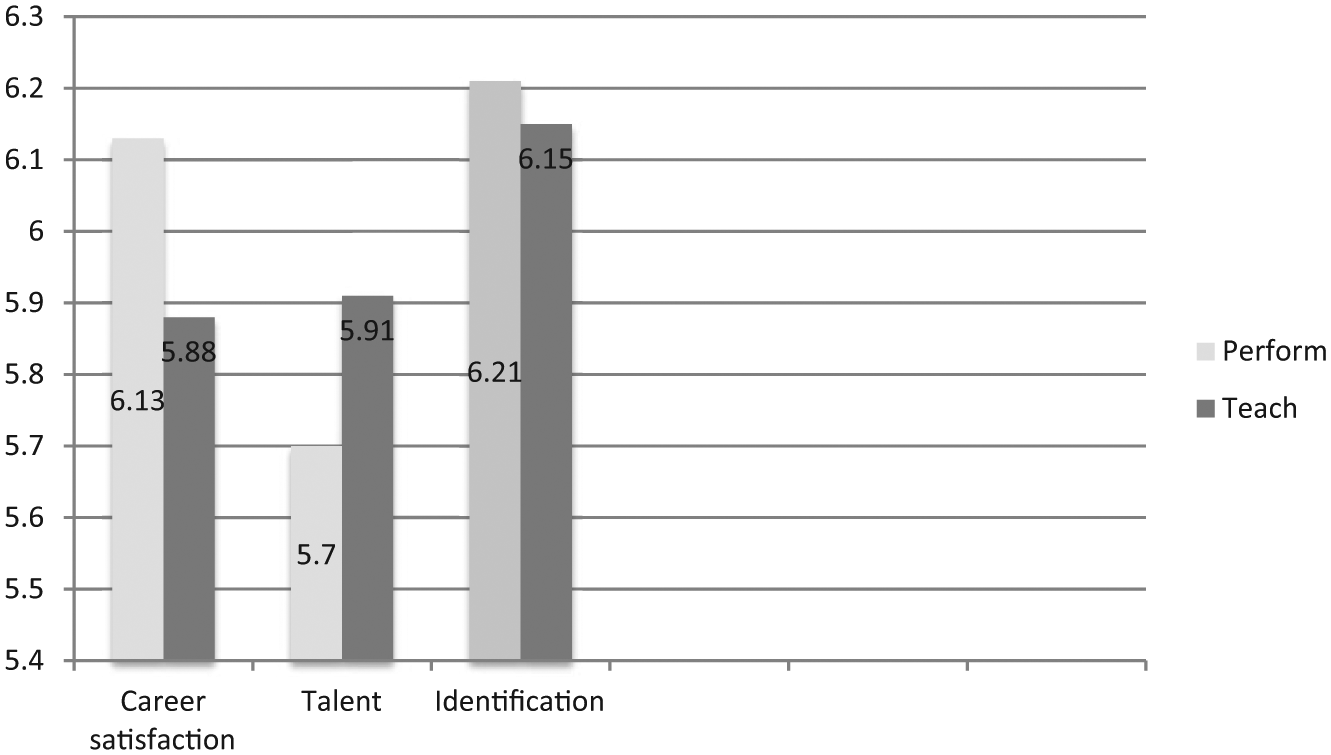
Comparison of means. Sample: N = 173.
Paired samples t-test.

Correlation is significant at the .01 level.
Examining intercorrelations between variables
Our third research question asked about the extent of the relationships between teachers’ beliefs about their identification with teaching, identification with performing, talent for teaching, talent for performing, and career satisfaction. We calculated correlation coefficients for the 6 variables and the correlation matrix is shown in Table 3. We present findings of positive correlations among three teaching variables (teaching satisfaction, teaching talent, and teaching identity) and among the three performance variables (performance satisfaction, performance talent, and performance identity). The additional positive correlations were between satisfaction for teaching and satisfaction for performing, as well as between talent for teaching and talent for performing. Finally, there were significantly high correlations between teaching identification and satisfaction with teaching, along with a significantly high correlation between performing identification and satisfaction with performing.
Intercorrelations among variables.

Correlation is significant at the .01 level.
Predicting career satisfaction
Our final question asked: “Do teachers’ beliefs about their identification with teaching, identification with performing, talent for teaching, talent for performing predict their satisfaction with the dual elements of their position (performing and teaching)?” We used a step-wise regression for each satisfaction (performing or teaching) and the four variables entered into the model were (a) identification with performing, (b) identification with teaching, (c) performance talent, and (d) teaching talent. We set the probability of F at .05 and the removal probability of F at .10 for the multiple regression. We checked the tolerance values as measures of collinearity for both the regression analyses. We set tolerance values, as suggested by Miles and Shevlin (2004), at less than 0.25. If below this value, collinearity presents a problem, but in both of the analyses reported below, none of the tolerance values were less than 0.25.
With the dependent variable as satisfaction with performance, the results showed that of the four variables entered, the first predictor was performance talent, R2 =.263; F(1, 171) = 60.90; p < .001; B = .57; SE B = .07; standardized coefficient β = .512; t = 7.8; p < .001. That is, performance talent explained 26% of the variance. The next significant factor entered in the model was identification with performance, explaining only a further 5% of the variance. Identity for teaching or talent for teaching did not predict their satisfaction with performing. With the dependent variable as satisfaction in teaching, the first predictor was the level of identification with teaching, R2 = .416; F(1, 171) = 121.95; p < .001; B = .85; SE B = .07; standardized coefficient β = .64; t = 11.04; p < .001. Identification with teaching explained 41% of the variance. The next significant factor entered into the model was teaching talent, explaining a further 1% of the variance. Identity or talent for performing did not predict their satisfaction with teaching. This illustrates that, for our participants, having a sense of being talented as a performer predicted their satisfaction with the role of performing, but identifying with teaching predicted their satisfaction with the role of being a teacher in higher education.
Discussion
Studio teachers in our study seem to have dual beliefs and dual identities that clearly co-exist and this is supported in the literature (Bladh, 2004). A key issue to emerge came via the numerous references to the nexus between teaching and performing; that the two are closely intertwined. While on the one hand studio teachers make decisions about how they identify with teaching or performing, the majority are able to explicate how they see the relationship between the two forms of practice and in particular, how one can positively influence the other. At the same time, there are clearly some teachers who express a much stronger identification with performing than teaching, which is potentially a concern and negative influence on their approach to teaching. An additional finding relates to teachers using the exact terms “identity” and “talent”; these also seemed to come together in many cases. Those who thought they identified more with being a teacher did so because they felt more “talented” at teaching, for example. The contextual debate regarding individuals’ levels of giftedness, perceived talent, or actual aptitude is outside the scope of this research, but we believe in framing our study in the identification theoretical framework; and using the strongly reliable instruments as part of this in-depth approach, we have a better understanding of this phenomenon as self-concept. Our items held strong internal consistencies, between α = .85 and α = .90, so we feel confident in our questionnaire items and the instrument in general. In using adapted items from Jones and Parkes (2010) we were able to reliably measure how identification and talent related to participants’ overall sense of satisfaction with the two roles embedded in the work they do in higher education. Our findings reveal that different constructs affect satisfaction in the two roles separately.
Our findings do not support evidence in the literature suggesting that individuals develop these identities separately (Huhtanen, 2004, 2008), although in some cases it was found that teaching emerges more strongly as identity with performance gradually diminishes (Mills, 2004b). Our findings do however show that, even if the balance changes over time, identification with both seems necessary to some degree. Our findings therefore do not support Huhtanen’s view that one identity may be given up in order to adopt the other (2008, p. 3). Our findings suggest that they hold high identification with both, and that in order to be satisfied with teaching, identifying specifically with teaching is particularly important. Our participants hold two identifications with high levels: one with teaching and one with performing.
We wanted to establish the extent of correlation between teachers’ beliefs about their identification with teaching, identification with performing, talent for teaching, and talent for performing. Their identification levels for these were significantly positively correlated (.35). With respect to their beliefs about their talent, our participants also reported perceiving themselves to be “talented” at both teaching and performing. These two were also significantly positively correlated (.46). It seems expected that the level of satisfaction for performance was significantly correlated with participants’ perceived levels of performing talent (.51), and identification with teaching (.46). Similarly, satisfaction for with teaching correlated most significantly with identification with teaching (.64) and talent for teaching (.54). The lower correlations such as those between identification with performing and satisfaction for teaching (.11), and identification with teaching and satisfaction for performing (.20), indicate that our participants keep these identities separate. That is to say, that identification with one domain does not affect satisfaction for the other.
We had hypothesized that teachers’ identification with music performance would predict their level of satisfaction with the performance aspect of their work, yet our findings after regression analyses show that their perceived level of talent for music performance predicted 26% of the variance for their level of satisfaction with music performance. Identification with performance was the second predicting factor but with only 5%. We also hypothesized that if our participants had identification in the domain of teaching, this would predict the level to which they are satisfied with this aspect of their work. Our findings support the work of Jones and Parkes (2010) who found that identification with teaching was a significant predictor of the likelihood that students would pursue a career teaching music (p. 50).
The current study illustrates that identification with teaching is important to an individual’s decisions to continue teaching as a career. Identifying oneself “as a teacher” is important to being satisfied with teaching. Alongside this finding is that, for our participants, the significant predictor of continuing to perform as a career is their level of perceived talent for performing. Parkes and Jones (2011) also found that for students choosing to undertake performing as a career, their beliefs in their ability to succeed at playing music was central (p. 23) to their decision-making process.
Limitations
Our participants may not be representative of studio teachers in higher education. We cannot account for the perceptions of the teachers who chose not to take our survey and we do not know how their perceptions might have differed from our participants. Another limitation is that we had 173 respondents but 13 did not disclose their country. We are not making claims for between-country differences however, and this should be researched in future studies. Our participants may also have been biased as a consequence of feeling that they needed to legitimize their own positions and/or present themselves strongly as “talented” or “identified” in the answers they provided. Our participants were also mostly white, or Caucasian, which from a socialization standpoint may mean they were all socialized in a similar manner, that is, in the western music tradition of conservatory learning and interaction.
Implications for the field and for future research
Our findings, as seen in the studio teachers in our sample regardless of country or institution, suggest there are implications for studio teachers who find the dual nature of their work difficult or if they are dissatisfied with one aspect over the other. Developing identity as a teacher might best be achieved through paired teaching sessions with peers, professional development in studio instruction with master teachers, conducting self-reflection to recognize successful teaching outcomes, and examining the importance of teaching within the social context of continuing high level musical instruction in society. Developing professional and caring relationships with students may help teachers become invested in student success. It also seems important to encourage studio teachers to explore the performance/teaching nexus, so that they no longer see them as separate activities. For studio teachers less satisfied with their performing role, it may help to support their self-concept with strategies such as professional development opportunities in music making, taking lessons with virtuosic colleagues, giving more recitals, and participating in collaborative learning with other studio colleagues in new music performance practices. These activities may increase their perceived self-concept for performing.
It is important for future research to establish exactly when these studio teachers made the decision to become teachers. Further questions have been raised by this study about when they chose to become a performer and when they chose to become a teacher along with when they might have aligned these identities. Issues regarding influences and motivations for this population need further investigation because when individuals identify with a domain, it is usually because they value it. Examining the motivational constructs from the expectancy-value framework would be appropriate as a next step. Expectancy beliefs are those that illustrate perceptions of ability and the expectancy-value framework may yield a better understanding of why highly trained performers value teaching and why they persist with both aspects of this position in higher education.
Conclusion
In summary, with both the qualitative and quantitative data, our participants do not fall neatly into one of the three constructs proposed by Bernard (2005, pp. 7–8). There are some in each category of (1) a dichotomy between musician or teacher, (2) a balance between the two, and (3) equating all teaching as performance and any performance as educative. The majority of our participants balanced between both identities and see them both as aligned and mostly satisfying.
In considering studio teachers’ identification, talent, and career satisfaction, we found that their beliefs predict satisfaction with the dual elements of their work, both performing and teaching, however, they will most likely stay satisfied with the teaching aspects required of their career if their domain identification is with teaching. They will stay satisfied performing while they feel talented at performing. Findings from this study suggest that identification is a very good predictor of future satisfaction with teaching, therefore we suggest that further research related to career satisfaction include the constructs related to identification to better understand the process through which highly trained musicians, who teach in the studio, construct a domain identification with teaching.
Footnotes
Appendix A
The items in the instruments used in this study are shown below. All of the items were rated on a 7-point Likert-type scale with end points as noted.
Satisfaction in instrument teaching
If I could, I would choose the same career, to be a music instrumental teacher, again (1 = strongly disagree, 7 = strongly agree)
Satisfaction in music performing
If I could, I would choose the same career, to be a music performer, again. (1 = strongly disagree, 7 = strongly agree)
Identification with instrument teaching (α = .90; 1 = strongly disagree, 7 = strongly agree)
Identification with music performing (α = .88; 1 = strongly disagree, 7 = strongly agree)
*Talent in instrument teaching (α = .85; 1 = not at all, 7 = very talented)
*Talent in music performing (α = .87; 1 = not at all, 7 = very talented)
Funding
This research received no specific grant from any funding agency in the public, commercial, or not-for-profit sectors.