



Abstract
The purpose of this research is to evaluate the effects of a self-regulated learning practice strategy curriculum (SRL–PSC) on 30 high school instrumentalists’ performance achievement, self-efficacy, practice behaviors, and self-perceptions of practice behaviors. The curriculum included peer collaboration, verbal mediation, group discussion, and goal-setting. Results of this research revealed that participation in the SRL–PSC enhanced self-efficacy, F(1,19) = 14.86, p = .001, and perceived music practice behaviors such as strategy usage and thoughtful intent, F(1,19) = 4.78, p = .041. Implications from this research suggest that offering students opportunities to employ a self-regulated application of practice strategies may enhance musical independence supporting lifelong learning.
Effective practice skills are necessary to obtain high levels of musical achievement. In music practice, students are frequently challenged to combine their understanding of practice processes and strategies with the task of analyzing musical challenges and applying appropriate strategies to remedy these challenges. Young students tend to exhibit a lack of musical intent presented as thoughtful pauses and error detection (Rohwer, 2006). Research examining the most prevalent practice behaviors of intermediate band students revealed that repetition of less than four measures at a time, varying tempo, and irrelevant playing were strategies most often employed by this age group (Miksza, 2012). Research has long suggested that students are not likely to be productive when they practice individually (McPherson & Renwick, 2001).
There are many potential reasons for this lack of productivity. First, young instrumentalists may lack a practical approach to musical practice (Miksza, 2007). Beginners and secondary students demonstrate little to no self-regulation in their practice. Instead, studies report that younger instrumentalists tend to measure musical achievement by time spent in practice rather than accomplishments (Duke, 2009). The measurement of adequate practice by time investment is reinforced by instructors who often assign young instrumentalists time constraints with a new piece of music rather than specific instructions for practice (Kostka, 2002).
Self-monitoring, a process necessary for effective practice, can be developed through instructor-guided activities such as listening to examples of errors and discussing solutions with an instructor (Kostka, 2004). Research suggests that providing analytic and strategic approaches for musical practice in eighth-grade band students contributes to higher performance accuracy (Rohwer, 2006). Opportunities to develop self-monitoring skills are necessary in an instrumental curriculum.
Self-Regulated Learning (SRL) is a construct that refers to the processes that can facilitate the development of strategic, motivated, and independent learners. SRL encompasses goal-setting, strategic-planning, maintaining organization, controlling the environment, self-monitoring, self-assessing, fine adjustments and self-reflecting (Zimmerman & Schunk, 1989). While SRL can be learned indirectly through social interactions and shared experiences, students acquiring SRL through context-specific practice, such as music or sports-training, are better able to focus on the organized metacognitive applications of strategies contributing to SRL (Paris & Paris, 2001).
Research suggests that systematic approaches will enhance self-regulation (McPherson & Zimmerman, 2002). Since few published studies to date have been conducted on practice behaviors of high school instrumentalists, there is a need to evaluate a self -regulated curriculum for secondary music students that fosters self-regulation in music practice.
Music and self-regulated learning
Self-regulation in music learning consists of six areas of focus: motivation, teaching method, time management, learning behaviors, physical environment, and social factors. The first area, motivation, is influenced by encouragement and feelings of high self-efficacy. Studies reveal that students who are considered motivated learners in music have been encouraged initially to learn through positive parental involvement and support (see Hallam, 2001). Research suggests that students with parental support have enhanced self-belief in their ability to learn and develop a pattern of practice that transfers into satisfying musical accomplishments (Zimmerman & Schunk, 2008). Musical accomplishments are the antecedent for increased musical self-efficacy. Zimmerman and Bandura (1994) extended this view by showing how self-efficacy affects achievement through its influence on students’ goals. That is, self-efficacy is regarded by many educational psychologists as “antecedent to academic success because it motivates behavior (primarily perseverance) that leads to success” (Jinks & Lorsbach, 2003: 113).
The second area, teaching methods, refers to the tasks and learning activities accompanying a formal curriculum. Music learning activities that include goal-setting and self-monitoring can provide opportunities to think critically, self-reflect, and problem solve. The ability to clearly define goals that are specific, proximal (short-term), and moderately challenging is a major component of effective practice (McPherson & Zimmerman, 2002). Research suggests that young instrumental music students are unable to describe specific practice goals and plan productive practice sessions (Oare, 2012). Therefore, a curriculum or teaching method that supports effective goal setting may motivate students to make progress through improving self-monitoring, a skill necessary for musical independence (Pintrich, 2000).
The third area, time management, refers to the way in which students go about their learning. Teaching students to structure practice time effectively provides motivation and develops systematic approaches to learning and time management skills. Research findings suggest that productivity increases as additional skills are acquired and refined (McPherson & Renwick, 2001). The last three areas of focus; learning behaviors, physical environment, and social factors, tend to work cohesively. Piaget’s theory of assimilation and accommodation suggests that students learn more effectively through associations between new knowledge and a student’s environment and/or personal experiences (Piaget, 1973). The learning environment for a music student cannot always be self-controlled; however, students can learn appropriate learning behaviors, such as proper posture, commonsense positioning of music or study material, and seeking quiet environments to practice or study. The physical environment is then closely associated with the culture of learning, established in the music classroom by the educator’s philosophies as well as various social factors. For example, in the Reggio Emilia philosophy, the curriculum is influenced by social factors and the environment espoused by the students. This social community reinforces knowledge discovered and encourages students to participate in creating and exploring new concepts and skills in an environment in which they demonstrate learning behaviors that reflect ownership and teamwork (Cadwell, 1997).
The purpose of this research is to evaluate the effects of a Self-Regulated Learning Practice Strategy Curriculum (SRL–PSC) on high school instrumentalists’ performance achievement, self-efficacy, practice behaviors, and self-perception of practice behavior.
This study sought to answer the following questions:
How does implementation of the SRL–PSC affect performance achievement?
Does implementation of the SRL–PSC contribute to self-efficacy?
How does implementation of the SRL–PSC effect practice session behaviors?
What are the effects of the SRL–PSC on perception of practice strategies in high school instrumentalists?
Method
Participants
Thirty adolescent wind instrumentalists (n = 17 females, n = 13 males M age = 15.40 years; SD = 1.30) enrolled in an intermediate or advanced level daily band course were recruited from a public high school in the Southeastern United States. Participants served as part of a convenience sample that included 46.6% Caucasian, 16.6% African American, 30% Hispanic, and 6.5% Asian students. Twenty-one woodwind players and nine brass players reported average number of years of musical training (M = 10.07 years; SD = 1.14). Only five participants reported previous enrollment in individual music lessons, and two students reported playing piano in addition to their wind instrument. This project was approved by the University Institutional Review Board and informed written consent from parents and assent from students was obtained prior to research participation.
The Self-Regulated Learning Practice Strategies Curriculum
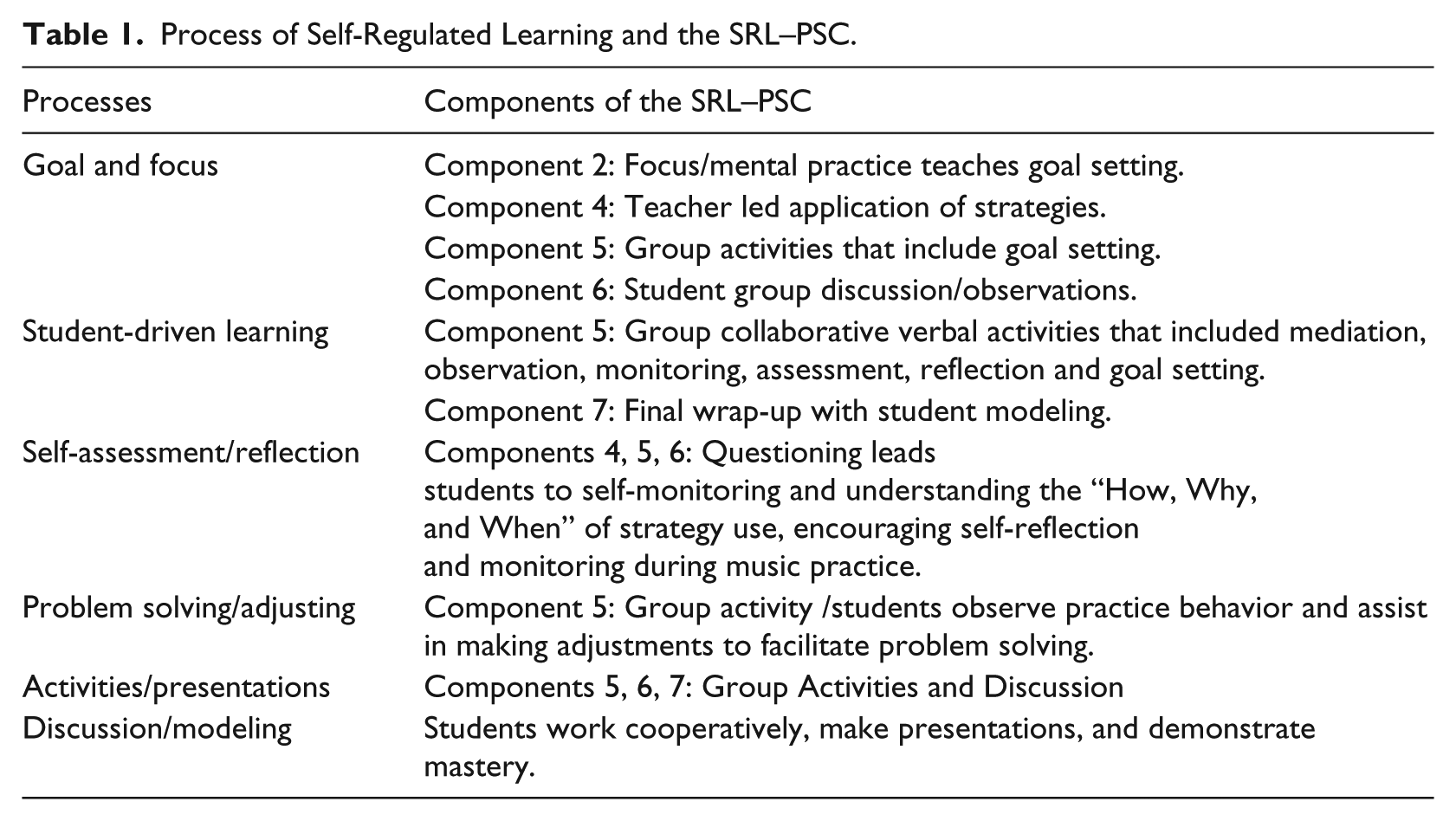
The Self-Regulated Learning Practice Strategies Curriculum (SRL–PSC) was designed to assist students to better self-regulate based on the various processes of self-regulated learning such as goal setting, student-driven learning activities, pacing, self-assessment and monitoring, problem solving and adjusting. These key processes of SRL were aligned with the seven components of the SRL–PSC (Table 1).
Process of Self-Regulated Learning and the SRL–PSC.
Teaching strategies with theoretical and practical substance are a valuable tool for music educators to assist students in the development of self-regulation in music practice. The purpose of the SRL–PSC is to provide practice strategies for students to develop self-regulation. The SRL–PSC is based upon 22 accessible practice strategies derived from research of practice behavior of pianists and wind players (Bugos & High, 2009; Smith, 2005). The 22 practice strategies in this curriculum are organized into three categories; element elimination; thoughtful repetition; and make it musical .
Element elimination reduces learning challenges by altering the sequence of notes, presentation of rhythms, pitches, and dynamics or articulation. Strategies such as such as sizzle, speak, sing, finger, tap and clap, and mental practice eliminate one or more elements of musical practice behavior and facilitate a more concentrated focus on tonal center, intervallic pitch relationships, and rhythmic comprehension. Element elimination is also referred to as contextual interference, a learning strategy that makes the process of learning more elaborate by increasing variation in either a physical motion or skill. Research suggests that high contextual interference or element elimination also improves skill retention (Boyce & Del Ray, 1990; Giuffrida, Shea, & Fairbrother, 2002). Research presents a developmental order to the acquisition of a skill such as music or sport with the components of this process including attention, retention, motor reproduction, and reinforcement (Jourden, Bandura & Banfield, 1991).
Mental practice, is a widely recognized concept in element elimination that involves cognitive acquisition of a skill without physical performance. Electrophysiological studies suggest that the same neural pathways are activated when musicians imagine musical performance as when engaged in musical performance (Zatorre & Halpern, 2005). Mental practice combined with physical practice involves associations with previous tasks that promote focus, concentration, and visualization and is best executed in brief sessions (Denis, 1985).
The repetition category of practice strategies contains thoughtful repetition such as chaining, whole–part–whole, using the metronome and woodshedding. Although repetition is a strategy most often employed by young instrumentalists, repetitive practice alone is not always effective (Stambaugh, 2011). By implementing a random order of strategies in combination with repetition, students become more familiar with sequencing, and begin to practice more effectively.
The make it musical category is a metacognitive practice behavior that includes attention to musical phrasing and expressiveness through dynamics, articulation, and tone experimentation. These elements can be explored by marking the part, gradually speeding up or slowing down the tempo and altering the expression of rhythms and articulations.
The researcher designed music performance assessment rubric (MPAR) was used to measure performance achievement. The MPAR contained ten domains that include essential and expected practice outcomes such as note accuracy, rhythmic accuracy, articulation, dynamics, and tone-quality. The following error scale was used in determining scores on the MPAR: 0–5 errors = 4 point score, 6–10 errors = 3 point score, 11–15 = 2 point score and anything over 15 errors was a 1 point score. Musical expression was also measured on this four-point scale using a subjective observation of attempts made to explore phrasing and creative musical expression. A proxy of the performance achievement measure was made using a panel of eight music education doctoral students with an extensive background in education and was revised upon suggestions. The performances etudes were rated using this measure by four collegiate music education majors who received 6 hours of training conducted in two sessions on the MPAR. Split halves reliability analysis of pre-training and post-training ratings was r = .94 and r = .96 respectively. Mean performance scores on the MPAR were included in the Repeated Measures ANOVA. Although no significant interaction was found, repetition was the most representative strategy observed by independent judges.
Self-efficacy was measured pre- and post-treatment, using an abbreviated form of the Self-Regulated Motivation in Music Practice Survey (SRM–MP) administered pre- and post-curriculum implementation. The questions were adapted from the Motivated Strategies for Learning Questionnaire (Miksza, 2006), which consisted of sub-scales designed to measure self-regulation (ten items). These five-point Likert scale items (ranging from SD = strongly disagree to SA = strongly agree) were used to examine self-efficacy in a high school population. An example of an item is, “I usually have a plan of what I need to practice most before I begin my practice session.” For three sub-scales included in the measure—consisting of intrinsic value, cognitive strategy, and self-regulation—reliability correlations have been reported, r = .63 to .83 (Pintrich & DeGroot, 1990).
Practice behavior was measured during the pre- and post-test practice session using a research-based 22 practice strategies check list. Three collaboratively trained collegiate music education majors evaluated the pre- and post-test practice session videos for frequency of strategies demonstrated. Inter-judge reliability of practice strategies observed was r =.96 for pre-test and r = .97 for post-test.
Perceptions of practice session behavior were measured using a questionnaire that was administered after both the pre- and post-test practice sessions. Questions on the Pre and Posttest Practice Survey correlated to the 22 practice strategies. Participants indicated the number of times each practice strategy was demonstrated. The questions were objectively worded to encourage complete disclosure without judgment. For example, “How many times did you repeat a single measure?” Or “How often did you take out the rhythm in order to master a technical passage?” Students could select 0–2, 3–5, 6–10 times, or more than 10 times. A pilot survey was administered to 45 high school music students in a separate sample. Split halves reliability (r = .798) indicates moderate reliability.
Procedures
A pre-test video was made of each participant practicing for 20 minutes and then performing the research author composed unison etude #1. A post-test video was made of each participant practicing for 20 minutes and then performing the unison etude #2. Both etudes were designed to provide age and ability level appropriate musical and technical challenges such as technical passages and dynamic and stylistic contrasts. A proxy of the etudes was given to a group of three collegiate wind performance majors who determined that the instrument ranges and level of difficulty were appropriate for the parameters of this study. Participants were instructed to practice the etudes for 20 minutes, using whatever means necessary to prepare for a final performance. Each participant worked undisturbed in a private practice room with special precautions taken to provide confidentiality. Upon completion of the pre-test and post-test practice and performance of the etude, participants completed the Practice Session Questionnaire that correlated to the 22 practice strategies and processes of self-regulated learning (see Figure 1.).

Perceived repetition.
A two-week treatment period took place in between the pre- and post-test practice and performance sessions where participants received one 90-minute after school SRL–PSC each week. Additional implementation of the SRL–PSC was followed by daily review and reiteration throughout the week during regularly scheduled music classes. The SRL–PSC guided participants through a seven-component lesson that included unison warm-ups and breathing exercises. The breathing exercises utilized the concepts of visualization and mental practice techniques. In addition, each SRL–PSC lesson also included a reading session of unison etude #1 that facilitated the discussion of musical challenges and encouraged the participants to formulate opinions concerning those musical and technical challenges. Finally, the instructor demonstrated and discussed the application of the 22 practice strategies such as repetition, take it out of context, and make it musical in etude #1. Each component of the SRL–PSC took approximately 10 to 15 minutes with additional time allocated for questions posed during the discussion. For example, “In measure eight, what strategy or strategies would you use to better facilitate the technical challenge of the sixteenth note passages?”
Results
Differences in performance between pre- and post-test scores were measured in three areas: perceived usage of practice strategies, self-efficacy scores, and performance achievement. Results of Repeated Measures ANOVA (Factor × Time) in two areas: perceived practice strategies and self-efficacy reveal significantly increased perceived practice strategy usage, F(1,19) = 4.78, p = .041, and self-efficacy, F(1,19) =14.86, p = .001. Results show no significant interaction for performance differences between pre- and post-testing, F(1,19) = .345, p = .564.
Practice strategy usage measured with a Pre and Posttest Practice Survey included questions coded according to the three areas of focus: repetition, removal from context, and musicality. Analysis of independent areas of practice strategy usage included perceived enhancements by students in two areas of practice strategy implementation: repetition, t(29) = -2.73, p = .011, d = .67 (Figure 1), and removal from context (element elimination), t(29) = -.2.69, p =.012, d =.50 (Figure 1). Data suggest that this was a small to medium effect. No significant difference between pre- and post-strategy survey data was found for practice strategies focused upon musicality, t(29) = 1.86, p = .073.
In addition to perceptions, we collected a 20-minute practice session video pre- and post- curriculum implementation to document actual practice strategy usage in rehearsals. Three Collegiate Music Education majors with 6 hours of training tallied the number of times practice strategies were implemented. A paired samples t-test conducted on the number of strategies implemented pre- and post-training in three specific areas: repetition, t(29) = -1.06, p = .30; removal from context (element elimination), t(29) = .03, p = .97; and musicality, t(29) = -1.26, p = .22, show no significant difference between time points respectively.
Participants completed a measure of self-efficacy pre- and post-SRL–PSC. Self-efficacy data show pre-training scores, M = 34.20, SD = 4.60, and post-training scores, M = 36.10, SD = 3.73. Results of a paired samples t-test on SRMP self-efficacy scores shows significantly increased self-efficacy post-training with a small effect size, t(29) = -2.85; p =.008, d = .51 (Figure 2).
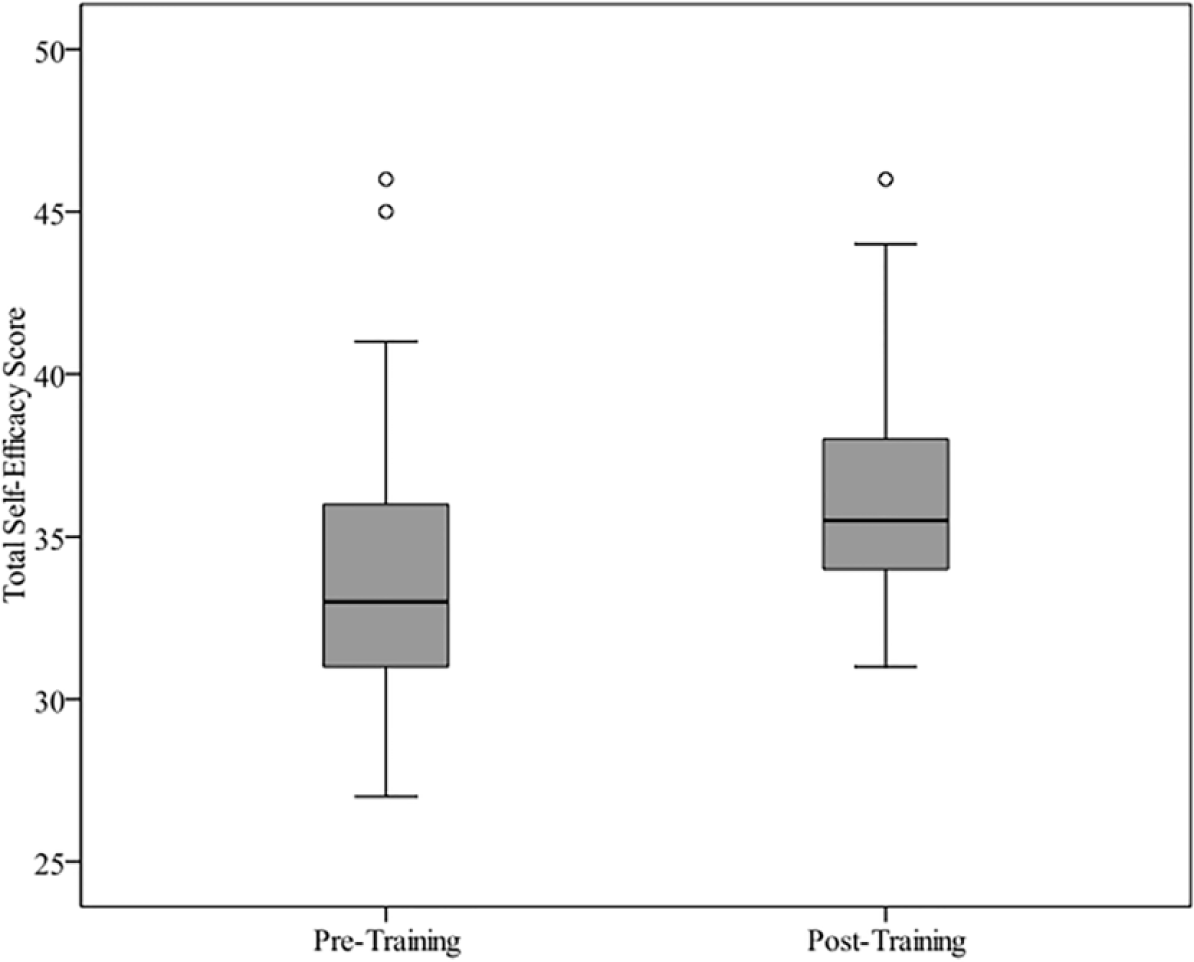
Total self -efficacy score.
The performance measure rubric (worth 1–4 points) captured ten domains, including: note accuracy, rhythmic accuracy, tempo, articulation, dynamics, form, tone, breathe support, phrasing, and musical expression for a possible total of 40. Results of a paired samples t-test on performance measure scores show no significant difference between time points, t(29) = -1.41, p = .169. However, the mean for pre-testing differed (M = 18.07, SD = 5.69) slightly when compared to post-testing (M = 19.17, SD = 5.78).
Discussion
The results of this research study show curricular introduction and focus on practice strategies may increase students’ perceptions of music practice behaviors which may contribute to musical self-efficacy. Perception contributes to the development of deliberate and varied practice procedures and strategies (Bugos & High, 2009). While no difference in practice strategy usage was observed, students in this study perceived increased strategy usage and credited this increase to their acquisition of practice tools and processes.
The strategy most often perceived was repetition. Within the three main areas of perception regarding practice, there was a large increase in the perception of repetition post-training. This is consistent with previous literature concerning high school wind players (Miksza, 2007). The prolific use of repetition across all disciplines as a learning strategy has been reinforced in students from a very young age with focus given to blocked repetition versus random. In this study, we believe students gravitated to repetition more readily due to numerous strategies choices and group activities that endorsed thoughtful intent.
Although repetition was the most often perceived strategy, taking out of context or element elimination was also a prominent self-perceived strategy. Element elimination reinforced the concepts of varied practice while enhancing retention and improving skill acquisition. Participants engaged in a number of tasks associated with this strategy such as removing an articulation or making a rhythm more difficult in an effort to perfect it in its original form. Attention to practice strategies may cause students to feel more empowered in their own musicianship, thus contributing to enhanced musical self-efficacy. Self-efficacy also contributes to enhanced practice in young children and adolescents. Our data suggest increases in self-efficacy after only a short period of time with a novel curriculum. This is consistent with previous research in adults who receive a two-week training period (Bugos, Kochar, & Maxfield, 2015). It is interesting to note that while self-efficacy was increased, according to our results, performance achievement did not increase. Perhaps a 2-week treatment period may not have been a sufficient amount of time for participants to grasp the concepts of the SRL–PSC thoroughly. More repetition and reiteration time may have been needed in order for performance achievement to increase. While other studies suggest increases in music performance stemming from increased self-efficacy, these studies measure the influence of extensive practice and long-term training (McPherson & McCormick, 2006).
Limitations and potential explanations
This research represents a first step in the evaluation of the effectiveness of a SRL–PSC. Future research with a larger population group and a no treatment or alternative attention-based control group is necessary to ascertain the effectiveness of a SRL–PSC and will contribute to generalizability. After assessing the participants’ knowledge of application and comprehension of the strategies during the module through questioning, it was observed that many students were not able to verbalize why a certain strategy should be used in a presented musical challenge Therefore, more cooperative learning activities involving discussion, verbal mediation, and goal setting are needed in order to engage students in the thought processes necessary to understand the “when” and “why” of practice strategy application. Future longitudinal research is necessary to evaluate behavioral changes and performance outcomes related to a SRL instructional component.
Conclusion and implications for music education
This research, one of few studies including high school instrumentalists, suggests that providing a SRL–PSC may benefit self-efficacy and strategy usage in adolescence. The authors of this research observed that the teacher-led group discussions and group activities during the curriculum module treatment period encouraged participants to consider the “what,” “why,” and “how” of strategy usage as well as their application to musical challenges. This thoughtful intent and consideration of practice strategies supports the possibility of developing and or enhancing problem-solving skills and peer-collaboration in the instrumental rehearsal. Application to other settings of music practice is possible such as solo and ensemble and full instrumental arrangements. Using this curriculum as a guide, music educators may instill skills imperative to the process of lifelong music learning by imparting the processes and strategies necessary for effective music practice. Educators may find that SRL–PSC can serve as a building block for creative and cognitively engaging lessons as well as explorative applications, review, and reiteration. Although the SRL–PSC served as an innovative guide for instruction, further longitudinal research is still needed to evaluate the effects of a SRL–PSC on high school instrumentalists’ ability to self-regulate in their practice behavior and to attain higher levels of performance achievement.
Footnotes
Funding
This research received no specific grant from any funding agency in the public, commercial, or not-for-profit sectors.