



Abstract
The purpose of this study was to establish the relationship between musical self-concept and musical creativity, and to determine the best predictors of musical creativity given the musical self-concept dimensions. Participants (N = 201) were music students, drawn from 21 secondary schools in Kenya. Music Self-perception Inventory-Version 2 (MUSPI) was used to gather data on participants’ musical self-concept. Musical creativity was measured using the Consensual Musical Creativity Assessment Scale (CMCAS). Results indicated a positive relationship between musical self-concept and musical creativity (r = .25, p < .01). All the musical self-concept dimensions, except singing and dancing showed positive associations with musical creativity. Further, a significant mean difference in musical creativity for positive and negative musical self-concept was observed. Multiple regression indicated that the best predictors of musical creativity were sense of rhythm and dancing self-concepts and the strongest predictor of musical creativity was sense of rhythm self-concept. A significant gender difference in musical creativity was observed, with males scoring higher than females. However, there was no significant difference in participants’ musical creativity based on age. The study recommends interventions and conducive environments for the development of positive musical self-concept.
Background
The enhancement of students’ creativity is one of the main purposes of music education. Creativity refers to a process or a product that is original to the creator and appropriate to the purpose or goal of the creator (Amabile, 1996, 2012; Baer, 1997). This definition supports the notion of “small c” creativity, whereby every person is more or less creative in comparison to others in their cultural and social context (Hickey & Lipscomb, 2006). According to Kokotsaki (2012), creativity includes the use of original thinking or imagination in problem solving. In the fields of education and psychology, creativity has been understood as students’ ability to produce work that is both novel and appropriate within a particular domain (Sternberg & Lubart, 1995). Amabile (1996, 2012) advanced a componential model of creativity in which social environment, domain-relevant skills, creativity-relevant processes and intrinsic task motivations are all viewed as necessary components of creative performance. Accordingly, previous studies suggest that students who are intrinsically motivated tend to adopt deep processing learning strategies, to put more effort and persistence into learning tasks, and to attain high creativity (Ruscio, Whitney, & Amabile, 1998; Schatt, 2011).
A number of studies identify musical self-concept as an important socio-cognitive factor, which regulates students’ behaviours, effort and motivation towards music practice and learning tasks, and ultimately impacts on musical performance (Hallam, 2002; Schmidt, 2005; Spychiger, Gruber, & Olbertz, 2009; West, 2013). In a study of American secondary instrumental music students, Schmidt (2005) found a correlation between musical self-concept and intrinsic motivation. A similar pattern of results was established by Schmidt, Zdzinski, and Ballard (2006), among undergraduate music education majors in America. Based on Amabile’s componential model and the aforementioned studies, it is therefore apparent that positive musical self-concept enhances students’ musical creativity.
Literature review reveals limited studies on musical self-concept in relation to musical creativity involving secondary school subjects (Laycock, 1992). Additionally, the studies were primarily conducted in developed countries and are lacking in developing countries context. African countries are categorized as developing countries, which are less industrialized and have a lower human development index (HDI) scores. These countries have high illiteracy rates, poor educational and communication facilities and high levels of poverty. Conversely, developed countries are advanced in terms of economy, industrialization, infrastructure and technology. The aforementioned socio-economic factors influence music pedagogical practices and creativity. The relative lack of contemporary research in this area, especially in an African educational context, necessitated this study.
Musical creativity
Musical creativity is defined as the ability to generate an original musical product that is appropriate for the musical context in which it is produced (Elliott, 1995; Kokotsaki & Newton, 2015). According to Webster (1990, 2002), musical creativity involves creative thinking in sound, which swings between convergent (factual) and divergent (imaginative) thinking, with the objective of generating a novel musical product. Burnard (2012) conceptualizes a practice-based perspective of musical creativities, where distinctive forms of musical creativity are rendered differently in different socio-cultural contexts of experiencing music (practices). This contextually situated view of musical creativity allows learners to be creative on the basis of their socio-cultural background and experiences (Kokotsaki, 2012). For children in a classroom, the most creative products are those that are the most unusual, yet appropriate, in the context of that classroom or age-group within that cultural setting (Hickey & Lipscomb, 2006).
Musical creativity can be demonstrated through composition, improvisation, performing, listening, writing and analysing (Burnard, 2012; Kokotsaki & Newton, 2015). However, the methods and criteria for assessing musical creativity remain elusive and highly contested (Hickey & Lipscomb, 2006). Amabile’s (1996, 2012) consensual theory of creativity suggests that creative ability is best measured by assessing the creative quality of the products that are a result of creative endeavors. Amabile further proposes that subjective assessment of such products by experts in the domain for which the product is created is the most valid way to measure creativity. Hickey (2001, 2002) adapted Amabile’s Consensual Assessment Technique (CAT) and applied it to creative musical thinking in the context of musical composition with children in the classroom. Amabile suggests that teachers can recognize creative work according to their own understanding of creativity when they see it because of their expert knowledge and experience in the classroom (Kokotsaki & Newton, 2015). Studies on composition and improvisation are generally considered as investigating musical creativity because the fundamental activity they look into is the creation of new music (Hickey, 2002; Webster, 2002). Furthermore, compositional process allows for refinement of musical ideas and shows participants’ intentional acts in music making (Auh, 1997).
Musical self-concept
Shavelson, Hubner, and Stanton (1976) define self-concept as an individual’s perceptions of self, formed through experiences with the environment and interpretations of those experiences. These perceptions are partly influenced by evaluations from others, reinforcements, and causal beliefs about one’s behavior. Based on Shavelson’s et al. (1976) model of self-concept, Vispoel (1994) conceived a multidimensional and hierarchical theory of the musical self-concept. The author hypothesizes that musical self-concept is organized, multifaceted, hierarchically structured, and differentiated, and that relationships between music and higher-order facets of self-concept are mediated to some degree by domain importance. In this framework, musical self-concept is broadly defined as self-appraisals of one’s competence in music that are formed through experiences with the environment and interpretations of those experiences. These appraisals are influenced in part by evaluations from others, reinforcements and causal beliefs about one’s performance and accomplishments in music (Vispoel, 1994). Musical self-concept integrates perceptions, beliefs, and self-schemas about an individual’s musical abilities and potential (Morin, Scalas, Vispoel, Marsh, & Wen, 2016). In education programs, musical self-concept is viewed as an individual learner’s self-perception of his/her musicianship, which is formed through the learner’s experiences and interpretations of the school environment (Bong & Skaalvik, 2003; Elliot, 1995).
Vispoel (1994) integrated his model of musical self-concept and developed the Music Self-Perception Inventory (MUSPI), which investigates different dimensions of the musical self-concept at both general and specific levels (Morin et al., 2016; Vispoel, 1996). General musical self-concept assesses perceptions of broad music accomplishments (e.g., doing most music-related activities is easy for me). It is established at a higher-order level relative to the specific music abilities in singing, composition, dancing, etc. The current study is based on the recently developed MUSPI-Version 2 (Vispoel, 2017). The instrument assesses perceptions of general music ability (global musical self-concept) as well as perceptions of skill in the music subdomains of singing, instrument playing, reading music, composing, listening, dancing and sense of rhythm.
Musical self-concept and musical creativity
Previous research generally suggests that students with positive musical self-concept tend to excel in music accomplishments. Demorest, Kelley, and Pfordresher (2017) examine the relationship between musical self-concept and the singing ability of junior high school students in the USA. The results indicate that musical self-concept is a unique predictor of students’ singing precision and performance, suggesting a relationship between students’ musical self-concept and their singing ability. Schmidt (2005) investigates musical self-concept in relation to instrumental performance and effort among 300 secondary school instrumental music students in the USA. Results indicate that instrumental performance and effort are strongly correlated with musical self-concept. Similarly, in a quasi-experimental study to establish the association between pupils’ self-concept and creative ability in Spain, Franco (2006) reports that the self-concept and levels of creativity in the experimental group increased significantly as compared with the control group.
Further, Laycock’s (1992) study shows a strong relationship between musical self-concept and musical creativity among 56 high school students aged between 15 and 18 years, in Ohio, USA. In the study, musical creativity is based on participants’ original compositions, which were played directly on a piano, recorded and rated by two independent judges. Musical self-concept is measured using the Self-Esteem of Music Ability Questionnaire (SEMA) which focuses on the general musical self-concept. Conversely, the MUSPI -Version 2 (Vispoel, 2017), which is used in the current study, considers musical self-concept at both general (global) and specific levels (dimensions). Vispoel (1994) suggests that singing and dancing self-concepts are relatively distinct from other musical self-concept dimensions. Therefore, by considering each musical self-concept dimension independently, we expected to facilitate an in-depth analysis, to compare the variables, and add some new and potentially useful insights which could be of interest and benefit to teachers as well as music psychologists and musicians.
The primary purpose of this study was to establish the relationship between participants’ musical self-concept and musical creativity. Specifically, the relations among the eight dimensions of musical self-concept comprising singing, instrument playing, music reading, music composition, listening skills, dancing, sense of rhythm and global musical self-concept, and participants’ musical creativity were established. The secondary purpose was to determine the best predictors of participants’ musical creativity given the eight dimensions of musical self-concept. Additionally, age and gender differences in participants’ musical creativity were explored. The study was guided by the following research hypotheses:
Ha1: There is a significant relationship between participants’ musical self-concept and musical creativity.
Ha2: There is a significant prediction model of musical creativity from the eight musical self-concept dimensions.
Method
Participants were 201 form-four music students (equivalent to Grade 12), drawn from 21 secondary schools in Kenya. The sample consisted of 62 male students (31%) and 139 female students (69%), with a mean age of 17.24 years (SD = 0.78). Music education is an optional subject and therefore offered in selected schools. Purposive sampling was used in selecting participating schools and class level (Grade). Further, due to the small population of music students in form-four level, census was used. A sample of form-four students, which is the final year of secondary school, was deemed appropriate for this study because they had covered adequate course content necessary for notation of creative music composition. Relevant research authorizations were obtained prior to the study. All participants were treated in accordance with the American Psychological Association (APA) Ethical Code.
Instruments
Data were collected under normal music classroom conditions, in two separate sessions. The first session, lasting approximately 30 minutes, was for administering the questionnaire, while the second session, of approximately 45 minutes, was for notation of creative composition. A member of the research team was present to distribute and collect the questionnaires as well as answer any questions students posed about the items.
The participants’ musical self-concept was measured using Vispoel’s (2017) Music Self-Perception Inventory-Version 2 (MUSPI). The researchers obtained authorization from the author to adopt this instrument. The MUSPI comprised eight subscales, which assessed participants’ perceptions of their musical ability in seven specific dimensions of singing (e.g., I am skilled at singing), instrument playing (e.g., I am confident in my ability to play a musical instrument), reading music (e.g., reading music is difficult for me), music composition (e.g., creating music is easy for me), listening skills (e.g., identifying characteristics of music by ear is difficult for me), dancing (e.g., creating dance movements to music is easy for me) and sense of rhythm (e.g., I can repeat rhythms I hear with high accuracy), as well as perceptions of global musical self-concept (e.g., doing most music-related activities is harder for me than for other people of my age). This questionnaire consisted of 48 items; six items in each subscale. The items were rated on a six-point Likert-type scale, ranging from 1 (false) to 6 (true). Participants were instructed to indicate the extent to which each item was a true or false description of their abilities in different music-related areas. The scores in each subscale ranged from 6 to 36, while the overall musical self-concept score ranged from 48 to 288, with higher scores indicative of positive musical self-concept and lower scores corresponding to negative musical self-concept.
The MUSPI-Version 2 was originally developed and validated in America. The current study validated this instrument in an African educational context, which is relatively different in socio-cultural orientation and practices including ethnic or religious identities, values, lifestyles and economic development. Africa’s culture is also unique in its arts, handicrafts, music, dances and literatures. Unlike in the USA, use of computer technology in music teaching and learning in Kenya’s secondary schools is not advanced. This is compounded by insufficient music teachers and shortage of necessary facilities such as musical instruments. These factors impact on students’ musical self-concept and creativity.
The Consensual Musical Creativity Assessment Scale (CMCAS), a rating scale adapted from the Consensual Assessment Technique (CAT; Amabile, 1996; Auh, 1997) was used to evaluate the participants’ musical creativity. The administration and evaluation of the participants’ creative compositions complied with the procedure for the use of Amabile’s CAT. First, the participants notated creative compositions. Then, the researcher transcribed the participants’ compositions using the computer program NoteWorthy Composer Version 2. Thereafter, two secondary school music teachers (expert judges) independently listened to and rated the participants’ compositions relative to each other. The rating was in accordance with the four composition dimensions of musical craftsmanship (the degree to which the tonal and rhythmic elements in a composition demonstrate technical competence); musical syntax (the degree to which the tonal and rhythmic patterns in a composition are structured in a logical manner, so that the melody makes sense); musical originality (the degree to which the composition is unique, when compared to the existing melodies by other students) and aesthetic musical sensitivity (the degree to which the melody is musically expressive and appealing (Auh, 1997). The rating of the compositions was based on a five-point Likert-type scale, ranging from 1 (low) to 5 (high). Thus, musical creativity scores ranged from 4 to 20, with higher scores corresponding to relatively higher musical creativity. The scores from each judge were averaged to represent the participants’ musical creativity. To enhance the reliability of the CMCAS, the authors trained the two expert judges on its use during the pilot phase of this study. Many empirical studies that assess music composition creativity have successfully adapted Amabile’s CAT (Auh, 1997; Hickey, 2001, 2002).
Results
Before testing the hypotheses, we established that all the preliminary parametric assumptions were met. Additionally, the construct validity and internal consistency of the research instruments were examined. Confirmatory eight-factor analysis, varimax rotated, was conducted to verify the construct validity of the MUSPI-Version 2 (Vispoel, 2017) based on the main study. All the items strongly loaded onto the predicted factors. However, item 23 (I am confident in my ability to perform music with good timing) loaded more heavily onto the listening skills subscale (.41) than the sense of rhythm subscale (.39). Internal reliability coefficients for the MUSPI subscales were high to very high (α = .86 to α = .95; Mα = .95). This was consistent with the findings of Morin et al. (2016), that established reliability values of between (α = .96 to α = .97; Mα = .97) for the MUSPI. Inter-rater reliability for musical creativity dimensions ranged from .72 to .87; overall .82. This was comparable to those found in Auh (1997), Kiehn (2003) and Laycock (1992).
Figure 1 shows three samples of compositions that were rated as highly creative by the two expert judges. The three melodies sounded interesting; demonstrated high music competencies, with varied and logically structured rhythmic constructs; and applied musical elements and techniques, which were considered unique relative to other participants’ compositions.

Compositions evaluated as highly creative.
Descriptive statistics, reliability coefficients and correlations for all the dimensions of musical creativity and the MUSPI subscales appear in Table 1. The maximum possible score for each musical creativity dimensions was 5, and their means ranged from M = 2.72 for the musical originality dimension to M = 3.55 for the musical craftsmanship dimension. The standard deviations were in the range of 0.62 to 0.87, while all the skewness and kurtosis values were (< ± 1), indicating a normal distribution for musical creativity. In general, participants had moderately high levels of musical creativity (M = 12.75, SD = 2.68; maximum possible = 20).
Descriptive statistics, reliability coefficients and correlations for the independent and dependent variables.
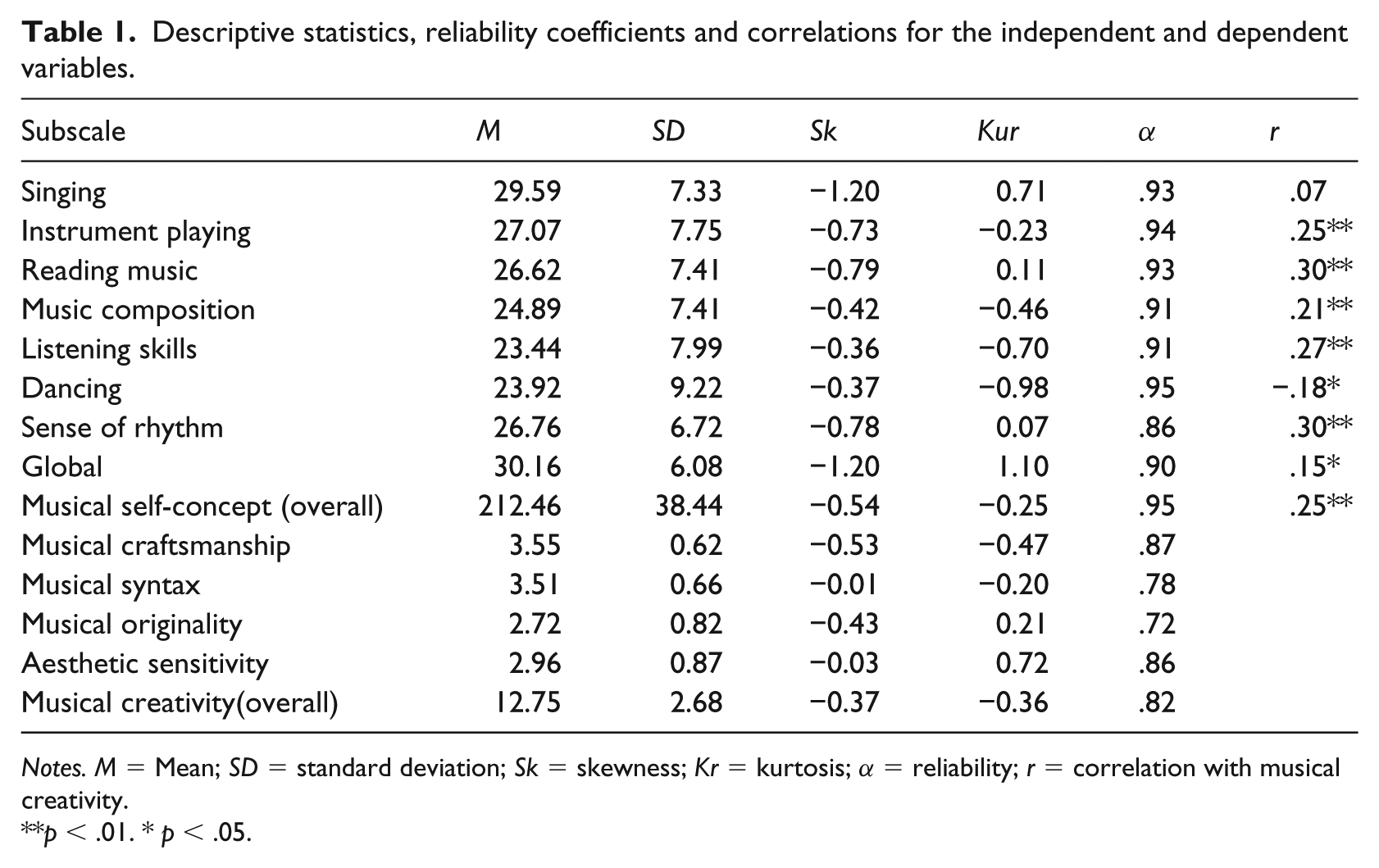
Notes. M = Mean; SD = standard deviation; Sk = skewness; Kr = kurtosis; α = reliability; r = correlation with musical creativity.
p < .01. * p < .05.
Among the musical self-concept dimensions, the highest means (M = 30.16, SD = 6.08 and M = 29.59, SD = 7.33) in order, were found for global musical self-concept and singing self-concept (maximum possible = 36). By contrast, relatively low means of M = 23.44, SD = 7.99, M = 23.92, SD = 9.22 and M = 24.89, SD = 7.41 were observed for listening skills, dancing and music composition self-concepts, respectively. Dancing self-concept had the greatest variability and indicated that a wide range of self-concept existed within the dimension. The skewness and kurtosis values for all the eight musical self-concept dimensions were (< ± 1) except for singing and global self-concept, generally indicating they were close to a normal distribution.
Bivariate correlation analysis was computed to establish the intercorrelations among the musical creativity dimensions. The highest correlation was observed between musical originality and aesthetic sensitivity to music r = .83, p < .01, while the lowest correlation was between musical craftsmanship and aesthetic sensitivity to music r = .68, p < .01. Intercorrelations between musical creativity (overall) and each of the four dimensions ranged from r = .86, p < .01 for musical craftsmanship to r = .93, p < .01 for musical originality. The relatively high intercorrelations among the dimensions indicated that there was a substantial overlap in the dimensions.
Among the musical self-concept dimensions, dancing self-concept was not significantly correlated with any dimension except singing self-concept r = .21, p < .01 and composition self-concept r = .16, p < .05. The relation between singing and instrument playing self-concepts was not significant. All the other correlations were generally low to moderate, positive and significant. The highest relationship was observed between sense of rhythm and listening skills self-concepts (r = .65, p < .01), while the lowest correlations were among dancing and composition self-concepts (r = .16, p < .05), global and dancing self-concepts (r = .17, p < .01), reading music and singing self-concepts (r = .19, p < .01) and sense of rhythm and dancing self-concepts (r = .19, p < .01), in this order. The finding that there were low to moderate correlations between the musical self-concept dimensions indicated that most of the factors were distinct and were measuring different constructs or abilities.
The participants’ overall musical self-concept scores were further used to categorize them as having high (positive), moderate or low (negative) musical self-concept respectively. The scores falling at least one standard deviation below the mean (n = 37, 18.4%) were categorized as negative musical self-concept (M = 151.32, SD = 19.60), While the scores falling at least one standard deviation above the mean (n = 43, 21%) were categorized as positive musical self-concept (M = 258.74, SD = 10.53). Those scores around the mean (n = 121, 60.2%) were considered as moderate musical self-concept (M = 214.71, SD = 19.57) and the highest possible score was 288.
To address the first research hypothesis, the following null hypothesis was formulated: H01: There is no significant relationship between musical self-concept and musical creativity. Pearson product-moment bivariate correlation was computed to examine the relationship between participants’ musical self-concept and musical creativity (see Table 1). A significant positive correlation (r = .25, p < .01) was found. Consequently, the first null hypothesis was rejected.
Further, considering that musical self-concept had eight dimensions, Pearson product-moment bivariate correlation was computed to examine the relationships among the musical self-concept dimensions and participants’ musical creativity (see Table 1). The correlations revealed that most musical self-concept dimensions had positive associations with musical creativity. In fact, musical creativity was positively and significantly related to instrument playing (r = .25, p < .01), reading music (r = .30, p < .01), music composition (r = .21, p < .01), listening skills (r = .27, p < .01), sense of rhythm (r = .30, p < .01) and global musical self-concepts (r = .15, p < .05). In contrast, a significant negative relation was observed between dancing self-concept and musical creativity (r = −.18, p < .05), and the correlation between singing self-concept and musical creativity was not significant. Additionally, an independent-samples t-test was computed to compare musical creativity for participants with positive musical self-concept and those with negative musical self-concept. Results indicated a significant mean difference t(78) = 2.25, p < .05 in musical creativity, in favor of the positive musical self-concept.
To address the second research hypothesis, the following null hypothesis was formulated: H02: There is no significant prediction model for musical creativity from the eight dimensions of musical self-concept. Stepwise multiple regression analyses were computed to determine prediction of participants’ musical creativity given the eight musical self-concept dimensions (see Table 2). A significant regression model was found, F(2, 198) = 16.67, p < .01, with adjusted R2 = 0.14. The best combination of predictors of musical creativity was sense of rhythm and dancing self-concept which accounted for 14% of the variance in participants’ musical creativity. Sense of rhythm had the highest significant positive predictive value (β = 0.34, p < .01) on participants’ musical creativity, accounting for 8% of the variance in participants’ musical creativity. While dancing self-concept was found to have a significant negative predictive value (β = −0.24, p < .01) on participants’ musical creativity, accounting for 6% of the variance in participants’ musical creativity. Dancing and sense of rhythm self-concepts were the most common predictors for the musical creativity dimensions. These results allowed for rejection of the second null hypothesis.
Stepwise multiple regression analysis for the best predictor of musical creativity.
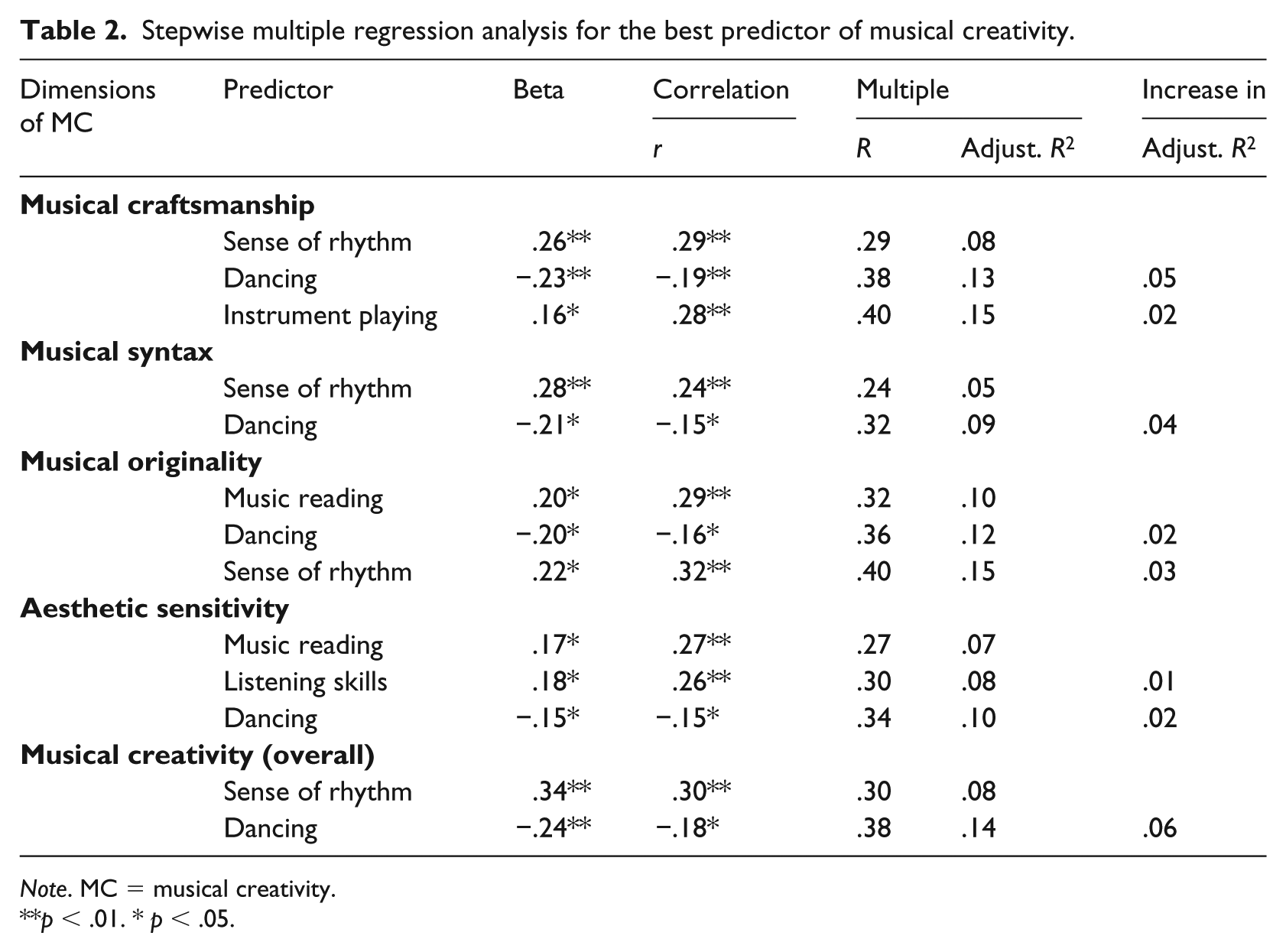
Note. MC = musical creativity.
p < .01. * p < .05.
For the exploratory part of the study, an independent-samples t-test was computed to compare musical creativity between males and females. A significant gender difference t(93.5) = 4.3, p < .01 in musical creativity was observed, in favor of males. However, there was no significant difference in participants’ musical creativity based on age.
Discussion and conclusion
The main objective of this study was to determine the relationships between musical self-concept and musical creativity. The findings revealed a significant positive correlation between musical self-concept and musical creativity. All the dimensions of musical self-concept, except singing, had significant relations with musical creativity. Whereas instrument playing, music reading, composition, listening skills, sense of rhythm and global musical self-concepts correlated positively with musical creativity, dancing correlated negatively. Further analysis indicated that participants with positive musical self-concept attained significantly higher musical creativity than their counterparts with negative musical self-concept. These findings implied that as musical self-concept scores increase, so do musical creativity scores. Therefore, students with high musical self-concept are likely to attain high levels of musical creativity. In contrast, those with low musical self-concept are likely to attain low levels of musical creativity. This was supported by the finding that participants with positive musical self-concept also achieved higher musical creativity relative to those with negative musical self-concept. The study findings were consistent with the principle held in earlier studies that positive musical self-concept is favorable in creative achievement circumstances. For instance, Hallam (2002) suggests that students with positive musical self-concept are intrinsically motivated to pursue music learning activities and practices, which are seen to be important determinants of the level of expertise attained in music. Similarly, Demorest et al. (2017) conclude that there is a significant relationship between students’ musical self-concept and their singing ability. Similarly, Franco (2006) reports a significant relationship between self-concept and pupils’ levels of creativity. The study also corroborated Laycock’s (1992) study which reveals a strong relationship between musical self-concept and musical creativity. Similar findings are reported by Schmidt (2005) that musical self-concept strongly correlates with instrumental performance creativity.
Based on these results, positive musical self-concept tends to enhance students’ musical creativity. Therefore, music educators should create conducive environments for the development of positive musical self-concept to enhance musical creativity among music students. Establishing music recital programs may provide for musical self-expression through performing, composition and improvisation. Such opportunities might create a sense of accomplishment, and build confidence and competence among music students. Active engagement with music positively affects creativity (Hallam, 2010). The teacher’s strong belief in learner’s creative potential and overt recognition of their creative acts is crucial for creativity in the music classroom (Barnes, 2009). Music educators should be aware of their possible role in shaping students’ musical self-concept, and how their interactions with students could act to nurture or hinder the development of positive music self-concept. They should focus on enhancing students’ self-confidence by improving musical experiences, providing constructive feedback and encouraging students to be more creative. Additionally, they may adopt learner-centered and discovery learning strategies which emphasize active mental engagement with the creative process.
Moreover, our findings revealed that the correlation between singing self-concept and musical creativity was not significant. In addition, dancing self-concept was negatively correlated with musical creativity. These results were consistent with Vispoel (1994), suggesting that singing and dancing self-concepts are relatively distinct from other musical self-concept dimensions, and contribute less to overall perceptions of music ability. It should be noted that the current study was based on composition creativity, which mainly involves application of music knowledge in music creation. The implication is that dancing and singing self-concepts tap into relatively distinct domains of performing creativity. The various domains of musical creativity comprising composition, performing, improvisation, listening and analysis are distinct constructs and may correlate differently with the musical self-concept dimensions.
The second objective of the study sought to establish the prediction of musical creativity given the eight dimensions of musical self-concept. A significant prediction model for musical creativity was found, sense of rhythm and dancing self-concepts were significant predictors of musical creativity, with sense of rhythm self-concept being the best predictor of participants’ musical creativity relative to other dimensions of musical self-concept. The suggestions that sense of rhythm self-concept may have played a key role in composition creativity supports the notion that knowledge of rhythm is fundamental for musical creativity (Gordon, 1993; Morin, 2002). Based on these results, musical self-concept seems to be an important predictor of musical creativity. Music educators should pay more attention to the development of students’ competence in rhythm and consider it as a key variable in determining students’ composition creativity.
The exploratory part of the study revealed a significant gender difference in musical creativity with males scoring higher than females. These results corroborate the research of Kiehn (2003), which indicates that males scored significantly higher than females in music improvisation creativity. However, Auh (1997) differs by reporting that gender is not significantly related to composition creativity. Similarly, Schmidt (2005) reports a non-significant difference of gender in performing creativity. Future research should look more carefully into gender differences and at possible interventions to help both male and female students accomplish musical self-expression to enhance positive musical self-concept and musical creativity.
The finding that age was not significantly related to musical creativity did not confirm earlier findings by Laycock (1992) who reports that age was significantly correlated to the musical creativity of high school students aged between 15 and 18 years. However, it is important to note that the participants in the current study were all form-four music students, with the majority of the students (75%) falling into the 16–17 years age category. Therefore, a comparison of students at different levels of schooling, for instance among learners in form one to form four, is more likely to yield different results.
The limitations of the current study include the use of self-report measures that have an inherent subjective response bias. Secondly, musical creativity was purely based on composition creativity. Results indicated that sense of rhythm was the best predictor of composition creativity. This raises the question of whether the same trend would be established with other domains of musical creativity. For instance, whether singing, dancing and instrument playing musical self-concepts, which are more allied to performance, would predict performing creativity better. To provide a more comprehensive view of musical creativity, future investigations may wish to consider the relationship between musical self-concept dimensions and other measures of musical creativity such as performing and/or improvisation creativity. In conclusion, the results of this study seem to suggest that musical self-concept is an important socio-cognitive factor of musical creativity. However, the study was limited to secondary school music students, and the results may not be generalizable beyond a secondary school setting. Therefore, caution should be exercised in over-generalizing these results. Future research in this area should extend sampling to include elementary school and college-level music students to enhance generalizability to other levels of education.
