




Abstract
The Ministry of Education of China issued a new document of Music Curriculum Standards in 2011 substituting the old version of 2001. This study aims to investigate how music teachers in China implement and respond to the Curriculum Standards through a questionnaire survey and semi-structured interviews with voluntary teachers. A total of 2206 music teachers from 15 regions/provinces responded to the survey in 2015. Findings reveal that, after a few years of implementation, most teachers found different constraints in implementing the new curriculum. Trained teachers, younger teachers and experienced teachers are more receptive and capable in implementing the curriculum, while rural schools are still in a disadvantaged situation. Most teachers do not understand the concept of music education as aesthetic education. In-service training is found to be insufficient, especially in rural schools. In sum, the current ‘knowledge-centered curriculum’ might need to be redirected to the directions of society-centered and student-centered in order to make a balance.
Background
In 2001, the Ministry of Education, People’s Republic of China, published Music Curriculum Standards of full-time compulsory schooling (Trial) (Ministry of Education, People’s Republic of China, 2001). Ten years later, after further research and discussion, the Ministry published the Music Curriculum Standards of full-time compulsory schooling (2011 edition) (hereafter, ‘Curriculum Standards’). This new edition was developed based on a great many surveys of teachers’ practices, all of which aimed:
to understand the extent to which education had responded in a timely fashion to rapid economic developments in China;
to re-emphasize the basic core values of socialism;
to discover what changes in actual practice had taken place in the 10-year period since 2001;
to answer society’s critiques of, and suggestions based on, the ‘Trial’ version; and
to keep abreast of international music education trends and theories based on research updates (Wang, Wang, & Wu, 2012).
For nearly a century, China has regarded ‘aesthetics’ as the core attribute of music education. In 1999, the Party’s State Department published Thoughts on the deepening of educational reform and the promoting of quality education (Ministry of Education, People’s Republic of China, 1999), which clearly recognized aesthetic education as an essential element of quality education development. As a result, arts education as aesthetic education became a clear direction within education policy, the term ‘aesthetic education’ (Cao, 2000) concurring with Bennett Reimer’s advocacy of music education as aesthetic education (Reimer, 1988). Reimer argued that the value of music education derives from the essence of music itself, in the process emphasizing both its nominal qualities and its impact on students’ emotional development. After visiting China in 1986 and 1998 on an academic exchange, the Chinese versions of two of his books, A philosophy of music education (second edition) (Reimer, 1988) and A philosophy of music education, advancing the vision (third edition) (Reimer, 2003), strongly influenced music education after China’s subsequent reforms and increasing openness to the West. However, that parents’ and school students’ motivations are regarded as ‘utilitarian’ is reflected in a motivation study (Xie & Leung, 2011), and students lose their motivation in learning music when they get older and are facing the challenges of further studies and a career. Thus in their high school study, it was shown that students’ motivation in learning the core subjects, such as Chinese, English and mathematics, is higher than in music, visual arts and physical education. It appears that music might not be valued because it is considered as possessing mere ‘aesthetic’ value when music education is regarded as aesthetic education.
2011 music Curriculum Standards
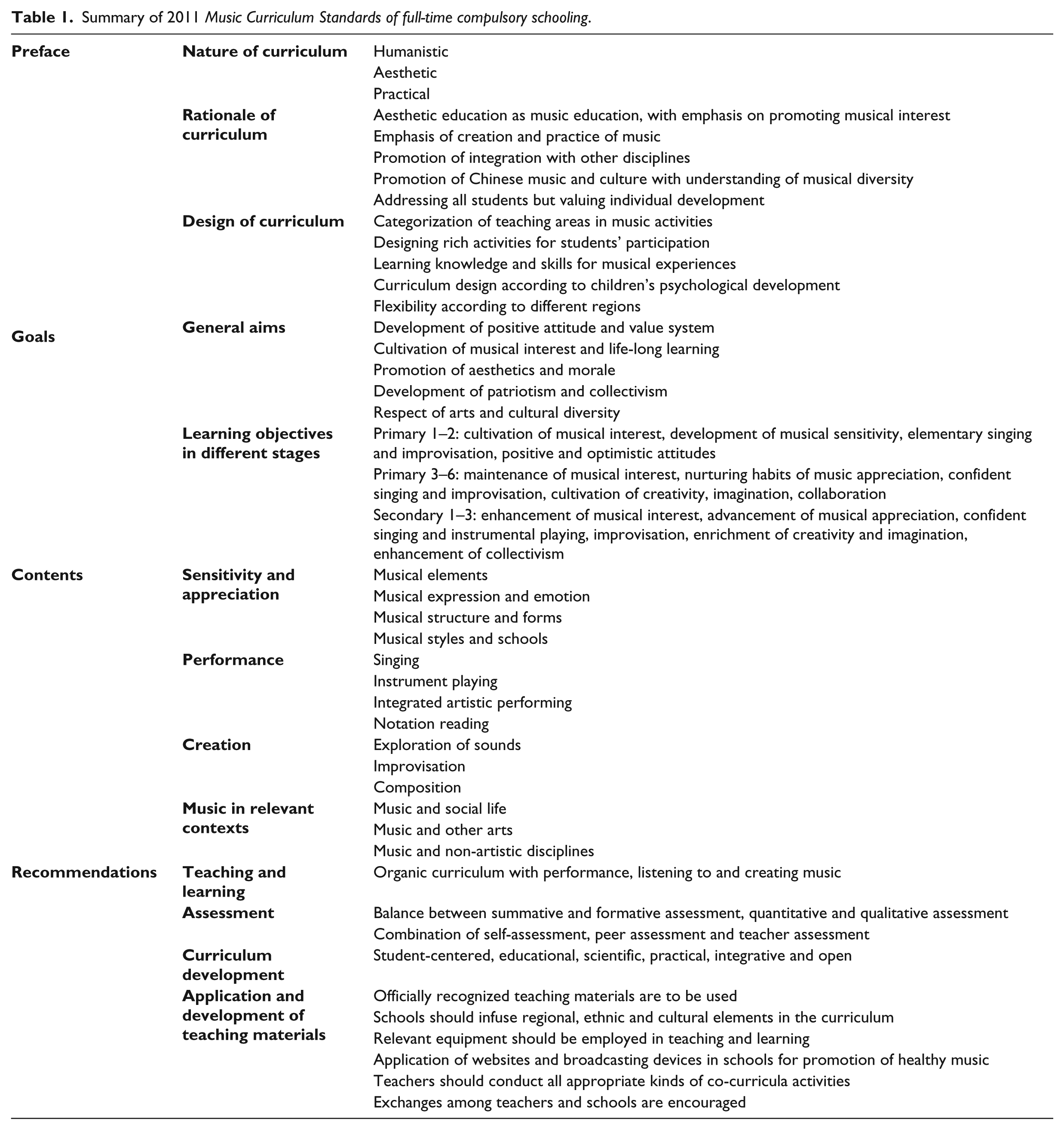
The Curriculum Standards (Ministry of Education, People’s Republic of China, 2011) covers four areas concerned with the school music curriculum: (a) rationale; (b) aims and goals; (c) content; and (d) recommendations for implementation. In terms of rationale, it is stated that aesthetic education should be at the core of school music education; teachers should raise the interest of students in learning music through music activities and creation. It advocates that music should be integrated with other disciplines for learning, including poetry, dance, theatre and media. Chinese culture should be emphasized through music education for national education and patriotism.
The overall aims include nurturing the holistic personal development of students, learning basic music knowledge and skills, and the cultivation of positive attitudes and wellbeing. Furthermore, the Curriculum Standards covers three stages of learning for the nine years of compulsory education: Stage 1: primary 1–2; Stage 2: primary 3–6; and Stage 3: secondary 1–3. Stage 1 emphasizes imitation and nurturing the curiosity of children in learning music. In Stage 2, instrumental music experiences are to be added, in addition to singing, with an introduction to the simple creation of music. Stage 3 is the time to further develop students’ creative thinking and imagination with humanistic learning experiences.
Four content areas are stated in the document, namely: (a) appreciation, which includes music and emotion, genres and forms, as well as musical styles and schools; (b) performance, including singing, instrument playing, integrated performance, and notation reading; (c) creation, including sound exploration, composing and improvising; and (d) music and culture, which comprises music and social life, music and other art forms, and music and non-art disciplines. At each stage, some concrete expectations are listed. For instance, in Stage 1, students should be able to appreciate and describe changes to dynamics and tempi, and respond to duple and triple meters. Students in Stage 3 should be able to use their voices, musical instruments and other sound sources to express specific expressions and depict scenes.
Recommendations for teaching and assessment include some general principles for music education, which are globally recognized. For example, the ability to listen is regarded as the core element in order to prepare students for all kinds of musical activities; practical music activities are preferred; and implementation of the curriculum should be undertaken with reference to the learning context. For comments and assessment, suggestions include striking a balance between formative and summative, qualitative and quantitative, and between self-assessment, peer assessment and teacher assessment. Table 1 summarizes the content of the updated Curriculum Standards.
Summary of 2011 Music Curriculum Standards of full-time compulsory schooling.
Curriculum theories
With reference to the curriculum studies literature, the Curriculum Standards may be reviewed in a holistic manner. To that end, Morris (1998) provides a framework for the benefit of curriculum designers and teachers, of which intention, content, teaching method and assessment are the four basic components. However, how to plan a curriculum, how to arrange a curriculum and whether it works and how to improve it all need to be viewed from a technical standpoint. Furthermore, the curriculum is subject to a number of social and political considerations. These include identities of the decision-makers, the implementation of their decisions, other influences on the curriculum, and future priorities.
Curriculum studies focuses on three main points, namely: the nature of the subject matter, the nature of society and the nature of the individual (Marsh & Willis, 2003). These categorizations can be regarded as another theoretical framework for further understanding the music curriculum in China. A curriculum that focuses on subject matter from different academic disciplines based on an organized scope and sequence can be considered as a knowledge-centered curriculum (Ellis, 2004). McNeil (2015) considered this an ‘academic curriculum’, the primary goal of which is to use the organizational structure of knowledge to nurture a rational mind.
A curriculum that responds to social needs is regarded as a society-centered curriculum, the focus being on the search for social relevance and education for citizenship (Ellis, 2004). According to McNeil’s (2015) categorization, it is named the social reconstructionist curriculum, which should address the universal and widespread issues in the curriculum.
A curriculum that concerns itself with the needs of the individual, for example, personal growth and interests, with the emphasis on affect (Ellis, 2004), is regarded as a learner-centered curriculum. Humanists perceive the function of the curriculum to be the facilitation of self-actualization, with teachers acting in order to provide a suitable environment for learning (McNeil, 2015).
The Curriculum Standards is considered to possess elements of both learner-centered curriculum and knowledge-centered curriculum. The main goal of the Curriculum Standards is to nurture students’ musical interests and competences, attitudes and value system, and cultural awareness. On the other hand, music appreciation, performance, creation of music as well as music in contexts are identified as the four content areas, which are globally recognized areas in music curricula.
Aim of the study
The new Curriculum Standards as a program document proposes a list of core teaching philosophies, content, assessment methods and expectations for teachers’ reference. Since guidelines for actual implementation are insufficient, teachers need to study it prior to its practical adaptation. This study aims to investigate music teachers’ understanding of this curriculum and their transfer from knowledge to actual teaching practices. Information sought included the status of music teachers, offerings of music classes, the provision of training within the curriculum following the publication of the new curriculum, teachers’ understanding and implementation of ‘aesthetics as a core philosophy’ and their evaluation of the Curriculum Standards document as a whole. The following research questions guided the whole study: (a) to what extent do music teachers in China understand the 2011 music Curriculum Standards? (b) How does the provision of music in schools reflect the implementation of the 2011 music Curriculum Standards?
The first author is an editor of an influential music publisher issuing music textbooks in Beijing, while the second author is an academic in music education. It was the original aim of the first author to investigate the feedback of music teachers in China on the 2011 Curriculum Standards and the current situation of music teaching in schools after the issue of the updated Curriculum Standards.
Methodology
To understand the actual application of the new curriculum, we conducted a questionnaire survey in 2015. A total of 2206 music teachers from 15 cities/provinces covering Beijing, Shanghai, Tianjin, Hubei, Guizhou, Sichuan, Jilin, Liaonin, Fujian, Anhui, Zhejiang, Guangdong, Shanxi, Shaanxi and Hebei responded. The places and the individuals surveyed included developed municipalities, coastal provinces and less developed provinces, as well as teachers from city schools and rural schools. Geographically, the survey covered eastern, middle, southern, western and northern regions of China.
The questionnaire covered four areas: (a) demographics (gender, education, teaching experience, weekly class hours and class levels); (b) the school-based music curriculum (including ratios of music class offerings, performance classes and music assessment); (c) implementation and monitoring of the new music curriculum; and (d) open-ended comments, including factors affecting the application of the new music curriculum and other recommendations. Apart from demographics, the other three sections were constructed in connection with the Curriculum Standards. A small-scale pilot study was implemented, in which two music teachers in Beijing reviewed the questionnaire. Both of them agreed that they fully understood the questionnaire with no recommendations for revision. The questionnaire was designed based on a seven-point semantic differential scale and analyzed using SPSS 22. Descriptive and inferential statistics were employed in analyzing the data.
Following the survey, primary and secondary school music teachers were voluntarily invited to participate in interviews pertaining to the topic of applying the music curriculum in real classes with an aim of better understanding its overall usage, as well as answering questions aimed at developing a greater understanding of teacher training situations and the current state of music education in rural schools. For more in-depth understanding the first author also invited four teachers to participate in a semi-structured interview (Bogdan & Biklen, 1992). After the interviews, however, one of them asked the first author not to disclose his/her opinions even though all the interviewees were informed that their names would not be exposed to the public. Thus, this article reports the interviews of three teachers. The interviews were audiotaped with authorization of the interviewees. The sound recordings were transcribed into Chinese with the second author’s review and validation in order to maintain high credibility in terms of investigator triangulation (Cohen, Manion, & Morrison, 2011). The transcripts were then sent to the teachers for their verification and then analyzed using meaning coding with a number of keywords derived from the Curriculum Standards, including learning and teaching quality, difficulties and provision for music to formulate categorizations (Kvale & Brinkmann, 2009). In addition, these were found to be highly relevant to the findings of the questionnaire survey in terms of how teachers implement their school-based curriculum. Nevertheless, due to the limited samples of interview, the findings from the interviews should not be generalized but for reference.
The ethical issues were fully considered before and after the implementation of the study. Before the study, an invitation letter was sent to all the participating schools and teachers to inform them about the aims and content of the study. The names of all participating schools and teachers were hidden in order to protect their privacy. Teachers were assured that they were free to quit the study for any reason at any time.
Results
Demographics
Most of the respondents (>80%) were young to middle-aged female teachers. However, their teaching experiences tended to be rather long, reflecting their stable appointment. There were more primary than secondary school teachers. In terms of their weekly teaching load, half of them taught six to 15 lessons. The majority of teachers were university graduates. However, it was found that all teachers were qualified, as the minimum qualification of the responding teachers was as a graduate from college, which is a sub-degree qualification. In China, all teachers in primary and secondary schools are specialists with a major in their teaching subject (Ge, 2006). Table 2 summarizes the above with specific figures.
Demographic data (N=2206).

Current situation of music classes and teachers
In general, Chinese schools can be categorized into three types: (a) key schools; (b) common schools; and (c) rural schools. Key schools refers to those institutions whose teachers hold better qualifications and possess more resources and facilities, and which enjoy a higher rate of enrollment to universities compared with common schools. Rural schools are located in areas that may face different difficulties, including a lack of both resources and qualified teachers. Of the school types surveyed, common schools represented the majority (83.2%), while key schools and rural schools accounted for 10.8% and 6%, respectively. With regard to the training of teachers for the new curriculum, 57.1% of the respondents reported having received training, while 42.9% claimed to have received none. Nearly half of the teachers surveyed had not received any relevant training, despite four years having elapsed since the new Curriculum Standards was published.
Offer of music classes by school type
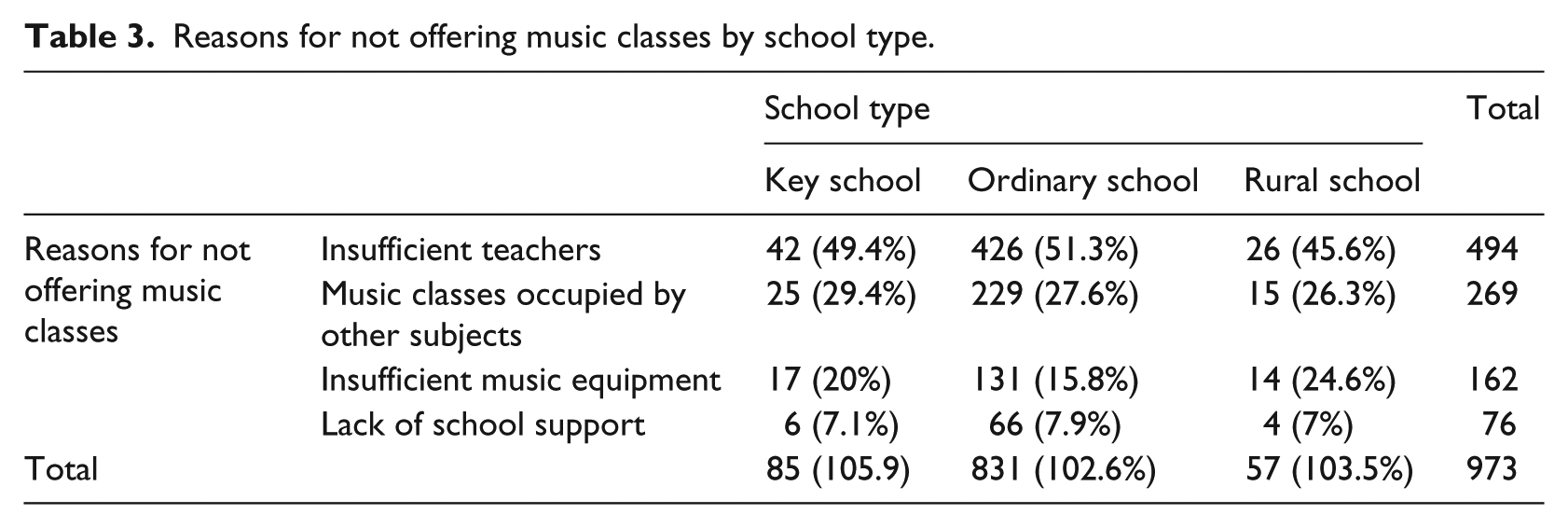
Four choices were provided for the question about the reasons affecting the provision of music classes in the questionnaire: (a) availability of qualified music teachers; (b) the degree to which other subjects overrode the class music schedule; (c) the availability of teaching equipment; and (d) the degree of school support. The results indicated that half (51%) of the schools could not provide music classes due to an insufficient number of music teachers, 27.5% were unable to operate as a result of the music class schedule being taken over by other subjects, 16.6 % suffered from a lack of teaching equipment and 7.8% reflected an absence of school support.
In those instances where no music classes were offered, teachers were asked if this was a feature of all school types or only those in remote areas. Clarification of this issue might help policy makers better understand the actual scenarios and respond accordingly. Surprisingly, among those key schools that took part in the survey, 49.4% of them did not have sufficient numbers of music teachers, thereby negating the impression that key schools were usually better equipped and more resourceful. Table 3 shows that music classes were taken over by other subjects in key schools (29.4%), and that rural schools (24.6%) were the least equipped.
Reasons for not offering music classes by school type.
Teachers’ understanding of ‘aesthetics as a core philosophy of music education’ and difficulties encountered in teaching
The Curriculum Standards heavily emphasizes aesthetics education. As stated in the document, ‘Music education fosters students’ ability in sensibility, expression, appreciation, and creation; subsequently shapes up characters, develops self-awareness, enlightens and enriches imagery thinking, stimulates creativity, so to fully elevate students’ inner quality’ (Ministry of Education, People’s Republic of China, 2011, p. 2). Since ‘aesthetics’, as in ‘aesthetics as a core philosophy’, is an abstract concept, teachers’ understanding may directly affect their teaching philosophy and practices. As a result, we used a seven-point Likert scale for two questions in the questionnaire. Question 1 asked about how well teachers understood the philosophy of ‘aesthetics as a core philosophy’; Question 2 asked about the difficulties in applying this philosophy in real-life music teaching situations. With a mean score of 5.36 (SD=1.373), the results demonstrated that teachers’ understanding of the philosophy was higher than its application.
How curriculum training affects understanding of philosophy and application
The author used an independent t-test to examine the differences between those teachers who had been formally trained in the curriculum and those who had not. The results showed that trained teachers understood ‘aesthetics’ significantly better (M=5.48) than those without the benefit of training (M=5.21) (p<.001). Moreover, trained teachers reported that they found it significantly less difficult to apply the philosophy (M=4.39) than those who had not been trained (M=4.67) (p<.001). The Double Logistic Regression Method was also used to analyze the influence of curriculum training: the p-value was found at p=.028, and the level of significance of application difficulty p=.001. Proper training was therefore deemed to have had a measurable impact on both teachers’ understanding of the curriculum and its actual application. Table 4 summarizes the results.
How curriculum training affects understanding of aesthetic philosophy and application difficulty.

Difficulty and feasibility of the curriculum in actual music teaching
After four years of practice, teachers in general thought that the curriculum performed appropriately in terms of the degree to which it conformed to students’ ages and psychological development. The survey results revealed that the mean difficulty level was 4.83, which is intermediate. The feasibility of delivering the curriculum in actual music classes was M=5.03, which is regarded as positive.
Teachers’ understanding of the new edition
We specifically surveyed a few word changes in the new edition: these largely concerned the use of action verbs such as ‘grasp’, ‘understand’, ‘familiarize’ and ‘learn’. The general level of comprehension was recorded at 5.26, although that for changing ‘appreciate’ to ‘enjoy’ was 5.23. Despite the fact that the main difference in terms of the requirement for ‘composition’ was reflected in a change of words from ‘improvisation’ (old version) to ‘improvised adaptation’ (new edition), a score of only 4.75 was recorded, suggesting that teachers had not really benefitted from the change. Table 5 summarizes the results.
Teachers’ understanding of the new edition.

Teachers’ views on how the new curriculum affects students
The degree to which the new curriculum has helped raise students’ abilities in score reading, composition, appreciation, singing and performing is considered here. The mean score as it pertains to the first of these was 4.61; composition registered 4.50, with 4.92 for appreciation and 4.96 for singing. Since some schools did not offer performance classes, based on the 1778 returns collected the mean for performing skills was 4.46. That said, the new edition of the curriculum carried a certain extent of effect in terms of raising students’ musicality, but not so much in strengthening composition and performance training. Table 6 summarizes the findings.
Teachers’ views on how the new curriculum affects students.

One-way analysis of variance (ANOVA) was used to further investigate the relationship between the new curriculum and teachers. The relationship between the three variables – that is, teachers’ application of the new curriculum, teachers’ satisfaction and teachers’ evaluation of the effects of the new curriculum – and teachers’ ages, their academic backgrounds, school type, classroom hours, teaching experience and salary was analyzed. As shown in Table 7, the only factor that failed to have a significant effect on the relationship between the new curriculum and teachers was their academic background.
Results of one-way analysis of variance.

According to a post-ANOVA review (pairwise comparison), teaching experience mattered the most in terms of the actual implementation of the new curriculum. Age was the second-ranked factor, especially for those between 36 and 50 years; teachers who were under 35 years old and those over 50 years old seemed to find the curriculum less applicable. Teachers’ ages and their satisfaction with the new curriculum seemed to be inversely proportional: the younger the teacher, the higher their satisfaction was rated, and vice versa. When it came to ‘its effect on students’, teachers’ age ranges also reflected wide differences. Younger teachers thought that the impact on music learning of the new curriculum would be substantial, while older teachers thought the opposite. Figure 1 demonstrates how teachers’ ages were related to the three variables.
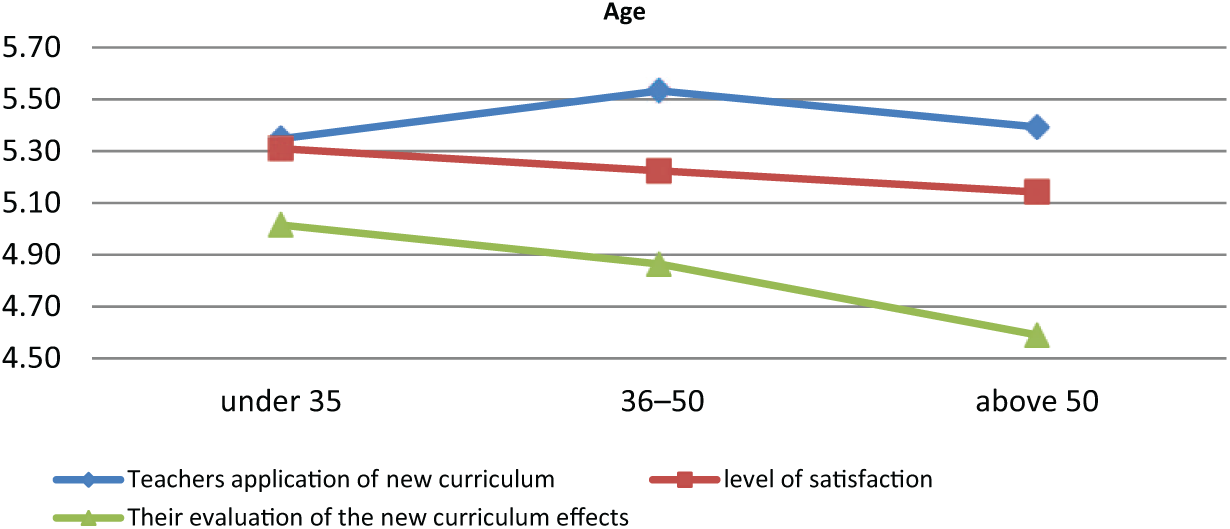
Teachers’ ages related to the three variables.
From the perspective of classroom hours, teachers managed to apply the curriculum to real-life teaching better when these did not exceed 25 a week. Beyond that, the rate of application dropped to its lowest point, as did the level of satisfaction, even though the teachers simultaneously believed the new curriculum was at its most effective (M=5.40). Levels of satisfaction were at their highest when classroom hours were set below five per week; although they likewise thought that the curriculum would have limited impact for the same reason (see Figure 2).

Classroom hours related to the three variables.
Pairwise comparison revealed that the application of the new curriculum was in direct proportion to teaching experience. Teachers with more than 16 years of experience differed significantly (p<.001; p<.001) compared with more experienced and less experienced teachers, respectively. Teachers with less than five years of teaching experience rated the highest level of satisfaction (M=5.36). They believed that the curriculum would be more effective (M=5.06) than those who either had around six to 15 years of teaching experience or more than 16 years of teaching experience. The means of the latter two groups were M=5.23 and M=5.26, respectively. They both believed that the curriculum had had relatively less impact on students. Figure 3 shows the variables.
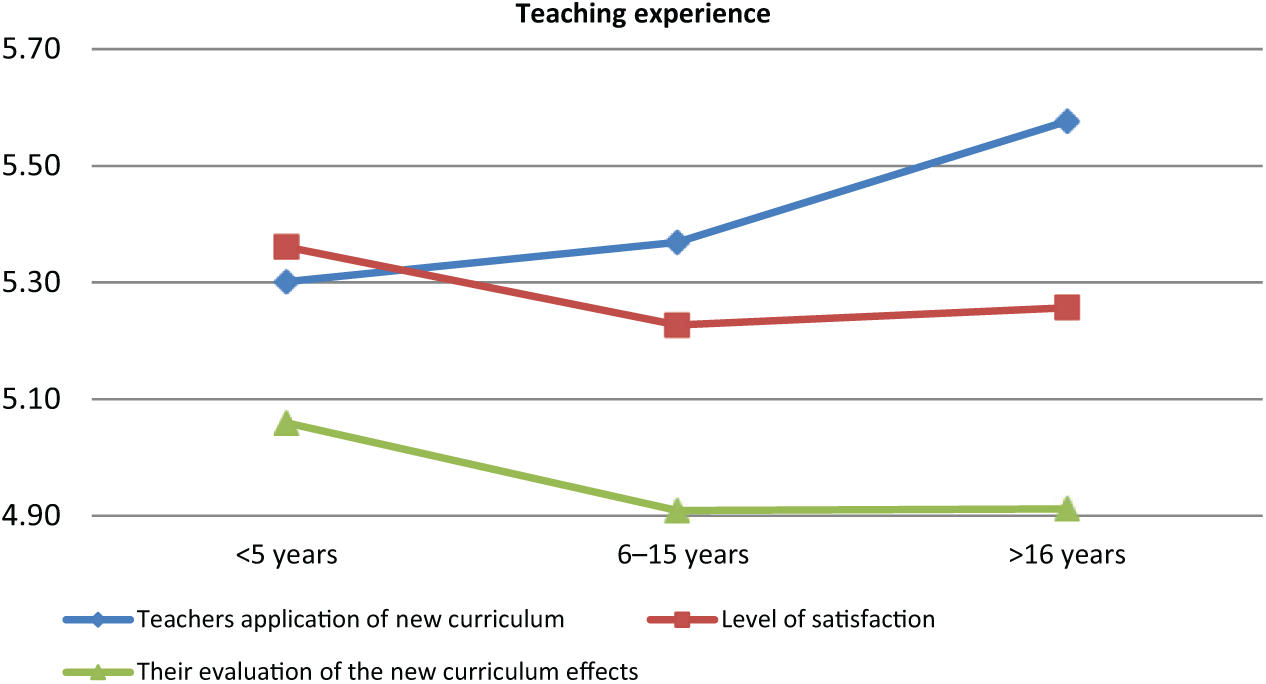
Teaching experience related to the three variables.
Pairwise comparison also revealed that whether teachers were trained to teach the new curriculum was significant in determining the level of teachers’ application of new curriculum (p<.000), level of satisfaction (p<.000) and teachers’ evaluation of new curriculum effects (p<.000). Trained teachers appeared to be significant more positive in applying the new curriculum, maintaining a high level of satisfaction, and evaluating the new curriculum. Figure 4 shows the variables.
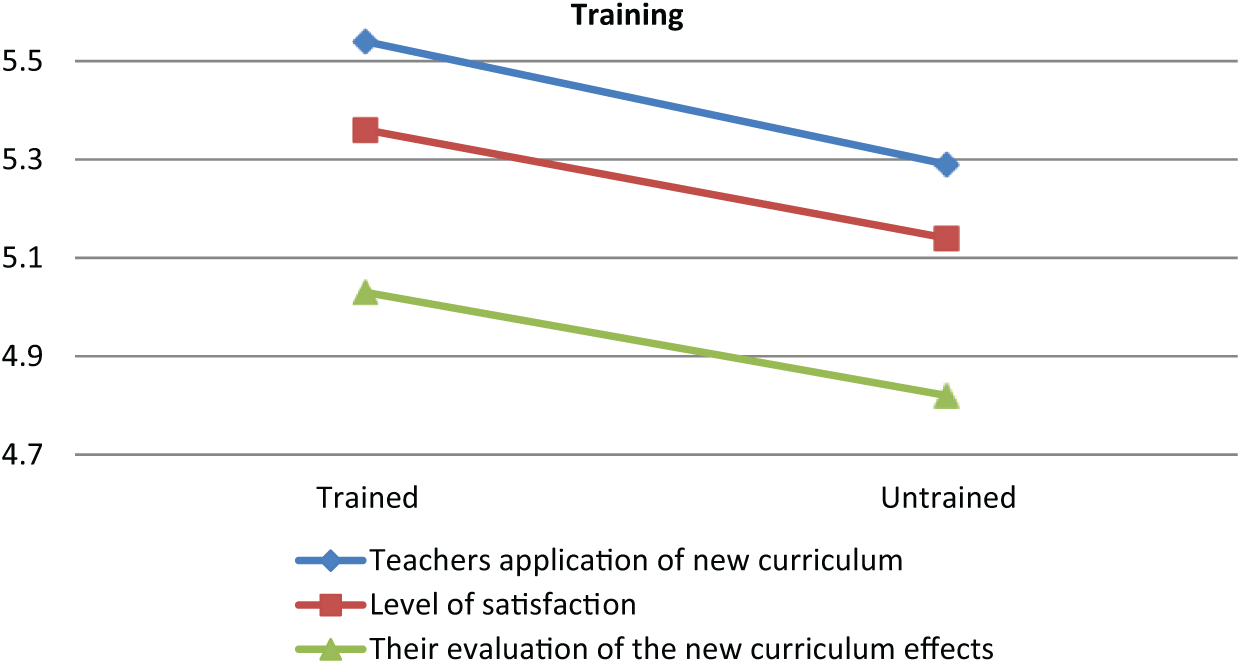
Training related to the three variables.
Factors affecting implementation of the new curriculum
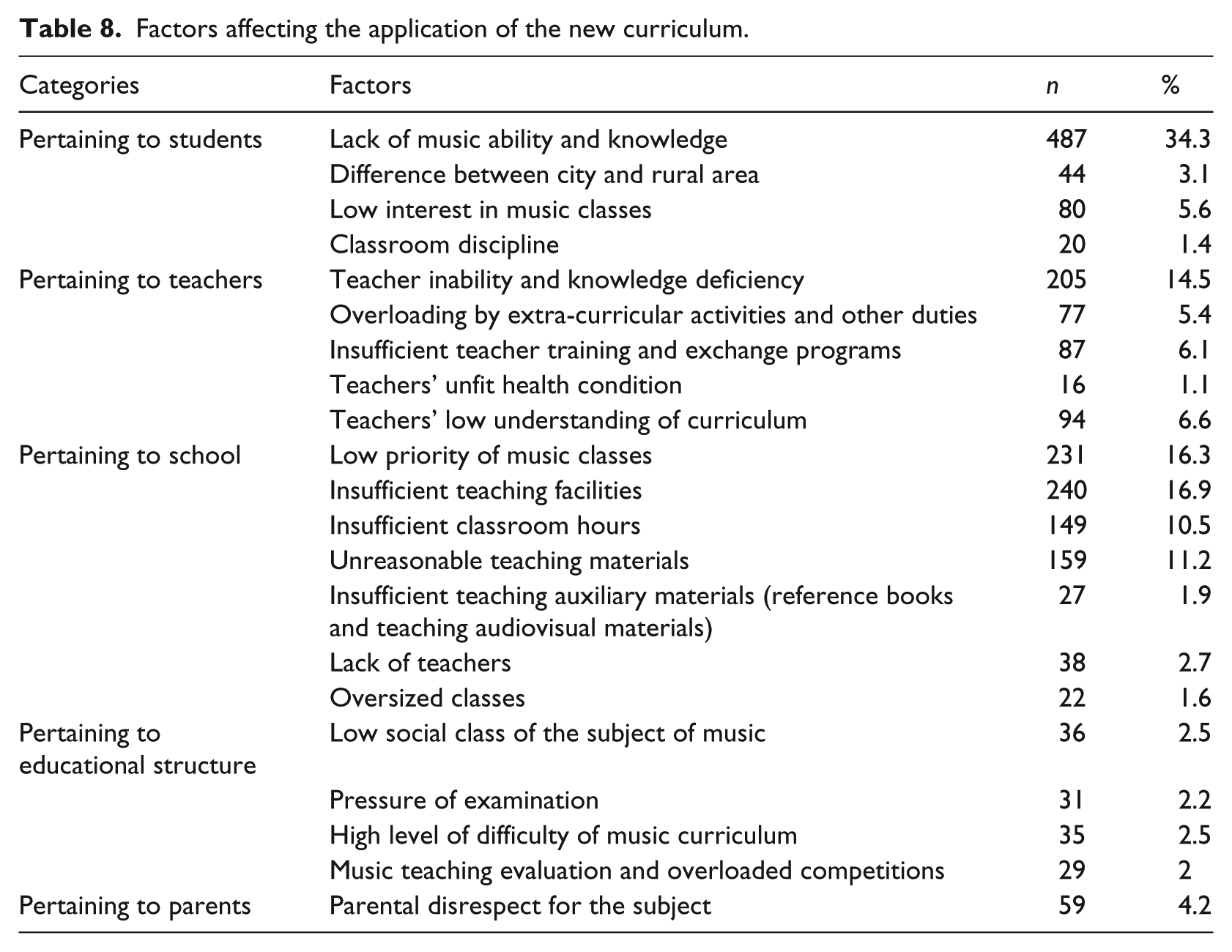
In the last part of the survey, we inserted two open-ended questions. In relation to the first, ‘What factors would affect your application of the curriculum?’, a total of 1418 teachers replied. Of the 21 choices given, teachers thought the predominant factor was the ‘student’s ability and quality’ (34.3%), followed by ‘school’s facilities and equipment’ (16.9%); the third was the extent to which music was prioritized within the school (16.3%), while the ‘teacher’s ability and teaching philosophy’ ranked fourth (14.5%).
The first three factors were categorized as extrinsic factors and the fourth an intrinsic factor. That being said, teachers generally thought that factors supporting the application of the new curriculum in schools were subject to external conditions, as opposed to being affected by the teachers themselves. There is no doubt that teachers, as organizers and leaders in school education, as well as being responsible for designing teaching directives, content, methodologies and formats, play a dominant role in the entire process. Objective conditions that allow them to perform these roles should be secured. If regular music classes are disrupted due to social factors, school problems or unreasonable curriculum design, or because of a lack of professional guidance, this can adversely affect teachers’ performance. All existing problems that teachers face should therefore be considered, as well as bearing in mind the relevant conditions and dialectics. Table 8 summarizes the factors affecting the application of the new curriculum.
Factors affecting the application of the new curriculum.
Teachers’ recommendations regarding the new Curriculum Standards
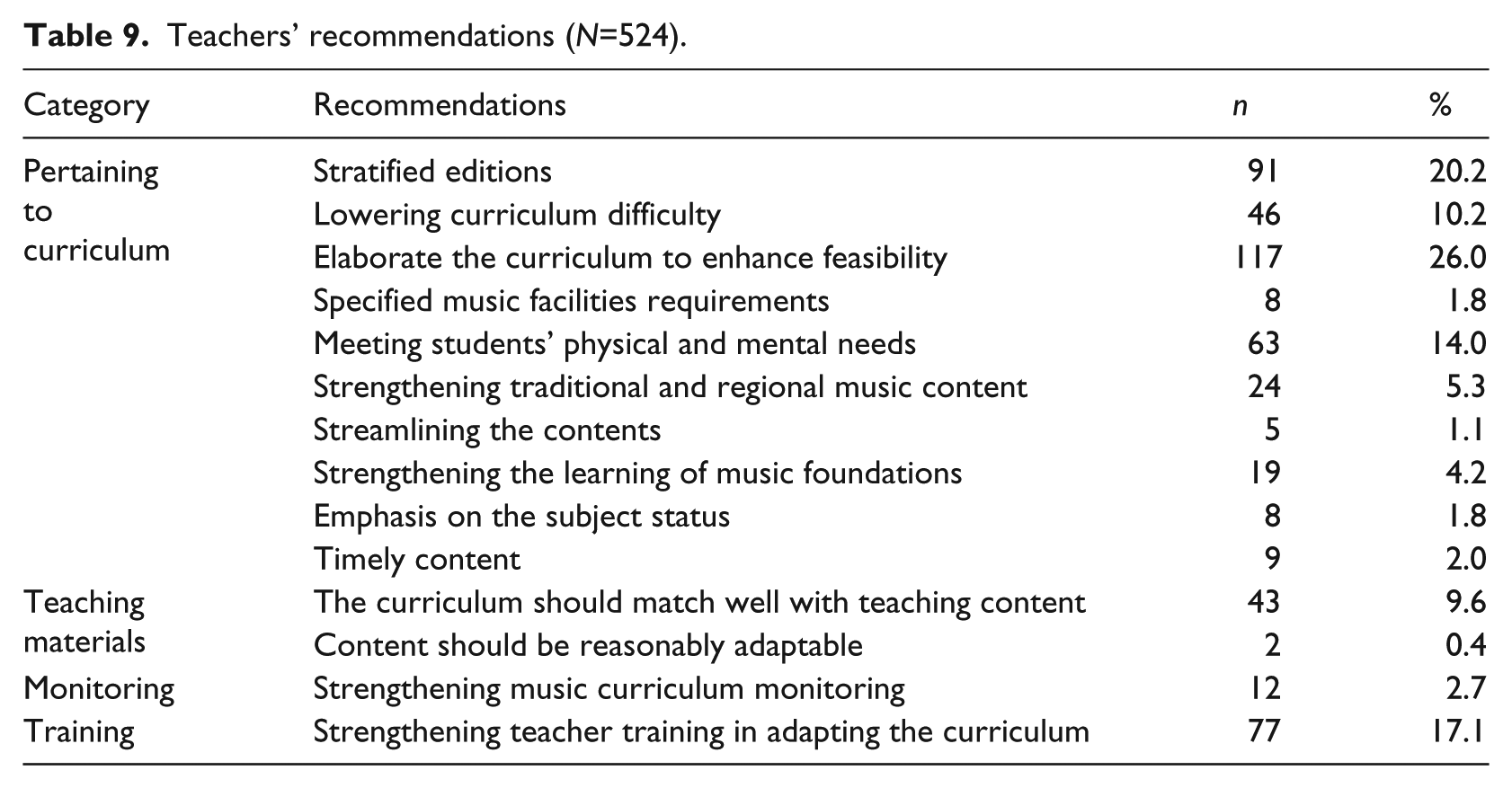
The second question asked for ‘comments on the curriculum’. Only 450 responses out of all questionnaires were collected, of which 14 comments were summarized. Major issues included: (a) the need for a concrete and elaborate new curriculum that enhances feasibility (26%); (b) the importance of a stratified edition (20.2%); and (c) the requirement of training for the new curriculum (17.1%). Table 9 summarizes the results.
Teachers’ recommendations (N=524).
Interview findings
Individual semi-structured interviews were conducted with three teachers. The findings revealed some specific issues related to the implementation of the music curriculum. Due to the limited supply of professional music teachers, many rural schools hired only part-time music teachers for their music classes, which affected the teaching and learning quality.
There are almost no music teachers in the entire province, so no exchange of the subject as such at all. Little research and exchange on professional music education was ever organized. I can only learn the curriculum myself and the result is limited. Despite good music curriculum, if [teachers have] no ability, it means nothing. Teachers are hired on a part-time basis; there is no systematic training, no research activities, no music ability tests for the teachers. All they need to get by is the three evaluations on their teaching annually. To most frontline music teachers, what is the purpose of the Curriculum Standards? Some rural school teachers, who have little outreach and training opportunities, do not even know about the existence of the new music Curriculum Standards.
The quality and quantity of music education between rural and urban schools were largely different; significant effects were discovered when the standardized music curriculum was initiated and implemented. In rural schools, students were in a disadvantageous situation, which hindered their learning, while music teachers were not only poorly equipped with sufficient knowledge and skills, but also faced limited resources.
I am teaching in a rural school of my home province. I think it is difficult to implement what the new music curriculum [standards] sets out in an underdeveloped rural area. Music education is quite behind and it is difficult to carry out music education in the next few years. The new music curriculum standards are quite demanding to both teachers and students… It is difficult for them to follow the new music curriculum. For example, teachers would have to teach many music basics prior to introduce the idea of music arrangement and improvisation, and this seems impossible to do. The music curriculum also suggested to apply an integrated artistic approach to design and create artistic activities in class. Perhaps there might be one or two talented individuals, but in general, this is quite unachievable in rural schools at large. (Rural school teacher) Schools do not respect music teachers… Most rural schools have only one music teacher. There are no collective efforts of class preparation, no research activities, no monitoring or supervising. There is not even a chance for discussion or advice seeking when the music teacher encounters teaching problems. As time goes by, slackness defeats the purpose of new curriculum. In addition, the lack of support and respect from the school and parents actually affect how music teachers teach in accordance with the curriculum. (Rural school teacher)
Teachers in urban schools faced other kinds of difficulties, including an academic-oriented atmosphere, a utilitarian perspective on the part of principals, and parents who sought fame for the school through competitions.
Academic scores of cultural studies are quite heavily rated. Everything is judged upon marks. Discussion on arts education and reform seem impractical. Teachers, leaders, parents do not support one another. Education departments only sent out instructions or offered observations, so the effects of music reform is minimal. Moreover, there are far too many music activities and competitions. Teachers are occupied by rehearsals that would seriously affect the actual execution of regular music classes. Dance festivals, music festivals, choral festivals, drama festivals, New Year performance showcase, quality enhancement games; as well as all kinds of governmental or departmental performances and duties, many music classes are cancelled. The actual music class time is countable when teachers were always engaged in rehearsals, performances or on trips. (Urban school teacher)
Discussion
This study aimed to investigate music teachers’ understanding of the new curriculum and their transfer from knowledge to actual teaching. In summary, the Curriculum Standards, to a certain extent, has followed international music education trends, with an emphasis on practical music experiences at their core, supported by a balance among the areas of listening, performing, creating music and music in contexts, as well as considering creativity and different assessment methods. However, music teachers in China face different constraints when implementing the new curriculum, including a misunderstanding and ignorance of the notion of ‘aesthetics’, a situation compounded by a lack of updated and relevant in-service training and the frequently disadvantaged status of music as a subject within schools (rural schools in particular), together reinforced by an absence of concrete guidelines and assessment rubrics on the part of the curriculum document itself.
Orientation of the music curriculum in China
The Curriculum Standards is regarded as the official music curriculum for schools in China. The document has, to a certain extent, addressed the four basic elements of a curriculum suggested by Morris (1998), that is, intentions (or aims), content, teaching methods, and assessment. However, it does not consider either how to plan or arrange the curriculum, or whether the curriculum works and, if not, how it should be improved. Furthermore, we can further review the Curriculum Standards using the categorization of curriculum by Marsh and Willis (2003) focusing on subject content, society and individuals. The tendency of the Curriculum Standards is towards the promotion of knowledge, with a focus on the subject matter (Ellis, 2004), on the aesthetics of music education. In such a setting, traditional Chinese education practices, which refer to a teacher-centered, top-down mode of curriculum and teaching practice (Offutt, 2013), run the risk of being reinforced, with music teaching and learning becoming a teacher-centered exercise while the students operate merely as passive ‘recipients’. To improve the situation, teachers and curriculum planners may have to develop the concepts of the ‘learner-centered curriculum’ and ‘society-centered curriculum’ (Ellis, 2004). In a learner-centered curriculum, students’ interest is first addressed and considered, with inquiry as the basic learning method. In order to achieve this, the environment should be open, with teachers acting as facilitators. In the society-centered curriculum, students work in groups in cooperation with the real world in a kind of ‘learning laboratory’. Teachers involve students in problem-solving situations, while assessments require the application of knowledge and skills. In general, a balance between the knowledge-centered, learner-centered and society-centered curriculum should be sought as a means of further improving the existing document.
Practicing music aesthetics
Reimer’s philosophy of music education as aesthetic education was adopted by the Chinese government after his visit to China in the 1980s (Reimer, 1989). This article deliberately avoids confronting many of the controversies surrounding aesthetics in music education, such as the debate between Reimer (1988) and Elliott (1995). Nevertheless, the use of expressions such as ‘using aesthetics as a core philosophy’, helping teachers practice ‘music aesthetics in education’, and directives to integrate the philosophy in regular classes are issues which, as a result of the difficulties involved in their application, assume a sense of urgency. The Curriculum Standards may be regarded as serving as an introduction to the philosophy, as opposed to offering any advanced pedagogy for its inclusion; certainly, teachers’ diverse backgrounds and experiences mean that they will invariably possess their own unique understanding and interpretation of aesthetics, together with their own individual teaching methods. Nevertheless, for most primary and secondary music teachers, such abstract written expressions run the risk of failing to improve their general practices. The Curriculum Standards should provide more details regarding how to apply aesthetics as a core philosophy, and design relevant evaluation rubrics to make it a more feasible proposition.
Insufficient continuous and relevant in-service training
A prerequisite to carrying out any education reforms is the provision of sufficient and relevant in-service training for teachers (Bakah, Voogt, & Pieters, 2012; Defise, 2013). In-service training is intended to raise the quality of teaching, minimize the gap between city and rural schools and promote the balance of education. However, findings from the study revealed that almost half of the teachers had not received any in-service training for implementing the new curriculum standards. Actually, after the 2011 edition was published, the Ministry of Education hosted a few training programs for key teachers at the national level. The first author took part in one of these ‘national training programs’ in the same year. The program consisted of six modules: Goals, Singing, Music Creation, Appreciation, Performance and Evaluation. Participating key teachers, that is, those who would become trainers of peer teachers in their home regions, were trained via an interactive, online, question-and-answer format. Apart from the national training programs, there were also irregular provincial training programs at different scales, where experts were invited to share their views on the curriculum. Despite these efforts, it would appear from this study that not only were these training programs felt to be ineffective, since they only indirectly reached the school teachers, especially in rural areas, but it is also questionable whether or not such educators possess the skills to subsequently train their colleagues effectively.
Status of music in schools
A lack of sufficiently well trained music teachers, allied to unsatisfactory levels of in-service training, are indicative of the low status that music currently occupies in Chinese schools. More resources are instead routinely used on teacher training for academic subjects including Chinese, mathematics and English, as well as training for principals. The actual amount that is spent on music teacher training reflects the utilitarian view that music is not as useful as those academic subjects, a feeling which may, in turn, impact on students’ perceptions. Research has revealed that students in China tend to have significantly lower task values of music compared with the core subjects, and that their expectancy in learning music declines as their perceived difficulties rise across the school levels (Xie & Leung, 2011). However, the same study also showed that students’ interest in learning music tends to rise across the school levels, a phenomenon that suggests students like music but that their development is restricted by the discouraging school environment.
If the arts are to be valued by both society and school stakeholders, teachers may need to commit to their advocacy as a means of nurturing students’ generic skills (Ghazali & Bennett, 2017). At present, the Curriculum Standards simply stresses creativity, which is far from satisfactory. In fact, not only is creativity not well explained in the document, but also other important generic skills, such as critical thinking, communication skills, collaborative skills and self-management skills, are missing. Learning music in schools in China remains focused on merely developing students’ aesthetics; this is the main attribute to the current situation that learning music in schools is inadequately valued by Chinese society, in which Chinese people tend to think that learning music may prepare for a music career only. In other words, Chinese people may not consider sufficiently the Theory of Learning Transfer, in which learning could be transferred from one context to another (see Hutchins & Leberman, 2015; Macaulay & Cree, 2007).
Disadvantages among rural schools
In China, difficulties for arts education among rural schools have long been an unresolved situation (Sun & Leung, 2014). Due to living hardships, low income rates and a lack of teaching facilities, many schools may only guarantee to offer core-subject classes, such as Chinese and mathematics. From October 2007 to February 2008, the Ministry of Education conducted a survey on arts education in rural schools; the results showed that the class-offering rate for music and art was about 52.1% for primary 1–4, 38.6 % for primary 5–6 and 36.3% for secondary 1 and 2 (Wan & Guo, 2009). From secondary 3 and above, there was no offering of arts classes at all, due primarily to the lack of teachers. Because of the remote geographical locations, some music teachers in rural schools were unable to take part in any regular form of teaching training and research activities. Current professional development programs for rural primary music teachers are considered ineffective and underdeveloped (Sun & Leung, 2014).
Results from the current study reflect that rural teachers often complain that they have insufficient resources and in-service teaching; as a result, rural school students are perceived as relatively weak in music. The Curriculum Standards is also considered to be too demanding. However, according to a case study by Riley (2013), music class teaching in rural China can be improved with the use of different strategies. First, Chinese music teachers need to change their view of music education from a didactic method that sees the textbook as the only resource to a more constructivist approach that places greater emphasis on hands-on and problem-solving activities. Teachers have to learn to take risks when making pedagogical changes. For instance, they may have to create music with the students in which no specific results are forecast. Music teachers may also have to develop their own teaching materials, rather than relying on existing textbooks that do not suit their specific context. In addition, since teachers may not currently reflect on their own teaching when using others’ teaching materials (Mills, 2007), further exposure to global music education literature might be required so that they can learn from their international peers.
Specifically, rural schools may need to explore their own regional resources more thoroughly, encourage collaboration between schools and local artists and arts communities, and bring in local expertise in traditional Chinese music, all of which can serve to lead the students to fully engage with music. Western musical instruments should no longer predominate: commonly used instruments by villagers, such as the erhu (a Chinese string instrument), harmonica and suona (a Chinese wind instrument), can be introduced in music classes in their place. In addition, teachers may explore the use of traditional folklore and the xiqu (Chinese operas) as teaching materials of traditional music. In short, rural school music education needs to adopt a more diverse approach in order to complement the deficiency in resources and training. Ministry management should strengthen music education in rural schools through the regular secondment of city teachers to rural schools.
Setting the standards and content of the new curriculum
As reflected in the survey, many teachers wish to see an elaborated-upon curriculum document. However, even a national program should not list every single step, since such an approach neither conforms to good teaching practices nor suits student development. Instead, the document should serve as a reference for desired standards; teachers may organize their classes in accordance with their actual needs in terms of syllabus design and organization. At the same time, the curriculum should be refined and concrete. For example, it should specify evaluation rubrics by class levels; teachers may then follow the evaluation results in order to assess students’ understanding. The National Core Arts Standards (2014) can serve as a particularly useful reference in this regard.
When it came to stratifying the music curriculum by class level, most rural school teachers thought that the document should be designed in accordance with school regions and student levels. However, in major cities like Beijing and Shanghai, teachers’ comments in terms of difficulty levels were more divergent. One group thought that the curriculum was too easy, a situation which failed to enhance student development; however, the other group, whose members came mostly from the two cities’ suburban areas, thought that the curriculum was too demanding to be successfully implemented. The music curriculum should not incline toward either group but seek to connect to international standards while at the same time reflecting the needs of the country.
All course guidelines could be designed in accordance with the actual situation. In the Curriculum Standards, students’ voices are missing. To measure student achievement accurately, not only should opinions from experts, teachers, principals and researchers be relied upon, but actual evaluation of music teaching from the perspective of the learner needs to be taken into account. Only when all the qualitative and quantitative data has been fully integrated can the scientific data be said to genuinely support curriculum revision. Students’ thoughts and perceptions toward the curriculum documents should therefore be surveyed so that a stronger sense of ownership on their part is achieved.
