



Abstract
Interpretative Phenomenological Analysis (IPA) is an experiential research methodology that aims to rigorously investigate personal meaning and lived experience. Informed by phenomenological philosophy, hermeneutics and idiography, IPA allows researchers to conduct a detailed exploration of how participants construct meaning from their personal and social contexts. The method has been applied further afield in social science disciplines such as education. This article provides insight into the process of conducting IPA in music education research, which is illustrated by material taken from studies conducted by the author who began using the analysis system in 2005. In this context IPA is regarded as an authentic approach situated in constructivism for exploring and interpreting authentic learning and teaching practice. It is proposed that such an approach can be used in music education qualitative research studies to provide an evidence-base for practice.
Keywords
Introduction
Interpretative Phenomenological Analysis (IPA) is an experiential research methodology, specific to the discipline of psychology and informed by phenomenological philosophy (Smith, 1996). The aim of IPA is to rigorously investigate personal meaning and lived experience. This resonated with a series of studies being conducted by the author on authentic learning in music education (Crawford, 2009, 2013, 2014). This research began in 2005, with the aim of investigating the philosophy and practice of authentic learning and digital technology in the secondary music classroom. In this context, music learning and teaching is considered an experiential endeavour. IPA is the detailed exploration of ‘how participants are making sense of their personal and social worlds, and the main currency for an IPA study is the meanings that particular experiences, events and states hold for participants’ (Smith & Osborn, 2015, p. 25). The experiential focus of IPA aligned well with the music research study principles, providing a rigorous and iterative means by which to deconstruct, explore and interpret education practices. The methodology had also been applied further afield in social science disciplines such as education (Smith & Osborn, 2015). Given the changing education landscape, which emphasises accountability measures and evidence-based practice, it is proposed that IPA can be utilised as a rigorous analysis system to provide a foundation for evidence-based qualitative research. Such qualitative studies will rely on an in-depth interpretation of data and the dichotomy of objectivity and subjectivity, in contrast to the generalisability of quantitative data sets.
Contemporary education systems are highly complex. There are a diverse range of education theories, curricula, education programmes, pedagogical approaches and teaching strategies. Researching these complex education issues and contexts requires an equally diverse range of methodologies that will complement such studies. Further, there is a contemporary argument that a closer link needs to be made between research and practice (Skogh & De Vries, 2013; StGeorge, Holbrook, & Cantwell, 2012). Structural changes to education research have been suggested as a way to create a more evidence-based profession, similar to medicine (Hargreaves, 1996). Over the last two decades research funding has in turn been directed towards research that is more positivist in approach, where consistencies in practice must be demonstrated in order to find causes to issues and or predict outcomes. This has provoked long-standing debates around whether such a direct and outcomes-based approach to education research is possible or appropriate given that much of this research relies on the exploration and understanding of human activity and experiences such as teaching in some education studies (Edwards, 2000; Evans & Benefield, 2001; Hammersley, 1997; Kessels & Korthagen, 1996; Sanderson, 2003). As evidence-based research gains traction, a shift in discourse suggests a redefinition of what evidence in education research could be (Abbott, 2016; Bassey, 2007; Cochran-Smith & Lytle, 1999; Elliott, 2001). Context-specific inquiries that encourage practitioner research or smaller-scale studies are seen to hold particular value with regard to informing education practice and can provide an evidence-base if positioned within the context of how findings might be used more widely (Bassey, 2007; Cochran-Smith & Lytle, 1999; Elliot, 2001; Pring, 2000). Cochran-Smith and Lytle (1999) recommend the notion of ‘inquiry as stance’ where practitioner researchers in individual and collaborative contexts develop practice that is informed by inquiry and underpinned by theory. Teachers can enhance their critical understanding of their practice and the context-specific findings can be disseminated more widely into the profession to enrich knowledge and experience, providing examples of best practice. Adding to this discourse about the value of qualitative evidence-based education research, it is suggested that an ‘interpretive tradition in which we seek to understand the world from the perspective of the participants, or to understand a set of ideas from within the evolving tradition of which they are a part’ (Pring, 2000, p. 259) is critical. There are many exemplars of research studies in music education that adopt such an experiential approach (Crawford, 2014; Juuti & Littleton, 2010; Karlsen, 2011; Lamont & Maton, 2008; Perkins, 2013; Plummeridge & Philpott, 2001; Roulston et al., 2005; Sloboda, 2001).
This article does not seek to report detailed findings from the authentic learning music study, which is already published and referenced appropriately throughout this paper. The intention is to provide insight into the process of conducting IPA in music education research. This is illustrated by material taken from studies conducted by the author who began using the analysis system for interrogating qualitative data in 2005. In this context IPA is regarded as an authentic approach situated in constructivism for exploring and interpreting authentic learning and teaching practice. This article will explore the value of such an analysis system in linking research to practice and inform music educators who may be considering IPA as a way to approach qualitative research studies. This approach recognises that research is a dynamic process (Smith, 1996). It may therefore see the emergence of different perspectives in music education research that is both rigorous and interpretative, providing a qualitative evidence-base that elicits both convergent and divergent thinking.
Constructivist perspectives on learning and teaching as related to authentic learning
The premise of constructivism asserts that cognitive change can only take place when previous conceptions go through a process of disequilibration in light of new information and recognises the important role of socio-cultural mediation on knowledge constructs (Anderson, Greeno, Reder, & Simon, 2000; Brown, Collins, & Duguid, 1989; Lincoln & Guba, 2013; Steffe & Gale, 1995; Tishman, Jay, & Perkins, 1993). In such a context, the understanding of knowledge can only occur if the learner individually, and in some cases collaboratively, discovers and transforms complex information. The constructivist paradigm has resulted in the evolution of ideas and terminology used in education, such as active learning, discovery/inquiry or project-based learning, student-centred learning, authentic learning and experiential learning. These ideas are grounded in the research of Jean Piaget (1896–1980), Lev Vygotsky (1896–1934), the Gestalt psychologists Frederic Bartlett (1886–1969) and Jerome Bruner (1915–2016) as well as the Progressive educational philosophy of John Dewey (Lincoln & Guba, 2013; Steffe & Gale, 1995). There are constructivist approaches found in all education disciplines including music (Scott, 2011; Shively, 2015; Webster, 2011). Researchers and practitioners contributing to the current ‘body of work on music education often make direct reference to constructivism or discuss issues that reflect constructivism, such as the nature of classroom experiences or what constitutes relevance’ (Shivley, 2015, p. 133).
There are many common principles and ideas that can be applied to teaching and learning approaches situated within a constructivist framework. These include authentic tasks and learning (situated in real-life contexts), complex and challenging learning environments, student-centred learning and teaching, collaborative learning or social negotiation and shared responsibility as part of learning, concept and content scaffolding, understanding students’ zone of proximal development, representations of content in multidimensional and non-linear ways, catering for student interest and valued knowledge, embedding an understanding that knowledge is constructed, opportunities for self-regulated learning development, metacognition, reflective teaching and learning (Brooks & Brooks, 1993; Crawford, 2014; Lincoln & Guba, 2013; Steffe & Gale, 1995; Zimmerman & Moylan, 2009; Zimmerman & Schunk, 2011). Within the context of music education, these principles reinforce the active and authentic nature of learning in which real-world experiences are used to build lessons on big ideas in music (Crawford, 2014). This is not only critical to the nature of music itself, but also to the way in which the teaching of music might be considered.
Teaching pedagogy that is underpinned by constructivism will seek to involve all students in authentically engaging music making in practical and diverse ways. As active facilitators, ‘we must involve our students in thinking about the experiences in which we are collectively engaging, which allows them to connect their own prior knowledge to the knowledge of the teacher, as well as to knowledge about the field of music’ (Shivley, 2015, p. 130). Explicit links need to be drawn for students so that they can develop metacognitive skills and processes, which will allow them to contextualise learning in the real world. The fluidity of knowledge in this regard is constructed through authentic learning in a highly effective way, which is not only accepted by students, but also considered valued knowledge (Crawford, 2009, 2013, 2014). Many constructivist perspectives recognise that the construction of knowledge and learning is mediated by the influence of socio-cultural factors. This framework aligns with the phenomenological principles that govern IPA, suggesting that this is an authentic approach for qualitative research studies in music education that explore concepts of authenticity and experiential learning.
Theoretical background of Interpretative Phenomenological Analysis as applied to the authentic learning music education studies
The interconnecting relationships between the theoretical components of IPA as applied to the authentic learning music education research study is illustrated in Figure 1.
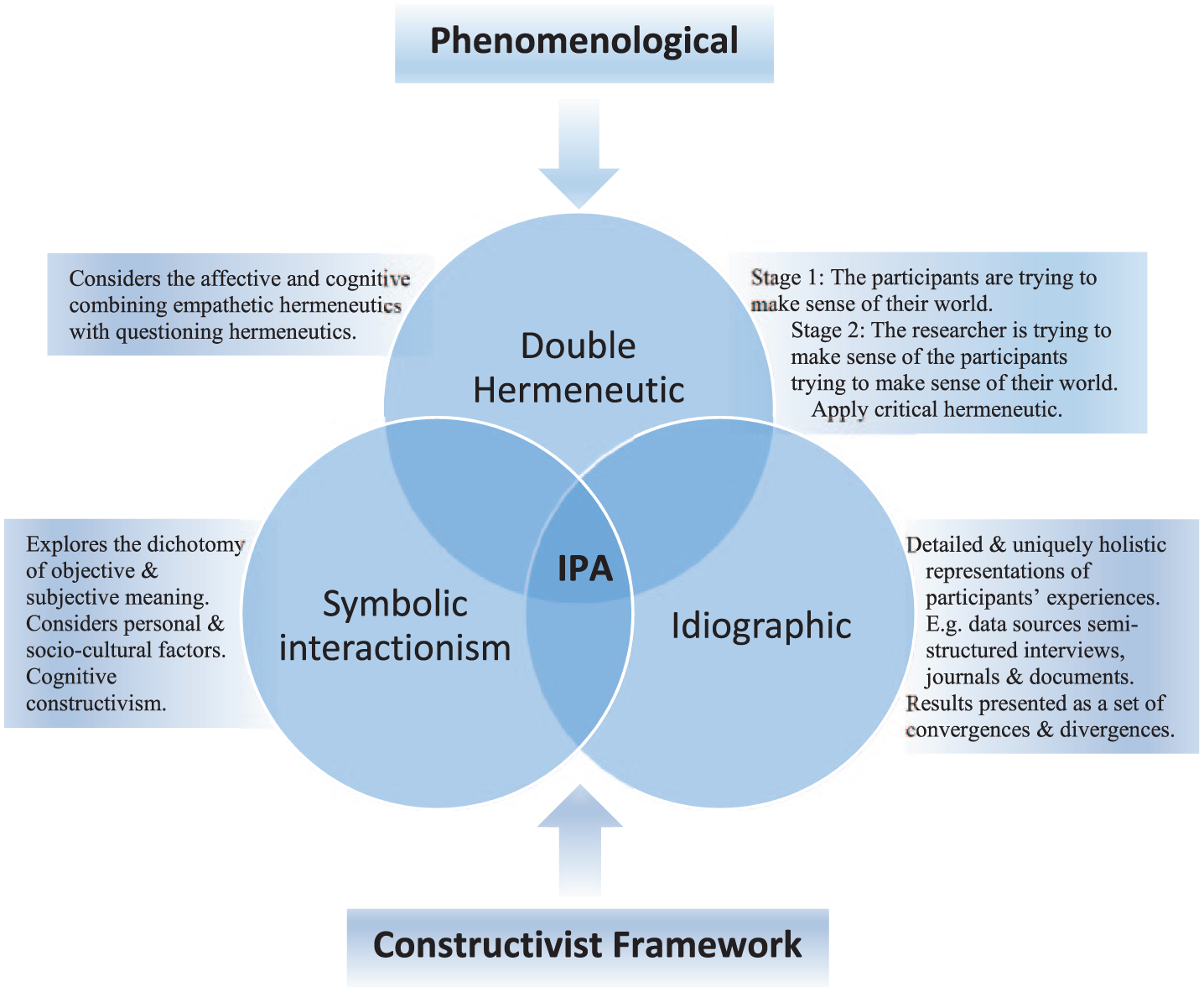
The IPA theoretical framework as applied to the authentic learning music education research study.
The intersections concerning the double hermeneutic, the symbolic interactionism and the idiographic mode of inquiry will be discussed in turn in this section.
IPA is a valuable critical tool for work within a constructivist framework due to its link to idiography. Therefore, lending ‘itself to concern about a person’s perception … [while] actively taking account of the researcher’s own conceptions and that these are required in order to make sense of the other person’s world’ (Davidson, 1999, p. 32). A dual lens is used to develop understanding from the perspectives of the participant/s and the researcher/s. This process is an exploration of personal experience and perceptions of an authentic account of an object or event (Smith & Osborn, 2015). This idea is derived from Edmund Husserl (1900/2001) who asserted that phenomenology should essentially be an authentic account. This means ‘to see things as they present themselves in their own terms, rather than as defined by prior scientific hypothesis or abstract conceptualizations’ (Smith & Osborn, 2015, pp. 25–26). The strength of the IPA approach is that it allows researchers to take advantage of its flexibility, while still demanding rigour in methodological process when exploring individual perceptions of music learning (Taylor, 2014). Phenomenon is not ‘defined by prior scientific hypothesis or abstract conceptualizations’ (Smith & Osborn, 2015, p. 26). Effective IPA research demands the rigour and depth involved in the process of systematically reviewing qualitative data. As a phenomenological study, the researcher must interrogate their own assumptions and bracket these. In this sense it could be regarded as a rigorous account of reality as subjectively perceived. The analysis itself should continue until data saturation is achieved, that is, when data categorisation is well established and in turn validated (Constantinou, Georgiou, & Perdikogianni, 2017). It is important to note that although there is no single way that IPA is conducted, Smith and Osborne (2003: 74) suggest that ‘deciding upon which themes to focus upon requires the analyst to prioritize the data and begin to reduce them’. This is based on the richness of the data and how it can highlight themes or illuminate aspects of participant accounts rather than relying only on prevalence (Smith & Osborne, 2003). The analysis process acknowledges that socially and culturally mediated factors may influence both the participant and the researcher. The interpretation of data relies on the researcher to balance this dichotomy of objectivity versus subjectivity. Further, it is suggested that triangulation of data can still be achieved in qualitative research studies through the application of multiple data sources (Creswell, 2007; Creswell & Miller, 2000). Alase (2017) has suggested that quality IPA research studies must include triangulation as a mechanism for navigating the collecting and analysis of phenomenological data.
The researcher’s role in IPA is active, making the research process itself dynamic, evolving organically and seamlessly. Conrad (1987) described the ‘insider’ perspective as that which locates the subjective experience at the centre of an inquiry, which is also how it is considered in phenomenological and ethnographic research studies (Schwandt, 2007; Thomas, Blacksmith, & Reno, 2000). In this sense, insight into the participant’s personal world ‘depends on, and is complicated by, the researcher’s own conceptions … these are required in order to make sense of that other personal world through a process of interpretative activity’ (Smith & Osborn, 2015, p. 26). This intellectually aligns IPA to theories of interpretation (Packer & Addison, 1989; Rennie, 2012; Smith & Osborn, 2015) and the interpretative or hermeneutic development of phenomenology (Holloway, 1997). This meant developing notions of the way human beings or participants give meaning to experience, behaviour and action. In IPA this double hermeneutic or two stage interpretation process involves, first, the participants trying to make sense of their world and, second, the researcher trying to make sense of the participants trying to make sense of their world (Smith & Osborn, 2015). In the context of the authentic learning music education study, the researcher is trying to establish an understanding of the students’ experiences with music-making activities that emulate real life, and also the teachers’ experiences in implementing a change in their own pedagogy (Crawford, 2009, 2013, 2014). Reflexivity is critical in this process, which required an awareness of how complex layers of meanings and knowledge are constructed. Emotional attachments and characteristics of the researcher must be acknowledged when immersed in the collection and analysis of data. In this case, my experiences as a teacher with regard to this area of study were carefully documented. I already understood the value of authentic learning and at the time technology was pivotal to shifting paradigms in education, although not always used to its full potential. I continually challenged myself and the educators I worked with to contextualise and situate preconceived knowledge that was often infused with expectations from the industry and educational authorities. I did this by asking questions such as: What drives pedagogy and practice? Is technology driving pedagogy or is pedagogy driving technology? Is technology really effective for teaching and learning in this case or do I just know it to be because of how I have used it in the past? Having expertise in an area needs to be carefully acknowledged on the one hand as having an intimate understanding of a topic area, but on the other for any potential bias, attachment or emotional responses that can influence how data is interpreted and reported. Researchers have an ethical responsibility to ensure that data is treated appropriately.
Critical hermeneutics are a vital part of the IPA approach used in the authentic learning music education study as emphasis is placed on music learning and teaching experiences being influenced by socially and culturally mediated factors. In turn, the importance of examining the historical and cultural consciousness embedded in artefacts and texts, placing emphasis on the idea of exploring both the object and the subject’s prejudices are stressed (Bryne, 1996). Critical hermeneutics has influenced qualitative research by stressing the importance of the researcher recording their judgements and potential prejudices during their investigation, which then becomes an integral part of the study. As such, a researcher’s journal was used throughout the studies that investigated authentic learning and digital technology in the music classroom (Crawford, 2009, 2013, 2014), providing an authentic and accurate account of the researcher’s perceptions. Gadamer (1965/1989) asserted that the social sciences must not suspend the subjectivity of the researcher, but instead engage with and challenge these prejudices as part of the continual meaning-bearing process. In IPA such potential prejudices are illuminated as part of the researcher’s interpretations and provide an essential critical lens to the double hermeneutic.
While there is an expectation that different interpretative stances are possible, IPA considers both the affective and the cognitive, combining empathetic hermeneutics with questioning hermeneutics (Smith & Osborn, 2015). This is useful in education and music education research, which seeks to explore questions such as: What is the teacher trying to achieve in this context and how does this impact on students’ experiences? What are the intended and unintended learning outcomes based on the pedagogical approach and the decisions made by the teacher? To what extent is the teacher aware of the implications of these decisions (why/why not)? Is the teacher less aware than the researcher (why/why not)? The following is an example in context: What learning experiences is the teacher trying to achieve by using authentic learning in the music classroom? To what extent is the teacher aware of digital technology contributing to the learning outcomes of the students (why/how)? To what extent is the teacher consciously aware of the role of their pedagogical content knowledge in this teaching and learning sequence? To what extent does the teacher perceive that the learning context is engaging and interesting to the students? What do the students perceive to be the role of technology in this context? Understanding of participants’ experiences can be established through identifying or empathising with the accounts as well as trying to make sense of what occurred. This will lead to a richer analysis that allows for a holistic consideration of the participant in this context. Smith and Osborn advocate that, ‘both styles of interpretation are part of sustained qualitative inquiry but the degree of emphasis will depend on the particularities of the IPA study concerned’ (2015, p. 26).
The connection between IPA and constructivism can again be eluded to with regard to the concern for how meanings are constructed by individuals within both a social and a personal context. Symbolic interactionism (Denzin, 1992, 1995) plays a role in IPA by addressing the subjective meanings that people impose on objects, events and behaviours. Subjective meanings in this sense are given primacy because people behave in certain ways based on what they believe and not just on what is objectively factual or true. Therefore, society is thought to be socially constructed through human interpretation. IPA researchers are acutely aware of the complexities that exist between the cognitive, linguistic, affective and physical connections that are present in what participants’ attempt to express. The researcher has to interpret the participants cognitive and affect state based on what is said, how and why. A theoretical alliance with the cognitive paradigm is suggested by Smith and Osborn (2015) as there is an emphasis on sense-making by both the participant and the researcher that can be described as ‘having cognition as a central analytic concern’ (p. 27). In the context of education research, this can in turn be linked directly to Piaget’s cognitive constructivism.
IPA is primarily interested in the detailed examination of particular cases, in understanding how participants have experienced particular events, and is therefore idiographic (Smith & Osborn, 2015). This process ‘does not eschew generalizations but works painstakingly from individual cases very cautiously to more general claims. In practice, an IPA study will usually present its results as a set of convergences and divergences within the accounts of participants’ (Smith & Osborn, 2015, p. 27). This idiographic mode of inquiry is antithetical to nomothetic inquiry, which typically investigates large groups of people using quantitative methodology such as surveys in order to establish behavioural laws that can be generalised to broader populations (Maykut & Morehouse, 1994). While idiography has been defined as relating to or concerned with discrete or unique facts or events (Bryne, 1996; Maykut & Morehouse, 1994), its connotation as used in this IPA context can perhaps be more accurately characterised as the richly detailed and uniquely holistic representation of words and actions that attempt to describe a situation as experienced by its participants. This is particularly pertinent to the authentic learning music education study discussed as the researcher implemented a multidimensional teaching and learning model that relied on holistic learning and the whole-person phenomenon (Crawford, 2014). Using qualitative methods such as semi-structured interviews, will allow researchers to collect in-depth data and probe the distinctive complexity of each participant in order to develop a global understanding of the chosen phenomenon (Smith & Eatough, 2006). Thus allowing an evidence-base for practice to be established.
IPA can be applied to a range of research designs and methods and is a suitable analysis approach for data that require an exploration of how participants are perceiving certain situations and making sense of their personal and social world. An example of the types of research questions or aims and data collection relevant for IPA is considered in the next section.
Research questions and data collection
Example research questions
Research questions in a study that makes use of IPA are usually framed in a way that is considered quite broad or open. Smith and Osborn (2015) explain that such research questions do not ‘attempt to test a predetermined hypothesis of the researcher; rather, the aim is to explore, flexibly and in detail, an area of concern’ (p. 28). When a study is concerned with complexity, process or a unique context, the systematic and rigorous conduct of the analyses of qualitative data in IPA can be particularly valuable and useful. The following are some exemplars of music education research questions or aims addressed in studies that utilise IPA for qualitative data:
‘What are the key social relationships, discussions and feelings about self and self-in-relation-to-others that emerge when a child learns a musical instrument?’ (Davidson, 1999, p. 33).
‘To understand “how talented young musicians”, or “specialists”, are able to maximise their musical potential and become professional performing musicians’ (Burland & Davidson, 2002, p. 124).
What are the experiences of participants coping with operatic career disruption due to physical incapacity? (Oakland, MacDonald, & Flowers, 2014).
What are the experiences of young refugee background students engaging in music education? (Crawford, 2016a).
Each of the examples above assumes several layers of complexity in exploring the lived experience of the participants involved in the studies.
The following section outlines the aims of the authentic learning music education study introduced earlier. This will provide a context from which to explore how IPA was used in this research.
Research aims of the authentic learning music education study
The main purpose of this research was to consider the effectiveness of current Victorian (Australian) government secondary school music teaching and learning practices when engaged with technology. There was a preconception that, for school music to meet the requirements and expectations of contemporary society, music education had to reflect music practice in the ‘real-world’ or ‘authentic’ context. IPA was used in this study to explore the past and present experiences of teachers and students when engaged with technology in music education and the meanings that participants ascribe to the development of teacher pedagogy or student learning outcomes in this context. There were three aims to this inquiry (Crawford, 2013):
To investigate the utilisation of digital technology within school music education.
To investigate teacher pedagogy in the music classroom when technology is employed.
To investigate students’ perceptions of the use of digital technology in the music classroom.
Three interrelated contentions were formulated in order to investigate these aims, which became the philosophical and theoretical basis for this research:
The nature of valued knowledge in music education: there is a tension between what schools understand as valued knowledge in education and what students actually value.
The significance of authentic learning in music education: one of the problems of school music is that it is not considered to be authentic by students, in that, it does not relate to real-life experiences.
Teaching and learning practices should be a reflection of current society, which is multidimensional/non-linear.
To provide opportunities for authentic learning in the music classroom it was important to identify the nature of valued knowledge. In turn, teaching and learning in a non-linear/multidimensional praxis signifies a reflection of current society, making learning authentic and thus recognises what is valued knowledge. These three contentions, working in tandem, introduced the notion of a holistic perspective and practice of learning. In this study, such a notion is defined and referred to as the ‘whole-person phenomenon’ (Crawford, 2013). (For more information regarding the specific findings of this study or further detail regarding notions such as multidimensional/non-linear pedagogy, please refer to Crawford 2013, 2014, 2016b.)
Methodological tools and sample size
The methodological tools used in the authentic learning music education study were surveys, classroom observations, semi-structured teacher interviews, student and teacher reflective journals and a researcher’s journal. At the outset, the researcher recognised that due to the quantity of complex qualitative data that would be generated from a range of methodological tools, an analysis system that provided focused and highly specific coding and organisation was required. Therefore the results of the qualitative questions on the survey, the semi-structured interviews with teachers, student and teacher journals and researcher’s journal are analysed using IPA. Smith et al. (2009) confirm that while most IPA studies have been conducted through semi-structured interviews, it is possible to obtain qualitative data appropriate for IPA analysis in a number of ways, such as the range of qualitative data sources used in the authentic learning study outlined above.
When considering sample size there is no set principle when using IPA. This will largely depend on the purpose of the research being conducted, the richness of the data collected, the expectations around reporting outcomes and at times operational constraints. Due to the complexity and quantity of some qualitative data generated, there has ‘recently been a trend for some IPA studies to be conducted with a very small number of participants’ (Smith & Osborn, 2015, p. 29). While sample sizes vary across studies, it is important to be realistic about what can be achieved within certain time frames and to use a homogenous sample where possible.
It has been mentioned that IPA can be conducted on various qualitative data collection tools or sources, but as the semi-structured interview is identified as the one most widely used, it is valuable to consider in this context. Further, the quality of the interview is critical as it will in turn determine the quality of IPA.
Conducting a semi-structured interview
Semi-structured interviews allow the researcher to engage in a dialogue with the participant that relies on both a set of questions on an interview schedule and the flexibility to probe into important or interesting issues that arise, highlighting the idiographic nature of IPA. The researcher should share the direction of the conversation with the interviewee for a couple of reasons. First, this allows the interviewee to feel partly in control and at ease, which helps to establish a sense of trust and entice the participant to share their experiences. Second, as the researcher wants to probe into the personal and social world of the participant, this provides the interviewee opportunities to introduce issues that the researcher may not have considered. Smith and Osborn (2003) explain that in this regard the participant can be ‘perceived as the experiential expert on the subject and should therefore be allowed maximum opportunity to tell their own story’ (p. 59). They also outline the advantages and disadvantages of the semi-structured interview: it facilitates rapport/empathy, provides a greater flexibility of coverage and allows the interview to go into novel areas, and it tends to produce richer data. This form of interviewing gives voice to both participant and investigator, which means that it may be more time consuming and more complex (Smith & Osborn, 2003). Figure 2 provides an example of a semi-structured interview question schedule used in the authentic learning in music education research study. This schedule was used to interview a teacher prior to the commencement of a new unit of work that utilised digital technology.
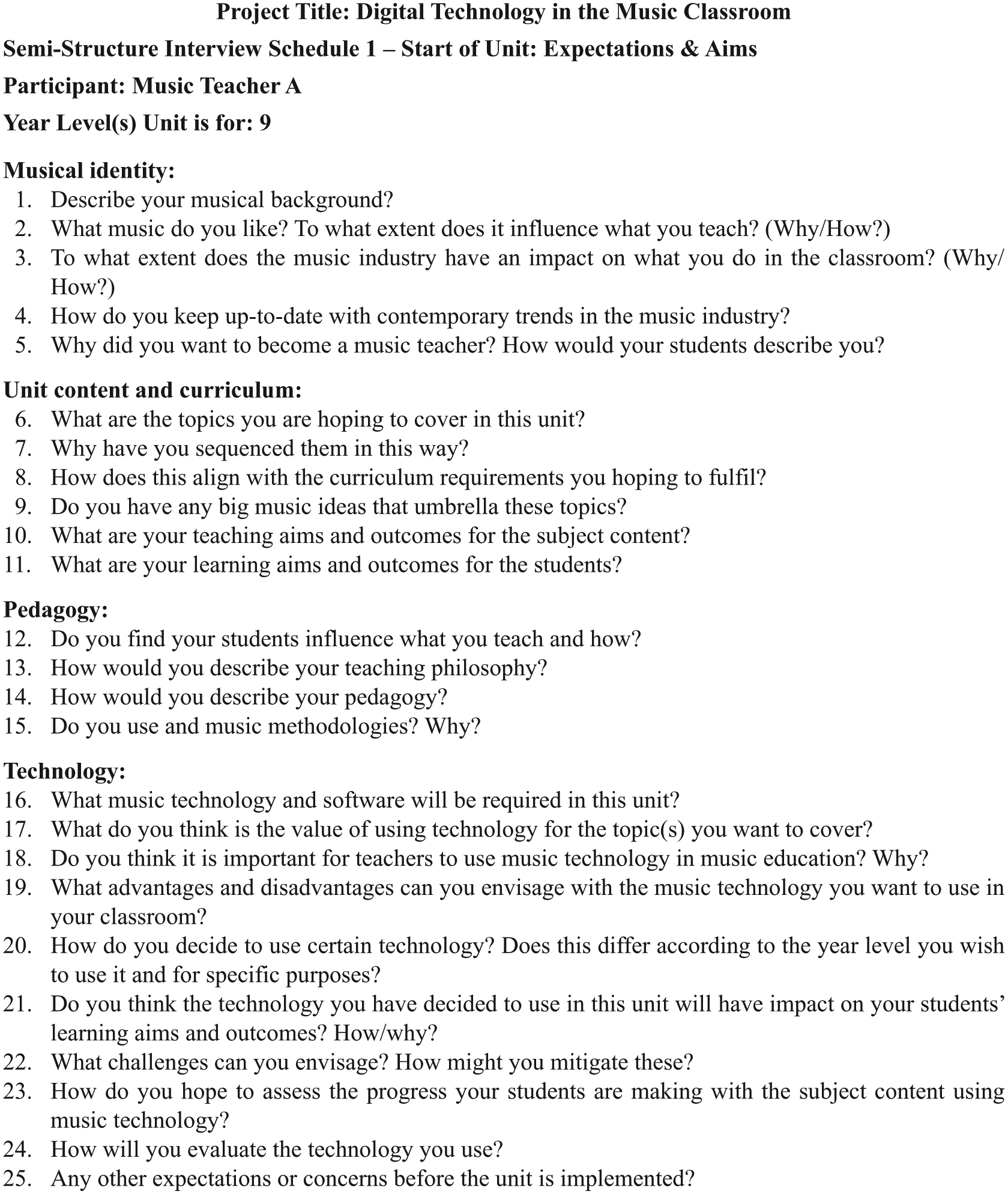
Semi-structured interview question schedule – Music Teacher A prior to the commencement of a unit of work that utilised digital technology.
As exemplified in Figure 2, the interview schedule provides guidance about important questions that needed exploring at the beginning stages of the authentic learning music project. In this context, four primary components were used in the designing of the interview schedule and associated questions for IPA:
The range of issues were quite broad, this is dependent on the topic area being investigated, but the research question and the literature in the field assisted in determining what should be covered in the interview.
The sequence of topics and associated questions were written in a logical sequence, but the researcher remained flexible about the iterative and non-linear way semi-structured interviews may be conducted given the shared control of the conversation with the participant.
Consider possible probes and prompts to some of the questions to assist the participant in understanding the question being asked if required. It is also a sequencing strategy to resume control of the conversation and redirect to questions that will answer the issue being investigated. Probes and prompts were used judiciously to avoid potential leading and to ensure the accuracy of the account, which should represent the participant’s experiences and understanding about the topic.
Questions were constructed neutrally rather than value-laden or leading. They were concise and clear, avoiding confusion or double-barrelled questions that ask more than one thing that often leads to the same answer. It was also important to use open not closed questions and avoid assumptions of technical proficiency or jargon.
It is useful to begin with broad or general questions as an exploratory exercise to see what the participant might understand about a topic. However, this may be insufficient to elicit a satisfactory response depending on the complexity of an issue or if the question is too general for a particular participant. In these cases more explicit prompts are constructed and the technique of funnelling is suggested by Smith and Osborn (2003) to produce a sequence of questions to elicit general and then specific views from participants. An example of funnelling used in the authentic learning music education study can be seen in Figure 3.

The technique of funnelling used in semi-structured interviews in the authentic learning music research study.
The funnelling technique was used to produce the participant’s elicit views on the mismatch between curriculum expectations and what is achievable in the reality of a music secondary classroom. Asking questions in this sequence ensured that participants were provided with sufficient time to give their own views before funnelling them into more specific questions related to the study. This also avoided the possibility of producing biased data.
Semi-structured interviews can vary in length, those conducted in this context ranged from 40 to 80 minutes. While it is important to allow for sufficient time in conducting an interview, it is also a professional courtesy to realise that the teachers and participants involved in the research have a paucity of time in their demanding work. Getting the balance right is critical in the quality of data that can be collected and in turn analysed using IPA.
The analysis system
Stage 1: the interview transcript and initial interpretation
There is no single, definitive way to conduct IPA, as is generally the case with qualitative research (Smith & Osborn, 2015). Depending on the study, variations may be found in the sources for data collection and within the analysis process itself to accommodate the data being analysed. IPA can be considered more like a set of processes in this context. Data analysis in qualitative research can occur either straight after the collection of data has been completed or concurrent to the data collection process. This allows for developing or revising research objectives, evolving understandings and considering unanticipated results. The assumption in IPA is that the researcher is analysing the data in order to learn something about the participant’s personal and social world. Smith (2003) explains that this may be represented as beliefs and constructs of meaning that are suggested by the participant’s discourse, or it may be that the participant’s narrative/story is a window into their identity. Regardless, the meaning is central to the analysis and IPA aims to understand the content and complexity of those meanings. The frequency at which these various meanings may occur is secondary at the initial stages of analysis, themes are constructed after the researcher has read through the transcript of the interview several times engaging in the process of interpretation. Capturing the participant’s meanings may not be transparent, depending on the complexity of the issue being investigated. Therefore, ‘they must be obtained through a sustained engagement with the text and a process of interpretation’ (Smith & Osborn, 2003, p. 66). Table 1 provides an example that illustrates the interview transcript on the left and the researcher’s interpretations on the right of that column.
An analysis example from an interview transcript in the authentic learning music research study.

There are no specific rules or requirements about what should be commented upon, some parts of the interview will be richer than other sections and in turn warrant more commentary (Smith & Osborn, 2003). Table 1 demonstrates that the researcher’s comments attempt to interpret in ways that summarise or paraphrase responses, there are also some associations or connections in the dialogue. For example, ‘Technology thought of as a tool that is hindering rather than an enabler for positive pedagogical change.’ To assist in establishing the participant’s meanings, it is also useful to comment on the use of language and tone as seen in Table 1. For example, ‘Tone sarcastic, body language defeatist’ and ‘Assertive tone used.’ As the researcher progresses through the transcript, comments are written into the interpretation column about similarities and differences, reiterations, emphasis and contradictions in what the participant is saying at various points. This is critical in establishing the double hermeneutic that allows the researcher to make sense of the participants meaning within the authentic learning music education study. This follows an idiographic approach to analysis, which begins with specific examples and through interpretation evolves into general categorisations or claims, such as ‘technology as a learning tool’ (refer to Table 1).
Stage 2: coding categories and emergent themes
The next stage involves the code and theme columns, which can be seen in Table 1. The interpretations are rewritten as concise phrases, which aim to capture the essential quality of what was found in the transcript (Larkin, Watts, & Clifton, 2006; Smith & Osborn, 2003). The emergent themes move the text and associated interpretation to a slightly higher level of abstraction and may invoke more technical terminology associated with the topic. The link to what the participant actually said and the initial interpretation should still be clear. It is at this stage that the frequency of meanings through thematic development become important and should allow theoretical connections to be made within one case and or across cases.
In IPA, the analysis of the data requires a reduction method that consists of identifying patterns and elicit key themes. The emerging patterns or themes within this ‘experiential material, emphasising both convergence and divergence, commonality and nuance’ (Smith et al. 2009, p. 79). The following broad coding system was used to assist in the identification of the types of themes appearing: perception codes, setting/context codes, and process codes. An important part of the authentic learning music research study was to investigate how students and teachers perceived technology and its use in the classroom. The themes that are derived from perception codes, such as ‘authentic learning’ and ‘valued knowledge’ (refer to Table 1), captured these specific perceptions as they are translated from the particular to the shared, and from the descriptive to the interpretative. Given that IPA is concerned with constructed meanings that express experience, the participant’s perceptions of the investigated phenomenon was the primary coding type that appeared in the analysis of this study. Setting/Context codes generated themes that, as the name implies, reflect the context or setting in which the phenomenon under study is observed. Table 1 demonstrates the teacher reflecting on their own experience as a music student to make comparisons about current expectations, this is reflective of ‘historical context’. Process codes focus on the sequence of events and how changes occur. This is useful when comparing sections of data within a single case, across cases or more broadly across the data collection overall. Any number of possible themes can be used within these coding categories, which are specific to the research study.
In addition to the broad coding categories described, there is a process by which the coding of the themes occur after the researcher interpretations are inputted as part of the abstraction. This assists in exploring the similarities and differences within and across cases allowing a set of convergent and divergent themes to emerge. Open coding is used to break down and categorise data into manageable segments. Axial coding is the process of reconstructing data in order to make connections between and across categories. Selective coding is used if a potential theme has been identified due to having a prior clear and selective focus, data are reviewed systematically for that specific category. It is important to note that the coding categories or terminology discussed are often used in grounded theory method analysis. However, the purpose of IPA is not necessarily that the data will result in a new theory. In this context, the categories are used for the exploration of data within and across cases using a phenomenological perspective that focuses on a holistic understanding to describe an experience as it is lived by the participant.
The overall process of analysis
Due to the complex idiographic nature of the interpretation and the fact that authentic meaning is central to the analysis, IPA should not be confused with thematic analysis. The depth and quality of the data will define the breadth of the thematic categories required. Flexibility in refining themes is important, including subdividing and subsuming where appropriate. Figure 4 represents the basic premise of the process of analysis used in this context:

The process of analysing the semi-structured interview data in the authentic learning music research study.
Once abstraction is complete and data saturation is achieved, the themes or data categorisation are considered well established and in turn validated (Smith et al., 2009). This can now be used to compare and in the case of the authentic learning music study, triangulate with other data collection sources. A final evaluation or a general claim can then be made regarding the issue being investigated. Due to the extensive amount of qualitative data generated, responses are judiciously chosen as exemplars of the results received. It is important to ensure that the account presented in the results is an accurate authentic representation of the participants’ meaning and understanding regarding the issue being investigated. Results are presented using a number of different devices, such as a narrative or thematic table/s with illustrative quotations used to highlight meanings and provide transparency (Smith et al., 2009).
The students and their music teacher’s meanings and experiences, through responses and reactions to using technology for teaching and learning, are central to discerning what appropriate practice might be in this context-specific study. The qualitative results have shown an overall positive response to using technology in music teaching and learning in a way that encapsulates the theoretical contentions valued knowledge, authentic learning and multidimensional/non-linear learning (Crawford, 2014). The application of this research to practise resulted in the guiding principles for a multidimensional/non-linear teaching and learning model that can be applied in many contemporary education contexts, which explores the interplay between the contentions of this study. This model is extended to the teaching and learning of music and in turn its application led to a matrix or a multidimensional/non-linear model that encompasses all facets of music practice (Crawford, 2016b).
Conclusion
As a general principle, all research is oriented towards the extension of knowledge and the solution of problems. Wiersma (2000) explains that the overall function of education research, ‘is to improve the educational process through the refinement and extension of knowledge. The refinement of existing knowledge or the acquisition of new knowledge is essentially an intermediate step towards the improvement of the educational process’ (pp. 23–24). Education research within both local and global contexts covers a range of issues and requires a requisite range of methodologies and techniques. In an era of accountability, the continuing argument that a closer link needs to be made between research and practice has never been more pertinent. A consideration of what an evidence-base means in education research has contributed to the recognition and importance of context-specific inquiries that encourage practitioner research or smaller-scale studies. These are regarded as particularly valuable in informing education practice and can provide an evidence-base if positioned within the context of how findings might be used more widely (Bassey, 2007; Cochran-Smith & Lytle, 1999; Elliot, 2001; Pring, 2000). Qualitative research gained both credibility and popularity among education researchers in the early to mid-1990s and is viewed as a legitimate and important means of illuminating the teaching and learning process and a distinguishing feature of research as it is now practiced (van Ernst, 1994). In broad terms, research will address such questions about learning processes, the effectiveness of current teaching practice, the relationship between practising industries/vocations and schools, the cultural context and expectations of education programs, and their historical precedents (van Ernst, 1994).
One of the benefits of using IPA for qualitative research is that it resonates with both the theoretical and practical principles inherent in many contemporary education contexts. For example, IPA is an experiential approach and therefore provided a way to authentically handle large quantities of complex qualitative data in a music education study that investigated authentic learning and teaching with technology. While it is a rigorous analysis system, it is flexible and unique to each researcher and the associated requirements of their study. It has never been more important for teachers to be able to demonstrate evidence of their practice. One way to do this is to investigate experiential and authentic education contexts using methodologies, research tools and approaches to analysis in an authentic way.
IPA enables the rigorous exploration of idiographic subjective experiences and, more specifically, social cognitions. Consequently, IPA acknowledges that the researcher’s engagement with the participants’ experiences and, in turn, data has an interpretative element. In contrast to some other qualitative methods, such as discourse analysis (Potter, 1996), this engagement assumes an epistemological stance whereby, through careful and explicit interpretative methodology, it becomes possible to access an individual’s cognitive inner world. Further, while discourse analysis examines the role of language in describing the participant’s experience, IPA explores how people ascribe meaning to their experiences in their interactions with the environment. As such, there is value in using such an approach for music education research studies that aim to relate findings to socio-cultural frameworks. Given that music learning and teaching is an experiential activity, it is appropriate to use an experiential methodology to understand the inner workings of teaching and learning music.
It is important to briefly consider some of the conceptual and practical challenges and limitations associated with IPA. It is acknowledged that the flexible nature of the approach can cause ambiguity and a lack of standardisation. Outlined in this article is a very systematic approach to conducting IPA, which uses a process that is both rigorous and iterative. This is believed to be the intention of the original principles of IPA as outlined by Smith in 1996. The integral role of language in methodological studies that concern phenomenology are also being questioned (Brocki & Wearden, 2006). As the purpose of IPA is to gain insight into the experience of participants, it will always be intertwined with language whether this be in the form of, for example, narratives, discourse and metaphors. It is this reason that the interpretative element of the transcript as illustrated in Table 1 specifies connection with language as a critical component. Lastly, IPA has been scrutinised because the focus of its inquiry is on the perceptions of the lived experiences of participants and may in turn limit understanding (Tuffour, 2017). As demonstrated in the music study example explored, an authentic research inquiry seeking to understand the experiences of its participants will also seek to explore the conditions that are related to the experiences, which are located in past events, histories or a social-cultural domain. Smith et al. (2009) have argued that IPA uses hermeneutic, idiographic and contextual analysis to understand the cultural position of the experiences of people. Further, the authentic learning music education study was firmly embedded in a constructivist framework, which places import on the socially and culturally mediated factors of the study context.
This article explored the process of conducting IPA in music education research that sought to investigate students’ and teachers’ experiences of using authentic learning and digital technology in the secondary classroom. It was explained that the aim of IPA is to rigorously investigate personal meaning and lived experience. In the context of the music education study discussed, IPA is regarded as an authentic approach situated in constructivism for exploring and interpreting authentic learning and teaching practice. This discussion highlighted the value of such an analysis system when dealing with complex qualitative data such as semi-structured interviews in order to understand the personal and social meanings of participants. The historical and theoretical background of the approach was used to provide context for the application of IPA in practice.
It is recommended that IPA be considered as a way to engage with complex qualitative data and that the rigour of the analysis system provides a means to develop evidence-based practice. This in turn recognises the value of context-specific studies that can be positioned within a wider context. A double hermeneutic provides a critical lens for the researcher to engage in the interpretation of personal and social meanings and constructs in a complex idiographic way. Symbolic interactionism and the role of the researcher in this interpretative process is acknowledged and incorporated as part of the study to balance the dichotomy of objectivity and subjectivity. This approach recognises that research is a dynamic process (Smith, 1996). This has positive implications for educators and music educators who are constantly engaged in the notion of reflexivity as a way to develop their innovative and contemporary practice. IPA provides not only opportunities for researchers to position themselves within the research context, but also the ability to reflect on and consider the intersubjective dynamics between researcher and data (Finlay & Gough, 2003). Reflexivity requires an awareness of how complex layers of meanings and knowledge are constructed, including a consideration of any potential emotional attachments and characteristics that a researcher might bring to the interpretation of data in a particular context. In the authentic learning study the researcher’s experience as a teacher was important in enacting curriculum in meaningful ways and evaluating the effectiveness of pedagogical teaching models. In exploring how other teachers did this, it was equally as important to be able to understand where this knowledge was constructed from and how to maintain some objectivity when collecting, analysing and interpreting data. IPA allows education researchers to authentically and rigorously investigate context-specific studies. The application of IPA may see the emergence of different perspectives in music education research that is both rigorous and interpretative, linking research to practice by providing a qualitative evidence-base that elicits both convergent and divergent thinking.
Footnotes
Funding
This research received no specific grant from any funding agency in the public, commercial, or not-for-profit sectors.
