



Abstract
Generally, one-to-one music lessons in tertiary settings are delivered by practicing professional musicians. While contemporary musicians draw upon a broad foundation of musical skills, they tend to develop highly specialized skills in a narrow area of performance. This may not be ideal for the one-to-one teaching studio, a situation that calls for a broad repertoire of teaching strategies tailored to individual student needs. This tension is exacerbated, as one-to-one tertiary performer-teachers are often employed on a sessional basis, and as such are offered limited opportunity to receive feedback or professional learning related to their one-to-one teaching practice. This article presents findings from a pilot study employing a peer observation and collaborative reflection approach to professional learning conducted by two contemporary trumpet performer-teachers. Similarities and differences between teaching strategies were identified in order to develop a broader range of teaching strategies that the participants might draw on in the future. In turn, the efficacy of a peer observation and collaborative reflection approach to professional learning for the participants is discussed.
Keywords
Background
Typically, one-to-one music lessons in tertiary settings are delivered by practicing professional musicians. While professional musicians in the contemporary (inclusive of jazz and popular music styles) milieu draw upon a foundation of broad musical skills, they tend to be specialists in a narrow area of performance. The professional profile of a successful contemporary musician is based largely on the development of a highly personalized musical identity supported by highly specialized skills. It follows that the teaching approaches of contemporary musicians are as diverse and individual as their musical identities (Purser, 2005). Problems may arise when the performer-teacher (Mills, 2004) finds their specialist skills and knowledge challenged by the demands of the one-to-one teaching studio, an environment that calls for a broad repertoire of teaching strategies tailored to individual student needs and interests (Hallam, 1995; Persson, 1996). This tension between the highly specialized skills of a performer and the broad range of teaching strategies desirable in a teacher is exacerbated by the fact that most tertiary instrumental music lessons are delivered on a one-to-one basis, often by sessional academics. This offers very limited opportunities for teachers to receive guidance, feedback, or professional learning related to their one-to-one music teaching practice. Furthermore, there is a tendency for higher education providers to employ one-to-one performer-teachers on the basis of their stature and reputation as performers, and to a lesser extent their skills and qualifications in education (Purser, 2005). This is understandable given that students are often inspired by and wish to learn from performers with celebrated profiles. Similarly, higher education providers often seek to align themselves with high-profile performer-teachers in order to attract students. This privileging of performance skills may not be conducive to developing the teaching skills required of a performer-teacher. Scholars argue that there is a need for greater professional learning opportunities for one-to-one music teachers in tertiary settings (Carey, Grant, McWilliam, & Taylor, 2013; Gaunt, 2011) and school settings (Stanley, 2011). There is a general lack of knowledge about what constitutes effective professional learning in this context, and more specifically, how to address the particular needs of performer-teachers, who may lack pedagogical content knowledge (Millican, 2016).
Prior research into one-to-one tertiary music teaching has largely focused on pedagogy (Carey & Grant, 2015), effective teaching (Mills & Smith, 2003), benefits and difficulties (Persson, 1996), and teacher–student relationships (Gaunt, 2011; Presland, 2005). Research into teaching strategies and professional learning is less common. Existing studies have examined teaching strategies in conjunction with aspects of teaching practice such as gender (Zhukov, 2012), area of study (Young, Burwell, & Pickup, 2003), and dialogue (Burwell, 2006). Some research into instrument-specific teaching strategies has focused on piano in Western-art contexts (Daniel, 2004; Pike, 2014) while other research has investigated strategies across instrument families (Duke & Simmons, 2006). Studies specific to the learning and teaching of contemporary or jazz music includes Berliner’s (1994) seminal study. Berliner (1994) examines jazz learning and teaching broadly, rather than from an instrument-specific perspective. Some existing research into trumpet-specific teaching strategies is concerned with sound production rather than musical considerations (Hickman, 2006). Existing research has investigated teaching strategies in one-to-one tertiary music teaching such as modeling (Dickey, 1992), teacher talk (Duke & Byo, 2012; Young et al., 2003), practising (Jorgenson, 2004), and metacognition (Hallam, 2001). Research into teaching strategies to develop improvisation skills includes studies by deBruin (2018) and Ward-Steinam (2008). Existing research into strategies particularly useful for the trumpet includes metacognitive strategies such as biofeedback (Brown, Penhune, & Zatorre, 2015) and mindfulness (Ericsson, Krampe, & Tesch-Roemer, 1993). Opportunities for, and research into, professional learning for one-to-one tertiary music teachers is beginning to emerge in projects such as the ICON project through the Reflective Conservatoire conferences in the United Kingdom (Duffy, 2016) and the Transformative one-to-one project at Griffith University in Australia (Carey et al., 2013), which included using peer-assisted reflection (Carey & Grant, 2016). These projects were institution and researcher-led.
Our interest was in identifying teaching strategies or pedagogical content knowledge (Shulman, 1986) specific to contemporary trumpet teaching. The pedagogical content knowledge construct is thought to be useful for music educators to interrogate “teacher effectiveness competencies that distinguish great performing musicians from great teachers” (Colwell, 2011, p. 137). Shulman (1986) argues that being knowledgeable, or having subject-matter expertise, in a field does not automatically translate to the ability to teach effectively. This resonates with the common occurrence of one-to-one music teachers being high-level performers but having little or no opportunity for professional development or formal teacher education related to their one-to-one teaching practice (Mills, 2004; Purser, 2005).
Peer observation and collaborative reflection is a potentially useful approach to interrogate one-to-one teaching, thereby promoting professional learning (Glazer, Abbott, & Harris, 2004). Peer observation involves educators observing each other’s practice and learning from one another through peer discussion and self-reflection. Each educator observes and provides feedback on another educator’s practice and receives feedback from that educator about their own practice. Peer observation is thought to be a powerful form of collaborative professional learning that can instigate change of practice and engagement with new teaching strategies (Stoll, Harris, & Handscomb, 2012). Collaborative reflection assists this process by drawing on another’s knowledge to supplement that discerned by an individual alone. This may assist with critical analysis and moving beyond intuitive, tacit understandings of teaching practice. This resonates with Cole’s (2012) work that suggests effective professional learning should be embedded in or directly related to the work of teaching, grounded in the content of teaching, organized around collaborative problem solving, and integrated into a comprehensive change process. Similarly, Stanley (2011) contends that collaborative professional learning ought to be conducted over a period of time that allows multiple cycles of action; this learning should be focused on pedagogy and/or content; that the hierarchy between participants allows them to lead and take responsibility for learning; and an accurate and transparent view into classrooms is provided, for example, through the use of videos.
The research focus of this study was to employ a peer observation and collaborative reflection approach to professional learning for two contemporary trumpet performer-teachers. This research addressed the following two questions: What are the similarities and differences in teaching strategies of one-to-one contemporary trumpet teachers? Whether and to what extent are peer observation and collaborative reflection useful professional learning tools? Similarities and differences between teaching strategies were identified in order to develop a broader range of teaching strategies that the participants might draw on in the future. In addition, the efficacy of a peer observation and collaborative reflection approach to professional learning for the participants was examined.
Methodology
This project was conceived as a pilot study employing self-study methodology (LaBoskey, 2004). Self-study methodology is suited to this project because it places teacher experience at the center of the research and provides a framework for practitioners to illuminate learning and teaching strategies, and support change in practice. Using multiple perspectives and sources of data, including feedback from peers and students, self-study methodology supports practitioners to collaboratively and critically reflect on their work.
Data were collected from three sources: video-recordings of 12 one-to-one lessons of 1-hr duration, audio-recordings of three collaborative reflective discussions, and an audio-recording of a student focus group. The video data were collected via a video camera positioned unobtrusively in the corner of the teaching room while contemporary trumpet lessons were delivered at two Australian tertiary education institutions. The lessons were delivered by two participant-researchers, Eugene Ball and Paul Williamson, who are professional contemporary trumpet players with ongoing academic positions that include one-to-one teaching of contemporary trumpet performance. Eugene and Paul are both recipients of numerous awards, grants, and commissions for performance, composition, and recording, and are highly sought teachers of contemporary trumpet, each with over 20 years of teaching experience. Eugene and Paul each invited two students (assigned pseudonyms) to participate in the research. The four student-participants were all intermediate level and in second year of their Bachelor of Music degree. Students at the same stage of their studies were approached to participate in this study, and data collection was undertaken concurrently by the two performer-teachers in order to minimize difference in lesson content. Ethical approval was obtained from both institutions.
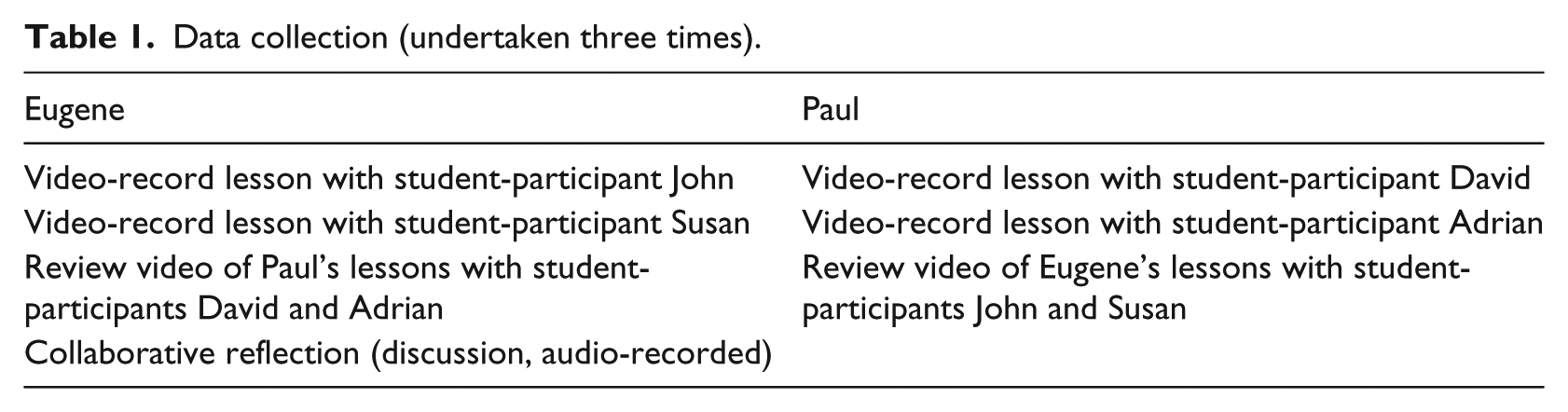
Once the student-participants had consented to participate in the research and video-recording, three cycles of data collection were undertaken (Table 1). The steps of each cycle were Eugene and Paul video-recorded one lesson with each of their students; Eugene and Paul viewed (independently) each other’s videos and made open and unstructured observation notes detailing similarities and differences in teaching strategies employed; and Eugene and Paul (together) engaged in collaborative reflection (audio-recorded), in which they discussed and reflected on the similarities and differences observed by each other, as well as usefulness of the peer observation process as a means of professional learning. The collaborative discussion was semi-structured and guided by the two research questions. Finally, Eugene and Paul independently reviewed the video-recordings of their own lessons.
Data collection (undertaken three times).
In order to elicit a student perspective, Emily, a research assistant, conducted a focus group with the student-participants. The focus group questions related to the students’ overall impression of what happened in their one-to-one lessons, what they found helpful and challenging, and their experience of the various teaching strategies identified. The focus group was conducted after the three cycles of data collection had been undertaken. As a high school music teacher and music education researcher, Emily took on the role of a critical friend for the participant-researchers. This is consistent with self-study methodology which views a critical friend as essential to support the critiquing, rethinking, and reframing of practice (Schuck & Russell, 2005).
All audio- and video-recordings were transcribed. The process of data organization and transcription involved re-reading the data several times, thereby becoming familiar with the content and forming initial codes. Following Creswell’s (2007) procedures for qualitative data analysis, the researchers undertook thematic analysis (Braun & Clarke, 2006) as a method of distilling and reducing the large amount of data.
An inductive process of coding was undertaken by the three researchers together. Small segments of data (single ideas varying in length from a phrase to a sentence) were assigned names. From this process of identifying and then condensing codes to form categories, the researchers grouped the categories and agreed on a coding scheme of the teaching strategies observed. Remaining data were then independently coded, before deciding on broader themes as a group. Emergent themes related to teaching strategies were identified and organized under headings drawn from music education literature. Analysis of the data revealed clear points of intersection and divergence in the teaching strategies of the participant-researchers. Overarching themes were formulated into a discussion representing the data. Finally, pertinent examples were selected from the data to support the discussion. Triangulation of the qualitative data was undertaken to strengthen the credibility of the findings (Rothbauer, 2012). Triangulation of methods was undertaken using observation of videos, reflective discussion, and focus group interviews. Investigator triangulation was undertaken by involving Emily in the transcription, observation, and analysis of the video data. Triangulation of data sources was undertaken through the student focus group. The multiple methods and sources employed provided a more complete picture and enriched the interpretation of Paul and Eugene’s teaching and the usefulness of peer observation as a means of professional learning.
Findings and discussion
Convergent and divergent teaching strategies of the two participant-researchers emerged from the data. Five interrelated teaching strategies common to both researcher-participants were the simultaneous development of improvisatory and technical skills, metacognitive or learning-to-learn skills, and embodied, kinesthetic learning. Both participant-researchers also provided models for students to emulate and created real-time problem-solving strategies.
Confluence of improvisatory and technical skills
Addressing improvisation and technical skills simultaneously was a feature of both Eugene and Paul’s lessons. Improvisatory and technical skills are core aspects of contemporary trumpet performance. A contemporary trumpet player needs both the improvisatory skills required to generate ideas that are appropriate to the context in which they are playing and the technical ability to articulate these ideas. For many students, technical and improvisatory skills are presented and conceived of as distinct components. While it can be useful to isolate individual technical components in order to address them rigorously (Cooper, 2004), if the improvisatory and technical domains are not at some point integrated, a disconnect between what is practiced and what is expected in performance can arise (Ball, 2004; Karlsson & Juslin, 2008). Both Eugene and Paul encouraged their students to bridge this divide by promoting a confluence of improvisatory and technical skills. Both asked student-participants to consider how they might imbue the practice of technical exercises with improvisatory elements, and, conversely, devote some attention to the technical aspects of playing the trumpet when practicing improvisation. For example, Paul, asked Adrian to practice a scale (knowledge of which was required for his impending technical examination) with improvised variations of timbre and articulation. Similarly, Eugene encouraged John to approach the practice of a “head” (melody) with a focus on airflow similar to that applied to the Clarke Second Study, an exercise commonly used to promote consistency of airflow and sound production (Clarke, 1984). In a collaborative reflective discussion, Paul commented on the effectiveness of “combining technical improvement with musical concepts” and “looking [at] it [technique] in the context of repertoire, because it is the bridge that usually separates the two domains.”
Metacognition
A focus on developing metacognition or learning-to-learn skills was common to both Paul and Eugene’s lessons. Metacognition refers to being actively aware of and engaged with the learning process, including the planning, monitoring, and regulation of practising and playing (Hallam, 2001). Teaching strategies employed by both participant-researchers to encourage metacognition included encouraging students to practice mindfully; attend to biofeedback; diagnose problems; and prescribe, implement, and evaluate solutions. Figure 1 illustrates the interrelated and cyclic nature of these components observed in the video-recorded lessons:
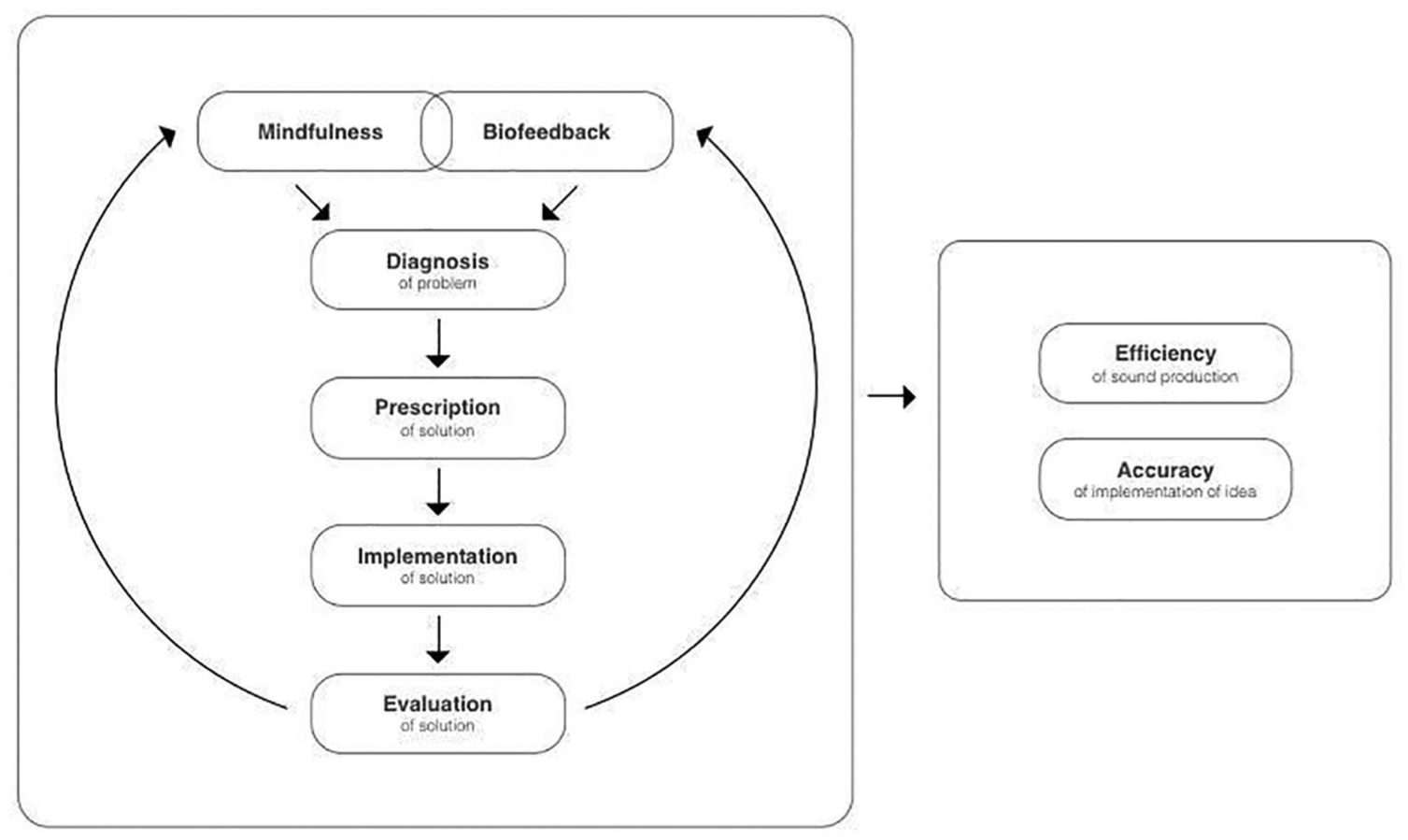
Metacognition (observed in the video-recorded lessons).
Mindfulness refers to the cultivation of an intentional state of awareness during deliberate practice (Ericsson et al., 2003) of the trumpet. To be mindful requires a heightened state of presence; to observe and attend to problems and solutions. Mindful practice can be described as active or deliberate practice (Werner, 1996). Its antithesis, passive practice, refers to the purely mechanical (non-mindful) repetition of exercises, executed without thinking. In the reflective discussion, Eugene describes mindfulness in this sense as “practice as research or enquiry,” meaning that effective practice occurs when students approach each practice activity as an investigation of how to play with greater efficiency and precision. In the lessons, Eugene encouraged his student-participants to regularly ask, “[how can I] make this note [or phrase] more beautiful, more easily?” Asking questions of students is a recognized strategy for increasing student mindfulness and scaffolding music learning (Kennell, 2002). Both participant-researchers frequently asked student-participants questions specifically framed to encourage mindfulness: In the 12 lessons examined in this project, 35 such questions arose.
Biofeedback refers to information that is known through sensorimotor means, which is used to gain greater awareness of physiological functions in order to improve performance (Brown et al., 2015). Biofeedback is part of metacognition, as the student observes the physical sensation of playing the trumpet as a means of evaluating the effectiveness of a given technique, approach, or exercise. Figure 1 shows the interconnected nature of biofeedback and mindfulness. In a collaborative reflection, the participant-researchers noted the importance of biofeedback. Eugene observes that “the feedback that the student can get from the feeling from playing a note is so important. It’s almost as important as sound.” Paul affirms biofeedback is used to “gauge” the effectiveness of a playing strategy, which is then fed “back into the [learning] process.”
For both participant-researchers, the aim of responding to biofeedback is to increase efficiency of sound production by minimizing tension. Tension is unnecessary muscular activity, which is understood to be a barrier to both efficient and accurate trumpet performance (Hickman, 2006). In their first lesson, Eugene guides student-participant John to observe and respond to biofeedback in order to minimize tension: . . . ask yourself is if there is anything that you are doing here, in the chops that you can let go of, ’cause I reckon even around where you were [plays long note], you can see quite pronounced dimples in your chops . . . and I reckon that’s because this [indicates embouchure] is just working a bit too hard. So, more than looking at it, it’s just a feel thing . . . it’s alright to kind of let things sag a little bit, to see what you can and can’t let go of.
Similarly, Paul encouraged student-participant David to use biofeedback as a way to gauge readiness to move on (in the practice routine) from the warm up stage: . . . you have to be really careful to have an awareness of the feeling . . . the whole idea of warming up is [to ask] “is your body generally feeling like it’s in a good place to move on to more intense practice?” . . . on a good day your chops and the breathing feels good, the lips feel fat . . . that’s the feeling your aiming for in your warm-up.
Kinesthetic learning
Kinesthetic learning refers to learning that takes place through physical action (Gardner, 1993). Throughout the lessons reviewed for this project, both participant-researchers emphasized the need for the physical embodiment of knowledge pertaining to the mechanics of trumpet playing, as well as that relating to theory of harmony and improvisation. The participant-researchers discussed their insistence on “in-lesson-doing” as a way of ensuring that the student-participants have an embodied sense of the correct way to execute the concept at hand; an embodied goal toward which to strive. In a collaborative reflection, Eugene articulates his preference for kinesthetic learning, stating, “it teaches the body to do what it [the required technique] is, and that feeling of doing it right is going to lead more than intellectual knowledge of doing it right.” Paul supports the use of kinesthetic learning as a means of establishing embodied goals, describing the idea as: “. . . teaching them the sensation [that] they can head towards that at home.” Teaching strategies focused on promoting kinesthetic learning were observed throughout each of the lessons reviewed in this study.
Exemplar models for emulation
Both participant-researchers demonstrated techniques and principles by playing the trumpet in lessons. In doing so, they provided exemplar models (Dickey, 1992) for the student-participants to emulate. An advantage of having an excellent musician as a music teacher is that they teach in and through music rather than resorting to ineffective verbal explanations (deBruin, 2018; Karlsson & Juslin, 2008; Young et al., 2003). Both participant-researchers acknowledged the importance of demonstration as a way of communicating complex ideas, and the student-participants recognized this as a positive feature of their lessons. In the student focus group, David commented, When I started uni I used to [play with] a terrible swing [feel]. Paul, every other lesson, mentioned that, and then he’d play something, like a scale with really nice swing [feel] and articulation. Oh! That’s what it’s meant to sound like! Then I’ll be able to play it.
In a reflective discussion, Eugene observed that the purpose of performing models for students in lessons is “to give them a first-hand experience of the language . . .” of the principle/concept in question. Significantly, performing models for student-participants to emulate, as distinct from using recorded examples, allowed the participant-researches to tailor exemplars specifically to individual student-participant needs.
Real-time creation of problem-solving strategies
In addition to providing tailored exemplars, both participant-researchers frequently created or tailored exercises in lessons in real-time in response to identified individual student-participant needs, reflecting Kennell’s (2002) notion of expert-novice musical problem solving. For example, in response to issues experienced by student David with air-flow, continuity of sound, and excess tension, Paul created an ascending and descending scalic exercise designed to increase David’s awareness and control of these technical aspects. While both Eugene and Paul identified benefits associated with spontaneously “. . . invent[ing] exercises on the spot,” both acknowledged the potential issue of not committing to a given exercise for a sufficient duration before moving on to/creating an alternative.
The convergent strategies observed were identified as significant throughout the reflective conversations. The participant-researchers repeatedly describe that the effect of identifying a convergent teaching strategy was to boost each participant-researcher’s confidence in applying that teaching strategy. Both participant-researchers deemed this significant given that, like most one-to-one contemporary performance teachers in the tertiary sector, formal feedback on teaching in the one-to-one context remains essentially non-existent. To realize that the other employed the same or very similar approach to the teaching of a specific technique made each participant-researcher feel as though they were “not just making it up” (Eugene, collaborative reflection), and that the approach they took was supported by a logic that extended beyond their own experience. During the reflective conversations, the participant-researchers were somewhat surprised by the extent to which their teaching strategies converged. They attributed this to the fact that the milieu of performer-teachers of contemporary trumpet performance in Melbourne is small and collegial, and can be considered a community of practice (Lave & Wenger, 1991; Prouty, 2012) whose members frequently share information and ideas about contemporary trumpet playing and teaching.
In contrast to the similarities, there were areas in which the approach of the two participant-researchers diverged. For the most part, the differences identified refer to the frequency and degree with which each participant-researcher employed the teaching strategy in question. Differences were observed in the use of singing, use of recording devices during lessons and home practice, balance of verbal explanation and playing, lesson structure, and emphasis on application of theory of harmony to improvisation.
Singing
Paul frequently required his student-participants to sing during lessons, while Eugene used the strategy only occasionally. Paul often asked his student-participants to sing phrases and exercises prior to playing them. Using singing in this way when learning brass instruments is a strategy endorsed by leading brass pedagogues (Loubriel, 2011), and is generally understood to aid aural comprehension (pitch and interval), and the mechanics of airstream and breath support.
Recording devices
Paul encouraged student-participants to use recording devices in both lessons and practice more frequently than Eugene. Williamson asked student-participants to regularly record and review excerpts to promote critical reflection, which is widely encouraged in music education literature (see, for example, Lebler, 2007). Recording and reviewing excerpts during practice provides immediate feedback. In addition, recorded excerpts can provide an archive through which students can track their progress. During the student focus group, David commented on the effectiveness of this strategy, describing the experience of listening to an excerpt of a recording of one of his lessons with Paul: “. . . when I heard myself play something and Paul play the same thing, and everything’s so much different. And that’s what you’re aspiring to.”
Balance between verbal explanation and playing
Paul observed that his lessons included a significant amount of verbal description and discussion, which he expressed might have impeded the flow and pacing of his lessons and reduced the opportunity for the student-participant to play. Eugene’s lessons, on the contrary, tended to include less verbal explanation and discussion, and focused instead on playing. In Eugene’s lessons, discussion and feedback were generally concise and on-topic. Other authors (Duke & Byo, 2012; Young et al., 2003) suggest that, in general, music teachers talk too much, and teach by explaining and demonstrating rather than creating opportunities for students to work through well-designed challenges in ways that deepen their understanding and skills. This is congruent with Ward-Steinam (2008) who argues that immersion in the practice of jazz is paramount in lessons.
Lesson structure
Eugene’s lessons appeared more distinctly structured than those delivered by Paul. They each commenced with discussion of the student-participant’s progress and review of the last lesson’s learning tasks. Eugene then used this feedback to determine and prioritize the lesson’s objectives. Each lesson concluded with Eugene and the student-participant clarifying and taking note of the lesson’s outcomes and the learning tasks for the week ahead. Paul’s lessons, on the contrary, took a more free-form approach. While this allowed for a student-centered focus, Paul observed that it gave student-participants the opportunity to steer the lesson away from the prescribed tasks (which they clearly had not adequately tackled in practice) and on to tangential topics. Eugene and Paul discussed the useful strategy of emphasizing experiential and kinesthetic learning in lessons as a means of combating verbal deflection from under-prepared students. Other authors (Creech & Hallam, 2011; Green, 2012; Varvarigou, 2014) present the advantages and disadvantages of interventionist and more facilitative methods of music teaching that support discovery learning. The increasing recognition of the importance of metacognitive skills for students to become autonomous and take responsibility for their learning has implications for the approach the teacher takes. Standing back and allowing time for students to develop self-regulation skills in regard to practice is often in tension with the increasingly limited amount of one-to-one lesson time offered to tertiary music students.
Emphasis on applying theory of harmony to improvisation
There was considerable emphasis in Eugene’s lessons on developing student-participants’ ability to practically apply harmonic theory in the context of improvisation. In contrast, Paul seldom referred to the application of theory of harmony to improvisatory activities. Eugene’s approach builds on ideas outlined in Galper’s (2003) text Forward Motion, and emphasizes the importance of employing smooth voice leading across the point of a change of chord. In lessons, Eugene prescribed exercises that he developed for this purpose. Each exercise isolated a single aspect of the complex problem of improvisation, a method described as the ready, aim, fire approach by Crook (1991). Crook’s approach, adopted by Eugene, “funnels” student learning toward the single aspect being targeted, and reduces the chance of the student becoming distracted or overwhelmed by other aspects.
The final area of divergence of significance observed was that Eugene frequently played the piano or play-along recordings in lessons to provide accompaniment for student-participants as they improvised. This gave student-participants immediate and direct aural feedback about the appropriateness of their melodic choices in the context of the underlying harmony. Paul, on the contrary, seldom employed modes of accompaniment during lessons.
Peer observation and collaborative discussion
Divergent strategies were significant in that the identification of divergent strategies caused each participant-researcher to reflect on, adapt, and expand the suite of teaching strategies that they employ. In the reflective conversations, the participant-researchers describe a process of reflecting on divergent strategies that either strengthened their confidence in their own approach or affected change of practice. Change manifested in either adjustment of existing strategy or inclusion of a new strategy. While less frequently observed than the similar teaching strategies, it was the different teaching strategies that prompted a change in practice. Paul and Eugene were able to broaden their repertoire of teaching strategies and this was immediately observable in subsequent lessons. These changes in practice reflect Stanley’s (2011) and Stoll et al.’s (2012) contention that peer observation is a powerful form of collaborative professional learning that can instigate change of practice, critical analysis, and engagement with new teaching strategies.
Several changes in teaching practice were observed during the course of the research. For example, Paul adjusted his teaching practice by reducing the amount of verbal discussion in lessons. Eugene included recording devices in lessons. Paul adopted Eugene’s method of concluding lessons with a summary of goals that the students documented in a practice journal. Furthermore, Paul increased his focus on linking of chords in improvisation and included the use of the piano and play-along recordings as accompaniment during lessons. Eugene began to include singing in his lessons, in response to observing the effectiveness of the strategy in Paul’s lessons. For both participant-researchers, the majority of changes to practice related to the degree that a strategy was employed. For instance, Paul previously used various modes of accompaniment in lessons prior to undertaking this project, but increased his use of this strategy after observing its effectiveness in Eugene’s lessons. Similarly, Eugene had previously encouraged students to sing in lessons but was reminded of the effectiveness of the strategy through observing Paul’s lessons. These changes in practice are primarily concerned with pedagogical content knowledge (Shulman, 1986) rather than content knowledge which is consistent with Stanley’s (2011) contention for music teacher professional learning to be focused on pedagogy and/or content.
It is noteworthy that changes in teaching practice occurred through observation of divergent strategies in the video-recorded lessons and through the reflective discussions. There were instances during these discussions when one of the participant-researchers would offer collegiate advice to the other, based on what they had observed. For example, in the second reflective discussion, Paul observed that John (student of Eugene) might benefit from adopting a quieter approach to mouthpiece buzzing. Eugene reflected on this advice, and passed it on to John, who drew immediate benefit from the revised approach. Unexpectedly, a change in teaching strategies employed by the participant-researchers was observable during the course of the project. The peer observation process had an immediate influence on the teaching practice of both participant-researchers, which was observable in the videos from the second cycle of data collection.
Conclusion
This article posits that many one-to-one teachers of contemporary instrumental performance in the tertiary sector are primarily employed on the basis of their performance profile, with their skills and qualifications in teaching being a secondary consideration. Furthermore, it is argued that the specialist expertise required of the professional contemporary trumpet performer may not align with the broad skills and knowledge required of a one-to-one contemporary trumpet teacher. It has also considered that one-to-one contemporary music performance teachers are rarely offered opportunities for professional learning or structured feedback within the one-to-one teaching context. As such, many performer-teachers of contemporary music in the tertiary sector have little to no structured means by which to further develop their teaching practice. This project examined this issue by applying a peer observation and collaborative reflection approach to identify similarities and differences in the teaching strategies used in lessons delivered by two high-profile trumpet performer-teachers with the aim of acquiring a broader repertoire of strategies to draw on in future.
Using audio-video-recordings of lessons that they each delivered, the participant-researchers observed, reflected on, and discussed their own teaching practice and that of the other, with a focus on areas of similarity and difference. Several teaching strategies were common to both participant-researchers, including promotion of a confluence of improvisatory and technical skills, metacognition, an emphasis on kinesthetic learning, providing exemplar models for emulation, and real-time problem solving. Other strategies were used, if not exclusively, then considerably more by one of the participant-researchers, including use of singing, use of recording devices, clearly structured lessons, and an emphasis on improvisatory application of theory of harmony.
The researchers found the peer observation and collaborative reflection process applied to this project to be an effective means of generating reflection on and change in teaching practice, and speculate that it could provide a useful model of professional learning for other one-to-one contemporary music teachers in the tertiary sector. Despite criticism that self-study methodology is not generalizable, the position taken is that readers can determine if insights emerging from the findings are applicable to their own context (Stake, 2010). Perhaps, this project may prompt professional reflection among other one-to-one contemporary music teachers. The effect of identifying and discussing a teaching strategy common to both was to increase the participant-researchers’ confidence in applying that strategy. Identifying and discussing a point of difference led the participant-researchers to consider, and on occasion, affect change in their practice. This project created a framework by which the two performer-teachers could reflect on their own previously isolated practice, and resulted in a strengthening and expansion of the teaching strategies they each employ.
Like all research, this project has limitations. The project was initiated by the participant-researchers based on their identified needs. The participant-researchers consider each other friends and peers of equal footing. As such, at no stage throughout this project did either participant-researcher feel as though the other was casting judgment on the effectiveness of their teaching practice. Problems may arise if music teachers in a similar situation are not as respectful of each other, if there is a significant difference in professional hierarchy between them, or if one or both felt forced to participate. Despite these limitations, the researchers of this project agree that the success of this pilot warrants a larger study. The researchers suggest this could be an international study as this will circumvent a potentially smaller range of teaching strategies that may arise when participant-researchers are drawn from a small and collegial pool, such as performer-teachers of contemporary trumpet in Melbourne, Australia.
Footnotes
Declaration of conflicting interests
The author(s) declared no potential conflicts of interest with respect to the research, authorship, and/or publication of this article.
Funding
The author(s) received no financial support for the research, authorship, and/or publication of this article.
