




Abstract
The purpose of this study was to examine the experiences of four US music educators during and after a 3-week adult choir camp in South Africa. Findings reveal that the camp positively influenced music teacher understandings and practices, both during and after the exchange. Throughout the camp, participants navigated race, privilege and prejudice and expressed value for a vast array of shared experiences with choir mates, teachers, and homestays. Participants reflected regularly on processes of learning new musics, describing growth through authentic and at times challenging activities. Furthermore, all participants recognized that firsthand experiences were essential to deep learning. During the camp, all participants expressed hopes of bringing new ideas and music home; 2 months after returning to their classrooms, 3 of the 4 participants reported the teaching of South African songs along with modified pedagogical approaches. Ultimately, participants shared that the trip had impacted them in various personal ways, noting increased tolerance, patience, kindness, confidence and hope.
Keywords
We are living in exponential, exciting and turbulent times of change and rapid globalization. Researchers have investigated multicultural music curriculum in universities and the impact of work with culture bearers on music teacher cultural capacity (Bradley, 2012; Cain, 2015; Howard, Swanson, & Campbell, 2014; Wang & Humphreys, 2009). While on- or near-campus trainings can help teachers in their knowledge of diverse repertoire and pedagogy, many of these trainings focus on theory with little or no practice and experience. Experiences within institutional walls may be superficial and lack the impact to make a lasting effect on music teachers.
Important questions remain in our field today: how do music educators provide an equitable music education to heterogeneous students, one that is both culturally responsive and relevant in the 21st century? How can music educators be prepared to be inclusive and adaptable, ready to work in a vast array of settings that may be unavoidable in the years to come? Many well-intentioned music teachers versed in multicultural approaches apply simplistic cultural labels and a fixed epistemological picture of world musics—what Westerlund and Karlsen (2017) have called a musical mappa mundi. Specifically, music teacher education often fails to highlight contextual, political and ethical situatedness in musics-of-the-other. Multiculturalism risks being seen as something teachers should check off a list, thus lacking an emancipatory spirit against hegemonic ideologies.
Research points to the need for music teachers to experience extended encounters with diverse cultures (Howard et al., 2014). Exchanges within a disparate cultural context—those not imbedded in the dominant local cultural hegemony—may address teachers’ intercultural needs in important ways (Marx & Moss, 2011). Some research in the United States and Australia has examined outreach and intercultural projects between predominantly white pre-service music teachers and minority populations, suggesting that preservice music teachers often come away from such experiences inspired to make a difference to distant and outlying communities (Ballantyne, Canham, & Barrett, 2016; Campbell, 2010).
A number of studies have been conducted on Scandinavian international, transnational music exchanges, conveying that such experiences can be meaningful and transformative for music educators and musicians. During a 10-day intercultural music education exchange between Swedish and American university students, immersive experiences such as homestays provided rich opportunities for cultural understanding (Burton, Westvall, & Karlsson, 2013). Ultimately, participants reflected critically on philosophy and pedagogy, with particular attention to differences in teacher–student hierarchies. A 3-week immersion course in Cambodia also provided graduate students with a platform to deeply ponder philosophical orientations in music education (Westerlund, Partii, & Karlsen, 2015). During the course, students realized the importance of flexibility and “letting go of control.” Gratitude for the experience was evident and participants were impressed by the skill level of the Cambodian musicians, coming to find that a common language was not needed for genuine connections in lessons. Related, in a study on a 10-day camp at the University of Cape Coast and the University of Ghana (Hebert & Saether, 2014), findings showed that diverse music students were often inspired by experiences with disparate musicians, which lead to creative experimentation. The opportunity for networking was also valued by participants.
These studies provide context-dependent glimpses into intercultural music teaching and learning, with positive implications. Overseas intercultural music study may be an effective way for music educators to increase confidence in performing and teaching diverse musics as well as the ability to respond to culture more readily. Future research that addresses similar yet contrasting exchanges will corroborate or counter past study findings. No known research has examined the impact of intercultural music training on music teacher practice post-experience.
While studies have attested to the challenges and growth that can occur during exchanges, one cannot be certain that such experiences equip music teachers to implement diverse repertoire and pedagogy at home. When teachers experience something they cannot assimilate into their existing teaching perspective and practices, they are likely to reject it or struggle to implement it (Patterson, 2014; Talbert-Johnson, 2009). Furthermore, one may assume that intercultural exchanges will generate improved cultural competencies in teachers, research on pre-service teachers has described instances in which such experiences are ineffective or even detrimental: reinforcing stereotypes or allowing misconceptions to remain (Kambutu & Nganga, 2008; Pray & Marx, 2010). Research is still needed on the influence of intercultural exchanges on music teacher practice, particularly after returning home.
Research purpose and questions
This case study examines the experiences of four US music educators during and after one 3-week adult choir camp in South Africa. Throughout the study, experiences were generally defined as emerging understandings and practices, particularly regarding choral singing, music pedagogy and culture. Broadly stated, this study explored what it means to be a music educator—trained in the western art tradition—learning black South African vocal music overseas. Two research questions guided this study:
What kind of emergent understandings and practices manifest on a trip of this nature?
Upon returning to work in the United States, how do teachers perceive they have changed personally and professionally?
Context of the study
I recognized a South Africa choir camp in particular as an apt occasion to study intercultural professional development due to the country’s disparate cultures and vibrant music traditions. South Africa, with its long history of settler colonialism, has endured long-lasting effects of racism, ethnicism and xenophobia that continue to afflict contemporary society (Tafira, 2018). While Apartheid ended in South Africa in 1994, the country still struggles with deep-rooted inequality and racial tension among its diverse people. For foreign visitors, a visit to South Africa has the potential to provoke political and ethical dialogues regarding race and justice.
A “singing nation,” in the words of one of the choir camp leaders, black South Africans sing in their places of work, at church, in ceremonies and celebrations, at political rallies, at school, and in competition (Cuyler & Stone, 2013). Songs have been passed down in communities through oral tradition, stemming from the 19th century when European missionaries converted black South Africans to Christianity. This camp experience is unique in that black South African choral music is not typically shared or experienced by white communities—the English or Afrikaans. Because the two US leaders of the camp have studied and traveled to South Africa for decades, meaningful networks allowed for immediate immersion into the music and culture of South Africa.
This 3-week camp began in Johannesburg, where the choir members met—most for the first time—and boarded vans to Nylvsby to rehearse for 5 days. Following rehearsals, the choir tour took singers to many different parts of the country: 6 days in the Limpopo Provence, 3 days in Gauteng Provence, and a final 6 days in the Western Cape. Participants stayed with five different families in Sesheho, Polokwane, Haenertsburg, Zepediela and Soweto and spent an additional two nights at a hotel in Pretoria. The final week was spent in shared housing in Constantia, Cape Town. During homestays, singers were assigned different roommates, which allowed choir members to get to know one another better.
The choir consisted of 32 singers, including 8 black South African singers who were sponsored by the organization. The choir was intercultural in race, nationality, and age. Amateur and professional singers of varied ability levels were in attendance. For the non-South African choir members, the 3-week camp fee was 2,100 USD not including air fare. Four of the choir members shared the role of conducting and leading; two white US choral directors taught Western Art and European folk music, while two black South African conductors brought a variety of Black South African folk music and compositions. Singers learned over 20 pieces of music in the first 5 days of rehearsal.
Rehearsals, concerts, and travels together in three large vans between destinations gave singers significant time to know one another and reflect together on the music and culture. The South African singers were invaluable resources for the non-South African singers. Homestays were diverse and most choir members found these experiences insightful and important. Performing in shared concerts with church choirs, prison choirs, and school choirs of all ages also provided opportunities for singers to observe the choral traditions in many forms and to talk to singers and audience members alike. Excursions to parks, beaches, mountains, town centers, and tourist attractions such as Robben Island also provided singers with numerous opportunities to learn about South Africa.
Participants
An e-mail inviting non-South African music teachers to participate in the study was sent 4 weeks before the camp began. Four US teachers were selected through purposive sampling to maximize differences, and each participant is referred to by a pseudonym: Avery, Sophia, Lawrence, and Bridget. All four teachers were white and taught music full time in the United States. Bridget and Sophia were full-time choral directors, working in non-profit choral organizations. Avery taught elementary school general music and choir, while Lawrence, Avery’s fiancé, was an elementary band teacher. The four participants ranged in age from mid-20s to mid-30s, with three out of four holding master’s degrees. Bridget had visited South Africa once before when attending a 2013 adult choral trip of a similar structure. It was, however, the first time traveling to South Africa for the other three participants. At the start of the camp, each expressed a personal connection to South African music, which all had performed and heard to varying degrees. Avery shared at the start of the camp, “I can tell you that there’s certain music that speaks to my soul and this would be in that category.”
Procedures
I selected a case study research design for this inquiry. Case study methods are useful for the study of an individual or individuals (i.e., the case or cases) within a current, real-life context or setting (Yin, 2014). Creswell and Poth (2018) state that a good qualitative case study includes detailed and in-depth data collection and reporting, typically including no more than five participants or cases.
Data for this case study came from semi-structured one-on-one and focus group interviews during the camp and 2 months afterwards: a total of 14 interviews. I sang and traveled with the choir, which allowed for participant observations and select audio music recordings that highlighted the context in which participants were learning. My presence in the field alongside participants, and shared daily interactions, helped to inform the interview protocols. In camp interviews, I asked participants broad questions about cultural and musical experience, at times prodding for highlights, new insights and feelings since prior interviews. In the final two camp interviews, I asked the question, “What do you anticipate these experiences will mean for your teaching upon your return?” Interviews were conducted in comfortable, private locations and were audio-recorded and transcribed for later analysis. In follow-up Skype interviews, I asked participants to reflect broadly on what had been most influential, whether or not new insights had been gained and current philosophical and pedagogical approaches implemented.
For analysis, I followed the five steps of Creswell’s Data Analysis Spiral (Creswell & Poth, 2018). I managed data analysis by first reading and memoing, followed by systematic posteriori word coding. Many iterations and adjustments over the course of 3 months resulted in nearly two dozen salient codes and thematic analysis. Triangulation, utilizing different interview formats, participant observation and audio recordings, helped to ensure credibility and validity. Two participants assisted with member checking procedures, approving of all findings. In addition, expert auditing from a music professor specializing in cultural diversity, at multiple points during analysis and reporting, also helped to maintain a thorough and rigorous interpretation of data.
This study is limited to four participants and their particular intercultural experiences. Although qualitative research of this nature lacks generalizability, the findings may have transferability to other music teachers in similar settings. Ultimately, this study will contribute to the small body of research on the impact of intercultural music on teacher education. With this, all music teachers are unique and all intercultural trainings and camps are different; there is value in uncovering “context-dependent knowledge” and “nuanced views of reality” (Flyvbjerg, 2006).
Theoretical framework
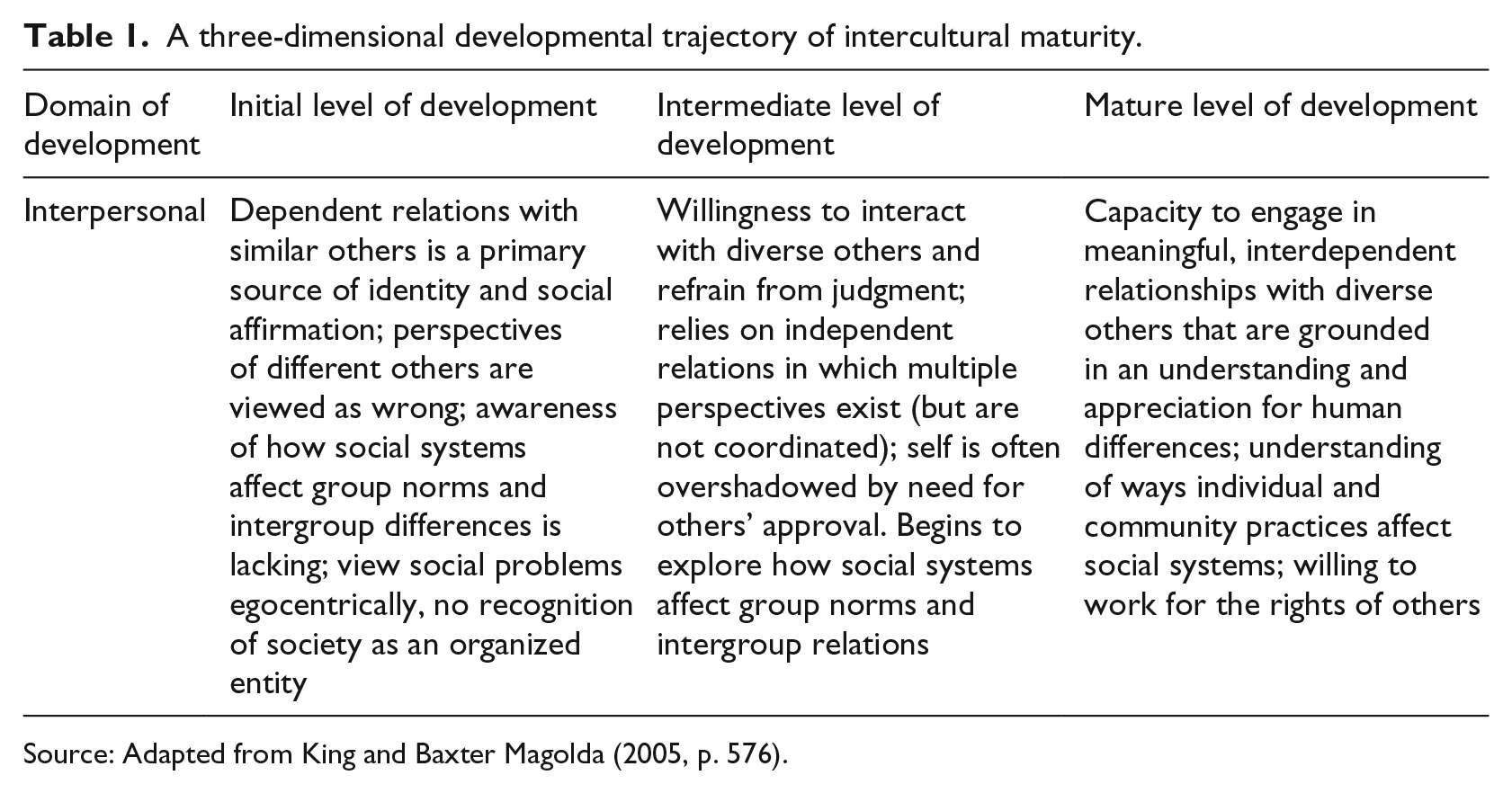
The experience of going overseas to engage in a fully immersive intercultural exchange and then returning home, somehow changed, may be best understood through a theoretical framework. This study relied on both intercultural maturity and transformative learning theories. Teachers today are being asked to interpret cultural differences in complex ways, working toward “an expanded understanding of one’s own and other cultures and an increased competence in intercultural relations” (Hammer, Bennett, & Wiseman, 2003). An intercultural overseas journey has the potential to move one from an ethnocentric understanding of other cultures to a more ethnorelative understanding. In King and Baxter Magolda’s (2005) multifaceted intercultural maturity model, ethnocentrism and ethnorelativism can be understood as how one sees the world (cognition), themselves (intrapersonal) and their own (interdependent) agency. An example of progressing through the interpersonal domain is illustrated in Table 1.
A three-dimensional developmental trajectory of intercultural maturity.
Source: Adapted from King and Baxter Magolda (2005, p. 576).
Mezirow (1997) observes that adults have already acquired a coherent body of experiences that define their lives; these span associations, concepts, values, feelings, and conditioned responses. He further specifies that transformative learners move toward a frame of reference that is “more inclusive, discriminating, self-reflective, and integrative of experience” (p. 5). While frames of reference are primarily a result of cultural assimilation and the influence of primary caregivers, Mezirow states that individuals can transform ethnocentric habits by becoming aware and culturally reflective outside of their existing frames of reference (i.e., in new cultural experiences). The four processes of transformative learning are to elaborate an existing point of view, establish new points of view, transform our point of view, and transform our ethnocentric habit of mind. Furthermore, researchers have emphasized discourse, social engagement, and critical reflection as invaluable to transformative learning (Mezirow, 1997; Stachowski & Mahan, 1998).
Researcher positionality
I experienced this exchange alongside participants as a member of the choir, speaking and connecting with Sophia, Avery, Lawrence, and Bridget each day. Through shared experiences, I grew close to the participants and other choir members—as a “family,” as Avery put it in one interview. Throughout the camp, singers spoke openly about their experiences with one another and I was candid and cordial in these conversations. My role as a choir mate had no known effect on participant responses and study findings. The depth of my relationship with participants as well as my own related experience as a singer in the choir seemed to allow for greater richness in interviews and greater “analytic sensitivity” (Corbin & Strauss, 2015) in working with data.
Findings
This study reveals that the camp influenced teacher understandings and practices in many ways. To answer the first research question, experiences are described under three emergent themes: (1) navigating race, privilege, and prejudice; (2) valuing shared experiences; and (3) expanding through South African music. Teacher implications and implementation are discussed to answer the second research question.
Navigating race, privilege, and prejudice
Processing racial tension and privilege/whiteness
Given the racial divide still present in South Africa, it was not surprising that participant’s queries over race, prejudice, and privilege became a salient theme throughout the camp and especially during the first couple weeks as we transitioned between disparate communities and audiences. Experiencing varied tensions and disorientations firsthand put the teachers face-to-face with the country’s history of injustice. For example, teachers reflected on being laughed at by black audience members in an early performance, being glared at by white South Africans while walking through a village alongside black choir mates and the explicit lack of integration between white and black people in various communities. These experiences, often shared with black South Africans, brought participants to think deeply about racial relations in South Africa and the United States.
In discussing dissonant and consonant experiences, participants actively reflected on their own privilege and whiteness both in and outside of interviews. Sophia reflected on feeling uncomfortable in her first interactions with a black audience: “I wasn’t prepared to speak the language . . . that was a time when I felt very aware of me being this privileged white girl coming in and being like oh, I can’t even freaking say ‘how are you,’ you know?” Discomfort during one homestay in Zebediela, a rural and impoverished area of the Limpopo region, left participants feeling not just aware of privilege, but humbled. Lawrence reflected afterwards: “the struggles I have had are so different . . . I’ve not experienced the things that the people in this country have experienced. And I admire the culture—the black culture here.”
Participants also explored what it meant to be a white South African. After visiting two black areas of the Limpopo region, the camp choir performed and stayed for one night in Haenertsburg, a predominantly white and Afrikaans town in the North. Sophia processed her initial judgment toward the white, privileged community there: We’ve had four nights with these wonderful families—who were black. And then to spend an evening with a white family, and singing for a white people, I was so aware of it and I was kind of like, I don’t know what the word is: resentful? I’m like, I don’t want to waste my time doing this and [I ended up having] a lovely conversation with one gentleman during intermission and that was very helpful.
Ultimately, the segregation in Cape Town was the most jarring to participants. Avery voiced surprise to know that most white South Africans had never seen the townships: Really? They have to drive through it . . . the parallel to that back home would be, you don’t find a lot of white people going to Harlem or just walking around in the ghetto somewhere . . . However, it was just initially baffling to us that people who lived just 5-10 minutes down the road never actually really see. And so my first reaction was, what, is it just overwhelming guilt? People don’t want to see it?
Being the change/making a difference
A striking emphasis throughout the trip was the desire to make a difference in racial and cultural inequality—both in South Africa and in the United States. Lawrence reflected after the performance in Haenertsburg, “But it seems like they can then take that energy that was in that room—that accepting energy of whoever and it doesn’t matter who it is, and maybe it will start to spread a little bit further.” Avery shared, “I felt that, for me, it was perhaps the most groundbreaking experience where I felt like we had a job to do.” Later, she remarked: “We’ve been like the seed planted, and there’s just this tree growing from that seed—amazing conversation and enlightenment—and we’re helping other people to join in.” Sophia also reflected on a performance shared with a white Afrikaans high school choir: “We were the teachers, which I loved. I felt that really, really strongly.” This emerged as a clear purpose for being on this trip for all participants.
Valuing shared experiences
Homestays
At the heart of this camp were the regular interactions that took place between diverse individuals. While many discussions centered on race and privilege in the first part of the camp, reflections on the importance of human connectivity were most prominent in the last week. Avery stated, “I realized that my priority is the human connection.” Bridget confirmed, “relationships, connections, personal interactions: that’s what really sticks out on this trip.”
Participants shared moving memories about their time with families. Avery reflected, “we have gotten some really moving e-mails or greetings on the way out, things like . . . ’we feel like angels came to our house and this will be life changing’.” Lawrence shared in a follow-up interview, “the homestays that Avery and I stayed with were some of the best people I’ve ever met in my life, and I just felt so much joy . . . I felt like they were grateful that we were there.” When asked about the strengths of the camp after returning home, all participants emphasized the importance of the homestay experiences. Avery stated, “I appreciated that level of authenticity that just comes with being with the people. Staying with the people. The immersion concept.”
Within-choir connections
Participants reflected about within-choir connections and learning from the camp leaders. Some reflected on the depth of relationships, especially by the end of the camp. On an evening out for dinner and live music at a restaurant in Cape Town, Bridget reflected, We were at Marcos—I mean that night, I am still reflecting two days later because I think it was the pinnacle of complete and utter organic happiness. And I can’t, I will never be able to recreate it, no watching of any video will make me feel that same way or make anybody feel that same way, but it was palpable in the room. [One of our leaders] was just saying at breakfast, he looked up at one point and there were four interracial [couples dancing from our choir] and to see that in a society in South Africa and in the U.S. that is so segregated still, even though it’s not illegal, it’s still, it was just incredible and beautiful that we can meet each other and in three weeks feel that comfortable.
Lawrence also emphasized connections within the choir: The little stories and differences in all of our personalities are the things I’m really reflecting on at most times of the day when we’re not out and about. . .these very people we’re spending all this time with are so wonderful and so different. And I think every single person I’ve learned and will continue after this trip to have lessons from. The more I chat with people, the more I know that it’s so incredibly beautiful. That’s really the drill in my head is more about this camp, it’s not necessarily about the music.
Participants also expressed gratitude for learning from the black South African choir members. Bridget stated, “the different music was really eye opening for me, having two teachers from two separate areas of South Africa.” Sophia emphasized that “having the South Africans sing with us” was important.
Discourse
Participants were grateful for the deep conversations that occurred over the course of the camp. Sophia reflected on the importance of dialogue during the first focus group: “So to have these conversations freely . . . I’m very grateful for that and happy. I think that’s what we lack in the United States.” Toward the end of the camp, she shared, I feel probably a regret I’ll have is that I didn’t have more conversations . . . For me, it’s not shying away . . . and I’m not even talking deep conversations, just conversations with people and getting to know people as humans, and not just lumped in a group of a-type-of-person who is just different than me.
Avery reflected, “I wish we could be having [these conversations] back home, but people are just too uncomfortable.”
Expanding through South African music
Challenges in teaching, learning and performing
Participants discussed the varied challenges involved with learning a foreign music throughout the trip. For Lawrence, Avery and Sophia, not enough formal discussion was provided on the history and context of the music. Lawrence reflected on the initial pace of learning: “I think we were rushed in our rehearsal time—on getting some back-story of all the different cultures of music that we’re doing . . . I feel ill prepared completely in the music in general.” Avery also reflected, “It felt [at times] like we didn’t really know the language well or we didn’t know the true meaning.” Further, Sophia offered a specific example: “So the fact that when we sing Fiela, people know that. Why? How? What’s that song? . . . why is that a song that people are singing?” In a follow-up interview, she shared that she had a list of unanswered questions on her phone.
Sophia and Avery were both callers/soloists on tour and reflected on the challenges of “getting it right.” Avery shared, My soprano sisters helped me a lot when I was feeling shy and unsure of a six note solo . . . this was a wonderful experience for me, first of all, because I had such great mentors and teachers in my group . . . I felt like I had a voice and I contributed to this group because it was such a shared experience.
Sophia offered, I’m so much more comfortable being a conductor than a singer. That’s really interesting to say because in South African music, the vocal leader is essentially the conductor. So if I think about it that way, that’s fine—then I feel more comfortable with it. But the first few times, because I am who I am, I was so concerned and worried about doing [my solo/call] right and, how many times should I do it? How many—where, when, you know—how do I know when to end? And I have so relaxed into it now that I have a general idea . . . but I really was anxious about it. I wasn’t enjoying that part of that—and having that responsibility.
All participants found it challenging to plan ahead for how South African choral music could be implemented at home.
Authenticity
Authenticity and what is meant by this term was a topic of discussion. Each participant observed the nature of the music and its stylistic traits throughout the camp. Sophia discussed, I think some of our misconceptions going into it of what that sound is—because what that sound really is—is head register with a lot of full sound, with a lot of depth and fullness as opposed to chest register . . . I said, “gosh, the sound is so rich here in Cape Town I’m just really noticing a change [from the North]” and [our leader] said “yeah, that’s true, but you’ll also notice everything is pitched much lower so the Sopranos are never singing where Polokwane’s choirs are singing which is high, high, high.”
Bridget reflected, “they could have started on the wrong foot, they could have ended on the wrong foot and I would have never noticed. Because it’s the feeling that is evoked from the music.”
Participants also observed the way the music was learned and shared in South Africa. Avery noted, “they don’t have that same distinction between performers and audience. Everyone is experiencing music, everyone’s feeling it. People chime in, people start singing along. It’s just different here.” Lawrence echoed this, “I’m learning that they’re not audiences. Everyone’s just a part of the music.” He further recognized, “I just know that they don’t have music in schools—in main schools. So, a lot of this is done at church and at family, growing up . . . there’s not necessarily this active teaching. They’re just here growing up.”
Upon returning home, Bridget reflected on the benefits of authentic experiences and how this camp and the music she learned has brought greater authenticity to her teaching: It’s not authentic if you’re reading it from a score and the amount of people that don’t know that makes me all the more connected to the fact that I do know it and that my students know that this is how you authentically sing this genre.
Gaining contextual clarity
Participants reflected often on the dynamic nature of the music in social contexts. Some expressed how new and varied understandings of the culture—history, politics, and traditions—would change how they would bring the music back. For example, Avery shared how she previously perceived the South African National Anthem, featuring five national languages, as an exemplar of unity. During the camp, however, she realized that not all citizens embraced it: I didn’t know until coming here that there is as much tension regarding the National Anthem—and in general the political, in the state right now—as there is. I would perhaps teach that a little differently back in my classroom.
While participants regularly discussed context in relation to the music, significant conversation also centered around the culture in general. Lawrence reflected, Having poverty and places where there is not really a lot of material things, the importance of family and playing games and learning together and going to church and singing together and just ultimately the village vibe—where everyone’s kind of together, working together—is so strong here. And where I live, there’s so much separation, even in families. . .there’s a huge, huge, difference between the community and the culture here and the community and the culture where I am.
Music educator implications and implementation
Implications
As participants reflected on the implications of their learning, each spoke about the importance of immersion. For all four, firsthand experiences were acknowledged as essential to deep learning. Avery reflected, “no amount of research on the internet or in the books can really paint that full picture of what the people experience and the current standing of anything, the culture.” Lawrence shared, I’ve seen things on television, I’ve seen pictures in magazines, on the internet, documentaries, but it’s easy to just see that and not really understand it on any level—and I’m not arguing that I understand it at any level—but seeing it firsthand kind of opens my eyes a little bit wider. That has really stuck out: completely grown my appreciation and gratefulness.
Lawrence also described the immersion as “unbelievably emotional” and offered that learning about a culture from afar is “just easier.” Participants expressed how the constant immersion was tiring but were extremely grateful for the “genuine camaraderie” it yielded. Avery reflected, “it was sort of exhausting at first being in a different environment and experiencing everything for the first time every day, but it was so stimulating and I went back considering it a once in a life time opportunity.” She reflected, So if I had just seen it, you know done the full tour of South Africa and stayed in hotels the whole time or still in our protective bubbles, I don’t think it would have had the same impact. It certainly would have had an impact still but being in the villages with the families, sharing those experiences with them, that was humbling and that’s probably what brought me to bring these changes in my classroom.
Teachers often reflected on the field of music education and what implications this experience would have for others. Realizing not everyone can afford to take a trip of this nature, some stressed the importance that music teachers find firsthand sources. Some participants reflected at the end of the camp on how they wanted others—such as their work colleagues—to experience this kind of exposure. Avery offered, “I think someone needs to experience that passion and purpose that we have witnessed on this trip to really make that a priority in their teaching.”
Implementation
During camp, all participants expressed hopes of bringing new ideas and music home. Lawrence was particularly moved by some of the Black South African singers in our choir: I am very excited to get back into the world of creating different ideas and doing things . . . there was a melody that [he] wrote and he was teaching me . . . I have no idea what time signature it was in—it’s not in a time signature—it’s just a melodic idea that changes and is all over the place and is so incredibly beautiful, and I love that.
Some also discussed ideas, aware that they were unlikely to be fully possible or realistic. While Lawrence had a few clear ideas, he was aware that implementing them in an instrumental setting would be difficult. In focus group interviews, participants discussed how to modify the music “to meet our students where they are” and “bridge the gap and find somewhere in between that’s going to make it successful in the situation that you’re in.”
Camp experiences mainly affirmed participants’ teaching philosophies, particularly regarding music’s ability to build unified communities and to build individual self-confidence and self-expression. Avery shared, “being here. . .gave me permission to make teaching human or community skills a priority—like empathy or team work, patience, working together.” Bridget reflected, It has also affirmed my philosophy . . . not only [to] be teaching notes on a page but to be teaching kids to have a voice—and how to find their own voice. And I think the culture of singing in South Africa is legitimately that, because black South Africans do not have a voice still.
Witnessing music taught in different ways, participants were further encouraged to try new approaches in their classrooms or to take a step further with ideas they had already tried. Avery concluded, “it would be very hard for me to go back and teach anything without purpose . . . everything I’ve seen here has been done with purpose and passion and feeling and expression.” In how to teach South African music, Sophia processed, “It’s more of like let’s get to the point of community . . . you’re going to get it eventually so let’s just keep going . . . encouraging the discomfort.” She confirmed a shift in her teaching upon returning in that she was more relaxed about students getting it “right”: “I feel more patient now . . . like, oh that kid’s not really matching pitch yet. It’s fine, we’ll get there. It’s all good.” Bridget stated that one of the South Africa conductors was particularly influential in shifting the way she conducted her own rehearsals, describing newly implemented practices that better support choristers who are struggling to learn at the pace of their peers.
In follow-up interviews 2 months after the camp, Bridget and Avery spoke of teaching their students repertoire learned at camp, and Sophia shared plans to do the same in the near future. On the latter, Sophia discussed her hope to teach two simple South African songs not only to her choirs, but to their families and community at an upcoming concert so as to emulate the participatory nature of South African music. These three women emphasized increased confidence in teaching South African music due to the immersive, authentic experiences with the camp choir. With the exception of Lawrence, participants also taught South African music not sung on tour. Each reflected on a heightened dedication to teaching the music respectfully and accurately. Bridget shared, “it has changed for me since the trip, because I feel more strongly now that people shouldn’t do things that they don’t know about.” Sophia stated on the South African arrangement she was teaching, “I am so on them about knowing what language it’s in, where it’s from, what it’s about.”
Influences of the trip went far beyond repertoire. For example, Avery used pictures and videos from her travels to support discussions in class: We had some discussions on the culture. I [asked] the kids: “so what do you think”—I showed some pictures we saw driving through [the township]—and I said, “if you grew up here and this was your home, what do you think your everyday life experience would be like?” Or “how would you feel” or whatever, and a lot of the kids said, “oh I’d be really sad” and all these things, but then I said, “look at the performance—did they look sad?”
Avery concluded, “I really did feel as though we established a stronger sense of community in our classroom as a result of having those conversations.” Lawrence, the lone band director, did not share South African songs or related pedagogies after the camp, offering, “If I was still teaching vocal music I think it would impact how I teach immensely.” However, he said that the trip had caused related shifts: Ok. I will say I have less patience for my students because they’re kind of pissing me off with their entitled attitude . . . I think this trip has made me less ok . . . with these privileged children having terrible attitudes and not being grateful. At all. For what they have. Because, shit man, some of those kids had nothing.
Participants shared that the trip had impacted them in various personal ways, noting increased tolerance, patience, kindness, confidence and hope. Avery shared, “More tolerance, more openness, more acceptance, even just with friends and family . . . I have become more of an open and patient person.” Lawrence reflected, “it makes me want to be more friendly to other races, period . . . just the constant friendliness and welcoming energy from the people [in South Africa]: that impacted the way that I want to be.”
Discussion
Findings indicate that shared intercultural experiences throughout the camp—at times of a vulnerable nature—deepened teachers’ understanding of culture, diverse others and diverse musics, as well as ultimately improved their teaching. Their experiences helped to expand their notions of musicianship beyond Western art paradigms, similar to the findings in prior research (Burton et al., 2013; Westerlund et al., 2015). Specifically in this camp, exposure to different conducting practices, creative improvisation, and performer-audience dynamics highlighted diverse ways to rehearse and perform. Indeed, Sophia elaborated on the striking difference between a US conductor at the podium and a South African conductor as the vocal leader. Lawrence talked about his intrigue over the way a choirmate improvised—unlike what he had ever heard before, in meters he couldn’t identify by ear—and both Lawrence and Avery experienced and observed the joy of a participatory audience, with South African audiences regularly joining in to sing and dance with choirs on stage. Like some who attended a music camp in Ghana (Hebert & Saether, 2014), three of the participants also voiced gratitude for networking, further holding intentions to reach out to South African choir members as culture bearers in the future. Indeed, while participants were uncertain how their learning would manifest upon return to the United States, they were able to develop confidence in the music as the camp progressed and brainstorm teaching ideas during interviews.
Unlike other research that has examined music teacher experiences during intercultural music exchanges, this study uniquely looked at how participants perceived they had changed personally and professionally post-exchange. In follow-up interviews, Sophia stated that the exchange had “stretched” her, further offering, “I feel fuller. I feel more connected.” Also back in the United States, Avery described the camp as “a major growth experience.” In the end, Bridget, Avery and Sophia reported successful implementation of South African choral music and related pedagogies in their first 2 months of teaching post-experience. Such assimilation into practice may not have been possible without extended immersion and reflexivity (Patterson, 2014; Talbert-Johnson, 2009).
Fundamentally, professional development of this nature is about much more than learning world music or a new pedagogical approach; rather, it is about shifts in how one sees culture and his or her role within an increasingly heterogeneous society. In considering intercultural maturity (King & Baxter Magolda, 2005), participants were quite mature and ethnorelative prior to the camp. That stated, the intercultural nature of this camp—more multicultural than what participants typically experience at home—augmented interpersonal maturity and teachers’ capacity to engage in meaningful relationship with diverse others. Upon returning to America, participants reported varied awareness and appreciation for human differences. This camp also challenged participant worldviews and beliefs and brought individuals to think more deeply about culture. Bridget reflected, Culture is a vast and almost a—unable to be fully comprehended—concept. Culture is ever changing first of all . . . I think it kind of challenged my idea of culture since we’ve been here. It is a complex thing that cannot be fully figured out in one visit to one part of one country, in an entire continent.
Future research is needed on how intercultural exchanges influence the intercultural maturity of in-service and young adult music teachers, who may or may not begin such exchanges from an ethnocentric point of view.
Each participant sought and experienced transformative learning (Mezirow, 1997), regularly participating in active and reflective discussions and coming to a deepened and critical understanding of themselves in relation to society. As per Mezirow’s four processes of transformative learning, participants elaborated on pre-existing points of view through discourse with choirmates and community members during the camp as well as in interviews. An example of this is Avery articulating her previous misconception that South Africans were united across differences and that the multi-language national anthem was an indication of this. Through discourse, participants established and transformed new points of view; indeed, Avery acknowledged the intercultural tension still present in South Africa and voiced her intention to teach the National Anthem differently upon return home. As another example, Sophia’s point of view that white South Africans were ignorant or prejudiced in some way was challenged and transformed in Haenertsburg when she engaged in illuminating conversations. It is worth emphasizing that the interviews themselves were a meaningful tool for transformative learning, with three of the participants voicing appreciation for the time to reflect during interviews.
There is evidence that this camp contributed to the transformation of ethnocentric habit of mind, which Mezirow (1997) describes as “broad, abstract, orienting ways of thinking, feeling, and acting” (p. 6). For example, while the four participants’ rationale for attending the camp was not originally to take a stand against cultural inequality, each music teacher quickly realized a desire to make a difference through their presence in concerts and homestay visits, for example by being “the teachers” to Afrikaans high school students or “planting the seed” and “helping other people to join in” to intercultural exchange and acceptance. Every music teacher remarked in their follow-up interviews in the United States that they were prioritizing and standing up for togetherness across diversity in and/or outside of their classroom in some way.
Related, in a follow-up interview, Lawrence stated that it was the welcoming homestays and community members in South Africa that he felt had triggered his new found manner of being intentionally friendly and welcoming to people of different races in the United States. This may be an example of a transformed ethnocentric habit of mind, and is certainly an example of increased interpersonal intercultural maturity. In a separate follow-up interview, Avery also emphasized the impact of being welcomed into homes and communities, stating that these experiences triggered not only related actions in her own classroom and community, but hope for what might be possible in the United States. In addition, meaningful intercultural experiences, like that at Marcos restaurant discussed by Bridget, likely contributed to new or deepened commitments to unity across difference.
Avery, Bridget, and Sophia noted a shift in their teaching, with new elements of passion, community, and patience. These pedagogical shifts, which could be interpreted as a transformation of ethnocentric habit of mind, were influenced by learning and performing with the choir in South Africa. In a follow-up interview, Sophia stated that witnessing and experiencing community across choirs and audiences in South Africa was “life changing” and impacted her new attempts to build community through music with her choirs in the United States. Ultimately, this study exemplifies Mezirow’s theory by illuminating how an immersive experience that challenged music teacher’s cultural norms sparked cultural reflectiveness outside of their existing frames of reference. All four teachers emphasized the importance of this immersive exchange, and the conversations and reflection that ensued, for impacting their development.
Some camp experiences and related influences were non-musical in nature. For example, homestay experiences led to a developed understanding of South African culture and appreciation for shared experiences with diverse others. However, most homestay families were members of churches and communities that attended the choir concerts—at times choral singers themselves. These meetings and extended time together would not have been possible without the music making. Avery offered, Music is the connecting source there. Music is what has given us the opportunity to come together and so, I’d be remiss if I did not mention that music was really the reason that I had this opportunity to talk to these families . . . it is the universal gateway into making connections.
Unique opportunities for diverse choir mates to sing, create and discuss music and culture together were presented due to the choir’s short 3-week existence. For intercultural exchanges without music, not like this choir camp, one can wonder whether or not such deep understanding and communication would be possible between diverse individuals, or at least possible in the same ways. In the end, the immersive nature of this camp—with an intercultural choir who rehearsed, performed and traveled as a team, performed with other South African choirs, and stayed with numerous diverse homestays—regular opportunities to reflect on experience and time to deepen learning led to meaningful growth that impacted participants in their personal and professional lives.
Footnotes
Declaration of conflicting interests
The author(s) declared no potential conflicts of interest with respect to the research, authorship, and/or publication of this article.
Funding
The author(s) received no financial support for the research, authorship, and/or publication of this article.
