




Abstract
Participating in large-scale musical performances as part of a secondary school ensemble can be exhilarating. Although students experience such events differently, emotional state is not uniform throughout the process. Developing musicians may put themselves under pressure to perform well and once the event is over, the feelings of anxiety and anticipation are replaced by relief, euphoria or in some cases, melancholy. These emotional reactions can impact the desire to attend subsequent rehearsals and performance projects. Three student members of a school choir reflected on their emotional state from the early part of the rehearsal process to the post-event period. Semi-structured interviews were conducted, transcribed and thematically analysed. Findings address the five phases of the performance process: early rehearsals, later rehearsals, the performance, immediately after the event, and the aftermath. Recommendations for secondary school music ensemble conductors encourage lifelong learning of adolescent ensemble musicians through understanding fluctuating emotions connected with performance.
Introduction
Student musicians invest emotionally in large-scale performance projects. Such performances can be exhilarating with a build-up of resources, time and energy that culminate in life-changing moments (Adderley et al., 2003). Heightened feelings including euphoria are common for adolescents making music that is the culmination of commitment and hard work (Gouws & Kruger, 2014). Fleeting moments of euphoria replaced by counter emotions can manifest as sadness, loss, or depression (Bodner & Bensimon, 2008). The process from first rehearsal to performance and contemplation of future music making involves fluctuating emotional states. Negative emotions can be a reaction against a heightened emotional state experienced in a performance, described as a peak experience (Maslow, 1971), as an epiphany (Ansdell, 2005), as a spiritual sensation (Jampel, 2007). For some musicians, feelings of pressure are replaced by strong sensations of relief after the performance (Stoeber & Eismann, 2007). Understanding the change in emotion and resultant motivation allows ensemble conductors to engage critically with their musicians’ psychology and more effectively encourage lifelong learning. The purpose of this study is to explore the lived experience of post-performance for school-aged ensemble musicians. This part of the performance process is often ignored and little understood.
Much of the literature exploring emotion and musical performance focuses on the period prior to (Beck et al., 2006), and during the event (Kenny, 2006; Osborne & Kenny, 2008; Sinden, 1999). Performance anxiety (Kenny & Ackermann, 2015; Spahn et al., 2016), and emotional responses to listening to music (Bhatti et al., 2016; Cotter et al., 2018), are also frequently addressed. There is a need to understand the period following the performance better, particularly with adolescents as post-euphoric emotions can manifest as melancholy. Students experiencing negative emotions and a lack of motivation may elect to discontinue, exacerbating issues of student attrition (Sandene, 1994). Vallerand and Ratelle (2002) observe that demotivation often manifests as reduced focus and engagement with the activity before withdrawing completely.
Adolescent music making
A multiplicity of factors determine the extent to which adolescents enjoy performing in music ensembles. For performances projects that are considered as being important, performance anxiety can inhibit the enjoyment factor (Khalsa et al., 2009; LeBlanc et al., 1997). Furthermore, negative thoughts about a performance following the event can produce a recurring cycle of performance anxiety (Nielsen et al., 2017). Anxiety can reach peak levels during the performance. What follows, is a need to return to normalcy, however; the motivating factor of the approaching performance is removed, providing a sense of loss (Bodner & Bensimon, 2008). Young musicians who experience increased desire for performance perfection can experience anxiety (Patston & Osborne, 2016). Performance anxiety with musicians can manifest; as overt physiological arousal such as increased heart rate, sweating, and dry mouth, apprehension and a fear of making mistakes, and a decrease in performance standard owing to trembling or memory slips (Abel & Larkin, 1990).
Psychologists Robert Yerkes and John Dillingham Dodson examined the link between performance and arousal. The influential Yerkes-Dodson Law (Yerkes & Dodson, 1908) suggests that increased arousal helps with performance; however, excessive arousal can diminish performance. Yerkes and Dodson assert that an optimal level of stress can aid focus and lead to motivation. Individuals will likely experience arousal differently from the same stimulus, and in the case of music ensembles in schools, the number of variables that exist outside of the performance project will influence overall levels of arousal. More recent scholars question the universal applicability of the Yerkes-Dodson Law. Kenny et. al. (2004) proposes a modified model of music performance anxiety based on the development of social phobia. Kenny (2016) offers a model of the development, maintenance, and avoidance of music performance anxiety. The participants in this study did not experience fear, alarm, or apprehension. Rather, they perceived their generalised biological and psychological vulnerability, but this was not debilitating and they circumvented performance anxiety to attain successful performance through thorough and careful preparation and coaching.
According to Bodner and Bensimon (2008), a ‘depressive syndrome includes an increase in negative feelings and a decrease in the person’s self-esteem’ (p. 175). Depression may manifest in adolescents in a variety of ways. Robson and Gillies (1987) assert that Post-performance depression is characterized by sadness, crying bouts, anxiety and panic attacks in some individuals, anhedonia or lack of interest, lethargy, fatigue, excessive sleeping, truancy or failure to attend class or coaching, failure to complete home-work assignments, suicidal ideation and, in some instances, serious suicidal attempts. (p. 137)
Robson and Gillies (1987) discuss the sense of loss that follows a performance. If the camaraderie of a production is replaced by loneliness, and purpose is replaced by lack of direction, artists can be left with unexpected emotions in stark contrast to the anticipation of an important event. While Robson and Gillies recommend early education for dealing with emotional fluctuations, Bodner and Bensimon acknowledge that no psychological treatment for post-performance depression has been proposed.
Although music is widely discussed as a useful tool to counter depression, a melancholic state manifest following a heightened state experienced during musical performance can be triggered by a variety of reasons. Teenagers who place themselves under pressure to perform well may feel that their efforts were unsatisfactory (Krumboltz, 2009). It is also possible that the build-up of the performance event did not live up to the expectations of the performer, leading to disappointment (Wilson & Roland, 2002). A lack of positive feedback for the ensemble member can also bring about disenchantment (Matthews & Kitsantas, 2013; Sutherland, 2018). Each of these triggers can result in varying degrees of negative emotions depending on the individual and their unique circumstances.
Exploring the emotional state of adolescent musicians following the heightened state experienced in performance may provide school ensemble conductors with more in-depth understanding of students’ experiences and emotions following a major performance. Stothert (2012) recommended research in this area in their work on performance anxiety. The research question is; ‘How is motivation effected by emotion throughout the rehearsal and performance process in school ensemble musicians?’ For the purposes of this study, the term ‘student musician’ refers to secondary school musicians belonging to an ensemble, led by an adult conductor.
Methodology
Background
The participants attend a long established, boys’ secondary school in England. The school offers a comprehensive music programme with a wide range of ensembles that perform at a high standard. The students, many of whom sing regularly as well as playing multiple instruments, take music very seriously. As part of its busy musical calendar, the school Music Department operates an annual concert which brings together all of the school choristers, which number around 100–120, choristers from a nearby girls’ school, adult singers from the staff and local community, which brings the total number of singers to around 200, and an orchestra. The orchestra is comprised mainly of professional musicians, hired for the occasion as well as several capable students. The Head of Music conducted the performance as he has for the past 14 years.
The concert occurred at the end of the Lent term, the shortest term of the year and rehearsals ran over a 10-week period. The performance took place in a large venue on the school campus. Rehearsals during the term were largely carried out as sectional rehearsals in the evenings with trebles and altos rehearsing separately from the tenors and basses. The girls from the neighbouring school and the participating adults each rehearsed separately. In the final week leading up to the performance, the choir amalgamated. The orchestra and soloists were introduced to the choir at the dress rehearsal on the day of the concert.
Data collection and analysis
Initial ethical approval was provided by Monash University. Once the Head Master of the school and the Head of Music gave permission, the Head of Music sent explanatory statements that outlined the parameters of the research, and consent and assent forms to parents and students respectively. Once signed and returned the first author conducted semi-structured interviews with three student musicians as well as the conductor of the performance who is also Head of Music. Following an invitation from the conductor, three choristers from the school volunteered to participate and answer questions about the performance and their emotional state. Adult singers were not invited for interview as a homogeneous sample was sought. The Head of Music arranged suitable times for the three volunteers to be interviewed. The individual interviews occurred sequentially in a school music room the day after a performance of a major choral and orchestral work. The timing of the interviews was important so that participants could most accurately remember the feelings of being involved in the performance and resultant emotional state. Open-ended questions were used to illicit descriptive responses to best understand the phenomenon through the perspective of the participant (Patton, 2015). Questions included were as follows: How did you feel while preparing for the performance? How did you feel immediately after the performance? Was the performance what you hoped for/expected it might be? How did you feel about attending the first rehearsal after the performance? Can you describe a time when you were least enthusiastic about being in the ensemble? These questions were supplemented with further questions to encourage extrapolation, more detailed description and clarification. The Conductor (Head of Music) was asked questions relating to student motivation, such as: What is the first rehearsal after a large-scale performance like? Can you describe your own level of enthusiasm for rehearsing the ensemble after a big performance? What techniques do you use to deal with flagging ensemble motivation?
The three participants provided highly descriptive and thoughtful responses in their respective hour-long interviews. As no new themes were arising, and the data could be effected by the passing of time, one interview was deemed appropriate. Pseudonyms are used for each participant and the school has been de-identified.
In this qualitative inquiry, a phenomenological stance was adopted which allows the lived experience of participants to be understood through the social constructivism worldview (Creswell & Poth, 2007). Identifying, connecting with, and finding meaning in human reality is the basis of phenomenology (Roller & Lavrakas, 2015). Phenomenological enquiry is usually carried out with a small number of homogeneous participants (Smith & Shinebourne, 2012). Data were analysed using Thematic Analysis (Patton, 2015) which is a flexible research tool, useful for providing a rich, detailed and complex account of the data (Braun & Clarke, 2006). This analysis methodology is appropriate for this study as it allows common threads to be identified across a set of interviews (DeSantis & Ugarriza, 2000). The process began during the interviews, when the interviewer made mental notes about important features that guided the semi-structured process (Aronson, 1995). During the process of transcribing the interviews, informal notes and ideas about the meaning of the text were added. Formal coding was possible following several readings of the transcripts, which provided thorough familiarity. Transcriptions of each interview maintained the voice of the participant. A column was created on the right-hand side of the text and sub-themes were identified by emphasis, repetition, and emotional import (Aronson, 1995). A re-examination of the sub-themes then revealed convergence and a smaller number of broader; overarching themes emerged that reflected the meaning of the transcript. Fragments of ideas or experiences can be meaningless when considered alone, but when pieced together, create a comprehensive picture of their collective experience (Leininger, 1985). The two authors agreed that the themes accurately represented the transcripts. Figure 1 indicates the interpretation of the sub-themes into overarching themes.
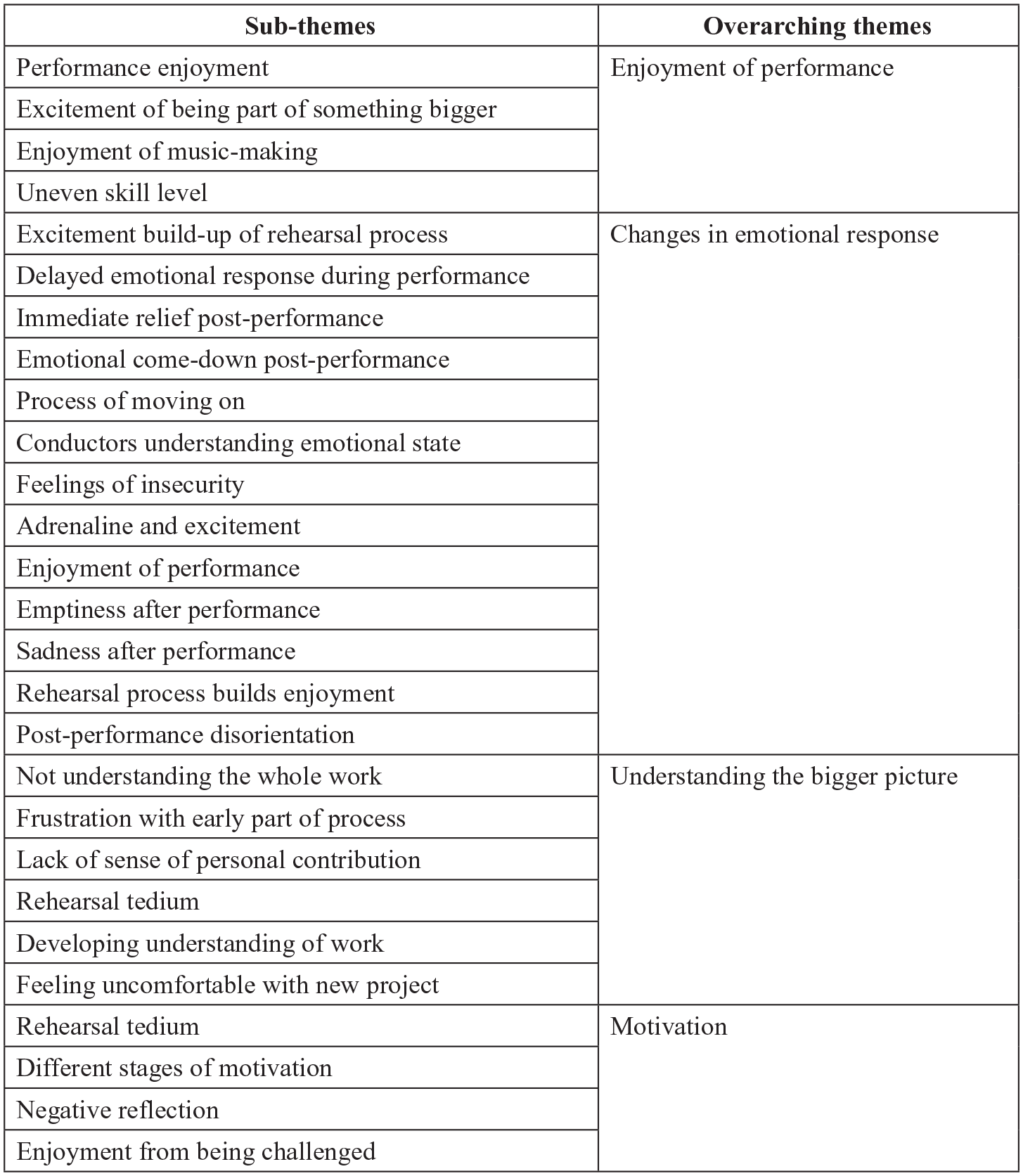
Sub-themes from three participants with interpreted overarching themes.
Participants
George has been involved in four performances with the Choral Society and is an experienced chorister. He was a chorister at a large Cathedral in England as a treble and has performed many large-scale choral works and enjoys experiencing a variety of music which he finds challenging. For this performance, he sang counter-tenor and is aged around 16.
Ivan has also been singing with the Choral Society for 4 years and performs with other school vocal ensembles and instrumental groups. Ivan also performs in theatre productions outside of the school. Ivan sang tenor and is around 16 years old.
Nicholas has performed four major works with the Choral Society also. As well as Classical singing, Nicholas enjoys performing popular music. He trained as a treble in a well-known English church choir, exposed to regular and high standard performance experiences. He now sings bass and is aged around 16.
Edward has been the Head of Music at the school for 14 years having previously been Head of Music at another school. He has conducted the Choral Society and other school music ensembles since arriving at the school. He enjoys directing large-scale orchestral and choral works and frequently performs a variety of works with the students.
Findings
Presentation of the participant responses are by the chronology of the performance process. Interview questions elicited responses about emotional state during different parts of the process. These are presented in five phases: early rehearsal period, later rehearsal period, the performance, immediately following the performance, and the aftermath and moving on. Providing specific times for changes of emotional state was inappropriate, as rigid parameters would less accurately reflect the individual experiences. The five phases are presented in turn, followed by discussion of lapses in motivation.
Phase 1: the early rehearsal period
George felt that the early rehearsals were ‘a real drag’. He was accustomed to the process having been involved with the ensemble for several years. He explained, ‘You get this huge score and it just seems like this is going to be a huge task and we’re just going to have to labour away at this . . ’. He reflected on not being able to understand the project as a whole in the early stages when working in sectional rehearsals on decontextualised sections, It was quite frustrating at times just to be working on small extracts and not to be able to hear the whole sound. ‘He felt that his enjoyment of learning the work in the early stages may have been enhanced by listening to the whole piece first’. He said, ‘It was quite frustrating at times just to be working on small extracts and not to be able to hear the whole sound and fully know the piece’. It was like that for quite a long time.
Ivan’s experience was multifaceted. He stated that learning the work ‘. . . was quite daunting, thinking, ‘are we actually going to be able to get through all of this?’’ He also experienced frustration during the early rehearsal period. ‘You’re frustrated; you need to catch up on work. Then you realise you have a rehearsal that night . . . that’s when I least enjoy it . . . when my mind-set’s not up there’. He found the purpose of the early rehearsals harder to appreciate. Countering feelings of uncertainty and frustration was the enjoyment of making music with his friends. He explained, ‘The earlier ones [rehearsals] are quite fun because we’re coming together as a big choir. I’ve got loads of friends who did it with me’.
Nicholas also struggled with motivation during the early rehearsal period. He stated, ‘The first few rehearsals were rough, especially when there’s just a few boys there on a Tuesday night and it’s dark outside’. In addition to environmental factors, he mentioned the struggle of learning complex music. He went on, ‘It’s really tough music and what you’re going to get out of it does seem like quite a long way away and it’s just slogging, trying to get through the notes, really difficult stuff’. The decontextalised rehearsals were an important factor, ‘You can’t really take any enjoyment from the music at that time because you’re doing very short sections and very split-up’. He explained, ‘You’re doing it note-by-note really so you have no appreciation at all. You might only have two lines so I don’t think you can appreciate the music at all at that point’.
Phase 2: the later rehearsal period
For George, the later rehearsals provided feelings of tedium. He explained, ‘I’d learned it and I just started to get frustrated and slightly irritable with the people around me who were a little bit slower’. As well as frustration with his fellow choristers, he found sectional rehearsals demotivational. He continued, ‘we were just doing it in sectionals; just the alto parts which at the time were quite weak. Just this feeling that it was never going to end; I’ve got to wait until the very end of March’. The combination of frustration and demotivation began to manifest in George’s behaviour, he described, ‘I was just trying to pull everyone else through and I was just starting to get tired I think people eventually started to find me irritating because I think sometimes I can be a little bit aggressive and snappy’. He felt aware of his unintentional reactions and was circumspect. He added, ‘I try not to and I’m aware that when someone makes a mistake I go . . . [sharp intake of breath], and people find that annoying which is fair enough’.
Ivan’s emotional state during the later rehearsals were not an important memory for him. He reiterated the experience of being unaware of the full effect the work could have. He stated, ‘I didn’t really know what the performance was going to be like because we never sung the whole thing through and obviously whenever we were rehearsing, there’s this huge story behind it’.
Nicholas explained that there was a noticeable change in the way he experienced rehearsals as they progressed. He explained, When you get closer to the performance, you realise things are hotting-up a bit because you have to get things right . . . it gets more serious and you start realising that it’s definitely going to be worth it.
Nicholas’ emotional state changed with the approaching performance. He said, The last few days when you have the most rehearsals together . . . that is when you take the most out of it . . . you feel maybe not pressure so much, but the anticipation and everyone coming together.
Phase 3: the performance
George was excited by the performance. The size of the combined choral and orchestral forces was an important part of his response. He stated, ‘I felt like I was part of something bigger, which is always exciting’. He then went on to add, ‘I love making music and it’s kind-of addictive’, which suggests that the euphoric feeling is something that he wants to experience regularly. He added, ‘There is something quite exhilarating about that which makes you want to keep going and you do it again’. He continued, ‘It was very exciting while you were doing it and just the few moments before when you feel the build-up and you can hear the orchestra and that’s always a great feeling’.
Ivan recalled numerous emotions throughout the performance, which he described as an ‘emotional rollercoaster’. He described his thoughts prior to the first down beat, ‘there was a rollercoaster in the performance as well and when we’re sitting down just before we’re about to start, you’re quite nervous, your brain is always saying, “This may go wrong”’. His nervousness changed to experience of flow-state in which he was able to focus on the music, ‘You have that real boost of energy’. ‘You don’t need to worry about anything because that doesn’t matter at the moment. I really like that’. This transformed to euphoria when the music was complete, which Ivan explained is ‘how I feel after any performance’.
For Nicholas, the enjoyment of the performance was through the reaction of the audience. He said, ‘It’s giving people pleasure; emotion which I think is just amazing’. As with George and Ivan, Nicholas also experienced a physical as well as emotional change during the performance. He stated, ‘I think at the beginning there’s a lot of adrenaline involved so you can compare it to similar things that you’ve been anticipating and looking forward to’.
Phase 4: immediately following the performance
When asked how he felt after the performance was over, George was succinct, ‘I would say relief’. For George, the sense of relief was quickly replaced by emotions that seemed to counter the euphoria from only moments earlier. He described the change, ‘and then I don’t know, I just had a massive come-down, just thinking, ‘that’s it now’’. He explained further, ‘As soon as the audience started clapping and everything just calmed down, I just thought, “OK, job done now, until next time”. I think my emotions were all cooped-up during the performance’. George experienced negative emotions when reflecting on the performance, . . . as soon as you’ve finished performing sometimes, the automatic thing is to go back and think about the negatives and you just think what you could have done better and I did feel a bit down after that.
Ivan also experienced a noticeable change in emotional state following the euphoria during the performance, which was ‘a huge adrenaline rush’. Initially, Ivan seemed to enjoy the audience response. He stated, ‘There’s that big pause once we finish and you haven’t quite clocked that you’ve done it and then once the audience starts clapping, there’s that huge applause and appreciation being given to you’. He went on, ‘I really enjoy that moment of being part of something huge and you’ve been able to share it with loads of people and they’ve all appreciated it and enjoyed it’.
Ivan recalled his change of emotional state, ‘I think once you’ve finished something, a few days afterwards . . . like whenever I finish a big performance, there’s always a sense of . . . I feel not empty but there’s something missing’. Ivan felt a sense of loss as he recalled, Where have all those rehearsals gone? You feel quite sad about that, it’s a bittersweet ending because you have the adrenaline and you’ve been working so hard towards it so all the pain and hard work that’s gone into it has had this amazing outcome but then you are quite sad in a way that you won’t get any of those rehearsals again and it’s over.
Nicholas felt he was able to accept the need to move on more readily. He said, ‘There’s a sense of let-down on your first day back . . . putting your mind to the next thing, whatever concert you’ve got next and just concentrating on that’. Nicholas has become aware of the change of emotions from previous experience. He explained, ‘I don’t think it’s so much dealing with it, more just accepting it, that this is the atmosphere after being involved in the concert’. He continued, ‘You remember the feeling but the pace that you move on and do new music, new repertoire, it’s not going to linger forever’. Nicholas’ ability to be circumspect may lie in the consideration of the next performance. He stated, ‘I think you can move on fairly quickly and very quickly you’re going to have to start preparing for the next thing coming on’.
Phase Five: the aftermath and moving on
Following the immediate post-period of around 24 hr, was a time for either further reflection or consideration of the future. George was able to recover relatively quickly from the emotional slump he experienced which he described as, ‘tough and you get the drop afterwards’. He found positivity in the responses from concert attendees. He said, ‘It was very brief. I’m feeling good about it now. It was just for the rest of that night, I thought ‘that’s done’, but in the morning people were still talking about it and you can see it afresh’.
He noted that recovering emotionally did not equate to forgetting. He said, ‘I won’t forget the experience, that’s certain but obviously I will forget the notes . . . so just the vague memory of the feeling will stay with me, of being part of it’. The prospect of starting the next project was positive. He proffered, ‘I think the energy would still be there because people would still be buzzing from the last performance . . . if you have the whole week to decompress, it feels like you’ve got to climb back up again’. George planned to be singing during the school holidays shortly after the interview and thinking about this may have enabled him to recover relatively quickly.
Ivan felt less ready to move his emotional investment in the performance. He explained, ‘Whenever we start a new piece, I feel like it’s replacing something. I don’t like that at first but obviously after a few days it becomes the new normal group’. He continued, ‘It was quite disturbing in a way. You’ve had this huge part of you and your time has gone into this and your mind-set has been only that so when you change it to something else, it’s not nice’. Ivan described the time it took him to recover, stating, ‘Once you finish a production or a performance, it’s always a few days after that adrenaline or emotion; what you’re feeling dies away and so as soon as you get into something else, you do feel uncomfortable about it’. He went on, ‘Once that becomes part of your daily routine or your mind-set, a few days, a few weeks maybe, that’s when the disturbing feeling stops in a way’.
Nicholas felt that the performance provided social cohesion, which he would miss. He reflected, ‘There’s a bit of sadness after the concert. You see people, you have a laugh with people and then for that to be over is a shame’. He felt that the best way to recover emotionally was to begin work on the next project. He explained, ‘You come back definitely refreshed and the let-down and the disappointment that the big thing is finished. You get over that and your ability to look forward; to get excited about the next thing’.
Nicholas felt that rest between events was important. ‘I think more than anything, just a bit of rest afterwards might be quite needed, especially if it’s been a big sing; a big concert’. When considering the next series of rehearsals, Nicholas has learned to consider the final outcome. He suggested, ‘I can’t say I’ll be too excited, but I think every time you do it, you realise you can take an awful lot from it. It definitely gets you more ready and excited for the slightly more mundane rehearsals’.
Motivation and emotion
Numerous factors affected the fluctuating emotions experienced by the participants. How the conductor reads the collective emotional state and responds further impacts individual motivation to remain engaged. The three student participants and the conductor discuss this process.
George explained that he likes ‘seeing the passion of a conductor. If you feel like they’re enjoying it and they want to do well and they want to create something really good, then that often helps’. This suggested that George responded to the emotional temperature of the conductor. He continued, ‘Obviously you get those dips in rehearsals and there are some conductors who just know what to do’. George indicated that some conductors are better at responding to emotional fatigue than others. He offered an example of an approach, suggesting that if ‘they’ve got a really good anecdote and they just try and lighten the atmosphere a little bit to make it less of a pressurised environment, [it] is helpful’.
Ivan agreed that humour can be helpful but also considers empathy critical. He stated, ‘I think it’s nice when the director or the conductor knows you’re tired and can possibly relate to you, saying, “Yeah, I’m tired as well”’. For Ivan, a lack of empathy can be damaging to morale. He proffered, ‘Obviously if they have no sympathy towards you and say, “I don’t care that you’re tired, we’re going to crack on”, then obviously you just lose all respect for them and say, “I’m not going to do this”’.
Nicholas discussed the impact of a frustrated conductor. He recalled ‘the conductor getting angry. That normally gets everybody together; maybe not in the right kind of way but I think it’s a pretty natural response, a pretty human response from the conductor’. Nicholas suggested that with projects with a longer rehearsal period, motivation strategies need to evolve. He stated that with, ‘. . . earlier rehearsals when your weeks out from it, I think getting angry then doesn’t help anybody’. He continued, ‘Trying to get the sense of motivation, anticipation and excitement so people are really looking forward to it, not dreading’. He noted the increase in tension prior to the performance, reflecting, ‘Yesterday afternoon, just a few hours before the concert, and people start doing things wrong, it must be pretty stressful for the conductor . . . and anger then is pretty understandable’.
Edward felt that motivation is linked to planning. He stated, ‘I think the thing is, again, motivation is making sure you plan your rehearsals carefully’. He acknowledged however that over the course of a long rehearsal period, this can be difficult. He says, making sure that you keep those motivation levels high . . . because you can’t . . . when you’re working over ten weeks, it’s easy for me to see overview but the boys can’t see really what the trajectory is.
Edward enjoyed the rehearsal period, and his ability to see the bigger picture allowed him to maintain motivation throughout the process. He continued, ‘Someone said to me when we were doing this, ‘We’re halfway through the term and we’ve hardly looked at any of the pages’’. Edward acknowledged that the view on musical progress was incongruent between himself and the singers.
Musical leadership involves taking responsibility for motivation. Edward claimed, ‘If the motivation drops or the rehearsal is not going as you want it to, there’s only one person to blame, it’s the conductor’. According to Edward, the role of the conductor involves responding to changes in motivation. He said, ‘You’ve got to make sure that you’re constantly re-evaluating what you do. It’s down to the person out the front to make sure the motivation is there, and you keep the boys engaged’. Edward described techniques for sustaining motivation, ‘I don’t let them get away with anything. I’m quite tough most of the time’. He aligned motivation with concentration and describes his technique, ‘If I feel that they are not concentrating and I think they could probably be doing better, [I become] really pedantic about a couple of small things’. He acknowledges that this technique ‘can either go really well or not’.
Discussion
Four important overarching themes emerged from the analysis of the transcripts: Enjoyment of performance, Changes in emotional response, Understanding the bigger picture, and Motivation. These will be discussed in turn.
Enjoyment of performance
The enjoyment of the performance experience was a common theme among the participants. Despite experiencing moments of tedium, frustration, loss, and other negative emotions, the willingness to go through it all again for the thrill of performance was shared. One participant suggested the experience was addictive, congruent with Ansdell (2005), and Jampel (2007). In support of the Yerkes-Dodson Law (Yerkes & Dodson, 1908), the boys described the nervousness and ‘emotional rollercoaster’ that manifested during the flow state experienced during the performance. The notion of audience appreciation immediately after the performance and in the days following was considered an important factor in coping with the sense of emptiness.
One of the limitations of this study is the relative experience these boys had with the process of preparing musically and emotionally for a large-scale event. They gave a sense of acceptance of the anticipated feelings of emptiness reflective of learned experiences. For these participants, experience with performing in a variety of ensembles has prepared them to expect the range of emotions throughout the process. At the time of interview, the joy of performing uniformly outweighed any negative emotions they encountered. Hallam et al. (2016) found that as musical expertise increases, so does motivation and that advanced secondary school musicians who had maintained self-motivation were almost obsessive. This is congruent with the three participants in this study who each expressed strong levels of musical engagement.
Changing emotional responses
Although the fluctuating emotions of the participants were not uniform, the three participants expressed shared elements of their emotional journey over the five stages of the performance process. Phase One was characterised by tedium and lack of motivation, Phase Two by frustration and anticipation, Phase Three by exhilaration and flow state, Phase Four by euphoria, relief and loss, and Phase Five by acceptance and recovery.
These changes in emotional response to performance reflect a unique convergence of factors, such as an increasing desire to achieve musical perfection (Stoeber & Eismann, 2007). Previous experience provided understanding that a heightened emotional state during performance was something to look forward to and helped with motivational issues in earlier stages. Performers valued public presentation highly and relied on strong memories of the performance experience to maintain motivation momentum (Lamont, 2012). The participants concurred with this notion and reference to positive audience response combined with powerful recollections of euphoria during the concert contributed to long-term engagement.
Understanding the bigger picture
The need for young musicians to understand the bigger picture was seen in response to two circumstances. The first involved the appreciation of the whole work, which was seen as important to enjoy the rehearsal process. The decontextualisation of the work into sectional rehearsals with careful focus on discreet musical passages was understood as necessary, but difficult to enjoy without knowing the complete context. Musicians progress more successfully when the overall shape of the piece of music was generally understood (Chaffin et al., 2003). Their study explored the process for individual performers but participants in this study support the notion in the large ensemble context.
The second circumstance was the understanding of the performances to follow. When finding something to replace a sense of loss, the participants who most clearly articulated what projects they were engaged with following this project seemed to recover most quickly from any feelings of emptiness. Expectations lead to predictions, which provoke actions that can be emotional, mental, or physical, which in turn influence our beliefs end future expectations (Cont, 2008). This cycle of expectation and anticipation can be broken if musicians are not allowed to envisage the next moment in which performance euphoria could be experienced.
Motivation
Although motivation to remain musically and emotionally engaged in the process does not derive exclusively from the conductor, all participants indicate that conductors largely inform the emotional state of the group through their rehearsal techniques as well as the mood they provide. School music ensembles will largely reflect the emotional temperature of the conductor. Musicians rely on the personal attributes of a conductor as well as musical awareness to provide motivation (Matthews & Kitsantas, 2013). The three students and the conductor participating in this study acknowledged the need for patience and humour in order to nurture relationships.
While the argument for gravitas is necessary, the data from this study suggest that the combination of negative emotion from the leader as well as demotivational rehearsal technique can negatively affect engagement. The participants found decontextualised rehearsals less enjoyable than full rehearsals, and although the musical benefits may be apparent, the effect on motivation should be fully understood.
Conclusions and implications
Demonstrably, the students enjoy making music and the positive benefits of engaging in group activities in a social and educational context. It is also clear that the levels of motivation and enjoyment change dramatically over the course of the process and these changes are experienced differently for each individual. When rehearsal time is at a premium, it is difficult to justify complete ensemble familiarity of a large work at the beginning of the process. Strategies for providing context prior to commencing detailed focus on decontextualised phrases range from providing access to recordings, explanation of historical and cultural context, sing-through or play-through of the work despite inaccuracies, and a combination of the three.
The two parts of the process eliciting negative emotions are the early rehearsals of a long process, and the period after the performance. The demotivation experienced in the beginning stages of slow, note-learning are understandably not as thrilling as the final rehearsals, but negative emotions can be mitigated through contextualisation of the work being undertaken. The period after the performance can be characterised by immediate resumption of preparation for the next project, which can lead to physical and emotional fatigue, or it can be a period of loss; a void in which something thrilling and motivational has become emptiness. Ensemble conductors should consider the impact of such shocking juxtaposition on adolescents. Providing opportunity for future inspiration should not be left until the musicians have rested and recovered, it should be shared prior to the performance.
Participants referred to performance anxiety and the need for meaningful positive feedback. Managing performance anxiety for a large ensemble is difficult when the conductor is bearing the strain of leading complex works, but experienced adults are often better equipped to deal with it than comparatively inexperienced adolescents. Similarly, conductors need to consider the importance of providing meaningful, timely, and positive feedback to young performers who may experience strong emotions related to negative self-image and performance contribution. Both recommendations provide a pro-active approach to managing fluctuating emotions during the process.
Music teachers with responsibility for the well-being of student musicians often consider fluctuating emotions intuitively. Considering the data in this study, the need to pre-empt the emotional rollercoaster experienced by students is clear. Through clarification of the planned events into the future, teachers can allow adolescent musicians to replace completed performance projects with consideration of future possibilities. Refusal to consider the next major project until completion of the present one is to provide students with nothing to help with moving on emotionally. Effective musical leaders provide musicianship guidance as well as understanding how to navigate the extreme emotions that large-scale music making can provide.
Footnotes
Declaration of conflicting interests
The author(s) declared no potential conflicts of interest with respect to the research, authorship, and/or publication of this article.
Funding
The author(s) received no financial support for the research, authorship, and/or publication of this article.
