



Abstract
The purpose of this study was to develop a valid and reliable assessment tool to measure music educators’ participation in and perceptions of their high-quality professional development (PD) experiences. A sample of 450 in-service music educators across the United States completed a 78-item rating scale embedded within 10 domains reflecting high-quality PD criteria: (a) content, (b) evidence/research, (c) coherence, (d) relevance, (e) active learning, (f) application, (g) collaboration, (h) reflection, (i) feedback, and (j) duration. Participants also answered the open-ended question, “What are some adjectives you would use to describe your overall professional development experiences?” Data were analyzed using Rasch measurement analyses and sentiment analyses. Results indicated an overall acceptable data-to-model fit, with the content domain reflecting most participation and the duration domain reflecting least participation. Bias analyses suggested that music educators received systematically different quality PD experiences based upon their teaching area and/or grade-level emphases. Participants had an overall positive sentiment of their PD experiences, which positively correlates with the level of quality PD they experienced (r = 0.42, p < .05). The most frequent emotions of the participants were trust and joy. Implications for the development and programming of PD in the field of music education are discussed.
Professional development (PD) of educators is essential to the improvement of teaching and learning within and across schools (Guskey, 2014; Kyriakides et al., 2009; Reeves, 2010; Wells, 2014). Research literature in music education supports the value of PD and its positive impact on music educators and their students (Koner & Eros, 2019). This is the case both in the United States and internationally. For example, Pellegrino et al. (2018) identified PD communities as having a positive impact on music teacher educators’ sense of empowerment and self-understanding in the United States. In Korea, Shin and Seog (2018) suggested that collaborative PD positively affects music educators’ content knowledge and confidence in teaching. Andrews (2016) found that community PD experiences play a significant role in arts educators’ personal development in Canada.
Researchers investigating PD in music education primarily focus on educators’ needs (Bauer, 2007; Bautista et al., 2018; Bowles, 2002; Conway, 2007, 2011) preferences (Ferrara, 2009), and motivations (Bush, 2007). Although there is clear support that music educators’ engagement in PD positively affects a variety of variables in music teaching and learning, there is little evidence as to (a) what defines PD as being a “quality” experience, (b) what extent music educators experience “quality” PD, and (c) how the “quality” of PD affects music educators’ perceptions of its effect. In the United States, not all music educators experience the same amount or quality of PD. The first problem, as noted by McCaffrey and Lovins (2019) based upon a State Education Agency Directors of Arts Education (2016) study on arts assessment, is that “. . . there is no vetting system to ensure the quality of professional development offerings” (p. 41). The second problem, they continue, is that “educators are often left to their own devices to find opportunities. . . and they often bear the cost for such professional growth opportunities themselves” (p. 41). Bauer (2007) identified several limitations for programming and music educator access to quality PD, including geographic areas, time allowances, technological considerations, and the role of individual experiences and practices. Conway (2008) identified similar limitations, including challenges related to communication, observation, time management, technological interaction, and mentor training. Although there are many limitations to overcome for defining, programming, and accessing quality PD, its continuing need for improvement is continually recognized by the field of music education (Bowles, 2002).
These limitations are not only music-specific but also true for the field of education, broadly. As Buysse et al. (2009) noted, there is no agreed-upon definition of what constitutes “quality” PD in education or related fields. Guskey (2000), also recognizing this disparity, suggested three reasons for this lack of consensus: (a) research literature contains narrow and disjointed representations of criteria that describe quality PD; (b) there is a premature focus on the effects of PD rather than on the components or processes of PD; and (c) there is a focus on the quantity of PD experiences and neglect toward quality.
Characteristics of high-quality professional development
Outside of a review of literature by Bautista et al. (2017), who described a five-feature framework (content focus, active learning opportunities, coherence, collective participation, duration) of quality PD based upon the work of Desimone (2009), there is little research as to what characterizes “quality professional development (PD)” specific to the field of music education. Therefore, similar to Bautista et al. and expounding upon their work, we revisited educational research and policy literature to identify and extrapolate more detailed characteristics of high-quality PD suitable for developing a comprehensive rating scale. To systematically and validly identify themes in the research literature that are characteristic of high-quality professional development experiences, we used the thematic coding process prescribed by Gibbs (2007). Based upon this methodology, we identified 10 key themes. We used these ten themes as domains in the scale: (a) content, (b) evidence/research, (c) coherence, (d) relevance, (e) active learning, (f) application, (g) collaboration, (h) reflection, (i) feedback, and (j) duration.
Content
Content-driven PD supports the improvement of content knowledge related to instruction and the student (Desimone, Porter, Garet, et al., 2002; Garet et al., 2001). PD that is anchored in content appropriately aligned to the age and ability of students can support educators in clearly defining educational goals and objectives (Hiebert, 1999). PD that focuses on the appropriate alignment between the rigor of content and levels of student achievement may better support student learning and achievement (Kennedy, 1998).
Evidence/research
Evidence/research-based PD reflects the best available research and practice in teaching, learning, and leadership (Peixotto & Fager, 1998). Teaching-specific PD is often not adequately supported by up-to-date educational research, which may yield inherent uncertainties in trustworthiness, verifiability, and replicability (Guskey & Yoon, 2009). It is important that PD developers have access to relevant research and knowledge of best practice, that it is applied to the structure and design of PD, and that PD participants are informed of its origins (Guskey, 2000).
Coherence
Coherent PD is consistent with school, district, regional, and/or national reforms and policies (Desimone, 2011). Loucks-Horsley, (2010) recommended that school administrators and other stakeholders support educators’ PD programs to create consistency for teachers across schools, districts, and regions. Input from stakeholders and administrators can help ensure PD programs align with regulations, initiatives, reforms, and policies at all levels.
Relevance
Relevant PD is designed in direct response to teachers’ needs (Bautista et al., 2018). Bush (2007) suggested that high-quality PD be aligned to teachers’ educational and instructional objectives. Teachers are more likely to affect positive change in their teaching practices if they regard PD as relevant to their day-to-day teaching contexts and classroom practices (P. Little & Hayes, 2003).
Active learning
PD that includes active learning processes can facilitate engagement, interaction, and decision-making (Wei et al., 2009). Desimone (2011) suggested that teachers should have a participatory role, as opposed to a passive role, in their PD activities. PD that necessitates active participation such as discussion, observation, and networking, has been found to be more effective than programs that does not support active learning processes (Blank, 2013). Active learning opportunities may increase the effectiveness of teachers’ instruction (Desimone, Porter, Garet, et al., 2002).
Application
Applied PD is embedded in authentic contexts, such as real-world teaching and learning environments (Leong & Tan, 2019). Applied PD activities facilitate opportunities for teachers to apply new knowledge to ongoing teaching activities and enact long-term change in teaching strategies, fostering a more reflective stance toward evaluating student learning (Darling-Hammond & McLaughlin, 2011). Examples of applied PD activities include participating in mentoring, coaching, or observation (Garet et al., 2001), collecting data (Desimone, Porter, Birman, et al., 2002), action research (Bauer, 2007; Desimone, 2009), or other activities that take place during everyday teaching.
Collaboration
Collaborative PD involves interaction and discourse within a community of stakeholders (Stanley et al., 2014). Opportunities for collaboration should take place early in PD design and involve decisions among teachers, administrators, and PD facilitators (Helterbran & Fennimore, 2004; Peixotto & Fager, 1998). Collaboration focuses on teaching communities by invoking the sharing of knowledge (Darling-Hammond & McLaughlin, 2011 ) and promoting the spirit of positive change beyond individual teaching contexts and classrooms (Darling-Hammond & Richardson, 2009). Collaboration may also lead to improved depth-of-knowledge of subject matter, improved instructional strategies, and greater collegiality (Feiman-Nemser, 2001).
Reflection
Reflective PD promotes self-evaluation of teaching and learning (Forde et al., 2006; Ragland, 2017). It involves inquiry, experimentation, and critical reflection on teacher practice and the effectiveness of PD activities (Darling-Hammond & McLaughlin, 2011; Loucks-Horsley, 2010). Desimone (2009) suggested that because teacher reflection is a warranted component of teacher effectiveness frameworks, it should also be used to evaluate the quality of prescribed PD.
Feedback
PD should include effective feedback from a variety of stakeholders that is timely, appropriate, satisfactory, and useful (Bautista et al., 2014; Peixotto & Fager, 1998). It can stem from a variety of sources, including PD facilitators (Bautista et al., 2014), school administrators (Gallo, 2018), colleagues (Garet et al., 2001), and students (Mandouit, 2018). Receiving feedback is important and necessary for facilitating ongoing high-quality PD, particularly when it is longitudinal in nature (Desimone, 2011).
Duration
PD with extended duration is characterized as longitudinal and sequential in nature. PD should be of adequate duration to best support quality learning (Bautista et al., 2014; Boyle et al., 2005; Hiebert, 1999; Lydon & King, 2009; Wells, 2014). Varying lengths and durations for effective PD have been prescribed, including an average time of 6 months or 91 total hours (Blank, 2013), spread out over a semester including 20 hours or more of contact time (Desimone, 2011), or between 30 and 100 hours over 6 to 12 months (Darling-Hammond & Richardson, 2009). Although there is no consensus regarding the efficiency of contact time, researchers support the notion that longitudinal and sequential PD may be more effective than single-day experiences (Adey, 2004; Garet et al., 2001; Wei et al., 2009).
Purpose and research questions
As Guskey (2000) and Buysse et al. (2009) suggested in education, broadly, and Bautista et al. (2017) noted in music education, specifically, there is a need to focus more on the components and characteristics of quality PD as one way to improve educators’ experiences. The field of music education is in need of a mechanism to outline characteristics of quality PD in a way that also identifies and measures the extent to which music educators engage in quality PD experiences. Furthermore, little is known as to the relationship between the quality of music educators’ PD experiences and their perceptions of their experiences. The purpose of this study was to develop a valid and reliable assessment tool to measure music educators’ participation in and perceptions of high-quality PD experiences in the United States. The research questions that guided this study include:
What is the ordering and fit of items/domains representing participation levels of music educators’ high-quality PD experiences?
To what extent does bias exist in music educators’ PD experiences based upon their teaching area (e.g., primary, secondary, both) and/or grade level (e.g., pre-k/elementary, middle school, high school).
Is there a relationship between the quality of PD music educators experiences and their sentiments and emotions toward those experiences?
Method
Participants
In-service music educators across the United States were randomly solicited via the National Association for Music Education’s (NAfME) Research Survey Assistance portal. The selection criteria included all K-12, full-time, in-service music educators that are active members of NAfME. Prospective participants were contacted via two emails (one initial invitation email and one follow-up email). A total of 450 music educators completed the survey, which is an adequate sample size based upon recommendations prescribed by Linacre (1994b), Smith et al. (2008), and Wright and Tennant (1996). Demographic information collected from the participating in-service music educators included (a) state, (b) grade-level, (c) music content area taught, (d) full-time years taught, (e) level of education completed, and (f) music degrees completed (see Figure 1).
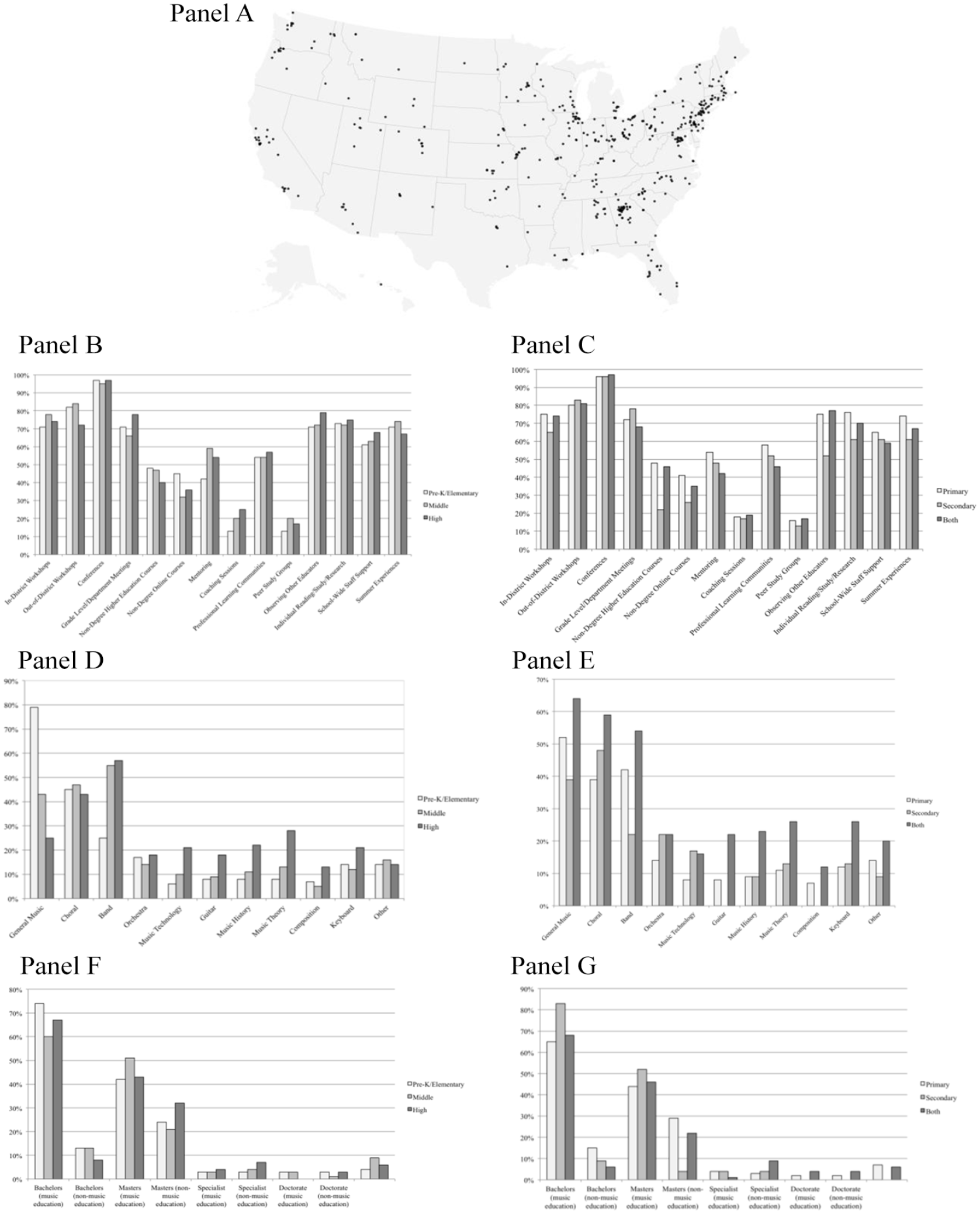
Demographic data by grade level and teaching area. Panel A: National sample of respondents (N = 450). Panel B: Frequency (%) of PD experiences by grade level. Panel C: Frequency (%) of PD experiences by teaching area. Panel D: Frequency (%) of content area taught by grade level. Panel E: Frequency (%) of content area taught by teaching area. Panel F: Frequency (%) of degrees obtained by grade level. Panel G: Frequency (%) of degrees obtained by teaching area.
Survey items, domains, and response categories
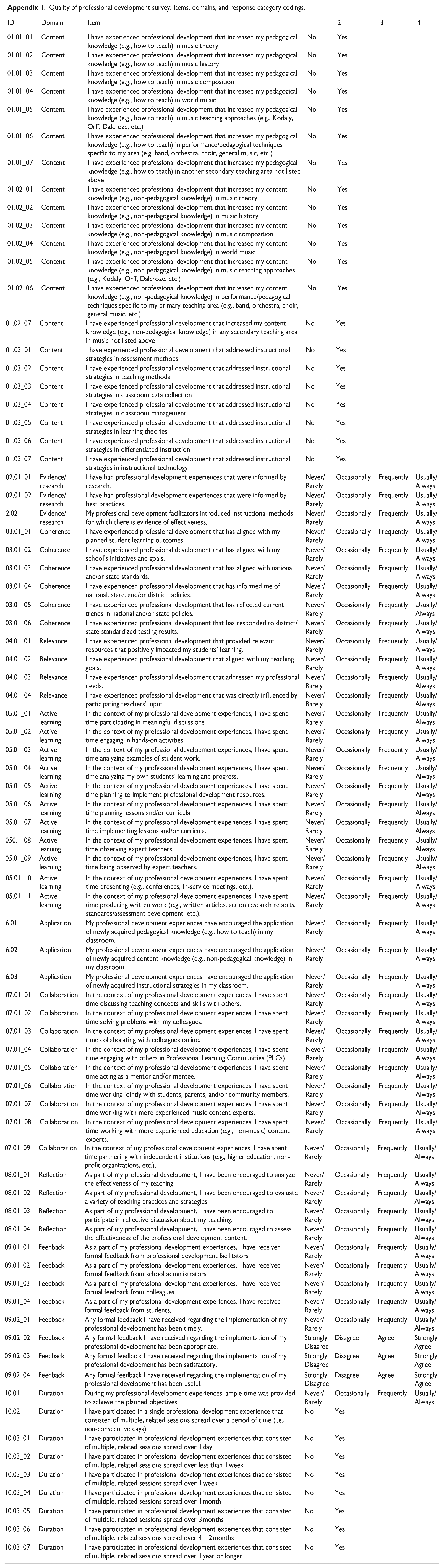
The survey consisted of 78 items embedded within 10 domains described in the literature review: (a) content (n = 21), (b) evidence/research (n = 3), (c) coherence (n = 6), (d) relevance (n = 4), (e) active learning (n = 11), (f) application (n = 3), (g) collaboration (n = 9), (h) reflection (n = 4), (i) feedback (n = 8), and (j) duration (n = 9) (see Appendix 1). The response categories were based upon a dichotomous response format (e.g., no/yes) or a polytomous, 4-point Likert-type scale format with two possible anchor-types: (a) frequency (e.g., never/rarely, occasionally, frequently, usually/always), or (b) agreeability (e.g., strongly disagree, disagree, agree, strongly agree).
Psychometric considerations and data analysis
Rasch measurement
To answer the first and second research questions, Rasch Measurement analyses were used. Rasch measurement models (Rasch, 1960/1980) are part of the family of Item Response Theory models and are particularly effective for measuring latent constructs in the behavioral, social, and psychological sciences (Wesolowski, 2019). All surveys contain psychosocial information related to a latent construct under investigation (Wright, 2000; Wright & Masters, 1982). In the case of this study, the latent construct under investigation was defined as “high-quality professional development.” In survey research, the goal of Rasch measurement is to simultaneously and independently estimate respondent measures and survey item measures, thereby allowing an opportunity to make meaningful inferences about the usefulness and suitability of the items’ patterns of responses (e.g., construct validity; Bond, 2003; Linacre, 2004) and respondents’ patterns of responses (e.g., predictive validity; Linacre, 2004). The most meaningful application of Rasch analyses in survey research is to detect respondent and item idiosyncrasies through the analysis of fit statistics and related standard errors of measurement. Fit indices falling outside the range of 0.60–1.40 identify items and respondents that demonstrate idiosyncrasies in patterns of responses expected by the model (Linacre & Wright, 1994). When fit indices are outside of the acceptable range, they are considered not acceptable for making meaningful inferences. When fit indices are inside of the acceptable range, construct validity is supported for item measures and predictive validity is supported for respondent measures. The respondent measures can be interpreted as the respondents’ amount of participation in high-quality PD (herein referred to as “respondents,” or “respondent measures”). The item measures can be interpreted as the amount of participation in the criterion described in the item (herein referred to as “item,” or “item measures”). The FACETS computer program (Linacre, 2014) was used for all Rasch analyses.
Sentiment analysis
To answer the third research question, a sentiment analysis was conducted. Sentiment analysis is a computational process for extracting and classifying affect (e.g., sentiments and emotions) from natural language text (Liu, 2015; Mäntylä et al., 2018). The survey response options in this study were all forced-choice; therefore, we wanted to provide the respondents an opportunity to freely describe perceptions of their PD experiences. Respondents were posed the open-ended question, “What are some adjectives you would use to describe your overall professional development experiences?” We hypothesized that the more quality PD experiences respondents participate in, the higher the aggregated sentiment index score they would demonstrate. This relationship between the amount of quality participant experiences and their level of positive valence also served as a type of concurrent validity for the results of the Rasch analysis.
To examine affect, a corpus of descriptors was built from the raw responses. The responses were cleaned and normalized using the R (R Core Team, 2019) text-mining package, tm (Feinerer & Hornik, 2018). To identify sentiments and emotions, the R packages sentiment (Rinker, 2019) and syuzhet (Jockers, 2017) were used. First, the response data were restructured into a single character vector and aggregated sentiment scores were obtained for each respondent. Aggregated sentiment scores were assigned to each respondent based upon the positive, neutral, or negative valence of descriptors they provided. To further explore the lexical diversity of the polarized text, the distribution of emotions for the descriptors was also examined. After excluding all neutral-classified words, sentiments were classified into two categories (positive or negative) and emotions were classified into eight categories (anger, anticipation, disgust, fear, joy, sadness, surprise, or trust) (Ekman, 1992; Pluchik, 1980) using two lexicons developed by the National Research Council (NRC): (a) the Word-Emotion Association Lexicon, and (b) the Hashtag Sentiment Lexicon (Mohammad, 2012; Mohammad & Turney, 2010). The NRC lexicons have consistently demonstrated high reliability (alpha = .91–.98) (Kiritchenko and Mohammad, 2014, 2016).
Results
Table 1 provides the summary statistics of the Many-Facet Rasch Partial Credit (MFR-PC) model for the respondent facet, item facet, teaching area facet, and grade-level facet. Tests of chi-square significance answer the substantive question, “Are the overall differences between logit-locations for the elements (i.e., each respondent, each item, each teaching area, or each grade-level) statistically significant?” Results indicated overall statistically significant differences for the respondents (= 5634.40, p < .01), items (= 5070.80, p < .01), teaching areas (= 14.30, p < .01), and grade-levels (= 16.40, p < .01). Reliability of separation (Rel) statistics answer the substantive question, “How spread out are the element locations on the logit scale?” For respondents, Rel is interpreted similarly to Cronbach’s alpha. For the three remaining facets, Rel is interpreted as the degree to which the elements can be reliability differentiated from each other. Results indicated moderate to high reliabilities of separation between respondents (Rel = 0.95), items (Rel = 0.99), teaching area (Rel = 0.89), and grade level (Rel = 0.88). Mean square error (MSE) answers the substantive question, “How consistently have the patterns of responses been interpreted?” Acceptable fit is demonstrated by MSE ranges between 0.60 and 1.40 (Wright & Linacre, 1994). Values below 0.60 indicate underfit (i.e., too similar) patterns and values above 1.40 indicate overfit (i.e., too sporadic) patterns to make meaningful inferences. Results indicate that all facets demonstrated an acceptable range of data-to-model fit.
Summary Statistics for the Rasch Measurement Model.
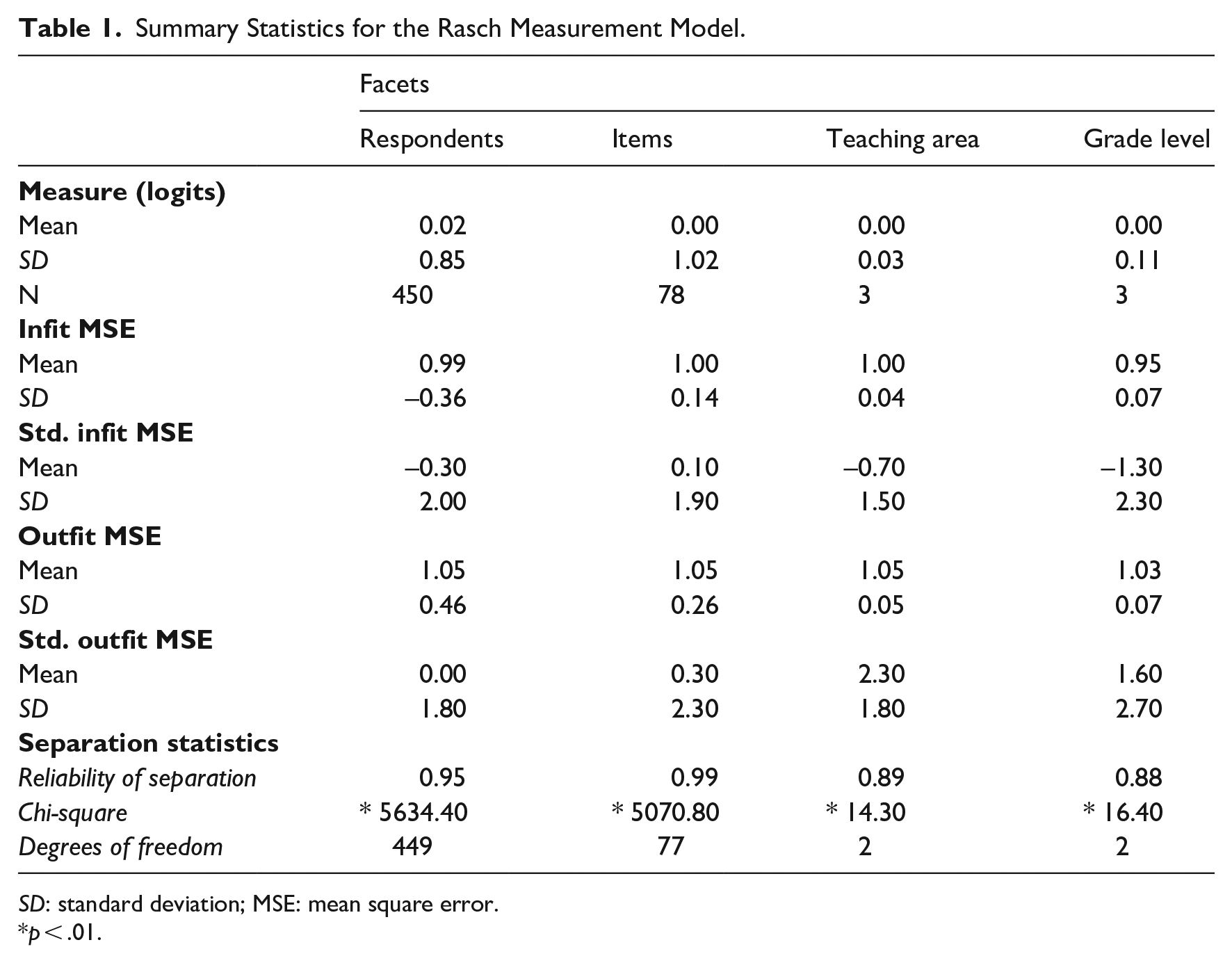
SD: standard deviation; MSE: mean square error.
p < .01.
Item and domain calibrations (Research question 1)
The measurement calibrations and ordering for the items and domains are found in Table 2. Higher logit scores (i.e., measure) represent higher levels of participation in quality PD and lower logit scores represent lower levels of participation in quality PD. For the items facet, the least participation was demonstrated by item 10.3_04 (2.10 logits; I have participated in PD experiences that consisted of multiple, related sessions spread over 1 month) and the most participation was demonstrated by item 1.03_02 (–3.16 logits; I have experienced PD that addressed instructional strategies in teaching methods). One item demonstrated overfit (3.01_06, infit MSE = 1.57; I have experienced PD that has responded to district/state standardized testing results). For the domain groupings, the least participation was demonstrated in the Duration domain (1.02 logits) and the most participation was demonstrated in the Content-driven domain (–0.96 logits). All domains demonstrated acceptable data-to-model fit.
Calibration of Domains and Items for the Professional Development Quality Scale.

Note. Domains and items are arranged in measure order from the least amount of participation to the most amount of participation. Observed Average refers to the average raw score (1–4) of all responses. Measure refers to the estimated linear measure based upon the transformation of observed average to logit units of measurement. Standard Error refers to the standard error of the measure estimate. Fit statistics answer the question, “How well do the data fit the model?” Infit MSE refers to the information-related fit and Outfit MSE refers to the outlier sensitive fit. Std. fit is the standardized version of MSE fit reported as a Z-score. MSE: mean square error.
Bias analysis (Research question 2)
Two bias analyses were conducted: (a) item-by-grade-level interaction analysis; and (b) item-by-teaching area interaction analysis.
Item-by-grade-level interaction
Overall, the analysis indicated a statistically significant omnibus test based upon grade level (= 333.20, p < .01), suggesting that bias occurs between items and grade level. A post hoc pairwise interaction analysis between all items (N = 78) and grade-levels (N = 3) indicated that of the total 234 interaction terms, 24 (10.3%) were found to be statistically significant (see Table 3). Of the 24 statistically significant interactions, four interactions had a moderate effect (|DIF| 0.43:0.64) and 11 interactions had a large effect (|DIF| >/= 0.64) (Zwick et al., 1999). Any bias sizes below 0.43 are considered to be negligible.
Significant Pairwise Interactions Between Items, Grade Level, and Teaching Area (|Z| ⩾ 2.00).
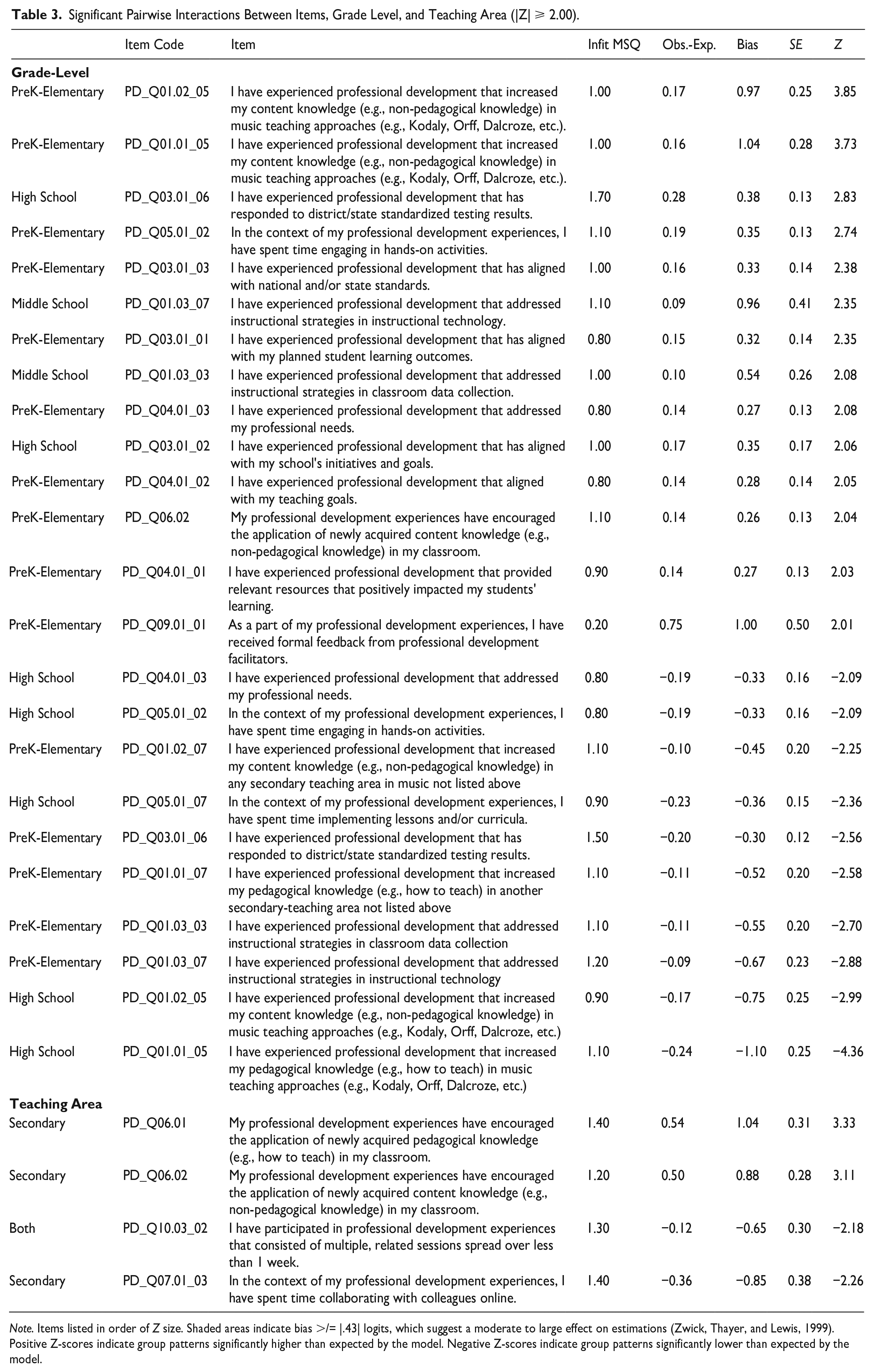
Note. Items listed in order of Z size. Shaded areas indicate bias >/= |.43| logits, which suggest a moderate to large effect on estimations (Zwick, Thayer, and Lewis, 1999). Positive Z-scores indicate group patterns significantly higher than expected by the model. Negative Z-scores indicate group patterns significantly lower than expected by the model.
Item-by-teaching area interaction
Overall, the analysis indicated a statistically significant omnibus test based upon teaching area (= 342.10, p < .01), suggesting bias occurs between items and teaching area. A post hoc pairwise interaction analysis between all items (N = 78) and teaching areas (N = 3) indicated that of the total 234 interaction terms, four (1.70%) were found to be statistically significant (See Table 3). All four interactions had a large effect (|DIF| >/= 0.64) (Zwick et al., 1999).
Sentiment analysis (Research question 3)
The sentiment analysis resulted in an overall positive valence for respondents, with a mean aggregated sentiment index score of 0.18 (SD = 0.69). A Pearson’s r correlation between respondents’ aggregated sentiment scores and respondents’ Rasch measures was 0.42 (p < .05), indicating a statistically significant, moderately positive relationship. This suggests that as respondents’ experiences with high-quality PD increase, sentiments toward a positive valence also increases.
A total of 482 positive and negative descriptor responses were identified. 324 (67.22%) descriptors were identified as positive valence and 158 (32.78%) descriptors were identified as negative valence. Of the 482 total descriptor responses, 86 (56.20%) unique descriptors were identified as positive valence and 67 (43.80%) unique descriptors were identified as negative valence.
Upon examining the emotional distribution of responses, all eight emotions of the lexicon were represented: trust (33.60%), joy (27.5%), anticipation (9.20%), sadness (8.10%), anger (7.50%), disgust (7.10%), surprise (6.10%), and fear (1.00%). Figure 2 provides a breakdown of the most frequently used positive and negative descriptors with a minimum of three use cases as well as the overall distribution of emotions underscoring the sentiments.
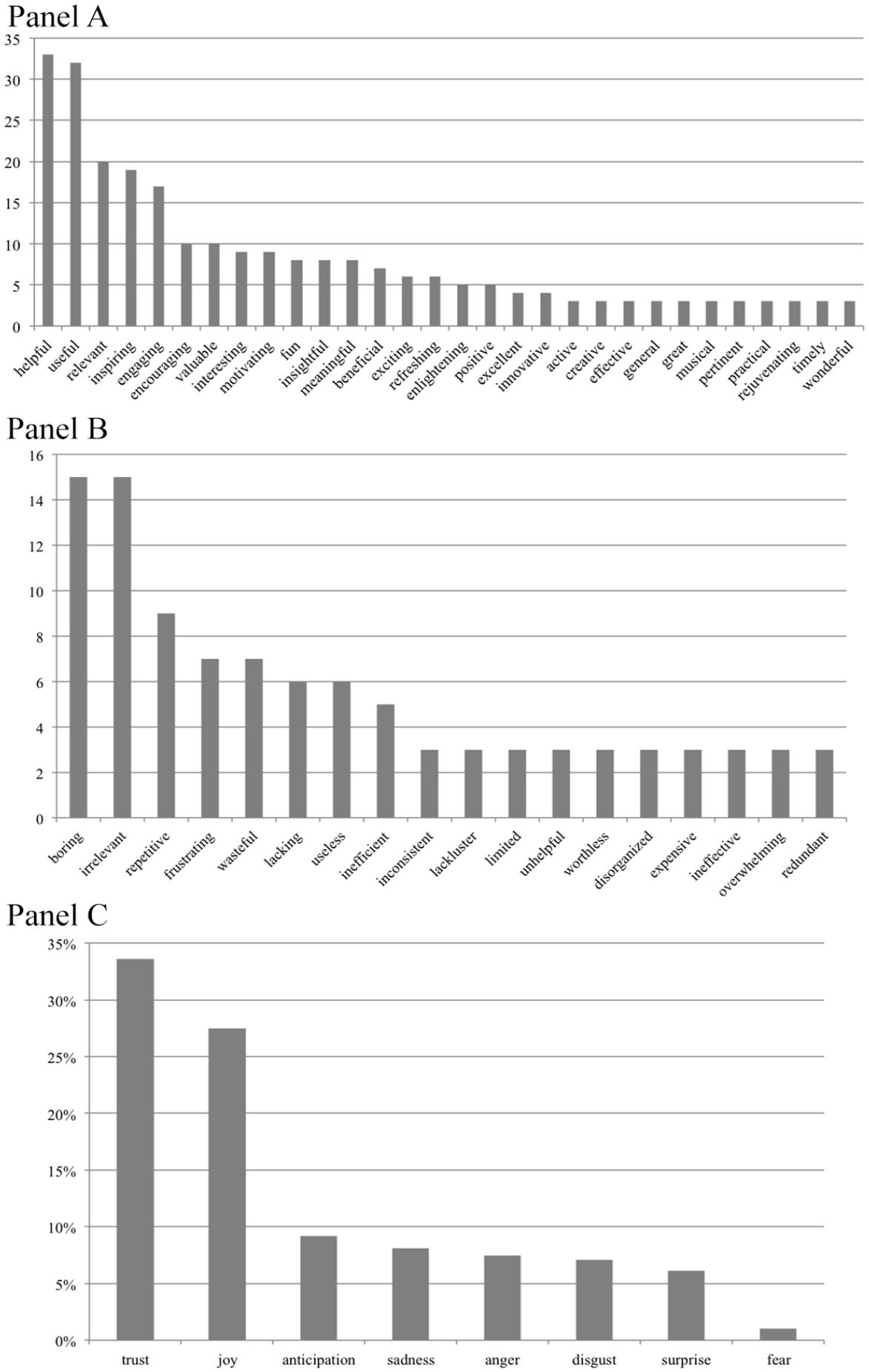
Descriptive statistics for the sentiment analysis. Panel A: Counts of Most Frequently Used Descriptors: Positive Valence. Panel B: Counts of Most Frequently Used Descriptors: Negative Valence. Panel C: Frequency (%) of Emotional Distribution for All Descriptors.
Conclusion and discussion
The purpose of this study was to develop a valid and reliable assessment tool to measure music educators’ participation in and perceptions of high-quality PD experiences in the United States. In answer to research question one (What is the ordering and fit of items/domains representing participation levels of music educators’ high-quality PD experiences?), results suggest a clear and reliable ordering of domains, items, and respondents. The significant and high reliability of separation for the items and domains provide empirical support for the strong construct validity of the measure. The significant and high reliability of separation for the respondents provide empirical support for respondents’ shared understanding of the construct (Lopez, 1998; Wright & Linacre, 1992). The ordering of domains from least participation to most participation is: (a) duration, (b) active learning, (c) feedback, (d) collaboration, (e) reflection, (f) relevance, (g) coherence, (h) application, (i) evidence/research, and (j) content.
In answer to research question two (To what extent does bias exist in music educators’ PD experiences based upon their teaching area and/or grade level?), results suggest that music educators experience different participation levels of high-quality PD experiences based upon teaching area and grade level. A total of 28 significant interactions were identified across grade-level and teaching area, with 11 interactions demonstrating moderate to large effect sizes for grade-level and 4 interactions demonstrating moderate to large effect sizes for teaching area.
In answer to research question three (Is there a relationship between the quality of PD music educators experiences and their sentiments and emotions toward those experiences?), results suggest that music educators’ sentiments were moderately and positively correlated with their experiences of high-quality PD. This suggests that the higher quality PD music educators experience, the more positive their sentiment toward those experiences.
The results of this study suggest that each of the 10 domains adequately describes the quality of PD in the field of music education. While the teachers’ needs, perceptions, preferences, and motivations of PD are important when designing and evaluating PD programs, there is a need for continued evaluation, consideration, and inclusion of the criteria that define “high-quality PD.” Results suggest that music educators are experiencing an abundance of music-specific PD that is content-rich, evidence-based, embedded, and coherent to policy, standards, teacher needs, and preferences. These findings corroborate with previous research regarding music-specific PD that is focused on content needs due to the broad music teaching certificate and alternative music classrooms where teachers may be teaching unfamiliar musical content (Grieser & Hendricks, 2018; May et al., 2017; West, 2020).
The results of this study also suggest that music educators are less likely to be experiencing music-specific PD that (a) is longitudinal in nature, (b) has active learning opportunities, (c) provides adequate feedback, and (d) is collaborative. These findings support research regarding teachers’ experiences in music-specific PD. In comparing PD activities of music educators with those in other disciplines, Gallo (2018) suggested that music educators participate in content-focused programs, but that the lengths of programs fall short of hours recommended by researchers to change instructional practices and improve student achievement. Gallo additionally reported that there is not enough information regarding collaboration within music education PD to make concrete statements. Results from this study suggest that music educators are less likely to experience collaborative activities and engagement in their PD experiences. Secondary content area teachers are even less likely to experience collaborative PD activities than their peers who teach only a primary content area. Research suggests that many music educators feel isolated in their school environment, which may inhibit effective collaboration within their local school community (Bautista et al., 2017; Conkling & Henry, 2002; Grieser & Hendricks, 2018). In addition, lack of professional learning communities that are readily accessible within local schools for music educators, the prevalence of “one-size-fits-all” PD, and the trend of focusing on general pedagogical strategies for an entire school faculty may contribute to the decreased music PD experiences that incorporate collaboration, feedback, active learning opportunities, and adequate duration (Bautista et al., 2018).
The results to the second question highlight the systematic differences of educators’ experiences of quality PD across content and grade levels. Elementary educators experienced more content-specific PD and received more formal feedback from PD facilitators than middle and high school music educators. However, elementary educators experienced less PD focusing on instructional technology, data collection, and content or pedagogical knowledge regarding secondary teaching areas. Middle school music educators received more PD that includes instructional technology and data collection. High school music educators received less PD that includes content and pedagogical knowledge in music teaching approaches. Specifically identifying Kodaly, Orff, and Dalcroze in the items, however, may influence these findings. We suggest more specific research examining and comparing PD programs as they relate to differing needs of grade levels and content areas.
Findings regarding differences between teaching areas suggest that music educators teaching a secondary content area experience more PD that encourages the application of newly acquired pedagogical knowledge and content knowledge than others. Music educators teaching both primary and secondary content areas experience less longitudinal PD than their counterparts who teach one content area. Perhaps the challenges inherent in managing two content areas inhibit teachers’ abilities to experience more continuous and longitudinal applications of PD in their classrooms.
From a policy perspective, data evaluation has been identified as an important part of implementing and assessing PD effectiveness with respect to the allocation of funding and other resources (Eraut, 1994). However, inadequate data available due to a lack of systematic PD assessments often leaves stakeholders unable to examine PD effectiveness and impact (Bredeson, 2002). Government is now where many crucial decisions about policy implementation are being made, and it is important that district leaders support meaningful policies (Johnson & Uline, 2005). Unfortunately, little attention has been given to identifying PD opportunities as they relate to the allocation of appropriate funding. Current research literature highlights the importance of using valid assessment tools to evaluate the quality of PD utilized by local school districts across the United States (Bredeson, 2002; Eraut, 1994; Guskey, 2000). We hope that the survey developed in this study may be used to provide valid and reliable data as to music educators’ participation in high-quality PD experiences.
Footnotes
Appendix
Quality of professional development survey: Items, domains, and response category codings.
| ID | Domain | Item | 1 | 2 | 3 | 4 |
|---|---|---|---|---|---|---|
| 01.01_01 | Content | I have experienced professional development that increased my pedagogical knowledge (e.g., how to teach) in music theory | No | Yes | ||
| 01.01_02 | Content | I have experienced professional development that increased my pedagogical knowledge (e.g., how to teach) in music history | No | Yes | ||
| 01.01_03 | Content | I have experienced professional development that increased my pedagogical knowledge (e.g., how to teach) in music composition | No | Yes | ||
| 01.01_04 | Content | I have experienced professional development that increased my pedagogical knowledge (e.g., how to teach) in world music | No | Yes | ||
| 01.01_05 | Content | I have experienced professional development that increased my pedagogical knowledge (e.g., how to teach) in music teaching approaches (e.g., Kodaly, Orff, Dalcroze, etc.) | No | Yes | ||
| 01.01_06 | Content | I have experienced professional development that increased my pedagogical knowledge (e.g., how to teach) in performance/pedagogical techniques specific to my area (e.g. band, orchestra, choir, general music, etc.) | No | Yes | ||
| 01.01_07 | Content | I have experienced professional development that increased my pedagogical knowledge (e.g., how to teach) in another secondary-teaching area not listed above | No | Yes | ||
| 01.02_01 | Content | I have experienced professional development that increased my content knowledge (e.g., non-pedagogical knowledge) in music theory | No | Yes | ||
| 01.02_02 | Content | I have experienced professional development that increased my content knowledge (e.g., non-pedagogical knowledge) in music history | No | Yes | ||
| 01.02_03 | Content | I have experienced professional development that increased my content knowledge (e.g., non-pedagogical knowledge) in music composition | No | Yes | ||
| 01.02_04 | Content | I have experienced professional development that increased my content knowledge (e.g., non-pedagogical knowledge) in world music | No | Yes | ||
| 01.02_05 | Content | I have experienced professional development that increased my content knowledge (e.g., non-pedagogical knowledge) in music teaching approaches (e.g., Kodaly, Orff, Dalcroze, etc.) | No | Yes | ||
| 01.02_06 | Content | I have experienced professional development that increased my content knowledge (e.g., non-pedagogical knowledge) in performance/pedagogical techniques specific to my primary teaching area (e.g., band, orchestra, choir, general music, etc.) | No | Yes | ||
| 01.02_07 | Content | I have experienced professional development that increased my content knowledge (e.g., non-pedagogical knowledge) in any secondary teaching area in music not listed above | No | Yes | ||
| 01.03_01 | Content | I have experienced professional development that addressed instructional strategies in assessment methods | No | Yes | ||
| 01.03_02 | Content | I have experienced professional development that addressed instructional strategies in teaching methods | No | Yes | ||
| 01.03_03 | Content | I have experienced professional development that addressed instructional strategies in classroom data collection | No | Yes | ||
| 01.03_04 | Content | I have experienced professional development that addressed instructional strategies in classroom management | No | Yes | ||
| 01.03_05 | Content | I have experienced professional development that addressed instructional strategies in learning theories | No | Yes | ||
| 01.03_06 | Content | I have experienced professional development that addressed instructional strategies in differentiated instruction | No | Yes | ||
| 01.03_07 | Content | I have experienced professional development that addressed instructional strategies in instructional technology | No | Yes | ||
| 02.01_01 | Evidence/research | I have had professional development experiences that were informed by research. | Never/Rarely | Occasionally | Frequently | Usually/Always |
| 02.01_02 | Evidence/research | I have had professional development experiences that were informed by best practices. | Never/Rarely | Occasionally | Frequently | Usually/Always |
| 2.02 | Evidence/research | My professional development facilitators introduced instructional methods for which there is evidence of effectiveness. | Never/Rarely | Occasionally | Frequently | Usually/Always |
| 03.01_01 | Coherence | I have experienced professional development that has aligned with my planned student learning outcomes. | Never/Rarely | Occasionally | Frequently | Usually/Always |
| 03.01_02 | Coherence | I have experienced professional development that has aligned with my school’s initiatives and goals. | Never/Rarely | Occasionally | Frequently | Usually/Always |
| 03.01_03 | Coherence | I have experienced professional development that has aligned with national and/or state standards. | Never/Rarely | Occasionally | Frequently | Usually/Always |
| 03.01_04 | Coherence | I have experienced professional development that has informed me of national, state, and/or district policies. | Never/Rarely | Occasionally | Frequently | Usually/Always |
| 03.01_05 | Coherence | I have experienced professional development that has reflected current trends in national and/or state policies. | Never/Rarely | Occasionally | Frequently | Usually/Always |
| 03.01_06 | Coherence | I have experienced professional development that has responded to district/state standardized testing results. | Never/Rarely | Occasionally | Frequently | Usually/Always |
| 04.01_01 | Relevance | I have experienced professional development that provided relevant resources that positively impacted my students’ learning. | Never/Rarely | Occasionally | Frequently | Usually/Always |
| 04.01_02 | Relevance | I have experienced professional development that aligned with my teaching goals. | Never/Rarely | Occasionally | Frequently | Usually/Always |
| 04.01_03 | Relevance | I have experienced professional development that addressed my professional needs. | Never/Rarely | Occasionally | Frequently | Usually/Always |
| 04.01_04 | Relevance | I have experienced professional development that was directly influenced by participating teachers’ input. | Never/Rarely | Occasionally | Frequently | Usually/Always |
| 05.01_01 | Active learning | In the context of my professional development experiences, I have spent time participating in meaningful discussions. | Never/Rarely | Occasionally | Frequently | Usually/Always |
| 05.01_02 | Active learning | In the context of my professional development experiences, I have spent time engaging in hands-on activities. | Never/Rarely | Occasionally | Frequently | Usually/Always |
| 05.01_03 | Active learning | In the context of my professional development experiences, I have spent time analyzing examples of student work. | Never/Rarely | Occasionally | Frequently | Usually/Always |
| 05.01_04 | Active learning | In the context of my professional development experiences, I have spent time analyzing my own students’ learning and progress. | Never/Rarely | Occasionally | Frequently | Usually/Always |
| 05.01_05 | Active learning | In the context of my professional development experiences, I have spent time planning to implement professional development resources. | Never/Rarely | Occasionally | Frequently | Usually/Always |
| 05.01_06 | Active learning | In the context of my professional development experiences, I have spent time planning lessons and/or curricula. | Never/Rarely | Occasionally | Frequently | Usually/Always |
| 05.01_07 | Active learning | In the context of my professional development experiences, I have spent time implementing lessons and/or curricula. | Never/Rarely | Occasionally | Frequently | Usually/Always |
| 050.1_08 | Active learning | In the context of my professional development experiences, I have spent time observing expert teachers. | Never/Rarely | Occasionally | Frequently | Usually/Always |
| 05.01_09 | Active learning | In the context of my professional development experiences, I have spent time being observed by expert teachers. | Never/Rarely | Occasionally | Frequently | Usually/Always |
| 05.01_10 | Active learning | In the context of my professional development experiences, I have spent time presenting (e.g., conferences, in-service meetings, etc.). | Never/Rarely | Occasionally | Frequently | Usually/Always |
| 05.01_11 | Active learning | In the context of my professional development experiences, I have spent time producing written work (e.g., written articles, action research reports, standards/assessment development, etc.). | Never/Rarely | Occasionally | Frequently | Usually/Always |
| 6.01 | Application | My professional development experiences have encouraged the application of newly acquired pedagogical knowledge (e.g., how to teach) in my classroom. | Never/Rarely | Occasionally | Frequently | Usually/Always |
| 6.02 | Application | My professional development experiences have encouraged the application of newly acquired content knowledge (e.g., non-pedagogical knowledge) in my classroom. | Never/Rarely | Occasionally | Frequently | Usually/Always |
| 6.03 | Application | My professional development experiences have encouraged the application of newly acquired instructional strategies in my classroom. | Never/Rarely | Occasionally | Frequently | Usually/Always |
| 07.01_01 | Collaboration | In the context of my professional development experiences, I have spent time discussing teaching concepts and skills with others. | Never/Rarely | Occasionally | Frequently | Usually/Always |
| 07.01_02 | Collaboration | In the context of my professional development experiences, I have spent time solving problems with my colleagues. | Never/Rarely | Occasionally | Frequently | Usually/Always |
| 07.01_03 | Collaboration | In the context of my professional development experiences, I have spent time collaborating with colleagues online. | Never/Rarely | Occasionally | Frequently | Usually/Always |
| 07.01_04 | Collaboration | In the context of my professional development experiences, I have spent time engaging with others in Professional Learning Communities (PLCs). | Never/Rarely | Occasionally | Frequently | Usually/Always |
| 07.01_05 | Collaboration | In the context of my professional development experiences, I have spent time acting as a mentor and/or mentee. | Never/Rarely | Occasionally | Frequently | Usually/Always |
| 07.01_06 | Collaboration | In the context of my professional development experiences, I have spent time working jointly with students, parents, and/or community members. | Never/Rarely | Occasionally | Frequently | Usually/Always |
| 07.01_07 | Collaboration | In the context of my professional development experiences, I have spent time working with more experienced music content experts. | Never/Rarely | Occasionally | Frequently | Usually/Always |
| 07.01_08 | Collaboration | In the context of my professional development experiences, I have spent time working with more experienced education (e.g., non-music) content experts. | Never/Rarely | Occasionally | Frequently | Usually/Always |
| 07.01_09 | Collaboration | In the context of my professional development experiences, I have spent time partnering with independent institutions (e.g., higher education, non-profit organizations, etc.). | Never/Rarely | Occasionally | Frequently | Usually/Always |
| 08.01_01 | Reflection | As part of my professional development, I have been encouraged to analyze the effectiveness of my teaching. | Never/Rarely | Occasionally | Frequently | Usually/Always |
| 08.01_02 | Reflection | As part of my professional development, I have been encouraged to evaluate a variety of teaching practices and strategies. | Never/Rarely | Occasionally | Frequently | Usually/Always |
| 08.01_03 | Reflection | As part of my professional development, I have been encouraged to participate in reflective discussion about my teaching. | Never/Rarely | Occasionally | Frequently | Usually/Always |
| 08.01_04 | Reflection | As part of my professional development, I have been encouraged to assess the effectiveness of the professional development content. | Never/Rarely | Occasionally | Frequently | Usually/Always |
| 09.01_01 | Feedback | As a part of my professional development experiences, I have received formal feedback from professional development facilitators. | Never/Rarely | Occasionally | Frequently | Usually/Always |
| 09.01_02 | Feedback | As a part of my professional development experiences, I have received formal feedback from school administrators. | Never/Rarely | Occasionally | Frequently | Usually/Always |
| 09.01_03 | Feedback | As a part of my professional development experiences, I have received formal feedback from colleagues. | Never/Rarely | Occasionally | Frequently | Usually/Always |
| 09.01_04 | Feedback | As a part of my professional development experiences, I have received formal feedback from students. | Never/Rarely | Occasionally | Frequently | Usually/Always |
| 09.02_01 | Feedback | Any formal feedback I have received regarding the implementation of my professional development has been timely. | Never/Rarely | Occasionally | Frequently | Usually/Always |
| 09.02_02 | Feedback | Any formal feedback I have received regarding the implementation of my professional development has been appropriate. | Strongly Disagree | Disagree | Agree | Strongly Agree |
| 09.02_03 | Feedback | Any formal feedback I have received regarding the implementation of my professional development has been satisfactory. | Strongly Disagree | Disagree | Agree | Strongly Agree |
| 09.02_04 | Feedback | Any formal feedback I have received regarding the implementation of my professional development has been useful. | Strongly Disagree | Disagree | Agree | Strongly Agree |
| 10.01 | Duration | During my professional development experiences, ample time was provided to achieve the planned objectives. | Never/Rarely | Occasionally | Frequently | Usually/Always |
| 10.02 | Duration | I have participated in a single professional development experience that consisted of multiple, related sessions spread over a period of time (i.e., non-consecutive days). | No | Yes | ||
| 10.03_01 | Duration | I have participated in professional development experiences that consisted of multiple, related sessions spread over 1 day | No | Yes | ||
| 10.03_02 | Duration | I have participated in professional development experiences that consisted of multiple, related sessions spread over less than 1 week | No | Yes | ||
| 10.03_03 | Duration | I have participated in professional development experiences that consisted of multiple, related sessions spread over 1 week | No | Yes | ||
| 10.03_04 | Duration | I have participated in professional development experiences that consisted of multiple, related sessions spread over 1 month | No | Yes | ||
| 10.03_05 | Duration | I have participated in professional development experiences that consisted of multiple, related sessions spread over 3 months | No | Yes | ||
| 10.03_06 | Duration | I have participated in professional development experiences that consisted of multiple, related sessions spread over 4–12 months | No | Yes | ||
| 10.03_07 | Duration | I have participated in professional development experiences that consisted of multiple, related sessions spread over 1 year or longer | No | Yes |
Declaration of conflicting interests
The author(s) declared no potential conflicts of interest with respect to the research, authorship, and/or publication of this article.
Funding
The author(s) received no financial support for the research, authorship, and/or publication of this article.
