



Abstract
A number of studies suggest a link between musical training and both specific and general cognitive abilities, but despite some positive results, there is disagreement about which abilities are improved. This study aims to investigate the effects of a music education program both on a domain-specific competence (meta-musical awareness), and on general domain competences, that is, cognitive abilities (logical-mathematical) and symbolic-linguistic abilities (notational). Twenty 4- to 6-year-old children participated in the research, divided into two groups (experimental and control) and the measures were administered at two different times, before and after a 6-month music program (for the experimental group) and after a sports training program (for the control group). Children performed meta-musical awareness tasks, logical-mathematical tasks, and emergent-alphabetization tasks. Non-parametric statistics show that a music program significantly improves the development of notational skills and meta-musical awareness while not the development of logical-mathematical skills. These results show that a musical program increases children’s meta-musical awareness, and their ability to acquire the notational ability involved in the invented writing of words and numbers. On the contrary, it does not affect the development of logical skills. The results are discussed in terms of transfer of knowledge processes and of specific versus general domain effects of a musical program.
Keywords
In this study the aim is twofold: to investigate the effects of a music program in musical competence itself, measured innovatively in its component constituted by meta-musical awareness. And, to verify the effects of a musical program on mathematical skills and notation systems, in an underexpolored population such as preschoolers. The expectation that a music program should exert its effects both directly on skills closer to its content and indirectly on skills less close to it, such as general cognitive and linguistic abilities, derives from a model to explain development that can be traced back to the theoretical proposal of Borkowski et al. (2000). We assume that development of metacognitive knowledge begins highly domain- and situation-specific and becomes more flexible and domain-transcending with practice and experience (Borkowski et al., 2000). The term “metacognition” refers to a concept consisting of two components: (1) the knowledge and (2) the monitoring (experience) and regulation (skill) component. The metacognitive knowledge a learner possesses may include knowledge regarding the demands of a particular learning task, one’s own capabilities to master a task, and the strategies available. It is stored in long-term memory, is consciously accessible, explicable, and can be used to control cognitive processes (Pintrich, 2002). An implication of the model is that this knowledge is acquired through experience of concrete learning situations (Pintrich, 2002). Metacognitive competence also develops spontaneously, but its increase is much greater when specific cognitive training opportunities are implemented (Hartman, 2001). The musical training that we are studying offers an organized set of structured experiences, which could provide adequate scaffolding for the enrichment of metacognitive skills, and for its generalization and across-domain transferability.
The concept of transfer of learning is defined as the process in which competences acquired in a specific context can influence the development of other cognitive skills, which can be transferred to different fields (Biasutti & Concina, 2013; Welch et al., 2020). Transfer of learning occurs when learning in one context enhances (positive transfer) or undermines (negative transfer) a related performance in another context. Transfer includes near transfer (to closely related contexts and performances) and far transfer (to rather different contexts and performances) (Perkins & Salomon, 1994).
The transfer of learning from one domain to another depends on the similarities between the processes involved (Lobato, 2006). In our research, this transfer occurs for processes that combine the musical domain with emergent mathematical and literacy skills, and can be defined as inter-domain learning transfer that involves competences based on a different domain than the one involved during the training (Dias, 2003). Based on these premises, we investigated whether participation in a specific music program can have an effect in preschoolers on meta-musical awarness, mathematical skills, and graphic notation in the emergent literacy field.
Music training and meta-musical awareness
The effect that music has on the specific domain aspects of musical skills is established (Schellenberg & Weiss, 2013). Less explored is the effect that musical training has on meta-musical awareness, a kind of metacognitive competence in the musical domain. Based on Flavell’s definition of metacognition (i.e. the awareness and control that the individual has of his/her own cognitive processes [Flavell, 1976]), we defined meta-musical awareness as the ability of an individual to reflect on the processes involved in musical activities to know how notes represent sounds, how melodies are put together and how melodies become composition (McPherson & Gabrielsson, 2002).
Several scholars refer to the role of metacognition in music learning (Benton, 2013, 2014; Concina, 2019; Leon-Guerrero, 2008), documenting how meta-musical activities favors, already in preschoolers, the ability to reflect and monitor rhythmic accuracy (Gordon, 2007), and to recognize errors and apply strategies to correct them (Benton, 2014). From a methodological point of view, measuring metacognitive knowledge presents considerable difficulties, especially with younger children, for whom interviews and questionnaires require a mastery of language that they have not yet achieved. Research on drawing provided an interesting innovation, showing how graphic representation allowed children to express, bypassing verbal language, their knowledge about various aspects of the mental states, such as problem solving (Goldberg, 2005), social emotions (Pinto & Bombi, 2008), and cognitive states (Pezzica et al., 2016).
Preschool children’s meta-musical knowledge has been little investigated: we aim, in the present research, to access it using thematic drawing.
Music training and logical-mathematical skills
The effects of music education on child’s cognitive development (Winsler et al., 2011) and on non-musical domains, are well-documented, even by meta-analysis studies (Dumont et al., 2017). The results of studies focused on the effects of musical training on children’s logical-mathematical abilities are mixed. A number of studies have observed positive effect on mathematical skills (Geoghegan & Mitchelmore, 1996; Neville et al., 2008; Rauscher & Hinton, 2011), such as counting (Hallam, 2010; Vaughn, 2000) number handling, operations, and completion of pattern according to an algebraic series (Bahr & Chistensen, 2000; Barroso et al., 2019; Guhn et al., 2020), understanding of proportions and ratios, and prenumber concepts such as seriation (Vaughn, 2000).
A few studies (Holmes & Hallam, 2017; Yang et al., 2014) have not observed an impact of music activity on mathematical learning or such impact was variable. Furthermore, when the small associations between musical training and mathematical skills emerge in correlational and quasi-experimental studies, they might be the consequence of individual differences in general intellectual capacity, with high-functioning children who are more likely than others both to attend music lessons and to perform better logic and mathematics (Schellenberg & Weiss, 2013).
Music training and emergent literacy skills
The relationship between musical education and emergent literacy skills has also been investigated (Ozernov-Palchik et al., 2018; Vaiouli & Grimmet, 2020). Beneficial effects of musical educationwere documented on phonological awareness and early reading skills (Bolduc, 2008; Gordon et al., 2015; Linnavalli et al., 2018; Standley, 2008), word matching, letter sounding, word reading, (Degé & Schwarzer, 2011; Peynircioglu et al., 2002), rhyme generation, identification and segmentation of sound, and blending onsets and rhymes (Anvari et al., 2002).
Less investigated, instead, are the effects of music education on another component of emergent literacy, notational awareness. Notational skills refer to “the acquisition of various systems of notation, which appear in the very early preschool period: drawing, alphabetical and character writing, number writing, musical notation, different signs that children see as they constantly intersect with the world around them that they themselves produce early and synchronously” (Cameron & Pinto, 2020, p.13).
Preschoolers are able to create spellings before they embark on the formal learning of reading and writing. These invented spellings can be regarded as a way for children to explore the written code (Alves Martins, et al., 2013) and can be considered the antecedent of the integration process that characterizes formal spelling Pinto et al., 2017; Ouellette & Sénéchal, 2017). Becoming notation users in particular, is gradual and not without difficulties (DeLoache, 2004): Hence the interest in seeing the possible sources of support and enhancement of this key ability and the theoretical and practical relevance of in research that has investigated the effects of music education on notational awareness of writing in preschoolers.
The few studies conducted in this direction show that children who participate in music programs develop word recognition, and invented spelling skills more efficiently than their classmates who do not participate in such programs (Bolduc, 2006; Gromko, 2005; Register, 2001). The results of the already mentioned study by Neville et al. (2008), in which music activities included listening to music, moving to music, making music, and singing, showed benefits in pre-literacy skills, and letter identification.
Preschooler who benefit from music training program were documented to transfer the positive effects to their emergent literacy skills (Bolduc, 2009) and this effect also occurs on formal literacy skills in older children (Butzlaff, 2000; Gordon et al., 2015). Similarities between music and language have been used to support the hypothesis that to explain the reason why music training may strengthen notational and writing skills. Music and written language involve formal notation read from left to right; music notation consists of symbols that represent information about sound (e.g. pitch) and time (e.g. rhythm), and listening to both music and speech requires attention to the temporal order of rapidly changing acoustic events (Foxton et al., 2003).
Rationale and aims
The reviewed literature offers an articulate and non-unique pattern of the effects of music education on the meta-musical, logical-mathematical, and notational skills. The effects of music education are particularly under-investigated in preschoolers, although this is a period of great developmental interest, as it is characterized by the transition to formalized schooling.
Considering the predictive value of emergent abilities on subsequent development, this study aimed to verify whether a music education program, applied to preschool children, acts on the acquisition of logical-mathematical and notational abilities, and on meta-musical awareness. The hypothesis that moves us is that musical education involving domain-specific processes that are music-related, such as reflection, control, and monitoring, exercise its beneficial effects on domain-general learning such as logical-mathematical ability and notational ability, through a transfer-of learning process.
From a theoretical standpoint, this research presents a novelty in researching the effects of music education on the particular skill constituted by writing notation, within the construct of emergent literacy. Notational skills refer here to children’s knowledge of print conventions, a developmental step in which children attempt to merge phonological and orthographic characteristics of a word (Pinto et al., 2017). Another element of novelty is the investigation of children’s meta-musical knowledge, whose importance in promoting musical competences is well known, but also little investigated. To this end, a new methodological tool has been introduced in this study. In fact, we chose to adopt drawing as a way of accessing children’s metacognitive knowledge about musical activities and the environment in which music is practiced.
Specifically, we have hypothesized that participation in a specific music education program for 6 months can improve (i) meta-musical awareness, (ii) general logical-mathematical skills and in specific areas of seriation, counting, and classification, and (iii) graphic notational skills, defined as invented spelling and invented reading, in preschool-age children.
Material and methods
Participants
Twenty children (12 boys and 8 girls) aged between 4 and 6 years (M [SD]: 4.9 [.72]) participated in the study. The participants were divided into two groups (experimental vs. control), matched one-to-one by age (±2 months), the same biological sex, class attended (last year of kindergarten) and the same initial level of performance on the Logical Operations Test (Vianello & Marin, 1997) and the Conceptual Knowledge of a Writing System task (Bigozzi et al., 2016). Participants were recruited from kindergartens in Fiesole (Florence, Italy). The experimental group started going out in the extra-school hours to the Music School of Fiesole, while the control group only received the lessons of the public kindergartens. In Italy, preschoolers attend kindergarten from the ages of 3 to 5 years old and enrol in primary school when they are 6 years old. Most children attend public kindergartens. Educational activities for kindergarten children were identified by Ministerial Decree 254 /2012, which contains national guidelines for the curriculum of kindergarten and first cycle education, paying attention to, for example, body and movement, images, sounds, colors, speech and words, and knowledge of the world. Conversely, the national curriculum for kindergarten does not include formal practices in teaching music at this stage.
All the participants came from families with middle socio-economic level, based on both parents’ educational level and profession. Neither parent was a musician or a mathematician. Participants did not perform musical activities outside the school-music context and they did not have access to musical instruments other than during class time.
The total number of participants in the music school was 18. Others for the selection of the control group were recruited from three classes (one for each age) from a kindergarten in the same geographical area. Approximately 115 families were contacted at the schools. The study was presented to the families through a meeting at school. The control group was chosen from a group of 97 children. Each of the 10 children in the experimental group was matched with a child inexperienced in music on the basis of age and initial performance in the variables. While the experimental group underwent musical training for 6 months, the control group carried out non-musical extra-school activities, specifically sports activities. Moreover, neither the children in the experimental group nor the children in the control group had any other musical activities in their free time.
The study was conducted in full accordance with the Ethical Guidelines of the Declaration of Helsinki (World Medical Association, 2013). In accordance with the ethical guidelines mentioned above, informed consent was obtained from the parents of each participant.
Description of the music education program
The music program was arranged by the teachers of the Department for Musical Education in Children of the Music School of Fiesole. It was based on and integrated some principles of two different methods of musical teaching: the Suzuki (1983) method and the Rolland method (Rolland, 1974). From the Suzuki method, imitation and play were used as learning tools. From the Rolland method, gradual and individualized teaching, attention to movements, and development of musical creativity also through interpretation, were used. Children were trained for 40 minutes twice a week for a period of 6 months in lessons for individuals or couples. The teaching methodology was applied with flexibility, taking into account the characteristics of individual children, such as listening, concentration, expression, motor skills, and coordination.
The course was divided into two phases, one preliminary and one didactic. All the children participated in training lessons of rhythm and singing for 80% of the time and lessons with string instruments and keyboards for the rest. In the preliminary step (first month), basic instrumental rhythmic lessons were given, in which children learned to become familiar with rhythm and melody, to recognize the instruments, to hear them played by the teachers and to try them out in person (e.g. imitating sound). In the next phase (from the second to sixth month), the program included more than one course, one for each specific musical activity: violin or piano or rhythm and singing.
Regardless of the specific course, children were initially welcomed by the teacher in the room prepared for the course. Afterwards, a warm-up phase took place. Specifically, for violin and piano courses, the child was offered some fine motor games to become familiar with bows or keyboards. Subsequently, the child was invited to invent new games that stimulated imitation and improvisation. For the rhythmic and singing session, children were offered exercises of motor coordination accompanied by the rhythmic sound of some small percussion instruments, played by the children or the teacher.
Then, for the violin course, the child was invited to tell invented stories and to produce instrumental sounds that accompany them (e.g. reproduce the sound of the wind, the sound of animals, and all the other sounds of nature). Similar activities were applied during the piano course. In this case, however, it focused on using keyboards as a tool to learn how to distinguish the timbres of sound. For the rhythmic and singing session, children performed singing and dancing activities, and Orff instrumentation was used. At the end of each lesson, of all courses, feedback was given to the children on their performances.
As mentioned in the previous section, the national curriculum for kindergarten does not include formal practice in teaching music. Children actually participating in the research began to become familiar with musical instruments for the first time. Therefore, one of the purposes of this music program was to provide a first formalized approach to music education.
Measures
Meta-musical awareness
To assess meta-musical awareness, we used graphic representation. The children were asked to represent themselves while they were playing a musical instrument. To carry out the task each child was given a white A4 sheet of paper, 12 fine-tipped, color markers, a pencil, and an eraser. The content of the drawings was used as an indicator of their knowledge of musical instruments and of the playing activity. The drawing of the human figure playing an instrument is influenced both by the ability to plan and represent knowledge of the instrument and by variables of an executive nature. It is assumed that the choice of the details to be entered and the interpretation of the task is supported by a reflection on the nature of the experience and the task itself, which are actions of a metacognitive nature (Pinto et al., 2010).
The scoring of the test was entrusted to two independent judges (degree of agreement from 90% to 99%), who examined the content but not the execution quality of what they were presented. A dichotomous score of presence or absence was given to the following indicators: (a) presence of the activity of playing the musical instrument (when the musical instrument and the figure itself are both present); (b) adequacy of the posture of the human figure with the instrument played (if the posture assumed to play the instrument is recognized as a variation from the canonical human figure); (c) recognizability (recognizability and presence of instrument details or accessories).
Logical operations
To assess logical-mathematical skills, a short form of the Operations Logic and Conservation Test by Vianello and Marin (1997) was used. This is a Piagetian-inspired test that proposes assessment of the transition from intuitive to practical operation. It consists of 18 items, six for each of the three areas investigated: seriation (to order a set of elements, grading them according to a specific qualitative or quantitative dimension), counting (to say numbers one after the other in order, or to calculate the number of things in a group), and classification (connecting objects according to a criterion, e.g. by color, length, etc.). The dichotomous score provided for the assignment of 1 point if the task was achieved and 0 points in the opposite case; the total score (min-max: 0–18) was the sum of the tests passed. The split-half reliability was .87.
Notational skills
The linguistic abilities linked to knowledge of form and rules of the written language (i.e. notational skills) were investigated through a task on invented spelling (Bigozzi et al., 2016). This is a measure that aims to assess emergent literacy skills, which are precursors to the development of reading and writing skills that children learn through access to primary school. The test was administered individually. Each child was asked to write words as well as they could (e.g. Item 1: “Do you want to try writing your name?”) and finally to read what they had written as well as they could (e.g. “Do you want to try reading what you wrote by following it with your finger?”). The test consists of seven items for two performances: invented writing and invented reading, that were evaluated separately by two independent judges, whose index of agreement was between 90% and 99%. Agreement between the judges was good (Cohen’s k = 0.96). Four measures were derived, that assess: (a) shape of letters; (b) sign-sound correspondence for long and short words; (c) sign-sound correspondence for similar words; and (d) correspondence between groups of signs and groups of sounds. For scoring, see Bigozzi et al. (2016).
Procedure
Children were evaluated using a pre-test/training/post-test design. All the tests were administered individually to each child (experimental vs. control group) twice during the school year (before and after the music program—from January to June). Task administration was preceded by a familiarization phase with the experimenters, who were trained expert psychologists. The tests were presented in rotation, to avoid the fatigue effect. The children had the same amount of material (A4 sheets, color markers, pencils etc.) at their disposal for the execution of the drawings.
Data analysis
Using the Shapiro-Wilk test, we verified that variables were normally distributed. Although the significance of the Shapiro-Wilk test is p < .05, and consequently the scores are distributed normally, we used nonparametric tests due to the small sample size. The differences between the music training group and the control group were analyzed using the Jonckheere-Terpstra test. Using the Wilcoxon signed-rank test, differences within the group, before and after training, were calculated. In the case of statistically significant differences, the effect size was calculated (Rosenthal’s r; Rosenthal, 1994). Finally, to analyze the graphical representation test, a Fisher’s exact test for frequency was performed.
Results
Meta-musical awareness
First, we hypothesized that the musical training could improve preschoolers’ music awareness, measured as the ability to characterize a human figure drawn while playing, with positions, articulation of movements, details, and attributes specific to the musical activity. The frequency analysis showed a tendency of the experimental group to draw figures of musicians well differentiated from the generic pictorial representation of a generic human figure, whose activity is not well recognizable. The indicator most effectively used by the experimental group to characterize the musicians is their position, adapted to the instrument they are playing. Statistically significant differences were found between the two groups (χ2(1) = 3.810, p > .05). Table 1 shows the frequencies of the two groups in the pre- and post-test compared to the canonical representation of a human figure.
Frequency of the experimental and control group in the pre- and post-test of the indicator “adequacy of the posture of the human figure with the instrument played.”
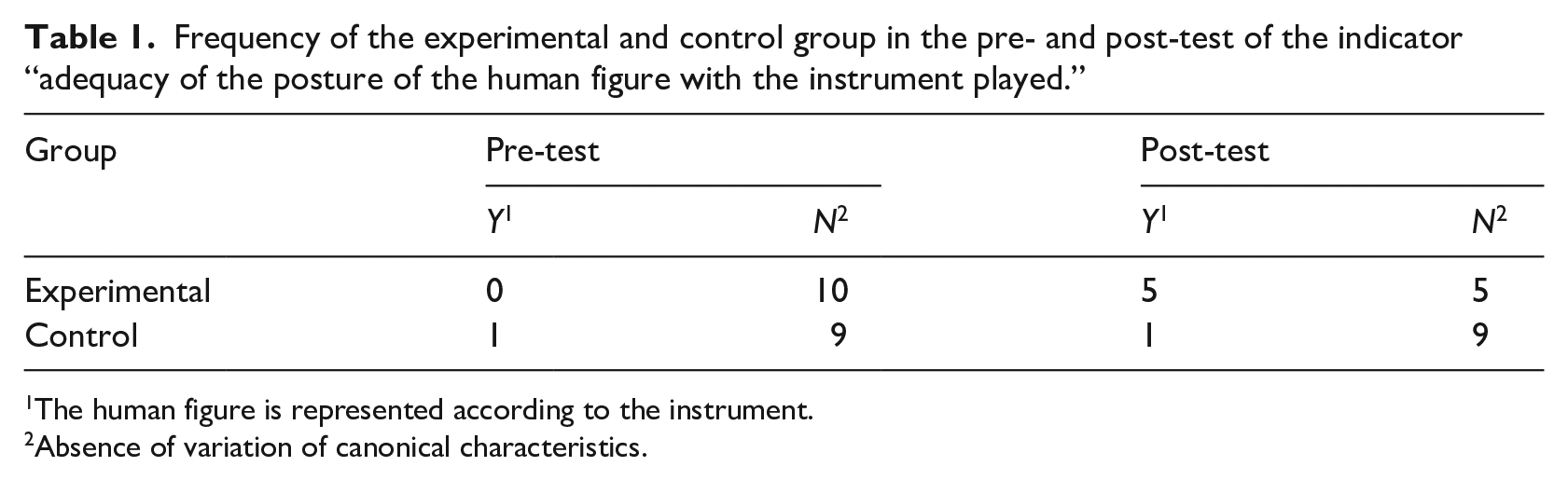
The human figure is represented according to the instrument.
Absence of variation of canonical characteristics.
Logical-mathematical skills
Our second hypothesis was to verify whether specific musical training would improve the development of logical-mathematical skills of preschool children. Comparing the experimental group and the control group to the pre-test, there were no statistically significant differences. A post-test comparison between the music training group and the control group showed no statistically significant differences (see Table 2) in logical operations areas (seriation, counting, and classification).
Post-test comparison between experimental and control groups: Jonckheere-Terpstra test.
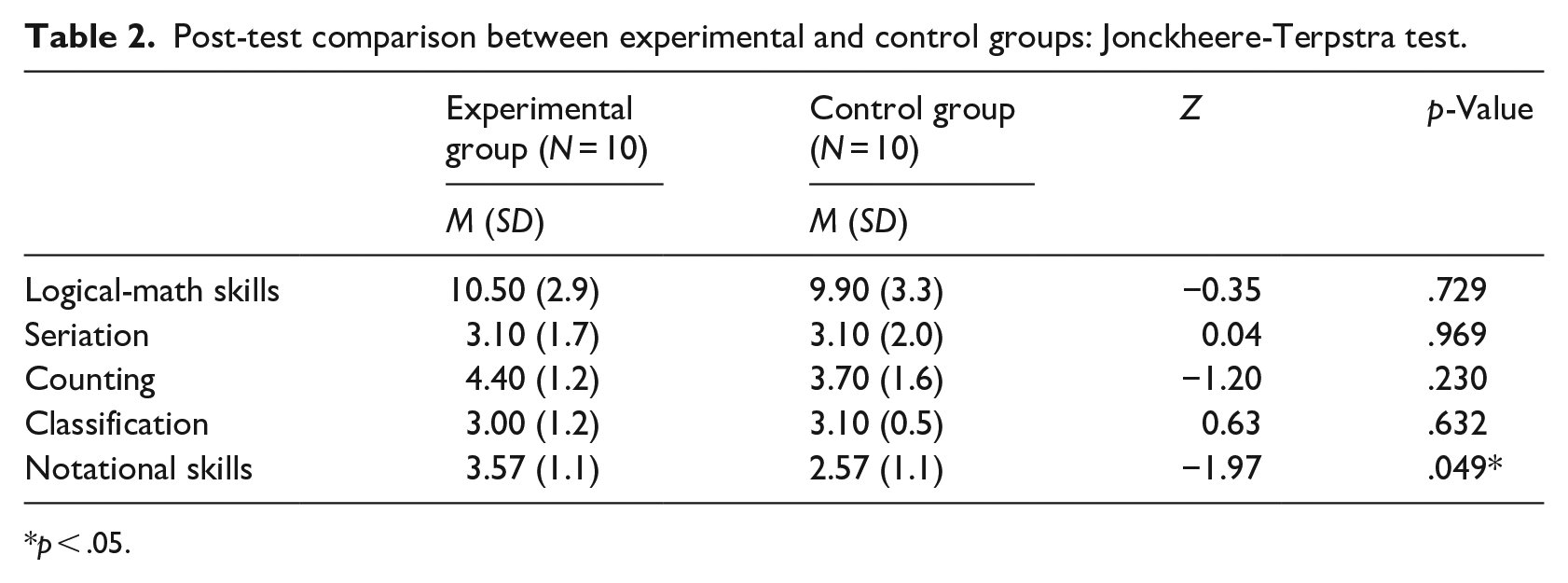
p < .05.
While there was a statistically significant increase in these abilities within the two groups from before and after the training, for the experimental group Z = −2.54, p < .05, r = .80; for the control group Z = −2.39, p < .05, r = .76. According to Cohen’s (1988) criteria, the effect size was high in both cases (see Table 3).
Comparison within the group before and after music education program: Wilcoxon signed rank test.
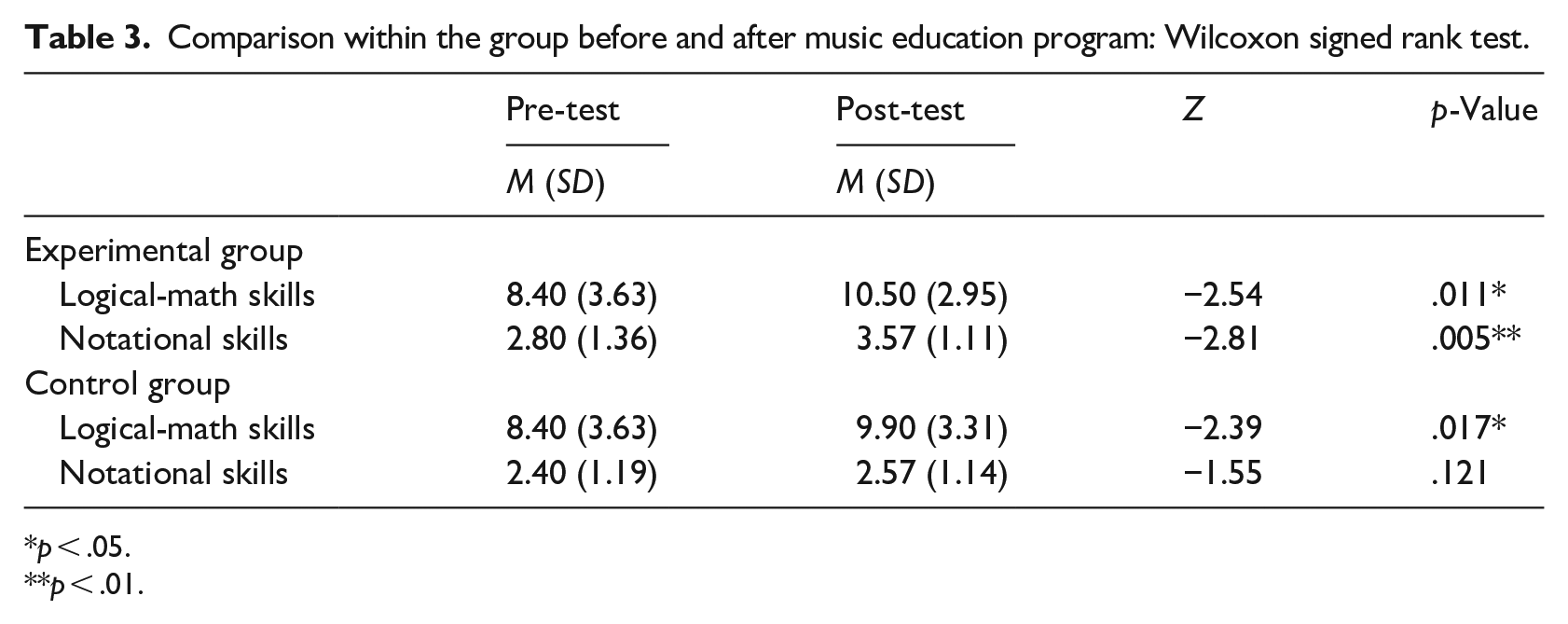
p < .05.
p < .01.
Notational skills
Finally, we hypothesized that this specific training would improve the notational skills of preschool children. Comparing the experimental group and the control group to the pre-test, there are no statistically significant differences. At the post-test, statistically significant differences were found between the two groups (Table 2), Z = −1.97, p < .05, r = .44. In this case, the effect size was moderate. Between the initial level and the final performances, a significant improvement emerges for the experimental group but not for the control group (Table 3), Z = −2.81, p < .01, r = .89. In this case, the effect size was high (Cohen, 1988).
Discussion
Recent work suggests that explicit musical instruction, in addition to enhancing music-specific knowledge, substantially affects development of basic behaviors and neural processes in a range of domains and modalities (Holochwost et al., 2017). The issue is still controversial.
The general aim of this research was to investigate the effects of a music education program on preschoolers’ logical-mathematical and notational skills and meta-musical awareness. The study presented here may contribute to the controversy that surrounds the question of whether the effects of music training are specific to music or extend to other domains. Our results only partially support the hypothesis that musical training is correlated both with musical ability and with performance on a wide variety of cognitive tasks, including pre-reading and pre-writing ability, mathematical and spatial abilities.
The study suggests that formal music training, through starting to play instruments, detecting wrong notes, remembering and reproducing familiar tunes and rhythms, detecting, blending and counting sound units, making appropriate correspondences between amount of sound and note writing, enables participants to improve their meta-musical awareness directly and, indirectly, to become more proficient in notational abilities, but do not affect their logical-mathematical abilities.
First of all, our research has verified that, as expected, a specific music education program acts on meta-musical awareness, an aspect of musical thought that plays an important role in musical learning. From the methodological point of view, these results confirm that pictorial representation can be a useful tool to detect the metamusical skills of young learners, whose metacognitive knowledge would be difficult to detect using the verbal channel. By drawing musical activities children can make visible their implicit knowledge, what they know about the rules, languages, and actions that characterize the musical code. In the pictorial representation of oneself in a specific musical context, the drawers belonging to the experimental group showed their physical, mental, and emotional involvement with respect to “being” musicians compared to their peers belonging to the control group.
This result, the transition from a tacit to a more explicit awareness of the child, may have been favored by the fact that the music education program uses extensively the explanation of the characteristics of the instruments and their way of functioning, and presents a rich variety of terms that name them, describe their component parts, narrate the expressive and emotional effects of sound, etc. In addition to verbal instructions and explanations, participants are offered a wide range of motor experiences, ranging from mimicry and motor reproduction of rhythms, to the imitation of the specific gestures necessary to play the different instruments. Children were also encouraged to perform a “pretend” musical session performing in front of peers, to listen to the work of others, and to compare their experience with the group. Thanks to these routines some aspects of meta-musical awareness increase, namely knowing the physical characteristics of the instruments and the gestures and postures related to them. These results provide interesting confirmation of the formative power of direct, in-person experiences for internalizing and memorizing the performance routines necessary for musicians. In fact, they suggest that a given amount of motor skill practice will enhance one’s subsequent awareness of features, postures, and gestures specifically involved in the motor activity.
The findings regarding indirect effects, due to transfer, on metacognitive knowledge other than music, which are more domain-general offer an articulated pattern. Some of the results such as those related to the effects of musical training on cognitive skills of logical-mathematical type, showed that there is no impact of a music education program on logical-mathematical operations. The slight improvements that are recorded in the two times of the research, do not appear significantly different between before and after, either in the experimental group or in the control group. This trend supports the part of literature that questioned the impact of musical training on these cognitive abilities and suggests that improvements in this area are due mainly to the developmental-maturative effect, as hypothesized by the pioneers in the field (e.g. Piaget, 1941). Another reason that might explain the low levels of association between musical training and mathematics may be that musical training is associated with some aspects of mathematics but not others. For example, Bahr and Christensen (2000) reported that performance on a mathematics test and a musicianship rating scale correlated in areas where music and math shared structural overlap in pattern recognition and symbol usage but not for other areas of mathematics where there was no overlap with the musical domain. This suggests that our music program may have, on the logical-mathematical skills used in our practice defined as seriation, counting, and classification, modes of learning transfer defined as “far.” Transfer can be near or far and it is stronger and more likely to occur if it is near (Hallam, 2015).
The picture of the impact of the music education program on domain-general skills is different when we examine symbolic-notational skills. According to our hypothesis, the results show that this music program increased preschoolers’ ability to make the appropriate graphic transcription of sound patterns presented in oral language selecting a specific type of graphic stroke or writing and differentiating it from other graphic signs, such as pictorial ones, and organizing these signs on paper in an appropriate way.
Why does the musical training improve notational ability? We can put forward two possible explanations. First of all, notational ability, as we said in the introduction, is not only a spatial, graphic ability, but also a certain degree of ability to segment the sound flow into sound units, of which to then find the appropriate graphic sign. Therefore, it can be advantageous, for notational ability, to improve the ability to operate on sounds already illustrated in the literature about phonological awareness. Since analysis of sounds has been shown to be largely a musical exercise (Anvari et al., 2002; Degé & Schwarzer, 2011), probably part of the effect on notational analysis comes from the analysis of sounds. Another explanation comes from the practice of handling the graphical representation of notes and practicing how to find the right graphic form that sounds should find on the sheet. Another explanation of the positive effect of musical training on notation ability may lie in the common symbolic nature of writing and reading notes and letters or numbers. Our results seem to strengthen the hypothesis that in order to become familiar with a type of notation, that is, because the child has to realize that all these marks on paper serve different or similar purposes, it is useful for him/her to experiment with a variety of symbolic codes, drawing, writing, numerical, and musical. Familiarizing yourself with the notational system consisting of notes facilitates the identification of specific graphic patterns of writing words and numbers (Cameron & Pinto, 2020). In this way children’s ability to discriminate between the use of notations in the various notational domains is refined and consolidated through comparison and identification of similarities and differences within the framework of ecologically valid tasks. It is useful to remember that the acquisition of each notational symbolic system is enriched by the acquisition of the other symbolic systems.
Our study as a whole confirms that a music education program has direct, beneficial, domain-specific effects on meta-musical awareness, while its contribution to domain-general skills remains controversial. The powerful mechanism of knowledge transfer seems to be active in generalizing to symbolic thought the acquisitions achieved within the specific musical notation, while it does not seem, in this age group, able to stimulate more general logical-cognitive competences, despite the existence of analogies between computation in mathematics and the importance of the notion of quantity in music.
Limitations
The results may not be generalizable to different educational contexts or socio-cultural backgrounds. An important limitation is the sample size. In general, at this age there will be a wide range of mathematical skills and concept knowledge, and it would only be with a very large sample that any meaningful statistical differences could possibly become evident. Studies with small samples limit the generalizability of results. As suggested by Hackshaw (2008), in these cases it is necessary to interpret the results carefully. Therefore, the study should be replicated with a larger sample size to ensure that the same results are still found.
It would be interesting to verify the duration of the beneficial effects of this training with a follow-up study. It would be useful to extend the research to different socio-cultural levels. Therefore, also considering the importance of the influence of the socio-cultural characteristics of the environment from which the child comes, investigating other aspects, such as family musical culture, may assist in encouraging a child to play a musical instrument.
Implications
For the specific educational context to which it applies, this research implies that more space should be given to music teaching. This implies the introduction of evidence-based music activities in the child curriculum (Abril, 2006). Not generically music, but a specific type of musical experience. The results suggest the usefulness of using graphical representation as a way to foster meta-cognitive reflection on learning, having children practice in a variety of symbolic systems, including numerical, word, and musical notation (Brooks, 2009).
The effectiveness of this program suggests two important implications: the importance of including broad musical skills in teacher training to significantly expand their professional expertise and collaboration with musicians; and, on the other hand, for children, the inclusion of music education programs in the educational curriculum from the kindergarten. In the Italian educational system, the preschool teacher does some musical training. In the training of teachers and in particular in that musical training it would be useful to disseminate the usefulness of these studies, to make available to children the use of musical notation and other musical systems and recognition of sound skills, phonological awareness and sound analysis. In this research, the music program was administered in a private music school. The Italian school system, based on a national curriculum, currently allocates very few resources to music education. Our work contributes to research in particular in the Italian context, as we believe that music education could and should always find more space in formal curricula.
In practice, facilitating participation in school music for all students may be improved by teacher pre-service and in-service education. Furthermore, improvements to music education in schools should be achieved through hiring adequately trained specialist teachers, increasing music time in the school timetable, and ensuring schools have adequate facilities and equipment.
Supplemental Material
sj-docx-1-ijm-10.1177_02557614211027247 – Supplemental material for The impact of a music education program on meta-musical awareness, logical-mathematical, and notational skills in preschoolers
Supplemental material, sj-docx-1-ijm-10.1177_02557614211027247 for The impact of a music education program on meta-musical awareness, logical-mathematical, and notational skills in preschoolers by Oriana Incognito, Laura Scaccioni and Giuliana Pinto in International Journal of Music Education
Supplemental Material
sj-docx-2-ijm-10.1177_02557614211027247 – Supplemental material for The impact of a music education program on meta-musical awareness, logical-mathematical, and notational skills in preschoolers
Supplemental material, sj-docx-2-ijm-10.1177_02557614211027247 for The impact of a music education program on meta-musical awareness, logical-mathematical, and notational skills in preschoolers by Oriana Incognito, Laura Scaccioni and Giuliana Pinto in International Journal of Music Education
Footnotes
Author’s note
With this letter I declare that this original contribution has never been published before, nor has been sent to any other journals for consideration. I confirm that all co-authors have reviewed and approved the final version of the manuscript that I am submitting and have agreed to the listing-order for authors. The corresponding author is affirming these details on behalf of all authors.
Funding
The author(s) received no financial support for the research, authorship, and/or publication of this article.

Supplemental material
Supplemental material for this article is available online.
References
Supplementary Material
Please find the following supplemental material available below.
For Open Access articles published under a Creative Commons License, all supplemental material carries the same license as the article it is associated with.
For non-Open Access articles published, all supplemental material carries a non-exclusive license, and permission requests for re-use of supplemental material or any part of supplemental material shall be sent directly to the copyright owner as specified in the copyright notice associated with the article.
