



Abstract
In Australia, access to music education is inequitable due to the challenges of distance, different state education systems and a lack of resources in schools. As a means to address this social justice issue, we explore here the viability and effects of a digitally based music outreach programme undertaken in collaboration with Hands on Learning (HOL), an alternative education provider. The programme was delivered over 6 weeks using GarageBand to children in a small rural town who were experiencing difficulties in upper primary and lower secondary school years. A qualitative approach was taken, holding focus groups, observing sessions and accessing HOL daily notes. The programme had a significant impact on the teachers and children involved, showing promise for a larger scale project in the future.
Introduction and background
The right to access music education has been taken up as a social justice issue across the globe (Green, 2003; Wright, 2015) and inequalities of access are also notable in Australia. The inclusion of music in school curricula and as extracurricular activities varies due to distance and resourcing (including music expertise), differing across states and territories. Outside cities, while access to music in schools is good in some states, in others, it is limited to generalist teaching in primary schools and just one mandatory year in high school. This practice occurs in the context of our increasing awareness of the benefits of music education to young people, in terms of wellbeing, creativity and learning outcomes (Hallam, 2010). These are benefits that can work beyond the metrics-driven constraints of the modern classroom where young people from backgrounds outside the dominant social classes are often disenfranchised due to a lack of recognition of the capabilities they bring to educational spaces (Whitty & Clement, 2015; Zipin et al., 2015).
In the Australian context, issues of ‘engagement’ in educational settings have led to a growing pressure to reform secondary education systems and address the impact of a progressively skills based and economically productive focus (Department of Education, Employment and Workplace Relations, 2011; Department of Education and Training, 2018). In response, governments are increasingly turning to alternative education providers as a means to ‘re-engage’ young people (Te Riele, 2014). This article shares research exploring equity of access to music education opportunity in an alternative schooling context. It describes a collaborative research project that explored the potential of a music programme, working in collaboration with Hands on Learning (HOL), an alternative education provider based in Victoria, Australia. Its particular focus was on widening access to music education through a digital programme. The opportunity to trial this initiative came through HOL, who were interested in expanding their curriculum to include music as a promising means towards engagement. This was based on an understanding that music features heavily in young peoples’ out-of-school lives (Ruthmann, 2007), thus offering high salience in everyday life, wellbeing and aesthetic opportunity (Hallam & MacDonald, 2013).
FLOs and curricula
HOL operates among a proliferation of Flexible Learning Option (FLO) Programmes in Australia that have emerged to engage young people who have lost or never had connection to mainstream schooling. In Australia, eight distinct education systems operate, one in each of the six states and two territories, encompassing diversity in age of commencement, age of transition to high school, curricula and matriculation exams. This challenge impacts FLOs that work across more than one state, such as HOL. According to Te Riele (2014), the following three models for FLOs operate in Australia: (1) programmes within mainstream schools, (2) programmes within Community Colleges and Technical and Further Education Colleges and (3) independent alternative programmes. Young people from backgrounds outside the dominant social classes are often held back by material and economic factors, which FLOs seek to address, offering meals, travel vouchers and, in some instances, child care (Mills & McGregor, 2014). Unlike most FLOs, which focus on secondary students, HOL offers alternative learning from primary school level onwards. As an example of programmes within schools, teaching is delivered in school grounds by artisan teachers, usually local community members. Through a student-centred approach in which young people have been shown to thrive (Mills & McGregor, 2016), HOL aims to create a culture of success, building self-esteem and confidence. HOL’s core endeavour is the ‘formation of positive, productive and meaningful relationships based on trust and respect with other students and adult role models’ (Te Riele, 2014, p. 100).
Within alternative educational settings, curricula are necessarily limited and music education opportunities are dependent on location and expertise. The Technical and Further Education (TAFE) system has a number of music courses, including production and performance, mainly located in large cities, with subject choice limited in regional areas. HOL’s curriculum is restricted to construction, landscaping and gardening, with the recent addition of cooking. For independent schemes, curricula are limited by staff expertise and school students may have to access music learning outside their education provider, which raises financial issues, given that many students in rural and remote Australia are categorised as being from low socio-economic backgrounds (ABS, 2018). Even in mainstream primary and high schools outside urban Australia, the quality of music education is varied (Pascoe et al., 2005).
Parity of participation
The concept of ‘parity of participation’ was proposed by Nancy Fraser (2000) to address the material, cultural and symbolic barriers to full participation in society by individuals. The concept encompasses the three aspects required for participation – redistribution (material and economic concerns), recognition (cultural concerns) and representation (political or ‘voice’ concerns). In Fraser’s view, it is the combination of these aspects that makes social justice possible. Furthermore, an individual’s social status within a social context such as a public school can lead to misrecognition, in which an individual’s status as subordinate to others prevents her from ‘participating as a peer in social life’ (Fraser, 2000). These are arguably the underlying and often implicit causes that HOL and other FLOs seek to redress through a focus on a student-centred approach. This challenge of inequity joins with the challenge of equity of access to particular resources – here music education. Of particular interest to the researchers was whether some under-achieving school students might respond to an opportunity related to music creativity, as an alternative to carpentry and gardening.
In working with an alternative education provider in Australia, this project sought to make a difference by working ‘close-up’ (Clegg et al., 2016) with educators, support workers, a university student and school students to offer a situated contribution to knowledge. Specifically, the initiative was designed to explore the affordances of music to furnish the school students’ worlds with new and creative possibilities (DeNora, 2000, 2016).
The learning environment and music
In the 21st century, it is relatively easy for most to find, share and listen to music through a smartphone or digital device. How we use music to manage, regulate and extend ourselves as we navigate our lives has been the subject of numerous studies (e.g., Clarke et al., 2009; Davidson & Garrido, 2014; DeNora, 2000). It is of critical importance to young people who commonly stream their playlists into their ears, a practice that can reinforce identity, enable personal expression and protect from what can be a confusing and antagonistic world. The sense of safety and affirmation evoked through music has the potential to support the learner, ‘making spaces more habitable, supportive [and] nurturing’ (DeNora, 2016, p. 65).
The use of music in our lives suggests its power as a resource for world-building (DeNora, 2000; English, 2020; English et al., 2018a). World-building encompasses the way we care for and manage self through accessing resources (here music) that protect and support us, reinforce identity, help explore emotions and feelings, and connect us to people, places and the past. Music is powerful for world-building as a time-based art that affords a sense of narrative, immersion and creation of memories. Furthermore, as DeNora (2000) points out, music creates a sense of safety that allows us to explore its other affordances.
Given music’s importance, whether as an aesthetic experience or for wellbeing and identity, access to music education has become a social justice issue (Abrahams, 2007; Green, 2014; Schmidt, 2002). In Australia, cost-cutting exercises have seen many music programmes removed or diminished. Music teachers often have to take on a second role at schools, music resources are frequently a low priority and extracurricular music is dependent on dedicated staff who put in long hours. Music education has been identified as the school subject with the greatest distributive inequity ‘to a degree found nowhere else’ (Wright, 2015, p. 342). Mills and McGregor (2014) note there is often a lack of space in traditional learning settings for students to insert their own experience. Yet, music offers a way into the student’s world and an opening to share across cultures as audible cultural capital (Abrahams, 2007). Moreover, music is a form of expression alternative to spoken communication, with the potential in music education ‘to be a transforming power in different realities’ (Schmidt, 2002, p. 4).
When music-making and music creativity are made accessible and grounded in collaborative and experiential learning styles, their distinctiveness from regular academic class learning becomes a key facet (Green, 2008, 2014). This is, first, because communication through sound is free of personal identity markers such as accents, use of grammar and slang, and is, therefore, potentially liberating for the individual (Oesch, 2019). Second, when there is a shift from learning based on traditional compositional processes to one on sound itself, the learning environment is levelled out in terms of student engagement and success (Schmidt, 2002). Third, this shift implies a move away from prescribed music (musical repertoire) that inevitably represents some and not others (Abrahams, 2007; Ruthmann, 2007). Music as collections of sounds is open to having meaning assigned to it or being made meaningful, in contrast to language which seeks to convey specific meanings (Oesch, 2019). It does not rely on privileged access to a cultural ‘code’ that is learned in some homes and not others (DeNora, 2017; Wright, 2015). Once canons of music repertoire and emphasis on acquired music skills and techniques (such as knowledge of scales, harmony and notation) are no longer the central focus, music is a medium that any child can engage with and feel a sense of capability. They are free to bring what they know from everyday listening to their projects, and teachers and students can work together to create and share music and ideas (Ruthmann, 2007). The pedagogical space then shifts to a more Freirean (1970) set of possibilities in which ‘new knowledge [is] discovered through dialogue and experience in and with the world’ (Schmidt, 2002, pp. 1–2). If this occurs in outreach, working with school students who have limited access to creative forms of learning and who are under-performing, music is potentially powerful (McPherson et al., 2012; Spychiger et al., 1993).
Music also contributes to generative learning environments when it is meaningful for children. The emotional climate of learning spaces has been shown to be vital to children’s disposition to learn (Mills & McGregor, 2016; Tyng et al., 2017) and emotional wellbeing has been linked to literacy and matriculation (Thomas et al., 2017). Education providers often require children to fit into set structures and learning styles, which may be experienced as oppressive and/or combative by the school student (Mills & McGregor, 2014). This is a motivator for FLOs’ student-centred approaches which invest in students’ emotional wellbeing through building relationships. Music creation can further support and improve emotional wellbeing through emotional expression (Abrahams, 2007), provided it is enjoyed and has meaning for the young person (Hallam & MacDonald, 2013).
The project
In early 2018, our research team met with HOL core staff to discuss the possibility of exploratory music workshops. In the HOL model, the organisation makes a partnership with a school (primary or secondary) where HOL offers small-group experiences, to which children can self-refer or be referred by school staff. The usual model is 1 day a week in the HOL environment and 4 days in regular classroom learning. The team worked with the HOL’s support officer to propose a creative learning experience that was complementary to HOL’s ethos. We were invited to co-develop a short programme in a small country town in Victoria run by two artisan teachers working with students from upper primary and lower secondary school years in the two local public schools.
In working with HOL staff, we co-theorised that a music programme would still encapsulate the concept of ‘hands on’ but might appeal to diverse students experiencing ‘disengagement’ in traditional educational settings, premised on the assumption that most young people are already engaged with music in their out-of-school lives. We contended that a music programme informed by notions of world-building and aspects of critical pedagogy (sound-based, dialogic, with no prescribed texts) might allow students to draw on their own soundworlds to express emotions, connect with others and feel successful (Bolton, 2008; Ruthmann, 2007). Intending to reach students with little to no experience of formal music learning, we considered how we could create music experiences for school children in a small country town with few conventional resources and no music-trained teachers. We decided on a digital technology approach, promoted by a university music student pedagogue to build relationships with young people. We would use software for music creation, and online videos to deliver the workshops and give feedback. In consultation with the university music student, then enrolled in Honours, we chose GarageBand as an intuitive programme that works at all levels from basic beginner to recording artist. The inbuilt musical metre and mode constraints, coupled with the automatic instruments identified by names, such as Jessie and Anders, allow beginners to experience success early on. The challenge of using GarageBand is its compatibility with Apple devices only. We considered personal computer (PC) and Android alternatives but GarageBand was potentially the most engaging product available due to its attractive interface, the touch-sensitive screen (iPad and iPhone) and its depth as a compositional tool.
The use of technology such as GarageBand software has been argued for as a means for social justice in music education because it enables composition from students with no ‘music capital’ (Lamb, 2010; Louth, 2015; Savage, 2005) and allows them to create music that is ‘culturally relevant to them’ (Bolton, 2008, p. 42). As a tool, GarageBand allows the novice to work with digital instruments, record their voice and experiment with texture through adding instrumental and vocal layers. As Chen (2020) notes, it can build motivation and narrow the gap between students with prior music learning and those without. Furthermore, many young people today are conversant with digital technologies, considered to be ‘natural features of [their] landscapes’ (Louth, 2015, p. 475). However, there are non-equitable aspects of technology, such as the expense of some products, their regular redundancy and their influence on education through what Louth (2015) refers to as a ‘de-skilling’ process, meaning the cognitive steps and learning missed out in features such as instant key transposition.
Methodology
Our approach builds on a social justice agenda of bringing high-quality musical opportunity to young people who currently have limited access. Our conceptualisation of social justice draws on Burke’s (2012) translation of Nancy Fraser’s social philosophy to understand the multi-dimensional nature of equity concerns and possibility in the context of education. This conceptualisation holds together considerations of recognition (cultural dimensions), redistribution (material and economic dimensions) and representation (political dimensions) to build a ‘parity of participation’ (Fraser, 2003). Translating this into a music education context: recognition might reflect a sensitively designed pedagogical and curricular environment in which a diversity of cultural tastes and histories were respected and celebrated, redistribution might reflect efforts to provide access to resources and experiences for students who otherwise lack access and representation might reflect how the perspectives, interests and insights of a young person are included in the cooperative design of initiatives. The tensions between these dimensions are important given that in the process of targeting resources for redistribution (e.g., money for musical software) care must be taken not to construct ‘the target’ of this allocated resource in ways that assume deficit, and therefore, deny recognition.
In this project, we sought ways to navigate and understand the complexities of using technology to broaden accessibility for schools and alternative educators who lack the expertise to include music in classroom teaching. Through HOL, we were working with vulnerable young people and our first priority was to ensure they felt safe and were able to participate freely. This affected our choice of methods. We watched the children at work and their musical pieces emerge but did not interview them. Our priority was for the young participants to enjoy the process, so we minimised intervention by focusing on observation, journaling and focus groups with the adults involved.
Research methods and workshop design
The project was exploratory and our questions focused on understanding the challenges and possibilities of using technology to deliver a music programme and the outcomes (including unexpected) of engaging in music composition with school students marginalised from the mainstream formal system. The project took a quasi-ethnographic and qualitative approach comprising a number of modes of data collection: observations, diaries, teachers’ notes, daily education reports and focus groups. The data from notes, diaries and reports provided a background for the more detailed focus group sessions: one with lead authors and the two artisan teachers; the second with all researchers, the online teacher and HOL’s School Support Officer. The focus groups were held by Zoom and recorded. Transcripts of the recordings were made and thematic analysis was used to identify key themes (Braun & Clarke, 2006). Ethics was approved by UON 2018-0249.
The HOL teaching and learning day is deliberately open in structure so that students have the choice to pursue any assigned project through the day. The music programme filled the morning session of 2–3 hr and ran for 6 weeks. The first author attended four out of the six sessions in weeks 1, 2, 4 and 6, and introduced the music programme to the lead artisan teacher before commencement.
The video tutorials were designed by an Honours music student with expertise in music technology. The content and delivery style were his own contribution, developed in conversation with the first author and framed in terms of guiding people younger than himself in a structured, positive yet exploratory manner. Using a student as workshop leader fits with a model for outreach developed in collaboration with the Centre of Excellence for Equity in Higher Education at The University of Newcastle over the past 8 years. This rests on the premise that school students are often readily able to identify with young workshop leaders and, through doing so, can imagine paths through education embodied by students who have often come from ‘similar’ backgrounds themselves (English et al., 2018b). For this project, the first author worked with the Honours student to develop a programme of six workshops.
The workshops blended a hands-on element (the iPad touch screens) with online pre-loaded videos and were supported by the artisan teachers. The project was created by researchers in consultation with the School Support Officer without access to the site, which turned out to present a number of challenges. These were (1) artisan teachers’ lack of confidence, (2) the physical learning space, (3) infrastructure and (4) resources. In this school, HOL was located in a shed in the town showgrounds where Internet was inconsistent and where the music workshops ran next to carpentry workshops. HOL activities usually centre on woodwork and the two artisan teachers had no experience of creative workshops and were apprehensive. This was resolved by spending an evening before the first session with the lead artisan teacher and running through the workshop plan, software programme and video content. The teacher’s concern that she would need a high level of musical knowledge abated once she understood the capabilities of GarageBand and the ways in which the school students would engage with it. The unpredictability of the Internet at the site was resolved by downloading the material (videos) before the sessions. Problems of sound in a large echoing space where music and carpentry competed were resolved by going outside. This was clearly reliant on weather and, though not sustainable across the entire year, the weather was fortunately mild during the music programme.
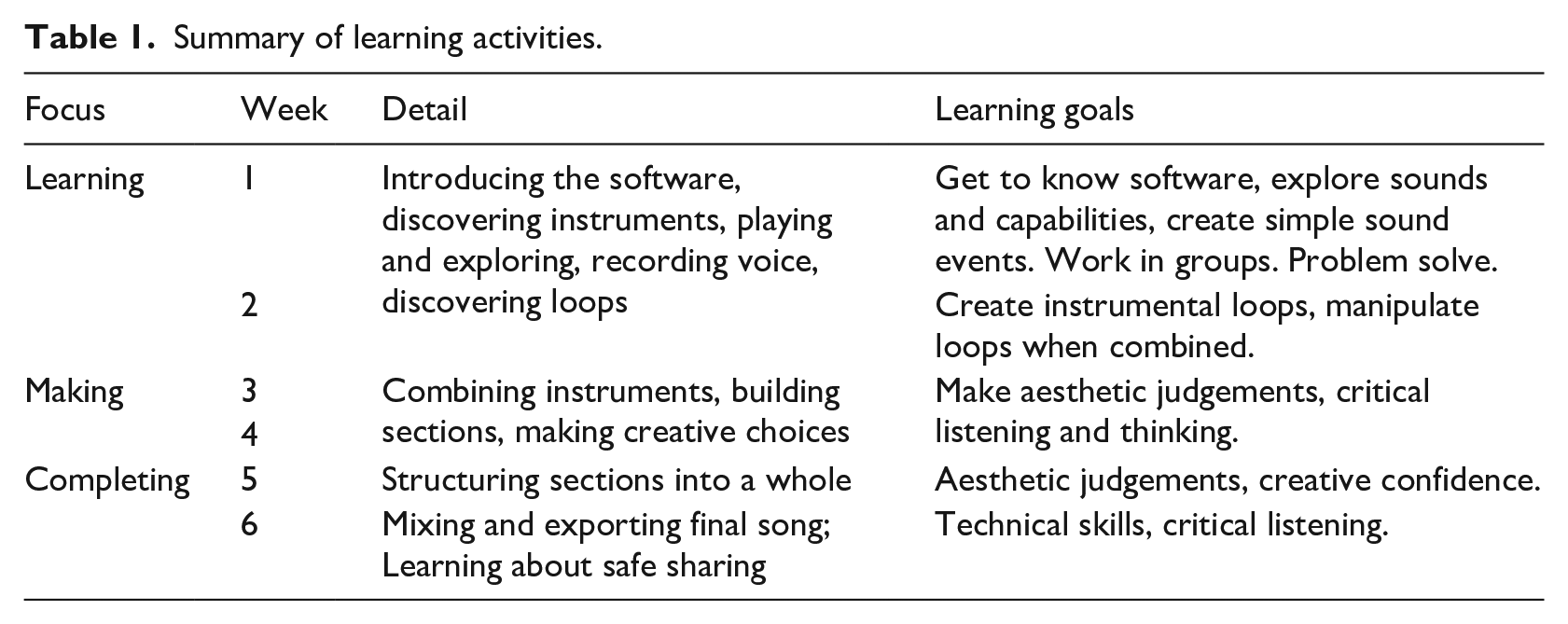
The workshops had the following requirements: students needed access to an iPad, workshops were designed for students to work in pairs and they were open to any school student. No prior learning in music was required. In addition, students chose their partners; which aligns with Green’s (2008) recommendation for peer learning. We provided iPads and used headphone splitters so that two students could collaborate on one device. There were underlying guidelines that were in keeping with HOL pedagogy. First, there would be a collaborative aspect to the music creation; second, students should be able to proceed at their own pace; third, the learning could be extended for more confident students. While the videos were primarily instructive in using the software, the tasks were deliberately open-ended with the intention of fostering the students’ creativity. The design is summarised below in Table 1.
Summary of learning activities.
The students who self-selected for the workshop were from upper primary school (10–12 years) and Year 7 in high school (12–13 years). There were six participants in week 1, which represented approximately half of the total number of students in the HOL programme. There was some fluidity about the group which shifted from two boys and four girls in week 1 to one boy and five girls in week 2. The group grew to seven in week 3 when an additional boy joined. The first author and lead artisan teacher ran the workshops. The location was a great distance from the first author’s base (over 1,000 km) and, therefore, she opted to lead four out of six sessions. None of the school students had prior music training. In this context (rural, low socio-economic town), the artisan teachers described working with children with low self-esteem, poor engagement and poor social skills, with few or no friendship circles. One boy, ‘T’, rarely spoke and when absolutely required, he would cry while speaking in a very soft voice. In the first workshop which introduced the programme, the children showed interest and T was immediately drawn to the GarageBand interface and began to chat about it. The following week (week 2), the first interactive workshop took place in which the Honours student’s video introduced GarageBand and demonstrated how to create and record tracks. We watched the video (12 min) and, as it proceeded, the children became more attentive. The children formed pairs to work collaboratively in the first 4 weeks. They found their own spots outside in the sun and worked together for nearly an hour, with some input from the artisan teacher and researcher. When they came in for morning tea at 11 am, we set a small task for them to do, tailored to each child. Each group had already mastered different aspects and one girl had worked out how to add loops. They were still playing their songs and trying new things when we came back in at 12 pm. At the conclusion of each workshop, the children played their compositions for the entire HOL group.
In week 3, the lead artisan teacher facilitated, finding that the videos worked best when the children could pause them and work at their own pace. She commented that ‘Like any lesson – some students picked up the concepts really quickly and kept up, others found it too much and only worked on half of the concepts taught in the podcast’ (diary notes). She found that the children were engaged and keen to explore GarageBand further. In week 4, the lead author guided and the children worked through the next stage of the software. Simple clapping and rhythm exercises were held since the group had little concept of counting a regular beat. At the end of the session, we airdropped their work to a laptop for feedback on each musical work from the Honours student. In week 5, the lead artisan teacher was able to download the feedback and share with students. Unfortunately, only three of the students were present due to conflicting school events. From week 5, the students decided to work individually on new work, allowing more confident students to extend.
Results
During the workshops, the children surprised their teachers and HOL staff with their appetite to embrace the software, persevere, collaborate and support each other. They worked in pairs in weeks 1–4, then moved to working on their own songs, taking turns with the iPads. At this point, some of them moved ahead quickly and relished the challenges of refining their ideas. However, others found it challenging to move beyond their first efforts and needed support. In our analysis of the focus group transcripts, diary notes and HOL observations there were a number of themes that emerged strongly. These were sustained engagement, collaboration in learning, positive response to feedback, achievement and ownership. In the following discussion, student names are replaced by letters.
Engagement is a contested term that is ubiquitous yet commonly uninterrogated in education research, practice and policy making (McInerney, 2009). The term ‘engagement’ was repeatedly used by adult participants in the study, often in relation to students’ interest to begin and continue a task or project: I didn’t expect, well normally these students would do the bare minimum, they’d come back, you know I teach some of these kids in the classroom as well so if I sent them off with a task, they’d come back with bare minimum effort and say that they’re finished. (Lead artisan teacher, focus group 1) Because I didn’t think some of these kids would actually sustain the 6 weeks and yet they have, and they loved every minute of it. (Lead artisan teacher, focus group 1) B had a good day and was working hard on her music even as the project is getting harder. It's great to see her trying harder as it gets tougher. (HOL observations, Term 3, Week 6)
In this observation above, a different perspective on engagement jostles with a mainstream understanding. The importance of ‘a good day’ in the lives of young, marginalised, rural students in an alternative learning context cannot be overstated. This view of engagement subtly undermines the instrumentalised and deficit-loaded discourse that invokes a need to conform in formal schooling. A more flexible approach surely holds the possibility of a less standardised framework of expected behaviours and evaluations of success. One aspect brought to the initiative was an equity-oriented recognition that ‘engagement’ can look and feel diverse.
A second theme to emerge was collaboration. These children usually found forming social connections challenging and lacked friendship groups at school. Working in teams is a key aspect of HOL’s work, usually focused on making and building. In this project, the children worked in pairs successfully and some also stepped up to help each other: D is enjoying the music program, she is polite and hardworking and always prepared to help within the group. (HOL observations, Term 3, Week 5) So you know, for the kids to have even been able to step up and do that shows me that they got a lot out of it. Because these kids would not normally be able to do that, they wouldn’t be confident to share their experiences and their learnings. (Lead artisan teacher, focus group 1) My major reflection from the whole program was the engagement of the kids across so many levels . . . the interactions among themselves, willingly sharing that information. (School Support Officer, focus group 2)
Third, teachers and observers were pleased with the children’s positive responses to feedback from the Honours student (C), which formed the main focus of a video in week 5: Not once did they come to me and say, ‘I don’t want to do what C suggested’, they’d come to me and say, ‘I did what C suggested and do you know, my song sounds better’. (Lead artisan teacher, focus group 1) The students had genuine rapport for him. They – there was that real strong bond of what he was providing so it was really interesting to watch. (School Support Officer, focus group 2)
The sense of achievement that the children experienced through creating their own music flowed through to their behaviour and confidence. They wanted to share their work and send more for review. As the first comment shows, no prior music knowledge was needed to excel in the workshops: The other thing I liked too was that it didn’t matter, their lack of musical ability so they still – they got that sense of achievement. (Lead artisan teacher, focus group 1) E had a great day with his music program. He was engaged and so willing to share his work with us. (HOL observations, Term 3, Week 7) The engagement of the kids across so many levels, basically creating a piece and they’re running around to try to get as many people to listen to it as possible and self-worth, you know, that motivation to create more from what they’re doing. (School Support Officer, focus group 2)
Finally, a sense of ownership became clear, linked to self-worth and the opportunity to draw on their own soundworlds: I was probably complementing the program more than that, saying they also choose to want to do it, it’s something that they for themselves like, getting them to do learning that suits them. (Artisan teacher 2, focus group 1) T has been extremely keen throughout and wanted to show me his four creations as soon as he arrived. (Researcher, diary notes, 2018) I really like seeing them have something that’s their own. (Honours student, focus group 2)
It is important to recognise that these changes were within the context of the HOL environment where there was a lot of positive reinforcement and where trust was being built. However, the music programme reached at least two students who were previously disengaged and there were several notes on the students’ positive attitudes carrying over to the regular HOL programme: T worked well with H to complete his music piece, then was happily engaging with R on the mosaic item and helped with the design. (HOL observations, Term 3, Week 7)
In the music workshops, high levels of motivation came with a sense of ownership, as well as respect for others and sharing of work and ideas. Technology skills (some transferable) were shown including manipulating digital sound, copying, pasting, extending, changing volumes, changing instrument type, moving sound tracks around and switching between track and instrument views. Students followed instructions to a high level of detail, copying the examples that the Honours student created. He had intended these as examples only but the children were motivated to replicate them, choosing their own learning pathway through replicating as a means to gain skills and understand the process before experimenting themselves.
Discussion
The concept of parity of participation offers an opportunity to move away from the contested term ‘engagement’ (McInerney, 2009) and focus on signs of participation from students who ordinarily experience material, cultural and political impediments to doing so (Fraser, 2000). Promising signs of a participatory parity were demonstrated in the students’ sustained and enthusiastic efforts to create and refine musical compositions. The students’ participation was already being encouraged by the broader conditions of the HOL programme, however, the music programme seemed to accelerate their self-directed learning and self-efficacy. Although only a 6-week programme, it had an immediate influence on the students’ desire to learn, often seen when marginalised learners access creative learning experiences (Spychiger et al., 1993). Louth (2015) notes that software like GarageBand can give students with no prior knowledge the opportunity to manipulate sounds and create meaningful pieces. He also notes that we cannot assume that technology of itself is empowering; it needs to be used within a positive learning environment where relationships and trust are critical (Mills & McGregor, 2016). The Honours student was key to the children’s continuing engagement through his playful video persona and his encouraging and committed presentation style. His approach evolved from other outreach experiences, notably in Walgett, Northern New South Wales, where he worked with Aboriginal children: I spent a few weeks up in Walgett, running workshops for Indigenous kids up there in remote communities who had very, very little. It’s just, I don’t know, it’s really hard core to see the reaction, I guess. I went back a year later and everything they’d learned was so firmly in their minds as being very important. (Honours student, focus group 2)
His individualised feedback was a key aspect (Bolton, 2008), as was its delivery as peer-to-peer communication, suggesting he and the students were co-musicians (Wright, 2015). The Honours student stated that he wanted them to feel free to make something ‘worthwhile’ and not ‘conveniently good’ (focus group 2). The analysis process he described as, I went through the songs and I picked apart their layers, their structures and I inferred what I could of what their direction was, if there was one to begin with. And then I gave them suggestions of how they could go ahead and even conventionally create more of a song structure or break apart ideas into small more compartmentalized sections or to further explore any avenues that they were going in that were a bit more exploratory. (Honours student, focus group 2)
Although interactions were not in real time, inter-personal connections were suggested through the Honours student’s personalised feedback and engaging style of presentation. It was striking to the observers how strongly the students related to him: The students had genuine rapport for him. There was that real strong bond of what [he] was providing. (School Support Officer, focus group 2)
In considering this later, we felt that the Honours student communicated recognition of each student through his feedback. As an outsider, his teaching produced recognition when each school student recognised him giving them recognition, with rapport and participation emanating from this dynamic (Burke, 2012). Taken together, the opportunity to access music composition workshops (a first for the students) as a form of redistribution, the serious appraisal of their work (recognition) and the new sense of contribution that the students made through sharing their knowledge with peers at school (representation) showed how effective such a programme can be for students who are under-resourced.
Throughout the initiative, an important backdrop for the work were behaviours and expectations identified by the local state schools as important to address. These behaviours included bullying, work refusal, bad language, insulting others, disrespect, refusal to follow instructions and rudeness. In the music workshops, no bullying was observed; neither was bad language nor insulting of others. Students followed instructions to a high level of detail, displayed high levels of engagement, shared their work and mentored others. While not presented here as some form of simplistic cause and effect claim of ‘impact’, it was certainly a stark difference between the behaviours used to characterise students and those observed during the initiative. To identify whether this can be attributed to the approaches taken within the initiative, the novelty of the experience for participants, or the power of participation is not necessarily the intent of this article. Importantly though, it was reported that these shifts endured from the music workshops and into subsequent non-music sessions.
What were the flow-on effects? (unexpected outcomes)
Significantly, the programme had a transformative effect for at least two of the participants. One boy discovered his voice through his engagement with the programme. This carried over to his school where the principal reported that he could not stop talking about the programme. This was a dramatic and unexpected outcome. Another child, also at primary school, was reported by artisan and teaching staff to shift from being a ‘bully’ to being a ‘leader’. Several of the children felt confident enough to help others within the group. All felt confident to share their work. At the end of the project, the students asked to extend the work and create videos to accompany the music. This was agreed on with HOL teachers as a development of the programme. In addition, the primary school students started a GarageBand club at their school, reflecting their move towards ownership of the participation.
Conclusion
The exploratory project with HOL was small-scale, emergent in design and flexible to the circumstances. The effects were striking and the benefits both immediate and then sustained as seen in the group continuing the project following our departure. The Honours student’s style of leadership was crucial to the success of the programme and important to record. Key aspects were his ability to communicate, his openness to all manifestations of creativity, his personalised feedback and his empathy. His commitment to the programme came from his strong sense of social justice regarding access to music, which stemmed originally from his own childhood experiences and was consolidated by the impact of his music workshops in Aboriginal communities. In this project, we saw music as a cultural tool being seized by young people to furnish their worlds in everyday schooling – for them, a challenging context. The emotional and connective benefits of music creation were further enhanced by the sense of success that the Honours student’s feedback reflected back to the school students. Importantly, in this process, they felt recognised. The programme showed that meaningful music programmes can be run with minimal cost once the videos are created. We suggest, therefore, that the programme has potential to address some embedded injustices in terms of music education access. Future research would benefit from being sustained over longer periods, involving more participants of a wider age range and different styles of music engagement.
Footnotes
Declaration of conflicting interests
The author(s) declared no potential conflicts of interest with respect to the research, authorship and/or publication of this article.
Funding
The author(s) disclosed receipt of the following financial support for the research, authorship, and/or publication of this article: The authors received financial support for the research project from the Faculty of Fine Arts and Music, University of Melbourne and the School of Creative Industries, University of Newcastle.
