



Abstract
“We do not learn from experience. . .we learn from reflecting on experience” (Dewey, 1933). Building on the theoretical frameworks of Dewey and Schön involving reflective practice, we expanded existent reflective research by examining timing of preservice music educators’ self-reflections after peer teaching. We examined reflection timing (immediately after peer teaching or after viewing video of that same teaching), effect of differing prompts immediately following teaching (free: “How did the lesson go?” or structured: “Name one good thing and one area to improve”), and changes over time (three peer teaching experiences). We examined 5,175 comments from 138 reflections across 69 lessons taught by 23 pre-service educators. Results, analyzed in terms of pre-determined categories, revealed that teachers were consistently less positive immediately after teaching than after viewing video. Positivity was well below 50% but increased across each lesson. Responses were primarily self-focused rather than student focused, especially immediately after teaching. Teachers tended to emphasize social aspects (confidence, atmosphere) during immediate reflections but mentioned music and instruction more frequently after viewing video. Descriptive data, consisting of percentages and graphic comparisons, were discussed in terms of implications for effective teacher preparation and suggested areas of further research.
Keywords
The benefits of reflection, “the intentional attempt to synthesize, abstract, and articulate the key lessons taught by experience” (Di Stefano et al., 2015/2016, p. 7) as a valued, desirable characteristic has been well established in many fields, particularly in education (Zeichner & Liston, 1996/2014). In Dewey’s landmark book, How We Think, published in 1910, but revised extensively in 1933 to clarify ideas specifically regarding reflectivity, Dewey succinctly summarized the connection between practicing and reflecting, “We do not learn from experience. . .we learn from reflecting on experience” (p. 78). Building on Dewey, Schön (1983, 1987) further explored reflective teaching/learning by distinguishing between reflecting in the moment while performing a task (Schön’s reflection-in-action) with reflecting after the fact (Schön’s reflection-on-action). While preservice teachers might benefit from reflection-in-action, we argue that most music education researchers (Killian & Dye, 2009; Powell, 2016; Schmidt, 2021) have asked preservice teachers to reflect after, not during, teaching (Schön’s reflection-on-action).
In a monograph aptly titled, “Learning by Thinking: Overcoming the Bias for Action Through Reflection,” Di Stefano et al. (2015/2016) emphasized the importance of reflection after the fact as they grappled with relationships between experience and reflection, arguing that “reflection on one’s accumulated experience leads to greater learning than the accumulation of additional experience” (p. 1). They noted that researchers in many fields (and, by extension, teaching in those fields) have examined the role experience plays in the accumulation of knowledge. The emphasis on experience has influenced researchers to equate experience with action. Di Stefano et al. (2015/2016) theorized that “once a person has accumulated a certain amount of experience with a task, the benefit of additional practice is inferior to the benefit of reflecting upon the accumulated experience” (p. 3). The amount of experience remained unspecified, but the results of their studies verified those assumptions in a variety of workplace settings outside of education. Wieland et al. (2016) concurred, arguing that “reflection at the right time has been shown to be one of the most critical components of learning” (p. 205) without specifying ideal timing.
Based on the complementary theoretical frameworks of Dewey and Schön, and the studies outside of education by Di Stefano et al. (2015/2016) and Wieland et al. (2016), we designed our current study to examine other intersections of timing and experience on preservice music educators’ reflective responses.
Value of reflection
Although reflective teaching has become an accepted, perhaps even expected, aspect of teacher preparation (Zeichner & Liston, 1996/2014), and inservice teachers value reflection (Schmidt, 2021), preservice teachers do not always view reflection as particularly valuable. For example, Killian and Dye (2009) found that 43 preservice music educators rated video reflection as the least valuable aspect of their teaching experience. A student explained: “I already know what I did; I don’t need to watch it again” (p. 11).
Reflection timing (memory-based vs. video-based)
Music researchers have explored aspects of reflection timing particularly related to teacher preparation (Conway, 2012; Duke, 1994; Kelly, 2000; Powell, 2014, 2016). Several have specifically asked teachers to reflect on past teaching experiences after months or years, most finding distinct differences in earlier versus later reflections. Kelly (2000) asked preservice music educators to reflect on their concerns prior to student teaching and again during their first year of teaching, finding distinctly different fears mentioned, demonstrating a change in reflective focus over time. Conway (2012) asked 12 music teachers to reflect on their student teaching written reflections 10 years later, and Bartolome (2017) questioned participants about preservice fieldwork after 1 year of teaching. Both Conway and Bartolome found distinct differences in focus after the passage of time and recommended formal self-reflection as a required component of fieldwork experience.
However, relatively few researchers have compared the effect of immediate reflection (immediate memory) with reflection a day or two later prompted by video. Sims (1986-1987), in an early study designed to test the effectiveness of video feedback, compared 41 preservice elementary teachers’ self-evaluations immediately after teaching a song and again after viewing a video of their teaching. She found that students’ initial impressions were more negative than their subsequent evaluations. In a study particularly related to our current investigation, Powell (2016) asked 19 instrumental music education students to complete 4 teaching episodes followed by free-form reflections immediately the following teaching and again after viewing a video of their teaching. Powell found that students provided 65% more comments following the video comments, speculating, “While the process of watching the teaching videos may have been the primary factor that results in participants’ writing more and with more specificity, other factors may have also contributed. One of these factors is time” (p. 500). We designed the current study to explore further reflection timing.
Structure of reflective prompts
Much variety exists in the types of prompts provided to stimulate reflection. There are several examples of free form prompts in which participants were simply asked to reflect (Henninger & Scott, 2010; Henninger et al., 2008; Powell, 2016; Springer & Yinger, 2019), to list anything observed from a video of a music classroom (Buonviri & Paney, 2022; Killian & Liu, 2018), or to list questions or concerns (Kelly, 2000; Killian et al., 2013). Other types of prompts have included responses to semi-structured dialogs with prepared questions (Stegman, 2007), ratings on pre-determined aspects of teaching followed by instructions to devise descriptive, non-evaluative statements (Duke, 1994), or responses to a prepared rehearsal analysis form (Killian & Dye, 2009). Silvey and Montemayor (2014) asked instrumental conductors to submit written self-reflections regarding their ensemble teaching. The researchers labeled their written reflections as “free-response,” but the responses were stimulated by prompts (positive/negative affect, strongest aspect of rehearsal, and aspect needing most improvement). A dearth of music education research was found comparing free response with structured prompts among the same respondents; thus, as Springer and Yinger (2019) recommended, we designed our study to address that issue.
Reflective dependent measures
Positivity
Various dependent measures have been chosen to examine written reflections. Several researchers employed established qualitative techniques (examining coded comments for emerging themes) to evaluate written reflective responses (Bartolome, 2017; Stegman, 2007; West & Clauhs, 2019). Springer and Yinger (2019) analyzed written reflections for the use of pronouns (I/we/they), time (present/future), and affect words (positive/negative) using linguistic software. They found that affect words were consistently more positive than negative, a factor that did not change across multiple teaching episodes. Contrastingly, in research particularly related to our current study, Henninger and Scott (2010) evaluated perceptions of 18 preservice music teachers who viewed videos of themselves teaching elementary music. Participants wrote reflective paragraphs for two self-selected excerpts (one good; one needing improvement) which subsequently were examined for the presence of pre-determined categories: positivity, teacher-related comments (use of strategies, music skills, teacher affect), and student-related comments (music skills, social skills, affect). Results indicated that 75% of the comments related to the participants’ perceptions of themselves and 25% related to their students. In contrast to Springer and Yinger (2019), responses were less negative for the second reflection than the first. Henninger and Scott (2010) urged further research on the effect of experience on positive/negative teaching perceptions.
Focus on self
Others have followed Henninger and Scott (2010) methodology by examining pre-determined factors. Powell (2016) coded for specific evidence of Fuller and Bown’s (1975) stages using a pre-existing codebook. Fuller and Bown (1975) speculated that teachers typically progress through three stages: self-concern, task-concern, and finally concern for student learning. Music researchers have examined the Fuller–Bown stages and their applicability in the music teacher preparation process, finding concurrence with the model regarding teachers’ emphasis on self-concerns (Berg & Miksza, 2010; Henninger, 2002; Killian et al., 2013; Powell, 2016). In each study, preservice teachers tended to focus on self. Other music researchers, however, using agreement with a checklist of prepared items rather than participant-generated comments as the dependent measure, found that preservice music teachers rated student-learning items more highly than self-items (Campbell & Thompson, 2007; Miksza & Austin, 2010). While not ignoring the importance of the “concern with content stage,” other researchers have tended to focus primarily on self versus student, sometimes exclusively so (Buonviri & Paney, 2022; Killian & Liu, 2018).
Further, Killian et al. (2013) found teaching experience to be an influential factor as preservice teachers moved from focusing on self to focusing on student progress. But Killian and colleagues noted that additional experience made very little difference in changes in the mention of subject content, whether it was defined generically as subject content or, more specifically, as music subject matter. For our current study, we were most interested in determining whether reflecting on teaching experiences would cause participants to focus more on student progress than on themselves as teachers. Thus, for this current study, we followed the theoretical framework of Fuller and Bown, but, while still recognizing the importance of subject content, limited consideration to self- versus student concerns.
Given the few studies comparing the timing of reflections and based on the inconclusive evidence regarding effects of teaching experiences on teacher positivity (Springer & Yinger, 2019), we examined the reflective process in-depth, particularly related to the timing of reflections. A unique aspect of this study allowed us to investigate effects of structured vs. free prompts on subsequent reflections. Research questions included:
Timing: Will content differences exist between reflections immediately following a teaching episode (memory-based) as compared with reflections after watching a video of the same episode days later (video-based)?
Experience: To what extent will individual self-reflections differ across three different teaching episodes?
Prompts: Will there be content differences between reflections solicited by free-response versus structured prompts?
Method
Participants
Participants were music education majors (N = 23) at a large southwestern, research-intensive, public university. All IRB requirements for the protection of human subjects were followed throughout this study. Participants were two semesters from student teaching and were enrolled in different sections of a curriculum course for music education majors team-taught by music education professors, two of whom were also researchers for this study. Thus, we used intact classes which provided authenticity but allowed neither randomization nor equalization of numbers in each group. As part of their regular curriculum, each participant taught a series of lessons to their peers (purposefully including vocal, woodwind, brass, percussion, and string students) performing on primary instruments. Participants (modeled after Raiber et al., 2009) composed/arranged music for this combination of musicians, created an instructor-approved rehearsal plan, taught video-recorded lessons, received immediate peer and instructor verbal feedback, and submitted a written reflection after viewing the video of their lesson.
Procedures
To further explore the effect of reflective timing (Powell, 2016; Sims, 1986), we instituted two reflections for each teaching episode. Immediately after completing the 15 to 20-minute ensemble teaching episode and receiving brief instructor and peer verbal feedback, each preservice music teacher left the room and emailed or texted an immediate reflection to the instructors regarding what they had just taught (memory-based reflection). We labeled this condition “Immediate Reflection.” Following the Immediate Reflection experience, each preservice teacher received access to a video of their teaching episode, viewed it outside of class as many times as desired, and responded in writing within 3 days to reflection prompts. Specific prompts included questions about overall lesson impression, planning, most and least effective teaching strategies, rehearsal technique, and conducting (Killian & Dye, 2009). We labeled this video-based condition “Video Reflection.”
We analyzed three lessons for each participant taught at the beginning, middle, and end of a semester to examine the possible effects of experience. Each lesson occurred 2 to 3 weeks after the previous one. Thus, participants (N = 23) taught three times (69 different lessons) and reflected on each lesson twice (Immediate and Video), resulting in 138 different written reflections.
To further evaluate the effects of differing prompts on Immediate Reflection, particularly related to positivity (Henninger & Scott, 2010; Silvey & Montemayor, 2014; Springer & Yinger, 2019), we asked some participants to reflect immediately using a prompt of one positive thing about the lesson and one area that could be improved (n = 16 teachers with three lessons = 48 lessons). We labeled this condition “Structured Immediate Reflection.” Other participants received no instruction beyond “How did your lesson go?” prior to Immediate Reflection (n = 7 with three lessons for 21 lessons). We labeled this condition “Free Response Immediate Reflection.” No participant experienced both immediate reflection conditions; each was assigned the same condition during all three teaching episodes.
Subsequently, we combined both Immediate Reflection groups when comparing the memory-based reflections with the video-based reflections since both groups received identical video prompts (N = 23 for 69 lessons). This design allowed us to examine the effects of immediate versus video reflections, the effect of structured versus free-response immediate reflections, and the effects of teaching experience across three lessons.
Data collected
We compared each participant’s Free Response Immediate Reflection or Structured Immediate Reflection with their Video Reflection. Because participants were free to format their responses in bulleted lists or paragraphs, each phrase was considered a single data point (Killian & Liu, 2018; Killian et al., 2013). One researcher read each comment and divided it into phrases. Any phrase division questions were discussed among the researchers until a consensus was reached. Ultimately, we considered 5,175 individual comments across 138 reflections.
Coding of data
We coded each written comment as defined below. One researcher coded all comments independently, while other researchers coded 40% of comments as reliability. We then collectively discussed any discrepancies until consensus was reached (Killian et al., 2013; Miksza & Austin, 2010).
Coding categories and definitions
Each comment (N = 5,175) was coded with three pre-determined categories:
Positivity
Positive (+), Neutral (N), or Negative (−) as defined by Henninger and Scott (2010).
Focus
Teacher (T), Learner (L), or Other (O) modeled after Fuller and Bown (1975) purposefully eliminating consideration of Fuller and Bown’s focus on subject matter for the purposes of this study (Buonviri & Paney, 2022; Killian & Liu, 2018). Other (O) referred to our inability to determine whether a comment referred to Teacher or Learner, for example, “rehearsal went well” or “room was cold.”
Teaching
Music (M), Instruction (I), Social (S), or Undeterminable (U) as defined by Henninger and Scott (2010). Music (M) included: conducting, music materials, warmups, music specifics, anything musical. Instruction (I) included: planning, pacing, directions, strategies, speech clarity. Social (S) included: confidence, atmosphere, demeanor, overall affect. Undeterminable (U) included anything except M, I, or S.
To allow analysis of only the interpretable comments, we removed all Neutral (n = 59), Other (n = 68), and Undeterminable (n = 59) comments from further analysis (3.73% of 5,175 total comments). Thus, we ultimately analyzed a total of 4,989 individual comments. Throughout, frequency data were converted to percentages (Springer & Yinger, 2019) to allow comparison of varying numbers of comments from individual participants.
Results
Immediate reflection versus video reflection
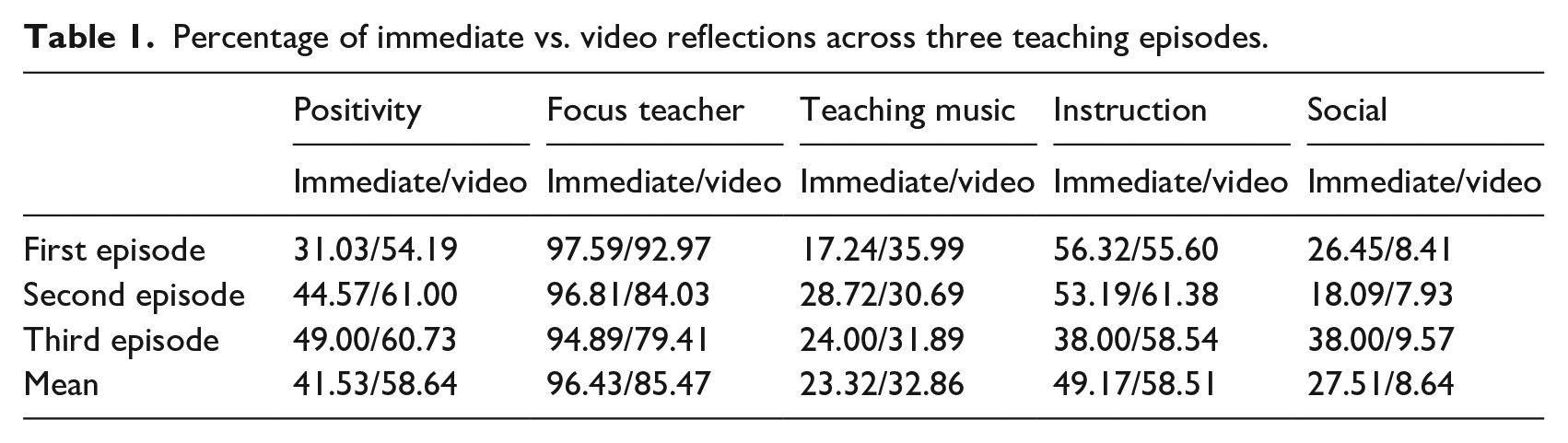
For this analysis, all Immediate Reflections (Structured and Free Response) were combined to allow comparisons between immediate impressions and after viewing videos. Results indicated that overall, substantially fewer comments of any kind were made during Immediate Reflection than after Video Reflection (835 Immediate comments = 16.74% and 4,154 Video comments = 83.36% of total comments). Table 1 displays the percentage of comments per category. Overall, comments during Immediate Reflections were less positive, had a higher percentage of Teacher comments, exhibited lower percentage of comments about Music and Instruction, but showed substantially higher percentages of comments in the Social category than did Video Reflections. The following are of note:
Positivity. Data were expressed as percentage of Positive to total comments. Lower percentages of Positivity occurred in Immediate Reflections (mean = 41.53% positive) than in Video Reflections (mean = 58.64% positive).
Focus on Teacher or Learner. Data were expressed as percentage of Teacher to total Teacher + Learner comments. Participants mentioned Teacher (self) frequently, sometimes to the exclusion of Learner comments (100% teacher focus). Immediate Reflections resulted in a higher percentage of teacher comments (mean = 96.43% teacher comments) than did comments after Video Reflections (mean = 85.47%).
Teaching: Music. Data were expressed as percentage of Music + Instruction + Social to total Teaching comments. Comments after Immediate Reflections exhibited a lower proportion of Music comments (mean = 23.32%) than after Video Reflections (mean = 32.86%).
Teaching: Instruction. Immediate Reflections resulted in fewer Instruction comments (mean = 49.17% Instruction) than did Video Reflections (mean = 58.51% Instruction).
Teaching: Social. Immediate Reflections resulted insubstantially more Social comments (mean = 27.51% Social) than did those after Video Reflections (mean = 8.64% Social). The composite graph (Figure 1) compares Immediate versus Video Reflections across three Teaching Episodes.
Percentage of immediate vs. video reflections across three teaching episodes.
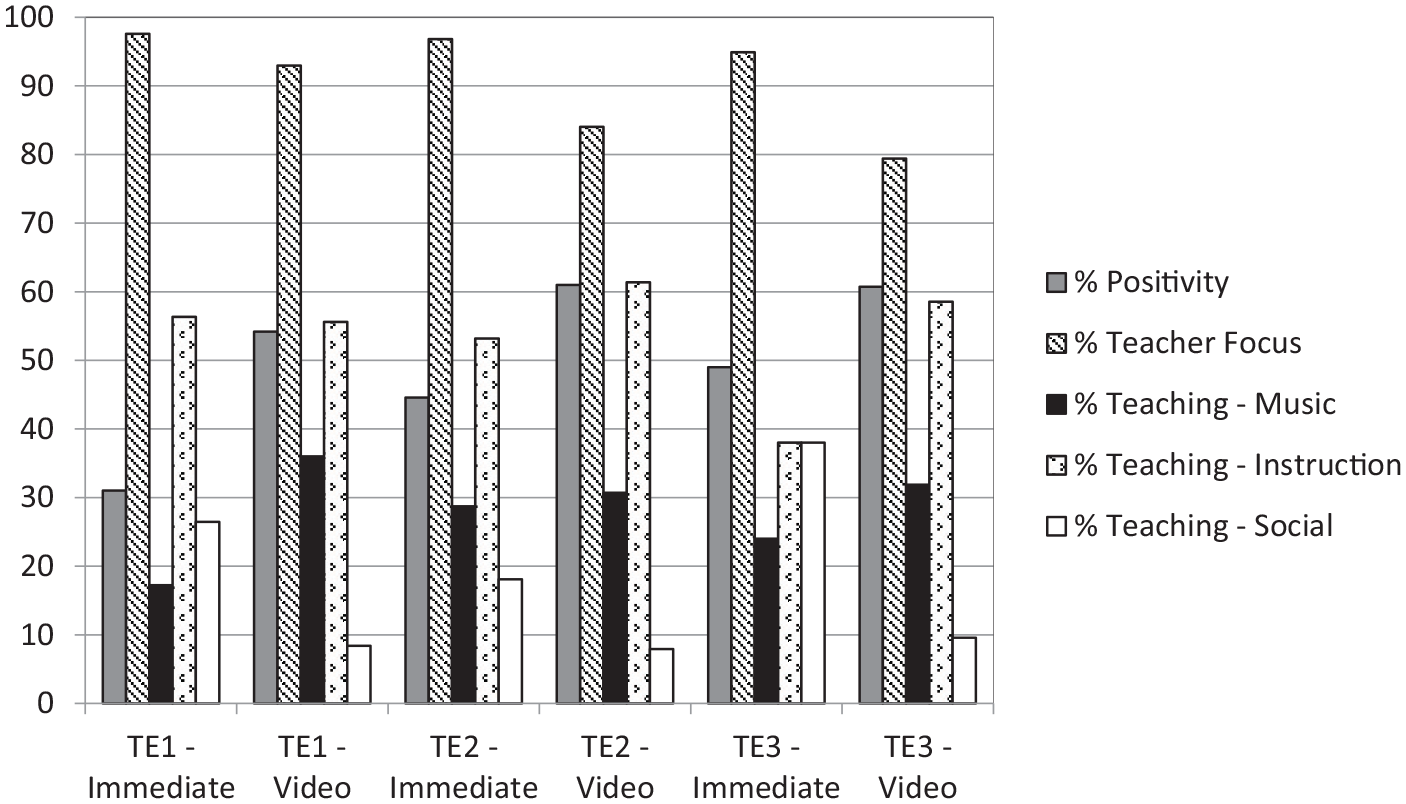
Immediate versus video reflection across three teaching episodes.
Effect of accumulated experience
We compared responses across Teaching Episodes (TE) 1, 2, and 3, which allowed us to consider the possible effects of teaching experience on reflective comments. Categories of responses appeared to vary as students gained teaching experience. See Table 1 and Figure 1.
Positivity. Initial Immediate Reflections were quite negative but became more positive across each teaching episode (TE1 = 31.03% positive, TE2 = 44.57% positive, TE3 = 49% positive). Video Reflections were initially more positive than Immediate Reflections, and became more so across time (TE1 54.19%, TE2 61%, and TE3 60.73%).
Focus. Teacher appeared to be the primary focus of all reflections. Comments about the Teacher (self) following Immediate Reflections remained high throughout each TE (97.59%, 96.81%, and 94.89%). Video Reflections also exhibited a high percentage of comments about the Teacher but decreased with each episode (92.97%, 84.03%, and 79.41%), showing a corresponding increase in mention of Learners.
Teaching. Instruction was the largest percentage of Teaching comments for both. Immediate and Video Reflections (38.00%–61.38% of the Teaching Category comments). Music comments appeared in lower percentages in Immediate Reflections (17.24%, 28.72%, and 24.00%) than in Video Reflections (35.99%, 30.69%, and 31.89%). Social comments (e.g. confidence, demeanor, atmosphere, overall affect) exhibited the greatest difference between Immediate (26.45%, 18.09%, and 38.00%) versus Video Reflections (8.41%, 7.93%, and 9.57%).
Structured versus free response immediate reflection
A unique aspect of our design allowed further examination of the effects of prompts on Immediate Reflections. We considered whether a free response prompt (“How did the lesson go?”) would yield different responses than a more structured prompt (“List one positive aspect of your lesson; list one thing that could be improved”). Results indicated that there were indeed differences in responses under the two conditions. Table 2 and Figure 2 present Immediate Reflections only, divided into Free and Structured conditions. Notable results included:
Positivity. Percentages of Positive comments increased across the three lessons (See Table 2 and Figure 2) with the greatest Positivity increase occurring in the Free Response group (26.53% positive in TE1 to 52.73% by TE3). A similar but less dramatic increase appeared in the Structured Response group, even though participants were instructed to list only one positive and one improvement aspect. Structured Response Positivity ranged from 36.84% to 44.44%.
Focus. Focus on the Teacher was extremely similar between both groups, with Teacher ranging from 100% to 92.86% of the comments with correspondingly 0% to 8% comments involving Learners.
Teaching: Music. When mentioning Music, the Structured Response group remained quite stable across all three episodes (ranging from 21.16% to 23.91%). However, the Free Response group exhibited much more variability among teaching episodes, ranging from 14.00% to 33.33%. See Table 2 and Figure 2.
Teaching: Instruction. Structured Response comments remained quite stable across the three teaching episodes (ranging from 65.22% to 53.35%), while the Free Response group showed more variability (26.32–54.00%). The Free-Response group started high (54.00%) and decreased the percentage of Instruction comments with each Teaching Episode.
Teaching: Social. Both groups exhibited much variability across the three teaching episodes. Notably, the Free Response group more frequently mentioned Social factors (confidence, demeanor, atmosphere, overall affect), with a mean of 34.79%, than did the Structured Response group with a mean of 18.53%. See Figure 2.
Immediate reflection: Percentage of structured vs. free responses across three teaching episodes.

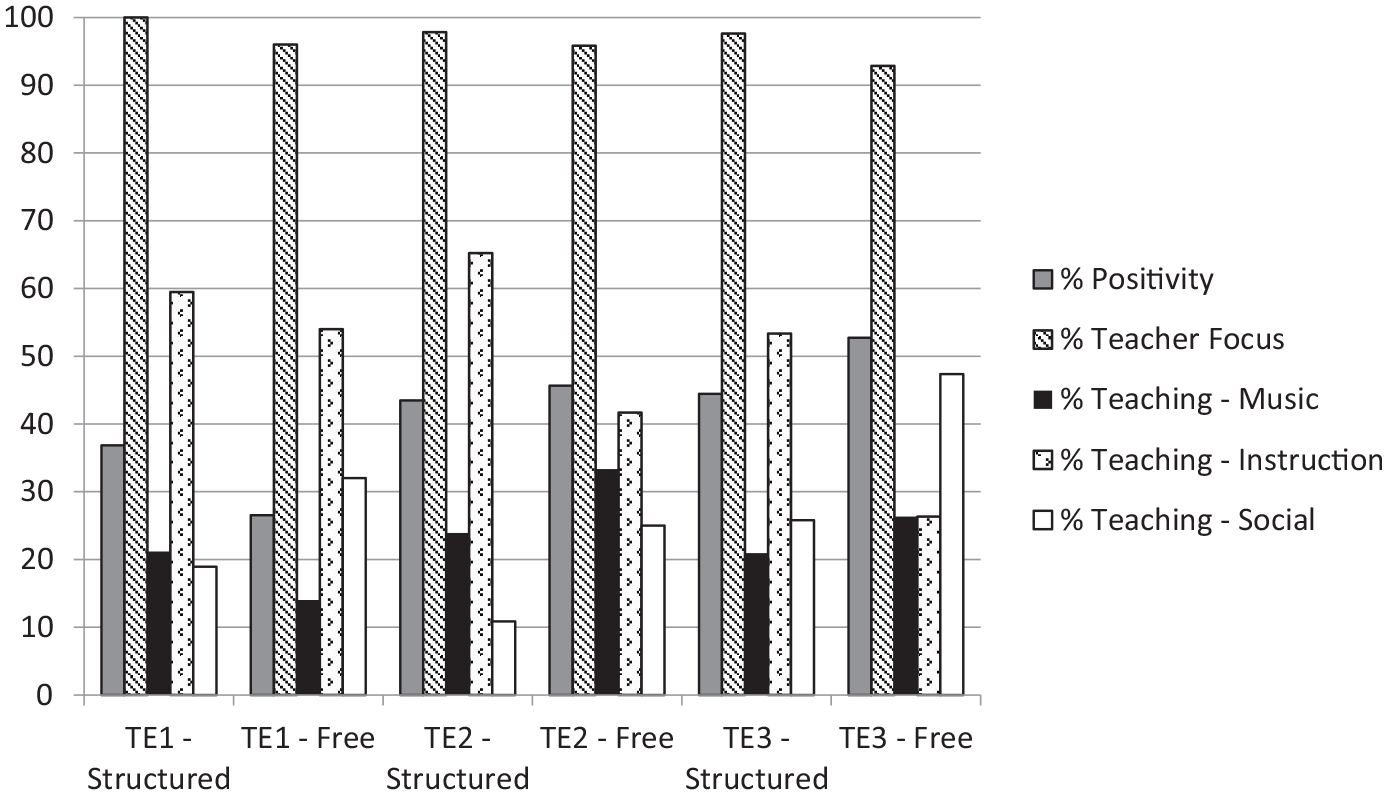
Immediate reflection: Structured versus free response prompts across three teaching episodes.
Discussion
“Because reflections play such an influential role in the development of preservice music teachers . . ..continued study of their reflections is needed to refine ‘best practices’ of experiential learning in these important preservice teaching settings” (Springer & Yinger, 2019, p. 67).
Given the recognized importance of reflection in the development of preservice educators (Zeichner & Liston, 1996/2014), this study was designed to contribute to that research by examining the effect of timing and structure of reflections of preservice music educators in an authentic setting. We compared immediate reflections (memory) of peer teaching experiences with reflections made after viewing a video of that same lesson across three teaching episodes. Additionally, a unique feature of this study allowed a deeper examination of how structured versus general prompts affected immediate reflection.
Results confirmed the importance of reflection in the development of preservice teachers; however, our examination of the timing of reflections revealed some important new information regarding preservice teachers’ initial perceptions. Initial perceptions (reflecting immediately after teaching based on memory of the teaching as compared to reflecting after viewing a video of that same lesson) were more negative (Henninger & Scott, 2010; Powell, 2016), more focused on self (Buonviri & Paney, 2022; Henninger & Scott, 2010; Henninger et al., 2008; Killian & Liu, 2018; Powell, 2016); however, current results indicated more emphasis on social aspects of the lessons, a new finding. These immediate reflections were affected by the experience of teaching three different times throughout a semester, becoming slightly more positive (but never more than 50% positive), very slightly less focused on self (but always more than 95% focused on self
In comparison, viewing video and reflecting on specific questions about the lesson appeared to result in more positivity (50–60% positive), in a bit less focus on self (80–90%), in fewer mentions of social aspects (less than 10%), and increased mentions of the music and the way it is taught (Instruction) as compared with Immediate Reflections.
Specifics are detailed below, but the overarching conclusion was that preservice teacher perceptions tended toward negativity and teacher-centered comments. Like most previous studies of the reflective process (Buonviri & Paney, 2022; Duke, 1994; Henninger & Scott, 2010; Henninger et al., 2008; Killian et al., 2013; Silvey & Montemayor, 2014; Stegman, 2007), these preservice teachers focused predominantly on themselves (Teacher) rather than their students, further confirming the self-concern versus the student-concern portions of Fuller and Bown Teacher Concerns model (Fuller & Bown, 1975).
Research question 1: Effect of immediate versus video reflection
Many fewer comments were made during Immediate Reflections (Powell, 2016), perhaps because the Video Reflection prompts included reminders to answer specific questions, because participants had more time to consider answers (Powell, 2016), or because immediate memories were so vivid that only a few striking factors were mentioned. Regardless of the reasons, graphic analyses indicated, in agreement with previous research (Powell, 2016; Sims, 1986/1987), reflections differed distinctly when written immediately versus after viewing a video. Notable areas of difference included: Immediate Reflections were less Positive, mentioned the Teacher more often, commented more about Social aspects of the rehearsal than these same participants did after they viewed video of their same teaching episode.
What caused preservice teachers to view Social aspects of a lesson as a relatively major part of the initial impression (27.51%), but to mention Social rarely during the video reflection (8.64%)? Perhaps Social considerations such as confidence, atmosphere, and affect were overwhelming initially, but Music and Instruction became more important considerations on further reflection. We speculated that initial perceptions might be broad, personal, and focused on self. Still, subsequent reflections might allow focus on the presumed initial points of a lesson, in this case, planning for Music and Instruction.
An intriguing question is the cause of a negative response immediately after teaching and a more positive response after viewing a video of that same teaching and/or letting some time pass before reflecting. It might be part of the human condition to remember negative aspects of an event immediately (Rozin & Royzman, 2001; Tierney & Baumeister, 2019), but decide after the passage of time, or after actually viewing a video, that perhaps it was not such a negative experience after all (Conway, 2012; Duke, 1994; Killian et al., 2013). Such findings would seem to emphasize the importance of reflection both immediately and after passage of time, and further research on these issues is certainly warranted.
Such results call for continued research examining the effects of when a reflection occurs. This study did not separate the impact of the passage of time from the effects of viewing a video of the lesson rather than remembering the lesson. We speculated that if one does not reflect after time passes, perhaps the only memory/impression that remains is the initial, primarily negative interpretation of events. The value of reflection after the fact might apply equally to practitioners, academics, and students considering adjudication results.
Research question 2: Effect of accumulated experience
Results also differed across the three lessons taught by each participant. Preservice teachers generally became less Negative across the three lessons, especially in Immediate Reflections. It should be noted that, in agreement with previous studies (Henninger & Scott, 2010; Sims, 1986/1987), Immediate Reflections initially were quite negative (only 31.03% positive for Teaching Episode 1) and never were more than 49% positive (Teaching Episode 3). Contrastingly, for the same lessons, Positivity in the Video Reflections was above 50% for Teaching Episode 1 (54.19%) and increased in Positivity by Teaching Episode 3 (60.73%). Note that these were the same teachers reflecting on their same lessons. Thus, Immediate Reflections averaged 31.03% positive and 54.19% positive in the Video Reflection for that same lesson. Our results, however, conflict with Springer and Yinger (2019), who used software to analyze the presence of positive and negative emotion words, finding that the frequency of positive emotion remained unchanged across four teaching episodes. Future researchers might want to address the effect of analysis of written words vs. software analyzing emotional content of words to address this question.
Research question 3: Structured versus free immediate reflection
Research Question 3 examined differences between Structured and Free Response Immediate Reflections and is one of the unique factors in this study. Changes in Positivity was a potentially important finding: Free Reflection responses exhibited marked increases in Positivity across each of the three teaching episodes (26%, 46%, and 53%) while the Structured prompts (one good thing; one thing to improve) resulted in a more consistent Positivity across the three teaching episodes (37%, 43%, and 44%). Consistent with previous research (Silvey & Montemayor, 2014; Sims, 1986/1987), Positivity was generally low, but the fact that the Free Response group trended higher across three teaching episodes would lead to future research exploring the relationship between teaching experience and growing confidence (as indicated in the Social results of this study) and retention of such confidence as preservice teachers become early-career music educators.
Our relatively low Positivity scores within the Structured Immediate Reflection group may have resulted from the prompt itself (they had to mention one good thing) or may have been due to other undetermined factors. Remember that no teachers in this study experienced both the Structured and the Free Immediate Reflection condition. Further research comparing the effects of free response and structured responses is warranted. Further research might also address how long the negative responses remain. Do initial negative responses develop into an overall lack of self-confidence, or were the most negative initial responses perceived by those who already lacked self-confidence, meaning that the initial negative response was a previously practiced perception?
Results should be viewed with caution due to the relatively small numbers of participants, all from the same university and receiving the same prior instruction, and not divided by teaching or musical skill levels. We intentionally made no statistical examination, viewing these descriptive data as preliminary and stimulus for future research directions rather than generalizable. Although analysis of 5,175 comments by 23 teachers teaching 69 lessons is of substantial size, the numbers in the Free Response Immediate Reflection group were too small for reliable analysis.
Implications for teacher preparation
The results of this study provide important details regarding the emotional affect (positivity/negativity) of initial perceptions. To the extent that the Free Immediate Reflection condition represented participants’ immediate and perhaps most vivid memory of how the lesson went, and the Video Reflection signified the most academic reflection, the differences between the reflective timing and structure would seem worthy of consideration for teacher preparation. If a student were only to reflect immediately (whether formally or to themself), it might be assumed, based on results of this study, that students’ impressions might remain primarily negative, Teacher (self) focused, and concentrated on the Social aspects of the lesson (confidence, atmosphere, demeanor, overall affect) rather than the Music or Instructional properties of the lesson. Taking this speculation one step further, these negative perceptions might be the sole perception the preservice teacher retains if further reflection is not undertaken. Future research should certainly follow initial studies (Conway, 2012; Duke, 1994) to explore additional lengths of time initial evaluative teaching perceptions remain and what factors influence changes in those initial perceptions. Further research is also advised to examine the possibly interactive effect of subject matter concerns (Fuller & Bown’s middle stage) on focusing on self or the teacher.
This study does not address whether or not the unguided preservice teacher with their initial perceptions would consider this lesson later as a typical part of the learning process since we required formal reflections as part of a course. Taking these results one step further into the realm of conjecture, we might speculate that a new inservice teacher with no reflective practice might view individual lessons or even an entire year as negative, focus on themself, and remember their confidence (or lack thereof), and overall affect rather than focus on music or instruction or student learning. It might be speculated that such negativity, if unabated, could contribute to their decision to leave the profession. We believe that this study contributes to the importance of reflection in the development of a preservice teacher’s growth as an early career professional. We urge the continuation of required reflection processes and continued empirical exploration of the factors that lead to reflection as a growth opportunity in the life of an effective young music educator.
Footnotes
Author note
Portions of these findings were presented in 2019 at the 22nd Madsen International Symposium for Research in Music Behavior, Estes Park, CO, USA and at the 2018 National Association for Music Teacher Education Conference, Atlanta, GA, USA.
Declaration of conflicting interests
The author(s) declared the following potential conflicts of interest with respect to the research, authorship, and/or publication of this article: we have no conflicts of interest to declare.
Funding
The author(s) received no financial support for the research, authorship, and/or publication of this article.
