



Abstract
The purpose of this co-autoethnographic qualitative case study was to chronicle the experiences of the first author as he taught general music in a blended, face-to-face, and online synchronous, environment during the COVID-19 pandemic. The co-autoethnography conveys a voice of a practicing teacher with advice and wisdom gained from living and working through the technological aspects of teaching and learning in a blended environment for practicing music teachers. His experiences chronicle how technology was used as a vehicle for amplifying the experiences of students and empowering them to creativities not possible before the pandemic. Implications for music education include exploring the stories of the lived experiences of teachers who taught through the pandemic with a focus on the possibilities and potentialities for profound change mediated by technology, learner-centered pedagogy, and creativities in practice.
introduction
On March 11, 2020, the World Health Organization (WHO) declared the COVID-19 outbreak a global pandemic (WHO, 2020). This event immediately changed many aspects of society, including the world of education. The School of Music where the second author (A2) works and the first author (A1) attends as a Masters student was moved online immediately, moving many studio faculty and ensemble directors out of their comfort zones. All music education field placements were moved online also, meaning that undergraduate students needed to create asynchronous online lessons having not really been prepared to do so. The two authors of this article met in a Masters level class that A2 taught, and A1 was a student in, over the Summer 2020 semester. The online class was titled “Learner-Centered Pedagogies I,” and proved to position A1 for the reality that he would face when he returned to his teaching position in the Fall of 2020. We thought that the greater music education community might like to hear this story as plans for the present and future of music curricula at all levels are being scrutinized, problematized, and potentially restructured.
Background
This research is situated in the Southeastern region of the United States, where the impact of COVID-19 and the conservative political policies of the state in which the authors reside caused massive spreading of the virus within society, schools, and higher education (Crawford et al., 2020). Response to government guidelines and regulations concerning the pandemic (Pather et al., 2020) caused a restructuring of the classroom experiences of music students in classrooms, one that Crawford had chronicled years earlier (2017). Social distancing and working from home became the new normal as all face-to-face (F2F) teaching moved online in March 2020 (Torda, 2020). A1 was caught in a position where he was forced to teach both F2F and online students simultaneously, what has come to be known as blended teaching and learning. Blended learning is “a style of education in which students learn via electronic and online media as well as traditional face-to-face teaching” (Stevenson, 2010). This research chronicles his journey of resilience and transformation during a particular transition to teaching and learning in a blended learning environment.
At the time of the writing of this article the authors had never met in person. A1 was a student and A2 a university professor. That being said, A1 had been in numerous classes, seminars, and independent study situations with A2 via Zoom and through e-mail. In this paper, we reflect on our practice as music educators, having lived through some difficult seasons of our professional lives (Schön, 1983). Teaching music online presented various challenges for music teachers (Calderon-Garrido & Gustems-Carnicer, 2021; Gibson, 2021; Salvador et al., 2021). Through various discussions in classes, seminars, and in an independent study the authors discussed unique experiences that A1 was having teaching blended music classes.
The over-arching goal of this research is to present a qualitative case study that uses a narrative approach to share the experience of the authors (Miles et al., 2014; Patton, 2015). In some ways this work can be viewed as co-autoethnography (Jones et al., 2013) in that the authors have experienced the phenomenon of blended learning together and seek to through this writing deal with the emotional and experiential weight of their collective experience. However, the burden falls more squarely in this case on the shoulders of A1 as he lived through blended learning on the ground level, while A2 helped him process and understand his experience. We discuss here some of the changes in our practice which offered the opportunity to re-imagine and transform our teaching. The research question that drove this article is: How can we effectively teach our students music in blended environments during a pandemic? Drawing on theoretical perspectives regarding the nature of online learning, the place of digital music creation, and technology in music education, the story of A1 is shared as he navigated the uncertain path of making learning work for music students in a blended teaching and learning environment. A2 helped him frame his experiences for the purpose of research.
Literature review
Online learning in music
Online learning in music (Cremata & Powell, 2017; Kruse & Veblen, 2012) has been studied and philosophized (Bowman, 2014) for the better part of 2 decades (Brown, 1999; Koutsoupidou, 2014). Waldron has studied online learning over the previous decade with much depth and rigor (2011, 2013a, 2013b). Findings of this work include elevating the status and perspective of the quality and richness of the work that occurs in online music-making and music-learning settings. Online instruction in music is not a passing fad (Vivolo, 2016), or something for the music education profession to ignore, belittle, or marginalize. People can learn in online environments, the highest quality (Horspool & Yang, 2010). These experiences are incredibly meaningful and often connect them to a community of like-minded individuals (Kruse & Veblen, 2012) from all around the world.
Digital music creation
Digital music-making has been researched in music education since the 1990s. Researchers have explored cloud-based music sharing (Thorgersen, 2012), the role of computers in the digital music-making process (Brown, 2007), the values of digital music-making to musicians (Partti, 2014), the role of technology in the creative lives of musicians (Burnard, 2012), and the power of digital technologies to transform classroom experiences (Bauer, 2020; Ruthmann & Mantie, 2017; Wise et al., 2011). Digital music creation (Webster, 2016) has grown in prominence over the previous decades in music-making that occurs inside and outside the music classroom (Haning, 2016). Webster has been writing for decades that music education should create an augmented space for these new and emerging forms of music teaching and learning. The education profession, including music education, has been working to create a space for more digital music creation that empowers students, facilitates autonomy, and fosters individual creativities (Burnard, 2012).
Technology in music education
Burnard (2007) suggests that the proliferation of technology in the experiential worlds of students and teachers in music education focuses our collective theoretical and practical efforts toward understanding how it encourages pedagogic change. Technology can provide a means to an end, but it can also provide completely different ways to think about pedagogical possibilities and potentialities. Moving classes online forced music education to approach technology from a fresh perspective. As a profession, we were forced to adopt the kind of change regarding technology that Wise et al. (2011) call amplicative and transformative (p. 120). Technology can rapidly extend the experience of students (amplify) and take it to new, interesting, and quite often exciting (transform) places. We can see from the experience of A1 during the time of COVID-19 in music education both of these constructs in practice.
Methodology
The two authors write this article as a part of A1’s independent study for work on his master’s degree in music education. We utilize a co-autoethnographic, double hermeneutic approach in this study (Ginev, 1998; Jensen, 2019). A2 could see in A1s work a passion, precision, and ability to theorize and practically execute a wide array of skills and dispositions for teaching from a learner-centered perspective. His brilliance shined from week to week as we met to discuss how things were going in his teaching. A2 suggested that it might be a good idea for him to write about his experience as a way of processing the things that he was experiencing. Topics from a previous course on learner-centered pedagogy were frequently discussed over the course of the semester. Learner-centered pedagogy is defined here as teaching and learning that puts the desires and motivations of the student at the forefront of the design and implementation of much of what happens in the classroom (Blumberg, 2008; Doyle, 2012; Weimer, 2002; Williams & Kladder, 2019).
Over the course of the semester A2 encouraged A1 to keep a journal, write down talking points for discussion during independent study times, engage in exploring the literature regarding online and blended learning. The work that emerged from this process was fascinating. After approximately 7 weeks of doing extensive literature reviews, having engaging discussions regarding process, and reflecting upon experience, A2 encouraged A1 to put his thoughts down in the form of an autoethnography.
Double hermeneutic approaches allow for concomitant production of meaning and meaning-making within the research process. The first and A2s lived through the same social situations, shared much of the same experiences, and were therefore keenly positioned to extrapolate meaning from experiences with the potential to add to the literature in the area of online and blended learning. A2 was in a position to share with A1 how research can flow from reflective and impactful teaching practice. This methodology and our analysis allowed for both authors to live out their normal roles, and use those roles to provide credibility for the results and implications of the study.
We discussed how autoethnography was often used to help researchers process their experience in a way that invites an open dialogue between readers and their lived experience by reading a handbook of autoethnography (Jones et al., 2016). A1 agreed to chronicle his experience in a way that would be approachable by music teachers like him. The autoethnography that follows is A1 writing directly to his imagined readership, music teachers like him who may find themselves in a similar situation—teaching music students in a blended, F2F, and synchronous online environment. What follows is A1’s experience and practical advice for teachers.
My experience teaching blended general music (author one)
The moment you as a music teacher walk into a classroom and hear a student emphatically shout “Yes!” because they have music today, you know that you have instilled into that student a portion of your fascination with music that once drew you into the music education profession. An elementary music teacher’s dream is to have all students excited about music class, but unfortunately this dream does not always become a reality. What is the elementary music teacher to do with those students that do not seem to be engaged with the singing games, movement games, or classroom instruments that are often the core of elementary music curriculums? The unfortunate COVID-19 pandemic has fortunately provided some answers to this question through the trials and tribulations of blended music teaching.
Prior to the global COVID-19 pandemic, many music educators were not the ones walking into a classroom for music class, but instead students traveled to the music room. Transitioning to teaching on a cart where one must travel from class to class is a challenge by itself, but music teachers across the country were also called upon to adapt to blended models of teaching. Music educators suddenly found themselves teaching virtual classes, in-person classes, and classes with a mixture of both in-person and virtual students. The sudden shift to reliance on technology in blended teaching proved to be a prime opportunity for incorporating technology and learner-centered pedagogy into music education. From the convergence of technology and new teaching methods in the blended learning model, music class is transformed into a place where students are still engaged in experiencing and learning about music in spite of physical and virtual distancing.
The blended music teacher drama
The blended learning environment includes several challenges in itself, but the 2020 to 2021 school year proved to exacerbate those challenges. The drama in this story, of the trials and tribulations of my experience as a blended elementary music teacher that navigated the uncertain waters of implementing new pedagogical tools and conformed to a new format for school. The story is told through three vignettes (or acts), and each describes my various discoveries along this journey that have resulted in a transformation in how I teach music.
Act I: A Whole New World of Teaching
It was the last day of August, and the first day of the 2020 to 2021 school year for my school district. School began virtually, but the rumblings of returning to brick and mortar school had already begun. Every week I faced the task of planning for the following week while not knowing when the plans to return to the school building would be enacted. Rumors made it appear that schools would offer in-person and virtual options to parents, but that these formats for learning would be separate. Even the school board members disliked the idea of combining in-person and virtual learning to create a blended learning style. However much the rumors appeared to be true, I found myself 2 weeks into the school year, teaching virtually, and now knowing that some students would return to the school building in less than a week with no promises of separate virtual and in-person classes. My adventure as a blended music teacher on a cart had begun.
The traveling blended music teacher strives to deliver the same lesson to students who are right in front of him while also ensuring that the students in the tiny boxes on a video conferencing application receive a similar experience through a laptop webcam. This goal proved to be a challenge because every classroom is setup slightly differently and each class has differing ratios of in-person to virtual students with some classes being one or the other. To meet the goal of the blended music teacher, I decided that my planning must consider the variables within my control (my cart, laptop, and lesson plans) and dealing with the variables outside of my control (classroom setups and technology errors) by considering as many different situations as possible.
One variable within my control was how to setup my cart as I prepared for the various classroom setups. Figure 1 (Cart Setup with Smartboard or Projector) shows how my cart played a role in the physical classroom space and enabled me to effectively interact with students in the virtual space. Google Meet is the choice video conferencing application for my school district, so I learned how to use it to both connect my in-person students, virtual students, and myself to the same lesson content with relatively similar experiences. My primary laptop’s (on the left of the figure) principal jobs were to present websites, slideshows, and videos to all students through the video conferencing app. Any materials presented in Google Meet would show up to virtual students in the application and would appear for in-person students on a SmartBoard or projector in the classroom that I had also logged in to the Google Meet. All audio, including any music examples and virtual students talking, are also played through a portable battery-powered speaker that is connected to the main laptop. A second laptop on my cart lets me always see the virtual students even when the main laptop is presenting content or has another application covering up Google Meet. With a second laptop, I can always see students raising a hand and get a feel for their level of engagement.
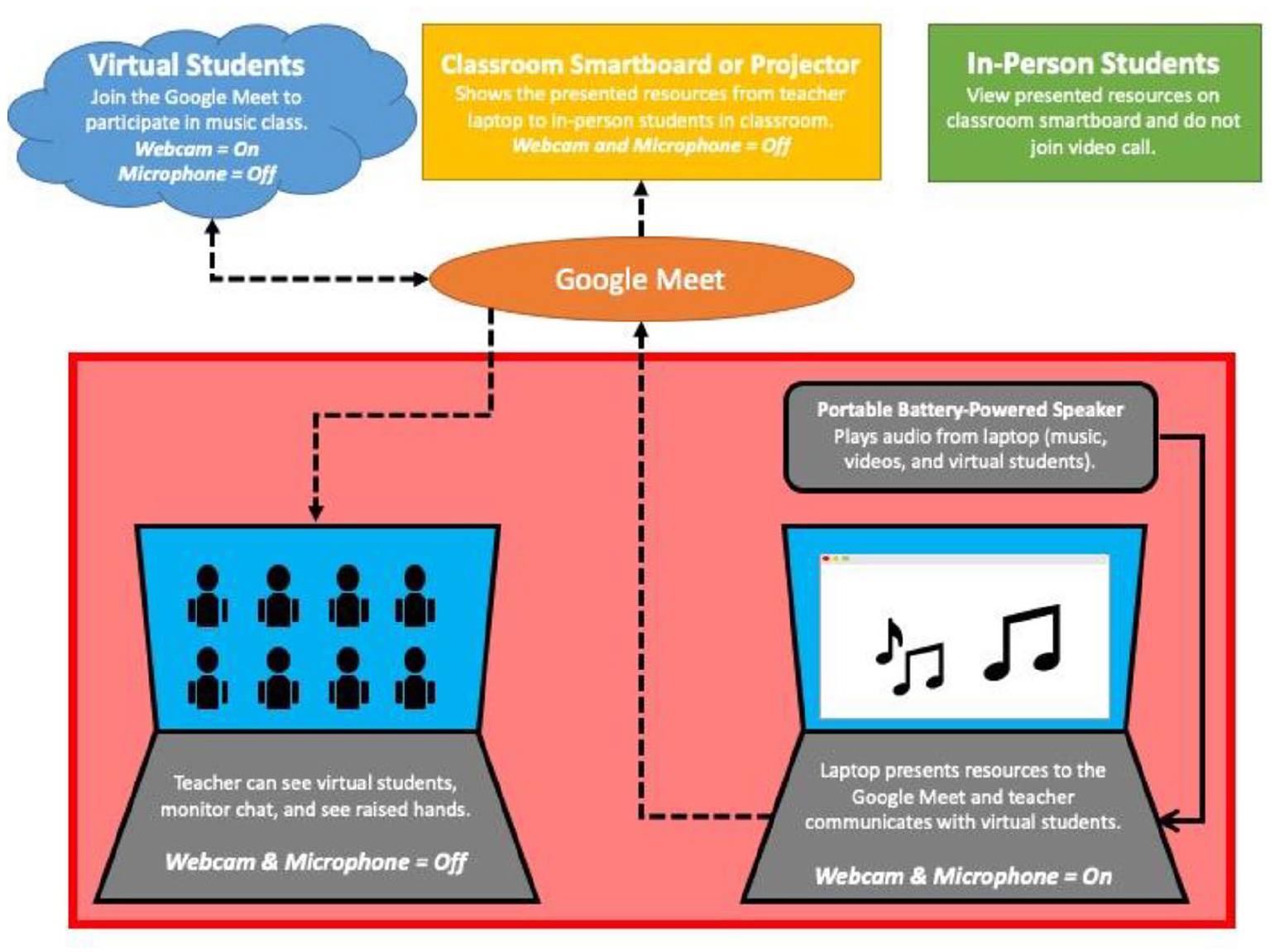
Music teacher cart setup (with smartboard or projector).
The various classroom setups were out of my control, but I found a setup that worked for most situations, with only a few modifications needed to make it work for all classrooms in my school. In Figure 2, a typical classroom at my school is visualized. All students in my district were issued a Chromebook and each classroom had a SmartBoard or projector. In-person students could interact with music apps on their own device and participate with the lesson from their desk while seeing any content presented on the SmartBoard that the virtual students could see simultaneously. In this way, the classroom setup and my cart setup functioned together to deliver an engaging experience to both in-person and virtual students simultaneously.
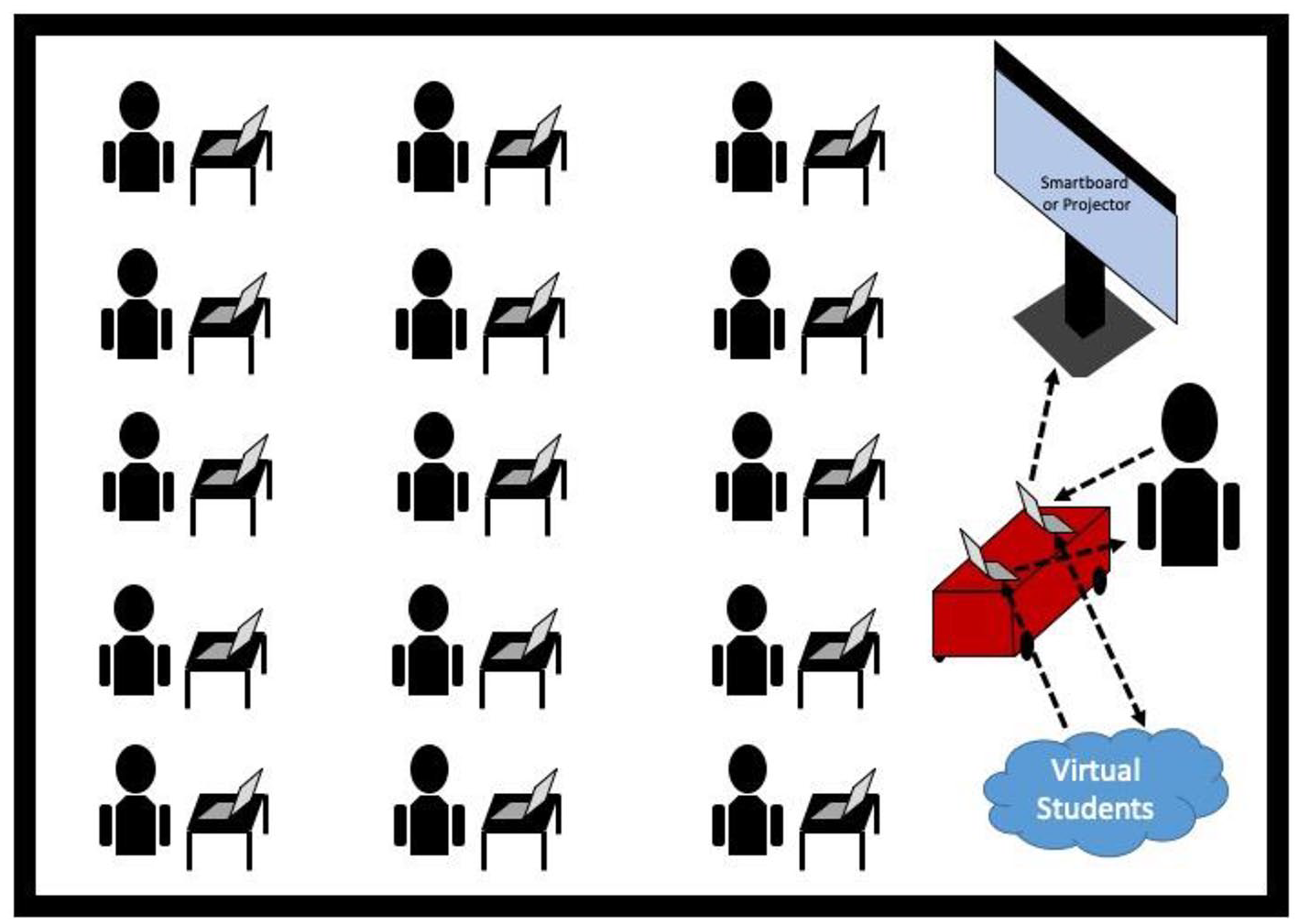
Classroom layout for hybrid teaching. Students interacting with an app. Materials presented on Smartboard.
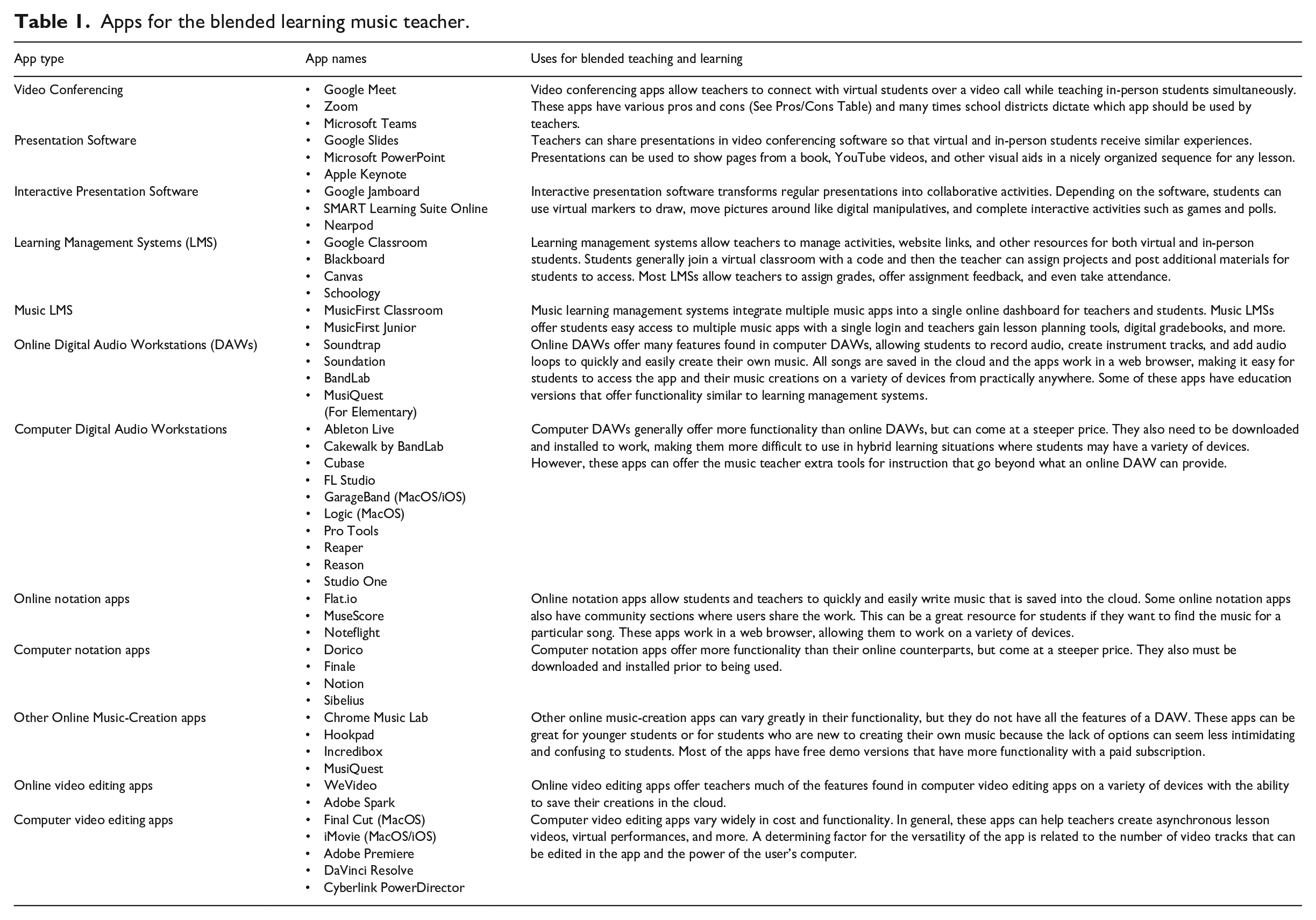
With students having their own device, their computer could be used as a musical instrument in place of the instruments in the music room that I could not use because of COVID-19. There were not enough instruments for all classes and there was not enough time in the schedule to clean instruments between classes, so each student’s computer opened a world of music apps that still let students engage with the content of each lesson. As a blended teacher, I also discovered several apps that enhanced the presentation of my lessons and also became the framework for my blended teaching setup. I searched Google, Facebook music teacher groups, blogs, and other websites, like many other educators did during this time to plan for the uncertain blended learning environment and several of my findings are included in Table 1.
Apps for the blended learning music teacher.
Act II: Surviving Blended Teaching
Act I may read like I had everything planned from the beginning. That was just not the case. My final classroom and cart setups followed from the unforgettable first day of blended teaching, a that was full of challenges. My first class of the day went well without any technology issues. Every other class that day though proved full of lessons about how to best approach blended teaching and learning. I began a process of refining my approach to this new teaching style.
The first lesson was that my school-district-issued Chromebook was not much more than an expensive frisbee. The device connected to Google Meet just fine, but the moment I needed to open another tab (which was necessary to present visuals), it crawled at a frustratingly slow pace. That first day of blended teaching was the first and last day I solely relied on that Chromebook. From that point on, the main computer on my cart became my personal MacBook and the Chromebook became a second screen to keep an eye on the virtual students.
As a second lesson, the various technology challenges that day proved the importance of having backup plans to handle the unexpected wrestling matches with technology. I faced SmartBoards freezing, teachers placing their SmartBoards in inconvenient spots, and internet connectivity issues on student devices. Having in-person students directly log into the video conferencing app circumvented the need for a SmartBoard or projector, though I usually preferred for in-person students to not log into the video conferencing apps to avoid the dreaded audio feedback loop that occurs if they unmute themselves. Figure 3 best visualizes this direct login setup. Some teachers even placed their SmartBoards in the back of classrooms or on the side where visibility was low for some students, so the direct login method also helped here as well. On the other hand, sometimes I had to give the class something to do while I quickly helped a student restart their device due to internet connectivity issues. Overall, the technology problems on my first day showed how important it is for the blended music teacher to have a cart setup and classroom setup that work for the times when one piece of the technology puzzle malfunctions.
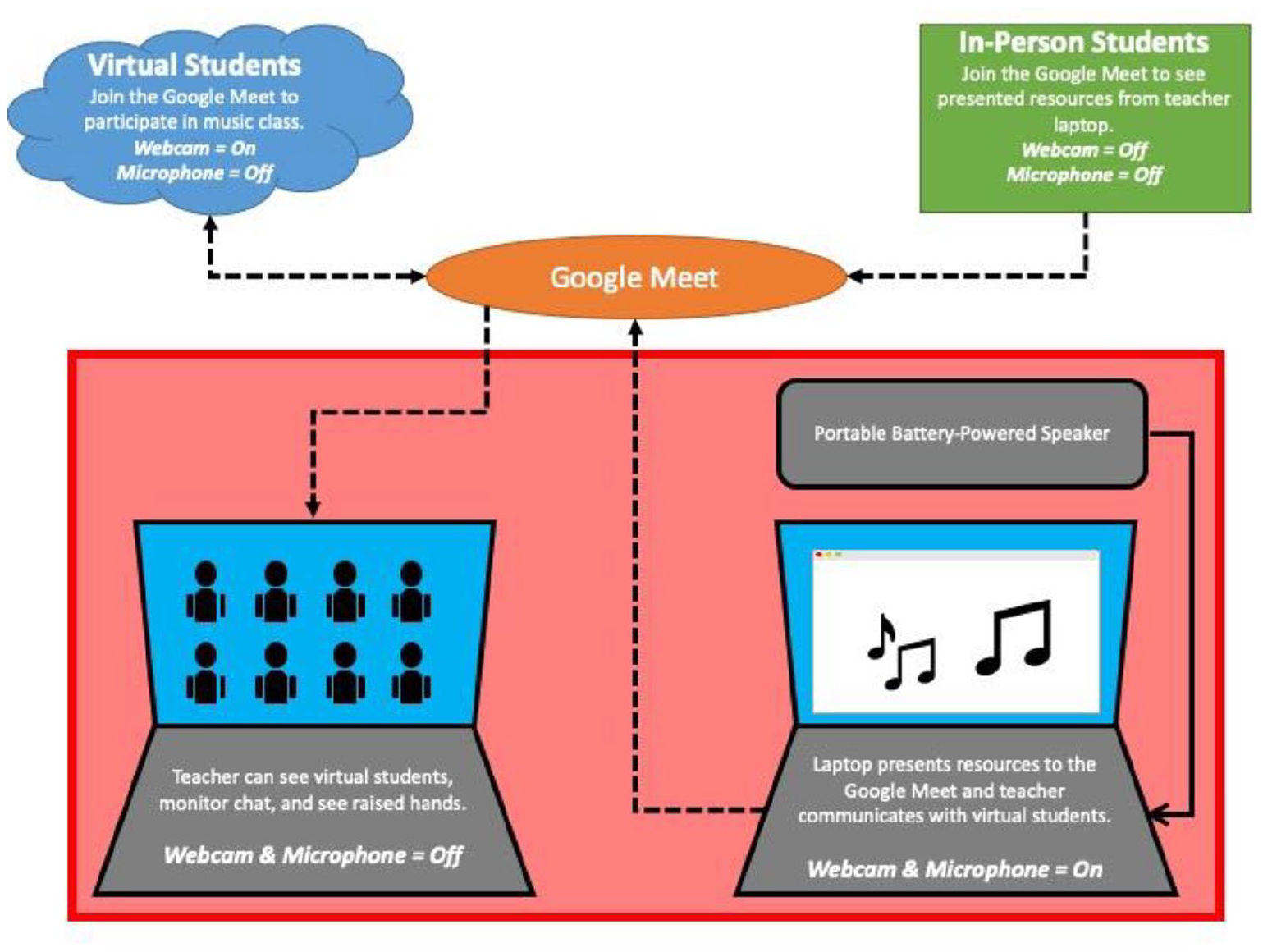
Music teacher cart setup (no smartboard or projector).
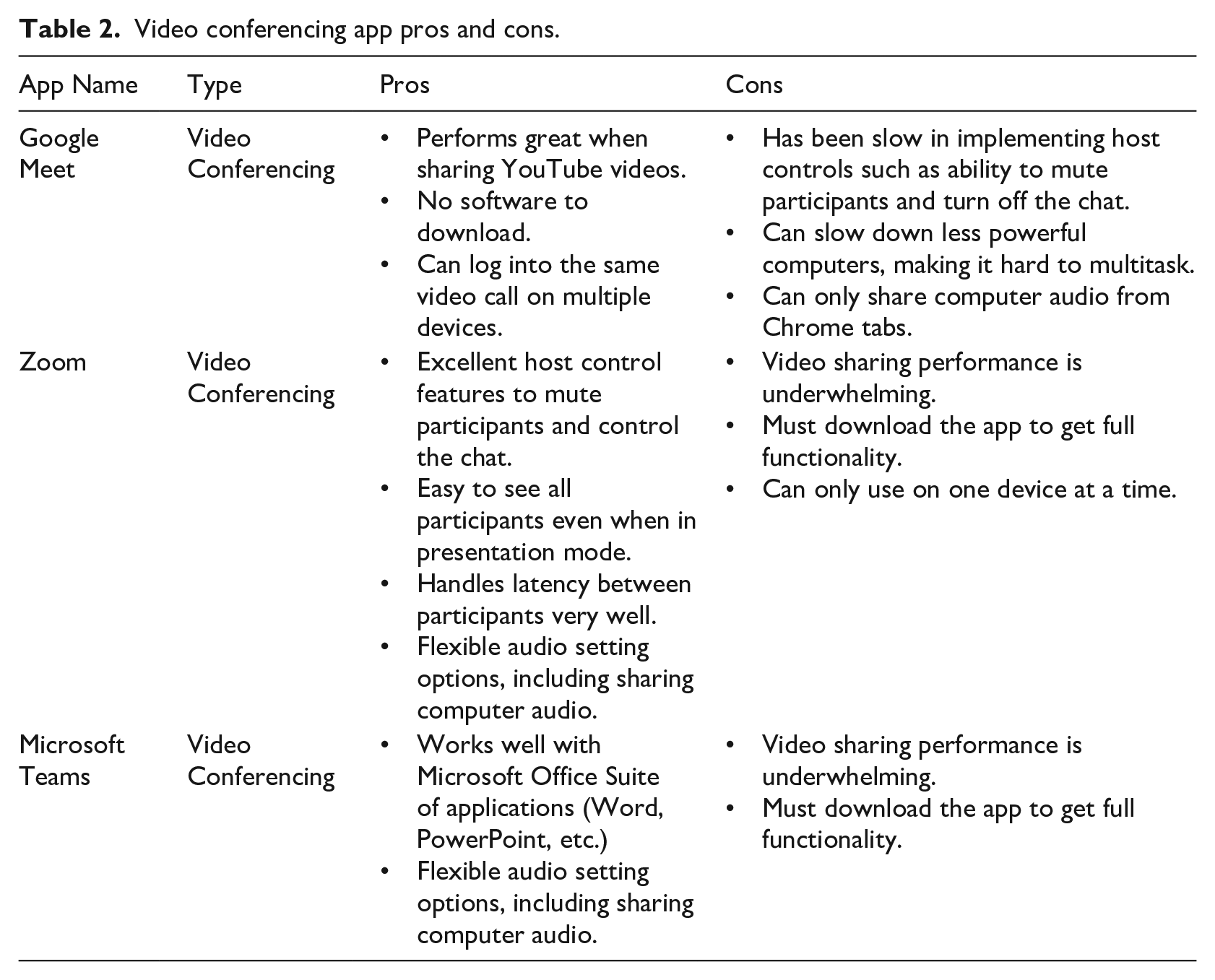
Using Google Meet as the video conferencing app of choice for my blended teaching setup led to my third lesson. This lesson revealed the pros and cons of Google Meet, and though I was not allowed by my district to use a different video conferencing app, I still saw the better aspects of other applications and had to learn to deal with the deficiencies of Google Meet. Table 2 shows the various pros and cons for the three popular video conferencing apps used for virtual instruction. Although Google Meet was slow in implementing various host controls that are important for teachers, such as disabling the chatbox, the ability to log into the same video call on multiple devices was crucial to my classroom setup. However, it also limited the quality of audio that virtual students received when I shared audio from applications like Spotify or Logic because Google Meet could not share computer audio, only audio from Chrome tabs.
Video conferencing app pros and cons.
Still, I had a fourth lesson that taught me the purpose of a “virtual” music room. For my students, my Google Classroom became the virtual music room for them. The music Google Classroom is the hub for both in-person and virtual students. Virtual students can access recorded lessons in case their internet connection failed, and all students can access links to various web-based music applications. My bitmoji also greets students visiting my Google Classroom as they search for links and resources for the days lesson.
The trials of my first day were many, but I learned from these lessons that in my preparations I was on the right path in terms of pedagogical choices. I transformed old lesson plans with new technology and I created new lessons that incorporated a learner-centered style within a project-based framework. Before COVID-19, students would be engaged with various manipulatives such as laminated pictures or music notes for lessons. The physical objects could not be used in light of the safety protocols, but thanks to applications like Google Jam, my lessons with manipulatives continued. Where students used to decide the order of quarter notes and eight notes by physically moving them on a whiteboard, they now could tell me what order they wanted to the notes to be in as I moved pictures of notes around on a virtual whiteboard in Google Jam. Other presentation software such as Google Slides or PowerPoint also provide individual students the opportunity to manipulate pictures of notes or objects that coincide with a lesson.
A learner-centered approach to lessons proved to be the most helpful implementation that diverged from my previous teacher-centered approach to music class. Even with my experience in pedagogical methods such as Orff, Kodaly, and Dalcroze, students tend to be tied to the music selection that a teacher chooses and the music is seldom relatable to the popular music that students are listening to outside of school. I began to formulate lessons where students had choices. Students might create a drum beat in an app or make a song in a music-creation app. Nevertheless, by tying each lesson to a project that sparked student curiosity and tied to their personal interests, I talked less and my students made more music.
Act III: Thriving in Blended Teaching
At this stage, I added a new goal to the goals of a blended learning music teacher—to keep the lessons interesting and not fall into a rut. The school year marched on and I needed new tools to avoid the “technology burnout” feeling of monotony while continuing to foster students’ creativity and curiosity towards music. I found a bevy of online digital audio workstations (DAWs), notation applications, and other music creation applications that transformed my view of integrating technology in the general music classroom. Traditionally, DAWs and notation apps are software that need to be installed on a computer, but in recent years new options have emerged such as Soundtrap (an online DAW) and Noteflight (an online notation app) that automatically save to the cloud and run in most modern web browsers without need for installation. Given that students use a wide variety of tablets and computers in the blended learning environment, the online applications offered the benefit of being compatible with many devices and not needing to be installed on students’ devices.
The list of online music creation apps is lengthy, with options ranging from subscription-based apps to free versions. Chrome Music Lab is one of the free choices, and although it is does not have the full functionality of a DAW, it could be incorporated into lessons so that students would explore a musical concept by using it to complete a project. Projects ranged from recreating melodies of popular advertisement jingles, creating a drum beat, or experimenting with audio effects. For Halloween, fifth-grade students explored various aspects of sound design and the science of sound in a cross-curricular lesson. Students first listened to “The Banshee” by Henry Cowell and described the emotions it made them feel. Then the lesson continued by covering the various ways music can sound “spooky” through sound design. Students learned that instruments can be used in unusual ways such as in the Cowell piece, audio recordings can be manipulated with computers, and synthesizers can be set to play strange sounds. At the end of the lesson, students were free to experiment with an online synthesizer app and Chrome Music Lab’s voice spinner to experience how sound waves can be manipulated. This lesson is just one example of how I integrated technology into a student-centered project-based lesson to avoid monotony within the blended learning framework.
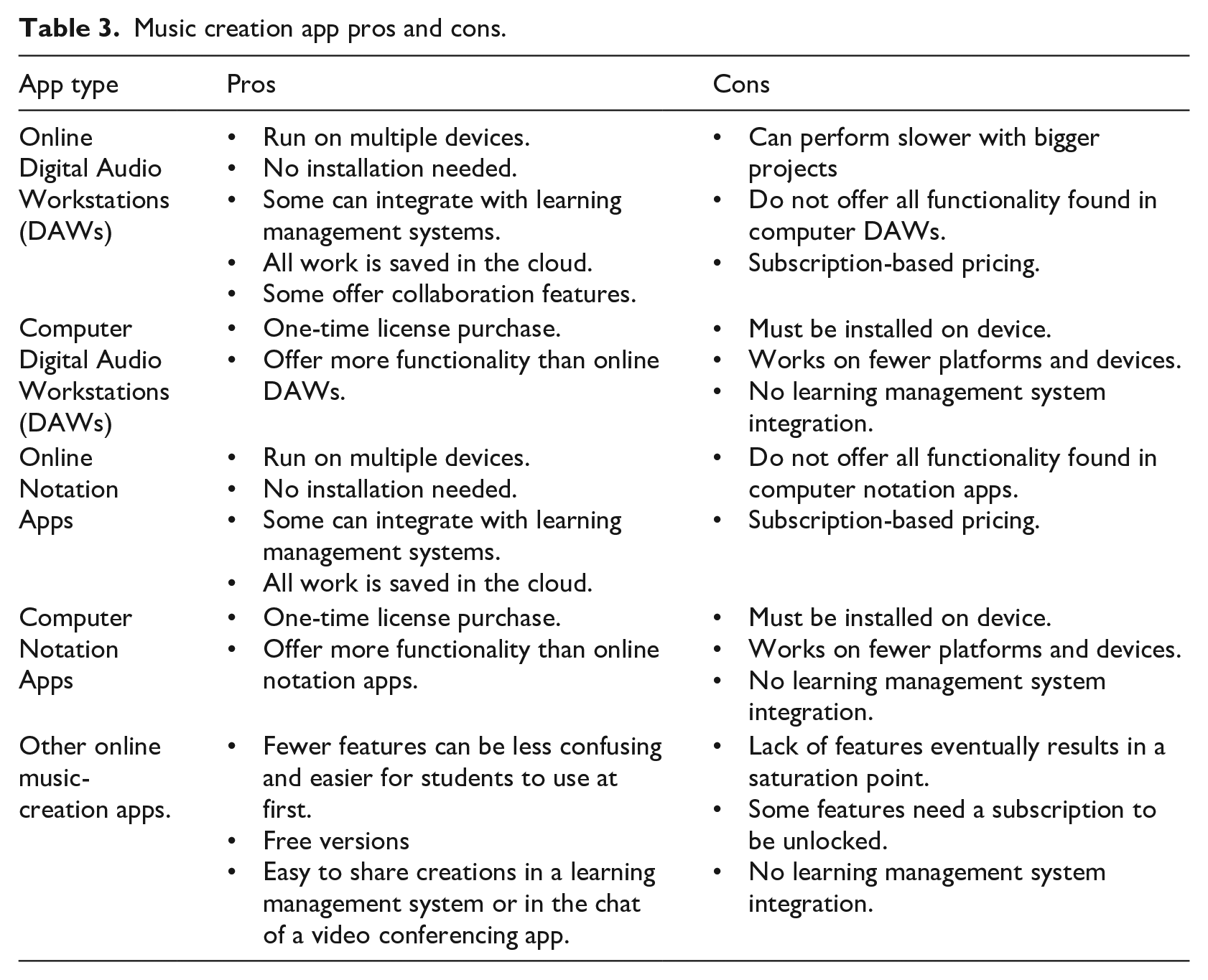
Avoiding monotony in blended learning is not merely surprising students with a new app every week. If that were the case, the design of lessons would only have to revolve around a google search for new music creation apps. Avoiding the boredom that arises in students from using the same technology every day is combatted with a fostering of creativity and curiosity for music. Even though the classroom setup stayed the same every class and students are limited by movement, the opportunity for students to interact with sound and create their own music provides a wealth of curiosity and creativity to keep them engaged, week after week. See Table 3 for some pros and cons of working with music creation apps.
Music creation app pros and cons.
The Next Act: Future Ramifications
The struggle of blended learning provided many learning experiences for me as a music teacher. Music teachers who endured the wild rollercoaster ride of blended learning music now embrace Act IV of the drama. Act IV is the next act for the general music room. When the webcams can be turned off and all students can gather in the music room once again, my music room will have a new normal unlike anything it has been before. Blended learning’s drama teaches music teachers how to make the music room relevant to their students. Technology is here to be embraced, students need autonomy, and music taught should be relatable to students.
Learning from this journey
As a proliferation of research and scholarship is produced from the experiences of music educators during the COVID-19 pandemic, the authors hope that these experiences and lessons learned will find a place in the discourse around blended learning in music. Crawford (2017) and Crawford et al. (2020) seem to have the pulse of the music education profession as it relates to the collective understanding of blended music-making scenarios. This article is the story of an elementary general music teacher who was prompted to teach music on a cart for students in physical and virtual spaces at the same time for an entire school year. He survived and lived to tell the story in these pages.
The independent study between the first and A2s provided a safe place for A1 to share his accounts of living and working through the trauma of teaching in a blended learning environment. As you read though, A1 was optimistic that blended learning presented him with different pedagogical pathways that would be great to have continue past the time-period of the pandemic, having just taken a class with A2 where new ways of opening-up the curriculum for diverse student creativities was the focal point. As Kruse and Veblen (2012) found, the formation of communities of learners experiencing meaningful music-making experiences hitherto impossible, as now possible with the introduction of blended learning. A2 encouraged him to get his thoughts down on paper, and to write to a music teacher audience as if to say, “here’s what happened to me . . . here’s what I learned.” Since we were having conversations and reviewing relevant literature during the analysis process, the autoethnography that is found here can potentially enlighten the music education profession regarding how music teachers viewed their jobs as music teachers while being keenly aware of the literature regarding online learning, digital music creation, and technology in music education.
A1 was processing a course titled “Learner-Centered Pedagogy I” for master’s students in music education just prior to being forced to teach music in a blended environment. Thinking about how music education should serve students and not programs or specific methods or literature seemed to put him in a position to be able to adapt, survive, and in some cases thrive in this new teaching and learning environment. It is worth exploring in future work the practical connection between courses on curriculum change and innovation and how ideas learned and discussed relate to practical decisions and courses of action in the classroom.
Students in the course, including A1 read the book ______________ (XXXXX, in press), which is about adapting teaching practice to allow for multiple creativities to emerge. That book inspired in some cases A1’s pedagogical choices, software applications, and design of his cart space. The book highlights the role of the teacher in a classroom where new and emerging creativities from students are the central focus. The authors referred back to the book throughout their discussions of A1’s emerging pedagogical practice over the course of the semester.
Some of the software applications, teaching strategies, and important findings of A1 as he navigated the uncharted waters of blended teaching and learning are important to note. The figures and tables included in this article were written with the practicing teacher in mind, as a part of engaging fully in the techniques and approaches to research used by autoethnographers (Berry, 2021). In congruence with the findings of Wise et al. (2011), technology amplified the experience of Sean’s students to the point where he suggests that the pedagogical shifts in his practice should continue when the time of the pandemic has concluded. From a certain perspective one might conclude that he was given a gift in being able to try out new pedagogical positions and potentialities in his teaching, to extend the ideas of “Learner-Centered Pedagogy I” (Blumberg, 2008; Doyle, 2012; Weimer, 2002; Williams & Kladder, 2019) and ________________ (XXXXX, XXXX) to move in new and directions with what he learned from the process.
It is likely that many autoethnographies might emerge from what happened to music teachers during the pandemic (Bakan, 2014; Gouzouasis & Ryu, 2015; Kruse, 2013; Manovski, 2014; Thompson, 2015). Autoethnography as a research method might be used well to categorize and chronicle the experiences of teachers and students during the pandemic. The authors would like to encourage future research among practicing teachers and researchers in higher education around topics related to change and curriculum expansion, online and blended learning, and use of new technologies in classrooms where new and emerging creativities (Burnard, 2012) are the focus. Autoethnography might be one of a number of useful research methodologies to help bring the worlds of research and practice in closer proximity.
The authors hope that this article will provide new ways of thinking about prior work regarding online learning, digital music creation, and technology in music education. When combined, a thousand stories that hold up and effectively tell the meta-story of music education during this time period can serve as a stepping-stone for all that we can become in the future. So, more work in this area is encouraged. As Burnard (2007, 2012) suggests, technology and more importantly our reflection upon the affordances of particular technologies can change the way that music teachers see the possibilities and extensions of their pedagogies. COVID-19 moved our thinking around these topics to new places, moved our experience to new territory. There we found gold that we will use to cover the roads that will wind far into our future.
