




Abstract
The purpose of this study was to examine what effect performer’s bodily movement may have on listeners’ (N = 103) perceptions of a choral ensemble performance. A 34-voice choir was audio/video recorded performing two different musical excerpts. Each excerpt was recorded twice, once with movement and once without movement, for a total of four audio/video recordings. Additionally, the audio from each of these recordings was isolated and used as a separate stimuli. Participants were presented each stimuli (movement/non-movement, audio only/audio + video), and asked to rate each for expressivity and style. The factor of audio/video was not found to have consistently significant differences in rating. However, there was a consistent interaction effect between these two stimuli, suggesting that both the visual and auditory differences when using movement conversely effected the listeners’ perception. College major did not prove to be a consistent indicator, but membership in a choral ensemble significantly impacted ratings. Implications may include a greater effect of movement when viewed by the listener than simply what can be perceived in the aural stimuli alone. Suggestions for further research include additional study between choral and instrumental music.
The concept of mind-body unity is at the heart of affective musical performance (Juntunen & Westerlund, 2001). Such concepts are clear in the works of John Dewey, having been influenced by the development of the Alexander technique (Rickover, 2015). The effects of studying the Alexander technique were crucial in the support of Dewey’s ideas of mind-body unity, in sharp contrast to the dualistic positions taken by early philosophers Plato and Aristotle (Dualism, n.d.). Such unity can be observed in the work of Elliott (1995), who claimed that, while musicing, “the body is in the mind,” (p. 51). The application of such ideas to musical performance are still being explored.
Mind-body unity can include both musical perception and action (Jaques-Dalcroze, 1912, Chapter 3; Seitz, 2005). The organization of information (aural, visual, and kinesthetic, among others) coming from the external world is formed into the core of perception (Meyer, 1956). Thus, in this view, the mind is simultaneously sensing and shaping the reality in which the body exists.
This reality may include a connection between aural stimuli, visual stimuli, and an ascribed emotion (Merleau-Ponty, 1969). Musical performance may be a prime example of this connection. Seitz (2005) writes of the work of Davies (1994) when stating that “music doesn’t symbolize, describe or represent. . . rather emotions are presented directly in the musical work through dynamic parallels to human movement, behavior, physiognomy, the human voice, gait, and the like,” (p. 422). These words are clearly pointed toward the importance of a connection between the mind and body when musicking.
The question that persists, however, is how this mind-body connectivity, or lack thereof, might affect the listener of such music. The present study is designed to measure the effects of bodily movement on the perceptions of musical performances, in this case, of a choral ensemble. More specifically, this study is designed to measure the effects that a choral ensemble’s free movement during recorded performances have on the musical perceptions of an audience. While the factors in this study are referred to as “movement/non-movement,” they may represent “natural movement/movement restrained,” respectively. The supporting literature on the influence of movement is organized into three prominent themes: embodying of musical elements within the performer, the use of movement in choral pedagogy specifically, and the communication of expression between performer and listener.
Literature Review
Embodying of basic musical elements such as steady beat and tempo are building blocks on which musicality can be developed, according to Jaques-Dalcroze (1912). While the immediate impact of movement on rhythmic factors has provided mixed results (Johns, 2002; Nolan, 2016) long-term effects may be more substantive. Rohwer (1998) found that movement instruction may provide a more solid foundation for advanced rhythmic development in the future, which is especially found in Laban Movement Analysis (Conway et al., 2014).
The use of movement as a pedagogical tool within the choral ensemble has been well documented. The effectiveness of movement in pedagogy has been identified when it is used as a tool for re-enforcement of musical element (Brunkan, 2012; Peterson, 2000), and when the student understands its purposeful application (Apfelstadt, 1985; Briggs, 2011; Conway et al., 2014; Rohwer, 1998). Students have also reported that the addition of movement put them at ease, thus enabling them to produce a more expressive sound (Liao & Davidson, 2016; McCoy, 1986). Specific techniques of Laban movement (Conway et al., 2014) and the Dalcroze approach (Apfelstadt, 1985; Crosby, 2008; Daley, 2013; McCoy, 1986; Seitz, 2005) have been shown to affect musical skills, expressive performance practice, and extra-musical outcomes. The empowering of choir members to involve movement has been shown to begin with the permission of the conductor (Benson, 2011; Crosby, 2008). One potential path toward establishing that connection has been through the linking of verbal metaphor to physical action, which is in turn attached to a positive musical effect (Wis, 1999). It may be that choral music pedagogy has been based largely on the endorsement of embodied singing (Paparo, 2016).
The largest body of research on the effects of movement is centered on the communication of music’s expressive qualities and their effect on the listener. The link between movement and increased perception of expression has been evident (Juchniewicz, 2008; Silveira, 2014; Williams, 2015). Communication of expression has been shown to support listeners’ connection to a specific emotion (Huang & Krumhansl, 2011; Krahé et al., 2015). To measure the listener’s interpretation of emotion, Dahl and Friberg (2007) conducted a study using stimuli from marimba, soprano saxophone, and bassoon players. Through manipulation of the video stimulus, it was determined that listeners were able to identify specific movements that they equated with the emotions of happiness, sadness, and anger. Fear proved to be unpredictable within the confines of this study. These findings overall were supportive of a connection between movement and the perception of musically expressive qualities.
Davidson (1993, 1994, 1997, 2001, 2007, 2012) has completed extensive work to map the listener’s perception of the link between body movement and the qualities of musical performance. Results of these studies suggested that performers may develop a vocabulary of movements and facial expressions which are used in specific expressive ways (Davidson, 2012), and that listeners’ perceptions of solo instrumentalists such as piano, violin, and voice may be impacted by such movements (Davidson, 2001, 2007). Additionally, bodily movement and facial expression may be an extra-musical communicative device that listeners perceive as an indication of style (Davidson, 2001). Similar links between visual stimuli and listener perception of style have been found in other research (Silveira, 2014; VanWeelden & McGee, 2007).
Experience and musical involvement have been included as factors in listeners’ perceived effect of body movement on musical performance, but with varying results. When given video and audio stimuli, neither musical novices nor professionals were able to identify winners of classical music competitions, though both groups reliably selected the winners while viewing a silent video recording (Tsay, 2013). Both music majors and non-music majors perceived homogenous levels of artistic tension (stress and release) in a dance recording (David Frego, 1999). Similar results were found by Nápoles et al. (2022) However, experienced musicians responded more acutely to stage behavior of pianists than their non-musician counterparts (Huang & Krumhansl, 2011).
Several studies were conducted to measure the condition of audio and/or visual stimuli combinations to determine if bodily movement effects the perception of musical performance (David Frego, 1999; Geringer et al., 1997; Huang & Krumhansl, 2011; Juchniewicz, 2008; Krahé et al., 2015; Platz & Kopiez, 2012). Elements of body movement conditions were executed by Silveira (2014), at three levels: deadpan, facial/head movement only, and full bodily movement. However, additional researchers noted issues of embodiment that isolation of movement may incite (Paparo, 2016; Seitz, 2005), thus leading to the decision to include only two levels (movement, non-movement) in the present study.
Previous studies have been conducted to examine body movement’s effect on tempo, steady beat (Conway et al., 2014), emotional perception (Krahé et al., 2015), and other expressive qualities (Nápoles et al., 2022). Additional research was conducted to measure bodily movement with stimuli including piano soloists, trombone quartets, vocal soloists, and several duets (Davidson, 1993, 2007, 2012). Recent studies have included choral ensembles (Nápoles et al., 2022), but included pre-recorded performances from Youtube™, as opposed to a controlled recording created strictly for the study. Thus, the diverse actions and movements of a choir are a unique aspect of the present study. Finally, there has been little research on the different perspectives of music majors versus non-music majors (David Frego, 1999; Howard, 2012), the latter of which serve as potential audience members. The overall purpose of this study is to measure the effect that movement might have on audience members perceptions of choral performances, how the element of video stimuli may affect that perception, and what other factors may contribute to that perception. Therefore, the following research questions are posed:
(1) What effect may the performers’ body movement have over a listener’s overall perception of choir performances?
(2) What effect may the performers’ body movement have on a listener’s perception of expressivity and style?
(3) How might the condition of audio only or audio + video stimuli effect a listener’s perception of choir performances?
(4) What may be the differences in perception based on the listener’s gender, college major, or ensemble membership?
Method
Participants
Participants for this study (N = 103) were undergraduate students at a university in the southeastern United States. Participants were selected through enrollment in Music Appreciation courses (n = 48) or a Choral Ensemble (n = 55). The self-reported gender of participants included 39 males and 64 females. Regarding the participants’ degrees of study, there were 29 reported music majors, and 74 reported non-music majors. Students of varying majors were represented in both Music Appreciation and Choral Ensemble groups.
Materials
Video/audio recordings of excerpts from two pieces of music, as well as isolated elements of those recordings, served as the stimulus material. The researcher chose to record the stimuli with a 34-voice, auditioned choir who were separate from the research sample choral ensemble. The demonstration choir contained 3 music graduate students, 25 music major undergraduate students, and 6 non-music major undergraduate students. The choir has received commendations at national and international events, and thus the researcher felt that they were a viable demonstration of choral excellence. No members of this demonstration choir were eligible to be participants in the study.
The choir was video/audio recorded performing two excerpts from compositions of differing style and expression: Garota de Ipanema (Pereira, 1932), measures 14 through 28, and Justorum animae (Stanford, 1905), measures 21 through 32. The first piece was written in the style of bossa nova jazz and was naturally inclined toward expression of style with rhythmic emphasis. The latter excerpt was a Romantic Period piece, and the selected section has been described as “a vivid depiction of malice,” (Bawden, 2016), with the text of “et non tanget illos tormentum malitiae,” translating to “the torment of malice shall not touch them,” (Stanford, 1905, p. 2–3). Together, these two excerpts were selected for their distinctive differences in style and expressive qualities. The decision to choose two excerpts was to control for participants’ possible preference for one style of music or for one type of expression. Although the style and expression were contrasting, both excerpts were found to lend themselves to free movement by the choir. Each recording was within a range of 40 to 43 seconds in length.
The choir was asked to perform each excerpt twice, with each iteration employing a variation on movement. During one recording, the choir was asked to stand still and avoid expressive facial movement (non-movement). For the other recording of each selection, the choir was told to move freely and use expressive facial movements (movement). The directions provided to the choir were consistent with previous studies of this type (Broughton & Stevens, 2009; Davidson, 1993; Silveira, 2014). Contrary to Silveira (2014), the current study utilizes only two levels (movement, non-movement) in order to avoid issues of isolation of specific movements (Paparo, 2016; Seitz, 2005). The choir frequently rehearsed with free movement (while their feet maintained a consistent place on the stage), and often utilized such free movement in performance, which may play a role in their level of comfortability utilizing it in such a way. While no specific movements were used in rehearsals of this repertoire, singers are always encouraged to move their bodies in what feels most affective and appropriate to their music making. Although singers were not explicitly told to avoid movement that reflected the director’s conducting gesture, there were no incidents of direct use of that movement. The pieces selected were both in the choir’s repertoire for the year, although neither had been performed prior to the recording for this study.
The choir was video/audio recorded with their full bodies visible to the camera. All choir members were instructed to wear concert black clothing, and the recording took place in an empty recital hall. Stage lighting was used in order to make the performers’ faces visible on camera. The choir stood on the floor of the stage (no use of risers) in two rows, and their positions were staggered so that each performer was fully in view. The choir stood in the mixed-voice arrangement in which they typically rehearse/perform. In all, the choir made recordings of the excerpt from each piece (Ipanema, Justorum) with each treatment (movement, non-movement). This resulted in four total excerpts.
The choir was allowed several opportunities to record each excerpt, and choir members gave feedback after certain recordings. Nearly all feedback from the choir was individual, including standard issues such as personal intonation, breath support, or clarity of release. The director of the choir was given final say over which recordings would be used for the study, and the director and choir members were sufficiently satisfied with the consistency and quality of the recordings. The excerpts were recorded using a Zoom© Q2HD camera and external microphone connected to a MacBook© Pro laptop. All excerpts were edited for length using iMovie™ software.
Additionally, the audio from each of the four excerpts was isolated, creating an audio-only version of that recording. This resulted in the four recordings now becoming eight stimuli, given the additional treatment (audio only, audio + video). Upon the completion of editing, all excerpts were converted into a combined iMovie™ file for each session of participants. In total, participants were asked to rate these eight recordings of the two excerpts, including each combination of treatments (movement/non-movement; audio only/audio + video).
The participants were divided into four groups for the evaluation of the recordings. A varied order of stimuli was created, so that the audio stimuli and audio + video stimuli from the same recording were never played consecutively. Each group was presented with the recordings in a different order, and that order was created using partial Latin Square counterbalancing. Prior to viewing or listening to any excerpts, the participants were given verbal and written instruction on how to complete the evaluation of each excerpt. Two example recordings of a different piece were played as preparation for the evaluation. These recordings were of a third piece by the same choir, and participants were asked to rate them as a priming exercise for the test excerpts. The total length of each evaluation session was 9 minutes, 13 seconds. This length included 15 seconds of silence in between each example.
Procedure
The evaluation form contained a written copy of the verbal instructions, explaining the criteria for response (overall expression, style). As in several studies of this type (Lychner, 1998; Madsen, 1997; Silveira, 2014), the constructs of “expression” and “style” were not defined for the participants. Therefore, each participant was able to apply their individualized understanding and worldview of these terms to the recordings.
Participants provided their answers on written evaluation forms, and they provided two ratings for each excerpt using a seven-point semantic differential scale, as based on a previous questionnaire by Silveira (2014). Each participant rated the excerpt on expressiveness (1 = not expressive to 7 = highly expressive) and style (1 = not effective to 7 = highly effective). Finally, participants were asked to provide the demographic information as previously outlined. No members of the demonstration choir were involved as participants in the study.
The recordings were projected on a screen in the evaluation room. Prior to each recording, the excerpt number would appear on the screen for 3 seconds. This was followed by the excerpt, which each lasted between 40 and 43 seconds. During audio-only excerpts, the screen was left blank. After each excerpt, a black slide with white writing displayed the text “Please respond to the previous example.” At the end of the final excerpt, participants were prompted to “Please complete the demographic questions. Thank you!”
Results
The primary research question for this study was centered on the effects of the use of movement and audio/video stimuli on the perception of expression and style in choral musical excerpts. Additional research questions considered an effect of the participants’ ensemble participation and major on the perceptions of the primary stimuli. As a control for bias of musical preference, these questions were addressed in two separate musical excerpts, which varied in style. Thus, the results will first be presented separately, and the results from each excerpt will be used to support the effectiveness of the overall findings. Descriptive statistics of the combined ratings can be found in Table 1.
Mean composite ratings and standard deviations by treatment (excerpt, audio/visual, movement, major, and course involvement).

Garota de Ipanema: Primary Question Results
Expression
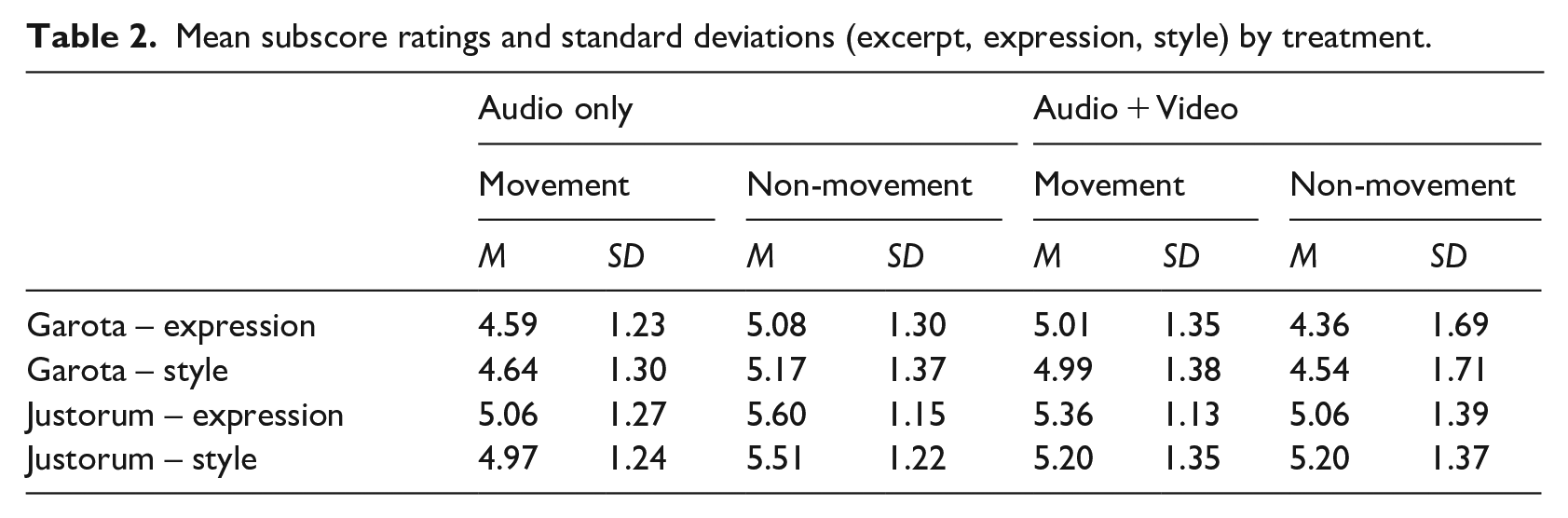
A two-way analysis of variance was used to test the effect of audio/video stimuli and movement (or the absence of movement) on the participants’ ratings of expression within Garota de Ipanema. The stimuli of audio only, or the addition of video, did not significantly impact the perceived expression, F(1, 102) = 2.323, p = .131, η2 = .022. The addition, or absence, of movement also did not significantly affect the rating of expression, F(1, 102) = 0.568, p = .453, η2 = .006. However, the interaction of audio/video stimuli and movement had a significant effect on expression ratings, F(1, 102) = 25.381, p < .001, η2 = .199. Descriptive statistics of subscores (expression, style) can be found in Table 2.
Mean subscore ratings and standard deviations (excerpt, expression, style) by treatment.
Style
A two-way analysis of variance was also performed to measure the effects of the same treatments on the style within Garota de Ipanema, with similar results as those reported for expression. The treatment of audio/video stimulus alone did not significantly impact the participants’ rating of style, F(1, 102) = 1.763, p = .187, η2 = .017. The same was true of the movement treatment, which also did not provide significant impact, F(1, 102) = 0.150, p = .700, η2 = .001. However, as in the analysis of expression ratings, there was a significant interaction effect between audio/video and movement treatments, F(1, 102) = 16.535, p < .001, η2 = .139.
Combined results
Precedence does exist in support of the combining of results in ratings such as these to create a composite rating (Juchniewicz, 2008; Morrison et al., 2009; Silveira, 2014). The combined ratings from Garota de Ipanema held similar results as the individual ratings for expression and style. The treatment of audio/video did not independently provide a significant impact, F(1, 102) = 2.284, p = .134, η2 = .022. Additionally, the treatment of movement was not significant, F(1, 102) = 0.051, p = .822, η2 = .000. However, there was a significantly strong interaction effect between the treatments, F(1, 102) = 23.156, p < .001, η2 = .185.
Justorum Animae: Primary Question Results
Expression
A two-way analysis of variance tested the effect of audio/video stimuli and movement (or the absence of movement) on the participants’ ratings of expression within Justorum animae. The stimuli of audio only, or the addition of video, did not significantly impact the perceived expression, F(1, 102) = 1.360, p = .246, η2 = .013. The addition, or absence, of movement also did not significantly affect the rating of expression, F(1, 102) = 1.744, p = .190, η2 = .017. However, the interaction of audio/video stimuli and movement had a significant effect on expression ratings, F(1, 102) = 13.997, p < .001, η2 = .121. Please refer to Table 2 for subscore descriptive statistics.
Style
A two-way analysis of variance was also performed to measure the effects of the same treatments on the style within Justorum animae. The treatment of audio/video stimulus alone did not significantly impact the participants’ rating of style, F(1, 102) = 0.119, p = .731, η2 = .001. Unlike previous results, the treatment of movement provided a significant impact on the style ratings, F(1, 102) = 7.196, p = .009, η2 = .066. The impact on style ratings for Justorum animae could be attributed to the powerful, harsh style of the excerpt. There was a significant interaction effect between audio/video and movement treatments, F(1, 102) = 5.977, p = .016, η2 = .055.
Combined results
A two-way analysis of variance was also performed to measure the effects of the same treatments on overall ratings within Justorum animae. The treatment of audio/video stimulus alone did not significantly impact the participants’ rating of style, F(1, 102) = 0.633, p = .428, η2 = .006. Again, the treatment of movement provided a significant impact on the style ratings, F(1, 102) = 4.808, p = .031, η2 = .045. There was a significant interaction effect between audio/video and movement treatments, F(1, 102) = 10.479, p = .002, η2 = .093.
Secondary Questions; Factors of Major and Course Enrollment
The results of the secondary factors (major, course enrollment) were analyzed concurrently, and are thus presented together here.
The factor of Major (Music major, non-music major) was measured through Independent T-Tests. The only significant difference occurred in the rating of the Video/Non-movement iteration of Garota de Ipanema. There was a significant difference in ratings of music majors (M = 7.586, SD = 2.797) and non-music majors (M = 9.419, SD = 3.294); t(101) = −2.644, p = .015. Students who were non-music majors rated this selection higher overall than did music major participants.
Students were selected to participate through enrollment in one of two courses; a choral ensemble, or music appreciation class. The factor of course membership was consistently significant between both song stimuli. These groups provided consistent results in both pieces in the Video/Non-movement iterations. Course involvement was a significant factor in the Video/Non-movement iteration of Garota de Ipanema, with choral ensemble (M = 7.419, SD = 3.095) and music appreciation (M = 10.604, SD = 2.541); t(101) = 5.658, p < .001. Similar findings occurred in the Video/Non-movement iteration of Justorum animae between choral ensemble (M = 9.782, SD = 2.720) and music appreciation (M = 10.813, SD = 2.285); t(101) = 2.065, p = .041. In both cases, music appreciation students rated these stimuli much higher overall than did the choral ensemble students.
Discussion
The purpose of this study was to identify any effect that movement may have on a listener’s perception of a choral performance. To evaluate this influence, musical excerpts with audio (or paired with video) stimuli were shown to participants. The results of this study show that, in general, movement does impact the perception of musical qualities. These results are consistent with previous research on this topic (Davidson, 2007; Geringer et al., 1997; Huang & Krumhansl, 2011; Juchniewicz, 2008; Krahé et al., 2015; Morrison et al., 2009; Nápoles et al., 2022; Silveira, 2014; VanWeelden & McGee, 2007). A comparison with audio-only stimuli shows that listeners discern not specifically a change in actual sound through the movement, but simply a change in perception of the sound when it is experienced in conjunction with the corresponding video stimuli. This may also lead to another assumption: is the combination of both visual and aural representations of the music greater than the sum of its parts, or is it, as Gestalt psychologist Kurt Koffka said, “other than the sum of its parts,” (Heider, 1977, n.p.)?
Movement was found to be impactful on the perceptions of the musical qualities associated with expression and style. However, movement alone did not prove to be a significant contributor over expression, which differs from similar research (Nápoles et al., 2022). Only when paired with the factor of the audio + video treatment was there a significant effect. This may mean that listeners responded more to the actual movement than to the sound produced by the choir. Thus, the visual stimulation may have changed their sensation of the musical performance. One element at play here may be the influx of information that individuals experience on a daily basis in our present society. The participants of this study were all traditionally-aged college students who were born around the late 1990s. For individuals from this generation, music is not simply something to be aurally consumed, but also visually consumed (Rickes, 2016). Visual presentation of music may become even more influential with the growing inundation of media and technology.
The results for style were similar to those of expression, with one major exception. The style ratings for Justorum animae were significantly affected by the movement treatment, with the non-movement audio recordings scoring much higher. While the style of Garota de Ipanema may be categorized as contented and easygoing, Justorum animae is much more pronounced, fiery, and passionate with a chordal wall of sound. The resulting style of the latter may, in the minds of the listener, be dependent on an embodied, powerful singing style. The stagnant presence of the non-movement recording may have negatively impacted the discernment of the style.
While the factor of college major was not significant, the factor of course enrollment was impactful. Participants who were enrolled in a choral ensemble rated the non-movement excerpts much lower than those who were only in Music Appreciation courses. Several issues may arise from this finding. It may be that choral ensemble students took less focus to grasp the choral sound, so they had more time to spend on the visual representation. Consequently, Music Appreciation participants may have been overwhelmed with too many stimuli, and instead focused on the visual aspects of the excerpts. Finally, it may be that Choral Ensemble participants were more inclined to utilize movement themselves and simply expected that in the performances of others. If this latter point is the case, then it supports the findings of Rohwer (1998), in that earlier musical movement experiences predispose choral students to prefer movement in choral singing. More research is needed in this particular demographic on the topic.
The present study has built upon some limitations of previous studies, but some limitations remain. The design of the stimuli, including the creation of four separate iterations, greatly reduced order effect issues that resulted in similar studies. The only order effect apparent was lower scores for the first two stimuli in each group, no matter of variable. This may have occurred consistently in the first two stimuli because that included the introduction of both selected musical excerpts.
Participants in both the Choral Ensemble and Music Appreciation classes may have been familiar with the recorded ensemble (or individual members), and this may have impacted their perceptions. A replication of this study could be performed in order to overcome the ensemble recognition.
All possible steps were taken to provide comparable examples in each recording, both in movement and non-movement stimuli. Both the research and the director of the choral ensemble felt that each recording was of similar quality. However, since the choir often performed with free use of movement, this may have affected the quality of the non-movement recordings to a small degree. In the view of both choral professionals present at the recording session, such effect was negligible but not worthy of ignoring.
The text of both pieces was intentionally foreign language to minimize effect of familiar words. However, the melody of Garota de Ipanema may have been familiar, given its place in popular culture. While there is no evidence of an effect of tune recognition, further studies could be used to measure if familiarity has an effect on listeners’ ratings.
The findings of this study add to the growing body of literature addressing the importance of movement and embodied performance on the listener. Ensemble directors, private lesson instructors, and music educators may consider using this evidence as one avenue of connection to the repertoire being performed, functioning alongside other familiar approaches. While movement has been shown to be at the heart of several choral pedagogues (Benson, 2011), more choral director-teachers may wish to blend kinesthetic elements of rehearsal and performance into their philosophies of teaching.
More research is necessary on this developing topic. The current study limited the movement treatment to just two levels (movement, non-movement), whereas previous studies included facial/head-only movement levels. Future researchers may consider the merits of incorporating this level of movement as well. A comparison across musical instruments may also lead toward a more nuanced understanding. Using the same listeners to rate performances by multiple instruments (including voices) may glean new findings.
Finally, there may be a definitive line between movements that are considered expressive, and those that are considered distracting. Is there a limitation on the effectiveness that embodied musical performance has? Future research should investigate these and many other questions regarding the use of mind-body unity in musical performance. Continued exploration of this topic may find inspiration in the work of Dewey and Alexander, where the physical and mental facilities are aligned and unified toward a common outcome.
Supplemental Material
sj-docx-1-ijm-10.1177_02557614221096153 – Supplemental material for Mind, body, and soul: The effects of bodily movement on listeners’ perceptions of choral performances
Supplemental material, sj-docx-1-ijm-10.1177_02557614221096153 for Mind, body, and soul: The effects of bodily movement on listeners’ perceptions of choral performances by David W Langley in International Journal of Music Education
Footnotes

References
Supplementary Material
Please find the following supplemental material available below.
For Open Access articles published under a Creative Commons License, all supplemental material carries the same license as the article it is associated with.
For non-Open Access articles published, all supplemental material carries a non-exclusive license, and permission requests for re-use of supplemental material or any part of supplemental material shall be sent directly to the copyright owner as specified in the copyright notice associated with the article.
