



Abstract
As music educators around the globe continue to work in blended environments, it is important to explore how pedagogical approaches can be adapted and reimagined in ways that enhance teaching and learning in this changing educational landscape. In this study, the authors drew on elements of Collaborative Online International Learning (COIL) to teach three culturally diverse songs to pre-service teachers at a Spanish university. Acting as culture bearers and tertiary music educators, they selected and taught songs from three different geographic locations (South Africa, Sri Lanka, and the United States). Utilizing a descriptive case study design, the authors discuss their pedagogical approach and argue a Four Step Flip method (Asynchronous, Synchronous, Face-to-Face, and Hybrid Feedback) can be effectively applied and adopted in online music teaching and learning settings. This model prioritizes the culture bearers’ involvement in the learning process from start to finish while allowing students ample space to merge unfamiliar cultural perspectives with their own. The authors also contend building collaborative networks that extend beyond national borders can enhance understanding and appreciation of different genres, cultures, and languages in music classrooms.
Keywords
Introduction
Online teaching is a subset of distance education that embraces a wide range of technology applications and learning processes (Keengwe & Kidd, 2010). Although online teaching is certainly not a new concept, it has recently been thrust into the educational spotlight, due in large part to COVID-19 related lockdowns and government-imposed bans on in-person teaching at education institutions (Mishra et al., 2020; Pokhrel & Chhetri, 2021). This study builds on a previous collaborative project See, Listen and Share: Exploring Intercultural Music Education in a Transnational Experience, which involved teaching multicultural music across three university sites via online learning platforms (see Joseph et al., 2018, 2020, 2021). The authors (a quartet of voices) set out to answer one research question: To what extent can a four-step flipped method (asynchronous, synchronous, face-to-face, hybrid feedback) be employed to effectively facilitate culturally diverse musical learning experiences in an online setting? We build on our previous collaborative teaching experiences and position our experience as a practitioner this paper intended to foster three types of interactive engagement: student-to-content (asynchronous online learning), student-to-instructor (synchronous online learning and feedback), and student-to-student (face-to-face learning; Lock & Johnson, 2015).
Online learning approaches can be broadly grouped into two distinct categories: Asynchronous and synchronous. In asynchronous settings, learning is not bound by time (Johnson, 2020). “Learners can learn anywhere and can consume their time to gain knowledge of what they want to know and when they need to know” (Malik et al., 2017, p. 183). In contrast, synchronous learning approaches are time-bound and often attempt to simulate face-to-face classes online learning environments (Nieuwoudt, 2020). Flipped classroom models blend asynchronous and synchronous learning approaches in different ways, and often involve activities such as reading text, watching supplemental videos, or solving additional problems before class (or outside class) as pre-preparation for more active learning experiences during class (Awidi & Paynter, 2019).
Collaborative Online International Learning (COIL)
We drew on the notion of Collaborative Online International Learning (COIL) as we began the process of preparing content for this series of online workshops. COIL is “an innovative way to engage students in a shared, online multicultural and collaborative learning environment” (Western Sydney University, 2021). COIL considers “co-development of a shared syllabus by two or more instructors from geographically distant locations” (Western Sydney University, 2021). COIL has been recognized as a powerful form of global learning in which teachers from different institutions, countries, cultures, and backgrounds collaborate online to design learning experiences that cross the boarders of time, place, language, and discipline areas. It is also an accessible method of global learning that can be embedded into a fully online course or workshops. Nevertheless, COIL is also met with some disadvantages for instance technological challenges, institutional support, and language barriers (Marcillo & Desilus, 2016; Naicker et al., 2021). These key issues were overcome by carefully pre-planning and designing the workshops in which the authors had technical support by their host institutions, including a native Spanish speaker (Author 4). In this case, COIL features were adopted with modifications as we planned to deliver our workshops from various locations having different ethnic and national backgrounds. However, the students were geographically located in the same area, all Spanish nationals hence with similar backgrounds (Western Sydney University, 2021).
Proximal simulation
When teaching music drawn from unfamiliar cultural settings (or any type of music), authentic learning occurs when required skills and knowledge are transferred/taught by expert practitioners and culture bearers using similar resources and settings that they use in their own professional practice (Campbell, 2018; Fung, 2002; Mellizo, 2017; Nethsinghe, 2013). Nethsinghe (2013) proposes “Proximal Simulation” to provide the closest possible authentic experience to learners. “Proximal Simulation” involves providing background information about the song (where, when, why, and how the song is performed) and engaging experts/culture bearers and original instruments in the transmission process. Campbell (2018) also stresses the importance of culture bearers in the learning process, asserting, “culture bearers are valued for the musical knowledge and skills they bring, and for their capacity to frame their songs, tunes, and rhythms with a cultural perspective that only they can have” (p. 143). Hence the notion of virtually engaging culture bearers through “Proximal Simulation” was a viable option for our study.
The flipped classroom and praxial/experiential education
Even before the COVID-19 pandemic, online learning platforms were gaining popularity because they offer flexibility and efficiency (Xie et al., 2020), and have demonstrated effectiveness (Suardi, 2020, p. 591). While the online learning environment suited our purposes because we, as colleagues were geographically dispersed, it also worked well for the students at this moment in time, who had already been using online learning platforms for a full year (since the pandemic began in March 2020).
Our approach to preparing and presenting content in the online learning environment was influenced by the notion of “flipped” classroom models (Baker 2000; Bergmann & Sams, 2012; Hamdan et al., 2013). Especially since we were introducing music drawn from unfamiliar cultural settings, we recognized the need for students to engage with the learning materials in both asynchronous and synchronous ways. Previous research indicates there is a relationship between familiarity and musical preference (Fung, 1996). Therefore, we hoped that providing students with an opportunity to familiarize themselves with the chosen songs ahead of time would set them up to achieve a more meaningful experience during the synchronous sessions.
Our approach to planning synchronous learning experiences was influenced by praxial (Elliott, 1995) and experiential (Southcott, 2004) notions of music education. Although collective music making experiences can be frustrating in online learning environments (Camlin & Lisboa, 2021), they are still important. Learning experiences that promote students’ active participation, such as hands-on music making and creative collaborations are necessary for constructivist learning to occur (Webster, 2011) and can lead them toward deeper levels of musical and cultural understanding (Elliott & Silverman, 2015; Mellizo, 2019).
In the field of music education specifically, there is a lack of scholarship in the area of online teaching and learning (Dammers, 2009; Lim & Bang, 2018; Johnson, 2020). Effective implementation of online curriculum is challenging for music educators because music is “a subject that typically depends on students interacting throughout the learning process” (Hash, 2021, p. 384). Issues like to poor audio quality and delays become more than just minor inconveniences in the online music classroom–they have the potential to derail an entire lesson. Yet, when the pandemic hit in early 2020, music educators from around the world had no choice but to face these issues head-on as they attempted to provide meaningful instruction for their students “online.” Many of these teachers continue to work in blended learning environments and will likely do so for the foreseeable future. It is therefore imperative for music education scholars to explore how pedagogical approaches can be adapted and reimagined in ways that enhance teaching and learning in this changing educational landscape. The purpose of this practitioner-based paper is to explore ways in which the elements of Collaborative Online International Learning (COIL) and “flipped” classroom methods can be used to advance the practice of teaching songs from different lands to pre-service teachers (PSTs) in Spain.
Methodology
Research approach and participants
As researcher-participants, we drew on autoethnography as qualitative research methodology (Sze & Southcott, 2019) that focuses on our voices and personal experiences as we “connect the personal to the cultural” (Ellis & Bochner, 2000, p. 740). Our autoethnographic lens, meant we collaboratively reflected on our experiences as “we work[ed] together to share personal stories and interpret the pooled autoethnographic data” (Lapadat, 2017, p. 589) to address the research question. In doing so we describe and analyze the “uniqueness and commonality” of our personal and collective experiences (Stake, 1995, p. 1). We communicated with each other to jointly work as a team of researchers (Chang et al., 2012) and as practitioners. We placed self within a social context where our insider voice may be more true than an outsider’s voice (Dyson, 2007). Our narratives intersected with the patterns and processes we engaged with as we planned and implemented our intervention (Tedlock, 1991) functioning as counterbalances to each other’s narrative (Hernandez et al., 2017).
In the next section of the paper, we “describe the study in such a comprehensive manner as to enable the reader to feel as if they had been an active participant in the research and can determine whether or not the study findings could be applied to their own situation” (Baxter & Jack, 2010, p. 555). Specifically, we hope the stories that unfold within the context of this case will inform the practices of other music educators as they forge their own paths through this changing educational landscape. In order to establish reliability of our descriptions and trustworthiness, we respected and engaged with each other’s narratives (Bochner, 2001) which we documented as “an important way of knowing” (Ellis & Bochner, 2000, p. 761). We shared our reflections with trusted colleagues who provided feedback about our description (Selvitopu, 2020). In our single case study, we describe the process of implementing a four-step flipped method (asynchronous, synchronous, face-to-face, feedback) to facilitate culturally diverse musical learning experiences in an online educational environment.
The participants in this case study were four tertiary music academics Rohan (Author 1), Dawn (Author 2), Jennifer (Author 3) , and Alberto (Author 4) (see screen shot below, Figure 1). Dawn, Rohan and Jennifer delivered the workshops. As host in Spain, Alberto coordinated and facilitated the workshops. Authors 1 to 3 selected a song from their country of their origin (Sri Lanka, South Africa, and the United States) and provided relevant background materials (e.g. recordings, articles, videos, and notation). Author 4 as host instructor in Spain used these materials to familiarize his students with the songs (asynchronous learning). Across three weeks, Authors 1 to 3 taught their songs in a synchronous online environment: In a culminating fourth workshop facilitated by Author 4 (the host lecturer) and Author 3 (visiting scholar), students met face-to-face to create arrangements of the songs they learned. Subsequently, each author viewed videos of the student arrangements and met with students to provide feedback (Authors 1 and 2 online; Authors 3 and 4 in-person).
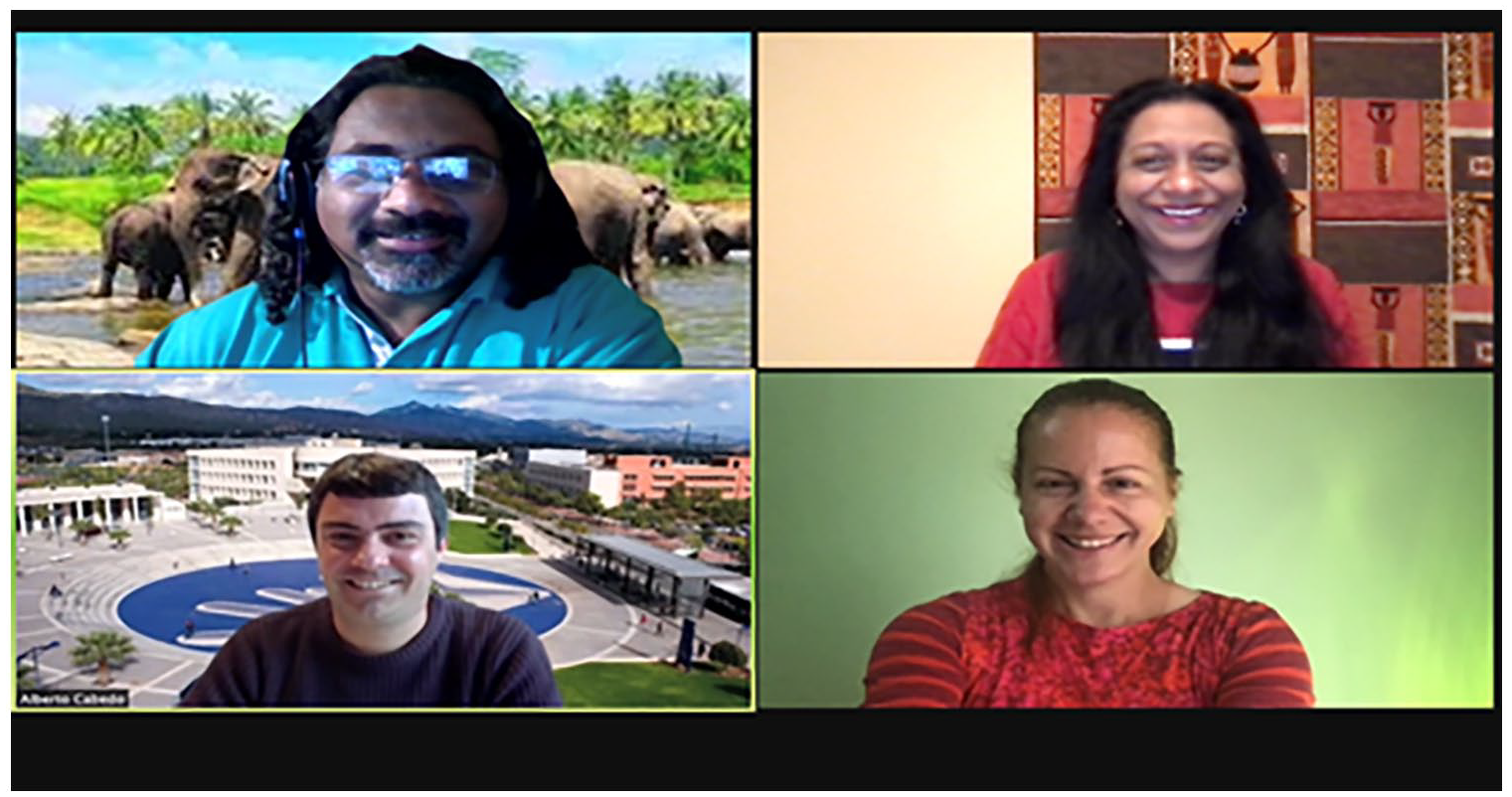
Collaboration in process.
Context, limitations, and delimitations
The pedagogical approach we discuss in this paper was implemented with pre-service teachers (PSTs) undertaking a music elective at a university in Spain in March 2021. Students were enrolled in this course as part of their Bachelor of Primary Education degree program. All students in the class planned to become primary teachers, but only about half of them planned to become primary “music” teachers. Therefore, it was important for the guest instructors to take into consideration that some of the students in the class had little to no formal music background. Although these university students were recipients of the workshops, their voices are not included in this paper.
The workshops described in this paper focused on learning by “doing.” In the Spanish educational system, however, “educational programs and interventions are [often] framed and assessed within the expectations of process-product” (p. 1477), as opposed to “learning by doing” (Poveda et al., 2021, p. 1478). It is important to remember that although “learning by doing” is not a new concept in and of itself, it might have been new to the students enrolled in this course. According to Poveda et al. (2021), “adopting some of the principles of collaborative approaches to plan and implement an educational intervention, at least in Spain and Spanish educational organizations, will probably be perceived as an unconventional path” (p. 1492).
One major limitation of single case studies is that they only discuss one site, therefore, generalizations to other universities cannot be made. Additionally, the scope of this paper is limited to the effectiveness of the four-step flipped pedagogical approach itself. Although we recognize researcher-participant perceptions of participating in this type of international collaborative teaching experience are, they are beyond the scope of this paper and addressed elsewhere (Joseph et al., 2021). Our findings should be interpreted with these limitations and delimitations in mind.
Data collection and analysis
The narrative descriptions of our experiences found below are drawn from individual journal notes that we made throughout the research process (planning, implementation, and reflection stages) and video recordings of the synchronous sessions. We met weekly through Zoom a month before delivery to plan the workshops (February 2021) and for a month after the workshops (April 2021). At each meeting, we individually took notes be it brief words to signal points of discussion, long sentences, or paragraphs. To confirm and validate what we wrote, our meetings were recorded. Our notes formed a rich part of our collaborative discussions as they informed our preparation and presentation. In the next section, we draw on these individual notes, collaborative discussions, and video recordings as we analyze the process of using a four-step flipped method to teach culturally diverse songs in a tertiary music classroom. Whilst student voices are not the focus of this paper, we offer a few student comments in our conclusion drawn from a student survey which was administered at the end of the four-week intervention.
Findings
Describing the “Four-Step Flip”
Step 1: Asynchronous preparation
As we began to plan for our workshops, we communicated regularly through email, telephone, and Zoom calls. We discussed “why” there is a need to share about music from diverse cultural settings in relation to “what,” “how,” and “when” we would share songs from different lands with Spanish PSTs in an online environment as we each were from distant locations (Western Sydney University, 2021). We collectively agreed that Authors 1 to 3 would each choose one song from their country of origin (Sri Lanka, South Africa, and the United States) and prepare PowerPoint presentations to teach their chosen songs. Based on personal preference, Author 2 opted to use Zoom, and Authors 1 and 3 chose Google Meet as online platforms to connect with the students. We agreed that Author 4 (host instructor) would share some basic information about each guest presenter’s musical background and teaching experiences ahead of time. Author 4 also shared one academic publication written by each guest presenter so that the students could come to understand the value of working with a culture bearing musician who is from a particular place (Campbell, 2018; Nethsinghe, 2013). Additionally, each guest presenter selected and provided a variety of multi-media tools related to the history and common performance context of their chosen song (e.g. audio/video recorded versions of songs, photographs, short articles, written notation, and song lyrics). Students had time to peruse these materials for several days before the synchronous lesson as preparation for an interactive learning experience (Awidi & Paynter, 2019).
Stage 2: Synchronous workshop delivery
The guest presenters facilitated their 90-minute workshops consecutively on Tuesdays during the month of March 2021 (1:30 local Spanish time), which meant that two presenters (based in Australia) taught their lessons late at night. All presenters began their sessions by sharing important contextual information about their home country (South Africa, Sri Lanka, and United States) and background information about their chosen song thus offering a “Proximal Simulation” to the learning experience (Nethsinghe, 2013). Drawing from Mayer’s Cognitive Theory of Multimedia Learning (Mayer, 2005), the presenters incorporated multimedia tools such as audio recordings, maps, video clips, and photographs into their PowerPoint presentations. Although each presenter chose a different pedagogical approach (Orff-Schulwerk, Guru-Shishya, World Music Pedagogy), all presenters prioritized oral/aural transmission methods and active music making experiences to stimulate higher levels of student engagement and musical/cultural understanding. Oral/aural approaches are used effectively in many locations and cultural contexts around the world to share songs from one culture to another, and from one generation to the next (Campbell, 2004; Schippers, 2012). Through the process of oral transmission, the teaching of culture is shared (Oliveira, 2005)
Workshop 1
Within the first workshop, Author 2 taught Thula Thu’, a commonly known traditional Zulu lullaby in South Africa. To begin, she shared contextual information (about South Africa generally and the Zulu people specifically) and played an audio recording of the song so students could familiarize themselves with the tune and language. As she began to teach the song, Author 2 drew primarily from the Orff approach, which resonates with the African tradition of teaching and learning music through an aural-oral tradition (Amoaku, 1982; Joseph, 2003, 2007). The Orff approach is inherently a process rather than a product-orientated methodology (Shamrock, 1997) that incorporates rhythmic speech patterns, body movement, body percussion, instruments. Initially, she taught the rhythms and melody through rote and imitation and introduced body percussion to reinforce memorization of the words. Because of time lags in the online environment, Author 2 asked the students to mute their microphones as they sang back to her phrase by phrase. After students began to look more confident, she revealed the music score, which has been arranged for western music educators to use in classrooms (Cock & Wood, 1995, p. 9). To break the monotony of only using voice and body percussion (clicks, stamps, claps), Author 2 encouraged the students to add movement as they sang (putting a baby to sleep or rocking a baby off to sleep). Since the students were located in their homes and did not have access to melodic and non-melodic instruments, she prompted them to create ostinato rhythmic patterns using household sounds such as eggbeaters, tables top as drums, spoons as rhythm sticks, grater and fork as guiro, rice or dried beans in a jar as a shaker, or water in a bottle as a shaker.
Workshop 2
Author 1 selected a Sri Lankan song called Rosa Male Natuwekatu. After sharing contextual information about Sri Lanka, he used Guru-Shishya (Raina, 2002), an approach that prioritizes repetitive rote learning, to teach the melody of the song. Similar to the Master-Apprenticeship model (Elliott & Silverman, 2015), the expert (master) models an activity as many times as required for learners to learn the tune by ear. After students were able to remember the tune, he aligned it with some aspects of the original cultural practices (mothers hum only the tune to their babies occasionally when they put them to sleep without using the lyrics). He then reviewed the meaning of the original lyrics (which were initially introduced during their asynchronous self-studies). Students spent the next part of the workshop composing new lyrics in their own language/s (in small groups). Students were placed in five groups virtual breakout rooms for about forty minutes to create. At the end of the lesson all students re-joined the main “room” and presented their lyrics for one another. One group managed to sing their newly composed lyrics along with a chordal accompaniment!
Workshop 3
Author 3 began her session by sharing photos of her home state (Wyoming) and a video of beautiful landscapes in the United States, set to the tune of the song she chose to teach, This Land is Your Land. As she began to teach the song, she drew primarily from World Music Pedagogy (WMP), an approach that emphasizes active listening as a pathway to deeper levels of engagement with and understanding of a music culture (Campbell, 2018). First, she helped students become familiar with the melody by facilitating a series of short attentive listening activities that required them to pay attention to specific musical features (tempo, rhythm, melody, timbre, structure). Next, she facilitated several engaged listening activities, during which students used different types of body percussion (clap, pat, snap, stomp, etc.) to keep a steady beat, performed and improvised rhythmic ostinato patterns, and hummed along with the recording. American folk songs (like “This Land is Your Land”) are most often learned “by ear” (Campbell, 2018), so Author 3 chose to teach the rhythm, melody, and lyrics through aural/oral strategies (modeling and imitation). Some of the students had guitars and/or ukuleles at home, so she also introduced the three chords required to play this song. As a culminating activity, they played and sang it together (mics off). Instead of dedicating one specific part of the lesson to historical and cultural context, she integrated small bits of interesting contextual information throughout. Students learned a bit about the lead instrument on the recording (banjo) and the composer (Woody Guthrie).
Stage 3: Face-to-face rehearsals and recording
The week after the three synchronous sessions were completed (which students joined from their homes), COVID-19 restrictions were relaxed in Spain, and students had the opportunity to return to face-to-face classes on the university campus. Author 4 (host instructor) and Author 3 (visiting scholar) therefore planned a 3-hour in-person session that incorporated collaborative and praxial activities around the three songs the students had learnt during the online sessions. The main idea was for the students to arrange, rehearse, perform and record all three songs. Students were invited to bring to the classroom their own melodic instruments from home (violins, cellos, etc.). The classroom also had a big set of instruments, including small percussion instruments (drum sets, xylophones, guitars, ukuleles, etc).
Authors 3 and 4 collectively agreed on how they would sequence the session: first, they would work with This Land is Your Land, second with Rosa Male Natuwe and third with Thula Thu’. Students worked for approximately 1 hour on each song. For each song, students:
Listened to an audio recording.
Split into groups according to the parts they wanted to perform: (1) those people doing melody (violin, cello, voice, etc.), (2) those working with harmony (piano, ukuleles, guitars, xylophones, etc.), and (3) those working with rhythm (drum set, small percussion instruments, etc.).
Worked in small groups (learning to play the song, proposing ideas for arrangements, and listening to each other).
Practiced and refined their arrangements (in small groups).
Rehearsed with the whole group.
Recorded the song (video recording).
As the session progressed, students worked mainly autonomously, applying approaches from informal learning (Green, 2008) that included aural learning, copying recordings, peer tutoring and integration of listening, performing, improvising, and composing. Authors 3 and 4 performed with the students by following what the group decided and only contributed when they faced a problem and directly asked for help. In all three cases, students decided to transform the songs, but also kept some moments that reproduced the most authentic possible version of the song. Regarding This Land is Your Land, the students decided to introduce the song by plucking with the guitar to open the song with what they called a “country style” (emulating the sound of the banjo from the original recording); then they added guitars, ukuleles, piano and, voices to different sections of the song and introduced a vocal line. In Rosa male natuwe katu, students decided to start and end the song with a monodic line played with the piano and hummed because, as they said, it “captured the essence of a lullaby.” However, they then transformed this lullaby into a party song and sang it with different lyrics (in both Spanish and Catalan). Finally, in Thula Thu’, they decided to start with a melodic line of the song using piano, violin, cello, ukuleles, and guitars–again emulating a lullaby; but this was soon changed into a Batucada style (a substyle of samba, African-influenced Brazilian percussive style of music), where all the students played instrument percussions and sang along with no specific lyrics.
Stage 4: Hybrid feedback
Providing feedback forms an essential part of teaching and learning, it helps promotes students’ achievement and enhances their performance goals (Wiggins, 2012). Once students recorded their iterations of the three songs, Author 4 sent the links for Authors 1 to 3 to view. These asynchronous videos were beneficial because they allowed the guest presenters the opportunity to watch the students’ presentation multiple times, formulate constructive feedback, and respond at their convenience (Lowenthal et al., 2020). Each presenter then met briefly with the students once last time to provide feedback on their arrangement/performance and “communicate visually their affective support” (Lowenthal et al., 2020, p. 387).
In this final synchronous meeting, Author 2 (who joined the students via Zoom) told them that she was impressed with their memorization and creative interpretation of the song (which started with strings: violin, ukes, cello, and piano), then added voice and some percussion instruments (shakers, drums, and claves), and culminated with an improvised jamming cadenza). She told the students she was proud of their efforts, stating, “when everybody improvised and jammed together it sounded great. I liked the conga drums holding it together giving it an African flair. Great drumming!” While the performance started with a nice feeling of a lullaby, Author 1 suggested starting softer to better convey the sentiment of the song. She also recommended adding more textured layering at the beginning of the arrangement and adjusting the level of dynamics so the voices could be heard. She also encouraged the students to think about breaking free from gender stereotypes (females putting a baby to sleep), stating, “it would have been nice to see the male students do a movement carrying a baby or rocking a baby to sleep.” She concluded by stating, “from the video it looked like you [the students] were having a great time, which is important.” She reminded them that as they enter the world of teaching themselves, it is important to “make learning enjoyable and relevant for students so that they find pleasure in music for the rest of their lives.”
Author 1 also expressed appreciation with the students’ level of engagement. He praised the students for composing their own lyrics (using both Spanish and Catalan) and performing the song expressively and meaningfully using Western musical instruments. He thought it was interesting to see the students highlighting the original nature of the song as a lullaby by arranging the coda to be played quite slowly on piano as a single melody line. He also commended students for going above and beyond by compiling all student-composed lyrics and sharing with him a recorded version of their arrangement that included ukulele accompaniment.
As a visiting scholar, Author 3 had the opportunity to deliver her feedback to students in person, both during and directly after the face-to-face music-making session. She congratulated them for creating an arrangement that was both culturally informed and innovative. She liked the way they began by performing the tune “in the style of” the recordings that were shared during the online session, and as the arrangement unfolded, they added some of their own musical knowledge and preferences (syncopated drumbeats, instrumental interludes, and vocal harmonies). Author 3’s main constructive feedback had to do with the learning process itself, since some of the students relied heavily on reading the musical score during the performance. She reminded them that in many cases it is difficult to capture the essence of a song through written notation (Campbell, 2018). Therefore, even though she knew it was not their preferred way of learning music, Author 3 encouraged them to develop their oral/aural skills as well.
Discussion
Overall, we found the “Four Step Flip” method (shown in Figure 2) worked well, as it incorporated the benefits of both asynchronous and synchronous learning, promoted a healthy balance between tradition and innovation (Allsup, 2016), and emphasized active music making as a way to deepen understanding (Elliott & Silverman, 2015). Previous scholars have noted that asynchronous approaches can be effective because they provide students with time to absorb new knowledge at their own pace and in their own way (Johnson, 2020; Malik et al., 2017). In this study, the asynchronous stage helped the students become familiar with the songs chosen by each guest presenter. This was important, especially since previous researchers have established a relationship between familiarity and musical preference (Fung, 1996; Yoo et al., 2018).

Four Step Flipped.
As Camlin and Lisboa (2021) observed, synchronous online musical learning experiences can be challenging for both facilitators and participants. Yet, they are important–especially when teaching music from diverse cultural settings. Campbell (2004) argues even a single visit of a culture bearing musician “can be an occasion for making the human connection to the music, and for allowing students to recognize its use and value by people within a particular segment of society” (p. 219). The “Four Step Flip” method used in this study prioritized the culture bearer’s involvement in the learning process from start to finish. It also allowed students space to consider different interpretations and perspectives of each song through listening and reading (e.g. song lyrics and short articles) on their own. This merging of asynchronous and synchronous methods recognizes that the student learning process includes both “information transfer” and “absorption internalization” (Zhao et al., 2020, p. 238). Other educational scholars have found that blended learning environments resulted in students achieving better learning outcomes (Cleveland-Innes & Wilton, 2018; Stacey & Gerbic, 2008). Although it takes time to find the right balance between asynchronous and synchronous teaching, the findings in the present study support the idea that blending components of synchronous, asynchronous, and face-to-face teaching promotes a learner-centered education (Baldwin-Evans, 2006) and should be viewed as a viable pedagogical approach for teaching music or any other arts area online.
Proponents of a praxial approach in music education contends that learners must have opportunities to merge unfamiliar cultural perspectives with their own through active music making, creating, and collaboration (Elliott, 1995; Elliott & Silverman, 2015). The face-to-face component of the “Four Step Flip” method facilitated the type of active participation necessary for constructivist learning to occur (Webster, 2011). After learning songs through asynchronous and synchronous approaches, students had an opportunity to demonstrate their new knowledge and skills through collective music-making, “paying tribute to the inspirations and origins of their musical creations” (Campbell, 2004, p. 193) while producing new arrangements of these songs.
The “Four Step Flip”: Asynchronous–synchronous–face-to-face–hybrid
In this section, we describe the steps of the “Four Step Flipped” we used in this study (see Figure 2). As blended learning environments become part of the “new normal” in education, we invite other music educators from around the world to consider implementing these steps and reflect upon the effectiveness of this method.
Conclusion
To conclude, we found that the “four-step flip” method described in this paper (asynchronous, synchronous, face-to-face, feedback) was an effective way to facilitate culturally diverse musical learning experiences in an online setting. Although these findings are limited to one site, we argue this method can be effectively applied and adopted in many online music teaching and learning settings around the world. While student voices are not included in this paper, it was apparent from survey data collected at the end of the fourth workshop that students felt “the flipped method experience has been enriching for us,” if it were not for the online environment, learning about multicultural music would not be possible for us,” we learnt a great variety of rhythms and intonations which was new for us,” and “learning about other cultures and getting feedback about our arrangements was beneficial.” In addition, students found “the workshops a very positive experienced” as “it contributed to our wellbeing during COVID.”
We hope that other music educators will find aspects of this method useful as they navigate the complexities of teaching culturally diverse music in this changing educational landscape. Additionally, we recommend using elements of COIL to collaborate with music educators and culture bearers across geographic borders to provide authentic and engaging learning experiences for students. We suggest for future practice:
The host facilitator (institute or teacher) plans the intervention in relation to the curriculum.
Prepare students with suitable background information before the lesson.
Consider potential language barriers.
Consider potential time differences, availability, and expertise of the culture bearer/s.
Consider potential technology matters coupled with access and equity issues.
Ethical, cultural, and traditional protocols are to be maintained and respected.
As music educators around the globe continue to face similar problems teaching face-to-face and online, collaborative international networks can promote innovative strategies that address the challenges of global change (Pokhrel & Chhetri, 2021) and enhance understanding and appreciation of different music, genres, cultures, and languages. We encourage music educators to work collaboratively to explore ways in which technologies can impact music teaching and learning across all education settings as “the landscape around universities is changing faster than the organisations themselves, making disruption more likely and decision-making more difficult” (Cawood, 2021).
Supplemental Material
sj-docx-1-ijm-10.1177_02557614221110952 – Supplemental material for Teaching songs from diverse cultures to pre-service teachers using a “Four Step Flipped” method
Supplemental material, sj-docx-1-ijm-10.1177_02557614221110952 for Teaching songs from diverse cultures to pre-service teachers using a “Four Step Flipped” method by Rohan Nethsinghe, Dawn Joseph, Jennifer Mellizo and Alberto Cabedo-Mas in International Journal of Music Education
Footnotes
Funding
The author(s) disclosed receipt of the following financial support for the research, authorship, and/or publication of this article: This work was supported by the Ministry of Science and Innovation, under Research Project PID2020-116198GB-I00.

Supplemental Material
Supplemental material for this article is available online.
References
Supplementary Material
Please find the following supplemental material available below.
For Open Access articles published under a Creative Commons License, all supplemental material carries the same license as the article it is associated with.
For non-Open Access articles published, all supplemental material carries a non-exclusive license, and permission requests for re-use of supplemental material or any part of supplemental material shall be sent directly to the copyright owner as specified in the copyright notice associated with the article.
