



Abstract
Stress can affect teachers’ mental and physical health, student-teacher relationships, and energy levels. During the COVID-19 pandemic, educators around the world experienced stress in terms of worry for their students and for their own well-being in terms of energy levels, sleep and anxiety. The purpose of this study was to examine female music educators’ stress, stressors, and well-being during 1 year in the height of the COVID-19 pandemic. We examined these factors with participants, approximately 1 year into the pandemic in spring 2021 and this study explored the same educators’ stressors 1 year later in spring 2022. Through this comparative case study, eight self-identified female music educators completed a questionnaire and participated in focus groups. We approached data collection through the theory of wellbeing and uncovered four themes; (a) self-care and mental health; (b) pressure and frustration; (c) scheduling and reprioritization; and (d) accommodation. Results suggest female participants experienced personal and professional stressors during the COVID-19 pandemic that impacted their well-being, with feelings of burnout, anxiety, and desires to possibly leave the teaching profession.
Teaching has been recognized as a highly stressful career (Gray et al., 2017; Greenberg et al., 2016), which can affect educators’ mental and physical health, student-teacher relationships, and energy levels (Abel & Sewell, 1999). For music educators, stress is often correlated with colleagues’ behavior, parents, administrators (Gordon, 2000), students’ behavior, heavy workloads (Gordon, 2002; Heston et al., 1996), discipline issues, and students’ motivation (Hedden, 2005). Novice teachers may experience additional stress (Brown, 2020; Stringham & Snell, 2019) related to concerns about one’s own level of preparedness to teach in the field (Gordon, 2000), which can even be linked to teacher attrition (Russell, 2012).
These stressors might also lead to burnout and emotional exhaustion among music educators. Bernhard (2016) found that music teachers who taught a combination of grade levels, not exclusively elementary, middle or high school, experienced higher levels of emotional exhaustion. Additionally, participants who taught a variety of specializations (e.g. choral, instrumental) reported more severe levels of burnout (Bernhard). Burnout has three dimensions that include an overwhelming exhaustion, feelings of cynicism and detachment from your work, and a sense of ineffectiveness and lack of accomplishment (Maslach & Leiter, 2017). Kertz-Welzel (2009) suggests that symptoms of burnout are a common part of the teaching experience and indicates that it can be caused by dehumanizing instructional issues for certain subject areas, such as music and specific demographics including female music educators.
In addition to the burnout discussed by Kertz-Welzel (2009), female educators may experience unique challenges over their male colleagues that contribute to stress. Klassen and Chiu (2010) shared that female educators faced 13% more workload stress and 8% more classroom stress than their male colleagues. Similarly, female music educators often encounter more difficulties in teaching than their male colleagues resulting in additional stress (e.g. Miksza et al., 2021).
In a study of female band teachers’ perspectives regarding their experiences in realizing their professional goals, Fischer-Croneis (2016) found that various factors impacted their career paths including availability of teaching positions, family responsibilities, and perceived time commitment and its effect on their personal lives. Participants also reported challenges as female music educators related to fitting in at professional development events, networking with those in positions of power, and gaining the respect of their students and colleagues. Furthermore, Hancock (2008) examined the effects of teacher characteristics, school conditions, teacher efficacy, and external support on music teachers’ risk for migration and attrition. Hancock found that female music teachers were more likely than male music teachers to be at a greater risk due to factors including, but not limited to, time off for maternity leave, raising children, and lower salaries.
Gender discrepancies of directors may also be evident in the ensemble experiences of music students, contributing to frustrations and stressors of female music educators. Shouldice and Woolnough (2022) examined relationships among Virginia high school band festival ratings and director gender, and they shared that male-directed ensembles were more likely to receive a “I” rating than female-directed ensembles. Similarly, Shouldice and Eastridge (2020) compared band assessments of male- and female-directed ensembles in Virginia and found a statistically significant association between ratings and director gender for both middle school and high school. Furthermore, female-directed ensembles were more likely to receive a “II” rating as opposed to male-directed ensembles.
Given the number of stress-related factors educators faced during “normal” academic years, one must recognize that teachers experienced much higher levels of stress during the COVID-19 pandemic (Fan et al., 2021; Klapproth et al., 2020). During the global pandemic, teachers experienced stress in terms of worry for their students (Kim & Asbury, 2020), attendance (Gupta et al., 2022), participation and motivation (Francom et al., 2021), and their own well-being in terms of energy, sleep (Casacchia et al., 2021) and anxiety (Fan et al., 2021). Rabaglietti et al. (2021) reported teacher stress related to integrating technology into the curricula and teachers’ perceived level of self-efficacy with integrating said technology. Minihan et al. (2022) examined Irish teachers’ (N = 245) occupational stress levels during the COVID-19 pandemic, and discovered that COVID-19-related adverse effects included physical and mental health, deterioration in eating and sleeping, use of alcohol, and the loss of a sense of safety at work. During the second wave of the COVID-19 pandemic, teachers continued to experience high rates of depression, anxiety, and stress symptoms including work-family balance (Lizana & Lera, 2022; Pressley et al., 2021; Santamaría et al., 2021).
For those teaching music during the COVID-19 pandemic, they may have dealt with depression (Parkes et al., 2021), stress regarding how to effectively teach online (Hash, 2021; Joseph & Lennox, 2021; Savage, 2021), students’ engagement (Shaw & Mayo, 2022), classroom management, parents/guardians, technology, and students’ motivation (Gül, 2021). Music teachers in Hong Kong experienced high levels of stress, fear, and anxiety in response to the COVID-19 pandemic with concerns about teaching online effectively, expectations of parents/guardians, students’ ability to adapt to learning online, and maintaining professionalism in a virtual environment (Cheng & Lam, 2021). Miksza et al. (2021) examined music educators’ (N = 2,023) well-being during the spring of 2020 and found the participants reported less positive emotions, less engagement, less accomplishment, and poorer overall health during this time. In addition, almost one-third of the participants described moderate depression and another one-third severe depression.
Worldwide, females in academia experienced the impacts of the COVID-19 pandemic in their professional worlds, with significant impacts to women’s research and publishing. This which may be attributed to greater demands than their male colleagues for homeschooling and caring for their children during the pandemic (Gabster et al., 2020). Turkish academics reported the COVID-19 pandemic affected academic productivity for females and greatly deepened gender inequalities (Parlark et al., 2021). Top challenges for Australian female academics during the COVID-19 pandemic included work-life balance, health and well-being, and a perceived lack of support by their institution’s leadership, while African female academics reported their top challenges as work-life balance, extended working hours, and access to a private workspace (Singh et al., 2022).
At the time of this publication, music education researchers have not fully examined the impacts of the COVID-19 pandemic, specifically on female music educators in regards to their stress and well-being. Therefore, the purpose of the study was to examine female music educators’ stress, stressors, and well-being. We examined these factors with participants, approximately 1 year into the COVID-19 pandemic in spring 2021 (Koner et al., 2022), and this study explored the same educators’ stressors 1 year later in spring 2022, specifically exploring the following research questions:
What are female music educators’ stressors while teaching during the COVID-19 pandemic?
How did female music educators mitigate personal and professional stressors during the height of the COVID-19 pandemic?
How has working and teaching through the COVID-19 pandemic impacted female music educators’ well-being?
Methodology
This study utilized a comparative case study (Creswell, 2012; Merriam & Tisdell, 2016) to examine the stress and stressors of practicing female music educators during the COVID-19 pandemic. We followed the same participants through 1 year of the COVID-19 pandemic (N = 16), including when the world was in lockdown through the transition back to in-person experiences. In our previous study (Authors, 2022), we examined the stress and stressors of practicing music educators because of the COVID-19 pandemic, gathering and examining data for individual participants throughout the United States by means of Google Form responses and input across 12 weekly focus group discussions in the spring of 2021. We uncovered the themes of logistics of teaching during the COVID-19 pandemic, student engagement, teachers’ feelings of helplessness, and curriculum changes and challenges (Authors, 2022). We followed up with these participants 1 year later in the spring of 2022 through a questionnaire and focus group discussion to examine stressors that female music educators have experienced in balancing personal and professional demands, personal stressors, and the overall impact of the COVID-19 pandemic on their well-being.
Theoretical framework
We approached data collection through the theory of well-being known as PERMA: positive emotion, engagement, meaning, positive relationships, and accomplishment (Seligman, 2011). The PERMA framework describes the five elements of each contributing to “what free people will choose for their own sake” (Seligman, 2011, p. 16). Seligman describes the first element, positive emotion, as the cornerstone of the well-being theory including happiness and life satisfaction. This theoretical framework has been applied to previous music education research (e.g. Ascenso et al., 2018; Forbes & Bartlett, 2020; Lee et al., 2017; Miksza et al., 2021; Parkes et al., 2021; Roseth, 2019) to examine well-being regarding musicians, music educators, and music students. When examining music educator well-being specifically, to the best of our knowledge, this framework has only been used in one quantitative approach (Miksza et al., 2021).
Procedure
In the spring of 2022, the host university’s Institutional Review board gave us permission to conduct our investigation. Drawing from our previous investigation (Authors, 2022), which occurred in the spring of 2021, we contacted sixteen participants to consider participating in the current investigation. Eight participants agreed to be part of this study and after participants confirmed their participation and we received their consent, they completed a questionnaire, which collected data pertaining to teachers’ stress (Bernhard, 2016; Hedden, 2005; Heston et al., 1996) and teachers’ stress during the COVID-19 pandemic (Kim & Asbury, 2020; Klapproth et al., 2020). The questionnaire contained several of the same questions from our previous work (Authors, 2022) to compare their responses in terms of participant characteristics, teaching setting, and current stress-related variables. We also included a section for participants to share their schedules to organize a Zoom focus group discussion, each with two to three participants.
We assigned each participant to a focus group time throughout a two-week period in the spring of 2022. During the focus group, the participants answered questions pertaining to stress in their personal and professional lives. We based our focus group questions on previous literature (Bernhard, 2016; Hedden, 2005; Heston et al., 1996; Kim & Asbury, 2020; Klapproth et al., 2020), the theory of well-being (Seligman, 2011), our previous work (Authors, 2022) and our participants’ responses to the questionnaire.
Participants
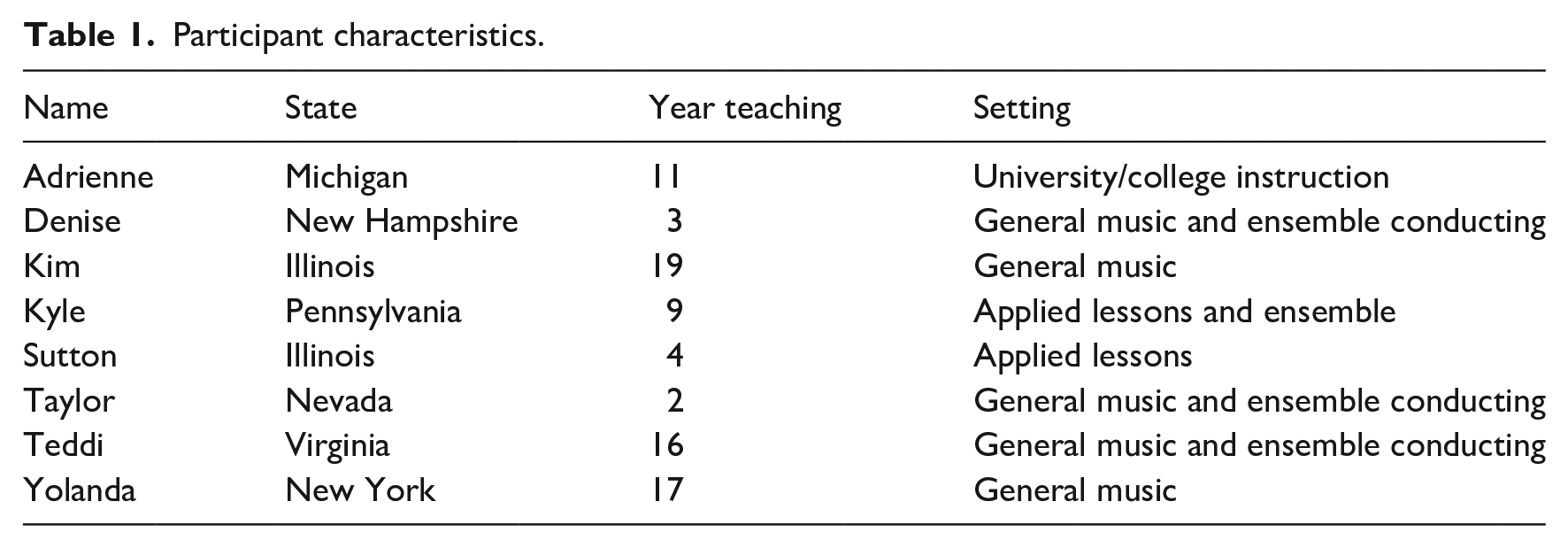
All of our participants were located in the United States, self-identified as female, were employed as a music educator throughout the height of the COVID-19 pandemic, and participated in our previous study (Authors, 2022). Our study was open to all K-12, applied lesson, and university educators, and, for our study’s eight participants, they represented those teaching at the university (n = 1), applied lessons (n = 2), general music (n = 2), and general music and ensemble conducting (n = 3). Throughout the previous year, Denise and Yolanda moved to new schools, while Kim became a traveling teacher within her building.
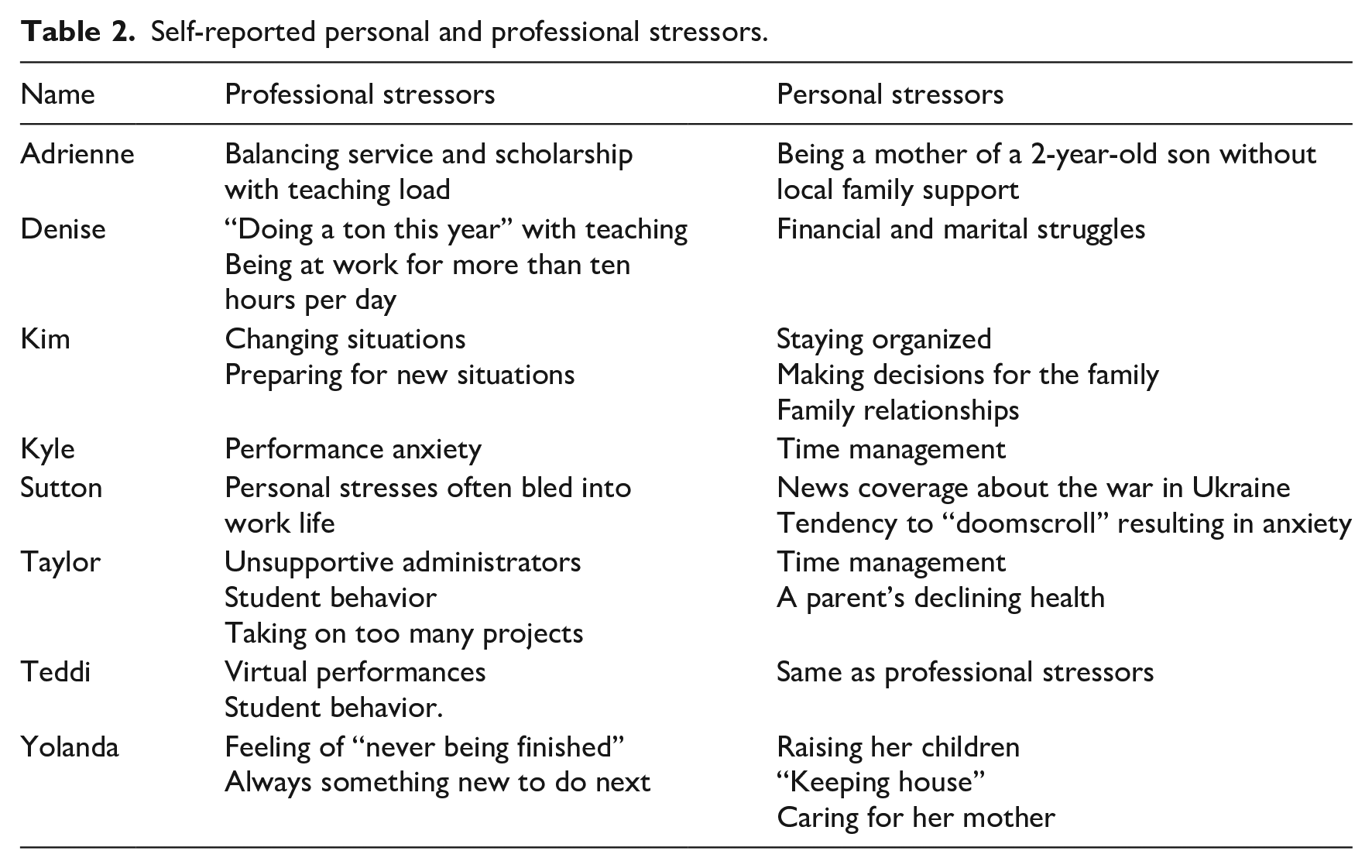
We utilized the same pseudonyms for the returning participants (Authors, 2022), which are located in Table 1. The eight participants were from all over the United States (see Table 1 for the specific state each was located) and were between the ages of 18 to 24 (n = 2), 25 to 29 (n = 1), 30 to 34 (n = 2), 35 to 39 (n = 2), or 40 to 44 (n = 1). Table 2 contains the self-reported personal and professional stressors for each of the participants, which included being a care giver to children and to parents, time management, and marital struggles. We asked them if they had any changes to their approach to self-care over the last year and all respondents said yes. Denise said she has done more meditation than in the past and Kyle stated she is more deliberate with her self-care. Sutton stated that prior to the pandemic she felt life self-care was more of a “treat,” however at the time of this study she said: I now feel that if I don’t engage in stress management and self-care, I might actually lose it.” We also asked participants to share what they were currently doing for self-care and stress management. Participants shared things such as getting enough sleep, resting, spending time with friends or family, meditating, reading, exercising, taking baths, listening to music, spending time outside, coloring, planning, attending therapy, journaling, and/or watching a favorite show.
Participant characteristics.
Self-reported personal and professional stressors.
Data analysis
We recorded all of the focus group discussions, using those features in Zoom, which produced secure recordings. We transcribed weekly focus group discussions, which we placed in a secure Google Drive for the duration of the study. Using open coding (Gibbs, 2007), we coded the data independently followed by applying axial coding to compare themes and patterns (Saldaña, 2021) and arrived at final themes. To support investigator triangulation, we used multiple data sources (e.g. questionnaire, focus group) and independent researcher coding. To support validity, we sent the paper to all of the participants to complete member checking (Merriam & Tisdell, 2016). We requested participants carefully review the material and elaborate and/or clarify any information.
Findings
The purpose of this study was to examine female music educators’ stress and stressors during the height of the COVID-19 pandemic. We uncovered four themes: (a) self-care and mental health; (b) pressure and frustration; (c) scheduling and reprioritization; and (d) accommodation. When relating the themes to the five elements of the theory of well-being (Seligman, 2011), the first and third themes relate to the element of engagement, the second theme to the element of meaning, and the fourth theme to the element of positive relationships. All themes connect to the positive emotion element, the cornerstone of the theory of well-being.
Self-care and mental health
Throughout our focus groups, participants discussed their methods of mitigating stress and how the COVID-19 pandemic pushed them into focusing on their own self-care and mental health. For example, Kyle talked about how she has always been an introvert and one of the silver linings of the COVID-19 pandemic lockdown was that it provided “an easy excuse to shield my alone time.” As lockdowns began to end, she worked on balancing alone time with work, friends, and family. Kyle also shared how the COVID-19 pandemic spurred her to care more for her own mental health and opened the door to find a therapist, and stated that she was able to be more selective about her mental health care. Kim also discussed how she felt the world around her is more aware of mental health and meditation: “self-care and self-awareness. . .I feel like it’s all around right now, whereas a couple years ago or definitely when I first started teaching, it was nowhere in sight.”
However, several participants struggled throughout the year with finding time or motivation for activities they considered for self-care prior to the COVID-19 pandemic. For Teddi, she always considered herself an active person; however, as her teaching moved to a virtual setting and she spent more time editing performance videos, she was not able to have her same level of activity, as she stated: I’m really exhausted from all the video editing and stuff. I’m usually a super active person, but I’ve had to like sleep, or you know, sit and video edit and stuff, and so I feel like I’m not quite as in shape and it’s annoying me but I don’t have the mental capacity or physical [capacity] to do it. I don’t feel like myself as much. I don’t have the room in my mental load to handle extra things that usually bring me joy, but now it just seems like a chore.
Teddi was not alone with her feelings of exhaustion and frustration when trying to prioritize self-care. Taylor also shared this struggle in that she was trying to be gracious with herself, but when she does, she feels like she is wasting time, being lazy, or filling her time with bad habits. She felt exhausted and it impacted her desire to engage in any of her personal passions such as practicing yoga in the morning and had no desire to go to rehearsal in the evening where she played trumpet in a community group. She was worried about the stigma surrounding this feeling: You shouldn’t feel lazy because you’re so busy, and like I hate the word burnout because it’s like the boogeyman for teachers. It feels like once you identify as burnt out, you’re put out to pasture.
Additionally, Taylor said that, throughout the past year, she wanted to sleep more—not because she needed to—but because she wanted to. She discussed taking a 15-min walk one day that turned into a 2-hr walk. She said she knew she did this to procrastinate and avoid other things she should be doing; however, she stated: “I can feel it feeding my soul, I can feel it bringing my stress down and so it’s like, is it a bad thing?” She went on to describe this more: “it’s like a self-care band aid. I’m just gonna do this thing right now. And then it’s going to get ripped off and then I’m gonna cry.”
Pressure and frustration
As participants worked through the lockdown at the height of the COVID-19 pandemic and the world slowly emerged, our participants seemed to feel the pressure to return “back to normal;” however, this brought forth a lot of frustration. Sutton discussed feeling the pressure on musicians and educators to achieve and add to their résumés but “we’re all exhausted and we’re all dealing with all these things.” Adrienne, a tenure-track music performance faculty member at a university, talked about the many logistical changes affecting educators worldwide (e.g. virtual teaching, hybrid teaching, mask mandates); however, the expectations of the requirements towards tenure of scholarship, service, and teaching did not change at all. She discussed how this impacted her: The modalities changed a lot and so being able to adapt and find creative and flexible ways to accomplish some more things means a lot more work, so I get to the end of the semester and I’m really tired and I don’t feel as excited about music or teaching, as I probably should or I want to.
Adrienne continued to share about the pressure of expectations. Due to the COVID-19 pandemic, people worked from home and in front of their laptops and computers for a majority of the work day; however, once we moved back toward in-person activities, some people still had the expectations that they would be as available and accessible. She stated: “people feel like they can reach out and expect an immediate response, regardless of when they reach out.”
Kim also discussed how she struggled with this idea of “going back to normal.” She mentioned finding time during the lockdown to do more things that she enjoyed and the pressure to go back to how life before the COVID-19 pandemic. She stated: I think it’s tough, we’re supposed to feel like ‘oh that was so horrible,’ the lockdown and then we want to get back to the way things used to be, right? We’re supposed to want pre-COVID things, but then it’s like why? You realize, you were in this race to nowhere.
Participants engaged in conversation that, perhaps, some of these pressures and frustrations came from being female educators. Adrienne discussed that she did not think her male colleagues experienced the same levels of stress as her female colleagues: “I’m not one to say, you know why it is or isn’t happening, but they seem to be kind of cruising at a more normal altitude than my female colleagues are.” She went on to say that, over the past year, she experienced compassion fatigue. She did not view it as a burden; however, she became a faculty member who the students could vent to about personal issues or about their stressors in the pandemic. She said: “I don’t think that my male colleagues experienced that same level of openness [from the students], or expectation and that’s across all of our female junior faculty members here have experienced that.”
Scheduling and reprioritization
As society moved from living and working in a lockdown to schools and performance venues returning to in-person activities, our participants appeared to experience challenges with scheduling and balancing teaching and performing with their personal lives. Adrienne, who teaches applied lessons, scheduled lessons back-to-back over Zoom, when they were virtual music lessons, and did not have to account for any traffic delays or other interruptions. However, when students returned to in-person lessons, they could be delayed, or end up having a long conversation with the lesson running long and throwing off Adrienne’s teaching schedule for the day. Kyle, who is also a gigging musician, discussed the stress of performance calendars filling up as organizations returned to in-person performances. She found it difficult to go back to such a full schedule and stated: “I didn’t realize how much I needed a little bit of a break.” She expressed that this was a problem many artists struggled with, not just musicians, trying to rebalance “professional life, with hobbies, home responsibilities, family obligations, and things like that.”
With these challenges of scheduling, participants discussed the need to protect their time from being over-committed. Sutton shared how, during the height of the COVID-19 pandemic, it felt like she was working non-stop, because we were all working from home and needed additional time to manage the changes of teaching modalities. However, as we moved back into in-person teaching and performance, Sutton reprioritized her time; “After this whole year of working every day, I’m just not gonna do it.”
Kyle reprioritized what types of performances and gigs she wanted to engage in as in-person performances started to return. She discussed feeling conflicted with the excitement that ensembles and organizations gained momentum; however, she said she was struggling with some mixed emotions about a regional orchestra that typically hired to perform with: “I did not miss that regional orchestra that’s an hour and 15 min away and has tolls and pays you $7 for travel.” Kim was in the process of reprioritizing things throughout her life, and reflected upon what aspects she wanted to go back to after the COVID-19 pandemic. She stated that she was having these questions such as: “how much do I want to give in certain places, where do I want to be, and am I doing what I want to be doing right now?” Sutton also experienced divergent feelings about her musical and teaching career and had moments of reprioritizing her teaching. She is worried she might be entering teacher burnout: Is this really what I want to do with my career? I’ll have thoughts which is ridiculous, because of course, it’s what I want to do with my career, but when it’s the moment of it’s time to leave to go to work. I don’t want to at all. And I think that’s probably a burnout symptom I would assume.
Accommodation
During one of the focus group discussions, the conversation gravitated towards the topic of accommodation or acting in a way that is accommodating to others. The entire group of participants discussed how, as a female educator, they have always been accommodating to their administration and colleagues; however, with the added stress of the COVID-19 pandemic, this was not always a possibility nor always a desire. Sutton discussed how, pre-pandemic, she would fill her schedule to accommodate all her projects and tasks; however, she was no longer practicing this sort of behavior. She said, “sometimes it makes me feel kind of like a jerk, but I also think it’s sort of necessary.” Adrienne, a tenure-track faculty member at a university, often noticed feelings of conflict about how much to accommodate the people around her. She talked about how this felt increasingly complicated, as all the tenured faculty members in her department are male and all the tenure-track (junior faculty) members are female. She stated: I’m a junior faculty member, and all my colleagues are evaluating my progress in my work. So I feel like it’s not required for me to be accommodating but also, I feel a need to be accommodating because I want to ensure that there’s positive reviews from a performance, so you feel that.
Kim expressed that, prior to the COVID-19 pandemic, seeing it as almost a challenge with her administration to accommodate whatever they asked. She described the feeling as, “I’ll show you how I can do this.” However, since the onset of the COVID-19 pandemic, she has advocated more for her program and her students, especially for materials for her classroom to have a successful music program. Denise discussed how she can no longer pile as many things “on her plate” and that she was learning to say “no” to others.
Teddi shared how the change in teaching modalities led her to change her outlook and be more honest with herself of what she is willing to accommodate. Teddi still produced virtual musicals for her middle school performances and mentioned that the time it took to upload videos and edit them was overwhelming, especially on top of her day-to-day teaching. She stated she was more forgiving with herself of when the performance would be ready and stated, “I’m not going to kill myself to do it.” Furthermore, Teddi experienced challenges with her administration throughout the COVID-19 pandemic. She discussed how she perceived some of these frustrations to be a gender bias and was no longer as accommodating: It’s so funny because the admin always goes around in the hallway and they’ll be like ‘hey how you doing’ and I always just say ‘fine.’ Now I’m like ‘actually I’d be a lot better if. . .’ or like ‘this is really bothering me, we really need to fix this’ and now they stop asking me. And they’re like ‘hi’ and then they just walk off. I’m tired of this because we have a PE department that’s mostly male, there’s one female out of five. And they get whatever they want all the time. They get preferential schedules, they get funding, they get. . . and I feel like it’s. . ..I don’t think it’s intentional, but I feel like it’s very sexist.
Discussion
On a professional level, the participants in this study experienced many of the same stressors seen in previous research throughout the COVID-19 pandemic such as challenges with students’ behavior, engagement, and motivation (Gül, 2021; Shaw & Mayo, 2022) and the logistics of adapting to an online curricula and virtual teaching environment (Cheng & Lam, 2021). Often, a positive part of music educators’ jobs includes relationships with their students (Matthews & Koner, 2017). Seligman (2011) describes positive relationships as an element of well-being; however, as the teaching community moved into a virtual setting, it was challenging to keep these relationships as strong. Adrienne expressed that, after her lessons returned to in-person, they would run long at times as many students just needed to talk, and she missed that type of connection with her students.
Female music educators’ careers are often impacted by outside variables including family responsibilities (Fischer-Croneis, 2016), which our participants also expressed throughout this study. For example, Kim, Adrienne, and Yolanda are mothers and discussed the extra challenges associated with caring for their children during this time. Adrienne had a 2-year-old at home and her family recently moved, which meant they did not have family support or assistance in their new area. Kim had children that did not attend the school in which she taught, and her school stayed in-person throughout the COVID-19 pandemic; however, her children’s school met virtually. As the participants discussed these factors, the gender discrepancy often came up in conversations and the participants connected over the struggles they perceived to be unique to female professionals, including administrative support, expectations, and burnout. This is not unique to the pandemic, as Hancock (2008) explained that female music educators are at a higher risk of attrition than their male colleagues, but was perhaps exacerbated in our participants due to the COVID-19 pandemic and experiencing more psychological distress (Miksza et al., 2021).
The participants in this study shared their challenges with balancing their stressors and personal and professional lives throughout the height of the COVID-19 pandemic. Scheduling, making priorities, setting boundaries, and finding time for self-care were all topics of discussion. Similar to previous research, our participants were challenged over the year with finding a consistent sleep schedule (Casacchia et al., 2021; Minihan et al., 2022) and dealing with anxiety (Cheng & Lam, 2021; Fan et al., 2021; Pressley et al., 2021; Santamaría et al., 2021). Furthermore, our participants struggled with taking time away from work, finding time for physical exercise and activities, and taking care of their own personal well-being, which is consistent with other educators during the COVID-19 pandemic (Kelley et al., 2022; Miksza et al., 2021; Minihan et al., 2022).
Throughout our focus groups, the participants mentioned many of the impacts of stress they experienced that have been discussed by previous researchers such as lacking motivation (Francom et al., 2021), struggling with work-family balance (Lizana & Lera, 2022), and experiencing more negative emotions (Miksza et al., 2021). As positive emotions are the cornerstone element of the theory of well-being (Seligman, 2011), we might conclude that our participants were not experiencing the full happiness and life satisfaction needed for well-being during the COVID-19 pandemic. Lizana and Lera (2022) stated there should be urgency for interventions to assist with teachers’ mental health; however, our participants did not discuss any assistance for mental health received from administrators or school sites, but rather that the expectations were the same, if not increased, during the COVID-19 pandemic. For many, this caused additional stress and concern. Adrienne discussed her concerns about potential impacts for her tenure and promotion, while Teddi shared the increased pressure and expectations of producing virtual performances on top of her daily teaching. In contrast to previous research (Miksza et al., 2021; Parkes et al., 2021), no participant expressed being depressed or having depression during this time; however, they did discuss experiencing anxiety, feeling burned out, and verging on the desire to leave the teaching profession. Teddi and Taylor both talked about the need for extra self-care time (e.g. exercise, playing an instrument), but it was difficult to find the time or the motivation.
Future research
Future research may explore if female educators throughout other areas of the world outside the United States have experienced similar struggles throughout the COVID-19 pandemic. Researchers may also examine the impact of female-specific challenges that emerged during this research (e.g. balancing motherhood, compassion fatigue of female music educators) on educators throughout these unprecedented times. Additionally, researchers have begun to discuss the impact of the COVID-19 pandemic on the productivity of female academics (Gabster et al., 2020); however, at the time of this publication, the impact on female K-12 music educators’ work and productivity has not yet been explored. Finally, future research might also continue to explore the long-term effects of the COVID-19 pandemic on music educators. At the time of this manuscript’s publication, the COVID-19 pandemic continued to impact the health of many around the world, and as a music education community, we are still working on a “new normal.”
Conclusion
The COVID-19 pandemic impacted music educators throughout the world and its lasting effects may be with the education community for many years to follow. Specifically for female music educators in this study, they felt the pressure of returning to “normal” with trying to balance schedules, accommodating administrators and fellow colleagues, and trying to maintain their mental and physical health. Music educators have worked to adapt to these new and additional stressors that they had not experienced prior to the COVID-19 pandemic. As the music education community continues to navigate these uncharted waters, it is important to mitigate teacher stress to prevent burnout and support well-being.
