




Abstract
Mission-driven nonprofit organizations sometimes struggle within a cycle of disempowerment resulting from oversaturation of data collection that is reactive to funder demands. In this article, we problematize Community Music School (CMS) data-collection and analysis efforts and discuss alternate approaches to learning about family and community desires and building community engagement. We first review literature on CMS goals, CMS engagement with communities, and the importance of student voice in educational research. Then, we briefly describe secondary analysis of a data subset from a previous study as context for critical discussion. Finally, drawing on literature from communications, urban planning, and school-family engagement, we make broader suggestions for how CMS can transform data collection practices into pathways for community engagement. We assert data quality and usefulness may improve when institutions seek input from community members who have not elected to participate and when CMS involve stakeholders in program design, goal setting, and measurement schemes from the outset. To that end, we describe three frameworks that could help CMS improve community engagement and make suggestions for future research.
Keywords
Introduction
Nonprofit organizations collect copious data to build their case for support from funders and other stakeholders (Erete et al., 2016). Such measurement and evaluation practices arise from “. . .expectations that organizations should be more ‘data-driven’[by] using increasingly larger aggregations of data to enable more productive and empowered decisions” (Bopp et al., 2017, p. 3608). While program evaluation data can serve as an external promotional tool, it also can distract from mission-driven efforts, particularly if external priorities imposed by funders do not align with an organization’s goals (Dolnicar et al., 2008). Additionally, measurement and evaluation efforts often are reactive to funder requirements, resulting in a drain on financial and labor resources, sometimes coupled with poor data collection strategies and limited analysis or long-term use beyond the current reporting cycle (Maxwell et al., 2016). The conclusion that “nonprofits are often collecting heaps of dubious data, at great cost to themselves and ultimately to the people they serve” (Snibbe, 2006, p. 39) resonates throughout recent scholarship. Indeed, mission-driven non-profits “. . .are not empowered by data. Instead, they are investing time, sacrificing expertise, and responding to largely external demands for data collection and reporting at the expense of the mission and operation of the organization” (Bopp et al., 2017, pp. 3608–3609). As mission-driven non-profits often reliant on grant funding, community music schools 1 (CMS) may fall prey to market forces prioritizing certain data, which can impoverish rather than enrich educational opportunities (Young, 2021).
Recently, we completed a mixed methods survey study regarding CMS stakeholder reactions to instruction moving online during COVID-19 (Salvador et al., 2021). While we used appropriate methods and found useful results, our conversations as a study team led us to critique data-collection efforts and wonder about alternate approaches to learning family and community desires that might also foster community engagement. Therefore, the purpose of this article was to problematize CMS data collection strategies and offer research-based strategies that might simultaneously provide information to guide planning and also increase community engagement with CMS. To that end, we first review literature on CMS goals, CMS engagement with communities, and the importance of student voice in educational research. Then, we briefly describe a secondary analysis of a data subset from our previous study as context for critical discussion. Finally, drawing on literature from communications, urban planning, and school-family engagement, we make broader suggestions for how CMS could transform data collection practices into pathways for community engagement.
Positionality
Positionality is an important consideration in community-based scholarship (Muhammad et al., 2015). We are all white cisgender women with PhDs who work at large universities, are straight, married, and have children. We each have substantial work experience as an elementary music educator in PK-12 schools, and we have worked for CMS in various capacities (teaching early childhood music, ukulele, and children’s choirs) and attended CMS early childhood music classes with our children. We have each experienced realizing that music classes we were hired to teach or felt best prepared to facilitate were a cultural mismatch with students and/or local communities. As researchers who study how music education programs (PK-12 and CMS) can better sustain student cultures and partner with local communities, we wondered about the role data collection plays in community engagement, and what meaning, if any, data collection holds for stakeholders and community members.
Review of literature
Community music school definition and goals
While the term community music lacks a consensus definition, Schippers and Bartleet (2013) asserted all community music operates in three domains: “structures and practicalities–infrastructure, organization and visibility; people and personnel–relationship to place, social engagement and support/networking; and practice and pedagogy–dynamic music-making, engaging pedagogy/facilitation, and links to school” (p. 459, format edited). Some views on community music emphasize situatedness and fluidity, embracing any communities engaged in making music unrelated to formal schooling or professional employment (Veblen, 2007). Some CMS programs focus on musical skill building, while others do not (Koopman, 2007). Researchers describe a range of possibilities encompassing approaches focused entirely on improvisational participatory music making with no possibility of wrong notes (Paton, 2011) to competitive Western art music performance programs (Leung, 2013).
Here, we focus on CMS as they have evolved in the United States. Such CMS typically center educational objectives, “offer(ing) programs in a variety of methods and styles” and serving diverse populations “as a ‘come one, come all’ type of gathering place” (Kruse & Hansen, 2020, p. 167). Some CMS seek to fill perceived gaps in PK-12 school music curricula by partnering with local schools (S. K. Jones, 2020; Prest, 2020). Overall, CMS strive to bring people together, create a sense of shared purpose, and provide a place where individuals and groups feel belonging (S. K. Jones, 2020). After COVID-19 drove CMS programs online, we (Salvador et al., 2021) asserted CMS may also play an important role in providing a physical location for social gathering and music making. As mission-driven non-profit organizations, CMS operate within a social enterprise model, advancing music making for skill building, enjoyment, community building, and advocacy goals.
Community music schools and local communities
Stakeholders conceive future directions for a CMS in relation to their understanding of its past, so “future community music contexts are therefore transformations of past community music contexts” (Higgins, 2012, p. 21). CMS histories may include insertion of programming or a physical building into a particular community on the basis of an outsider group’s desire to be present in a location or create social change (Baranski, 2011). White philanthropists and universities inserting CMS into places where historically marginalized racial groups and/or low-income people lived was at best steeped in inferential racism, “a form of racism underpinned by racist assumptions and premises rather than performed in overtly racist or bigoted ways” (Maurantonio, 2017, pp. 1133–1134). At worst, such insertions are examples of white organizations “operating from a sense of moral responsibility paired with paternalistic racism” (p. 1133). Thus, Higgins’s (2012) assertion regarding community music in the United Kingdom exerting political power remains true in US contexts, both 1) on a micro level, the relational interaction between individuals (music facilitator and participants). . . and 2) on the macro level, a challenge, and the raising of questions, to those who arbitrate funding for music, music organizations, and the institutions that engage people in music making, teaching and learning (p. 167).
However, Higgins was suggesting challenges and questions arose from the community musicians toward those in power, whereas in the US, some CMS are institutions (or extensions of institutions) that community members might challenge or question.
Communication Infrastructure Theory (CIT) proposes a social ecological model in which communities are discursively constructed (Ball-Rokeach et al., 2001; Kim & Ball-Rokeach, 2006). According to CIT, a community is created and defined through the stories its members tell themselves, each other, and the world. While CMS have community in their name, CMS participants’ stories generally are unexplored (Baranski, 2011) and the stories non-participant locals tell about CMS remain unknown. Data collection efforts in CMS likely are subject to the issues endemic among nonprofits: oversaturation of surface-level questions intended for reporting asked primarily of people who already have opted to participate (Bopp et al., 2017; Maxwell et al., 2016; Snibbe, 2006). While such data collection may include testimonials, the storytelling referenced in CIT is notably absent. Indeed, a lack of critically in-depth case studies is problematic because although continuous participation in community music school programs demonstrates a clear need for and interest in these offerings, we have too little insight into what brings people into these community music programs or what keeps them engaged (Baranski, 2011, p. 70).
Kruse and Hansen (2020) assert the need for more understanding of the communities surrounding CMS, particularly through sustained research that involves interviews with community members.
Communities are made up of individuals and families, and creating connections with families is one way school leaders can learn about community cultures, preferences, and needs. In collecting data regarding needs and desires for CMS programs, it may not be enough to speak with only one family member, as families are not monoliths (Salvador et al., 2021). CMS administrators must also deliberately consider the variety of family and household structures and circumstances in seeking relationships and stories (Walsh, 2016). Finally, within scholarship related to developing relationships with families, researchers generally reference only adults within family structures. Thus, scholars acknowledge children as present, but erase their voices and discount their agency (Walsh, 2016).
Student voice in research and decision making
Scholars consistently note the lack of children’s voices in educational research. The United Nations Committee on the Rights of the Child (2005) stated that the best interests of the child must be the primary consideration when adults make decisions, and that “children and young people have the right to say what they think should happen. . . and to have their opinions taken into account” (Article 12). Seeking input from children and listening to their ideas and preferences “enables students to feel that they are members of a learning community, that they matter, and that they have something valuable to offer” (Rudduck, 2007, p. 587). Rudduck asserted that when educational leaders elicit student voices, children experience a sense of belonging in a space and feel increased ownership/control in their own learning, while teachers develop a more open perception of young people’s capabilities. Unfortunately, organizations often tell youth they have a voice or ask them to support causes or projects, but youth opinions ultimately do not affect programming. Generally, the reasoning behind tokenizing youth in this way (see Hart, 1992) is to “attract attention, increase [the] likelihood of obtaining funding, or portray community relevance” (Funk et al., 2012, p. 290) rather than genuine efforts to incorporate children as collaborators in program design and implementation.
(Mis)alignment with local populations
As CMS combine educational and social goals, they must engage in ways that meet the needs of the local population (S. K. Jones, 2020). CMS generally welcome learners at all levels of experience and offer inexpensive tuition and/or scholarships (Kruse & Hansen, 2020). Although mission statements assert CMS value human diversity, and online and print materials feature visually diverse images, CMS program offerings primarily center Western art music (and sometimes jazz) lessons and ensembles (Baranski, 2011). While it is racist to assume that someone would not enjoy such offerings based on their race/ethnicity, Young (2017) noted mismatches between community music program goals and family cultures, goals, and expectations. Nickels and Leach (2021) elaborated, many local nonprofits work to serve vulnerable and historically marginalized communities, yet are neither representative of, nor have the contextual knowledge needed to, understand the social experiences of the clients they serve. Oftentimes, service providers assume they have the community knowledge necessary to provide adequate and effective services to their targeted communities. However, it is just as often the case that there are little to no data–or tools to produce such data–that authentically highlight the lived experiences and knowledge of underrepresented constituencies, be they staff or clients (p. 519).
While ostensibly interested in serving the needs of the local community, CMS programs risk reifying social stratification in the arts as well as perpetuating stereotypes based on both gender norms and Eurocentric notions of musical quality (Jeppsson & Lindgren, 2018). Additionally, many grantmakers prize evidence that a CMS is serving children and adults from historically marginalized groups or who are economically disadvantaged, so CMS often collect demographic data to indicate they support such a clientele. However, demographic data indicates only who was present, not whether an individual felt welcomed or how well the programming reflected community desires or personal goals.
Questions arising from a prior study
In March 2020, the COVID-19 pandemic caused a shift to online-only instructional delivery for two university-affiliated CMS. We conducted research to examine “experiences and perspectives of child and adult students and therapy clients, parents/caregivers, teachers, ensemble directors, music therapists, and administrators when CMS programs transitioned online” (Salvador et al., 2021, p. 196). We used descriptive statistics, linear regression, and qualitative analysis to examine each group’s perspectives. In contrast with some nonprofit data collection, our research was unrelated to grant reporting. During data analysis, we noticed disagreements between caregivers and children from the same household, but we did not analyze or report on these disagreements because they were unrelated to our research questions. Our researcher memos and conversations also indicated increasing preoccupation with bias we perceived from only surveying those who were currently enrolled.
Secondary analysis
Therefore, after publishing an article answering our original research questions, we revisited research literature and our data. We found that for many nonprofit organizations, data collection processes are reactive to funder priorities and create a burden on staff time (Dolnicar et al., 2008; Snibbe, 2006). Moreover, after staff collect data and write required reports, they rarely analyze further or use results to inform future actions (Maxwell et al., 2016). However, data collection efforts could be one way to address a perennial issue facing some CMS: lackluster community engagement, potentially caused by a misalignment of CMS programs/goals with local cultures and learning desires (Jeppsson & Lindgren, 2018; Nickels & Leach, 2021; Young, 2017, 2021). By examining disagreement within families and contextualizing these findings within the literature on challenges in nonprofit data collection, we explored what secondary analysis (McLeod & Thomson, 2009) might reveal about the limitations of survey data for fostering community engagement.
Secondary analysis process and findings
We had surveyed caregivers who interacted with CMS on behalf of a child or an adult therapy client (hereinafter, minor) and students ages 8 and older (Salvador et al., 2021). To examine paired data for this article, we sorted caregiver responses (n = 193, RR 21%) to isolate those that could be paired with at least one completed minor response. As most questions invited short answer text responses or were stated differently on surveys for caregivers and minors, we utilized content analysis (Neuendorf, 2017) to assess caregiver/minor disagreement by rating each pair’s disagreement across survey responses using a Likert-type scale. While most pairs (73.5%) frequently or always agreed, over a quarter of responding pairs consistently disagreed across responses.
Interpretation of secondary analysis
By examining survey data in caregiver/minor pairs, we saw individual families. Such analysis is not typical; surveys gather data from large groups of people, and scholars generally (correctly) take a holistic approach to survey data, as we previously did (Salvador et al., 2021). However, our observations of within-family disagreement led us to believe that better coordination and application of survey data and re-envisioning data collection efforts as pathways to community engagement would be a better use of stakeholder and staff time. Specifically, although they are low/no cost and expedient, surveys do not build relationships, and they may create negative feelings because commercial entities now survey people any time they interact (e.g. send a parcel, visit a website) (Field, 2020).
Several issues limited our confidence as we interpreted data. Wording in short answer responses made us suspect some caregivers filled out the survey on behalf of their minor. This may have affected parent-child agreement analysis, as research indicates parents have mixed accuracy as proxy reporters for their children (e.g. Birnie et al., 2020; Stage et al., 2019). Additionally, caregiver/minor pairs often gave different reasons for their selections in short-answer elaborations. We also suspected online survey fatigue may have affected response rates, the clarity and detail participants provided, and who elected to complete the survey (Field, 2020). Despite knowledge/approval of our survey, CMS administrators continued their own data collection targeting caregivers/minors and CMS educators. Thus, CMS stakeholders were oversaturated with requests for their feedback, often obviously for funder reporting purposes, and not for building relationships.
Transforming data collection practices to increase community engagement
This article resulted from our wondering about how CMS data-collection efforts could better inform CMS efforts to engage families, and through them, local communities. In our previous study, we had asked straightforward questions regarding experiences in online instruction and plans for in-person and online enrollment in the upcoming term. Disagreement within families further complicated interpretation of a dataset that also revealed disagreement among families and with teachers and administrators (Salvador et al., 2021). After revisiting our data, we wondered what other data collection practices could help CMS leaders and funders better know, partner with, and serve their communities.
Three models for integrating student, family, and community voices
In the absence of dedicated effort, organizations will replicate what they always have done. Sustaining student (child and adult) cultures in an organization serving hundreds of families in intersecting communities requires sincerely seeking relationships with community members in and out of the CMS. The resulting deeper and more honest conversations could bring about better community engagement. For example, CMS participants who responded to our survey generally rated courses and lessons favorably. But enjoying the programming may not equate to feelings of belonging, value, or empowerment (Liu et al., 2018). Moreover, nonresponse bias means that those who chose not to participate may have held more negative views (Hibberts et al., 2012), and we did not survey recently lapsed participants or those who had never participated. When we asked participants to suggest courses they would like CMS to add, 38% left the item blank, 46% answered “I don’t know,” and 16% suggested ideas—including several options CMS already offered. Perhaps imagination for the possible is challenging for stakeholders who have settled views on an organization, and strong relationships may be necessary for conversations that challenge assumptions or welcome criticism. Stronger relationships also could foster a sense of ownership from families and community, who could offer ideas knowing they would be valued. We located three models that offer potential paths toward integrating community and family voices in CMS data gathering, strategic planning, and program execution: CIT’s model of civil engagement (Ball-Rokeach et al., 2001; Kim & Ball-Rokeach, 2006), the REAP Metrix (Paton, 2011; Pearce et al., 2007), and the Dual Capacity-Building Framework for Family-School Partnerships (Mapp & Bergman, 2021).
Communication infrastructure theory, community engagement, and belonging
The CIT model of civil engagement offers one framework that could integrate data collection and relationship-building (Kim & Ball-Rokeach, 2006; See Figure 1). Using CIT, interested parties identify “types of local media, community organizations, and interpersonal networks most conducive to the generation and sharing of information about particular aspects of the community” (Villanueva et al., 2017, p. 478). CMS administrators and teachers would spend time within their local community’s integrated storytelling network (depicted in the center box), listening to how children and adults talk about their community and hearing stories they tell about the CMS. The CMS and its stakeholders also form part of the integrated storytelling network; getting the word out about programming may be strengthened through listening first to create conversations. Thus, reciprocal storytelling becomes an important data collection technique that also builds relationships (Hayman et al., 2012).
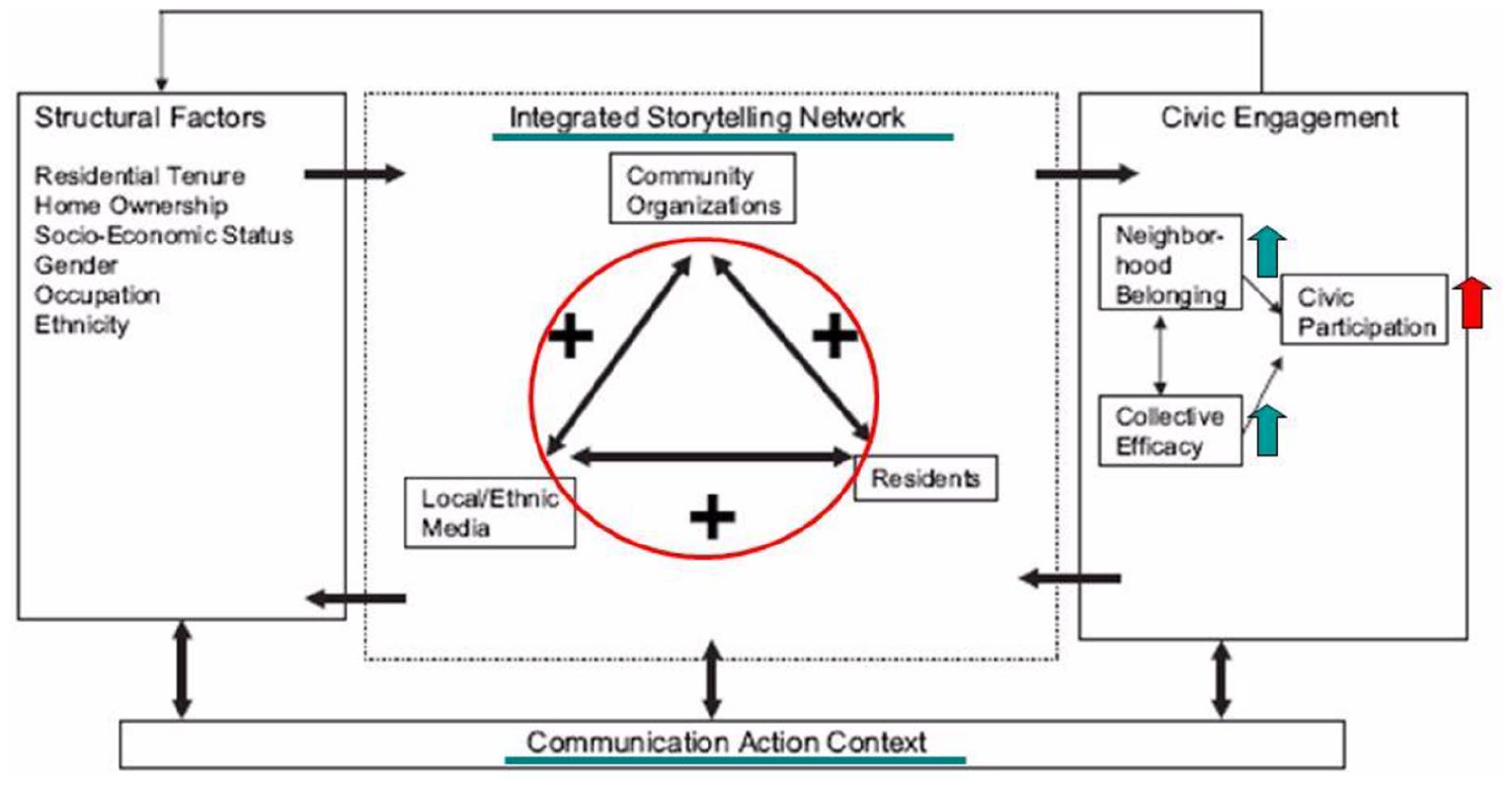
Communication infrastructure theory model of civic engagement.
Place focus and story gathering techniques
In CIT-influenced research, scholars view neighborhoods as places where people form a place-based collective identity (e.g. Liu et al., 2018; Villanueva et al., 2017). While some scholars criticize place focus as a solution imposed by distant experts (Jennings, 1999), we see potential in adopting strategies that community organizers and urban planners (who also are working to rectify troubled pasts with historically marginalized communities) utilize to learn about a place and the people who create it. For example, community asset mapping (e.g. Our United Villages, 2012; Villanueva et al., 2017) offers accessible strategies for learning about people, places, and community organizations. CIT proposes storytelling is “an intervening process between structural location and belonging” (Ball-Rokeach et al., 2001, p. 392). Thus, story-gathering techniques such as neighborhood walks with people identified through asset mapping could be important ways that CMS teachers and leaders become part of their CMS’s community. Unfortunately, nonprofit leaders sometimes only collect testimonials that showcase participants expressing gratitude for access to programming. Entering an integrated storytelling network requires more open-ended and reciprocal techniques (see Villanueva et al., 2017). Given the location-specific nature of non-profit funding, an asset map may reveal that people who might share stories are part of organizations competing for the same funding as a CMS. Competition tends to limit positive intergroup sentiments (Liu et al., 2018), which could make power sharing and equity-driven learning partnerships a challenge.
Increasing belonging
While CIT has been applied toward increasing community engagement, its original focus was neighborhood belonging (Ball-Rokeach et al., 2001), which remains salient (e.g. Liu et al., 2018). If a CMS data collection strategy consists only of distributing surveys to those who are currently enrolled, this could reinforce ingroup/outgroup boundaries, because respondents are people who have already bought into the offerings, interactions, and resources the CMS provides. Centering ingroup stories might create barriers for new members or obscure student, family, and community desires, ensuring continuation of the status quo. Increased contact among in/out groups through storytelling could foster belonging in diverse communities (Liu et al., 2018). As the US struggles with political polarization fracturing communities (Wenzel, 2020), CMS could be places community members gather, making music together to construct community and create belonging (Salvador et al., 2021; P. M. Jones, 2010). Stakeholders could apply CIT to position CMS as places for intergroup contact guided by shared music-making experiences.
Practical application: Participating in the integrated storytelling network
A data collection plan that mobilizes CIT through asset mapping and story gathering (including seeking dissent) could offer more honest and robust data to facilitate planning and program evaluation while also bolstering community engagement. In practice, this may include instituting community-involved strategic planning sessions at regular intervals to assess the goals and purpose of the CMS. Administrators could solicit community stakeholders’ perspectives to identify local needs and wants for programming prior to and following the implementation of any outreach services. Additionally, CMS could partner with local organizations, including small businesses, to support local culture. This may include partnerships for community events or traditions, such as festivals or special events hosted by the community, or utilizing CMS funds to support such events. Finally, CMS leadership could establish protocols surrounding purposeful conversations with families, particularly in the form of entrance and exit interviews. These discussions may provide insight into why families who chose to discontinue participation were originally drawn to the programing and why they then chose to stop. Whatever strategies CMS implement, they must include CMS teachers and leaders visibly participating in community life and openly listening for community stories.
REAP metrix
Historically, entities like universities and philanthropic organizations were instrumental in opening and sustaining CMS (Kruse & Hansen, 2020). However, issues related to paternalism and power imbalance can result when an outside entity inserts an organization into a community (Maurantonio, 2017). Thus, the connection between outside entities and CMS may not always be mutually beneficial. Universities, for example, have historically prioritized college student experiences over desires to learn about or consistently serve particular communities. References to community engagement in music education scholarship generally involve inserting teacher candidates into community settings for a pre-service educator’s edification (Forrester, 2019) or the need for university-educated musicians to be ready to work in community engagement to sustain their careers (Myers, 2007). More broadly, education researchers generally discuss community engagement as a means to increase student achievement in PK-12 school turnaround efforts (e.g. McAlister, 2013). However, as we discuss further below, school-centered efforts to partner with caregivers tended “to overlook culturally and linguistically diverse family participation. . .[and] focused on what non-dominant families were not doing, rather than what they were doing” (Baxter & Kilderry, 2022, p. 1, emphasis from original).
To pursue equity in university-community partnerships, Bradford University developed the REAP metrix, which integrates community stakeholders in program planning, execution, data collection, and evaluation from the outset (Pearce et al., 2007). In this model, universities utilize four key principles when engaging in community partnerships: Reciprocity, Externalities, Access, and Partnership (Paton, 2011; Pearce et al., 2007). Reciprocity refers to a multifaceted, mutually beneficial, and multidirectional flow of information between the university and community, while access necessitates providing continual access to university facilities and resources, instead of one-off provisions. When reciprocity and access guide community activities, this leads to the output and outcomes of partnerships and externalities. Pearce et al. (2007) argued that the quality of partnerships cannot and should not be quantitatively measured, but instead evaluated through qualitative evidence. Externalities are the outcomes of reciprocity, access, and partnerships. While hard to pinpoint, externalities might manifest as social capital or increases in associations and networks (P. M. Jones, 2010; Pearce et al., 2007). Utilizing the REAP metrix helps universities self-assess through each step of community engagement, and offers community stakeholders opportunities to co-lead.
Practical application: Sharing power
Operationalizing the REAP metrix might require a shift from positioning CMS as a location of expertise and community members as those who need skill building. Instead, a CMS focused on reciprocity and access might create partnership opportunities with local stakeholders that center their experiences, including their expectations and goals for the CMS, which may extend beyond musical goals, such as building community or a sense of belonging. CMS might develop such reciprocity by involving community members in leadership roles, such as board membership or other advisory/planning positions. The REAP metrix approach would require CMS sharing power and recognizing the expertise of students and community members, including children, and including these stakeholders in decisions including goal setting, program design, and program evaluation. By creating a reciprocal space of power sharing and expertise, CMS may increase externalities for both the university (or other sponsoring organization) and the local community (Pearce et al., 2007). While power-sharing could cause challenges with funders if community goals differed from funder goals, such challenges could create important growth opportunities for both the CMS and the funder(s).
Dual capacity-building framework for family-school partnerships
The COVID-19 pandemic forced schools and educational stakeholders to prioritize family involvement (Mapp & Bergman, 2021). However, as students returned to in-person classrooms, family engagement efforts waned. Mapp and Bergman (2021) designed the Dual Capacity-Building Framework for Family-School Partnerships (DCBF) to foster educational experiences that see families as the “core element of effective and equitable educational practice” (p. 8). In this framework, school leaders prioritize family involvement in both day-to-day operational decisions as well as organizational structures, with an overarching focus on an asset-based relational approach (Mapp & Bergman, 2021). To operationalize DCBF, a CMS might approach families as those who “know more, see more, and do more” (p. 6), while educators might critically examine their beliefs to reject deficit views of families, especially those with nondominant voices. Mapp and Bergman note that families are children’s first teachers, and educators must value these funds of knowledge.
Practical application: Centering child and family voices
To enact DCBF, CMS could center interactive co-learning and co-teaching with students and families to build trust and reciprocity. Additionally, CMS should prioritize messages to families and funders highlighting the indispensable nature of family involvement, and emphasize its value above periodic data collection. Then, when seeking information from families and listening to nondominant voices (including children), Mapp and Bergman (2021) encourage using asset-based qualitative questioning. This type of questioning may include soliciting children’s accounts of past musical experience(s) and their goals for participation as well as asking for detailed feedback following engagement with CMS activities. Amplification of child voices is important because Children are the most affected by planned changes, hence [should be] the principal key-actors of suggested reforms. That is, rather than recognizing children as merely targets of change efforts and services, [we] must treat them as partners in change (Nthontho, 2017, p. 3).
Rather than tokenizing children (Hart, 1992), CMS might shift toward making participation a process not an event, positioning children not only as customers of their education but also actors in its creation.
Finally, CMS might benefit from concrete guidance when attempting to enact more equitable partnerships with families and stakeholders. As one example, Facilitating Power (n.d.) offered a Rubric to Assess Authentic Family Engagement in School Planning for Educational Equity (pp. 8–10) that could help CMS assess and improve their efforts to share power with children and families. Organizations can use this rubric to evaluate different components of family involvement in their programs on a spectrum from marginalization and placation to full community ownership and deference to families and neighborhood stakeholders. In an effort to move closer to community ownership and deference, CMS might seek to re-design curriculum based on family interest, position families to be decision makers when allocating resources, and develop the CMS as not only a place that teaches music, but one that sustains community. Furthermore, to develop true community with families, CMS must critically examine issues of equity, including but not limited to ensuring that the leadership reflects the demographics, values, and diversity of the community they serve.
Suggestions for future research
In this article, we asserted the likelihood that CMS are hampered by ineffective data collection models, and validating this assertion empirically could be important research. It may also be useful to investigate CMS funder data requirements, including why funders ask for specific kinds of data in particular formats. Perhaps there is a role for scholarship that seeks to educate funders regarding the importance of richer stories, including dissent. Alternatively, researchers might discover funders believe nonprofits want to present certain data in particular formats based on tradition, but funding agencies might welcome change. Researchers might discover funders prefer to work with a CMS that actively co-plans, implements, and evaluates programming in collaboration with students and community members.
We echo Kruse and Hansen’s (2020) assertion that CMS administrators, teachers, researchers, and funders would benefit from more phenomenological and ethnographic studies of CMS participants and their communities. Such studies could center CMS student experiences of belonging (or exclusion), community views about CMS, and student and community desires for CMS. Indeed, prioritizing student voice is crucial for CMS that aim to be responsive community members. Revisiting existing data through secondary analysis or follow-up studies could be one way to better understand CMS student and community voices (McLeod & Thomson, 2009). We also suggest collaborative models of research, such as participatory action research, could be important means to increase equity. Bradford’s REAP model (Pearce et al., 2007) offers one possible framework for shared research and program design. Research regarding how CMS stakeholders enact story-gathering and relationship-building as data collection and how CMS administrators communicate these efforts to funders would be useful. Finally, we suggest scholars examine how, if at all, similar efforts to those we suggested could inform PK-12 school music education programs.
Conclusion
Current data collection strategies in many CMS may not produce information that reflects the community in CMS. This may be due to sporadic, impersonal, or top-down metrics that are reactive to funder goals and designed without student, family, or community involvement. We assert data quality and usefulness may improve when institutions involve stakeholders—including children and youth—in program design, implementation, and evaluation, and when they actively seek input from community members who have not elected to participate. Adopting a data collection strategy using the frameworks we outlined in this article to prioritize storytelling, relationship-building, belonging, and power-sharing might better engage students and families to help CMS that desire better community engagement meet this important goal.
Footnotes
Author contributions
Salvador directed the design and execution of this project, coordinated work efforts, and led manuscript preparation/writing. All authors created and field-tested data collection materials, acted as interviewers, transcribed interviews, and collaborated on qualitative data analysis and writing for the original study. Mayo coordinated data re-examination, and Salvador and Knapp wrote this article.
Funding
The author(s) received no financial support for the research, authorship, and/or publication of this article.
