



Abstract
Instrumental music teaching traditionally emphasizes the cognitive, motor, and motivational processes of score reproduction, often at the expense of creative musical activities, such as improvisation or composition. Since today’s international art school curricula prominently include creativity competencies, opportunities to integrate creativity in instrumental lessons must be explored. This study investigates instrument teachers’ conception of musical creativity: its scope, opportunities, and risks. About 273 teachers completed an online questionnaire on their use of creative class time, beliefs, and barriers to creative instrument teaching. Although the majority acknowledged the benefits of creative activities for score-playing, they invested little in improvisation and composition due to a lack of time and training in musical creativity. Teachers considered interpretation a valuable form of musical creativity, next to improvisation and composition, but questioned its feasibility in instrument lessons. Implications for instrument-teacher training are discussed.
Introduction
Creativity is essential to the very existence of humanity and society (Vygotskij, 1995 [1950]), and at the core of any artistic practice. National curricula and art standards worldwide include creative skills and attitudes, affirming their essential role in artistic development (Bernhard & Stringham, 2016; Davies et al., 2018; Larsson & Georgii-Hemming, 2019; Snell & Stringham, 2018). Consequently, scholarly and professional literature on teaching creatively and teaching for creativity has been increasing for several decades (Burnard, 2012a; Odena, 2018; Sullivan & Willingham, 2002; Tsubonou et al., 2019).
Historically, improvisation was common practice among instrumentalists (Campbell, 1991; Moore, 1992). It only became detached from Western, classical-music practice at the end of the 19th century (Moore, 1992). In the past, also composition was more integrated with musical performance (West, 2019). Musicians from the classical period were trained as a performer, composer, improviser, multi-instrumentalist, and conductor (Dolan et al., 2018; Gould & Keaton, 2000; Moore, 1992). From the 20th century, musical reproduction and creation were increasingly considered distinct specializations. Western conservatories idealize instrumental specialization and professional expertise, leaving less curricular space for improvisation or composition (Huovinen & Frostenson Lööv, 2021; Liertz, 2007).
Music educators generally consider improvisation and composition the preeminent creative musical activities (Kennedy, 2000; Schiavio & Benedek, 2020). They seldom consider score-playing, although sometimes called the “re-creation” of a composer’s thoughts and ideas (Hultberg, 2002), to be equally creative as improvisation or composition. Moreover, instrument lessons are often characterized by a master-apprentice approach (Burwell et al., 2019; Daniel, 2006; Jørgensen, 2000; McPhail, 2010; Nielsen, 2006; Rakena & Brown, 2016), in which teachers typically focus on technically controlling the instrument or passing on the “correct” interpretation of the composer’s work through a one-way process, leaving little room for student input and initiative. Although interpretation often is considered important in the artistic process of performing (see for instance the 2014 US National Core Arts Standards), expression and communication are given little attention in the early years of formal instrumental music learning (Karlsson & Juslin, 2008; Meissner, 2021).
And yet, education experts, researchers, and policymakers increasingly encourage a stronger integration of musical skills (Azzara, 2002; Duke, 2011; Elliott & Silverman, 2014; Gordon, 2012). Benson (2003) argues for a holistic view that considers all musical products and processes as improvisation and dialog and questions the boundaries between performing, listening, improvising, and composing. This process of integration could be facilitated by broadening the scope of musical creativity. Many conceptual frameworks of creativity emphasize the criterion of “novelty” for a perceptible product to be creative (Plucker et al., 2004; Runco & Jaeger, 2012). As improvisers and composers create music that did not exist before, their musical output is more easily regarded as creative than that of a performer who recreates an existing score. Viewed in this way, an interpretation, that is, “the process of selection and application of performance choices on a composition” (Holmgren, 2020, p. 106), is not as easily regarded as a novel artistic product than an improvisation or composition.
However, several authors argue that the cognitive, embodied processes of interpreting and performing a musical score transcend mere repetitive reproduction (Chaffin et al., 2007; Elliott & Silverman, 2014; Hargreaves, 1999; Thompson, 2009), For instance, Klickstein (2009) states that interpretation involves the player making decisions on sound and timing to communicate the chosen emotional layer. Both processes require intense practice. Payne (2016) studied musicians rehearsing for a concert performance of novel music. After intense analysis of the decision-making processes in playing music together, she questioned “a paradigm that opposes notated permanence to improvised transience” (p. 325). Cook (2014) conceives of music as performance, rather than the product of a written score and emphasizes the generation of meaning in real time.
All these authors emphasize the role of decision-making and meaning-construction in musical performance. Both (learning) processes—decision-making and meaning-construction—are addressed in some common theories and conceptualizations of creativity for example, divergent and convergent thinking (Guilford, 1967), creative learning (Beghetto, 2016), personal creativity (Runco, 1996), or the Four C theory (Kaufman & Beghetto, 2009). For instance, in Four C theory, Big-C concerns clear-cut, eminent and renown creative contributions, including major productions of scientific (e.g. Darwin’s Theory), technological (e.g. invention of the printing press), or artistic (e.g. Picasso’s Guernica painting) importance. Little-c concerns creative actions in which the non-expert may participate daily (e.g. combining available ingredients to a new meal). Pro-C is based on professional-level expertise and concerns developmental and effortful progression beyond little-c that has not yet attained Big-C status (e.g. a graduated trombonist who plays in a professional orchestra). The fourth C, mini-c, refers to the personal interpretation of ideas, actions, and events as a creative process. To this respect, musical interpretation might at least count as a form of mini-c and thus can be considered creative.
Broadening the scope offers opportunities to rethink musical creativity, paving the way to conceptualizations that emphasize the creative process rather than the product (Burnard, 2012b; Kupers & van Dijk, 2020; Odena, 2018; Schiavio & Benedek, 2020). Interpreting a piece may be an ideal base for student and teacher to initiate musical creativity: staying close to the familiar score, but aiming for divergent learning outcomes and developing learners’ personal voices (Coss, 2019).
Studies on musical creativity show a diversity of topics (Burnard, 2007, 2012b; Hickey, 2007) including class time use, experienced barriers to applying creative activities, teacher beliefs and the influence of personal, musical, and educational background on their beliefs and practice. Most studies focus on improvisation and composition in primary or secondary group tuition. Reviewing studies of improvisation in primary schools, Larsson and Georgii-Hemming (2019) noted that not only the number of studies is limited but also the range of countries in which improvisation has been explored. This is probably even more true regarding improvisation in instrumental lessons, which often occurs in one-to-one studio lessons, referred to as the “secret garden” by Burwell et al. (2019).
Studies on creative class time use show varying results depending on the research question (Chandler, 2018). Some studies (Koutsoupidou, 2005; Whitcomb, 2007) report high percentages of teachers using improvisation in their lessons (81%–87%) while others (Byo, 1999; Gruenhagen & Whitcomb, 2014; Orman, 2002; Wang & Sogin, 1997) show that creative skills and activities receive proportionally little class time. Gruenhagen and Whitcomb (2014) reported that 58% of teachers used improvisation for up to 10% of class time and only 16% of teachers for 21% or more. Strand (2006) confirmed that most (88.5%) teachers used composition in K-12 music classrooms, but more than one-third did so very rarely or never. Overall, these results suggest that most teachers have some experience with teaching improvisation or composition but do not implement these creative activities consistently in classroom practice.
Several studies have considered music teachers’ barriers to improvisation or composition (Dogani, 2004; Koutsoupidou, 2005; Menard, 2015; Orman, 2002; Snell & Stringham, 2018; Strand, 2006; Whitcomb, 2007). A lack of time, insufficient theoretical background and experience improvising, the absence of training, and a fear of reduced classroom discipline were common. Music teachers consider composition or improvisation difficult to teach (Koutsoupidou, 2005) but value them as necessary to the development of musical skills (Koutsoupidou, 2005; Snell, 2012; Stringham et al., 2015). However, the potential benefit apparently does not convince instrument teachers to implement creative musical activities (Elpus, 2013; Strand, 2006).
Music educational research focusing on teaching and learning musical interpretation is mostly limited to higher music education These studies often show the learning of interpretation as a process of mimicry or imitating the teacher (Holmgren, 2020; Hultberg, 2008; Silverman, 2008).
Although previous research has shed some light on creative practice or beliefs in general music classes, less research has addressed these matters in instrument lessons which foregrounds the sounding and interpretation of scores. Therefore, the first aim for this study was to study the practice and teacher perceptions on improvisation and composition in the context of small-group or one-to-one instrumental lessons. Secondly, this study introduced interpretation as a new look at musical creativity, next to the traditional conceptions (improvisation and composition). We wanted to find out whether instrument teachers support this broadened concept of musical creativity and how this relates to more common conceptions. The study addresses these research questions:
How much class time do instrument teachers spend on various creative activities (improvisation, composition, and interpretation) compared to score-playing?
What are instrument teachers’ barriers to engaging in improvisation, composition, or interpretation and do these differ by musical activity?
What are instrument teachers’ beliefs about the feasibility and effects of applying creative musical activities in instrument lessons?
Methodology
Context
This survey was part of the “Beyond the Score” research project on fostering creativity in instrumental music education. The project’s purpose was to explore how the educational field of instrument tuition in Flemish music schools (Belgium) defines and applies creativity in an artistic context. Formal music schools reside under the structure of part-time education in the arts, Deeltijds Kunstonderwijs (“Part-time Art Education”; DKO). This is a form of additional education for children, teenagers, and adults. The voluntary participants register and pay enrollment fees. The DKO offers artistic training, contributing to personal growth and artistic independence through a national standard of artistic competencies. At the time of the study, the music school curriculum included three levels: beginner level (duration: 4 years, minimum age: 8 years old), intermediate level (duration: 3 years) and advanced level (duration: 3 years). Pupils were offered A classes, mainly aiming at individual instrumental craftmanship, or B classes, focusing at ensemble playing. Instrument teachers typically taught in both levels. Furthermore, formal music education in Flanders was on the verge of a new decree setting new, explicit goals for developing creativity.
Participants
The sample represented 273 of the approximately 3,600 instrument teachers employed in DKO. Of the participants, 58.1% were female and 41.9% were male. The mean age was 44 years (SD = 11.06). The mean number of years of teaching experience was 21 (SD = 11.26). Most respondents (91.5%) were trained in classical music; 7.5% taught popular music and jazz; and only 1% held both qualifications. Table 1 shows the distribution of participants by instrument group. Different sample sizes are a result of missing values.
Distribution of instrument groups (N = 269).

We sent a link to the online survey to the principals of all Flemish music schools (N = 103). They were introduced to the research topic and invited to forward the link to their instrument teachers. About 1 week later, a standard reminder was sent. The survey was also announced in a Facebook group for DKO.
Instrument
We developed a self-completion questionnaire and piloted it with researchers and music teachers. We addressed technical issues and implemented suggestions for phrasing questions or statements. The questionnaire included an introduction and four sections. The introduction mentioned the researchers’ interest in different methods of instrument teaching. We avoided explicit references to creativity to reduce potential bias from demand characteristics (Sharpe & Whelton, 2016). Improvisation, composition, and interpretation were defined in the first section, emphasizing the student’s own input and personal, creative voice in all three musical activities. This was certainly a necessary addition for interpretation, as a student can equally play a teacher-led interpretation, which is not considered creative in this context.
The first section gaged creative class-time use. For each level, respondents marked the amount of class time spent on improvisation, composition, and interpretation, using a 5-point Likert-type scale (from “never” to “in every lesson”). They also indicated the percentage of class-time used for score-playing from 0% to 100%. In the second section, participants indicated their agreement with nine reasons for not engaging in creative instrument teaching. Four items were based on the literature on improvisation and composition in general music education. These items referred to the teacher having insufficient skills, creative forms being no part of teachers’ own curriculum, the lack of time during the lesson and the importance of creativity in the national standards. Five other items focused on the embodied cognitive features of the learner, relating to the creative process of musical sense-making in interpretation. These items included aspects of motivation, imagination, knowledge of music theory, mental processing speed and technical skill. In the third section, participants marked their level of agreement with 10 statements about teaching creativity in instrument lessons using a 5-point Likert-type scale (“strongly disagree” to “strongly agree”). The statements probed teachers’ beliefs about the relationship between creative musical activities and score-playing and the feasibility of applying creativity in class. In the fourth section, relevant socio-biographical data were registered: sex, age, instrument group, training institute, and the number of years teaching.
Data analysis
The data were cleaned (Curran, 2016) by deleting 40 cases (13%) with outliers (e.g. when respondents marked all survey items the same) or insufficient responses. We used IBM SPSS 22 to analyze the final sample using both descriptive and inferential statistics. We checked for sampling bias by comparing the distributions of gender, age, style (classical or jazz), and instrument group to those hypothesized using Chi-squared tests. The proportion of woodwind teachers in the sample was larger than expected on the basis of the population distribution but only the test for age was significant: χ2(4) = 10.417 (N = 270), p = .034 indicating an overrepresentation of the youngest age group compared to teachers aged over 60. To compensate for the overrepresentation, we weighted the cases proportionally for the descriptive statistics (Kish & Frankel, 1974).
We opted for non-parametric tests because we used ordinal measurement scales and the data were not normally distributed. For the analysis on the barriers, the items in Section 2 were aggregated in terms of content and treated as continuous variables. We performed an explorative factor analysis on the statements in Section 3 to identify an underlying structure in teachers’ beliefs about the feasibility and effects of applying creative musical activities in instrument lessons.
Results
Class-time use for score-playing, improvisation, composition, and interpretation
Figure 1 shows the percentages of class time working with a musical score at each level of training (beginner, intermediate, advanced). We aggregated the outer levels of the five-point scales, resulting in three levels—0% to 40%, 41% to 60%, and 61% to 100%—demonstrating not only that attention was mainly devoted to score-playing during instrument lessons, but also that the amount of time spent on score playing increases over the years.

Percentage of class time spent on score playing.
Two-thirds of the participants spent more than two-thirds (67.4%) of class time on score—playing in the first years of musical education. This number increased to almost 85% in the final years. Pairwise Wilcoxon signed-ranks tests (i.e. the non-parametric variant of the paired samples t-test) showed a significant median increase in the instruction time spent on score-playing, z = 5.80, p < .001 and z = 4.85, p < .001.
Figure 2 shows the medians for frequency of implementing composition, improvisation, and interpretation in instrument lessons per level. Inspection of the graph shows that improvisation receives a fair amount of attention at the beginner level but this decreases in later years. Composition generally receives little attention in instrument lessons. Interpretation gains importance throughout the curriculum.

Medians for different creative activities by level.
To verify whether the different activities significantly differ between levels, we performed Friedman’s tests (i.e. the non-parametric variant of a repeated measures ANOVA) with pairwise comparisons using the Bonferroni correction to assess for differences between creative musical activities. Class-time use for improvisation varied significantly between beginner and advanced levels (χ2(2) = 2.482, p = .039) and for interpretation between beginner and intermediate (χ2(2) = −7.254, p = .000) and between intermediate and advanced levels (χ2(2) = −4.044, p = .000). This indicates a decrease in improvisation and an increase in interpretation from the beginner to the advanced level.
Barriers to applying creative musical activities in instrument lessons
We calculated medians to find out which barriers to creative activities are experienced by the respondents. Figure 3 shows the medians for the nine arguments against improvisation, composition, and interpretation presented in the survey.

Barriers to creative activities in instrument lessons (1 = does not apply at all, 2 = rather applies, 3 = neutral, 4 = partly applies, 5 = totally applies).
The strongest barriers to engaging in composition or improvisation were the absence of creative musical training in the teacher’s education and the lack of class time. Barriers to improvisation were mainly related to pupil characteristics. Cronbach’s alpha confirmed a high internal consistency between the five items that related to pupil characteristics (α = .895) and between the four items that related to the teacher or learning environment (α = .784). Therefore, we aggregated the variables to two new variables (pupil-related barriers and teacher-related barriers) for the musical activities. We ran Friedman tests to determine differences between the barriers to improvisation, composition, and interpretation. The arguments were statistically significantly different for the three musical activities for both the pupil-related barriers, χ2(2) = 109.751, p < .001 and the teacher-related barriers, χ2(2) = 324.910, p < .001. Post-hoc pairwise comparisons of the pupil-related barriers revealed statistically significant differences between improvisation (M = 2.8) and interpretation (M = 2.2; p < .001) and between composition (M = 2.8) and interpretation (M = 2.2; p < .001) but not between improvisation and composition. The same was true for teacher-related barriers: There was a difference between improvisation (M = 3.25) and interpretation (M = 1.5; p < .001) and between composition (M = 2.2) and interpretation (M = 1.5; p < .001) but not between improvisation and composition. This means that improvisation and composition cluster as a type of musical activity different from interpretation. Differences between pupil-related and teacher-related barriers were significantly different for the creative activities (p < .001). Figure 4 summarizes these results and shows how the argumentation against the use of creativity changes depending on the type of creative activity.

Means for pupil and teacher related barriers by creative activity.
Effects and feasibility of creative musical activities in instrument lessons
In order to gain insight into the beliefs of the teachers, we prepared a frequency table for the answers to the statements about the effects and feasibility of creative musical activities in the instrument lesson. Table 2 shows the responses concerning interrelation effects between creative activities and score-playing and the feasibility of creativity in class. Highest and second highest values are highlighted in bold and italics respectively.
Percentage frequencies of beliefs and feasibility of creative activities.

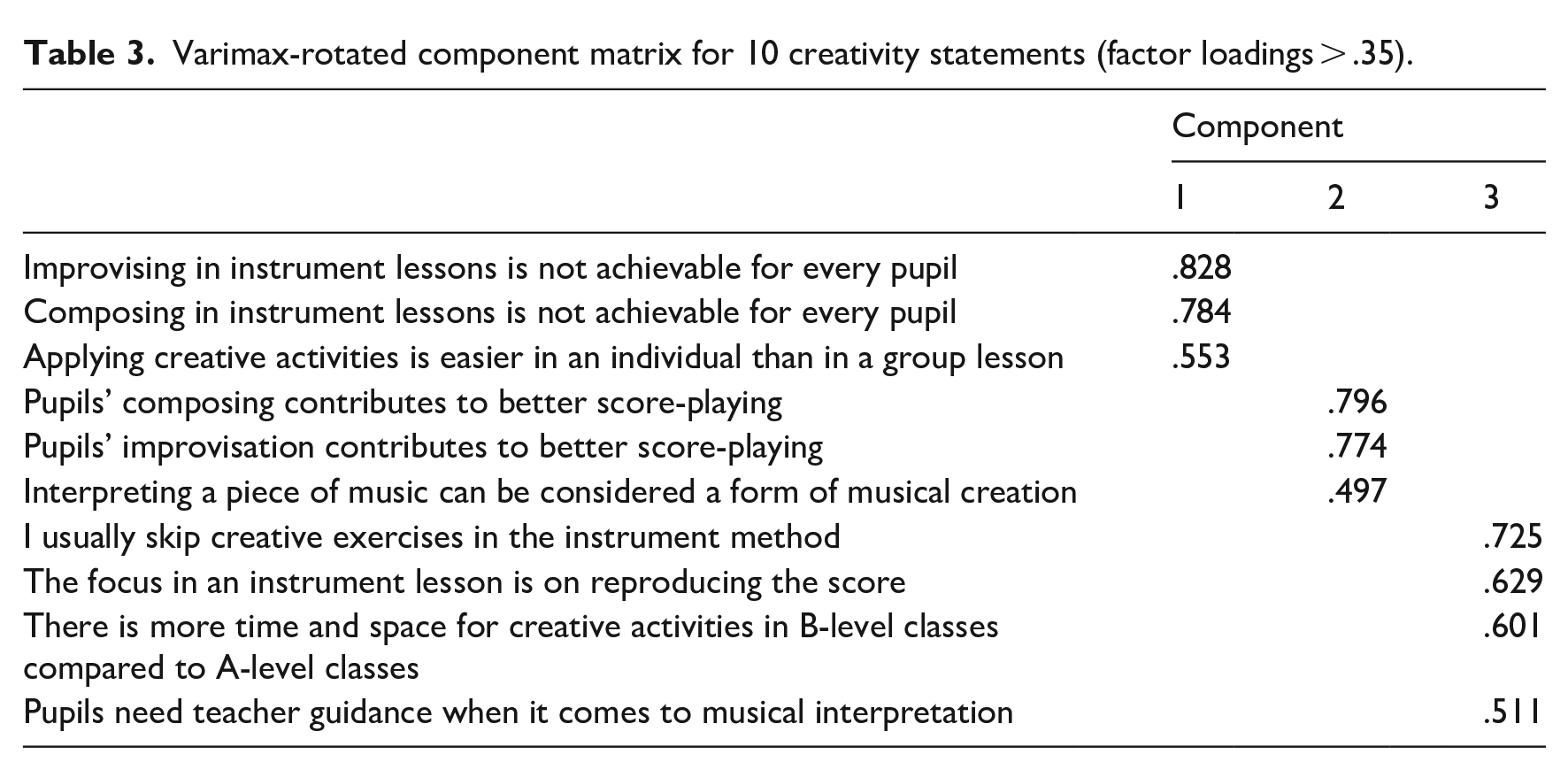
To reduce the dimensionality of the 10 items into a smaller set retaining most information, we conducted a principal axis factor analysis (FA) with varimax rotation (Field, 2018, p. 989) on the 10 items. The Kaiser–Meyer–Olkin (Field, 2018, p. 1014) measure verified the sampling adequacy for the analysis: KM = .65. The KMO values for individual items were between .54 and .81. To determine the substantive importance of factors, we ran an initial analysis to obtain eigenvalues (Field, 2018, p. 1004) for each factor. Three factors had eigenvalues over Kaiser’s criterion of 1 and combined, explained 52.44% of the variance. The scree plot showed an inflection that justified retaining three factors. Table 3 shows the factor loadings after varimax rotation. The item clustering suggests that Factor 1 represents the feasibility of applying creative activities, Factor 2 represents the beneficial effects of using creative activities on score-playing, and Factor 3 shows teachers’ beliefs about the implicit aims of instrument lessons.
Varimax-rotated component matrix for 10 creativity statements (factor loadings > .35).
Discussion
We surveyed a sample of 273 instrument teachers online on their creative class-time use, beliefs, and barriers to the use of creative musical activities (improvisation, composition, interpretation) in lessons. Results showed a substantial amount of score-playing during instrument lessons that increases with the pupil’s age and instrumental experience. This increase is accompanied by a stronger focus on interpretation at the expense of improvisation. Orman (2002) observed a similar decrease in improvisation in elementary general music classes, which was attributed to increasing curricular constraints impinging on the time-consuming development of creative skills. Similarly, the lack of interpretation in early tuition may reveal instrument teachers’ implicit notion that instrumental technique must precede musical interpretation (Hultberg, 2002; McPherson & Gabrielsson, 2002). Meissner (2021) calls this a sensible approach on one hand, as technical difficulties can hinder expressiveness but, on the other hand, points out that focusing on musical character may benefit young musicians’ instrumental technique. Composition seems to be an underexplored area in instrument lessons. Compared to general music classes, composition may be perceived as too time-consuming: It steals time from the instrument so contradicts implicit expectations regarding the content of an instrument lesson. However, by composing students become aware of musical forms, tonalities, characteristics of the instrument, all aspects from which musical performance can benefit (Hickey & Schmidt, 2019). The reported creative class-time use agrees with Gruenhagen and Whitcomb (2014) and Strand (2006), who focused on creativity in general classical music education and found that most teachers included little improvisation or composition.
The reported barriers to improvisation and composition are also consistent with extant literature (Koutsoupidou, 2005; Snell & Stringham, 2018; Whitcomb, 2007), including a lack of lesson time and teachers being insufficiently trained in creative music making.
The factor analysis performed on the attitude statements revealed tension in the beliefs of the teachers. They saw benefits in creative activities, but these were overshadowed by perceived teacher- or learner-related obstacles and by implicit beliefs about the fundamental goals of an instrument lesson (Riley, 2009; Snell, 2012). Again, these results resonate with findings in general music education (Elpus, 2013; Koutsoupidou, 2005; Strand, 2006).
Instrument teachers support the idea that interpretation is a form of musical creativity, thereby resonating with the concept of mini-C as a valid form of creativity (Kaufman & Beghetto, 2009). Designating interpretation as a creative activity paves the way for a third way to view musical creativity (Cook, 2014; Hultberg, 2002; Payne, 2016) and possibly to overcome some classic hurdles related to improvisation and composition. However, the instrument teachers also saw hurdles to inviting pupils to express their personal interpretations, albeit the barriers to interpretation are strikingly different from those to improvisation or composition. Avoiding composition or improvisation is attributed to the teacher’s situational features while interpretation is complicated by dispositional learner characteristics. This fundamental attribution error (Ross, 1977) may prevent instrument teachers from developing an artistic learning environment that fosters interpretative decision-making and artistic ownership.
Implications
These results are important for instrumental teacher educators. Research suggests that music teacher educators present the same arguments as instrument teachers for not engaging in improvisation or composition (Hewitt & Koner, 2013; Stringham et al., 2015). Breaking this cycle requires “a change in culture—a new definition of what teaching instrumental music means” and the ambition “to prepare educators who teach music more holistically, which might include C[omposition/I[mprovisation] even where it does not exist in the tradition” (Stringham et al., 2015, p. 21). Therefore, instrument-teacher training should exceed providing a toolbox of creative methods. It should include quality reflection on artist and teacher identities, values, aims, confidence, traditions, and the preconceptions of students (Biasutti, 2010; Natale-Abramo, 2014; Nussipzhanova et al., 2016). Espeland et al. (2021) found in a qualitative study that student music teachers reflect on their developing teacher identity alongside their personal identity but less on their teacher beliefs, compared to experienced teachers. The authors suggest reflection should be a structural part of teacher education in the didactic course and in internships. A persistent idea is that choosing activities in instrument lessons is not a zero-sum game. Investing in informal instrument training by composing or improvising need not mean less time for score-reading or technical skills: These aspects of instrument-playing are complementary in a pupil’s musical development (Azzara, 2002; Beitler & Thornton, 2010; McPherson, 2005).
Further, it is important for future instrument teachers to experience success in creative music-making as performers and teachers (Odena & Welch, 2009; Wright & Kanellopoulos, 2010). Teachers with a personal involvement in creative activities have a more positive attitudes toward improvisation (Creech et al., 2008; de Bruin, 2019; Koutsoupidou, 2005; Odena & Welch, 2007) and are more keen to include improvisation in their lessons (Whitcomb, 2007). In addition to reflection, instrument teacher education should include sufficient opportunities for creative music making through improvisation or composition in the curriculum and encourage students to engage in extracurricular creative performance. These personal, formative experiences may be more important for professional development than formal training (Stringham et al., 2015); occasional initiatives, such as creative workshops (Hickey & Schmidt, 2019); or an instructional model (Snell & Stringham, 2018).
Finally, learning and teaching musical interpretation (and expressiveness by extension) should gain more attention in instrument didactics as a valid way to unlock creativity (Brenner & Strand, 2013; Holmgren, 2020; Hultberg, 2008; Karlsson & Juslin, 2008; McPhee, 2011; Meissner, 2021; Silverman, 2008; Woody, 2006). Meissner and Timmers (2020) argue that pupils’ expressive performance benefits from a dialogic teaching approach, consisting of questions and dialog rather than the teacher imposing his or her own interpretation. Again, reflection on teacher beliefs concerning the opportunities of developing communicative and expressive skills, even in the youngest learners, as well as gaining positive teaching experiences would be key elements to this respect.
Limitations
Some limitations of this study should be noted. First, it is possible that the time-related results are an overestimation (Wang & Sogin, 1997). We tried to lessen social-desirability responses by framing the possible barriers as outcomes of scientific research to mitigate strong personal involvement. Nevertheless, a “social desirability response bias” (Robson & McCartan, 2016, p. 248) could explain the reported time. This is a common problem when conducting surveys but may have played a greater role in this study, which occurred at the verge of a new decree for music schools that increases emphasis on developing creativity and applying creative methods.
Second, the focus on arguments against applying creative activities, not on positive choices, may have elicited another form of response bias. A jazz teacher mentioned that some items lacked recognizability or applicability to his teaching practice. The focus on not engaging in creativity and the lack of a “does not apply” option may have hindered teachers who actively engage in creative activities.
Third, the class-time use analysis merely quantitatively marked creativity time without considering the quality of the instructional design. The reported changes in class time use between levels do not solely account for differences in the effectiveness of creativity teaching. They should be considered together with a qualitative analysis of the exercises’ relevance and goals (e.g. regarding the desired learning outcome or the learner’s developmental stage; Kratus, 1995).
Challenges
Teaching-career life-cycle literature (Snell, 2012) can further explore the ways in which teacher experiences influence creative practice and beliefs. Future research may focus on the delicate interplay between musical, teaching, and personal experiences in forming a teacher’s identity. Differences in creative practice and beliefs between instrument types could also be explored. How do the instrument’s cultural and historical significance, repertoire, or specific didactic approach integrate in the development of teacher identity and beliefs? These would be important keystones in forming a creative instrument-learning environment.
Instead of adding teaching skills to musical skills, further integrating teacher-training with domain-specific musical training, including improvisation, composition and sufficient concert practice, may be beneficial. This would build improvisational skills and reflective skills together to reinforce each other and the concept of the teacher-artist (Strickland, 2020).
Conclusion
Although creativity and the arts seem intimately linked, applying creative activities, such as improvisation or composition, in classical instrument tuition is not self-evident. Instrument teachers display practices and beliefs about musical creativity similar to general music teachers. The same challenges must be overcome before creativity is implemented in the classroom or studio. Developments in cognitive science, musicology, and music education justify a broader view of creativity and challenge music teachers to rethink class practice, aiming for accessible entrances to musical creativity for teachers and learners. Interpretation could be one entrance. Most of the teachers’ reasons for neglecting improvisation or composition do not apply to musical interpretation, as this creative activity is inherent to classic-format instrument lessons, in which score-playing dominates. Instead, intrinsic beliefs about learners’ creative possibilities and limitations risk undermining the opportunity to creatively handle musical scores. Gaining successful experiences in creative music-making and teaching and quality reflection on teacher identity should be fundamental in training creative instrument teachers.
Footnotes
Data availability statement
The survey questions and raw data supporting the conclusions of this article will be made available by the authors.
Declaration of conflicting interests
The author(s) declared the following potential conflicts of interest with respect to the research, authorship, and/or publication of this article: The research was conducted in the absence of any commercial or financial relationships that could be construed as a potential conflict of interest.
Funding
The author(s) disclosed receipt of the following financial support for the research, authorship, and/or publication of this article: This work was supported as an impulse research project by LUCA School of Arts.
