



Abstract
As the main way of inheriting traditional Chinese art, oral and heart-to-heart teaching (OAHTHT) has survived in all kinds of art inheritance activities. However, the existing literature fails to provide a clear explanation of the applicability and evolution of OAHTHT in contemporary school music classrooms. This article reports on a project of ‘local opera in the classroom’ carried out in primary and secondary schools in six regions of Shandong Province from 2017 to 2020. It attempts to research the presentation and evolution of OAHTHT in contemporary music classrooms through classroom observation and semi-structured interviews with teachers and artists participating in the project. Findings show that the change in OAHTHT is not only reflected in the differences of material media, teaching space and spiritual space, but also in the relationship between ‘oral instruction’ and ‘heart to heart teaching’(Xin Chuan): from the past gradual relationship from skill to mind to parallel relationship of mutual subjects. Meanwhile, under the new OAHTHT inheritance mode, a new form of campus opera performance with children as the principal part is taking shape.
Background
In the history of Chinese art inheritance, oral and heart-to-heart teaching (OAHTHT) is a widely used concept. Usually, it refers to an artistic inheritance method that does not primarily rely on text or score, but rather imparts the inherent charm of music art through oral and auditory communication between individuals (traditional mentorship), through emotional communication within the heart. In recent years, with the rise of the intangible cultural heritage fever and the implementation of the cultural policy of Opera Into The Classroom by the Ministry of Education, 1 opera campus inheritance has become a hot topic in Chinese academic circles. According to the survey data of various places in recent years, 2 the shortage of opera teachers, outdated teaching methods and unclear teaching objectives are common problems faced by all localities when implementing the project 3 (Liu, 2011), which has also aroused the renewed attention of domestic academic circles to the ancient inheritance method of OAHTHT. What is the traditional concept of OAHTHT? Is it still applicable to today’s opera education in primary and secondary schools?
The concept of academisation in the context of OAHTHT
The ideological origin of OAHTHT can be traced back to the discussion on distinguishing sound and examining sound sources in the New Tang Dynasty · Art and Culture Annals of the Tang Dynasty:
Twelve rhythms carry on the Qi of heaven and earth, like the sound of twelve months. The cycle is infinite and the natural number is constant. Although Tai Chi is invisible, the avenue is obvious. The grand image has no form and is difficult to record in writing. Although the number can be used to identify the approximate, If you don’t personally participate in practicing musical instruments, singing and listening to music with your heart, you can’t understand the essence of music philosophy. (Wu & Yuan, Tang Dynasty).
An important idea is mentioned in the above literature; that is, the music rule carries on the ‘Qi of heaven and earth’, and its ever-changing form shows the truth of nature, which cannot be recorded in written by music score. Therefore, if human beings want to search for the source of rhythm, only by personally participating in the experience of music can it correspond to the Qi of heaven and earth. Influenced by this thought, the inheritance of ancient Chinese arts is not limited to the text or music score but attaches great importance to the role of ‘person’ in literary and artistic inheritance.
The earliest written record of OAHTHT comes from the miscellaneous narration of Spring rain · Storytelling by Xie Jin of the Ming Dynasty: ‘Only through the method of oral and heart-to-heart teaching can we master the essence of calligraphy’. In the Siku Quanshu
4
compiled during the Qianlong period of the Qing Dynasty, there are 23 documents about OAHTHT in various artistic inheritances of Chinese philosophers and artists in previous dynasties, such as musical instrument performance, calligraphy, literary creation, opera, folk rap art and so on. These documents emphasise the role of ‘person’ in inheriting traditional art. For example, the opera theory works Yinlu Qu Tan discusses the reasons why music inheritance needs to adopt the method of OAHTHT:
In the six arts
5
, only music is easy to disappear. The level of sound and the speed of rhythm can only be understood through the method of ‘oral and heart-to-heart teaching’. Unlike other arts, they can use written records. (J. Wang, 1928).
It is the liveliness and crypticity of opera performance art that cannot be recorded in words. Among them, singing, chanting, body posture, footwork, gongs and drums, facial makeup and similar elements constitute the unique aesthetic programme of opera performance art (P. Wang, 2012). The first step in learning traditional Chinese opera performance is to achieve ‘Similarity in Appearance’ (形似), and then learn to adapt to the characters and plot in stage performance, these subtle contents are invisible, indescribable, and can only be understood by heart, which is ‘Similarity in Spirit’ (神似). ‘Similarity in Appearance’ and ‘Similarity in Spirit’ are two important concepts in Chinese art aesthetics, corresponds to the two parts of OAHTHT: oral transmission and heart-to-heart teaching. In the process of inheriting traditional Chinese opera, the external forms of aesthetic formulae (such as recitation, body posture, footwork) can be imparted through oral transmission, but the spiritual charm (such as the tone of singing, inner rhythm, the expression of the eyes) that need to be conveyed through ‘heart-to-heart teaching’(Chinese is ‘Xin Chuan’).
Contemporary application of OAHTHT
Does OAHTHT still play a role in contemporary Chinese opera teaching? There are two completely different viewpoints in the academic field of music in China.
One view points out that the saying ‘Xin Chuan’ of OAHTHT may come from the Buddhist Zen language, which means ‘heart to heart, no words, no scriptures, but with the hearts of teachers and disciples, understanding and agreement, giving and receiving’. 6 Oral transmission in the inheritance of traditional opera lies in imparting the external form of traditional opera, and spiritual transmission is reflected in the psychological perception of internalisation in the heart (Zhang, 2008), which is the psychological interaction between teachers and students in teaching activities (Lv, 2013; J. Zhu, 2010), The process of emotional resonance between teachers and apprentices in the common artistic conception and aesthetic atmosphere, that is the ‘field’(场) in the performing arts of traditional Chinese opera 7 , it contains the pattern of artistic creation from ‘Similarity in Appearance’ to ‘Similarity in Spirit’(Fu, 2020), it reflects the openness and creative inheritance consciousness of Chinese national music teaching (S. Wang, 1996). The inheritance of the unspeakable inner spirit of Chinese music relies on ‘heart-to-heart teaching’, and its occurrence depends on the ‘interactivity’ and ‘presence’ of teachers and students in the process of inheriting traditional Chinese opera (Lv, 2014), It depends on the artistic achievements and demonstrations of the teacher, the artistic cultivation of the students themselves, and their understanding of artistic concepts (Ye, 2019). Chinese-American composer Liang Mingyue pointed out that the ‘heart-to-heart teaching’(Xin Chuan) method represented by the Suzuki teaching method has become an internationally renowned music teaching method. But unfortunately, the important inheritance methods of Eastern music culture are being excluded and gradually disappearing in China (Liang, 1998). Recent research by Japanese scholars has also found that in contemporary Japanese violin classrooms, the lively, humorous, and relaxed dialogue between teachers and students that used to create a ‘heart-to-heart teaching’ atmosphere in Suzuki classrooms has disappeared, replaced by an efficient, silent, and tense teaching atmosphere (Taichi, 2020).
On the contrary, a viewpoint holds that ‘heart-to-heart teaching’(Xin Chuan) is an unfulfilled and meaningless statement, because in the process of opera teaching, it is the ‘brain’ rather than the ‘heart’ that truly plays a role (Wei, 2007). The expression of Xin Chuan is inaccurate and has been changed to ‘Body Teaching’ (Shen Chuan), which means that teachers teach through physical demonstration (Zhen, 2012). OAHTHT is an old-fashioned opera teaching method of emphasising imitation and neglecting creation. Due to the lack of unified teaching materials, scripts and music scores, the phenomena of lost transmission and false transmission are common in history (Fan, 2020). This inheritance method has a certain subjectivity and randomness, and teachers’ artistic cultivation plays a key role in the quality of inheritance (W. Zhu, 1997). The inheritance of opera is restricted by sects and geographical clans, forming an academic closure that is not conducive to the dissemination and development of opera art (Liu, 1999).
Through reviewing relevant literature, it was found that research on OAHTHT mainly focuses on literature analysis, staying at the level of speculation, and lacks empirical research on the presentation methods, interaction and dialogue between teachers and students in the process of contemporary opera teaching. Fortunately, since 2021, there has been communication between the field of music education in China and the field of educational research 8 . Influenced by the latter, the direction of music education research has changed, and emphasis has been placed on educational research methods, such as data collection and analysis, the use of data analysis tools, field visits and interviews. Also influenced by the field of educational research, the author attempts to use educational research methods to find the changes of OAHTHT in contemporary Chinese music classrooms from a real inheritance state. Thus, the research question of this paper is: Can the traditional method of OAHTHT be directly applied to the popularisation of opera education in contemporary schools? What changes have taken place in this method in today’s class?
Shandong opera campus inheritance case
From 2017 to 2020, with the support of the humanities and Social Sciences project of colleges and universities in Shandong Province, the author simultaneously carried out the project of Local Opera Into The Classroom in primary and secondary schools in six regions of the province. Six music teachers, six artists and 12 experimental class students (519 people) participated in the project (Table 1). All personnel signed informed consent before participating in the study.
Project cooperation schools, troupes and personnel.

Intangible cultural heritage of Shandong Province.
National Intangible Cultural Heritage.
The work was divided into five stages:
2017.06–2017.08: Sort out the inheritance of local operas and determine the types of selections to be promoted.
2017.09–2018.01: Collect and transform local opera teaching resources.
2018.03–2019.06: Start classroom implementation plan, build four-student drama troupes.
2019.06–2020.01: Cooperate with artists to carry out practical activities for student opera troupes.
2020.01–2020.06: Sort out the action data and write the closing report.
Due to the different opera levels of teachers in the six pilot schools, with the implementation of the project plan, each school spontaneously formed three inheritance modes of Local Opera Into The Classroom:
• Independently taught by music teachers (Region: Zibo, Jinan)
• Artists independently offer special courses (Region: Binzhou, Linyi, Rizhao, Qingdao)
• Music teachers and artists jointly prepare lessons and give lectures (Region: Qingdao)
These three inheritance modes provide different perspectives for this project to observe the changes and effects of OAHTHT in modern school music classrooms.
Material source and method
To facilitate teachers’ mutual communication and learning, at the beginning of the project, the project team established a WeChat working group, and the relevant course materials were uploaded to the group for sharing. At the end of each semester, the music teacher of the experimental class uploaded all the teaching videos of the semester to the network platform 9 of the project team and wrote the semester work summary. As of June 2019, the collected materials include the following:
• Manuscripts (six teachers): teaching plans, courseware, work summary, etc.; a total of 47 material.
• Teaching videos: 23 classroom videos for music teachers, seven classroom videos for artists, two cooperative classes for music teachers and artists and six rehearsal and performance videos for student opera troupes, a total of 38 videos.
• Semi-structured interview: From autumn 2018 to summer 2019, the author organised two WeChat teleconferences and recorded interviews with six music teachers and four artists participating in the project. Each interview lasted about 20 min. The questions related to OAHTHT in the interview included: (1) the understanding of OAHTHT; (2) Presentation form of OAHTHT in class; (3) students’ performance and feedback; and (4) the relationship between modern school education and OAHTHT.
These data were input into the NVivo data platform to find the core views of teachers and artists on OAHTHT and students’ feedback on these different presentation methods of OAHTHT through material coding.
Observation and interview
Next, the structured analysis of text and video materials mainly focused on several factors related to OAHTHT: (1) Teaching aids and teaching environment; (2) Teaching methods; (3) Classroom activities; (4) Students’ classroom responses; and (5) Interview: Main views of teachers and artists on OAHTHT.
Based on this structure, the author tabulated the two teaching modes, which can be seen in Tables 2 and 3.
Music teacher teaching (March 2018–May 2019).

Teaching aids.
Artist teaching.

Opera stage props: actors’ headwear, costumes, boots, etc.
Findings: Different presentation modes of OAHTHT
Through the sorting and classification of the data, the author summarised the classroom presentation of OAHTHT into three forms: (1) Singing imitation; (2) Question /Answer and demonstration; (3) Situation creation (Table 4).
Classroom presentation of OAHTHT.

Analysis and comparison
The method of singing and imitating is the teaching method of Carving Mould in traditional opera teaching. Carving Mould is another title of the oral teaching method in the field of Chinese opera, commonly known as ‘beat the music’. According to Yu Zhenfei (1902–1993), a famous Chinese Kunqu master said:
I learned to sing Kunqu Opera when I was a child, my father stressed that I should seriously “beat the music”, that is, I sang the same song with him over and over again, he asked me to sing it more than a hundred times for each song. If he thought that one word and one cavity were not accurately imitated in the process of singing, I had to sing it again a hundred times. . . Later, by the age of twenty, when I taught my students to “beat the music”, I realized that if I didn’t have the foundation to practice hundreds of times, I couldn’t sing lasting appeal. (Yu & Wang, 2016)
What Yu said about the beat-the-music method can still be seen in today’s class: ‘The initial stage of learning opera is imitation’ (Teacher 1). ‘You can sing as the teacher sings’(Artist S).‘If you listen more, you will learn opera naturally’(Teacher 2). However, this imitation and repetition teaching method has been criticised by foreign academic circles as ‘lifeless copier like imitation’ (Brooke, 2019), which is ‘cultivating a narrow set of performance skills, not music understanding’ (Raymer, 2003). We can also see from the students’ classroom performance in the video that the children sit upright and participate passively in the whole process. ‘Teaching and singing sentence by sentence’ is only an imitation mechanically. The children did not feel the charm of the tune. Their reaction in class raises the question: Is the traditional teaching, singing and imitation only suitable for the one-to-one mentoring system, but not for the modern classroom with 40 students in a class?
Q & A and demonstration is a common teaching method for music teachers. From the teaching videos of the five teachers, there are two different types of Q & A methods: one asks questions with fixed thinking and standard answers (Teachers 2 and 3, Artist X); the other uses the heuristic concept cognition and knowledge generation process (Teachers 4, 5 and 6). From the classroom effect, the latter method seems to be more suitable for large-class teaching because students no longer listen passively but actively participate. This link is similar to storytelling in traditional opera teaching. The difference is that, in the past, opera masters used to talk to their disciples anytime, anywhere and even sing and draw. When it comes to fascinating content, they pick up the fans, smoke guns and chopsticks around them as props, and they can enter the role immediately (Xu, 1992).
Modern classroom storytelling uses multimedia technology. Experienced teachers and artists know how to use multimedia to organise teaching (Teachers 4, 5, 6) and how to create performance situations through storytelling (Artists X and L). We find that when teachers understand OAHTHT as an open, vivid and comprehensive process of art inheritance, their teaching methods are relatively more flexible, rather than limited to imitation.
The third teaching method of situation creation is similar to ‘following the stage’ in traditional opera teaching. The difference is that, traditionally, ‘following the stage’ was a learning process of students waiting behind their teachers, facial makeup and performing. (Xu, 1992). It is a ‘silent teaching’ in real-life and stage situations. Whether an apprentice can learn depends on his understanding, which is the basis of heart teaching, and what Teacher 6 called ‘heart understanding’. In modern classrooms, the ‘opera scene’ become a micro opera space in the classroom. For example, in the experience class with Maoqiang opera costumes, martial arts instruments and roleplay as topics, students put on costumes under the guidance of artists and practiced walking and play gongs and drums. The past ‘follow the scene’ learning method has disappeared, students’ learning space is limited to the classroom, and the atmosphere, scene and performance of the opera stage are condensed into a fragment and a preset.
Although this class is very popular with students, the effect is obviously better than the first two methods. However, it still does not jump away from the teaching mode of lectures, and the hidden contents in the process of opera performance may lose their original significance if they are refined, pointed out and limited in the process of modern teaching. ‘The meaning beyond language can only be realised in the long-term learning process’ 10 , but it is difficult to realise in the limited space of the classroom. Therefore, in the past 3 years, we have also been exploring ways to inherit traditional Chinese opera outside of the classroom, such as inviting artists into the classroom and collaborating with music teachers, setting up a student opera troupe, moving the opera classroom into the theatre and Opera Art Museum and experiencing the opera art in front of the real stage scene. As a result, a fourth practical path of OAHTHT gradually emerged: dialogue and cooperation.
The fourth practical method of OAHTHT: Dialogue and cooperation
The fourth practice path is the result of the author’s observation of the French children’s music classroom 11 , as well as the inspiration of the French contemporary school music Philosophy of education 12 , and attempts to apply its idea to the Chinese opera teaching reform. Thus, if the author is an outsider in the observation of three teaching forms, then through this, the author became an insider and participant in the process of teaching reform.
From October 2018 to January 2019, we tried to change the situation that music teachers and artists attend classes independently and prepare lessons collectively by combining the advantages of both sides (Table 5).
Cooperative teaching between music teachers and artists.

Tripartite cooperation: artists cooperate with music teachers to recite lines and students accompany with small gongs and cymbals.
For example, when the students read the White Ring Festival, only one female student performed in the Qingdao dialect, and the other students spoke Mandarin. The author speculates that there may be two reasons: one is that the new generation of children in Qingdao have forgotten the dialect, and the other is that they may be embarrassed.
We also try to explore the main topics of this course, design the dialogue between artists and music teachers, select classic drama clips that are easy to learn and understand, and refine the division of teaching tasks: (1) before class, artists and music teachers jointly determine teaching tracks and design classroom activities according to the characteristics of tracks. (2) In class, artists are responsible for explaining scripts, singing and teaching singing; Music teachers are responsible for accompaniment, planning dialogue and organising group activities. (3) After class, they jointly plan the actor selection, rehearsal, performance and competition of the student troupe.
In terms of teaching steps, we take the local language in opera as the starting point, change the previous teaching method starting from singing, and introduce the teaching method of recitation (Opera dialogue). Students first learn to recite the dialogue of the characters in the opera in dialect, then add gongs and drums, gradually add action performance, and finally learn singing. In addition, each step integrates the tripartite cooperation of artists, music teachers and students (Table 6).
New presentation form of OAHTHT.

Practice has proved that students show great enthusiasm for the fourth teaching mode and amazing performance ability. For example, when reciting opera dialogues in Qingdao dialect, some students performed vividly. They can master the rhythm of gongs and drums in a short time and play together with artists. However, most middle school students are used to the passive acceptance mode of thinking, so they dare not take the initiative to ask questions to teachers and artists. Therefore, the dialogue with artists can only be replaced by music teachers. This shows that copying the dialogue model in French music teaching may not be appropriate in China. It needs to be adjusted according to the actual situation in China to find a more suitable ‘Dialogue and Cooperation’ scheme for Chinese students.
The effectiveness of cooperative teaching
In the subsequent practice, we promptly adjusted our teaching strategies and provided a more detailed action plans for the cooperation between music teachers and artists. At the same time, we encouraged more students to participate in local opera practices both inside and outside the classroom, and encouraged them to sing in dialects. With the deepening of the cooperation programme between music teachers and local artists, our reform has achieved some results: Four schools cooperated with local opera troupes to build their own student opera troupes (Jinan, Binzhou, Qingdao and Zibo). In the past 3 years, these student troupes have won 17 awards in provincial and municipal primary and secondary school opera performance competitions. Boxing County Le’an Experimental School and Jinan Chunhui Primary School have made outstanding achievements in opera aesthetic education, and won the medal of ‘National Characteristic Aesthetic Education Demonstration School’ issued by the Ministry of Education of China. Student opera troupes were invited to participate in the fifth exhibition of China’s Intangible cultural heritage. Their opera festival was broadcast on CCTV-11. People’s Daily, Guangming Daily and other important official media carried articles and reports.
Discussion: What are the changes in today’s OAHTHT?
Returning to the question of this article: When opera is used as a school aesthetic education resource, what changes have taken place in the traditional OAHTHT method in the modern classroom?
The first change is the difference in the material media
Take the music score as an example: in the process of the OAHTHT of traditional opera, there is no music score or figure score (except Kunqu Opera), 13 which all depends on the personal demonstration of master because the Chinese ancients believed that ‘music scores can be taught, but spiritual method cannot be taught. The way of mind Dharma exists in hearing’ (Huang, 1530). ‘Music score can only record the general, but can’t record the magic of Taoism. . . intelligent people can find the secret of spiritual method from the traces of notation’(Xiao, 1557). It can be seen that singing according to music scores is not the method inheritance in Chinese opera because music scores cannot record the charm of music. Only through the living inheritance method of OAHTHT can the subtle rules of opera be inherited. In today’s classrooms, singing along with the teacher (live inheritance) and singing according to the score (static inheritance) exist at the same time. The difference is that the old Gong Che notation (a musical notation from the Tang Dynasty in China) has completely disappeared and replaced by west musical notation. However, if you sing in full accordance with the pitch and rhythm of the notation, you will completely lose the charm of the original opera. Therefore, the demonstration of artists is necessary. This is the meaning of OAHTHT – to feel the charm outside the score in the living inheritance.
The second change is the difference in inheritance space
From the Yue Fu (乐府) of the Qin and Han Dynasties to the Liyuan (梨园) teaching workshop of the Sui and Tang Dynasties, the educational organisation of Chinese opera music can be divided into two categories: One is the theatrical troupe in the aristocratic family, which employs opera actors to teach at home for aristocratic entertainment. The other is the folk troupe, which specially recruits children from poor families. The children began training when they were young and followed the troupe to perform everywhere. therefore, the educational purpose of folk troupes is mainly to make commercial profits. The old troupe teachers and apprentices lived together, and teaching activities could take place at any time without space constraints. Today’s opera education mostly takes place in the classroom, from the past ‘professional’ education to general education, and only accounts for a small part of the school music curriculum plan. Obviously, today’s opera teaching is inferior to the old opera education in terms of the standardisation of techniques, the breadth of content and the depth of cultural experience.
The third is the difference in the formation of spiritual space
The heart is the source of thought. Musical language is the medium used to convey ideas. Traditional opera teaching is actually a process from oral to heart (Zhang, 2008). Heart teaching occurs naturally through long-term imitation and practice and accumulated observation and understanding. It is hidden and invisible. In today’s classroom, the method of heart teaching has evolved into a visible teaching strategy, which is presented by means of a virtual stage scene, roleplay, costume experience and musical instrument trial, and has become an artificial preset.
Concluding remarks
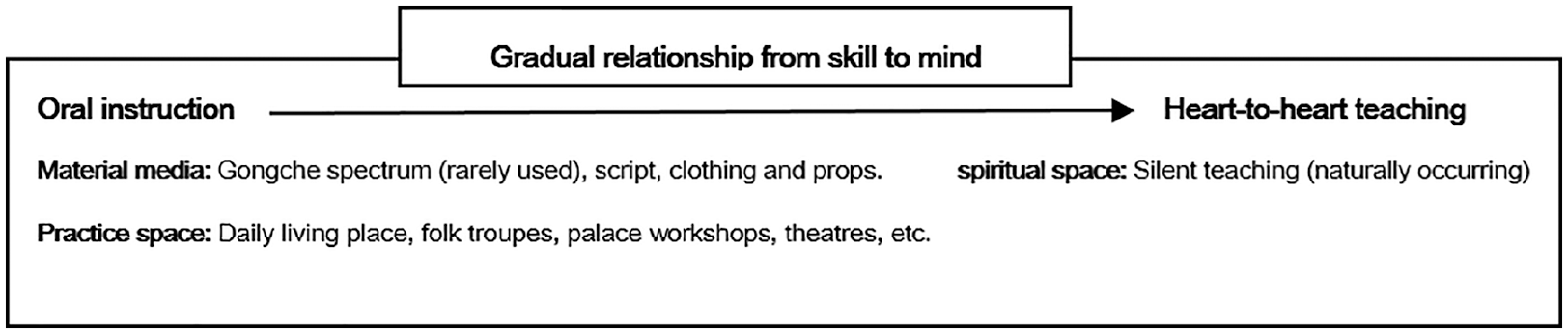
Through the observation and participation of opera classroom in primary and secondary schools in Shandong, this study combs out four opera teaching modes, and makes an empirical comparison with the traditional concept of OAHTHT and different views on its contemporary value. It is found that the ancient and modern changes of OAHTHT are not only different in the above three aspects, but also reflected in the different relationship from oral instruction to heart-to-heart teaching, which can be seen in Tables 7 and 8.
Traditional expression of OAHTHT.

Modern expression of OAHTHT.

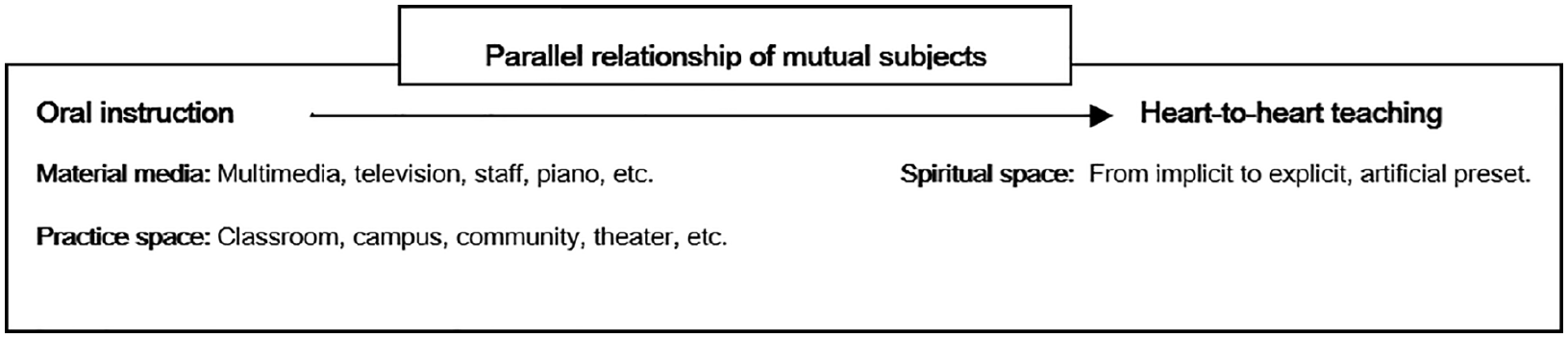
It can be seen that the relationship between oral transmission and heart-to-heart teaching is the most critical change. The old opera talent cultivation system had a rigorous path of gradual progress. Xu (1999) discussed the teaching plan of Peking Opera teachers:
Take the famous Fu Lian Cheng’ class
14
in Beijing as an example. After the apprentices go in, there are teachers who teach basic skills and also teachers who teach performances. In the latter, there are different levels: at the beginning of teaching opera, the master in charge of storytelling will teach, and later there will be a higher-level master to polish. . . To the higher-level master, it is instruction, inspiration and insight (Author notes: That is the stage of Xin Chuan).
The teaching steps of OAHTHT in traditional opera are clear and strict. A closer look at its teaching principle includes two parts: the demonstration of teachers (oral instruction) and students’ careful observation and speculation (understand by heart). Among them, heart-to-heart teaching (Xin Chuan) is not only reflected in the learning process of teachers and students passing on skills, but also in the complete process of students’ observation and practice from multiple angles. It has the meaning of a Chinese folk proverb: ‘Kung Fu outside the opera’ (功夫在戏外); it completes the process from imitation of external skills to inner comprehensive transformation, naturally and unconsciously. The key to the traditional OAHTHT is hidden in skills, but the key to the final control of skills is hidden in the mind. Among the highest-level opera masters, there is no restriction of ‘determination of rule’. At this time, we have entered the spiritual freedom described by Confucius: ‘Aspiring to the Tao, hold to virtue, based on benevolence, and seek relaxation and enjoyment in the art’. 15 (Analects of Confucius · Shuer).
In modern classrooms, due to the limitations of teachers, OAHTHT no longer have a loosely defined relationship, but as a teaching strategy, they appear at the same time, such as imitation, singing, group performance, teacher–student Q & A and situation creation, etc. The method of Xin Chuan has evolved into a spiritual interweaving and emotional resonance between teachers, artists and students at a certain time; it has become an instant spiritual memory. Currently, the time and space of OAHTHT no longer have the diachronic development of experience accumulation, but a synchronic existence.
However, we also see that, although so many changes of OAHTHT have taken place in the modern classroom, its function has not changed: the common language and cultural identity of the Chinese people. On this basis, with the participation of artists, a new form of campus children’s opera performance is being born, which can be seen from the construction process of student opera troupes in six pilot schools in recent years. 16 Certainly, due to the limited research conditions, this paper still has some limitations: Can the six schools selected in this study represent the overall level of Opera Education in Shandong Province? Does OAHTHT exist in villages, communities, folk associations and social music education institutions in different geographical environments in China? If so, how has it changed from the past? What is the difference between folk opera inheritance and school opera inheritance? These problems need to be further explored in our future research.
