



Abstract
This article maps the journey of the intimate companionship between a concubine and a Rajput ruler—Gulabrai and Vijay Singh, respectively—in the late eighteenth-century kingdom of Marwar in western Rajasthan. Based on hitherto unexamined local evidence, the article explores the ways in which a bond of friendship was constituted and unfolded in the everyday spheres of interaction between the concubine and the ruler. By turning attention to their evident emotions, such as of grief, trust, loyalty and love for each other, and shared partnership in spheres of religion and administration, this article suggests that friendship co-existed and overlapped with other forms of attachments in the overtly hierarchical relationship between the concubinage partners in focus. To emphasize the distinct form of this intimate companionship, the article also takes note of other forms of friendships that were centred on the agency of the concubine in the Rajput polity, and, in this way this article advances on the limited historical knowledge on concubinage in Rajput households and opens the possibility of including cross-sex associations in the discourse on friendship in early modern South Asia.
According to one of the letters in the Maratha patravali, on the night of 10 July 1793, Vijay Singh, the Rathor ruler of Marwar in the western state of Rajasthan, having just learnt about the cause of the death of his paswan (concubine) Gulabrai, approached two personal sevika (servants) of Gulabrai and repeatedly asked them: uski kaise hatya ki (‘How was she killed?’). 2 The ensuing conversation, in which the king learned the details of her assassination by some Rajput sardars (nobles) during his absence from the capital of Jodhpur, continued until midnight, when the ruler seems to have caught a high fever and passed the rest of the night in a state of unconsciousness (murchit). The following 4 days saw a further deterioration in his health and on 14 July 1793, a year after Gulabrai’s murder, Vijay Singh expired. 3
For 25 years of his four-decade-long reign, Vijay Singh (1752–93) shared a close association with his concubine Gulabrai. Sources from the period high-light, if most with an apparent abhorrence, that in the last decade of his reign, Vijay Singh developed a particularly intimate companionship with Gulabrai. Their intimacy, well known at the court, ultimately formed the underlying reason for Gulabrai’s murder, an event soon followed by the death of the ruler, whose illness, sources attest, was exacerbated by the grief from the loss of his concubine. 4
What are we to make of this attachment, one crossing the boundaries of friendship and concubinage? And how should we understand this grief at the loss of a concubine? What meanings could terms such as paswan denote in the regional courtly context? Grappling with such questions, this article explores the contours of the intimate companionship between Gulabrai and Vijay Singh. In the limited historical attention that concubines have received in studies on Rajput households, Gulabrai has nevertheless found a central place. 5 Descriptions of her have, however, been limited to statements on the political authority she wielded, which has most often been read, in the tone of Rajput court chroniclers themselves, as the undue or unexpected influence of a concubine over the ruler. A large part of this results from a neglect in fully understanding the nature and duration of the relationship between Gulabrai and the ruler, which would reveal a deeper context for Gulabrai’s significant role in the state administration. In order to shed light on this neglected association, this article pieces together passages from different Rajput khyats (court chronicles) that have so far been either ignored or read in isolation, along with a range of hitherto unexamined local Marwari sources including a letter authored by Gulabrai herself. The central objective of the article is to bring forth the ways in which friendship was constituted and unfolded in the intimate association between the concubine and the ruler in the spheres of spirituality, politics and emotions. The article distinguishes this association from the modes of formal friendships as they unfolded in and across elite Rajput households. While following the association of the concubine and the ruler, this article also highlights, where possible, other friendships and associations established by the concubine in various spaces of hetero-social interaction in the Rajput polity. The intention in doing this is to open our analytical perspectives on friendship to include cross-gender relationships, partly to correct the overweening tendency to view friendship only in the context of homosocial spaces in the South Asian past. 6
Concubinage at the Rajput House
It may be prudent to begin with a brief introduction to the forms and structure of concubinage as it prevailed in Marwar during the eighteenth century. As is well known, in the elite polygynous Rajput households of Rajasthan, apart from the Rajput ranis (queens) who were the formally wedded wives of a ruler, the rulers also maintained conjugally oriented relationships with concubines who were drawn from relatively inferior and non-Rajput castes 7 . Like the general hierarchical order of court societies, the elite Rajput households maintained a hierarchy in the ranks of concubines. In this system, the category of women denoted by the term khawas was lowest, followed by those known as pardayat and finally those women referred to as paswan occupied the highest ranks among concubines. 8 The difference between a khawas from the upper categories was the lack of formal announcement as a concubine though the title was often used interchangeably with that of a pardayat.
On the other hand, as indicated by Varsha Joshi, if a Rajput ruler decided to take a woman from the group of household servants (davri, badaran) or from the clique of personal entertainers (gayan, olganiya, talimvali) or rather still any woman from an ‘inferior’ caste as his pardayat, this was declared through an initiation ceremony. 9 In the ceremony, every new pardayat was provided with a chura (ivory bangles), an independent quarter in the janani deorhi (the space reserved for women in elite Rajput households), the right to wear gold (sona) on the feet and the right to wear ornaments made of emerald (panna), diamond (hira) and pure gold. 10 An important ritual element of this ceremony was the distribution of money and other material gifts (bhet) by the royal house to members of religious communities and the presentation of a token of money (nichrawal) to the new concubine by the members of the royal house, both of which were symbolic means of gaining sanctification and acceptance for the pardayat in the household and the wider society. 11 This set of initiation rituals, even though distinct from the customs of the formal marriage ceremony, served to establish a ‘wife-like’ status and image for the concubine, while the title of pardayat that was prefixed to the names of concubines, besides other social differences, formed an important marker to emphasize their distinct and inferior conjugal status compared to that of a queen, the distinction between the two being fundamentally premised on the social hierarchy of their caste affiliations.
Higher in the ranks of the concubines was the status of paswan. This term, so far read merely as one among the formal categories of concubines by historians, held deeper implications. To begin with, in contradistinction to the term khawas—composed of two root words kha, ‘to eat’, and was, ‘house’, thus literally denoting a servant who could ‘eat in the [elite] house’—and the term pardayat—composed of the root words parda, or ‘veil’, and yat, ‘within’, thus meaning ‘within the veil’ implying that the woman was ‘taken in the protection by the ruler’—the term paswan derived from the word pas, ‘to be close’, and the prepositional suffix wan, ‘to’, giving the sense of being ‘close to’ or ‘intimate’ with the ruler, invoking the notion of close companionship. 12 By the virtue of this status, paswans gained not just the rights to greater proximity with the ruler but also a superior financial position. In Marwar, the title of paswan was in fact also conferred upon a small circle of personal (niji) male servants (chakar, also known as khawas) of the ruler who, as Vasumati Sharma informs us, were chosen from select Kshatriya castes, such as Khichi, Dhandal, Padihar and Gehlot. 13 In addition, the sons of concubines, as Ramya Sreenivasan has pointed out, were also often among those included in the close circle of male paswans of a ruler. 14
Beyond the criterion of caste, it is unclear what process, if any, was used for the selection of male paswan. Records, however, reveal that the conferral of the status of a paswan to a female could not be based on the desires of the ruler alone as it also required the consensus of court officials. 15 While there is no evidence to confirm the reasons for this seeming requirement, it appears that a declared attachment by the ruler to a female from a relatively inferior background needed to suit the court’s sensibilities—and these sensibilities were not always easily accommodated. In one important case from the late nineteenth century, we see that despite the desire of Jaswant Singh II (1873–95), the king was not able to declare his pardayat Naini as his paswan due to the fear of rejection by members of the court. 16 His anxiety arose from the fact that Naini hailed from a local community of public performers (bhagtan), and attachment to a public performer was always despised by the elites of a Rajput household. 17 In sum, in the Rajput household—a political space composed of multiple agents—caste and community was clearly deemed an important element in the formation of the intimate circle of even the putative head of the house, the king himself.
Personal emotions were, however, implicit in the formation of categories such as the paswan. It should be noted that the Marwari records—whether telling us of the choice of the ruler or the rejections by the court— mention female paswans very rarely and one does not find evidence of a paswan in the reign of every Rathor ruler, and unlike the large number of other categories of concubines and other female associates of every king, there is no evidence of more than a single paswan for any one ruler. 18 However, in the case of Gulabrai, despite her official designation as a paswan, her association with Vijay Singh needs to be understood primarily as an interpersonal companionship that developed amidst the other processes at work in the Rathor state. I say this also because, going by evidence, the ruler and the concubine seem to have cemented their bond much before Gulabrai was conferred with the official status of being Vijay Singh’s paswan.
Shared Affiliation in the Sacred Domain
Gulabrai entered the Rathor house in 1766 as the result of some form of an unstated exchange or perhaps as a ‘gift’ from a local household in Jodhpur. 19 Information about her natal past, like that of most other concubines, is not available in the records of the Rajput household. 20 Marwari khyats, however, tell us that Gulabrai was from the Oswal (Jain) caste. 21 Within the Rathor house, Gulabrai began her career as a gayan (singer), then taking up the role of a concubine, first as a khawas and then a pardayat. 22 In 1774, 8 years after she entered the house, Gulabrai was conferred the status of Vijay Singh’s paswan. 23
Evidence relating to Gulabrai’s early life in Rathor house remains sparse, particularly before she was announced as the paswan of the ruler. Some evidence, however, brings to light significant information about her association with the ruler in the early period. For instance, evidence reveals that the year that Gulabrai entered the Rathor house, she travelled with Vijay Singh in his pilgrimage to Nathdwara, an important Vaishnava pilgrim site in western Rajasthan. 24 Significantly, in the same year, Vijay Singh formally joined the Vallabha Sampraday (sect) at Nathdwara, though it is not clear if he accepted this affiliation in the same journey in which he was accompanied by Gulabrai. 25 However, according to the evidence, Gulabrai also became an ardent devotee of the religious sect, and both the ruler and the concubine together undertook another significant and extended pilgrimage to Nathdwara in 1767. 26 These travels and shared spiritual beliefs seem to have been an important binding factor in their relationship.
It is significant that the Vallabha sect to which the ruler and the concubine were affiliated maintained a distinctive non-ascetical demeanour, laying emphasis on egalitarian values and on companionship and the emotion of friendship (saakhya bhav) to the Lord as an important form of service (seva) to him. 27 This notion of friendly bonding also created ‘lateral’ solidarities and intimacies among devotees of different social status. For instance, besides seeming to have played an important role in structuring the companionship between the ruler and the concubine—more on which will be highlighted in subsequent pages—this religious affiliation allowed the ruler and the concubine to form significant associations with other community members. By associating with the sect, for example, Vijay Singh was able to establish close contacts with a cohort of royal devotees from neighbouring Rajput kingdoms and with the wealthy mercantile community, who became enthusiastic devotees of the Vallabha sect. 28 On the other hand, numerous short notes in the arji bahis (record books with request notes and letters of household members) reveal that Gulabrai regularly sent offerings (bhet) in cash and kind to the local Balkrishna temple that was sponsored by Vijay Singh in Jodhpur and, through an exchange of notes regarding the bhet, Gulabrai seems to have developed a friendly bond with the religious head (mahant) of the temple. 29 This is apparent from the fact that in her notes to the mahant, which were supposed to be merely lists of the amounts and products of offerings sent to the temple, Gulabrai also conveys personal messages—asking about his health and happiness, fondly remembering previous meetings, expressing her gratitude for receiving a ‘favour letter’ (kripa patra) and conveying information about her travels to him.
The spiritual sphere also allowed Gulabrai to form some of her most lasting political associations. A salient example of this is the pilgrim journey undertaken by her in 1773 to the city of Haridwar in north India. 30 In this journey, Gulabrai was accompanied by an important noble named Singhvi Bhimraj, besides a large coterie of other male and female chakars (servants). This entourage is particularly significant because it was soon after this journey that Gulabrai earned the status of paswan. 31 The conferral of this status, as mentioned earlier, involved gaining the consensus of important court officials and Singhvi Bhimraj formed an important part of that circle. Moreover, records reveal that after the journey of 1773, Gulabrai frequently consulted Bhimraj on various administrative matters, and in a later period, when Gulabrai gained a significant voice in the administrative decision-making of the state, one of her first efforts was to facilitate the allotment of the post of Bakshi, or chief military officer in the central administration, to the son of Bhimraj, one Akhairaj. 32 Bhimraj also remained the travel companion of the concubine in her pilgrim journey 6 years later in 1779 to religious centres in Kota and Jaipur. 33 In the elite Rajput household, religious activities such as pilgrimage journeys, even if primarily undertaken for spiritual gratification by the household members clearly also provided important opportunities for women and men to travel together, interact and form associations of friendship, that could be both durable and useful, in the otherwise relatively limited interaction between the two genders.
Religious affiliations could often take very public and permanent expression in the form of temples and other religious monuments. These monuments, however, could also serve to sanctify, express or emphasize particular relations and bonds between the community of devotees. An important example of this is the Kunjbihari temple, commissioned by Gulabrai in Jodhpur that was completed in 1778 (by this time she had already been conferred the status of a paswan). 34 On the ceiling of the mandapa (gathering hall) of the temple is a painting depicting Vijay Singh and Gulabrai that seems to be declaring their adherence to Vallabha sect or the Pushtimarg (the path of grace). In this illustration (Figure 1), the ‘holy cow’ clearly takes the imagery of leading its protector, namely, the ruler, on the path of grace, while the concubine takes the place as a close companion of the ruler in this spiritual journey. 35 This important painting is clearly redolent with both political and emotional significance.
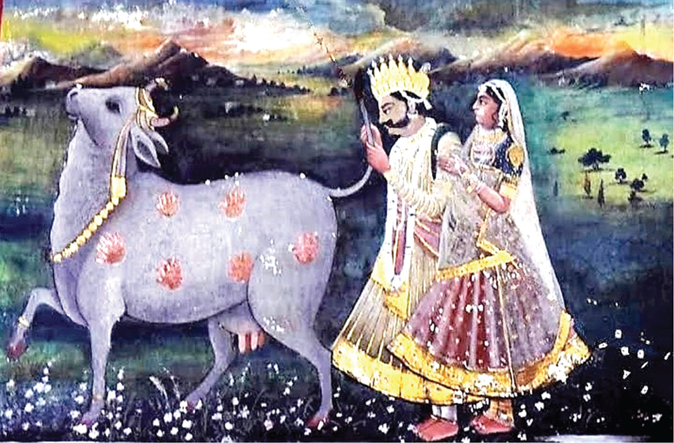
At one level, the painting serves as a clear announcement of the role of Gulabrai in the promotion of the state religion. At the same time, the bodily proximity between the ruler and the concubine, in the painting, also represents the social closeness shared between the two and reflects an intimacy that was bound up in the religious sphere. Interestingly, despite an implicit hierarchy evident in the horizontal arrangement of the painting (with the cow leading the ruler, who is followed by the concubine), the three are knit together by the touch of hand. Perhaps the touch of Gulabrai’s hand on the shoulder of the ruler is intended to symbolize the ‘supporting hand’ of the close companion that Gulabrai came to be as his paswan.
Routine Display of Friendship and Political Process
After Gulabrai acquired the status of paswan to Vijay Singh, the attachment between the two occupies a prominent place in the records. 36 For instance, it is evident that, with the increased financial resources that her new status brought, Gulabrai sponsored a separate palace (mahal) in 1775. 37 Named ‘Mahilabagh’ (lady’s garden), its layout was interlaid with numerous gardens (bagh) and a jhalra (large step tank). 38 According to Rajput court histories, Gulabrai shifted from the Rathor fort to this palace after a verbal altercation with one of the queens, Shekhawati Maharani, in 1777. 39 It is difficult to confirm the veracity of such narratives but entries in the haqiqat bahi, or the records of everyday happenings in the realm, reveal that from this period, Vijay Singh began to reside with Gulabrai in Mahilabagh clearly reflecting that his inclinations for Gulabrai superseded those for his queens and other women of the main household. 40
The development of such attachments with a concubine was, however, not an uncommon event in polygynous Rajput households, presumably because marriage relations were mostly premised on or were a part of explicit political alliances. Moreover, as the queens maintained strong natal affiliations, they were always connected to various political ambitions, and marital relations were first and foremost directed towards procreation as a seal of alliance rather than companionship. On the other hand, most women who had the status of concubines entered the Rajput households either as gifts or in conquests, exchanges and captures. 41 Such circumstances effectively delinked these women from their kin bases and communities. The practice of re-naming such women implicitly recognized this ‘social death’ and further distanced them from their natal families and earlier associations. 42 This forced ‘detachment’ of concubines from their previous social lives, when compared to other agents in the court and household, seems to have made them all the more appealing to rulers. Indeed, many, if not all, concubines, unlike wives, were partners of their choice. Furthermore, concubines were free from the entanglements and complexities of succession politics as their sons were disenfranchised from claims to the Rajput throne. These conditions, I would maintain, created a general emotional inclination or predisposition towards the building of certain types of close intimacies on the part of rulers with these women. Such conditions, however, did not preclude or rule out the agency or deployment of concubines in the political affairs of the court.
In fact, even though the progeny of concubines were excluded from the lines of royal succession, they nevertheless served as an important medium through which networks and alliances were established and sustained across elite Rajput houses. For example, at the time when Gulabrai was conferred the status of paswan, Marwar was preparing to confront the Marathas, to whom they had lost the territory of Ajmer in 1756. 43 To this end, Vijay Singh attempted to establish diplomatic ties with the Kacchwaha ruler Sawai Pratap Singh of Jaipur. The relations between the Rathors and Kacchwahas, which had been strained in an earlier period, were rebuilt through an oft-cited series of matrimonial alliances. So Vijay Singh’s granddaughter, Abhai Kanwar, was married to Pratap Singh, ruler of Jaipur in 1779. 44 To reciprocate this arrangement, Gulabrai’s only son Tej Singh (b. 1678) was married to the daughter of a khawas of Sawai Madho Singh, father of Pratap Singh. 45 In Marwar, as in the other ruling Rajput households of Rajasthan, the progeny of concubines were permitted to be married only with a member of a ‘same-status’ group from another Rajput house. 46 Such marriage contracts, just like those of the queen’s children, formed an important medium through which alliances or formal friendships were cultivated between elite households in Rajasthan. These forms of friendships spanned and overlapped into relations of kinship and were accompanied by prominent rituals of gift-giving that were often completed by the concubines. For example, to seal the wedding of her son Tej Singh with the Jaipur house, Gulabrai presented numerous gifts to Maharaja Pratap Singh as a part of the traditional Rajput ritual of sala katari, a custom in which the sister/mother of the groom presented gifts to the bride’s brother as an obligatory exchange for taking his sister in marriage. 47
Gifts also served as symbols of continued amity in relations established between houses. 48 For instance, records from the early nineteenth century reveal that friendly relations between the Jodhpur house and the thikana (estate) of Sikar were established by the Rathor ruler Man Singh (1803–43) by way of conducting the marriage of Bhabhut Singh (son of Man Singh and pardayat Chota Rupjyot) with a daughter of a concubine of the ruling head of Sikar, and as part of this association, the Rathor house received several horses and elephants as gifts from Sikar. 49 Similarly, 13 years later, at the wedding of Bhabhut’s son, numerous gifts were again received by the Rathor house from Sikar as part of the mayra or the ritualized presentation of gifts to the family of groom from the household of the maternal uncle. 50 It is important to note here that even as formal friendships between elite houses were often established and sealed through marriage alliances, with the two houses becoming permanent affinal relatives, the sustenance of the alliance nevertheless depended on a continued nurturing of the bond, whether through material gifts or other forms of reciprocation.
On the other hand, even though material gain was an implicit benefit of Gulabrai’s relationship with Vijay Singh, their interpersonal bonding is however distinct from formal friendships in both its intensity and its emotional reciprocity. To elaborate, records reveal that in March 1785, 6 years after his marriage, Tej Singh, Gulabrai’s only son, died. 51 According to Marwar Ri Khyat, Gulabrai was heartbroken at this incident and her continued sadness (udasi) prompted Vijay Singh to subvert the customary Rajput restriction on cross-class adoptions by allowing, in June 1785, the formal adoption (khole baithe) of his prince (kunwar) Sher Singh by Gulabrai. 52 This adoption, however, did not sit well with the court circles of the Rathor house. Their anxiety was further intensified as Gulabrai began to wield increasing authority in the state administration from this period. As per records, her authority extended from advocating re-allotment of administrative posts to taking command of tax collection in the kingdom. 53 Going by the evidence, such involvement in the administrative matters was in reality a consequence of her continued commitment to the ruler. A significant letter in the Marathi patravali, for example, reveals that before Vijay Singh and his Jaipur ally defeated the Marathas in the Lalsot campaign of 1787, the Rathor ruler had found that his most trusted and senior noble, Gordhan Khichi, along with several other courtiers, was spying for the enemy. 54 The letter states that the kingdom of Jodhpur had been compromised by immense distrust, cheating (chhal kapat) and conspiracies (prapanch). 55 In these circumstances, however, Gulabrai’s loyalty was deemed to be unsullied, with the image of her being solely devoted to the ruler. In another instance, when Scindia again waged a war on the Rajput armies in 1790, under the threat of the Maratha attack at Jodhpur, the members of the Rathor house were shifted to Jalore for safety but Gulabrai refused to go with the others, staying by the side of Vijay Singh. 56 It was perhaps owing to this loyalty that the ruler also demonstrated increasing trust in her administrative involvement evident also in the fact that, after the final settlement with the Marathas in January 1791, in the savan (July/August) of the same year, Vijay Singh gave to Gulabrai an exceptional patta (land deed) comprising the huge jagir (landed estate) of Jalore. 57 While the land grant was conferred for the hath kharach or personal expenditure of Gulabrai, it should be noted that Jalore was a pargana (territorial unit) that comprised 457 villages and the grant of this large share from the sovereign lands would not have been relinquished without the utmost trust and confidence on the part of the ruler towards his paswan, on both a personal and an administrative level. 58 Indeed, she was deemed competent and reliable to independently supervise the administration of a substantial portion of state land that essentially remained the property of the state since Rajput polity did not allow women to bequeath their jagirs to their children or to others. 59 It is, however, significant that, according to available land records from Marwar, this was the first ever land grant to a concubine in the Rathor house—a practice which later became customary. 60
The growing bond of confidence between the ruler and Gulabrai, however, was not without its fault-lines. One Marathi patravali notes that at one point, when Gulabrai had begun to wield substantial command in state affairs, not just the nobles but even Vijay Singh himself became uneasy of her increasing command in administrative matters, apparently expressing his concern to one of his male courtiers. 61 According to the administrative involvement, Gulabrai learned about this incident and after consulting the group of ‘her’ circle of trusted courtiers, she decided to secure the throne for her adopted son Sher Singh in order to protect her political position. Amidst this phase of friction between the ruler and his concubine, it is however significant that soon after, when one of Vijay Singh’s cousins, Prithvi Singh, came to meet the ruler and, displeased over his land confiscation, attempted to wound Vijay Singh, the latter was comforted by none other than Gulabrai. 62 Perhaps with this revived compassion, in the same year, much against the wishes of the nobles, Gulabrai requested (araj) Vijay Singh to nominate Sher Singh as his successor over the more senior heir, Zalim Singh. 63 That Vijay Singh supported Gulabrai’s proposition over the nobility—who were supporting the claims of one of Vijay Singh’s grandsons—is again a reflection of the trust invested in the advice of his concubine, especially when one takes into account the evidence from Marathi patravali according to which the eldest prince of Vijay Singh was never seen as a serious contender for the throne due a perceived ‘indolent’ nature, ensuing in a fratricidal conflict that had taken over Marwari politics even before Gulabrai proposed her nomination of Sher Singh. 64 That the ruler was in complete command of his affairs, and did not merely function under the alleged ‘influence’ of Gulabrai as is projected in some Rajput court chronicles is fact that Vijay Singh did not pass the throne immediately to Sher Singh, but only pronounced a proposal in favour of the latter as his successor. 65 This announcement, however, ruptured Vijay Singh’s erstwhile ‘friendly alliance’ with the house of Jaipur and other Rajput houses who accused him of setting a bad example for future generations by choosing the ‘son of a concubine’ as his successor. 66 The nobility also turned against him, and, joined by other hostile groups, they waged an armed protest against the state.
According to evidence, to contest this faction, Gulabrai, with the help of her religious and political connections, was able to gather a contingent of 500 ascetics (bairagi) and 2,000 Rajput horsemen (sawar). 67 At Bahali, in the Alwar district of Rajasthan, a battle took place between the two factions, which ended in the defeat of Gulabrai’s forces. 68 The nobles, spurred by their success, encircled the perimeter of the capital city and to pacify the situation, Vijay Singh moved out of Jodhpur, but in his absence, one of his grandsons (Bhim Singh) seized control of the fort, and a group of nobles, while escorting Gulabrai out of her mahal, murdered her on 16 April 1792. 69 Vijay Singh was able to enter the capital after about a year on 20 March 1793, and on learning the news of Gulabrai’s murder, he was stricken with grief, became ill and died shortly afterward. 70 While the assassinators of Gulabrai had managed to escape from the capital city after her murder but before his death, Vijay Singh seems to have reiterated her desire to enthrone her adopted son, Sher Singh, though this was disapproved by his court circles. 71
The political domain in late eighteenth-century Marwar was clearly a volatile one. In the courtly realm, associations, alliances and formal friendships did not always last, as loyalty and trust—the hallmarks of friendship—were most often situational and shifting. In the arena predominated by men, when a ruler developed an affinity, comfort or confidence in a female, it became a matter of great anxiety for the court society as a whole. The Rajput household was, after all, a patriarchal structure. In the midst of this, however, we have seen how a relatively sustained relation of trust and compassion confidence (not without material implications and political frictions) unfolded in the quotidian but nevertheless remarkable interaction between a monarch and his concubine. The evidence overwhelmingly demonstrates the emotional attachment that Vijay Singh developed with Gulabrai. Her emotions, however, remain largely veiled in the state records, which is perhaps why her relationship with the ruler has been misunderstood as her dominance over him. Fortunately, one extant but hitherto obscured letter (chitti) of Gulabrai to Vijay Singh brings to light the matters of her heart, to which I turn next. 72
Gulabrai in ‘Her’ Own Voice
Letters by women (janani chittiya)—including the letters of concubines, female subordinates and queens—begin to appear in the Rathor archive from the middle of the eighteenth century. The reasons for this seemingly sudden appearance of written letters may have been the result of the widespread availability of kagad (paper) in the Rajput kingdoms during this period. 73 This seems to have allowed women to document their concerns, emotions and lived experiences on more permanent materials, displacing the reusable pattis or slates that had been in use by women in the earlier periods to convey their messages in Rajput households. 74
It should be pointed out that even though an elementary education was imparted to women in Rajput jananas, there is no evidence to confirm if writing formed a part of this curriculum, and even though the nature of writing in some of the shorter available letters suggests that these could have been attempted writings of women themselves, more elaborate letters, such as that of Gulabrai, were almost certainly composed with the help of male scribes. 75 Moreover, Gulabrai’s letter, like those of other concubines, is not accompanied by a seal or any mark indicating it was once sealed. Letters like this one were perhaps rolled and tied with threads before being passed on for transmission. It is however not clear how these letters, particularly those of concubines, were dispatched to the king, though it is likely that the concubines’ own personal female servants (davris) conveyed them to male servants (chakars) who delivered them to the rulers. Judging from their ornate style, the letters were likely to have been read aloud to the ruler (rather than studied privately), after which they seem to have been preserved in an official file earmarked for the letters received by a ruler from women in his janana the form in which they have come down to us.
Before we turn to the contents of Gulabrai’s letter (see the original in Appendix I), it should be noted that, like the other letters of concubines, Gulabrai’s letter is without a date, and therefore we cannot be certain at which point of the association with the ruler it was written. Yet its contents reveal a seemingly already-established affinity, affection and intimacy, suggesting that it was not composed in the early years of the relationship. Significantly, no less than one-third of her letter professes admiration for the ruler, expressed through a myriad of poetic metaphors:
76
Presenting greetings decorated with beads and corals, Oh respected Master. 1008 [symbol of reverence]. Oh Great King over Kings, Lord over many Kings, King of the whole of Hindustan. [You are] the best decoration of the palace, master with abundant female admirers, pure as the moon, pure like beads, charming like gold, bright like silver, profound like the ocean, pure like the Ganges, the moon in the centre of the stars, Krishna among the gopis, [missing letters] among flowers, the support of the servant Gulabrai’s life. [You are] incomparable in facial beauty, singer of virtues, [You are like] the excitement of the heart, the crown of the forehead, decoration of one’s head, [You are the] basis of [my] existence, happiness in the world, the pleasure of a decorated bed, the spark of the eyes, [You are] master of control, a fascinating saint, the herb of life, the frame of heart, the peacock of the heart, a thief of thoughts, a garland of the heart, a garland of fragrant flowers, the precious seed of a valuable herb. Oh respected master, Oh beloved, Oh respected master! Oh joyful lover, flamboyant, free-spirited husband! [You are like] Indra among the Gods, Vikramditya among the rulers, Harishchandra among the truthful, Gorakhnath among all intelligent, Shesha among snakes, a wishing-tree among trees, Ujjain among cities. [You are the] master of intelligence, ornamentation of bangles, the pearl of the hanging nose-ring. [You are] Shiva of Gauri. [You are] steady like the earth, heavy like a mountain, strong as one who can stop a sea wave, shrewd like Chanakya, committed like Bhishma, obedient like Lakshmana, virtuous like Bharata, strong like Bheema, a protector of cows and Brahmins, devoted towards [parents] like Shravan, devoted to God like Prahlada, devoted to his teacher like Ekalavya. Oh Prosperous master of Marwar, master of Jodhpur’s nine forts, proficient successor of the Rathor clan, master of valiant Rathors and brave warriors, at your beautiful feet [with] folded hands [I] bow my head [and] present abundant greetings.
As conventional or hackneyed as these tropes might seem, it is important to keep in mind that eulogistic convention, though highly formalized, could nevertheless serve as an important medium for the expression of genuine feelings felt by the sender of a letter for the receiver. During his entire reign, Vijay Singh was faced with constant political hardships (hardships) and in such times, the choice of particular metaphors by Gulabrai may have served not simply to celebrate but perhaps also to inspire the ruler, as a companion might do, by comparing him to all things great, be it the prodigious intelligence of Chanakya or the famed strength of Bheema.
77
At the same time, there are also hints of romantic feeling in phrases such as ‘excitement of the heart’, ‘joyful lover’, ‘free-spirited husband’ and so on. Romantic connotations are also implicit in the next sentence in her letter where she invokes popular romantic couples whose love was proverbial, including Heer and Ranjha, Dhola and Maru, Mahival and Sohni and Mehndra and Mumal. These oblique romantic references give way in the next few lines to a direct address to the ruler, informing him of her well-being, expressing concern for his problems and offering him assistance to overcome his difficulties:
By your mercy, I am doing well. Day and night, morning and evening, dawn and afternoon, every moment, I request the Goddess Chamunda that she continues to shower her blessings on your health and eminence. Master, you have the abundant blessings of the Goddess Chamunda, with which you are celebrated in entire Rajputana. All your problems will come to an end [and] those who are your enemies will burn in front of your radiance. Master, this morning I received news from the fort that the enemies of your stomach are causing immense pain and that the available medicines are not reducing the pain caused by enemy, so if you grant permission, then there is an Ayurveda doctor in Pali whom I can present before you. The Goddess Chamunda will make everything fine.
In Rajput court society, the word dushmana (enemy) was often used as a trope of deference to inquire the health problems of a superior, although, given the financial problems in the reign of Vijay Singh, one may also consider the possibility that words such as dushmana (‘enemy’) and vaid (‘doctor’) were employed by Gulabrai as a rhetorical strategy to covertly hint at the financial problems caused by enemies (perhaps the Marathas or recalcitrant nobles), and perhaps to relieve this problem Gulabrai seeks permission to present a moneylender from Pali as the town was the hub of economic transactions in Marwar. Perhaps this request had to be ‘concealed’ because the transmission and reception of the letters was such that they were never entirely private, and while composing her letter, Gulabrai seems aware that her involvement in administrative matters was opposed by many in the court society. In any case, in discoursing about ‘enemies’ (shatru, dushmana) and in her concern to relieve his troubles, Gulabrai clearly takes on the persona of the ruler’s friend or a well-wisher.
These expressions of loyalty move to more passionate emotions in the next lines of the letter, which read as:
Master, when I see the male and female pigeons cooing, I remember you. I remember you so much that I lose control over my senses and I even forget about eating, drinking, covering and dressing.
Pigeons are a common reference to romantic love, whereas forgetting quotidian activities, loss of appetite and disengagement from the senses are all well-established symptoms of pining for a lover in separation. Both here and throughout the letter, Gulabrai clearly refers to memories, past intimacies and of time spent together, key elements of the conventions of love in separation that was the mainstay of the love letter.
78
A further invocation of a direct emotional connection may be found in her ‘signature’ in the closing lines of her letter:
If in this appeal there is a misplaced signature or if there has been any other mistake then (consider) me innocent, unwise, foolish dumb, dust of your feet (you) intelligent knowledgeable master. Server of your feet, Gulabi
To my knowledge, all the available letters from other court women from Marwar close with an epistolary protocol where they seek pardon for any mistake in their writing and even as Gulabrai particularly seeks pardon for any misplaced signature in the closing lines of her letter—reflecting that she was aware of the digression she was making in her letter—she nevertheless closes her letter with a signature, naming herself with an affectionate nickname which was surely known and seemingly given to her by the king.
This invocation of the ‘self’ was clearly an expression of intimacy and such ‘personal’ elements juxtaposed alongside the conventional formality in the letter suggest that even though intimate emotions were circumscribed by the rules of hierarchical interaction and patronage, this did not impede their development. In fact, we see that conventions of self-effacement and compliment actually facilitated their expression. Gulabrai’s letter shows that in the courtly worlds the emotions of friendship, love and service could overlap and co-exist as they did in her relationship with Vijay Singh.
Conclusion
The intimate companionship between Gulabrai and Vijay Singh was evidently informed and sustained by a range of sentiments including loyalty, trust, love, anxiety, concern and care that seem to have taken shape as they came to be co-religionists, sometimes fellow travellers and allies in the political sphere. That these emotions and shared activities—important mainstays of friendship—were shared between a woman and man serve to suggest that friendship was not a homosocial relation confined to male spheres. In fact, as this article highlights, in the Rajput polity of Marwar, women like Gulabrai formed varieties of sustained friendships, associations and alliances that were hardly restricted to the spaces of women alone. Moreover, both, men and women, in their bounded capacity, exercised choice and agency towards the development of such relationships and thus, even in deeply hierarchical, polygynous and patriarchal households of the past, even men and women could come to establish and share bonds of loyalty and friendship.
Footnotes
Acknowledgements
This article is dedicated to the fond memory of my teacher, guide and friend, the Late Professor Nandita Prasad Sahai. Many of the ideas presented in this article are inspired from discussions with Professor Farhat Hasan and Professor Rajat Datta. I am extremely grateful to them. I also owe a huge word of thanks to Professor Daud Ali for having me on board for this project and for closely reviewing the earlier drafts of this article. His comments and useful criticism have helped me to clarify my arguments significantly. I remain responsible for any errors.
Appendix
2
‘Marwar-Maratha Aitihasik Patravali’, trans. D.B. Chirsagar and Narayan Singh Bhati, Parampara 1, no. 93–94 (Jodhpur: Rajasthani Shodh Sansthan, 1990), 104. These letter series were written by the Maratha vakil (representative) Krishnaji Jagannath to Nana Phadnis, informing him about the day-to-day events at the Rathor house.
3
Ibid., 105. According to some Rajput chronicles, Vijay Singh died 1 day earlier, that is, on 13 July 1793. Gulabrai was assassinated in 1792. See Rathoran Ri Khyat: Jodhpur Rajya Ka Itihas: Siha Se Maharaja Mansingh (VS 1300–1900 = AD 1243–1843), ed. Hukum Singh Bhati (Jodhpur: Itihas Anusandhan Sansthan, 2007), vol. I–III, III, 656–57.
4
See, for example, Marwar Ri Khyat: Josi Tilokchand Kanha Singhvi Gyanmal Likhayi, ed. Hukum Singh Bhati (Jodhpur: Rajasthani Shodh Sansthan and Maharaja Mansingh Pustak Prakash, hereafter MMPP, 2000), 115. All translations from Marwari are mine.
5
The description, if limited, with varied interpretation on the authority wielded by Gulabrai can be seen in the works of scholars such as Varsha Joshi, Polygamy and Purdah: Women and Society among Rajputs (Jaipur: Rawat Publications, 1995), 99; Ramya Sreenivasan, ‘Drudges, Dancing Girls, Concubines: Female Slaves in Rajput Polity, 1500–1850’, in Slavery and South Asian History, ed. Indrani Chatterjee and Richrad M. Eaton (Bloomington: Indiana: Indiana University Press, 2006), 146–47; Kiran Shekhawat, Janani Dyodhi (Jodhpur: MMPP, 2013), 63; R.P. Kathuria, Life in the Courts of Rajasthan (New Delhi: S. Chand, 1987), 235; Padmaja Sharma, Maharaja Man Singh of Jodhpur and His Times (1803–1843 A.D.) (Agra: Shiva Lal Agarwala, 1972), 26; Vasumati Sharma, ‘Jodhpur ke Rajwansh ki Janani Deorhi’, Rajasthan Bharti, Part I (Jodhpur: Scientific Publishers, 1995), 165–71.
6
Apart from the limited historical attention to the theme of friendship, there has been an evident hesitation to include friendship in relationships shared between men and women in the past. Indeed, such friendships were not common or ubiquitous, given the limitations imposed by the patriarchal structure, but to completely negate its presence is historically unviable.
7
As highlighted by Varsha Joshi (Polygamy, 119), a Rajput ruler could not take women from Brahmin community as concubines nor could they actually take women from this caste in marriage, which was a standard north Indian practice of restricting hypogamous marriages. Women from ruling Rajput clans were also not to be initiated as concubines, a method practised to maintain the superiority of their lineages. On the other hand, women from social groups ranked lowest in society were not taken as concubines by Rajput rulers. The women who became concubines were thus drawn mostly from secondary social castes, such as Gujar, Oswal, Ahir, Jat, Mali, Kayasth, Darji and Vaisya. In addition, records, particularly from the seventeenth century, reveal the presence of Muslim women as concubines in some Rajput houses, and in one rare instance, a woman from an inferior Rajput caste was also taken as a concubine in the early eighteenth century by Ajit Singh (1707–24) of Marwar. For details on the concubine of Ajit Singh, see, Rathoran Ri Khyat, II, 430.
8
Marzia Balzani and Varsha Joshi, ‘The Death of a Concubine’s Daughter: Palace Manuscripts as a Source for the Study of the Rajput Elite’, South Asia Research 14, no. 2 (1994): 154.
9
Joshi, Polygamy and Purdah, 119–21.
10
Ajitvilas, ed. Shiv Duttdan Barhat, in Rajasthan Puratan, ed. Padamdhar Pathak (Jodhpur: Rajasthan Oriental Research Institute, hereafter RORI, 1984), 202. Lesser-ranked servile groups of females were permitted to wear ornaments that were only partly made of gold and mixed with either silver or other stones.
11
For example, see Maharaja Shri Bhim Singh Sahib Ke Raj Mein Bahi, no. 840, letter 41, VS 1851–53/1794–96, MMPP (Jodhpur).
12
I am grateful to Dr Mahendra Singh Tanwar, Research Officer, Mehrangarh for helping me to discern these meanings.
13
Vasumati Sharma, Rathore Rajwansh Ke Riti-Riwaj (1600–1850) (Jodhpur: MMPP, 2012), 42.
14
Sreenivasan, ‘Drudges, Dancing Girls, Concubines’, 153. Sreenivasan has also stated that khawas paswan was a term of identification for the sons of concubines but there is no evidence to support this interpretation. According to the archival records of Marwar, the sons of concubines were primarily referred to by the term bhabha (lit. ‘big brother’) until the mid-nineteenth century, and with administrative changes introduced by Takhat Singh (1843–73) from the mid-nineteenth century onwards, the bhabhas were conferred the title of Raoraja. For details, see P.R. Shah, Raj Marwar during British Paramountcy (A Study in Problems and Policies up to 1923) (Jodhpur: Sharda Publishing House, 1982), 191.
15
Chetan Chouhan, ‘Sthapatya Kala Ki Bejor Kriti: Nainibai Mandir’, Rajasthan Patrika (Jodhpur Circle), 11 April 1996, 10.
16
Ibid.
17
For another example, in early nineteenth century, Chattar Singh (1816–18) had retained a bhagtan named Sajni for his personal service, which records inform us led to severe protest in the court circles. See Maharaja Man Singhji Ri Khyat, ed. Narayan Singh Bhati (Jodhpur: RORI, 1979; 1997 reprint), 114.
18
See the table listing the evident names and categories of concubines in Marwar, in Priyanka Khanna, Half-Wed Wives: A Study of Concubines in the Rajasthani Kingdom of Marwar, c. 17th–Mid 19th Centuries, PhD thesis (Jawaharlal Nehru University, 2016), 47.
19
Rathoran Ri Khyat states that Gulabrai was a badaran (head servant) in the household of a man named Bhurat Argadram before she entered the Rathor house. Rathoran Ri Khyat, III, 665. Marwar Ri Khyat on the other hand states that Gulabrai was a gayan (singer) who resided with a singer named Nirat Sundarji and a nazr (eunuch) named Arandram acted as a mediator in bringing Gulabrai to the Rajput house. Marwar Ri Khyat, 58.
20
For details and discussion on the ancestry of ‘some’ concubines, see Khanna, ‘Half-Wed Wives’, 38–45.
21
According to some scholars, Gulabrai hailed from the Jat caste. For example, see V.N. Reu, Marwar Ka Itihas (Jodhpur: MMPP, 1999), vol. 1, 390.
22
Rathoran Ri Khyat, III, 665, amongst other sources. In some of the bahi records from the early reign of Vijay Singh, Gulabrai is titled as a pardayat as well as a khawas. See, for example, Jodhpur Haqiqat Bahi, no. 2, VS 1821–30/1764–73, Rajasthan State Archives (Bikaner) (hereafter RSAB).
23
Rathoran Ri Khyat, III, 665. Marwar Ri Khyat (p. 69) places this event at 1773. I have stuck to the evidence from the former source as it is considered a more reliable chronicle in terms of dates.
24
Marwar Ri Khyat, 60–61.
25
Vallabh Sampradaya was founded by the Vaishnav saint Vallabhacharya (1479–1531), a Telugu Brahmin from south India, around the mid sixteenth century. Vallabhacharya and his devotees spread the religion and devotion (bhakti) to Lord Krishna throughout northern India, especially Gujarat and Rajasthan. For details, see Richard Barz, The Bhakti Sect of Vallabhacarya (Delhi: Munshiram Manoharlal, 1992). For the date of Vijay Singh’s formal initiation in Vallabh sect, see G.H. Ojha, Jodhpur Rajya Ka Itihas (Jodhpur: Rajasthani Granthagar, 2000), vol. 2, 717–18. Records on the reign of Vijay Singh reveal that, as part of his religious affiliation to the Vallabh sect, the ruler passed injunctions throughout his kingdom outlawing cow slaughter and consumption of meat and alcohol, built majestic Krishna temples and donated food for temples, in festivals and provided gifts for the temple priests. His religious patronage extended beyond Marwar’s borders and he began to be recognized as an ardent devotee of Vallabha temples and festivals across Rajasthan.
26
For evidence on Gulabrai’s religious allegiance, see Reu, Marwar Ka Itihas, vol. 1, footnote 2, 390.
27
For details on these aspects, see Richard Barz, The Bhakti Sect of Vallabhacarya (Delhi: Munshiram Manoharlal, 1992).
28
For details, see Nandita Prasad Sahai, Politics of Patronage and Protest: The State, Society and Artisans in Early Modern Rajasthan (Delhi: Oxford University Press, 2006), 58–59.
29
Jodhpur Arji Bahi, no. 1, VS 1827/1770, RSAB, 38–44. The source also includes notes with offerings by Gulabrai to temples in Kota and Jaipur.
30
Marwar Ri Khyat, 69.
31
Ibid.
32
Rathoran Ri Khyat, III, 652–53.
33
Marwar Ri Khyat, 79.
34
Munhta Nainsi, Marwar Ra Pargana Ri Vigat, ed. N.S. Bhati (Jodhpur: RORI, 1968), vol. I, 572.
35
Protection of cow was one of the main principles of the Vallabha sect. For a detailed description on the principles of the sect, see E.A. Richardson, Seeing Krishna in America: The Hindu Bhakti Tradition of Vallabhacharya in India and Its Movement to the West (North Carolina: McFarland, 2014).
36
There are many activities and aspects of Gulabrai’s life that still remain to be highlighted, but in this article I have restricted myself to events and actions bearing on her interaction with the ruler.
37
Mahendra Singh Tanwar, Jodhpur Shaher Ke Etihasik Smarko Ka Dastavejikaran (Jodhpur: MMPP, forthcoming), 118. I am grateful to Dr Tanwar for permission to cite his forthcoming work. The other public structures sponsored by Gulabrai in the Rathor capital of Jodhpur include Gulab Sagar (lake) and Krishna Kund (tank). Y.D. Singh, Rajasthan Ki Jheelen Aur Talaab: Jodhpur Ke Sandarbh Mein (Jodhpur: MMPP, 2002), 99–100.
38
Jodhpur Shaher Ke Etihasik Smarko Ka Dastavejikaran, 118.
39
Maharaja Shree Vijay Singh Ri Khyat, ed. Brajesh Kumar Singh (Jodhpur: RORI, 1997), 94–95.
40
Jodhpur Haqiqat Bahi, no. 2, VS 1821–30/1764–73, RSAB. This fact is also recorded in Rathoran Ri Khyat, III, 654.
41
For details, see Khanna, ‘Half-Wed Wives’, 38–45.
42
On the significance of natal alienation and social death in slavery, see Orlando Patterson, Slavery and Social Death (Cambridge: Harvard University Press, 1982). Building on the arguments of Patterson in the Indian context, Sunil Kumar, in his study on military slavery in the early Delhi Sultanate, has argued that these characteristics (alienation and social death) were important factors that led slaves (subordinates) to become trusted dependents of the rulers. For details, see Sunil Kumar, ‘When Slaves Were Nobles: The Shamsi Bandagan in the Early Delhi Sultanate’, Studies in History 10, no. 1 (1994): 23–52.
43
Rima Hooja, A History of Rajasthan (Delhi: Rupa, 2006), 713–14. Marwar had also agreed to pay a sum of fifty-one lakh rupees as war indemnity to the Marathas.
44
Marwar Ri Khyat, 77. Abhai Kanwar was the daughter of Fateh Singh, the eldest kunwar (son of a queen) of Vijay Singh.
45
Madho Singh died in 1768 and this marriage was contracted by his son and successor, Pratap Singh.
46
The system was a part of the policy of ruling Rajput clans to preserve and bolster the superiority of their lineage by way of perpetuating the secondary status of the progeny of concubines.
47
Marwar Ri Khyat, 77.
48
In the Rajput households, like their sons, the daughters of concubines were also usually married off to a concubine’s progeny in other Rajput households. Many a time, the concubines’ daughters (baiji) were also married to subordinate chiefs and in such cases, apart from other material exchanges, these daughters became the primary ‘gift’ of contracts between the rulers and the chief often facilitating vertical bonds of loyalty between them. For examples on such marriage contracts, see Khanna, ‘Half-Wed Wives’, 122–23.
49
Maharaja Shree Man Singhji Sahib Ke Bhabhashree Bhabhut Singhji Bahi, no. 428, letter 66, VS 1892/1835, MMPP (Jodhpur).
50
Gifts included elephants and horses (a total of four), bangles (karha), pearls (moti), a pearl necklace (motiya ri kanthi), a head ornament (sirpech), clothes including embroidered and fine-quality stoles and 350 female dresses. See Maharaja Takhat Singhji Ri Khyat, ed. Narayan Singh Bhati (Jodhpur: RORI, 1993), 102.
51
Marwar Ri Khyat, 82. Tej Singh’s wife continued to stay in the janana after his death and she was a regular contributor in the rituals of the house. For examples, see Shadi Vivah Maharaja Shree Vijay Singh se Maharaja Shree Takhat Singh Tak Bahi, no. 834, VS 1811–1917/1754–1860, 35(b)–36, MMPP.
52
Marwar Ri Khyat, xxi and 82. While the tone of the courtly records reflects the distaste at this adoption, there is, however, no recorded reaction of Maharani (queen) Devri, the biological mother of Sher Singh in the sources.
53
Rathoran ri Khyat, III, 652–53.
54
‘Marwar-Maratha Aitihasik Patravali’, Letter number 18, dated 18 January 1791, 73. The letter states that Khichi was kept as a captive at this instance and others were to be punished after the war but Khichi absconded to Pokhran.
55
Ibid., 76.
56
Rathoran Ri Khyat, III, 647–48. From her reading of Shyamaldas’ Vir Vinod, Ramya Sreenivasan has also highlighted this fact in ‘Drudges, Dancing Girls, Concubines’, 147.
57
Munhta Nainsi, Marwar ra Pargana ri Vigat, ed. N.S. Bhati Singh (Jodhpur: RORI, 1969), vol. 2, 416.
58
I am grateful to Professor B.L. Bhadani for confirming the number of villages that composed the pargana of Jalore based on his reading of Jalore Vigat.
59
The progeny of concubines often received their own jagirs from the state for subsistence.
60
For details on the jagirs held by concubines in the nineteenth century, see Khanna, ‘Half-Wed Wives’, 55–57.
61
‘Marwar-Maratha Aitihasik Patravali’, Letter 20, dated 1 February 1791, 79. The name of the courtier was Khubchand.
62
Ibid., 82.
63
Rathoran Ri Khyat, III, 653.
64
‘Marwar-Maratha Aitihasik Patravali’, Letter 20, dated 1 February 1791, 88. According to the letter, Zalim was extremely lazy (mahan alsi) and a drug addict (avval afimchi) and owing to these personal weaknesses, Zalim was never considered a prospective contender for the throne by Vijay Singh or the nobles.
65
Ibid., 85.
66
Ibid., 86.
67
Ibid., 88.
68
Ibid. According to this evidence, the Rajput soldiers from Gulabrai’s faction did not pick any arms on the orders of nobles from opposing party and 238 bairagi died in this battle. For evidence of this battle, also see Col. James Tod, Annals and Antiquities of Rajasthan, or The Central and Western Rajput States, ed. William Crooke (Delhi: Motilal Banarsidas, 2010), vol. II, 1076.
69
Rathoran Ri Khyat, III, 656–57; Reu, Marwar Ka Itihas, vol. 1, 391.
70
For the date of Vijay Singh’s entry into the fort, see Reu, Marwar Ka Itihas, vol. 1, 392.
71
According to evidence, as the ruler proposed the name of Sher Singh, a clique of officials including Ved Amarchand, Bhandari Bhaniramji and deorhidar (guard) Shivji advised the ruler to nominate his 9-year-old grandson, Sur Singh, to avoid further protests in the kingdom. For details, see Rathoran Ri Khyat, III, 660; Marwar Ri Khyat, 130–32.
72
Her letter, along with the letters of other concubines, is preserved in Janani Chittiya: Jodhpur Dastri Record, File no. 105, RSAB.
73
For details on the circulation and ease of availability of paper in eighteenth-century Rajasthan, see Alexandra Soteriou, Gift of Conquerors: Hand Papermaking in India (Ahmadabad: Mapin,1999), 43–45 and Rita Pratap, ‘Paper/Kagaz-as Used in Miniature Paintings’, Shodhak 34, no. 102 (2005): 191–96.
74
For information on patti or slates, see Joshi, Purdah and Polygamy, 130. The use of patti as a tool of communication for women in earlier periods was also confirmed by the late Dr Mahendra Singh Naggar, Director, MMPP, in an interview conducted by me with him in October 2014 at Mehrangarh, Jodhpur.
75
For details on the education of women in Rajput households, see Shekhawat, Janani Dyodhi, 73–75. For a discussion on the handwriting, content and physical form of the short notes and other letters of concubines, see Khanna, ‘Half-Wed Wives’, 152–83.
76
All translations from Marwari are mine.
77
Emma Flatt’s paper in this issue elaborates on the importance of reading conventional metaphors against the context of the social setting. For a concise description on the political upheaval in Vijay Singh’s reign, see, Rima Hooja, A History of Rajasthan (New Delhi: Rupa,2006), 713–718.
78
For details on metaphorical flourishes on love in letters, see Francesca Orsini, ‘Love-Letters’, in Love in South Asia: A Cultural History, ed. Francesca Orsini (New Delhi: Cambridge University Press, 2007), 228–58.