




Abstract
Between the fourth and sixth centuries
Keywords
In the last quarter of the sixth century
In this article, we will explore this problem by engaging with the extant corpus of Pallava inscriptions, which are the most important sources of information concerning the Pallavas. We will first look at the early inscriptions—belonging to the fourth–sixth centuries
The sources under examination are fragmentary and do not enable us to construct a coherent narrative. The inscriptions, spanning over a period of nearly four and a half centuries, are either records of land endowment to brāhmaṇa beneficiaries or temples, or commemorative documents recording the construction of temples. There are also inscriptions that enumerate royal titles or provide information on musicology. None of them are comprehensive documents on kingship or statecraft commissioned with the express purpose of telling us what the king’s functions were or what his persona signified in political, economic, ethical, religious and aesthetic terms. The Pallava kings or their courtiers are not known to have produced works such as the Kalyāṇa Cāḷukya king Sōmēśvara’s Mānasōllāsa or the Vijayanagara ruler Kṛṣṇarāya’s Āmuktamālyadā, which contain lively discussions on statecraft. One of Sōmēśvara’s successors, Vikramāditya VI, hosted Bilhaṇa, who wrote a biographical kāvya [literary work], the Vikramāṅkadēvacarita, for his patron. A similar account, the Harṣacarita, was written for Mahēndravarman I’s North Indian contemporary, Harṣa, by the celebrated poet Bāṇabhaṭṭa. No such work was ever commissioned by a Pallava king. Thus, we are confronted with formidable limitations. We must, therefore, proceed with caution.
The Pallavas founded the first known state in Tamil Nadu in or shortly before the early fourth century
It should not be presumed that the areas where the Pallava, the Kadaṃba, the Gaṅga and the Punnāṭa rulers were active were contiguous with one another and formed single territorial blocs centring on the headquarters of the state. Rather, they were discontinuous clusters of villages or localities over which a family of overlords succeeded in extending their political, redistributive (if not markedly fiscal) and ideational control. Thus, the presence of the Kadaṃbas in Halsi and its surrounding areas in the northwestern Belgaum district and the sway of these kings over some chiefdoms in the Belur and adjoining taluks of the southcentral Hassan district does not mean that the whole stretch of land between Halsi and Belur was under Kadaṃba control. Large parts of this area were still under pre-state political conditions, yet to be acquainted with forms of political control that were state-oriented, if not state-driven.
Of these four states, the Kadaṃbas and the Pallavas rose on the strengths of the political infrastructure left behind by the Sātavāhanas and their successors. Banavāsi was an important Sātavāhana outpost and a leading Buddhist centre. It was ruled by the chiefs of the Cuṭukulānanda, Muḷānanda and Śivalānanda lines in the third century
The early Pallavas ruled from Kāñcīpuraṃ, a city not known to have been under Sātavāhana control at any time. That they held Kāñcīpuraṃ from very early times is confirmed not only by the famous Allāhābād pillar inscription carrying the posthumous praśasti (eulogy) of Samudragupta but also by a handful of Pallava records, such as the fourth-century Maidavōlu and Hirē Haḍagali plates of Śivaskandavarman,
4
and the fifth-century Jalālpuram plates of Siṃhavarman II.
5
However, most early Pallava inscriptions are found in the Krishna valley and the regions to its immediate south, where chiefs allied to the Sātavāhanas were once active. Numerous Buddhist sites have also been found in these places, which include the famous Nāgārjunakoṇḍa and Amarāvati (known in early sources as Dhānyakaṭaka). With the decline of the Sātavāhanas, a line of Ikṣvāku rulers appeared in Amarāvati around the third century
Seven of the ten earliest Pallava inscriptions are from the Krishna valley or the countryside to its immediate south. Two others, the Hirē Haḍagali copperplates of Śivaskandavarman and the Sakkarepattaṇa plates of Siṃhavarman II, are from neighbouring Karnataka. 8 In the Hirē Haḍagali plates, it is stated that the village being granted was in Sātāhani raṭṭha, that is, Sātavāhana territory. The region around Hirē Haḍagali in the mid-Tungabhadra valley seems to have come under Pallava control very early. Śivaskandavarman’s record tells us that a grant was already made here by his father (bappasāmi). 9
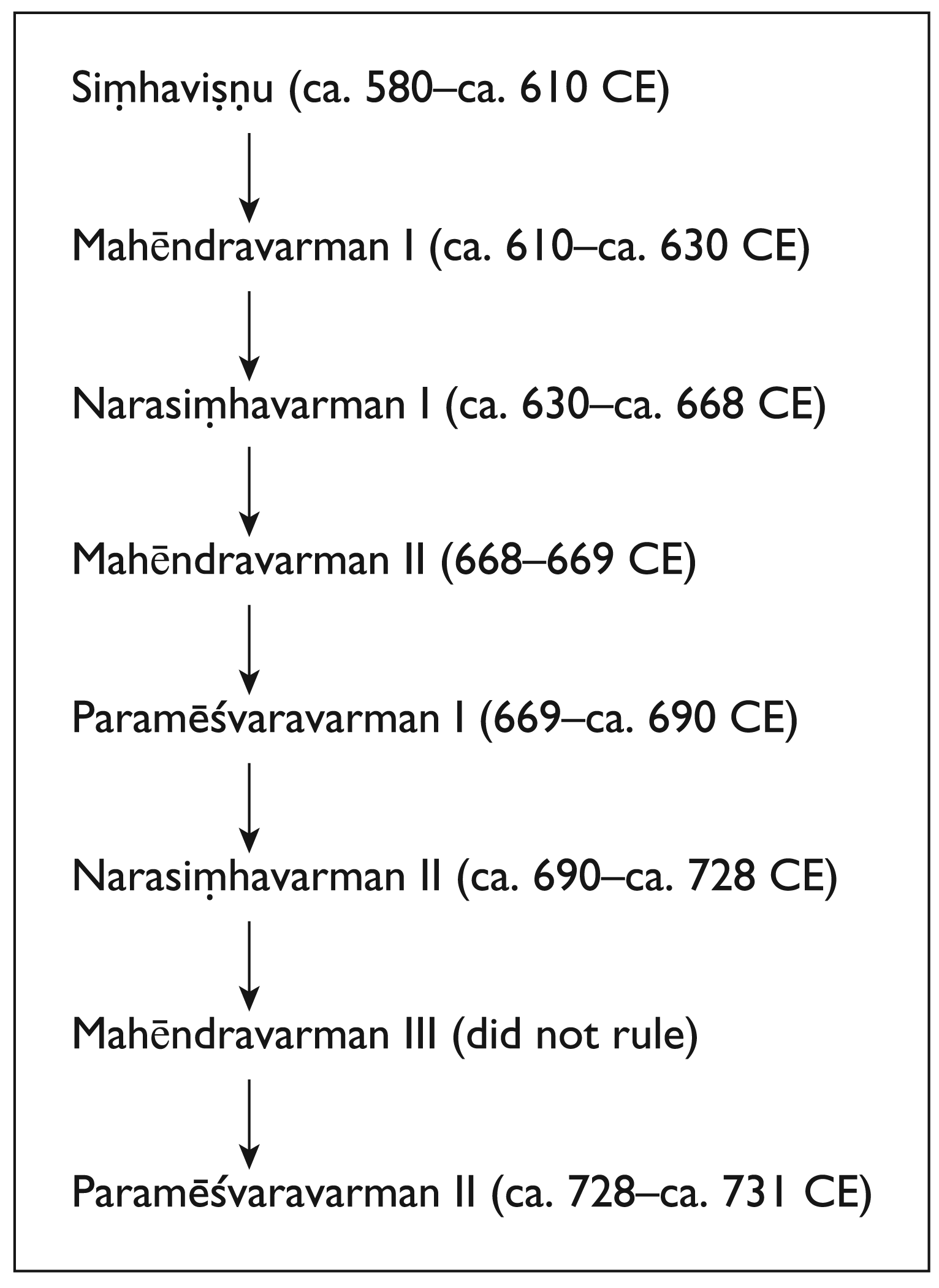
Only one of the first ten Pallava records is from Tamil Nadu. This is the Udayēndiram grant of Nandivarman I, which incidentally is the last among the first ten records. 10 The six records that follow are all, again, from coastal Andhra. 11 It is in the seventeenth record that we hear of Siṃhaviṣṇu conquering the Kaveri delta. This record pertains to a village near Veṇkunṟaṃ in the Wandiwash taluk of North Arcot district, although it was discovered from Paḷḷaṅkōvil in the Tiruttuṟaippūṇḍi tālūk of Tañjāvūr district. 12 What follows is also interesting in terms of the geographical distribution of inscriptions. Beginning with the next inscription in our chronology, the Chezjarla inscription of Mahēndravarman I, there are sixty epigraphs spread across the reign of six rulers—Mahēndravarman I, Narasiṃhavarman I, Mahēndravarman II, Paramēśvaravarman I, Narasiṃhavarman II and Paramēśvaravarman II. 13 Only three of them are from coastal Andhra, one each from the reign of Mahēndravarman I, 14 Paramēśvaravarman I 15 and Narasiṃhavarman II. 16 All the rest are from Tamil Nadu, save the Bādāmi inscription of Narasiṃhavarman I, commemorating the king’s victory over the Bādāmi Caḷukyas. 17
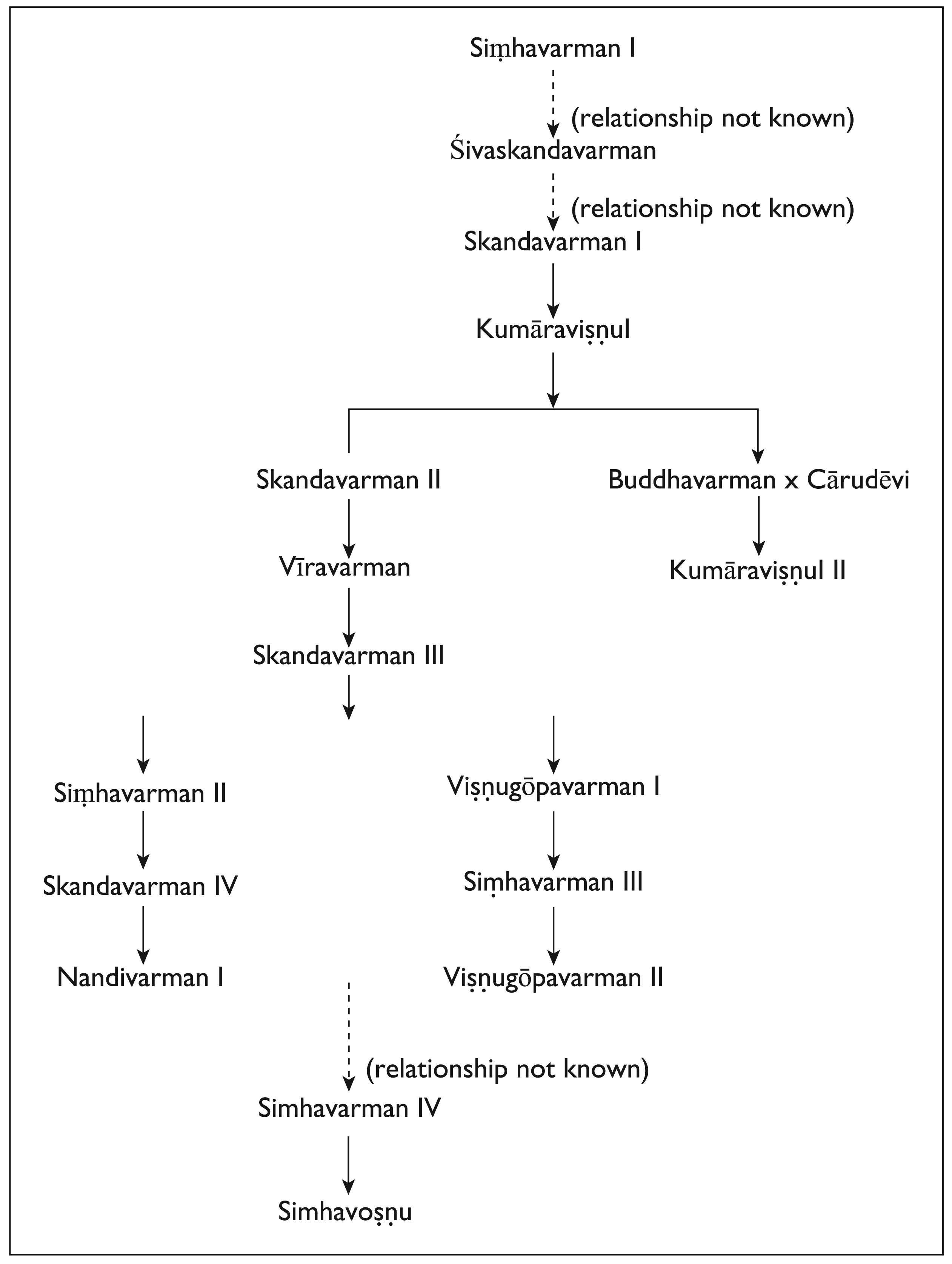
That fifteen of the early sixteen Pallava inscriptions are from Andhra or Karnataka is of considerable interest to us. The first nine records, all from Andhra and Karnataka, were issued during the reign of four rulers—Siṃhavarman I, Śivaskandavarman, Skandavarman III and Siṃhavarman II. After Śivaskandavarman, at least four rulers are known to have occupied the throne before the coronation of Skandavarman III, namely Skandavarman I, Kumāraviṣṇu I, Skandavarman II and Vīravarman. 18 Skandavarman III ruled for at least thirty-three years, and Siṃhavarman II for at least forty-one years. The father and the son thus ruled for nearly three quarters of a century. 19 How long their six known predecessors ruled is not clear. In any case, it is safe to assume that the nine records span a period of at least two centuries, if not more. Thus, for nearly 200 years, all known Pallava activities occurred far away from their headquarters in Kāñcīpuraṃ and its immediate neighbourhood. Between Siṃhavarman II and Siṃhaviṣṇu’s father Siṃhavarman IV, at least two generations of kings are known to have ruled. Their activities were also mostly concentrated in Andhra.
What were the early Pallava activities in Andhra and Karnataka? And how did the rulers represent themselves in the inscriptions? Let us turn to the inscriptions to address these questions.
The first of the sixteen early Pallava inscriptions is from Mañcikallu in the Palnāḍu tālūk of Guṇṭūru district. Engraved on stone, it is a short Prakrit epigraph in five lines, recording a donation made by Siṃhavarman I. The donor is said to have presented woollen blankets to the tēthi[ka]s [priests] of [Jīvaśiva]svāmi. The recipients seem to have been priests or functionaries of a temple, as the expression ‘deity of the temple’ (dēvakulasa bhaṭṭā[rakasa]) occurring in the inscription indicates. The record does not have much to say about the donor, except that he belonged to the Bhāradvāja Gōtra and was from the Pallava line. Siṃhavarman I is not identified as a king either, unless the lost prefix to the word [dha]rēṇa [bearer] was dharaṇī [earth], making him dharaṇīdhara, the bearer of the earth. The amateur, if not awkward, composition of the inscription suggests that the political existence of the Pallavas was still incipient. That it was blankets that the king presented, something unheard of in any subsequent inscription, and that he found it pertinent to record this humble piece of munificence on stone, seem to suggest that the Pallavas were only beginning to make inroads into the Krishna valley.
Unlike the Mañcikallu inscription, the fifteen remaining early Pallava epigraphs are engraved on copperplates and are records of land endowments. There is greater conviction in these records, as far as the Pallavas’ claims to political status is concerned. The word Mahārāja (king) or Yuvamahārāja (crown prince) figure in all of them. The first four records, which span a period of at least five generations, do not provide any genealogy. Only the name of the donor and the reigning king (in those cases where the king himself was not the donor) are mentioned. On the other hand, the next twelve records invariably mention the names of the donor’s father, grandfather and great-grandfather. It is obvious, then, that a need for royal continuity and claims to rightful succession on the basis of primogeniture was beginning to be felt by the latter half of the fifth century
The first four records are also different in another respect—they are written in Prakrit. The fourth record, the Guṇapadēya plates of Cārudēvi, 20 happens to be the first inscription in which the formulaic imprecatory verses appear in the end. ‘Many have donated lands’, the imprecation says, ‘and many have protected them. Fruits are earned according to the land held. Whoever confiscates land donated by themselves or by others incur the sin of killing a hundred thousand cows and drinking the malicious.’ These lines underline the importance that land was gaining as a form of property in this part of the subcontinent. The imprecation is written in Sanskrit. The idea and the verses are borrowed from the ‘Āśvamēdhikaparvan’ of the Mahābhārata. It may be said, figuratively, that these verses in the Guṇapadēya plates brought an end to the use of Prakrit in the Pallava inscriptions. All twelve of the subsequent Pallava epigraphs are fully in Sanskrit. 21
The expression of kingship found in the early deeds is closer in ideal to the model presented in the Mahābhārata. In terms of kingly functions, they draw inspiration from the prescriptions made in the dharmaśāstras, if not modelled after them to the last letter. It appears that dharma was the core value of this paradigm, and making land grants and protecting them the cornerstone of this dharma. The king is not simply a Mahārāja, but in most instances a Dharmamahārāja. But the dharmaśāstra model was perhaps restricted to the functional dimensions of kingship, as spelt out by Manu, Nārada and others. Representational and ceremonial strategies of affirmation and control, prescribed by the dharmaśāstras, do not seem to have captured the early Pallava imagination. Nowhere is an attempt made to draw a genealogy that affiliates the rulers with the deities, sages and heroes of the paurāṇic lore. Nor is the king ever equated with a deity. This is to say that divine kingship was not of much interest to them.
The image of the king that comes through in the early inscriptions is that of a great man wedded to the ideal of chivalry. Here is the representation of Siṃhavarman III in his praśasti in the Oṃgōḍu plates: the son of yuvamahārāja Śrī Viṣṇugōpa, who causes the flaws of the Kaliyuga to sink, who elevates dharma, who is ever equipped, who is a confluence of all royal virtues, a dharma vijigīṣu [aspirant for righteous conquest] among the vijigīṣus meditating on the feet of god and devoted to the feet of his father, a great devotee from the Bhāradvāja Gōtra, who with prowess overran the foundations of prosperity of other kings, who duly offered many hundred kalpasūtra sacrifices, the lord of the Pallavas, Dharmamahārāja Śrī Siṃhavarmā. The description is preceded by comparable praśastis of his father, grandfather and great-grandfather. 22 Many of these were stock expressions used in the copperplates rather stereotypically. The praśasti of Viṣṇugōpavarman I in the Neḍuṅgarāya plates can be examined in comparison. The prince, says the praśasti, is one who holds devotion to god and rectitude in high esteem, who has vowed to ceaselessly protect and entertain the people for the welfare of all, who has attained the light of fame for victories in many battles and acts of daring, who causes the flaws of the Kaliyuga to sink, who elevates dharma, who is ever equipped, who is a confluence of all virtues of a royal sage, a dharma vijigīṣu among the vijigīṣus meditating on the feet of god and devoted to the feet of his father, a great devotee from the Bhāradvāja Gōtra, the Yuvamahārāja Śrī Viṣṇugōpa of the Pallavas. 23 There is very little difference between the two praśastis, not only in the intent but also in the vocabulary employed. This picture of chivalry, which involved not only valour and the image of the king as a protector but also devotion to god and, more importantly, devotion to one’s father, is likely to have appealed to the rural imagination of the agrarian world.
The early Pallava land deeds fall under four distinct categories. One, land was made over to brāhmaṇas as brahmadēya. Nine of the deeds specifically refer to the endowment as brahmadēya. 24 Five of them state that the land was converted into a brahmadēya (brahmadēyaṃ kṛtvā) through the grant. 25 Three others declare that the land was being endowed according to the brahmadēya convention (brahmadēya maryādayā). 26 Two, land was given to existing holders, renewing an earlier grant or occupancy rights. There are two such records, both from Karnataka. 27 Three, land hitherto endowed to a brāhmaṇa was made over to another brāhmaṇa. Only one such case is known. 28 This record declares that the grant is pūrvabhōga-vivarjjitaḥ. What this expression means is not altogether clear. It can be interpreted as evicting the earlier holder. It can also mean excluding that portion of the land previously endowed. Four, land was given away to temples as dēvabhōga. Two such records exist. 29 The first of these does not identify the grant by this expression, but the second grant categorically states that the land was converted into a dēvabhōga (dēvabhōgaṃ kṛtvā).
An important trend noticed in the early inscriptions is that a whole village was never made over to temples. Cārudēvi gave only four nivarttanas [a measure of land] to the Kūlimahātāraka temple of Lord Nārāyaṇa in Dālūru. 30 The Uruvupalli plates of Siṃhavarman II recorded the grant of 200 nivarttanas made by Viṣṇugōpavarman I to the Viṣṇuhāra temple in Kaṇḍukūru, built by Viṣṇuvarma Sēnāpati. 31 In contrast to this trend, eleven of the thirteen grants made over to brāhmaṇas involved entire villages. For instance, the Maidavōlu plates of Śivaskandavarman registered the award of the village of Viripura to two brāhmaṇas, Puvakōṭuja and Gōnandija. 32 The Hirē Haḍagali grant, in which the recipients were many in number, involved the village of Cillarēka Koṇḍuka Vāṭaka. 33 Viṣṇugōpavarman I endowed the village of Neḍuṅgarāya to three brāhmaṇas, Doddisvāmi, Kaṇṇasvāmi and Nandisvāmi. 34 One of the deeds, the Udayēndiraṃ plates of Nandivarman I, records an additional grant of four pieces of forestland. 35 Only in two late records, the Cendalūra plates of Kumāraviṣṇu III and the Cura plates of Viṣṇugōpavarman II, do we come across a smaller endowment being made to a brāhmaṇa. The recipient was given only 432 paṭṭikas [a measure of land] in Cendalūra 36 and 108 nivarttanas in Cura. 37
It is interesting to note that none of these early grants were identified as perpetual endowments. Nowhere in these deeds does the expression akṣaya nīvī [perpetual endowment], found in some Sātavāhana inscriptions, occur, nor is it declared, as is done in numerous records from a later period, that the grant would last as long as the sun, the moon and the stars exist. There are also no suggestions to the effect that the grant constituted the private property of the recipient. Most inscriptions carried an imprecatory note at the end, declaring that the grant was not to be taken away, even by the donor. Nevertheless, the land granted continued to be under the control of the king as far as the right to alienate or transfer occupancy rights was concerned. The Hirē Haḍagali plates of Śivaskandavarman state that the grant being made was a renewal of the one made earlier (puvvadattaṃ [hitherto granted], Skt. pūrvadattaṃ) by the donor’s father. 38 In another case, the village of Ōṃgōḍu, hitherto awarded by Skandavarman III to the brāhmaṇa Gōlaśarman of Kāśyapa gōtra, 39 was made over by Siṃhavarman III to another brāhmaṇa, Dēvaśarman of the same gōtra. 40 A contemporary Kadaṃba inscription confirms the prevailing practice of renewing grants in South India. The Halsi plates of Ravivarman speak of a grant originally made to the Jaina monk Śṛtakīrtī of Pālasika by Kākustavarman and periodically renewed by his successors, Śāntivarman, Mṛgēśavarman and now Ravivarman. We do not know when and how the granted land relapsed to the king or why, if ever, it was revoked. But early Pallava inscriptions confirm that the most important function of the king was the regulation of property relations emerging in the context of landed wealth.
The references to dēvabhōga in the early inscriptions are important for our purposes. It must be noted that the early Pallavas made only two dēvabhōga endowments; 41 neither of them was by a king. The first of these was made by Cārudēvi, the wife of Buddhavarman, when Skandavarman II occupied the throne. The other one was given away by the crown prince, Viṣṇugōpavarman I. Only in Viṣṇugōpavarman I’s record is the builder of the temple named. The builder, Viṣṇuvarma Sēnāpati, was, as his name suggests, a military commander.
In addition to these, there are eight references to dēvabhōga in the early records. All of them occur in the context of grants given to brāhmaṇas. The deeds say that the village made over to the brāhmaṇa beneficiaries did not include the land set aside as dēvabhōga (dēvabhōgahala varjya [excluding the dēvabhōga land]). 42 The founding charters of these dēvabhōgas, if they existed, have not come to light.
Four things follow from these early references to the dēvabhōgas. One, temples in the period between the fourth and the sixth centuries
An interesting question needs to be raised before we move to the next section, although it may not be possible to answer it in the present status of knowledge. Was building temples and setting up endowments in the form of dēvabhōga by the local elites between the fourth and the sixth centuries
The next part of the story commences with the Paḷḷaṅkōvil copperplates of Siṃhavarman IV from the late sixth century
Of greater interest is the fact that the deed was addressed to the peasant proprietors (nāṭṭār) of the locality of Perunagaranāḍŭ in Veṇkunṟakkōṭṭaṃ. They were informed that the village of Amancērkkai and sixteen and a half paṭṭis of land in the village of Dāmar were given away to Vajranandi. Although the village awarded was in close proximity to the Pallava headquarters of Kāñcīpuraṃ, there were no royal functionaries stationed there. This stands in striking contrast to the early Pallava grants. The royal order in the Maidavōlu plates was communicated to the officials (vāpata) stationed at Dhānyakaṭaka. 45 The Hirē Haḍagali deed was addressed to a number of functionaries employed by the state, including the rājakumāra (prince), the sēnāpati, the rāṭhikas (local chiefs), the māḍhavikas (toll collectors), the dēśādhikas (officials in charge of the country), the vallabhas (officials in charge of pastures), the gōvallabhas (officials in charge of animal husbandry), the amaccas (counsellors), etc. 46 The Guṇapadēya inscription of Cārudēvi carried instructions for the gāmēyikas and the āyuttas (accountants). 47 The expression gāmēyika (Skt. grāmēyaka) may correspond to the Tamil ūrār or ūrōṃ, a corporate assembly of leading landholders in the village. However, the āyutta (Skt. āyuktaka) was also named, as if the deed would not be a deed unless the presence of a state functionary was duly recorded. Skandavarman III’s Oṃgōḍu grant was addressed to the adhikṛtas (officials) and the āyuktakas (accountants) of Karmmarāṣṭra. 48 The grāmēyakas also appeared in the deed recorded in the Uruvapalli plates of Viṣṇugōpavarman I, but instructions were given to all the āyuktakas, the naiyōgikas (agents), the rājavallabhas (officials in charge of the royal pastures) and the sañcarantakas (royal informers). 49 The same set of functionaries figured in the Siṅgarāyakoṇḍa grant of the same donor. 50 This general trend continued in subsequent early inscriptions as well, where we come across some of the above functionaries, as well as several others, such as the mahāmātras (overseer), the rājapuruṣas (the royal men), the śāsanasañcāris (heralds of royal orders), and the sarvādhyakṣas (chief superintendents). It is noteworthy that the lone early inscription from Tamil Nadu, the Udayēndiraṃ plates of Nandivarman I, does not mention any such state functionary. The Oṃgōḍu plates of Siṃhavarman III also does not mention any official, apparently because the village was hitherto given to another beneficiary by one of the donor’s predecessors, wherein the formality of addressing the deed to state functionaries had already been observed. This long tradition is what the Paḷḷaṅkōvil record breaks by communicating the order to the locality’s assembly of peasant proprietors. It is not of mean consequence that a village situated at a distance of only a day’s journey (by foot or by bullock cart) from the capital city of Kāñcīpuraṃ had no royal functionaries stationed there. The peasant proprietors were powerful enough to constitute a class in their own right, although the area was less productive when compared with the Kaveri and the Krishna delta regions, and agrarian expansion still incipient and hardly a match to the situation that obtained in the marudaṃ (wetland) belts of the deltas.
The absence of royal functionaries from the two known instances of land grants from Tamil Nadu between the early fourth and the late sixth centuries—the Udayēndiraṃ and the Paḷḷaṅkōvil plates—and their presence in every land grant deed from coastal Andhra and Karnataka points to the rather weak control the early Pallavas were able to exercise over the peasant population of Tamil Nadu. The inscriptions that follow seem to resonate with this proposition. In the long duration of about a century and a half after Mahēndravarman I was enthroned, the Pallavas made only three land grants. Only one of them, the Kūram grant of Paramēśvaravarman I, was from Tamil Nadu. 51 The other two, the Vunna Guruvapāḷeṃ grant of Paramēśvaravarman I and the Rēyūru grant of his successor, Narasiṃhavarman II Rājasiṃha, 52 were from coastal Andhra. The Vunna Guruvapāḷeṃ and Rēyūru grants were made for the merit of the king. The Kūram grant is significant because unlike the early Pallava grants, it was not made voluntarily by the king, but at the instance of Vidyāvinīta Pallavarāsan, who appears to have been a subordinate chief enlisted into the service of the state. The grant was made to the Pinākapāṇi temple built by Vidyāvinīta. This deed also recorded an additional grant to the temple of five and a half paṭṭis of land made after purchase by Vidyāvinīta, in addition to three of the twenty-five shares into which the village of Paramēśvaramaṅgalaṃ was divided. This is the first known instance of gift after purchase from the Pallava inscriptions and points to the importance of the peasant proprietors from whom Vidyāvinīta might have made the purchase.
Other than the three copperplate grants, all the remaining fifty-seven inscriptions issued between Mahēndravarman I and Paramēśvaravarman II were engraved on stone. Understandably enough, they generally do not carry praśastis or the royal genealogies of the king. It was the convention in this period to include praśastis only in land grant inscriptions recorded on copperplates, although this norm was increasingly disregarded after the tenth century. Few stone or pillar inscriptions from this period carried praśastis. Among the significant exceptions were the Allāhābād pillar inscription from the north, carrying a posthumous account of the exploits of the Gupta king Samudragupta, the Kadaṃba ruler Śāntivarman’s Tāḷagunda inscription from the south, commemorating the exploits of his great-grandfather, Mayūraśarman, and the Jūnāgaḍh rock inscription from the west, singing praise of the western Kṣatrapa king, Rudradāman. Two inscriptions of Narasiṃhavarman II, one each from Kāñcīpuraṃ and Vāyalūr, provide the Pallava exception to the rule. 53 The paurāṇic genealogy drawn in the Kāñcīpuraṃ inscription is similar to the one found in the Paḷḷaṅkōvil plates. It commences with Brahma, followed by Aṅgiras, Śakramantri (Bṛhaspati), Śamyu, Bhāradvāja, Drōṇa, Aśvatthāma and Pallava, in whose line Ugradaṇḍa (Paramēśvaravarman I) and his son Rājasiṃha (Narasiṃhavarman II) were born. This invented genealogy seems to have been standardized by this time, for the same list of paurāṇic predecessors are mentioned in the Kūraṃ plates too. 54 The Vāyalūr inscription is interesting because not only does it repeat this genealogy but also fills up the gap between the eponymous Pallava and Narasiṃhavarman II with a long list of succession. Pallava is succeeded by Aśoka, who is followed by many invented figures. The genealogy eventually merges with an impressive list of early Pallava rulers that concurs to a great extent with the family tree we have reconstructed in Figure 1. 55
The genealogy invented by the Paḷḷaṅkōvil inscription, and reproduced in the Kūraṃ plates and the Kāñcīpuram and Vāyalūr stone inscriptions, was perhaps meant for consumption only in the Tamil-speaking region. The two post-Mahēndravarman I copperplate grants from coastal Andhra, Vunna Guruvapāḷeṃ and Rēyūru, do not invoke this paurāṇic family tree. Like the early Pallava grants, it only mentions the immediate predecessors of the donor, up to three generations in the first case and two in the second.
In spite of the fact that praśastis and paurāṇic genealogies were generally absent from the stone inscriptions, the representation of the king in the fifty-seven stone epigraphs stands out for the lack of formulaic titles like Dharmamahārāja, used by the early Pallavas, or other contemporary titles, such as Mahārājādhirāja, Pṛthvīvallabha and Paramēśvara. Note the contrast between Pṛthvīvallabha or Pṛthvīśvara with one of the titles Narasiṃhavarman I used, Pṛthvīsāra (the essence of the earth). 56 In fact, even popular expressions such as Rāja or Mahārāja rarely figure in these epigraphs. The records invoke the personal names of the rulers or the titles unique to them. The two Daḷavānūr inscriptions of Mahēndravarman I refer to him as Narēndra and Śatrumalla. 57 The second of these records calls him Toṇḍaiyan Tārvēndan Narēndrappōttaraiyan. Toṇḍaiyan Tārvēndan, through a double-entendre, refers to the king as the one who wore the toṇḍai flower as well as the one who ruled over the flower called Toṇḍai, that is, the Pallava country. His Kāñcīpuraṃ and Pallavaram inscriptions contain no purports other than his titles. 58 Among the titles are Mahāmēgha, Citrakārapuli, Mattavilāsa, Vicitracitta, Abhimukha and Lalikāṅkura. The Maṇḍagapaṭṭu inscription refers to Mahēndravarman I as Vicitracitta and records the construction of a rock-cut temple for the trinity, Brahma, Viṣṇu and Śiva. 59 His name in the Śīyamaṅgalaṃ inscription is Lalitāṅkura. 60 Of his four Tiruciṟāpaḷḷi inscriptions, one calls him Guṇabhara, 61 another, Śatrumalla and Guṇabhara, 62 and the third, Lalitāṅkura. 63 The fourth is a lengthy list of his titles. 64 In none of his nineteen surviving inscriptions do we come across the preferred epithet of his forefathers, Dharmamahārāja. The expression Mahārāja also never occurs in any of his inscriptions, except the very first record ascribed to him, which comes from Chezjarla in the Narasarāvupēṭa taluk of the Guṇṭūru district in the Krishna valley. 65 Other than the Daḷavānūr inscriptions calling him Narēndra, there is one record that identifies him as Nṛpati 66 and one that calls him Rājñā, 67 both meaning king. Kingship, it appears, had broken out from the shells of its prevailing forms of articulation.
With Mahēndravarman I, Pallava kingship made a shift towards the cult of the royal personality. The new convention of engraving the king’s titles on stone was only one of its many manifestations. This convention was carried forward with zeal by some of his successors. A Mahābalipuraṃ inscription of Narasiṃhavarman I enumerates thirty-two of his titles. 68 Two of his inscriptions at Kāñcīpuraṃ were solely meant to provide a list of his titles. 69 The first of these is a great pageantry of the personality cult. It is a veritable catalogue of 233 titles of the king. There is a Cakravarti and a Rājarāja in this list of titles, but no Mahārāja or Mahārājādhirāja. There is a Vallabha, but no Pṛthvīvallabha. There is a Dharmasētu and a Dharmavijayi, but no Dharmamahārāja. Older forms of formulaic representation were being scrupulously avoided in favour of newer ones that underwrote the personality of each individual ruler.
The titles revealed the king’s personality through a wide spectrum of images. The king was truthful (Satyasanda), matchless (Apratima) and spotless (Kalaṅkarahita), his learning sharp, making him a goad of knowledge (Jñānāṅkuśa), and his renown ever on the rise (Uditakīrtti). Lofty (Udyōnnata, Utthānaśīla and Uttarōttara) and virtuous (Guṇabhara, Guṇālaya, Guṇavinīta and Guṇōnnata), an epitome of munificence (Atyudāra, Icchāpūra, Udārakīrtti and Dānavarṣa), blessed with fortune (Śrīnidhi, Śrībhara and Śrīmēgha), he stood like the conferrer of rains (Parjjanyarūpa, Nityavarṣa and Mēgha), upholding dharma on earth (Dharmanitya, Dharmakavaca, Dharmavijayi and Dharmasētu). The king was known for his perennial enthusiasm (Utsāhanitya), unmatched and extraordinary strength (Atulabala and Adbhutaśakti), fierce prowess (Ugrapratāpa), unfailing courage (Amōghavikrama), excited valour (Ucchritavīrya) and great daring (Atisāhasa). He was brave like a lion (Vīrakēsari), won battles (Raṇajaya), was always valiant on the field (Āhavakēsari, Saṅgrāmadhīra, Samaradhanañjaya, Raṇadhīra and Āhavadhīra) and was a ferocious arrow (Ugrasāyaka, Amōghabāṇa and Bhīṣaṇacāpa) that faced no defeat (Aparājita). He had the qualities of an elephant (Rājakuñjara and Gandhahasti), was known for his fury (Caṇḍadaṇḍa, Atiraṇacaṇḍa, Kālakōpa, Karṇakōpa and Tīvrakōpa), defeated enemies (Amitramarddana, Amitramalla, Amitrāntaka and Amitrāśani), destroyed evil (Duṣṭamarddana and Duṣṭadamana) and was a great hero (Mahāmalla). At the same time, he was soft like the shoot of a plant (Lalitāṅkura), was always well behaved (Nityavinīta), and excelled in fine arts, such as painting (Citrakārapuli). Resplendence (Avanidivākara, Uditaprabhava, Udayabhāskara and Udayacandra), an attractive mien (Ēkasundara and Nayanamanōhara) and love for the erotic sport (Mattavilāsa, Atyantakāma, Kāmarāga, Kāmalalita, Cāruvilāsa and Lalitavilāsa) added colour to his personality. With these and countless other qualities, including devotion towards god (Īśvarabhakta, Dēvadēvabhakta), he exercised sovereign control over the earth (Sārvvabhauma, Trailōkyanātha, Bhuvanabhājana and Avanibhājana) like a crest jewel among the kings (Narendracūḍāmaṇi and Nṛpacūḍāmaṇi).
The image constructed with such care and deliberation was also advertized through the temples the Pallavas built in large numbers. Many of them bore the title of the king. The temple built by Mahēndravarman I at Daḷavānūr was Śatrumallēśvarālaya, named after his title, Śatrumalla. 70 His Śīyamaṅgalaṃ temple was Avanibhājana Pallavēśvara, 71 and the one at Tiruciṟāppaḷḷi, Lalitāṅkura Pallavēśvaragṛhaṃ. 72 A temple commissioned by Paramēśvaravarman I at Mahābalipuraṃ had Atyantakāma Pallavēśvaragṛhaṃ for its name. 73 One of the temples Narasiṃhavarman II built in the capital city of Kāñcīpuraṃ was Rājasiṃhēśvaragṛha, 74 and another at the same place Nityavinītēśvaragṛha. 75 His temple at Śāḷuvaṅkuppaṃ was Atiraṇacaṇḍēśvaragṛha. 76 Some temples also carried the personal names of the kings. The Viṣṇu temple Mahēndravarman I built at Mahēndravāḍi was Mahēndraviṣṇugṛha. 77 The Mahēndravarmēśvaragṛhaṃ in Kāñcīpuraṃ was named after Mahēndravarman III, who is, nonetheless, not known to have occupied the throne. 78
Even as temples were being named after the Pallava rulers in great numbers, a new practice came into vogue in collusion with it. This was the naming of places after the king. Mahēndravāḍi, where an inscription of Mahēndravarman I is found, is certainly one such case. 79 The place is called Mahēndrapura in the record. This inscription also speaks of a water tank called Mahēndra taṭāka. The village donated in the Kūraṃ plates of Paramēśvaravarman I is named after the donor as Paramēśvaramaṅgalaṃ. 80 The water tank mentioned in this grant is, predictably enough, Paramēśvara taṭāka. Mahābalipuraṃ, where some of the finest specimens of Pallava architecture are found, was named Māmallapuraṃ after Narasiṃhavarman I, who has Mahāmalla as one of his titles. The water tank in Māmaṇḍūr, apparently built by Mahēndravarman I, was named after a title of his as Citramēgha taṭāka.
This discussion can be effortlessly prolonged with a greater body of facts from the records. But the primary argument of this article—that Pallava statecraft underwent a transformation from the cult of chivalry to the cult of personality in the seventh century—is sufficiently borne out by the evidence already presented. We must now turn to a discussion of the circumstances that occasioned this transformation.
Archaeological data tells us that in the second and the third centuries
The most important formulation concerning urban decay was made by Ram Sharan Sharma.
84
Although the data marshalled by him from excavation reports are yet to be seriously contested, it is now believed that there are critical flaws in his thesis.
85
First, Sharma held that urban decay was caused by a decline in India’s trade with Rome, an argument that is found wanting in evidence.
86
Second, he combined stray instances of urban decay from the period after the fourth century with the enormous evidence for decline in urban centres from the third and early fourth centuries to argue that the period between 300 and 1000
It is riding on the crest of this new wave of urbanization that Mahēndravarman I and his successors brought their new paradigm of statecraft into practice. The brahmadēya and other grants of the early Pallava rulers were mostly located in rural settings. Very little was seen in them by way of urban refinement. In contrast, the post-Siṃhaviṣṇu Pallavas directed their energies towards urban centres, such as Kāñcīpuraṃ, Mahābalipuraṃ and Tiruchiṟāpaḷḷi.
The temples they built, ranging from the smaller rock-cut caves to the larger ones, such as the Shore Temple of Mahābalipuraṃ and the Kailasanātha Temple of Kāñcīpuraṃ, involved forms of planning, artisanal labour and craftsmanship that were mostly alien to the Tamil-speaking region. These called for the cultivation of refined classical tastes in architecture and iconography, and a sound knowledge of the āgamic cosmology with its deities such as Śiva, Viṣṇu and others in their multitudinous forms. The dexterity involved in executing sculptures and motifs on the walls and roofs of the rock-cut caves was contingent on long periods of training in various aspects of civil engineering, such as the choice of suitable rocks, handling of a range of tools, lighting, the setting up of props and the imagination—if not physical production—of prototypes. It also warranted an evolved understanding of mathematical calculations, especially in the case of structural temples such as the Kailāsanātha Temple and the Shore Temple. These skills are unlikely to have been imported from other parts of the subcontinent. For the grand architectures of Kārle, Bhāja, Amarāvati, Nāgārjunakoṇḍa and other places in the Deccan region were already a thing of the past many centuries ago, and the second phase of activity at Ajanta had already come to an end a century and a half before Mahēndravarman I embarked on his temple-building mission. Thus, the seventh-century initiatives clearly marked a new beginning. That a distinct style of architecture and iconography evolved through these temples is another consideration that bears out this novelty. This style has since come to be known as the Drāviḍa style of architecture.
The first initiative towards architectural innovation in seventh-century South India seems to have been taken by the Bādāmi Caḷukya king, Maṅgalēśa (r. ca. 596–610 Certain features of the Pattadakal temples are close to the Pallava style: the square upper temple with kapōta-pañjara-aedicules in the walls, the miniature vimānas in the nāsis, the form of the nāsis themselves. If these are the result of Pallava ‘influence’, then this must already have taken effect during the reign of Vijayāditya, and not have awaited the admiration of his son Vikramāditya II for the Kailāsanātha, Kanchipuram. The Saṅgamēśvara, Pattadakal, roughly contemporary with the Kailāsanātha, or a little later, already has the ‘Pallava’ features, and with its progressively-multiplying composition (1–3–5) is the most ‘Pallava’ of the Cālukya temples.
91
Accompanying the fervour of temple-building was the eagerness to cultivate other classical arts, especially performance forms such as drama and music. To what extent had drama gained popularity in the seventh and the eighth centuries is not clear to us. But we know that Mahēndravarman I wrote a farce called Mattavilāsa Prahasana and possibly another extant play, the Bhagavadajjuka. 92 Music, however, was of special interest to the king. Mahēndravarman I patronized it with zeal and might have as well cultivated it with great care. An inscription from Tirumayyam mentions six of the seven svaras (sounds or notes) in Indian classical music, the second (ṛṣabhaṃ), the third (gāndhāraṃ), the fifth (pañcamaṃ), the sixth (dhaivataṃ), the seventh (niṣādhaṃ) and the fourth (madhyamaṃ). 93 A Kuḍimiyāmalai inscription records the rules of the svaras (svarāgama) in what appear to be seven classes of rāgas (musical tunes), namely the madhyama-grāma (with emphasis on the fourth svara, ma), the ṣaḍja-grāma (laying stress on the first svara, sa), the ṣāḍava (hexatonic rāgas, or rāgas that use any six of the seven svaras), the sādhārita (perhaps saṃpūrṇa or heptatonic, where rāgas are made of all seven svaras), the pañcama (where the fifth, pa, is important), the kaiśiki-madhyama (jointly focusing upon the fourth, ma, and the lower of the seventh, ni) and the kaiśiki (revolving around the lower seventh, ni). The rules were organized in the form of stanzas of four lines, with each line divided into four segments of four svaras each. Each class of rāga was made up of four to seven such stanzas. 94 The reasons for engraving these rules on stone are not clear. It appears that the rules were new and hence sought to be preserved on a lasting medium. In any case, the Kuḍimiyāmalai inscription is testimony to the long years of training in music that went into its making.
An instrument called parivādini was popular among the musicians. At least four inscriptions refer to it. 95 One of them informs us of a method of playing, promulgated by a certain Guṇasēna. 96 Another school of parivādini is mentioned elsewhere, although the name of the promulgator is lost. 97
Of greater consequence than music and the other performance genres was an event that was to transform the world of aesthetics in much of South Asia and beyond after the seventh century. This was the composition of the influential Kāvyādarśa by Daṇḍī, whose activities have been persuasively traced to the Pallava court of Narasiṃhavarman II. 98 The Kāvyādarśa was a treatise on poetics, and ‘probably the most influential work on literary science in world history after Aristotle’s Poetics’. 99 In this work, Daṇḍī identified eighteen descriptions as essential for a great poem, namely the city, the ocean, the mountain, the seasons, the sunrise, the moonrise, the garden, water sport, drinking bouts, lovemaking, the separation of lovers, marriage, the birth of a son, royal counselling, messenger, travel, war and the triumph of the hero. 100 Besides, he privileged the Vaidarbhi style of poetry and identified ten distinct attributes (guṇas) as its breath (prāṇa), implicitly favouring them as the very breath of genuine poetry. The attributes were double-entendre, clarity, uniformity, sweetness, tenderness, clarity of intent, nobleness, vigour, resplendence and equanimity. 101 The attributes and the eighteen-fold descriptions were proclamations of class-centred tastes and etiquette, and the limits and capacities of emotional expressivity that the kingship and its coterie upheld. 102 In some senses, they seem to underwrite the personality of the king that unfurled through his countless titles engraved on stone. An intertextual study of the titles and the canons of Daṇḍī might throw up stimulating insights in this regard.
Daṇḍī’s prescriptions were informed by a keen sense of urban refinement. They were class-oriented and maintained a guarded distance from the rural and the rustic. Note that the tradition of composing plays involving greater room for the rustic in the person of the vidūṣaka (jester) declined after Daṇḍī, and in the plays written in later times, the vidūṣaka was oftentimes missing. 103 Daṇḍī also gave precedence to the enunciation of properties (svabhāvōkti) over crooked speech (vakrōkti), identified a genre called caṃpū that involved a mix of prose and verse, and legislated several formal changes in classical poetry. The influence of his work soon spread to other parts of India, with theorists like Vāmana adopting and enlarging it further, and others such as Ratnaśrījñāna commenting on it. In less than two centuries, the Kāvyādarśa was adapted into Sinhalese under the name Siyabaslakara. Many of Daṇḍī’s ideas were included in the first known work on poetics in Kannada, the Kavirājamārgaṃ, as ‘the views of Nṛpatuṅga’ (nṛpatuṅga-mataṃ). This state-sponsored project was commissioned by the Rāṣṭrakūṭa king, Amōghavarṣa I Nṛpatuṅga (r. 814–878). It turned out to be a work of exceptional influence. Between the tenth and the twelfth centuries, a number of poets from the region—Paṃpa, Ranna, Ponna, Candrajāja and Nāgavarma I—many of whom were court poets, composed literary works that were profoundly influenced by the Kavirājamārgaṃ. Towards the turn of the millennium, Daṇḍī’s work found its way into Tamil through the Daṇḍiyalaṅgāraṃ. By the close of the twelfth century, the recommendations of Daṇḍī had come to be enshrined in a Pāli work, Saṅgharakṣita’s Subōdhālaṅkāra. This work circulated not only in Sri Lanka, where it was produced, but also in Myanmar. By this time, the Kāvyādarśa had travelled beyond South Asia into China, and by the mid-thirteenth century into Tibet as well, where it influenced traditions of poetry. 104
Thus, in striking contrast to the rural bearings of the early Pallavas, the seventh-century rulers created a compelling urban aesthetic infrastructure revolving around the cult of the personality. The emphasis of this infrastructure was on what the self could potentially accomplish: building sublime pieces of architecture, creating new rāgas, playing the parivādana, composing plays and poems, and legislating poetics. It suggests, à la Sheldon Pollock, that ‘the practice of polity was to some degree an aesthetic practice’. 105 Such was not the practice of polity in Tamil Nadu in the preceding centuries. This was certainly a seventh-century innovation. 106
While emphasizing the urban situation of seventh-century Pallava statecraft, one must not turn a blind eye to the massive rural agrarian hinterland from where the Pallavas derived their resources. The state, in all likelihood, was sustained by the agrarian land revenue it commanded. We know of no other sources of revenue substantial enough to have enabled the funding of the great temple-building projects of the state or its military deputations against the Caḷukyas of Bādāmi. While nothing substantial is known about the revenue system or the state functionaries of the post-Siṃhaviṣṇu Pallavas due to the non-availability of records to this effect, the mention in the Kūraṃ grant of a variety of dues, such as manai (house rents), manaip-paḍappu (garden dues), ūrāṭci (dues from the village headmanship), taṟi (settlement dues/dues from the loom), kūlaṃ (grain dues), taragu (brokerage/dry measure) and kattik-kāṇaṃ (protection fees, or fee for a sword-bearing guard), points to a rather extensive system of revenue, which, given the reference to grain dues, might have certainly included land revenue. There is, however, nothing to show that the state engaged in conscious efforts to expand its resource base or reorganize the regimes of agrarian production and control. No records exist to show that the state brought new land under cultivation, or created brahmadēya endowments in the seventh and the early eighth centuries. In fact, nothing on record shows that the post-Siṃhaviṣṇu Pallavas created brahmadēyas in Tamil Nadu before the time of Nandivarman II Pallavamalla. There is of course reference to a Siṃhaviṣṇu Caturvēdimaṅgalaṃ and a Mahēndramaṅgalaṃ from later sources. 107 But the practice of naming brahmadēya villages as Caturvēdimaṅgalaṃ was not known in the sixth or the seventh century. Attaching Siṃhaviṣṇu’s name to a Caturvēdimaṅgalaṃ was certainly a latter-day invention. The same appears be true of Mahēndramaṅgalaṃ as well.
Rajan Gurukkal has argued that the development of a contradiction in production relations during the Saṅgaṃ and the immediate post-Saṅgaṃ periods between plough-based wetland agriculture and the earlier forms of production such as ‘animal husbandry and primitive farming’ led to the dissolution of the older structures of production. 108 ‘Predatory marches of chieftains, their destruction of agricultural settlements and crops, and the dominance of the ideology of war and booty redistribution were averse to the growth of agriculture.’ 109 The ‘prime movers of change had to center itself on these contradictions and the alternative evolving out of [sic] them.’ 110 The ‘evolving alternative’ to this contradiction was the brāhmaṇa households involving an antagonistic relationship between the tillers and the non-cultivating landlords. 111 Now, the presence of brāhmaṇa households is borne out by the Eṭṭutogai texts. The songs tell us that some Saṅgaṃ chieftains also made land grants to brāhmaṇas. Āḍu Kōṭ Pāṭṭu Cēralādan is one such chieftain. The Padiṟṟuppattŭ credits him with having granted a village in Kuḍunāḍu, along with some cows, to brāhmaṇa beneficiaries. 112 A song in the Puṟanānūrŭ says that another chieftain, Pāri, gave away 300 villages in his country. 113 It must, however, be noted that the figures given for Pāri are grossly exaggerated, and the mention of the grant made by Āḍu Kōṭ Pāṭṭu Cēralādan occurs not in a song from the text, but in a colophon added later. The Pallava inscriptions examined by us confirm that brāhmaṇas’ households had not become a force potent enough to bring about changes in production relations in Tamil Nadu by the seventh century. The near-total absence of brahmadēya grants from the time of Mahēndravarman I to the time of Paramēśvaravarman II indicates that control over land was exercised by autochthonous peasant proprietors, the nāttārs, and not by the brāhmaṇas. 114 Gurukkal also suggests that predatory marches into Tamil Nadu by the Kaḷabhras accentuated the process of disintegration of the older modes of production. 115 However, the extant evidence, which is hardly substantial, does not tell us what the Kaḷabhra marches accomplished that the recurrent and oftentimes destructive raids of the Tamil chieftains couldn’t. The Kaḷabhra thesis is at best a myth, 116 and the historian’s quest for the Kaḷabhra interregnum rightly identified as an instance of ‘chasing the Loch Ness Monster’. 117
Inspiring greater confidence is the argument made by Kesavan Veluthat, in which large-scale expansion of agriculture is identified as the historical force that caused the breakdown of kin-based forms of production, paving way for the rise of an entrenched class of peasantry. ‘This meant the induction of extra-kin labour for purposes of production; and it proved to be the thin end of the wedge which ultimately eroded the entire system and brought about a new formation.’ 118 It must be noted that Veluthat does not identify the state or the brāhmaṇa establishments (including brahmadēya settlements and temples) as agents in bringing the transformation from the Saṅgaṃ to the post-Saṅgaṃ period into effect. The state and the brāhmaṇa establishments were, according to him, products of the transformation, and not its cause, agent or precondition. This is a persuasive argument. For we have seen that when these processes were unfurling in the Tamil country in the fourth, fifth and sixth centuries, the Pallava energies were concentrated almost completely in coastal Andhra and parts of Karnataka. The brahmadēyas established by them were also in these regions. The Pallava role in recasting production relations in the Kaveri delta and other parts of Tamil Nadu—if at all they played one—was peripheral. By the time Siṃhaviṣṇu and his successors turned to Tamil Nadu, powerful peasant proprietors (the nāṭṭārs) were already in control of the agrarian regime of the region, as testified by the Paḷḷaṅkōvil copperplates.
An effective way of engaging with the peasant magnates was enlisting them into the service of the state as revenue farmers, and recasting production relations in the region. This strategy was fruitfully deployed by the Cōḻas after the tenth century on a large scale. But the Pallavas of the seventh and the early eighth centuries took no steps in this direction. Owing, perhaps, to the influence the peasant magnates wielded over land relations, Mahēndravarman I and his successor seem to have treated them merely as sources of agrarian revenue, and allowed them to reign supreme in their respective agrarian worlds, without carrying out any interventions worthy of note. At the same time, they turned towards the emerging urban milieu, invented a new form of statecraft centred on the cult of the royal personality and developed a refined aesthetic infrastructure centring on architecture, music, drama, literature and poetics that in due course changed the grammar of statecraft, and its aesthetics, in large parts of South Asia.