



Abstract
The study examines the phenomenon of emotional labour, with a special reference to the frontline hotel employees. Deep acting and surface acting have been discussed as emotion regulation processes. The study hypothesized that emotional labour results in emotional exhaustion and co-worker support acts as a moderator in the relationship between emotional exhaustion and emotional labour. Responses of 140 frontline hotel employees were measured using a self-administered questionnaire to obtain data on emotional labour, consequent emotional exhaustion and moderating role of co-worker support in the proposed relationship. The findings suggest that emotional labour leads to emotional exhaustion, and surface acting was positively related to emotional exhaustion and deep acting was negatively related to emotional exhaustion. Male and female employees, in similar profiles, showed differences in their emotional experiences and emotion regulation processes. Co-worker support was found to have a ‘reverse buffering’ effect suggesting that high level of co-worker support may result in decrease in job satisfaction as emotional labour increases. This was indeed an interesting observation. The article discusses the managerial implications of these findings.
Introduction
We are fast marching ahead to become a service economy. There is a significant rise in the contribution of service sector in the GDP. Coupled with this is a service revolution and most products consumed need to be accompanied with the ‘service component’. Emotional labour has become an all-pervasive construct, especially in the service sector. This has its explanation in the fact that we are fast becoming a ‘service economy’ with most service sector jobs being high on emotional labour demands. It has thus become imperative to explore the emotions of the employees who are involved in this offering of services. Are their workplace emotions different from actual emotions? Do they always wish to smile or are mandated to smile as a workplace requisite? Does it come with ease or requires a lot of labour and effort? If so, then how are they managing their workplace emotions? This proposes that besides the physical and mental labour, employees are required to perform an emotional labour too, which implies manipulating one’s emotions and ensuring that they are in sync with those that are organizationally desired. This emotional regulation at workplace for a wage is termed as Emotional Labour.
Emotional Labour in the Service Context
Putnam and Mumby (1993) suggest that a few years back, organizations were expected to be truly rational entities and thus there was no place for a phenomenon called ‘workplace emotions’. Arvey, Renz and Watson (1998) propose that workplace emotions account for and explain important individual and organizational outcomes and hence need to be managed. Emotional labour as a construct was proposed by Hochschild (1983) in her book The Managed Heart: The Commercialization of Feeling to refer to ‘the management of feeling to create a publicly observable facial and bodily display’. She proposed that in every service encounter, the organization expects its employees to manage personal feelings, expressed both verbally and non-verbally. These expectations are translated into ‘feeling rules’ and ‘display rules’. ‘Feeling rules’ are norms that relate to experiencing emotions and ‘display rules’ are norms relating to expression/suppression of emotions (Hochschild, 1983; Rafaeli & Sutton, 1989; VanMaanen & Kunda, 1989). These rules are nothing but expected workplace emotional expressions (Ekman & Friesen, 1975; Goffman, 1959; Hochschild, 1983).
According to Morris and Feldman (1996), emotional labour is the ‘effort, planning and control required for displaying organizationally desired emotions during interpersonal interactions’. Grandey (2000) opines that emotional labour is ‘the process of regulating both feelings and expressions for organizational goals’. The desired emotions are essentially in sync with the organizationally expected form, but largely not in sync with those that felt. There is a huge incongruence between what is felt and what is expressed. Undeniably, there is an attempt to conceal what is felt in order to meet an organizational expectation. It involves expressing, suppressing, amplifying or feigning to adjust the actual emotions to align it with the job requirements. This is a kind of imposed labour that causes emotional dissonance, because the genuinely felt emotions contradict the display norms of the organization. According to Zapf (2002), this resembles an individual role conflict. Grove and Fisk (1989) opine that it is a genre of impression management, because it involves a deliberate effort on the part of the individual to direct his or her behaviour towards others to foster a social perception of himself or herself and a certain interpersonal climate.
All employees undeniably perform emotional labour (Mann, 1999), but it is a more rampant and more pronounced phenomenon in the service industry (Brotheridge & Grandey, 2002). The obvious reason being that in a service setting, it is inevitable for a service employee to interact with the customer. This interaction may be over phone/in person or even a more remote technology platform. This extensive and mandatory interpersonal contact with customers leaves little space for employees in service industry to exercise autonomy over their emotional expressions. Mann (1999) reported that emotional labour is an element of nearly two-thirds of workplace communications. It is a component of almost all occupations, but a much more fundamental element of service jobs as a higher level of emotional regulation is needed to cultivate, nurture and maintain positivity in relationship with the customers (Brotheridge & Grandey, 2002). Doctors, physicians, lawyers and consultants enjoy an authority over their customers, and they leverage this authority to ‘tip the interactional control balance in their favor’ despite the fact that they also face emotional labour (Tolich, 1993). Contrary to this, service employees are typically subordinate to their clients, their expressions are more structured and scripted, and thus their personal expressions are largely constrained. They are mandated to be servile, polite, responsive, follow a ‘scripted interaction schema’ and refrain from aggression and ‘emotional leakage’ of frustration even in the instance of an abuse from the customer (Glomb & Tews, 2004). Repeat business depends a lot on how service employees manage their behavioural intentions and expressions (Tsai & Huang, 2002). The bottom lines are thus affected, and hence, management expects employees to manage and modify emotions a part of their work role. It communicates the expected display rules through mission statements, employee handbooks, training manuals, performance appraisal policies and organization’s induction and orientation processes (Bolton, 2000; Seymour & Sandiford, 2005).
Hochschild’s (1983) Conceptualization of Emotional Labour— A Dramaturgical Perspective
Arlie Russell Hochschild in the seminal work titled The Managed Heart: The Commercialization of Feeling (1983) made an attempt to explore and draw attention towards the existence of work place emotions. She likened service delivery to a theatrical performance and used theatre as a metaphor for service delivery wherein the ‘employee’ is akin to an ‘actor’, the ‘customer’ is compared to an ‘audience’, the ‘service setting’ is likened to the ‘stage’ and ‘equipment’ used are the ‘props’ (Goffman, 1959; Grove & Fisk, 1989). If this view is accepted, then there can be an easy analogy between display rules and scripts, that is, individual behaviour is mandated by organizational display rules. The view is further substantiated by the servuction model proposed by Eiglier and Langeard (1987). In the model, the customer is present in the servicescape where the service operation/production and consumption of the service product occurs simultaneously. Imagine a situation and the outcome when a sullen employee expresses his anger towards a co-worker or a customer. The service experience undeniably fails, and the failure may often be beyond recovery. A good mood or expression facilitates a great performance and contrarily a bad mood or expression sabotages a seemingly great performance. Thus, the employees need to be adept in impression management in order to avoid their actual emotions overpowering their organizationally expected emotions. This dramaturgical perspective of service work offers two main mechanisms to actors to manage their workplace emotions. Hochschild (1983) proposed two processes of emotional labour:
Surface acting
In surface acting, an employee modifies the emotive expressions. For example, the employees may forge a fake smile or enhance their pleasantness and demeanour even when interacting with an activist customer. It is a superficial expression of the organizationally expected and normative emotion without making any attempt to modify one’s actual feeling. This is similar to putting a mask and simulating the actual emotions.
Deep acting
In deep acting, an employee regulates and thus modifies the internal thoughts and feelings to be in sync with organizationally prescribed display norms. To sum up, surface acting is about managing observable expressions, and deep acting is about a deliberate modification of feelings to express the expected emotions.
One of Hochschild’s major tenets is that both deep acting and surface acting are taxing. The overt effort expended in camouflaging the covert feelings relates to burnout and stress. Given the proposed negative outcomes, a question arises that why workers accept a job that expects a high level of emotional labour. In answering this fundamental question, Hochschild (1983) suggests that emotional labour is ‘sold for a wage and therefore has exchange value’. Hochschild termed this as commoditization of feelings while stating that ‘when deep gestures of exchange enter the market sector and are bought and sold as an aspect of labour power, feelings are commoditized’ (Hochschild, 1979). This commoditization is unpleasant and detestable because the organization mandates something as personal and as intimate as one’s emotions to improve its bottom lines. It mandates to show a warm welcoming smile on the face, where deep within one feels like crying. Emotional exhaustion is the natural fallout of emotional labour.
Emotional Labour Framework
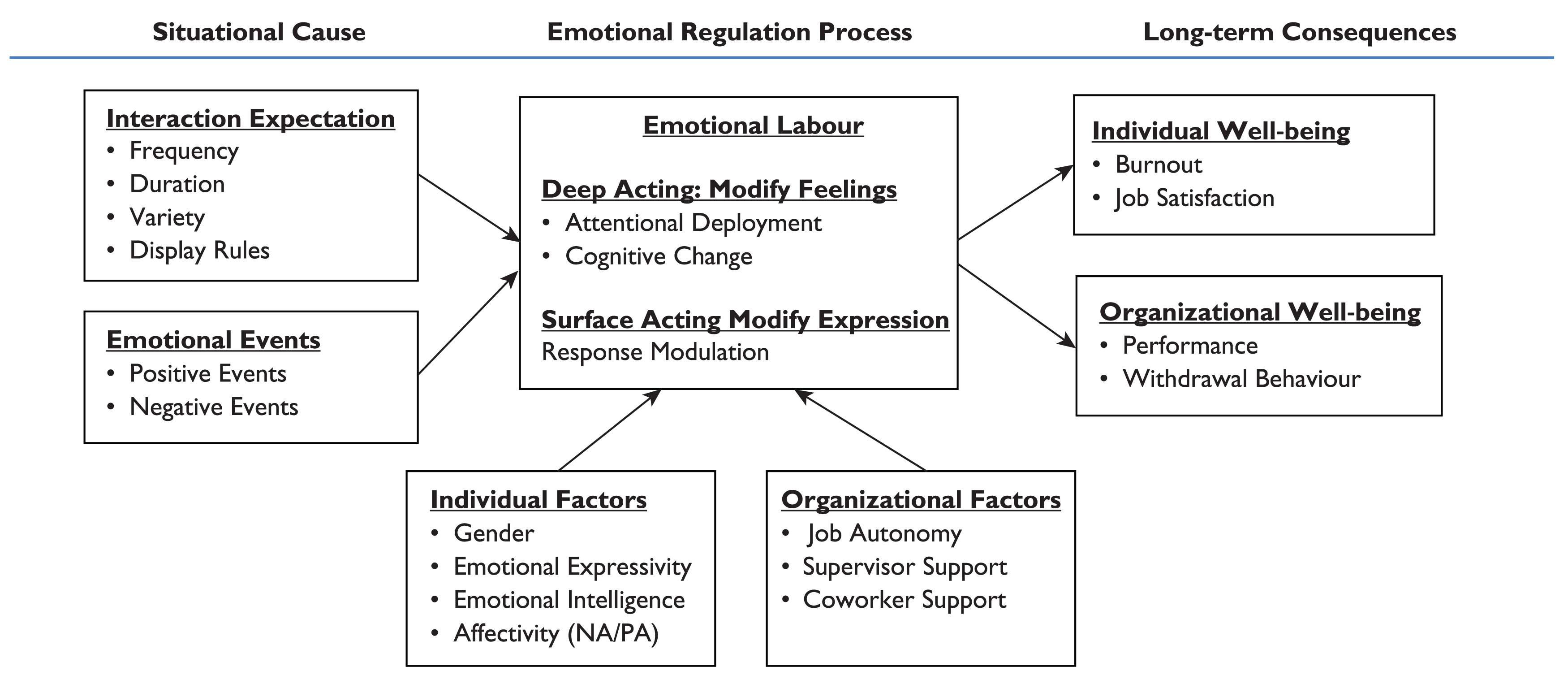
Figure 1 highlights the framework for understanding emotional labour. It discusses the antecedents, consequences and the process of emotional labour. Emotional labour, a workplace phenomenon, is affected by various factors-situational factors, emotional events at workplace, individual traits and organizational factors. The process of emotional regulation involves a modification of the feelings (deep action) and a modification of the expression (surface acting). Emotional labour has long term consequences (positive and negative) on the individual and the organization.
Antecedents of Emotional Labour
Gross (1998b) proposed that situational variables, namely, frequency, variety, duration and display rules, are the antecedents of workplace emotion regulation. These variables act as cues from which emotions emanate.
Frequency
Different jobs require different frequencies of employee and customer interactions. For example, the front desk employee of a small legal firm may welcome just four clients in a day, whereas the receptionist of a corporate hospital may have to meet 10 customers in an hour.
Variety
Service workers are expected to show a variety of emotional displays. However, three types of emotional responses have been hypothesized and confirmed. These comprise integrative emotions (happiness and sympathy), differentiating emotions (fear and anger) and masking as proposed by Jones and Best (1975) and Wharton and Erickson (1993). Frontline employees essentially are required to express happiness and sympathy (integrative emotions) and suppress fear and anger (differentiating emotions).
Duration
A paramedical staff may require interacting with a patient for hours during a procedure, while a house keeping staff may not often need to interact with a guest in a hotel. The higher the frequency and duration of interaction, the higher the likelihood of faking expressions (surface acting) or modifying feelings (deep acting). Therefore, these factors are labelled as the antecedents of emotional labour. There have been mixed results of the study of the relationship between the expectations of customer interaction and emotional labour. Morris and Feldman (1997) and Grandey (1999) reported non-significant co-relation between interaction frequency and emotional labour (surface acting and deep acting). A study by Brotheridge and Lee (1998) proposed a significant positive relation between interaction frequency and surface acting and deep acting though no relation was found between duration and surface and deep acting.
Display rules
Display rules imply the level to which showing and masking emotional expressions is considered to be a part of workplace performance of an employee and emotion regulation is mandated by the organization (Ekman & Friesen, 1975; Hochschild, 1983; Rafaeli & Sutton, 1989).
Emotional Events
Emotional events at work explain employee behaviour. The event may emanate both positive and negative emotions and may thus have a positive or negative effect on the employee’s well-being. For example, an irate customer blaming an employee for a service failure emanates negative emotions. The employee angry and disgusted, though, is expected to regulate his emotions to show a composed appearance, because the organization’s display rules expect him to be composed. His actual emotions are indeed incongruent from those prescribed by the organization. Such an event leads to more emotion regulation. Another example is about hearing a rise about a rise at workplace. This event creates a positive emotion and thus helps to comply with the display norms. In this event, lesser emotion modification is needed.
Long-term Consequences of Emotional Labour
Emotion regulation by way of surface acting or deep acting requires efforts and lays physiological demands on the incumbent (Gross, 1998a, 1998b; Lazarus, 1991). As discussed below, emotional labour leads to the following outcomes:
Burnout
Burnout is a characteristic of service industries and an outcome of stress. Phenomenally, burnout occurs when an employee gets overboard in his involvement and interaction with customers and is left with meagre means and resources to revive the emotional energies thus depleted (Jackson, Schwab & Schuler, 1986). The indications of burnout are emotional fatigue, depersonalization, personal estrangement and reduced sense of personal accomplishment. Repeated and high levels of emotional exhaustion detach or depersonalize the employee from the customers (Cordes & Dougherty, 1993; Maslach, 1982). Wright and Cropanzano (1998) have reported an association between burnout and important organizational outcomes such as turnover and performance. Empirical research works by Abraham (1998), Morris and Feldman (1997) and Brotheridge and Lee (1998) have proved that managing emotions at work lead to emotional exhaustion.
Job satisfaction
Job satisfaction is an indicator of well-being at work and is a measure of employee’s assessment of a job. Facial feedback hypothesis suggests that expressions may have a positive or negative relationship with job satisfaction (Adelmann & Zajonc, 1989) but the regulatory effort exercised to arrive at that expression is definitely negatively related to job satisfaction. Two studies by Abraham (1998) and Morris and Feldman (1997) suggest that the experience of dissonance was negatively related to job satisfaction. Table servers who showed ‘genuine smiles’ at workplace did not experience a personal alienation for being false and hence had more job satisfaction than those who gave fake smiles (Adelmann, 1995). Hochschild (1983) asserted that emotion regulation and job satisfaction are inversely related.
Organization Outcomes of Emotional Labour
Customer service performance
Customer retention and hence repeat business and thus the bottom lines depend on how well employees manage emotions in a service setting (Albrecht & Zfimke, 1985; Hochschild, 1983; Schneider & Bowen, 1985). Expressions of happiness, empathy, friendliness and smiles are expected and these expressions definitely induce appropriate feelings in customer and hence result in a great customer service (Ashforth & Humphrey, 1993). Emotion research suggests that surface acting and deep acting have differential effects on customer service. Customers may detect the ‘ingenuity’ of expression in surface acting. Such ‘leakages’ suggest deception to the customers and could affect the service performance negatively (Ekman & Friesen, 1975). Contrarily, deep acting leads to far more genuine expressions because it convinces the employees that they truly feel the way they are trying to express their emotions. This perception of ingenuity relates deep acting positively to customer satisfaction.
Withdrawal behaviours
Cordes and Dougherty (1993) and Singh, Goolsby and Rhoads (1994) reported that jobs high on emotion regulation result in high incidence of withdrawal behaviour and turnover. Thirty-six out of 49 respondents reported that they either left the work floor or talked to co-workers as a coping mechanism in dealing with difficult customers (Bailey, 1996). This is not a good sign because employee availability to customers is an essential prerequisite in customer service jobs (Parasuraman et al., 1985).
Factors Affecting Emotional Labour
Emotional labour comes easy to many and may be arduous for many. Personality variables, thus, need to be taken into cognizance for understanding the concept of emotional labour clearly.
Gender
Women are more likely to face more emotion regulation situations at home and at work and hence become more adept at it than their male counterparts, who probably find it more difficult to manage emotions and thus need more training inputs on managing emotions when they deal with customers (Wharton & Erickson, 1993). Resultantly, suppression of true feelings too often leads to higher stress levels in women.
Expressivity
Persons high on positive expressivity show a higher compliance with organizational display rules and consequently low levels of emotional labour and thus better performance in service interactions (King & Emmons, 1990).
Emotional intelligence
The ability to identify and use emotional information in social interactions is called emotional intelligence. Those high on emotional intelligence can handle social encounters well and make others feel good too (Goleman, 1995).
Self-monitoring
Self-monitoring is the extent to which people can monitor their self-presentations and control their expressions (Snyder, 1974). Low self-monitoring means being genuine and ‘true’ to internalized feelings, and high self-monitoring implies having the flexibility to adapt the emotional expression to match the situational needs. Suppression is a characteristic of low self-monitors and hence low self-monitors report relatively higher levels of emotional labour and consequentially a higher workplace stress, as against high self-monitors who react less to dissonance and hence report less burnout (Abraham, 1998; Hochschild, 1983).
Affectivity
Affectivity could be positive (enthusiasm, optimism) or negative (pessimism, aversion). High negative affectivity means strong reactions to negative events if they occur. Hence, more emotional labour needed to comply with the display rules in difficult encounters (Weiss & Cropanzano, 1996).
Organizational Factors
Autonomy
Autonomy implies control over events. Studies reveal that high autonomy at job reduces the stress of emotion modification. High autonomy leads to lower emotional exhaustion (Wharton, 1993). Morris and Feldman (1996) asserted that job autonomy has a relationship with emotional dissonance and exhaustion and has a positive relationship with job satisfaction.
Supervisor and co-worker support
Environment indicates the emotional response that is likely to follow (Gross, 1998b). Co-worker support creates a positive and conducive working environment (Schneider & Bowen, 1985). Working in a congenial environment leads to job satisfaction, reduces stress and leads to lesser withdrawals and excellent team work (Cropanzano, Howes, Grandey & Toth, 1997). Positive perceptions or feelings about the social environment necessitate less emotional labour. The expected emotions are genuinely felt, and hence, there is no dissonance in feelings and their expressions. In fact, coping with stress becomes far easier. A supportive environment offers a cathartic value, helps coping with difficult customers and thus provides a cushion against health risks (Carver, Schein & Weintraub, 1989). Social support at workplace shields against stress (Goolsby, 1992; Pines & Aronson, 1998). Social support moderates emotional labour and its outcomes and interacts with emotional dissonance to provide a defence against job satisfaction (Abraham, 1998).
Objectives of Study
To examine the relationship between emotional labour and emotional exhaustion for frontline hotel employees;
to explore if any significant difference exists between emotional labour experiences of male and female employees;
to study the moderating role of co-worker cooperation on emotional labour; and
to recommend the industry on reducing the adverse effects of emotional labour.
Hypothesis
Four hypotheses have been formulated to meet the objectives of the current study.
H1: Emotional labour leads to emotional exhaustion.
H2: Both the mechanisms of emotional labour (surface acting and deep acting) differ in their propensity to produce consequent emotional exhaustion. Surface acting results in more emotional exhaustion than deep acting. Technically, surface acting has a positive relation with emotional exhaustion and deep acting has a negative relation with emotional exhaustion.
H3: Male and female employees differ in their experiences of emotional labour. Female employees engage in more deep acting than the male counterparts in similar profiles.
H4: Co-worker support moderates the relation between emotional labour and emotional exhaustion.
Methodology
Participants and Procedures
Human resource (HR) personnel of 25 hotels in Jaipur were contacted via a personal meeting and apprised of the study objectives. Fifteen hotels agreed to the proposal. The unit of analysis was the frontline employees of various departments of the hotel. One hundred and fifty frontline employees of these fifteen hotels were administered the questionnaires. One hundred and forty questionnaires complete in all respects were used for analysis. A response rate of around 93 per cent was thus achieved. The hotels chosen for study all belonged to the same segment, size and clientele kinds and hence were quite comparable.
The respondents were all frontline employees. There were 80 women (57 per cent) and 60 men (43 per cent). These figures well represent the actual workforce in service industry. This is quite in sync with various research works asserting that more service jobs are performed by women than men (Bird & Sapp, 2004; Hochschild, 1983; Jordan, 1997).
Academically, approximately 65 per cent of the respondents were graduates, and 35 per cent were educated up to high school. The mean sample age was 25.4 years. Average organizational tenure of the sample was 2.06 years. The sample profile is indicative of a relatively young sample with less experience.
Measures
Three reliable, consistent and valid scales were used for measuring emotional labour, emotional exhaustion and co-worker support.
Emotional Labour Scale
Items measuring emotional labour (surface acting and deep acting) were taken from the emotional labour scale (Brotheridge & Lee, 1998). The scale had six items each for surface acting and deep acting. These items were drawn from a review of emotional labour literature and identified regulation mechanisms, such as faking, hiding and modifying feelings, as a part of the job. Reasonably good coefficient alpha values were reported for surface acting and deep acting. The dimensions were measured on a five-point Likert scale (where 1 = never and 5 = always). A higher scale on these sub-scales suggests higher levels of emotional labour.
Emotional Exhaustion Scale
Items to measure emotional exhaustion were taken from Maslach Burnout Inventory (MBI) (Maslach & Jackson, 1986). The inventory had nine items on emotional exhaustion (α = 0.9; sample item: ‘I feel emotionally drained from my work’). Besides, the inventory has six items on diminished personal accomplishment (reverse coded). The measures are validated by Cordes and Dougherty (1993). The responses were measured on a five-point Likert scale where 1 = never and 5 = always.
Co-worker Support Scale
Four-itemed Caplan et al.’s (1980) measure was used to record the level of co-worker support. A five-point Likert scale where 1 = strongly disagree to 5 = strongly agree was used to measure the responses. A sample item reads, ‘My co-workers go out of the way to make my work life easier for me’. Reported α for this scale = 0.79 (Repeti & Cosmas, 1991).
Analysis
Principal Components Analysis
The discriminant validity of the instrument was checked by performing three rounds of principal components analysis (PCA) for the multi-item scales.
First set of PCA involved the predictor variables of surface acting and deep acting. A varimax rotation revealed that two components had eigen values > 1. The two components taken together explained 70.90 per cent of variance. The first component deep acting contributed 38.42 per cent, and the second component surface acting contributed 32.48 per cent. All the items loaded substantially and were thus retained.
Second set of unrotated PCA involved nine emotional exhaustion items. Four items belonging to two factors were cross loaded and hence removed. Remaining five items were again subjected to unrotated PCA. All the five items were found to be loaded on a single factor that explained a total of 59.8 per cent of the variance.
Third set of unrotated PCA was performed on four co-worker support items. All the four items loaded clearly on a single factor which explained 60.25 per cent of the variance.
Descriptive Statistics, Zero-order Correlations and Cronbach’s Coefficients Alpha
Co-relation
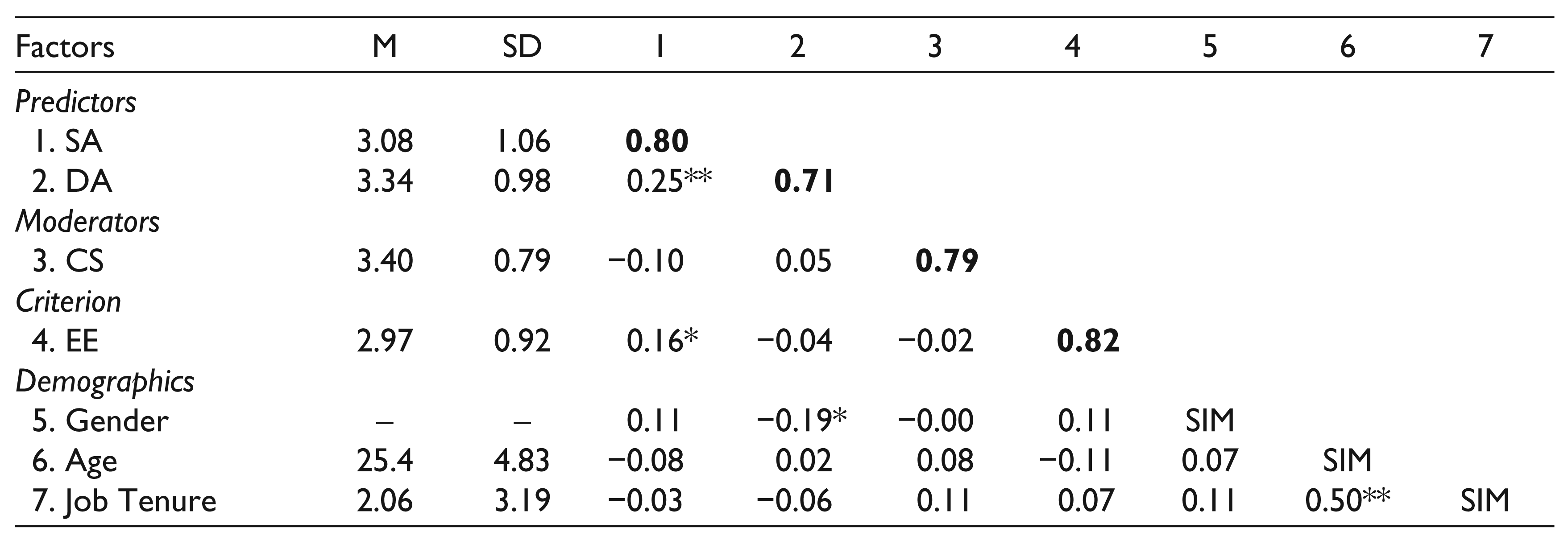
Table 1 shows the Pearson co-relation values between the study variables. The Cronbach’s alpha coefficient values for all the variables of interest exceeds 0.60, suggesting that the scales used have been found to have internal consistency and reliability. The table shows that emotional labour leads to emotional exhaustion (Hypothesis 1 proved), and surface acting was positively related to emotional exhaustion (r = 0.16, p < 0.05) (Hypothesis 2 proved). Deep acting was negatively related to gender (r = −0.19, p < 0.05), suggesting a significant difference between males and females with respect to deep acting and female workers being engaged in deep acting much more than their male counterparts (Hypothesis 3 proved).
Regression Analysis
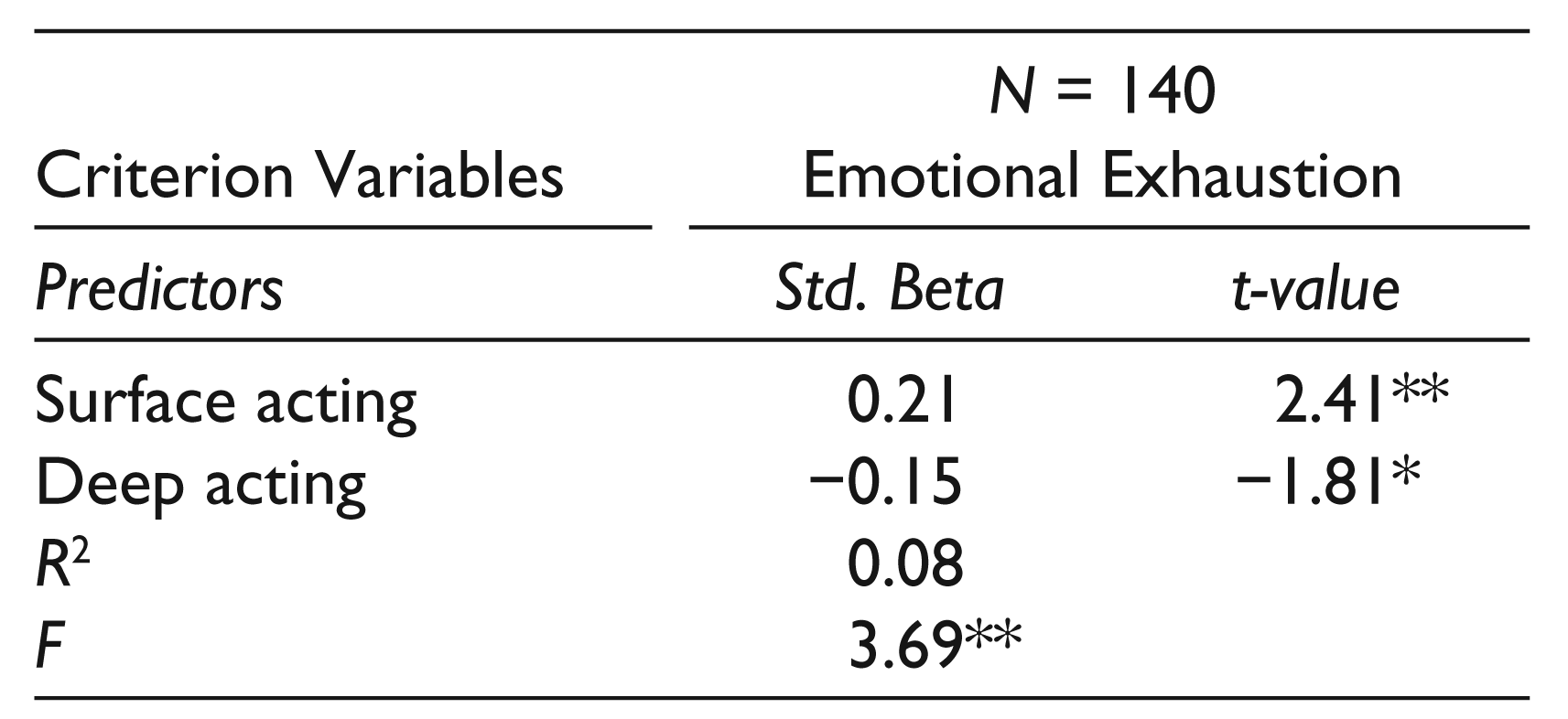
When emotional exhaustion was regressed on surface acting and deep acting, two outliers were found and removed. Table 2 indicates that surface acting and deep acting are significant predictors of emotional exhaustion (Hypothesis 1 proved). Surface acting being a positive predictor (β = 0.21; p = 0.02). Deep acting was the negative predictor of emotional exhaustion (β = −0.15; p = 0.07) (Hypothesis 2 proved). The model is significant with F = 3.69, p = 0.03. Both the processes, surface acting and deep acting, together explain a variance of 8 per cent (R2 = 0.08) in emotional exhaustion (Hypothesis 1 proved).
Regression Results: The Relationship between Emotional Labour and Emotional Exhaustion
Hierarchical Multiple Regression (Moderating Role of Co-worker Support)
Co-worker support as a moderator in relationship between emotional labour and emotional exhaustion was examined by a three-step hierarchical multiple regression analysis.
Step 1: Entering the predictor variables (surface acting and deep acting).
Step 2: Adding of proposed moderator (co-worker support) to the equation.
Step 3: Inclusion of interaction terms (SA × CS and DA × CS).
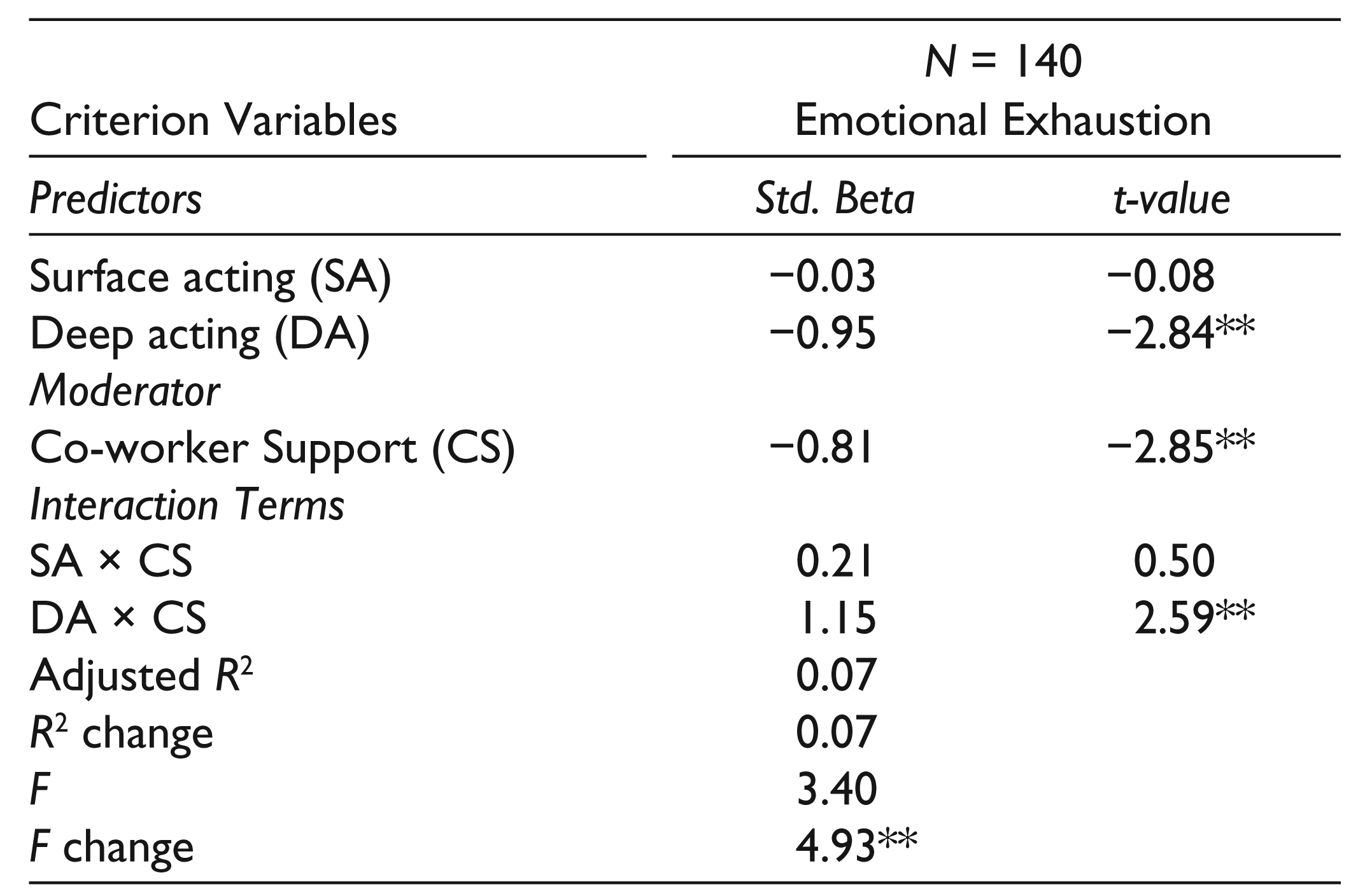
Table 3 indicates that with β = −0.81, p = 0.01, co-worker support significantly predicted emotional exhaustion in the expected direction. F = 3.40, p < 0.01 suggests that the model for emotional exhaustion was adequate. F change at 4.93 suggests that co-worker support is a moderator, but only for the relation between deep acting and emotional exhaustion (β = 1.15, p = 0.00) (Hypothesis 4 partially supported). The direction of the relationship is indeed contrary to the expectation. It reveals that as employees get engaged in more of deep acting, high co-worker support becomes detrimental, because emotional exhaustion is seen to increase significantly as levels of deep acting increase from moderate to high. This is indeed surprising.
Discussion
The key findings from the study and consequent recommendations are as follows:
The study corroborates the previous studies that propose that emotional labour leads to emotional exhaustion (Kim, 2008; Yang & Chang, 2008). Both surface acting and deep acting have been confirmed to be significant predictors of emotional exhaustion in the expected direction. It is the chosen mechanism of emotional labour, either surface acting or deep acting, rather than emotional labour itself that leads to emotional exhaustion. It is all about how emotional labour is performed (by way of either deep acting or surface acting) that decides the consequent emotional exhaustion rather than emotional labour itself. The study suggests that while surface acting is positively linked to emotional exhaustion, deep acting is negatively linked to emotional exhaustion. This implies that surface acting is detrimental to individual well-being, in the sense that it leads to more emotional exhaustion, whereas deep acting helps alleviate emotional exhaustion. We can thus conclude that is much better to ‘feel’ the organizationally prescribed emotions (deep acting) rather than ‘faking’ the emotions (surface acting) in compliance with the organizational display rules. The managerial implication of this finding is that the employees should be trained to experience and display appropriate emotions (deep acting). Sincerity in emotional displays should be emphasized upon. Superficial emotions (surface acting) are detrimental to both organizational and individual well-being, because they cause more emotional exhaustion and the customer can identify superficial feelings from those that are sincerely felt. Surface acting may thus actually offend an astute customer. Deep acting thus leads to organizational and individual well-being (Kim, 2008).
Regression Results with Co-worker Support as a Moderator in the Relationship between Emotional Labour and Emotional Exhaustion
The male and female employees in similar profiles differ in their experiences of emotional labour. Women use more deep acting in an attempt to comply to the organizational display norms than do their male counterparts. It is probably attributable to the fact that women face more emotion regulation situations at home and at work, they are better at socializing and relation building and hence they become more adept at emotional regulation than their male counterparts. This finding suggests that males need more training inputs on managing emotions when they deal with customers (Wharton & Erickson, 1993). Thus, education and training in emotion management should be gender specific (Grandey, 2000).
The current study did not fully support the fourth hypothesis (H4) which states that co-worker support moderates the relationship between emotional labour and emotional exhaustion. It failed to find a sync with previous research works of Abraham (1998), Hochschild (1983) and Schneider and Bowen (1985). In fact, the study suggests that co-worker support could be an antecedent of emotional labour and could contribute to emotional labour and its consequences. Contrarily, ‘reverse buffering’ as noted by Beehr (1995) is substantiated by the current study. Reverse buffering means that high level of co-worker support may lead to decrease in job satisfaction as emotional labour increases. Co-worker support may fail to buffer the effect of job stressors on individuals. The same has been documented by Johnson (2004) and Chu (2002). Johnson (2004) proposes an explanation to this seemingly contradictory observation. He asserts that social support is reciprocal in its intent in collectivist cultures. Thus, seeking support from a colleague has an implicit obligation to reciprocate the same when the co-worker is in difficult times. This situation becomes emotionally taxing as it requires an employee to support the co-worker in addition to managing his own emotions. Thus, as emotional labour increases, job satisfaction decreases and emotional exhaustion increases. Very evidently in the current study, co-worker support has failed to buffer the stressors and has been found to compound emotional exhaustion, instead of alleviating the negative aspects of emotional labour. This suggestively can be compensated by other ways like-use of humour, break in duty, open houses which provide a platform to vent off the job-related frustrations (Chu, 2002). Catharsis in open houses does not obligate an individual to reciprocate as is often required in seeking support from co-workers.
Limitations and Future Study
The small sample size restricted to a small number of hotels in Jaipur indeed makes it difficult to capture all the relevant relationships. The results can thus not be generalized and hence a future validation study with a more diverse and larger sample becomes imminent.
Other variables, such as individual characteristics and emotional labour, occupational roles and emotional labour, also need an exploration and warrant a future study.
A longitudinal study shall be more effective as compared to the current cross-sectional design. A longitudinal study shall ensure a better measure of emotional labour over a period of time.
Finally, the study draws attention to the oft neglected aspect of work place emotions. Emotional labour is also a form of labour that employees perform at their workplace, besides the more recognized physical and mental labour. Emotional contribution is unfortunately not recognized by the industry in designing its compensation structure. Perhaps, addressing the emotional labour aspect in designing the compensation for service employees shall lead to more job satisfaction, less emotional exhaustion, quality service encounters and consequently better bottom lines. A study can be designed to explore the aforesaid relationships.