




Abstract
India is one of the largest textile producers in the world. Textile industry is huge employment-providing industry after agriculture in India. The present article is an attempt to analyse first, the growth and composition of employees engaged in textile industry in India. Second, to find the growth and relation between employments, man-days employed, wages and net value added (NVA) by textile industry in India. And lastly, the impact of labour productivity in wage determination is also analysed. The results suggested that there is huge gender disparity in employment, that is, women are very few in comparison to men workers. Overall employment in textile has an increasing trend among both categories of textile industry. Further, spinning, weaving and finishing of textile manufacturing is growing faster than manufacturing of other textiles. Employment in textile industry has a positive and significant correlation with real wage rates in both categories of industries. This indicates that increase in real wage rate causes enhancement in employment in textile manufacturing. And further results suggest that labour productivity is a significant determinant of wage rate of textile employees.
Introduction
System and Growth of Textile Industry
India is the second largest producer of textiles after China. 1 Textile industry is one of the most labour intensive industries, providing huge employment in India after agriculture. Both skilled and unskilled people get employed in this industry. It has a significant role in Indian economy as it is the largest employer and exports contributor. 2 Its contribution to India’s GDP was 2 per cent and to exports it was almost 13 per cent during 2015–2016. 3 Textile industry is one of the traditional industries and has presently increasing scope in terms of employment generation, foreign exchange and GDP contribution. Future prospects of Indian textile industry depend on rise in demand of Indian consumers and exports (Landes, MacDonald, Singh, & Vollrath, 2005). Increase in female workforce participation further act as growth driver for textile industry. 4 Availability of raw materials such as cotton, jute, and silk and other fibres contributes to the development of this sector (Roopa, 2016). Further, the growth and development of textile industry depends on training and development of employees, proper compensation and incentives, its performance appraisal practices (Singh & Jain, 2014). Inaccessibility to these facilities cause reduction in productivity of industry and thus global competitiveness and prospects of textile manufacturing (Chaudhary, Pervej, & Anjum, 2016). Indian textile manufacturers must use advanced technology and high quality fibre by skilled workers to be a globally competitive industry (Chandra, 1999).
Schemes Initiated by Government of India for Textile Industry
Government of India has also initiated various schemes from time to time keeping in view the growth potential of textile industry. Government had approved Scheme for Integrated Textile Park (SITP) in July 2005 to achieve international standards textile manufacture. E-marketing scheme was initiated by central cottage industries corporation of India. These are successfully working in this direction. ‘Make in India’ scheme also facilitates the growth of manufacturing of textile. Textile industry is one of the 25 industries included in ‘Make in India’, which have high growth potential.
Growth in Employment and Wages in Textile Industry
Indian textile industry is growing faster to meet the global textile needs of globalization since 1991. However, with the introduction of multi-fibre agreement in 2005 by WTO, quota restrictions on exports were reduced. It opened a wider opportunity avenue for Asian textile industries to trade in global market without unnecessary restrictions and to earn and grow foreign exchange (Ambrogio, 2016). Employment and job opportunities are increasing in textile industry due to its globalization. Developing Asian countries have comparative cost advantage in terms of cheap labour cost, thus resulting in improved production, productivity and exports in textile manufacturing (Wang, 2013). This industry alone provides direct employment to nearly 45 million people in India. 5 It adds to 4 per cent in India’s GDP. Introduction of modern textile machinery could improve global competitiveness of India. 6 Wage rate in textile industry is higher than agriculture sector, and thus, it adds to the economic development of people of developing countries like India (Keane & Velde, 2008). Employment in textile sector is determined by capital employed, output of firm and past employment (Narayanan, 2003). After removal of quota barrier, it has captured international market share of textile. It further enhanced employment avenues for semi-skilled and unskilled labour and also provided alternate employment to rural migrants (Devaraja, 2011). However, overall female participation is low in Indian textile industry. But whosoever is employed on regular contract basis was found to have achieved self-autonomy and empowerment, delay in marriage and economic improvement of family (Sivasankaran, 2014). Thus, employment of females must be encouraged to enhance their economic and social empowerment and to improve productivity. Proper quality management of textile meeting international standards and improved productivity will further provide growth avenues of Indian textile industry in global market (Bedi, 2009).
The present article is an attempt to analyse the growth of employment, wages and net value added (NVA) by textile industry in India. Further, the relation between employment, wages, NVA and man-days per employee will also be analysed. After that, the impact of labour productivity in wage determination will be analysed. The study will provide insight into composition and growth of employees engaged in it and growth of various industrial attributes. It will indicate the impact of raise in productivity on employees wage rate determination. To study the sub-category trends in these two broad categories of textile industry and to know growth prospects and female participation in textile manufacturing will be the future implication of the present study.
Objectives of the Study
Present study is conducted with the following specific objectives:
To study the growth and composition of employees engaged in textile industry in India. To identify the growth in employment, wages and NVA by textile industry in India. To identify the relationship among growth of real wages, man-days employed per employee, real NVA and total employment in textiles industries. To know the impact of labour productivity in wage rate determination in textile industry in India.
Hypothesis of the Study
The hypothesis set up in conformity with the aforementioned objectives are as follows:
H01: There is no significant impact of labour productivity on wage rate determination in spinning, weaving and finishing of textiles industry. H02: There is no significant impact of labour productivity on wage rate determination in manufacture of other textile industry. H03: There is no significant correlation among growth of real wages, man-days employed per employee, real NVA and total employment in textiles industries.
Methodology of the Study
The secondary data for the present study are taken from Annual Survey of Industries (ASI), provided by Ministry of Statistics and Programme Implementation (MOSPI). Data for textile industries of 3-Digit NIC-2008 are taken for analysis which belongs to classification of the various codes discussed further.
Code-131: Spinning, Weaving and Finishing of Textiles
According to Central Statistical Organisation, NIC-2008, Code-131 category includes following activities:
1311 1312 1313
Code-139: Manufacture of Other Textiles
According to Central Statistical Organisation, NIC-2008, Code-139 category includes the following activities:
The data from 2008–2009 to 2013–2014 are included in study period. Wages and NVA is inflated by CPI for industrial workers. Pearson’s correlation coefficient is used to show the relationship between employment, real wages and man-days employed, and real NVA. However, the impact of labour productivity on wage determination is analysed through simple linear regression analyses. For calculating the impact of labour productivity on wage rate determination, the terms wage rate and labour productivity is calculated as follows:


Results and Discussion
Table 1 discusses the composition of employees engaged in the manufacturing of textile industry from 2008–2009 to 2013–2014. For spinning, weaving and finishing of textiles, workers and employees other than workers are engaged. From 2008–2009 to 2013–2014, trend regarding men and women workers are increasing but it shows more engagement of men in comparison to women in the industry. The disparity between men and women is massive. Strict restriction on women to work causes their less participation. Further less female workforce participation hinders global competitiveness of Indian textile industry as other competitive countries have adequate female participation. At the managerial level, employees engaged in the textile industry also show increasing trend except in the year 2012–2013. Other employees engaged in spinning, weaving and finishing of textiles show fluctuating trend. The number of employees decreased in 2011–2012 and 2012–2013. Unpaid family members, proprietors, etc. engaged in spinning, weaving and finishing of textiles show a fluctuating trend. It decreased from 2008–2009 to 2010–2011 and then suddenly jumped to 7,005 persons. It once again decreased in 2012–2013 and rose slightly in 2013–2014.
Composition of Employees Engaged in Manufacturing of Textile in India
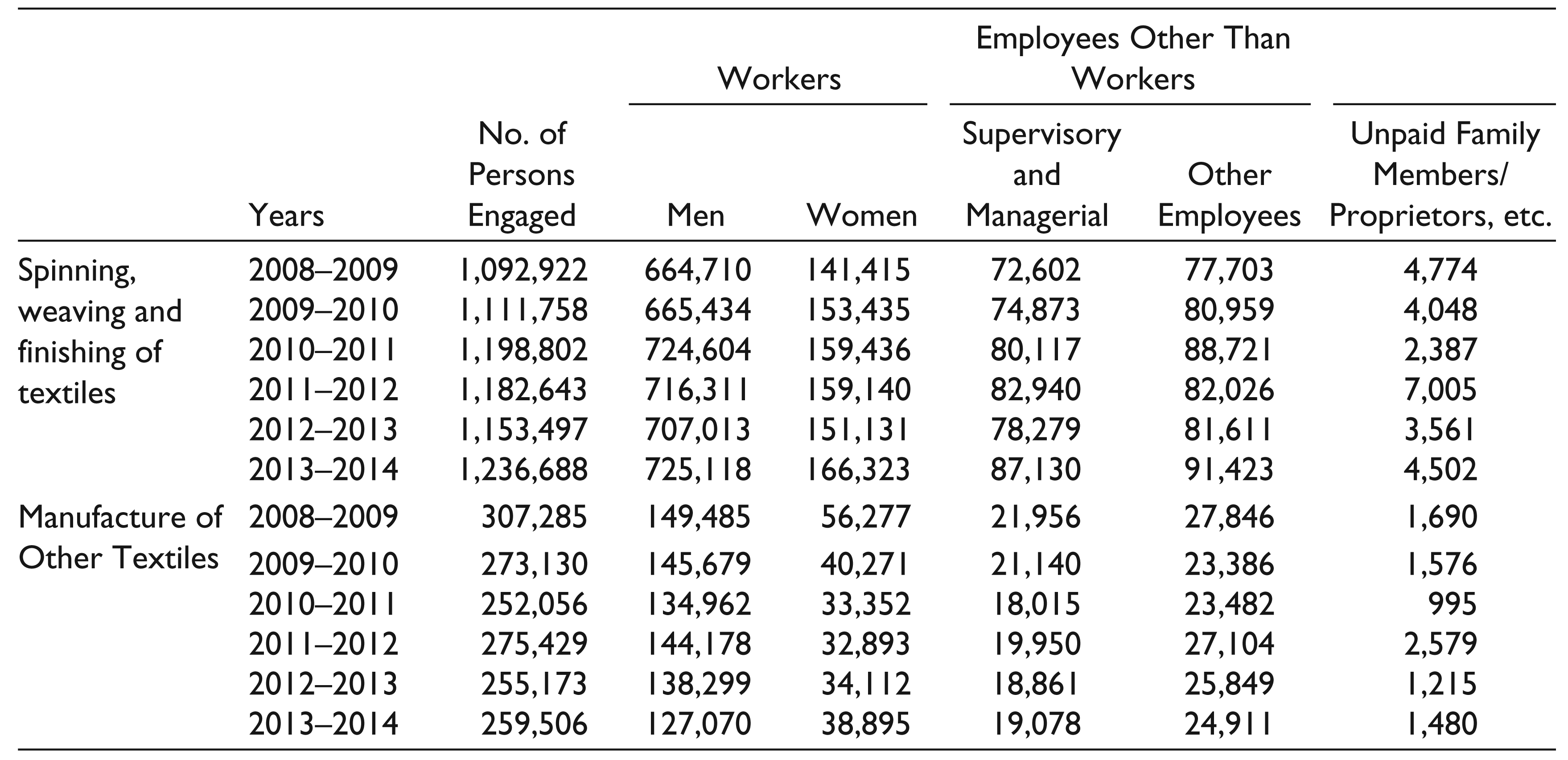
Regarding the composition of employees engaged in manufacture of other textiles from 2008–2009 to 2013–2014, the disparity between men and women is quite less than workers engaged in spinning, weaving and finishing of textiles. Men engaged in manufacture of other textiles shows fluctuation but stable trend workers do not raise much and remains less than 150,000 approx. Women workers remains less than 50,000 approx. during the aforementioned period. At the managerial level, employees and other employees engaged in the manufacture of other textiles show a low decreasing trend and show low fluctuation sometimes. Unpaid family members, proprietors, etc. show decreasing trend except in the year 2010–2011.
Overall result shows that composition of employees engaged in the manufacturing of textile industry is huge and more fluctuating than employees engaged in manufacture of other textiles. Many unpaid family members, proprietors, etc. are engaged in both.
Table 2 shows the growth of textile industry in India from 2008–2009 to 2013–2014. For spinning, weaving and finishing of textiles, real wages remain quite stable in the first two and next three years. In the year 2013–2014, real wages jumped to 454,876.7 rupees. Growth in real wages is quite high in 2010–2011 and 2013–2014, that is, 0.15 and 0.10. Growth in man-days per employee shows stable trend except in 2009–2010 and 2012–2013. These years show negative growth. NVA is rising except in 2011–2012 and 2013–2014, that is, –0.29 and –0.11. Growth in employment generated in spinning, weaving and finishing of textile industry shows fluctuating trend except in 2011–2012 and 2012–2013. Numbers of factories are rising speedily every year. All component of growth shows sign of upsurge for spinning, weaving and finishing of textiles.
Concerning the growth of manufacture of other textiles, real wages are quite fluctuating. So impact on growth is clear. Years 2009–2010, 2010–2011 and 2012–2013 illustrates negative growth. Growth in man-days per employee is stable during the study period. NVA and growth in employment generated is negative except in 2011–2012 and 2013–2014. Numbers of factories are also less than spinning, weaving and finishing of textiles. This presents it as the less growing sector than spinning, weaving and finishing of textiles.
Growth of Textile Industry in India
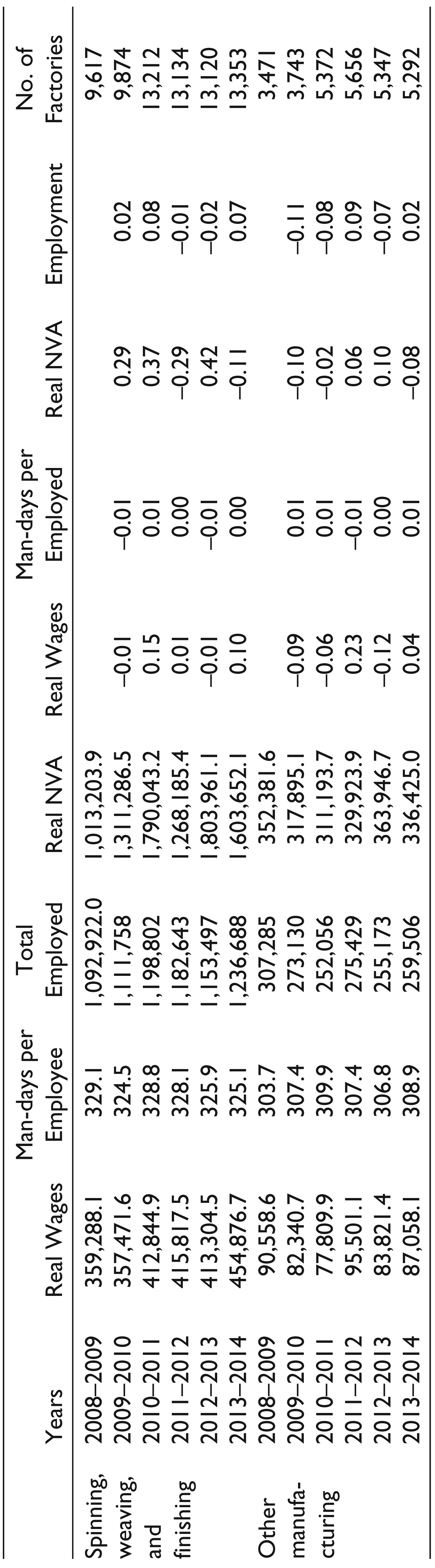
The overall outcome shows that manufacture of other textiles reported low growth than spinning, weaving and finishing of textiles. This sector is growing fast and has huge opportunities than manufacture of other textiles. Overall, there is an increase in purchasing power of textile employees as their real wage rates has increased.
Inter-correlation Matrix of Real Wages, Man-days Employment per Employee, Real NVA and Employment in Textile Manufacturing of India
Inter-correlation matrix is computed to know the relation between growth of real wages, growth in man-days employed per employee, growth rate of real NVA and growth rate in total employment in textile industry (in both categories, i.e., Code-131 and Code-139).
H0: ρ = 0, that is, the correlation coefficient of population is zero (null hypothesis)
H1: ρ ≠ 0 (alternate hypothesis)
Table 3 (Code-131) indicates that employment growth rate and real wage rate in spinning, weaving and finishing of textiles have significant positive correlation at 5 per cent level. It indicates that growth in real wages is significantly correlated with growth in employment. This pair is found to be correlated in population. All the remaining pairs have no significant correlation in population. Similar to our study, growth rate in employment and real wages were found to be significantly correlated in manufacturing sector but that relation was negative (Goldar, 2000). It can be concluded that growth in real wage is accompanied with growth in employment rate in the same direction in textile industry (Code: 131) (Table 4). NIC-2008, Code: 139 (Manufacture of Other Textiles)
Table 3 (Code-139) indicates that manufacture of other textiles also have significant correlation in the pair growth rate in employment and growth rate in wages at 5 per cent level of significance. It indicates that growth in real wages is positively accompanied by growth in employment in manufacture of other textiles. Null hypothesis is rejected only for the pair of real wages and employment rate. All other remaining pairs have no significant correlation at 5 per cent level of significance and hence null hypothesis is accepted.
Inter-correlation Matrix of Textile Manufacturing in India
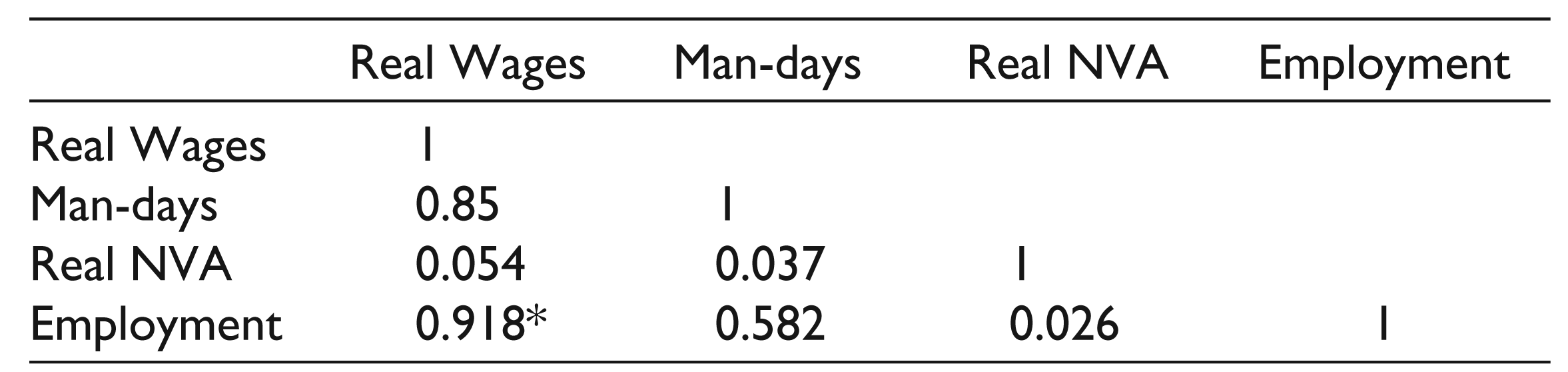
NIC-2008, Code: 131 (Spinning, Weaving and Finishing of Textiles)
Inter correlation matrix of manufacture of other textile manufacturing in India
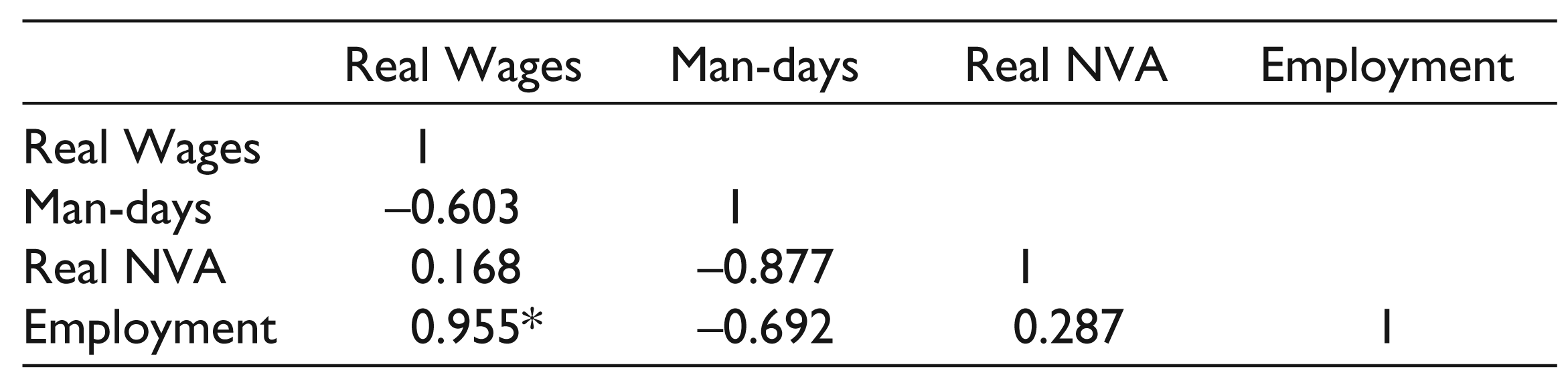
Thus, overall employment increases with positive growth in real wage rate in spinning, weaving and finishing of textile and manufacture of other textile industry.
Impact of Labour Productivity on Wage Rate in India
Labour productivity determines growth of an industry. Our effort in this study is to identify the extent of impact of labour productivity on wage rate determination in textile industry in India. To know the impact and relation of labour productivity, the following regression equation is used:
where
X1 = Wage rate of textile employee; X2 = Labour productivity of textile employee
α = Intercept
β = Regression coefficient
Є = Error term
Results of Table 5 indicates that for both the category of textile industries, NIC Code-131 (spinning, weaving and finishing of textiles) and NIC Code-139 (manufacture of other textiles), impact of labour productivity on wage rate determination is found to be significant at 5 per cent level of significance. In the former industry (Code-131), 74.5 per cent of wage rate determination is explained by labour productivity. On the other hand, the latter industry (Code-139) has 91 per cent role of labour productivity. Hence, higher the productivity of labour in industry, higher will be the wages in that industry.
Simple Linear Regression between Wage Rate and Labour Productivity in India

Conclusion
Indian textile industry is one of the largest employment-providing industries after agriculture. Number of employees (both workers and non-workers) have increased over the period but female workers are very few in comparison to male workers. Spinning, weaving and refining of textile manufacturing have major growth prospect in terms of employment, wages, man-days employed and NVA in comparison to manufacturing of other textiles. The growth in real wage rates of employees indicates increase in overall purchasing power of employees of textile industry. The growth rate of employment in textile is positively correlated to real wage rate in industry. It indicates that with an increase in real wage rate, the employment in textile industry also increases. Lastly, labour productivity was found to be a significant factor in wage determination. It indicates that with an increase in labour productivity, there is an increase in wage rates of textile employees.