




Abstract
The wave of change and rigorous competition has compelled the power sector to adopt a proactive resolution-oriented employee relations (ER) approach towards employee satisfaction and organizational performance. A cordial ER is based on fairness, trust and mutual respect and leads to motivated, loyal and high-performing employees and facilitates them to achieve the optimum results for their organization. Therefore, the study aims to examine the employer–employee relations prevalent in power sector. A structured questionnaire was administered to collect the data from a sample of 175 full-time working members including both executives and non-executives and were analysed using SPSS. For this study, a hypothesized research model was developed to investigate the relationship between drivers of ER and cordial ER. The regression analysis entails that the variables such as: interpersonal relationships, safe and healthy work environment, and employee welfare were significant predictors of cordial ER. The research will add practical insights for managers to realize the importance of these drivers of ER and to design appropriate strategies and policies for maintaining better ER.
Keywords
Introduction
Employees, named as human resources, are indispensable for the growth and sustainability of any organization (Benn et al., 2014). It is therefore, the obligation of business firms to satisfy the stakeholders by fulfilling their needs and desires to make them feel contented and committed. Happy and satisfied employees are productive employees. So, a variety of motivational tools, extensive efforts and significant resources have been adopted to attract and retain the productive workforce (Albrecht & Andreetta, 2011). In this globalized era, competent personnel has been given more preference, as they share a healthy relationship with their co-workers, supervisors and managers in the work setting to deliver their best performance (Armstrong, 2008). Thus, a collaborative employee–management relationship is an absolute one for the realization of common goal.
Employee relations (ER) is an integral aspect based on fairness, trust and mutual respect. Jacob (2002, p. 5) defined ER as ‘an important area of practice in which there is an integration of people into the work situation in a way that motivates them to work together to enhance value productively, cooperatively and with economic, psychological and social satisfaction’. ER includes a body of work concerned with regulating employer–employee relationships that lead to motivated, loyal and high-performing employees. It is involved in the proactive prevention and resolution of the issues arises out of or affects the work situation by encouraging employee participation. The relationship between employers and employees in the work context is based on the interpersonal relationships which are vital for the well-being of employees and affect their job-related decisions (Kanungo & Mendonca, 1994). The workforce becomes more productive, cooperative and affirmative when they are aware of their employer’s commitment to ensuring a safe and healthy workplace and prioritize their welfare (Kearns et al., 1998). So, the focus of the organizations needs to shift from institution building to nurturing a symbiotic relationship in order to engage and involve employees and to enhance and cultivate a positive psychological contract.
In the growing business scenario, organizations are mobilizing themselves with the new management techniques, functions and organizational dynamics which will help them in protecting and promoting good employee relations. In India, the power sector is growing at a faster pace and has a substantial impact on the economy and well-being of the nation. This is the hour, the organizations need to follow different strategies and policies, flexible and proactive resolution-oriented approaches, and new ER dynamics to promote cordial employee relations leads to organizational success. Thus, this study is an effort-making creation of the researchers to investigate the quality of relationship the employees’ exhibit with their employers in the power sector.
Overview of Literature and Hypotheses
In this section, three key drivers of cordial employee relations such as interpersonal relationships, safe and healthy work environment, and employee welfare are extracted from the existing theoretical background.
Interpersonal Relationships
It is an inescapable part of the working life developed through continuous interaction and association of employees with their co-workers, supervisors and subordinates for a positive and healthy ambiance at the workplace. The quality interaction among individuals can have a serious effect on their health, well-being and enjoyment of work. A variety of research has suggested that positive interpersonal relationships at workplace are linked with increased organizational commitment (Cogliser et al., 2009; Liden & Wayne, 2000), job satisfaction (Cogliser et al., 2009; Harris et al., 2009), employee morale, autonomy and team performance (Kostova & Roth, 2003). Dodgson (1993) and Carmeli et al. (2009) advocated that better interpersonal relationships inspire the employees to learn new things within the organizations. Researchers have investigated that positive interaction and social support encourages employee engagement (Hansen et al., 2014), creativity and innovation (Munoz-Doyague & Nieto, 2012; Nisula, 2015), sharing of knowledge (Peroune, 2007), positive mental health (Stewart-Brown, 2005) and reduce workplace violence (Bowen et al., 2011). Prior studies have reported that there are some contextual factors such as trust (Brower et al., 2000; Nienaber et al., 2015), work dimensions like task accomplishment, personal support and career development (Kahn, 2007), organizational culture, team size and company policies, which influence the development of a collegial relationship (Henderson et al., 2009; Liden et al., 1993). According to Brower et al. (2000), Pratt and Dirks (2007) and Gill (2008), trust is recognized as the central promoter of all positive relationships as it reflects allegiance or loyalty to each other. Thus, from the above discussion it is plausible to suggest that (Figure 1):

Safe and Healthy Work Environment
The work environment is considered as the most critical factor in keeping employees satisfied in today’s business world. It refers to the physical settings characterized by good physical, psychological and mental health of the workforce and inculcates organizational culture, policies and procedures prevailing in the workplace. A safe and healthy work environment is the right of all employees who have strived for the success of their organization, which can improve the health and well-being of employee as well as their families (French et al., 2001; Glanz & Mullis, 1988; Jeffery et al., 1994; Matson-Koffman et al., 2005). According to Nielsen et al. (2007), a positive mental health is the primary resource for creativity, which is increasingly relevant with a view on the emerging knowledge world. Prior studies have suggested that constructing a safe and healthy work environment can encourage employee motivation, productivity and organizational success, and reduce absenteeism (Benedict & Arterburn, 2008; Black, 2008; Harden et al., 1999). Jaskiewicz and Tulenko (2012) examined that safe and healthy work environment will enable workers to give their best and perform effectively and efficiently. Researchers have demonstrated that the workplace environment provides various resources to working individuals including job autonomy, a positive workplace climate and co-worker support (Crawford et al.,2010). The work of Dickson-Swift et al. (2014) shows organizational culture, personal relationships, flexible work, supportive management, good communication and an open and trusting workplace relationship (Kalliath & Kalliath, 2012) are the significant factors affecting the work environment. Employee involvement plays a central role in safe and healthy work environment (Vassie & Lucas, 2001). Workforce empowerment (Habeck et al., 1988, 1991; Hunt et al., 1993; Shannon et al., 1992) and good management–employee relations (Hunt et al., 1993; Shannon et al., 1992) are deemed essential, because each of these components was consistently found to be related to lower injury rates (Geldart et al., 2010). Creating work environments that enable people to flourish have proved to be very challenging (Bichard, 2009; Kossek et al., 2011). Hence, based on the findings of the previous researchers it can be proposed that:
Employee Welfare
It is an extensive term incorporating various services, benefits and facilities in addition to wages and salaries provided by organizations to its employees for the intellectual, physical, moral and emotional development (Patro, 2015). The International Labour Organization (ILO) report defined labour welfare as ‘such services, facilities and amenities as may be established in or in the vicinity of undertakings to enable the persons employed in them to perform their work in healthy, congenial surroundings and provided with amenities conducive to good health and high morale’ (Mamoria et al., 2008, p. 530). This influential measure has been commenced by the government, employers and trade unions towards furnishing statutory, non-statutory and mutual welfare facilities to the employees to maintain a decent life. The welfare provisions are governed by the policies and laws, but the welfare package is based on negotiation and agreement between the employer and employees without any government interference (Ogini & Adesanya, 2013). In the Indian constitution, different laws such as The Factories Act, 1948, The Mines Act 1952 and The Plantations Labour Act 1951 have been enacted to provide welfare amenities to the employees within the country. In this context, both intramural (inside establishment) and extramural (outside establishment) welfare facilities are provided. Intramural facilities include canteen, drinking water, restrooms, crèches, training, protective clothes, compensation for the accident, first aid, ambulance and social security measures. The extramural (outside establishment) facilities comprise housing, educational, medical, recreation club, transportation and so on which are availed by both the employees and their families. The welfare measures are the means to happiness of the employees and enhance motivation (Odeku & Odeku, 2015; Ramana & Reddy, 2015) morale, job satisfaction, employee involvement (Upadhyay & Gupta, 2012), retention, employee health, living standard (Mohan & Panwar, 2013), job performance, efficiency, productivity, employee creativity, industrial peace (Kemboi et al., 2013; Logasakthi & Rajagopal, 2013; Sindhu, 2012) and quality of work-life (Satyanarayana, 2010). It acts as a stimulus for employees’ dedication and efficiency in the organization (Casey, 1999; Tiwari, 2014). Previous studies have revealed that welfare facilities help in developing employees’ self-confidence and intellectual level (McGuire & McDonnell, 2008). Researchers have established that the prime objective of employee welfare measures is to promote healthy employer–employee relations (Satyanarayana, 2010). Sindhu (2012) advocated that welfare facilities boost the organizational productivity and encourage healthy industrial relations so industrial peace can be maintained. In other studies, it was analysed that employee welfare is the critical one to build up a strong relationship between employers and employees (Logasakthi & Rajagopal, 2013; Nanda & Panda, 2013; Odeku & Odeku, 2015; Yadav & Kumar, 2013). Several studies have suggested that inadequate welfare measures may lead to conflict, high turnover and absenteeism (Kumari, 2013; Yadav & Kumar, 2013). Thus, from the above argumentation, it can be hypothesized that:
Drivers of ER and Cordial Employee Relations
Employee relations, a broader concept incorporates both industrial relations (IR) and human resource management (HRM). ER is concerned with the administration of all managers as well as non-management labour. Gennard and Judge (2002, p. 6) defined ER as ‘the study of the rules, regulations, and agreements by which employees are managed both as individuals and as a collective group, the priority given to the individual as opposed to the collective relationship varying from company to company depending upon the values of management’. In the area of ER, several researchers have proposed that organizational culture, communication, employee loyalty and trust, organizational justice, provision of welfare amenities, and employee training and development are the key determinants which have paramount importance for its enhancement. These studies have been conducted considering their individual impact on ER. The current research takes into account the drivers of ER comprised of the three organizational factors, namely interpersonal relationships, safe and healthy work environment, and employee welfare, to explore their combined effect on cordial ERs, which have not been studied earlier. Thus, this study makes a novel effort to highlight on these three dimensions and to provide empirical evidence in the extant literature of employee relations. ER is so pertinent to public sector undertakings that relevant antecedents are required to be investigated to promote cordial employee relations. So, the study sheds light on these three factors named as drivers of ER and the following hypothesis can be assumed:
Objectives of the Study
The researchers and business leaders are paying continuous efforts to identify the antecedents of ER. Most of the scholarly works on ER have not been able to present a holistic approach on the drivers of ER. Thus, this study is a deliberate attempt of the authors to find out the most pertinent predictors and their significant impact (individual and combined) on ER in the power sector, which is a unique dimension towards people management across the nation. The research objectives are framed and cited as follows:
To examine the impact of interpersonal relationships on cordial ER in power sector. To analyse the effect of safe and healthy work environment and its relation with cordial ER. To explore the relationship between employee welfare facilities and cordial ER. To investigate the combined effect of the drivers of ER on cordial employee relations.
Methodology
Sample
Data pertinent for the study were collected from a state-owned public sector undertaking, named as Odisha Power Transmission Corporation Ltd. (OPTCL), located in Bhubaneswar, the capital of Odisha. The participants were selected by stratified random sampling method including both executives and non-executives as the basic sampling units for the current study.
Study Instrument
A structured questionnaire comprised of 21 items was developed and used as the prime instrument to gather relevant data from the eligible respondents. It was administered among 200 respondents, and 175 (87.5%) number of questionnaires having adequate information were collected and considered as relevant for the analysis. The items taken for framing the questionnaire were selected from the previous research studies and some were self-designed based on the feedbacks received from the respondents during the pilot study. The questionnaire was segmented into three parts: demographic profile in the first section, drivers of ER comprises of 17 questions enlisted in the second section and four questions meant for cordial employee relations were cited in the third section.
Variables and Measures
In this research, four key variables such as interpersonal relationships (IPR), safe and healthy work environment (SHWE) and employee welfare (EW) are considered as the independent variables and cordial employee relations (CER) as the dependent variable. The participants were asked to select the one that best defined their perceptions on a 7-point Likert scale ranged from (1 = strongly disagree to 7 = strongly agree) relating to the four key variables. The specific dimensions were used such as interpersonal relationships, which were measured using a six-item scale, out of which two items were adopted from Janssen and Van Yperen (2004), two items from Ferris et al. (1995) and two items were self-designed. For safe and healthy work environment, six-item scale was used, out of which four items were adapted from Morgeson and Humphrey (2006) and two items were developed by the author. The employee welfare dimension was measured using a five-item scale, out of which two items were adopted from Wallace et al. (2006) and three items were designed by the researcher. CER was measured using a four-item scale, out of which two items were adopted from Gill and Meyer (2013) and two items were identified by the researchers.
Analysis and Interpretation of Results
In this work, interpersonal relationships, safe and healthy work environment, and employee welfare were employed as the independent variables and regressed on the dependent variable CER. Before examining the combined effect of drivers of ER on CER, each independent variable is investigated through regression analysis to establish the significant impact of each item on CER. The authors have used SPSS version 20 to analyse the collected data using various statistical tools such as descriptive statistics, reliability, correlation coefficient and multiple regression analysis.
Demographic Profile
In this study, about 69.7 per cent were male and 30.3 per cent were female. Among the respondents, 36 per cent were between the age group of 48 and 57 years, 25.7 per cent were 58 years or above, 20 per cent aged between 38 and 47 years, 15.4 per cent were between 28 and 37 years and 2.9 per cent of the respondents were between 18 and 27 years. With regard to the marital status, about 92.6 per cent of the sample was married and 7.4 per cent was single, representing a maximum number of respondents was married. In terms of education, it was categorized as 10th, ITI/+2/Diploma, Graduation and Post-Graduation. But, it was found that 49.7 per cent of the respondents were graduates and 50.3 per cent were post graduates. The majority of the respondents about 30.2 per cent had work experience of 31 and above years, 26.9 per cent had between 21 and 30 years of experience, 22.3 per cent had between 11 and 20 years of experience and 20.6 per cent of the respondents had less than 10 years of work experience.
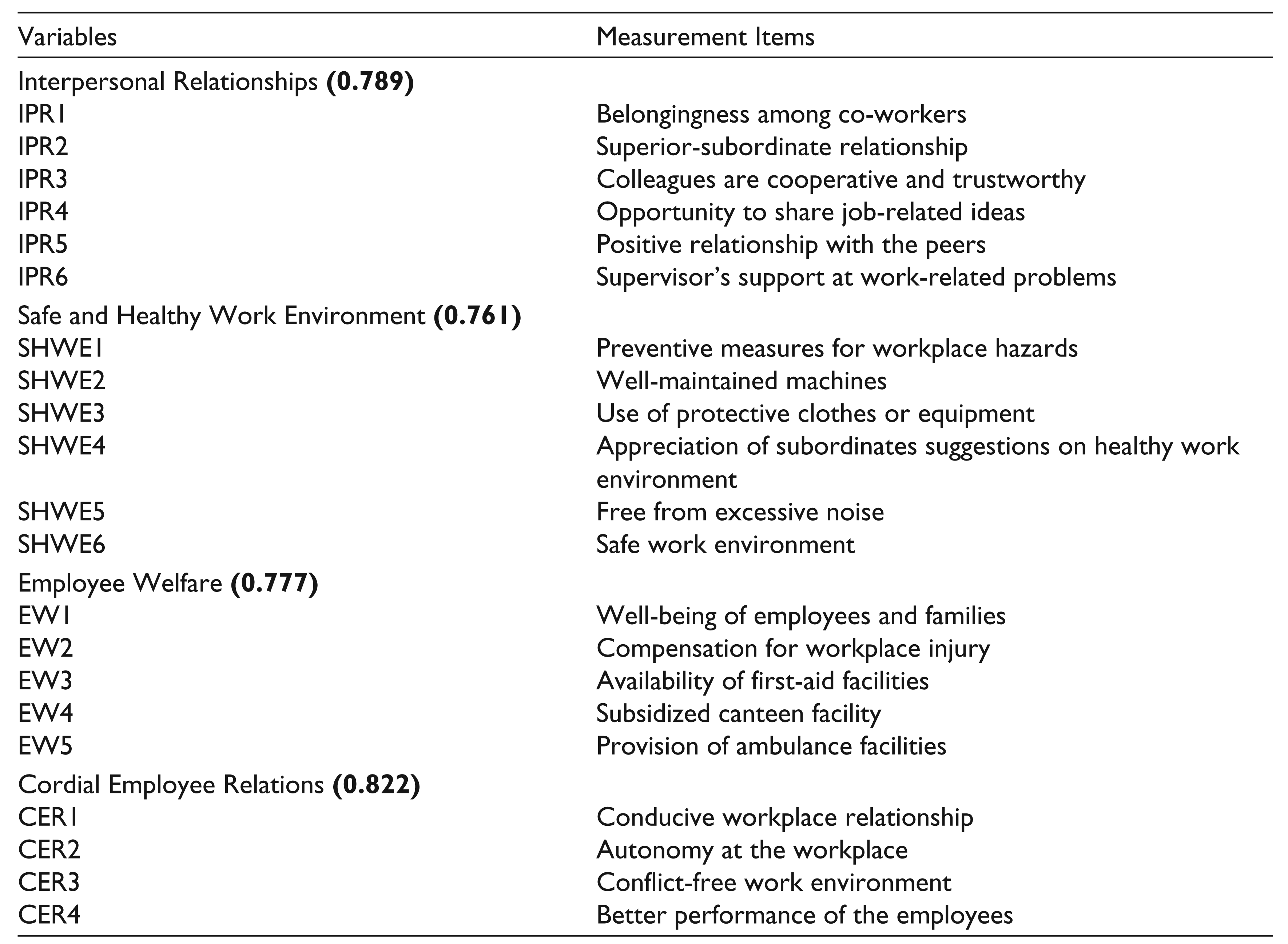
Table 1 depicts the values of the reliability coefficients to establish the internal consistency of all variables. The value of alpha coefficient should be ranged from 0 to 1 and 0.7 or above is considered more suitable (Hair et al., 2010). In this study, the alpha values of all the variables are greater than 0.7, which indicates the items in the scale are reliable.
The estimated values of the means, standard deviations and Pearson correlation coefficient are displayed in Table 2. The mean values of each variable lies between 5.39 and 5.86, indicating the variables taken for the study were acceptable by the respondents. As the table shows, the values of standard deviations of all variables lies between 0.58 and 0.90 which proves less variance from the mean response of the respondents. To analyse the significant relationship among the variables, Pearson correlation is used. The table shows that all the variables are positively and significantly correlated with each other and the absence of multicollinearity among the independent variables which is acceptable for regression analysis.
In this study, regression analysis was conducted to ascertain the predictors of ERs and to analyse the combined effect of drivers of ER on CER. Thus, the significant items of each variable are combined to get an average score and these variables are considered as the drivers of ER which are further regressed on the dependent variable CER.
In Table 3, the results of all the hypothesized relationships are interpreted and described as:
Model 1 describes the relationship between interpersonal relationships and CER, where, ‘F’ value of 46.237 is highly significant at (0.000) level. The value of R2 (0.623) depicts that 62.3 per cent of the variance in CER explained by the items under independent variable interpersonal relationships (IPR2, IPR3, IPR4 and IPR6).
There is a strong relationship between safe and healthy work environment and CER as evidenced from the results of the regression model (Model 2). In this model, the value of ‘F’ is 46.080 which is highly significant at (0.000) level. R2 is 0.612 which states that the items of SHWE (SHWE1, SHWE 2, SHWE 3 and SHWE 4) have explained about 61.2 per cent of the variance in CER.
The relationship between employee welfare and CER is presented in Model 3, where F-statistics is 55.787 and p-value are highly significant at (0.000) level. The value of R2 is equal to 0.623 and indicates that 62.3 per cent of the variance in CER can be explained by the items of EW (EW1, EW2, EW3 and EW5).
In Model 4, the relationship between drivers of ER and CER are displayed and the results reveal that ‘F’ value of 92.568 is highly significant at (0.000) level. The value of R2 is 0.619 which indicates that up to 61.9 per cent of the variance in CER can be significantly explained by the drivers of ER (IPR, SHWE and EW).
In Table 4, the results of regression coefficients of drivers of ER are presented, which are elaborated as follows.
Description of items and reliability coefficients (Cronbach’s alpha)
Means, Standard Deviations and Correlation Coefficient

Estimated Regression Models

Unstandardized and Standardized Coefficients
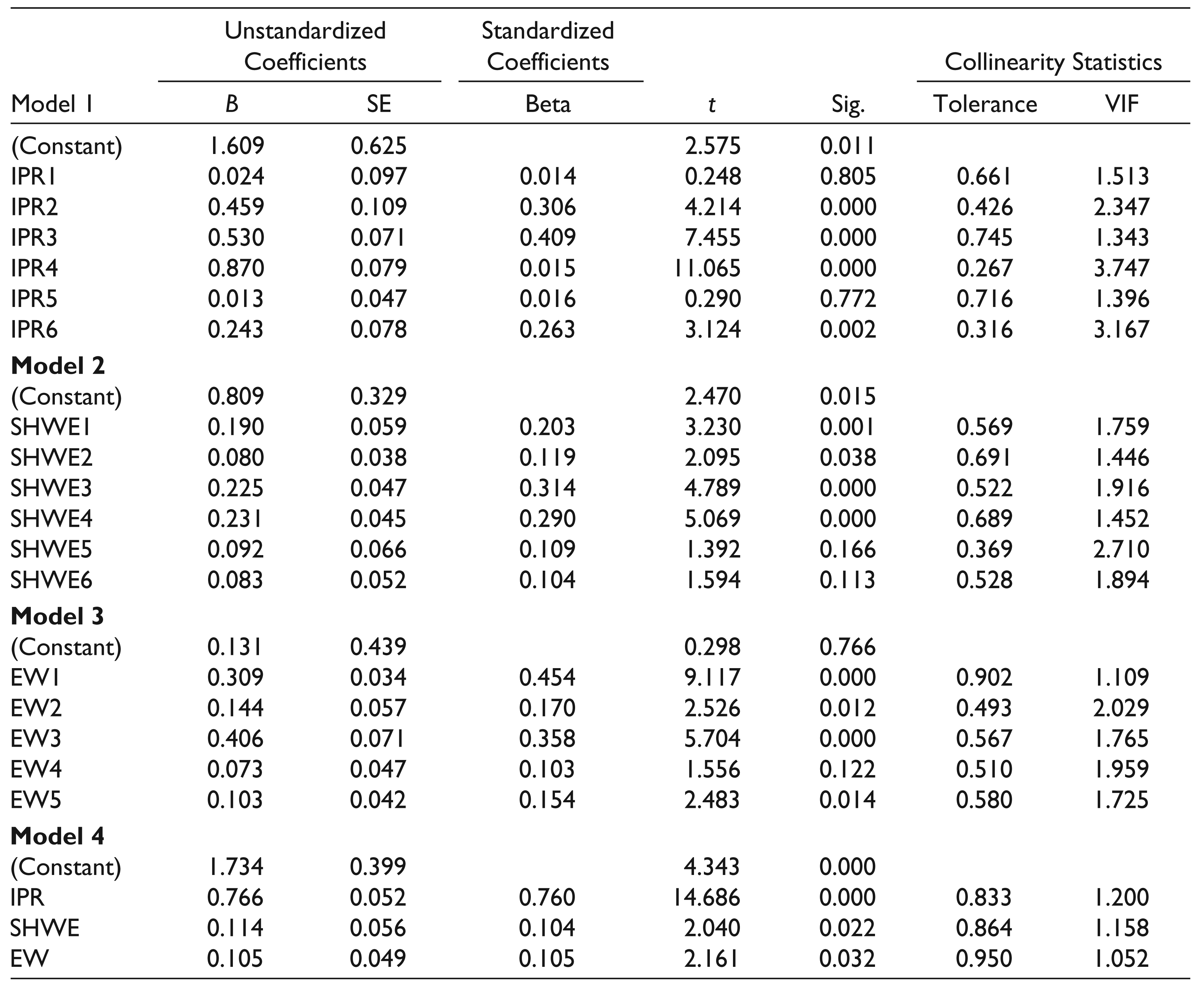
In Model 1, IPR3 is having the highest (0.409) beta coefficient value, indicating the strongest significant contributor in explaining CER. The beta coefficient of IPR1 (0.014) is the smallest and explaining all other items are more important than it. All the items are significant at (0.000) level except IPR1 and IPR5. The multicollinearity diagnostic statistics shows that tolerance value is not below 0.10 and VIF does not exceed the recommended limit of three but the estimated values are very close to this. It shows that the relationship among the independent variables is not creating any problem in explaining the dependent variable CER. Therefore, estimated regression model is:

Model 2 represents the regression coefficients of safe and healthy work environment, where SHWE3 is having the highest (0.231) beta coefficient value, describing the strongest impact on CER. The beta coefficient value for SHWE6 is the smallest (0.104), defining that impact of other items are more stronger than it. All the items are significant at (0.000) level, but SHWE5 and SHWE6 do not satisfy the significance level. In the multicollinearity statistics, none of the variables have a tolerance value below 0.10 and VIF above three. Thus, there is no multicollinearity problem among the predictor variables of the model. Thus, the following regression model can be estimated as:

Model 3 shows the result of regression coefficients of employee welfare, where EW1 is one of the items with the highest (0.454) beta coefficient value which explains that it is the strongest one in influencing CER. EW4 is having the smallest (0.103) beta coefficient value and denotes that the other four items are more important than it, and all the items are significant at (0.000) level except it. In collinearity statistics, tolerance and variance inflation factor (VIF) shows satisfactory results which are not less than 0.10 and exceed three, respectively. Therefore, we can estimate the regression model as:

In Model 4, IPR is obtaining the highest beta coefficient (0.760) with respect to SHEW (0.105) and SHWE (0.104). It defines, IPR is the strongest significant contributor of CER than the other two. The t-value for each of the three variables is significant at (0.000) level. In collinearity statistics, none of the variables have a tolerance less than 0.10 and VIF statistics is greater than the recommended limit of three. Thus, the relationship of independent variables is not creating any problem in explaining CER. From this analysis, it can be estimated that:

On the basis of the results obtained, we can conclude that the above-mentioned variables are significant predictors of CER. From the empirical analysis, the authors found that the values of R2 and F are valid and significant in all the three regression models. Hence, all the proposed hypotheses are confirmed and accepted.
Discussion
The main purpose of this study was to analyse the organizational factors that predict the relationship between the employees and managers of power sector in Odisha. The results of this study demonstrate that interpersonal relationships, safe and healthy work environment, and employee welfare have a significant impact on CER. The findings of the research are significantly different from other studies because the authors have given emphasis to determine the combined effect of the drivers of ER on CER. Previously, there has been plethora of studies on employee relations, but it is an initial step towards introducing the relationship between the drivers of ER and CER. Thus, the findings of the study provide a complete understanding of the significance of the antecedents towards establishing cordial employee relations in state-owned public sector undertakings.
The findings of the study illustrate that the interpersonal relationships have a positive and significant relationship with employee relations. This study provides an intuition for the enterprises to institute a positive interpersonal relationship with co-workers, supervisors, subordinates and managers to boost a healthy employer–employee relations. The study supports that the accurate incorporation of superior–subordinate relationship (Liden et al., 1993; Maslyn & Uhl-Bien, 2001), cooperative and trustworthy colleagues, opportunity to share new job-related ideas (Kianto, 2008), and superior’s support at work-related problems are the prime measures for promoting harmonious employee relations. It is also vital for the organizations to develop belongingness among co-workers and to maintain good relations with the peers. These two dimensions (IPR1 and IPR5) do not satisfy the significance level and need further attention. There is ample of studies on interpersonal relationships establishing a relation with communication, organizational commitment, job satisfaction, trust, quality of work life and employee’s creativity (Brower et al., 2000; Cogliser et al., 2009; Nisula, 2015). But, this work is an endeavour to examine the influence of positive interpersonal relationships on CER, which was not yet empirically analysed.
Another finding interprets that there is a positive and significant relationship between safe and healthy work environment and CER. The studies conducted by Shannon et al. (1992) and Hunt et al. (1993) have theoretically established that a safe and healthy workplace is deemed to be essential to build up a good employee–management relationship. But, this theoretical suggestion is not sufficient in this context. Thus, this study attempted to empirically investigate whether creating a safe and healthy work environment leads to CER which is an integral aspect of every organization. Previous studies rightly provide insights that well-maintained machines, protective equipment, acceptance of employee suggestions for healthy work environment (Brown et al., 2000), and preventive measures for workplace hazards (James, 2006; Brown et al., 2000; Kanten, 2013) are the effective measures to support harmonious employee relations. In prior studies, it was reported that noise-free work environment and low risk of accidents were the significant predictors of safe and healthy work environment, as it results in organizational productivity and industrial harmony (Ajala, 2012; Varonen & Mattila, 2000). But, in our study, these two dimensions (SHWE5 and SHWE6) did not reach the significance level, and more attention is required in future research. It has become an obligation of the organizations to provide safe and healthy work environment as it ensures psychological well-being, which further enhances employee performance and productivity of the organization.
The derived regression model (Model 3) explained that employee welfare has a positive and significant relationship with CER. In many studies, it has been theoretically established that the welfare measures offered by the organization aim at keeping employees satisfied and inducing a strong employer–employee relations (Logasakthi & Rajagopal, 2013; Nanda & Panda, 2013; Odeku & Odeku, 2015; Satyanarayana, 2010; Yadav & Kumar, 2013). Sindhu (2012) conducted a study on the hypothesized relationship and conferred a similar finding. In previous studies, it has been reported that adequate welfare benefits ensure high morale, motivation, productivity, satisfaction, employee health and well-being, industrial peace, better-living standard and quality of work life (Ramana & Reddy, 2015; Mohan & Panwar, 2013; Shrinivas, 2013; Upadhyay & Gupta, 2012). In this context, the employees are satisfied with the welfare amenities such as compensation for workplace injury and disablement, first-aid and ambulance facilities, and the well-being of employees and families offered by the power sector, which may lead to employee motivation and satisfaction. In this analysis, the dimension of subsidized canteen facility does not satisfy the significance level for which the organization may take necessary steps for this. Therefore, power sector needs to emphasize on welfare measures by considering the well-being of both the individual as well as the family to enhance cordial employer–employee relations that may contribute to the literature by developing a strong relationship between employee welfare and employee relations.
The central focus of the research was to investigate the potential influence of the individual drivers of ER towards flourishing a cordial employer–employee relations. On the basis of the results obtained, it can be suggested that the proposed hypotheses are accepted. The findings of the study demonstrate that the interpersonal relationships, safe and healthy work environment, and employee welfare are independent significant predictors of the dependent variable of CER.
The study also establishes the positive and significant influence of the aggregated ER drivers on CER, which has not been empirically validated in earlier studies. This may be an innovative approach and will enrich the body of knowledge in employee relations. Thus, organizations must focus on positive interpersonal relationships, safe and healthy work environment, and adequate employee welfare measures to have a multifold impact on CER. Further, the above brief discussion substantiates the relevance of the drivers of ER and CER and provides fresh insights for academicians and practitioners.
Implications
The results of the present study have some theoretical and practical implications. This scholarly work provides empirical evidence on the relationship between the drivers of ERs. The findings of this research also contribute to employee relations literature along with interpersonal relationships, safe and healthy work environment and employee welfare by exploring the perception of power sector employees, which is rare in the Indian context. The study is proving some meaningful and practical insights for practitioners to understand the importance of interpersonal relationships, safe and healthy work environment and employee welfare towards cordial employee relations. An important implication in this concern may help the power sector to design appropriate strategies and policies for maintaining better employee relations. The study recommends that organization’s priority towards employee satisfaction would create a happy and productive work environment as well as a lead towards harmonious employer–employee relations.
Conclusion
This study empirically examines the impact of the interpersonal relationships, safe and healthy work environment and employee welfare in shaping cordial employee relations in power sector. The analysis has explained that there is a concrete and significant relationship between the drivers of ER and CER. From the above analysis and discussion, it can be concluded that employees working in the power sector maintain a healthy cordial relationship with their co-workers, supervisors and managers. The employees are very much satisfied with the interpersonal relationships among superior and subordinates, which has a powerful impact on development of CER followed by safe and healthy work environment and employee welfare. Thus, the employees perceiving better relationship are vital for individual happiness and satisfaction, which would enhance the performance of both the employees as well as the organization.
Limitations and Directions for Future Research
The study of employee relations scenario in power sector is an initial effort made by the authors and has some limitations. In this research, a single organization was selected which curbs the generalizability of the results. For future research, a series of comparative studies emphasizing on employee relations can be recommended in order to reach a more generalizable outcome. The scope of the study can be extended to other units of this sector under the ownership of government and private parties located across the nation, employing a large number of individuals sharing a healthy relationship with other stakeholders. A variety of organizations and working environments may deliver different predictors of employee relations. The current research is based on these factors, such as interpersonal relationships, safe and healthy work environment and employee welfare, which are not the only essential predictors affecting employee relations. Thus, the establishment of a quality relationship between employers and employees is imperative to stimulate employee satisfaction and organizational performance.
Footnotes
Acknowledgements
The authors would like to extend sincere thanks to the Indian Council of Social Science Research (ICSSR), New Delhi, India, for the award of doctoral fellowship in favour of Ms Rojalin Sahoo to carry out her research work and this work is an outcome of her doctoral research.