



Abstract
This article proposes a feasible law for the social sciences asserting that we human beings are not commodities, assets, capital or resources. Mainstream economics and Marxism describe human participation in economic and societal production through a human-commodity framework. Intangible flow theory aims to replace that framework and interrelated conjectures as human capital, human assets and human resources. This theory is not exclusively applicable to capitalist/market organization forms. It suggests that (a) commodities are physical goods, and exhibit known characteristics differentiating them from human-related flows as service or knowledge flows; (b) human work has properties that make it akin to quasi-service production; (c) humans are not commodities, capital, assets or resources; (d) machines can obtain the skills necessary to replace human work or perform novel tasks when previously intangible dimensions are turned tangible (tangibilization); and (e) cash-flows generated or saved by those machines tend to flow to human beings who own or control them. According to this theory, greater attention must be paid to flows of economic material elements that display a relevant degree of empirical precision (e.g., cash and physical goods flows).
Keywords
Introduction
In the last century and currently, the dominant view has been to treat human contributions to economic and societal production, such as workflows, service flows, knowledge flows or communication flows, as commodities. This approach is lectured to thousands of students in economic and business schools each year and has influenced other social sciences, which frequently employ related metaphors (e.g., human capital, human assets and human resources). Curiously, last century’s major alternative to mainstream economics, namely, Marxism, also utilizes a human-commodity framework to explain production.
Although different conceptions of neoliberalism exist (Flew, 2014), the neoliberal endeavour is generally well served by treating human contributions to production as a form of capital, which can be metamorphosed into commodities that may be bought and sold. Neoliberalism argues for a larger influence of markets on human life through the commodification of nearly everything, an approach that has resulted in further inequality and fewer national-state production activities (e.g., Desan, 2014; Harvey, 2007; Piketty, 2014; Sandel, 2012; Smart, 2003). Yet, at what point was it demonstrated that humans and our contributions to production are similar to commodities? We may observe a reification process in which an abstraction of work is defined as a commodity as though it were the real thing, but without supporting evidence. For economists, labour in an organization or at home is only considered to be work if it involves some form of monetary payment (wage). Vital work, such as educating children, voluntary service to the community or even preparing food, is otherwise ignored. For instance, if a man marries his housekeeper or his cook, then the gross national product is diminished (Pigou, 1932). Thus, labour economics is not fit to theorize human relations or even work (Abbott, 2014).
Karl Polanyi (1944, 1957; Block & Somers, 2014; Bockman, 2014; Cahill, 2014; Dale, 2011; Fraser, 2014) has noted that the dominant view in economics is built upon a human–commodity framework. In economic sociology, the notion that economic phenomena are embedded in structures of social relations is common (Callon, 1998; Dale, 2011; Granovetter, 1985). Our comprehension of social relations in production has been expanded to include the study of institutions, environment, assets, contingencies, rules, interdependency, networks and micro-political and cognitive cultural dimensions of agency (Heidenreich, 2012; Ingham, 1996; Manning, 2008). Nonetheless, we have been unable to challenge the status quo of mainstream economics (Krippner, 2002, 2011; Crouch, 2011; Krippner & Alvarez, 2007; Lafferty, 2013; Spicer, 2012). Contemporary Marxists claim to have the long-needed alternative to mainstream economics (e.g., Adler, 2009; Beilharz, 2012; Braverman, 1998; Bryer, 2006; Buzgalin & Kolganov, 2015; Fleetwood, 2001; Hudson, 2011; Marens, 2009; Marzec, 2013; Thompson & Smith, 2009). However, although Marx referred to the alienation and reification of workers in productive processes (e.g., Brook, 2009; Meszaros, 2005), he also promoted a human-commodity framework explanation.
Using the intangible flow theory (Cardao-Pito, 2004, 2010, 2012a, 2012b, and further discussed here), we may build a valid alternative whereby humans cannot be construed as commodities, assets, capital or resources in production processes. Within and outside capitalism, human work exists regardless of an eventual association with cash-flows. To clarify that every economic phenomenon is also a social phenomenon is quite important, but not sufficient. We need to develop a persuasive explanation of mainstream economics’ structural failure to capture human participation in economic production. If human contributions to productive processes are not commodities, what are they? To answer this question, intangible flow theory proposes a challenging perspective that is not an end in itself because this theory embraces interdisciplinary contributions and dialogues with other perspectives. For reasons of space, this article exclusively compares the conception of intangible flow theory to those of mainstream economics and Marxism. Other theoretical frameworks should be addressed elsewhere.
What kind of problems do mainstream and Marxist theories face when they conceptualize human participation in production on par with commodity inputs and how the intangible flow theory addresses those specific problems? Mainstream economics and Marxism’s research methodologies are not technologically prepared to capture the intangible flow dynamics of economic and societal phenomena. Therefore, human-related intangible flows, such as workflows, service flows, knowledge flows or communication flows, become unobservable or inextricable from tangible flows as monetary or physical good flows. Thus, the distinction between humans and commodities befalls beyond reach. Therefore, a better solution cannot be attained than to describe human contributions to economic production as commodities (or assets, capital, resources), and humans as mere commodity-like production factors. Intangible flow theory can identify the intangible flow dynamics of economic and/or societal phenomena, and establish a distinction between humans and commodities. Thus, the new theory provides a foundation for research technologies capable of addressing phenomena that are mystified through the refutable human-commodity framework (e.g., productive processes and cash-flows). Moreover, the new theory may deal with human-related flows not necessarily connected to economic production or cash-flows.
Three Conceptions of Human Participation in Economic Production
Conception According to Mainstream Economics
Economists and sociologists have modified the meaning of the word ‘capital’. Although its previous concept of money investable or invested in business is still used in business circles, since long ago in economics and sociology capital implies elements involved in a production process that can be used to increase the wealth of investors. The exact moment when the original meaning to the word capital was established is difficult to estimate. Evidence demonstrates that the concept was already used by medieval traders in the Western world (Cannan, 1921; Hodgson, 2014) and Roman jurists (Schumpeter, 1954). In his Early History of the Term Capital, Cannan (1921) exemplifies several ancient texts conveying the original meaning, such as the Universal Dictionary of Trade and Commerce (1751), Bank of England’s 1697 Act of Parliament, Dictionary of the French and English Tongue (1611) or Postlethwayt’s Universal Dictionary of Trade and Commerce (1751).
On the other hand, the meaning modification seems well documented. The change was made by the economist Adam Smith (1977 [1776]) (Cannan, 1921, p. 480). Instead of considering capital as a sum of money which is to be invested, or which has been invested in certain things, Smith makes it the things themselves, for instance, machines, land or persons. This alteration has eliminated the direct association between capital and money. As a result, the word capital has been applied to describe both physical goods and human contributions to the productive process.
I identify mainstream economists as formalist economists who define economy by its object, namely, the study of utility maximization under conditions of scarcity (Caliskan & Callon, 2009). Utility functions are used to claim that individuals and organizations are motivated solely by self-interest. This particular concept of rationality, represented by a scantily defined mathematical function, is invoked to explain the behaviour of persons and organizations in nearly every context. This self-interest perspective existed before Smith’s texts on utilitarian philosophy, as developed by Jeremy Bentham and John Stuart Mill (Hurtado, 2008). However, Smith’s change of meaning to the word capital has had a vast impact upon the social sciences (Hodgson, 2014). It has led to a plethora of related terms, such as reputational capital, organizational capital, cultural capital and intellectual capital (Hodgson, 2014 for more details). The conceptualization of humans as capital is similar to using formulations such as ‘human assets’ (e.g., Harrel & Klick, 1980; Yin & Shanley, 2008) and ‘human resources’ (e.g., Price, 2011; Wright & McMahan, 2011), in that human contributions are seen as instrumental means to increase the wealth of investors. In sociology, a particularly popular leaning uses the expression social capital after Hanifan (1916) and Bourdieu (1977, 1986).
While money invested seems precisely measurable, the question of how to measure the post-Smith concept of capital was not solved by Adam Smith. The influential solution that persists today was devised by Irving Fisher, who has made a practical application of the discounted cash-flow model. An ad hoc approach to evaluate investment projects, this model had been used since the Old Babylonian period and throughout the Middle Ages (Parker, 1968). This model quantifies capital and organizational value through forecasts of how much cash will flow to owners or shareholders in the future, adjusted by a rate representing risk effects and the time value of money. This estimation, often called the net present value or net present worth, operates under the constraint of utility functions that are defined regardless of consumption preferences (e.g., Fisher, 1892; 1906, p. 202; 1907, p. 13; 1930, Appendix 6.11; Stigler, 1950).
No systematic evidence demonstrates that market values are explainable through discounted projections of future cash-flows (Bougen & Young, 2012; Cardao-Pito, 2012a; Shiller, 1984; Schinckus, 2012). Financial markets, as realms of meaning and practice, are prone to be structurally incoherent (Tarim, 2012). Moreover, very rarely it is not nearly impossible to be certain about future cash-flows or discount rates (Cardao-Pito, 2012a). Still, with this basic outline, Fisher provided a straightforward theory of the organization, which claims that the primary purpose of every organization is to maximize the cash-flows (and, thus, wealth) payable to the organization’s owners/shareholders, who are utility function maximizers. This conception is how mainstream economists today think about capital, income and value (Concise Encyclopaedia of Economics; Tobin, 2005). 1
Often confused with theories of the firm, several subsequent mainstream theories were developed from the Smith–Fisher conception of capital, such as the transaction costs theory (Coase, 1937; Williamson, 1975) or the resource-based view of the firm (Barney, 2001; Wernerfelt, 1984). Similarly, the Nobel Prize-winning human capital concept is an application of Fisher’s discounted cash-flow value toolbox. Mainstream economists define human capital as Fisher would have suggested, namely, as ‘…the knowledge, information, ideas, skills and health of individuals’ that can contribute to the creation of future economic benefits, discounted by some rate’ (Becker, 1962, 1964, 2008; Schultz, 1961). Adam Smith’s altered meaning already defined that humans are as capital in economic production (Cannan, 1921; Hodgson, 2014).
Although Fisher limited a more strict concept of ‘commodity’ to raw materials and finished products, he suggested that human beings are also forms of tradable wealth and, thus, capital (Fisher, 1906, pp. 5–7). Fisher considered as capital ‘not only slaves who are owned by other human beings, but also freemen who are their own masters’ (Fisher, 1906, p. 5). Wealth was viewed as having two dimensions, namely, ownership and materiality (Fisher, 1906, p. 8). A more restricted concept of wealth would not include freemen, who could own their own work capacity and control the future cash-flow generation process. Similarly, in contemporary definitions, workers are said to control their own human capital. However, seeking to describe the substance under the form, Fisher advocated that freemen be included as wealth and capital:
A man bound out to service for thirty years is almost indistinguishable from a slave, and if the terms of service be long enough and the control be absolute enough the distinction becomes a distinction without difference. On the other hand, the shorter term of service, the nearer does his condition approach freedom. As a matter of fact most workers in modern society are ‘hired’ i.e. bound by contract to some extent and for some period of time even though it be for no more than one hour, and to that extent are not free. (Fisher, 1906, p. 6)
Some well-known heterodox economists also adopt this reasoning framework (e.g., Hodgson, 2014; Piketty, 2014, pp. 78–84). Despite some findings in human capital research (e.g., the observation that higher education or skills tend to be compensated with higher remunerations), a great degree of rhetoric must be employed to suggest that those findings demonstrate that humans are similar to commodities, capital, assets or resources. The human-commodity framework is taken for granted.
Whereas pure mainstream economics is primarily concerned with rational choices related to human capital, psychologists studying behavioural economics have contributed with psychometrically sound assessments of some individual characteristics, such as knowledge, skills and abilities (Thaler & Mullainathan, 2001; Wright & McMahan, 2011). There are numerous problematic issues related to the quantification of indicators, such as the separations between the individual and the collective, between specific and general, as well as among skills, motivation and behaviour. Another unsolved (and likely unsolvable) question is with regard to the ownership of human capital (Wright & McMahan, 2011). Nevertheless, the underlying conception of treating human contributions as capital and akin to commodities remains generally unchallenged by behavioural economists. Faithful to the Smith–Fisher view, at an individual level, human capital consists of characteristics that can yield positive economic outcomes for an individual himself/herself. At the unit level, human capital refers to the aggregate accumulation of individual human capital, which can be combined in a way that creates economic value for the unit and, hence, shareholders/owners. Although contributions from neuroscience have the potential to transform the field of economics, behavioural economics is largely connected to the utility function framework, which is assessed by psychological insights (Martins, 2011). Unsurprisingly, a prominent behavioural economist has suggested that behavioural economics be integrated within mainstream economics, and that Irving Fisher be considered as a modern behavioural economist (Thaler, 1997, 1999).
Several researchers have argued that the post-Smith concept of capital harms our understanding of economy and society (Hodgson, 2014). To Cannan (1921), Smith’s meaning alteration was implemented without alerting readers, and while jumping between the original and modified meaning throughout his works. It could only lead to serious confusion. A confusion also detected by Innes (1914), who emphasized that for every banker and commercial man there is only one type of capital, and that type is money: ‘Every commercial and financial transaction is based on the truth of this proposition, every balance sheet is made out in this well-established fact. And yet every economist bases his teaching on the hypothesis that capital is not money’ (Innes, 1914). Innes’s position is similar to the sociologist Max Weber’s (1968, Vol.1, pp. 91–94). Likewise, Schumpeter (1954, pp. 322–323) asserted that if the original monetary and accounting meaning of the term capital had remained, economics could have avoided ‘a mass of confused, futile, and downright silly controversies’. By subverting the term capital, economists and sociologists have no word for its previous monetary meaning. Therefore, a basic tool might be missing to understand a societal system such as capitalism, its historical origins and evolutions or alternative societal systems (Hodgson, 2014). Still, mainstream economics must also to be understood through the Fisherian measurement formulation. Mainstream economics is fundamentally based upon Fisher’s measurement guidelines for the post-Smith concept of capital.
Conception According to Marxism
While aiming to consolidate an alternative to both mainstream economics and Marxism, I acknowledge the role of Marxism in providing a stronghold of resistance against the hegemony of mainstream economics for more than a century. My comments concern Marxism as found in Karl Marx’s own writings, which of course cannot interpret for more than one century of Marxist scholarship (Jappe, 2006). However, I hope to remain faithful to the original foundations. 2
In Das Kapital’s book I, 3 Marx clearly describes human participation in economic production as akin to the consumption of commodities (Hueckel, 2000; Jappe, 2006; Keen, 1993; Marx, 1990a, 1990b). As Aristotle had done many centuries before, Marx distinguishes between an object’s ‘use value’ (convenience) and its ‘exchange value’ (tradable value) (Marx, 1990a, pp. 45–112). Marx argues that the advantage of his perspective over the Aristotelian framework is that the latter ignores the concept of labour value. Aristotle would not have understood that the value of every economic element is based upon the value of labour expended to obtain it because during Aristotle’s time, economic production was based on slave labour. Therefore, Aristotle’s presumed inequality among human beings (Marx, 1990a, pp. 73–74). In contrast, Marx states that all commodity value is a mere abstraction of human labour worth (Marx, 1990a, pp. 63 & 89), that is, value does not necessarily correspond to the actual labour incurred to produce a specific commodity, but to the conception of abstract labour used to describe it (Marx, 1990a, pp. 53–54). 4
For Marx, commodity fetishism is the tendency of persons to see the product of their labour in terms of relationships between things rather than between people. In other words, people view commodities only in terms of the characteristics of the final product. The processes through which commodities are created remain obscured and, therefore, unconsidered (Hudson & Hudson, 2003; Marx, 1990a). Nevertheless, according to Marx, work is also a commodity that is consumed in the productive process. When paying workers, an organization does not buy the use value of labour (i.e., the work itself), but rather labour power (i.e., ability to work), as a commodity. By producing work, the workers are the ones who deliver the respective use value (Bryer, 2006, p. 5; Marx, 1990a, pp. 239–241).
Marx was a researcher of his time. He considered both goods and services for sale as commodities (Adler, 2009). Although Marx developed important tools for studying service production and studied some service-related activities, he did not analyze services per se, and sectors were not his units of analysis. The very concept of a service sector is not found in Marx’s economic approach (Tregenna, 2011). However, some contemporary Marxists take analysis to extreme levels by suggesting that in the service production context, even workers’ emotions and feelings are akin to commodities (Brook, 2009; Hochschild, 1983, 2003, 2004; Warhurst, Thompson & Nickson, 2009). In Marx’s writings, the underlying idea is that anything that generates a cash-flow must be a commodity transaction. This description of the production process is identified by Sraffa as ‘producing commodities by means of commodities’, an expression that is also applicable to mainstream economics (Jefferies, 2015; Martins, 2013; Sraffa, 1960). 5
Marxism seeks to describe the metamorphosis of money into capital in capitalist societies. Initially, money (M) is created to enhance the circulation of commodities (C). For example, consider a corn producer who wants to buy clothes. Instead of trading the two commodities directly, he can sell his corn to obtain money and use that money to buy clothes. This circuit is described as C–M–C (Marx, 1990a, Chapter 3). Capitalism has transformed money into capital by modifying this initial process of circulation. Instead of exchanging commodities for money, capitalists invest money in commodities to use in the productive process, with the goal of generating commodities with higher exchange values. The master goal of capitalism is to obtain more money–capital than in the first stage, which Marx calls surplus value.
Marx’s description of capitalist production systems encompasses three stages (Bryer, 2006, pp. 14–15; Marx 1990a, Chapters 4–7, 1990c, 1990d). In Stage 1, capitalists buy commodities to use in production (M–C). These commodities are the means of production (mp), such as raw materials, buildings and machines, and labour power (L). In Stage 2, new commodities are produced in a production process. These commodities should have use values with greater exchange values than the commodities consumed in the production process (mp + L). The new commodities are denoted as C’ = (C + c). In Stage 3, the organization aims to sell the commodities for more cash than the cash invested, thereby generating more money–capital. That is, the organization aims to trade C’ for M’ = (M + m), where m refers to the surplus value. According to Marx, the surplus value is generally appropriated by capitalists from workers.
Marx considers expenditures in mp to be fixed capital because these expenditures are directly transferred to the price of the final commodity. Labour power (L) is considered to be variable capital because capitalists only pay part of this value, appropriating the surplus of the abstract labour value to themselves. In the case of a financial institution, such as a bank, the circuit of circulation M–M’ does not necessarily involve commodities, as financiers increase their money–capital without producing actual commodities. Capitalists aim to maximize their return of capital, m/M. If workers were to gain control of the productive process at organizations, they would control the valorization process and the surplus value, eventually redistributing it to themselves. Nevertheless, Marxism cannot provide a systematic alternative to mainstream economics because both share several foundations, namely, the concept of capital, the mathematization agenda, the commodity box approach for describing economic production and the unpreparedness to address the systematic intangibility of economic production.
Common Features in Mainstream and Marxist Economics
Concept of capital. Similar to mainstream economics, Marxism adopts Smith’s conception of capital (elements of the production process that can be used to increase investors’ wealth). Specifically, Marxism describes a metamorphosis of money-capital into productive capital through the mp and L (Lotz, 2014; Marx, 1990a, 1990b).
Mathematization agenda. Many mainstream economists accept only mathematical/quantitative methods of scientific reasoning (Beed & Kane, 1991; Cardao-Pito, 2012a; Lawson, 2006). Although Marxist scholars do employ qualitative research methods, such as surveys and case studies (a review in Thompson & Smith, 2009), Marxist theory aims to describe the complexity of the productive process through mathematical formulas, summarized by M–C–M’ or M–M’. Previous research does not agree on whether Marxism concurs with positivism (Groves, 1985; York & Clark, 2006). Karl Popper discards Marxism as non-scientific because it makes predictions that cannot be tested/refuted (Hudelson, 1980; Popper, 1961). The ambition to describe complex social realities through simplistic mathematical formulae makes Marxism’s research methodologies quite similar to those of mainstream economics.
Commodity box approach. Mainstream economics compares organizations to boxes that consume commodities with the purpose of generating future cash-flows payable to owners (capitalists). According to this framework, the value of an organization can be determined through discounted projections of the future cash-flows payable to owners. The Marxist description of the firm also involves a type of commodity-consuming box aimed at generating cash-flows. According to this framework, the organization gains value through the abstract labour value that, instead of being paid to workers, is captured by capitalists via exploitation.
Both frameworks are focused on cash-flows, but offer very few explanations of how and why cash-flows actually occur. The productive process per se appears to be irrelevant apart from the cash-flows it produces. Mainstream and Marxists are unconcerned with the intricacies of organizations or products being produced, treating the productions of, for example, food, guns, health treatments and tobacco products as essentially the same.
Inability to address the intangibility of economic production. The act of mathematizing a description of economic production leads to a problem identified by intangible flow theory. Specifically, flows of economic material elements (e.g., physical goods or cash) are consummated by human-related intangible flows (e.g., flows of work, services, information or communication), which cannot be appraised at an actual or approximate value and cannot be classified as commodities, assets or capital. Thus, although mathematical/quantitative research methodologies are very relevant for science, they are insufficient for studying economy and society.
Conception According to the Intangible Flow Theory
For a full understanding of the following theoretical outline, and because previous arguments are not integrally reproduced again, the reader is directed to Cardao-Pito (2012b). The new theory’s intangibility concept is not linked to the sense of touch, but to precision. 6 The paradox of attempting to measure intangibility is that by definition, intangibility cannot be precisely measured. At best, intangible dimensions can be transformed into measurable tangible elements when humans find quantitative methods to assign an actual or approximate value to them. The unmeasurable elements remain intangible.
Some key components of mainstream economics and Marxism, such as discounted projections of future cash-flows and abstract labour value, can be classified as intangible because they cannot be estimated with precision at the moment of analysis. Using mathematical formulae to quantify these values may give an appearance of precision to otherwise highly speculative estimates. Economic production does have flows that are quite tangible, such as flows of money or physical goods occurring in a defined period of time (Corollary 4). Intangible flows that can be identified but not captured with precision require research methods other than quantitative methodologies.
Concerned with distinguishing tangible from intangible flows in economic production, the intangible flow theory avoids the post-Smith concept of capital. It defines capital as money investable or invested in business. Money is not transformed into other forms of capital. For instance, money that is used to buy a machine or pay a salary is not transformed into physical capital, human capital or labour power. Through this theory, money expended can be measured with precision instead of being lost in a self-vanquishing intangible concept of capital.
In both mainstream economics and Marxism, the existence of commodities is the main explanation for why cash-flows occur. That is, when a cash-flow occurs, a commodity, which could encompass any economic element, has been traded. The intangible flow theory follows Polanyi’s commodity-fiction critique, namely, no scientific evidence exists to show that we human beings are akin to commodities, assets, resources or capital in economic production. These are mere presuppositions that the new theory intends to eliminate. It is a fiction to consider human emotions, services, conversations and knowledge flows as commodities, even if they have some influence on the occurrence of cash-flows.
The occurrence of a cash-flow can be a very complex phenomenon. It may be associated with many tangible and intangible flows, which might display substantial time lags (Corollary 2 and 3). Some of these intangible flows can be very difficult to identify; however, that difficulty is not a motive for not scientifically systematizing and considering the intangible flow concept (Corollary 1). A cash-flow does not imply the transaction of a commodity. Human contributions to economic production that cannot be captured with precision are considered as intangible flows but not as commodities. Intangible flows can be very complex and are not restricted to workflows. We, as humans, may participate in the generation of economic rents through dynamic intangible contributions that we provide to production processes. Human work might be necessary to consummate and transform dynamic flows of raw materials, physical goods and cash-flows, but it must not be construed as a commodity.
By distinguishing labour power from delivered work, Marxists comprehend, to some extent, that cash-flows paid to a worker are not the same as the delivered work. However, despite distinguishing work commodities and unanimated commodities, Marxists intend to capture work with intangible formulations of abstract labour value and all-encompassing capital, which are unworkable with precision. Hence, they cannot escape the paradox of measuring intangibility.
Marx could not have known of the distinctions between physical goods and services, as they have only been learned in recent decades. These distinctions are relevant to the intangible flow theory, which suggests that human work, by sharing properties with service production, is akin to quasi-service production. Several of these properties are reviewed in Cardao-Pito (2012b, pp. 337–344), to which the reader is referred. They include (a) intangibility, (b) heterogeneity, (c) perishability, (d) non-separation of production and consumption in many services, (e) non-ownership of services, (f) active participation of the customer in the production of many services, contrary to what happens with physical goods, as well as other features of service production. 7 A deeper understanding of services is possible only if the worker–customer interaction is conceived as part of the social structure that shapes it. By distinguishing human-related intangible flows from commodities, intangible flow theory can show that intangible flows have several characteristics preventing them from being considered as assets, capital or resources.
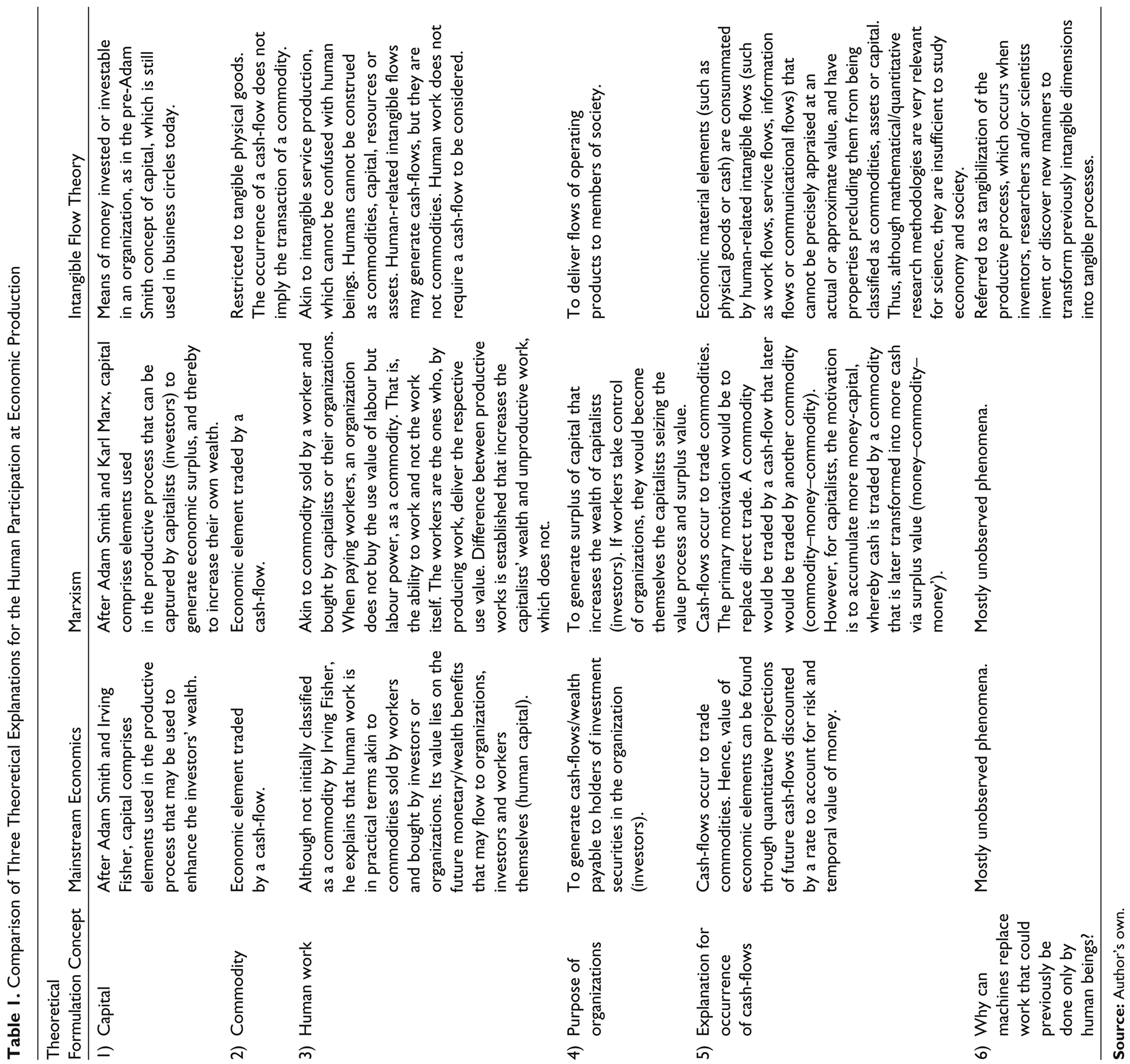
For example, when a human job is replaced by a machine, both mainstream and Marxist economics describe this event as the human-commodity (i.e., human being) being replaced by another commodity (i.e., a machine) in order to increase the future cash-flows or surplus value of the owners/shareholders. In the intangible flow theory, commodities must be defined in relation to human users or, more broadly, to humankind. Thus, when humankind produces high-precision machines capable of performing tasks that previously could only be performed by humans (e.g., robots capable of producing cars), the intangible flow theory explains this phenomenon by stating that humans have transformed previously intangible flows into tangible tasks that can be performed with precision by robots/machines. The production process undergoes ‘tangibilization’, which does not necessarily imply an end to organizations, industries and operating product flows, but rather a change in the production methods. Table 1 summarizes the three perspectives of human participation in production.
Comparison of Three Theoretical Explanations for the Human Participation at Economic Production
Defining Human Being in the Intangible Flow Theory
Until this point, a key concept has not been presented, explicitly, what are human beings to whom intangible flows are related to. The new theory requires a precisely demonstrable (thus, tangible) concept. Indeed, a human being is verifiable in intangible flow theory through the same burden of proof that would be required in a law courtroom prepared to test evidence. For the new theory, a human being is a living Homo sapiens who is recognizable through his/her human deoxyribonucleic acid (DNA). 8 Contemporary equipment is advanced to the point of being capable to trace every human being’s specific DNA, with high degree of confidence. In a tribunal, this technology can be used to solve legal conflicts (for instance, paternity tests or forensic evidence). It can also be employed in the social sciences. Unambiguously, human beings are quite tangible.
Human beings comprise complex inner systems, such as digestive systems, cardio systems, brain cells, feelings and consciousness. Nonetheless, elements that can be distinguishable from human beings are not human beings. In intangible flow theory, external intangible flows are those flows that can be separated from the human organism, that is, they flow outside the human being, in his/her interactions with the exterior world (e.g., a service, a communicational flow, a conversation, a text). Human beings die, while their outputs may keep existing. As noted by Roth (2013), in another context, the concept of a person or his/her work can be distinguished from the human organism. For instance, when a famous author/writer dies, collective memory of his/her works and the conception of his/her person may have flowed out of him/her, and keep subsisting in part of the living human population. Internal intangible flows that cannot be separated from a human being (e.g., inner information flows that remains within the body, or intangible intercellular communication) remain part of what that human being is.
The proposed law advanced in this study is that human beings are not commodities, and therefore, human beings are not assets, capital or resources in economic production. This law is to be applicable even in the extreme case when a human being is treated as a slave, where there is still no demonstration that he/she is a commodity. When Hodgson (2014), who himself criticizes the post-Smith capital concept, or Piketty (2014) argue that human beings can be capital when they are treated as slaves, they are victims of a key fallacy, which was explained before. Their reasoning is that slaves are commodities because they can be sold as collateral. As many economists and sociologists, they have tumbled upon the logical error of considering that the occurrence of the cash-flow defines the commodity. The pre-Smith concept of capital is restricted to means of money invested or investable in organizations. Further uses and flows of that money are not necessarily commodities or capital. 9
However, what about non-human sentient beings or transhuman beings, should they be considered commodities in productive processes? This additional question is not solved here. The expression sentient beings refers to beings capable of experiencing feelings, perception and consciousness. 10 Recent scientific evidence confirms that many animals (e.g., dolphins, dogs, elephants, cats, gorillas, and crows) have inner consciousness, perception and feelings that are akin to humans’ (e.g., The Economist, 2015). Those findings dismiss a long-established common sense (especially in the West) that human beings would be the only creatures capable of sensing consciousness and complex feelings. Transhumanism referred initially to the enhancement of the human condition through sophisticated technology, which could modify human bodies to improve intellectual, physical and psychological capabilities (More & Vita-More 2013; Ranisch & Sorgner 2014). When a living human body is still involved, the intangible flow theory’s law is straightforwardly applicable. However, posterior developments argue for a radical modification of human bodies through technology, which was called as post-humanism (More & Vita-More, 2013; Ranisch & Sorgner, 2014). Furthermore, robots and artificial intelligence beings might also reach a post-human stage, and become sentient (Clark, 2016). These later cases are more difficult to address. Seemingly, non-human or post-human sentient beings might be distinguishable from human beings while sharing features that are common in humans. In future research, a law defining that humans are not commodities does not define whether other sentient beings are commodities in economic production.
Example of Concrete Phenomena Addressable by the Intangible Flow Theory
Mainstream economics and Marxism have inability to identify, observe, and describe intangible flows because of attributes both hold, and which were previously described. Economics is short of research tools to distinguish tangible from intangible flows, or human beings from commodities. Two examples are presented about how intangible flow theory can address phenomena that are outside the scope of mainstream economics and Marxism’s research technologies.
Observing Production in the Productive Process
Mainstream economics and Marxism have mostly disregarded productive process altogether, as if productive processes could be taken for granted. Incapable to provide a description beyond the all-encompassing commodity, the strategy has become to focus on production’s monetary surplus 11 while displaying some extent of disdain for the inner details of production. A box description would suffice. As mainstream economics and Marxism hold that outputs from economic production are more or less similar, they have generally come up with explanations for production merely based upon surplus, supply and demand, or workers exploitation.
However, the peculiarities through which outputs are produced and delivered are not irrelevant to understand their societal relevance (or even monetary surplus). Consider, for instance, a supermarket. For many persons’ survival and existence, the supermarket may provide food and other vital supplies. Hence, how products are actually produced and reach supermarkets’ shelves are pertinent problems to understand those persons’ lives (or other people’s, such as the supermarket’s employees).
We cannot advance our understanding of human participation in production when social scientists are advised to focus on surplus and avoid concrete underpinnings of production. While claiming to describe economic production, mainstream economics and Marxism actually lack technological tools to understand human participation in productive processes. Furthermore, a human being’s life is not only restricted to be a production factor. In economics and sociology, the all-encompassing commodity description fails to acknowledge human existence not reflected on cash-flows. Social phenomena need to be understood in relation to, but not reduced to, their biological and psychological substrates (Jenks & Smith, 2013).
The intangible flow theory is applicable not only to capitalist/market forms of organizations but to all organizations that deliver flows of operating products to members of society, which also include NGOs, governmental organizations and hybrid forms. After all, markets are themselves human organizations (Ahrne, Aspers & Brunsson, 2015). A methodology to quantify equilibrium market prices (for transaction values) has been elusive because such prices are social constructs embedded in structures of social relations (Beunza, Hardie & MacKenzie, 2006). Indeed, there might be no adequate quantitative methodology to find equilibrium prices because these prices are dependent on complex intangible flows that cannot be measured with precision.
The Occurrence of Cash-flows: To Where Do Cash-flows Flow?
Intangible flow theory suggests that we must pay greater attention to tangible flows of economic material elements occurring at specific moments, which can be identified with a relevant degree of accuracy (Cardao-Pito, 2004, 2012a, 2012b). Instead of chasing intangible concepts of value based upon projections of future cash-flows or abstract labour values as in mainstream economics and Marxism, we should understand what happens to the tangible cash-flows generated by organizations through sales of operating products.
To where do cash-flows actually flow? A model to address this question is formulated in Figure 1. Money generated through sales can (i) remain in the organization and be reinvested in operations, (ii) flow to the owners of the firm, through either dividends or stock (equity) buy backs, (iii) flow to the top-level managers/executive deciders, (iv) flow to debt holders in the form of interest and repayments, (v) flow to the organization’s workers, (vi) be used to pay the accounts of suppliers and other creditors, (vii) flow to national governments in the form of taxes and other legal obligations, (viii) be used in donations and philanthropy or (ix) be used in other cash-flows. Hence, the mainstream and Marxist approach of treating economic production as a commodity-consuming box fails to capture the complexity of the cash-flow generation process. Furthermore, their value approach implies that after exploiting all commodities (including human commodities), the appropriated value goes solely to the owners of enterprises. In reality, the situation is not nearly so simple, and sales-generated cash-flows are allocated to many people.
For instance, consider markets for automatic guns, tobacco and alcohol. Cash from these businesses flows not only to corporate shareholders but also to workers, lenders, suppliers and government taxes. Regardless of whether a worker of a related enterprise has any alternative choice for employment, in order to earn a wage for him/herself, the employee is responsible for producing intangible flows that might eventually cause lethal gunshots or tobacco-and alcohol-related diseases. Within the intangible flow theory framework, workers (and their representatives) are, as human beings, the owners of capitalist firms. As suggested by mainstream economics and Marxism, many capitalists/investors may participate in the productive process to increase their monetary flows. However, the intangible flow theory refuses the abstract category of capital as a homogeneous group of people, preferring the tangible identification of human beings. Capitalists may control monetary stocks and be very different among themselves. A group of workers who gain control of a firm’s capital become capitalists themselves. Owners of an organization’s capital can also be workers. The existence of rent-maximizing capitalists does not imply that human societies allow human organizations to exist merely for that purpose. Workers cannot be excused merely because they would be allegedly alienated and reified in the productive process, as suggested by Marxism. As another example, an elected politician might be willing to legislate against automatic gun trades or tobacco/alcohol sales, but to do so, he/she would face a decrease in tax revenues and an increase in unemployment due to the closing of factories and shops. Although cash generated by operating product sales can be used to support many important philanthropic projects, it can also be used to finance lobby organizations and to support campaigns and media outlets that promote the election of lobby-friendly politicians.
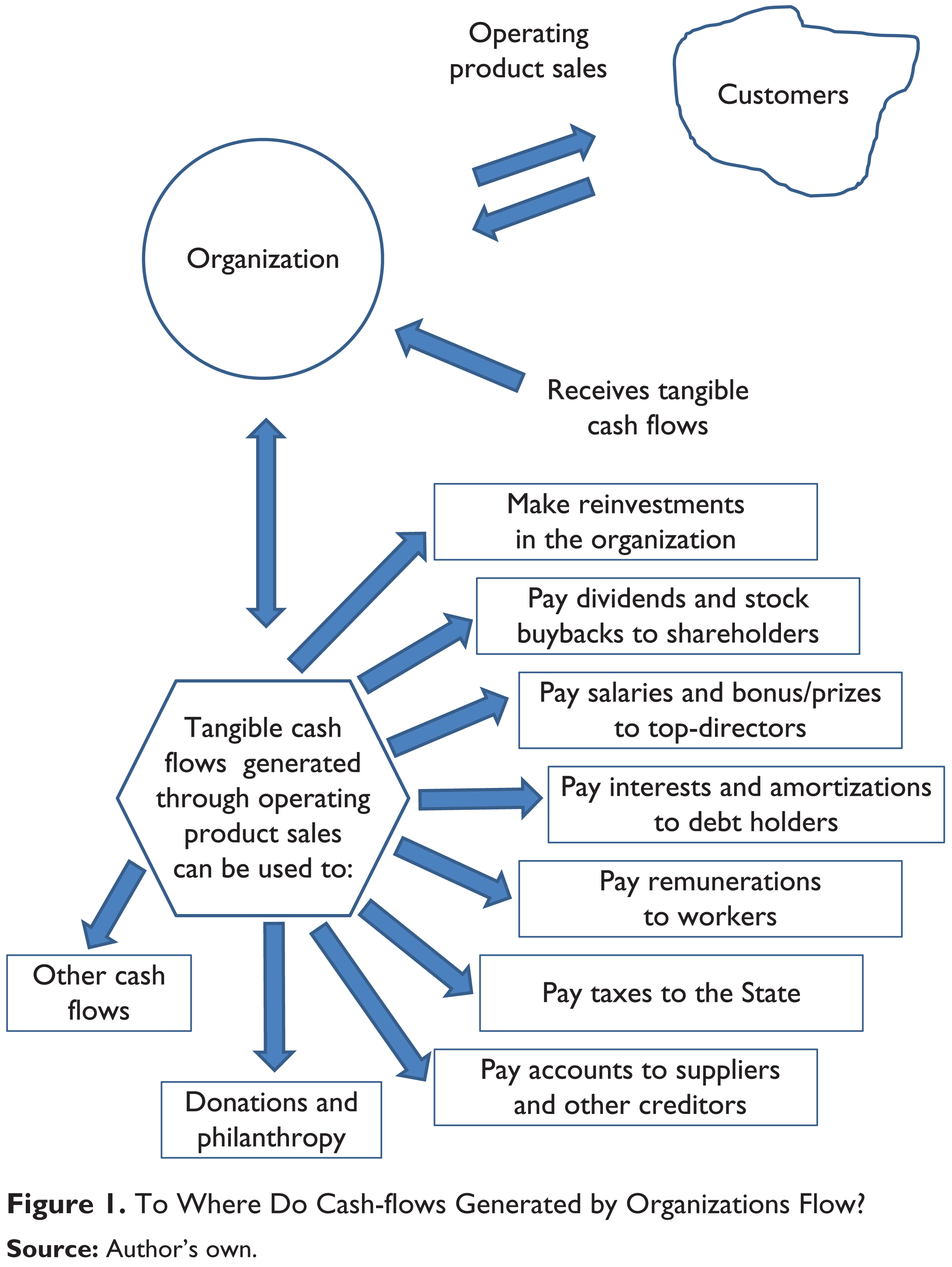
After the tangibilization of the productive process occurs, money that otherwise would flow to workers can be either distributed or partially captured by those in control of the productive process (Figure 1). 12 In industrialized societies, those in control of the productive process refer to owners, financiers and managers/directors of large corporations (e.g., Kristal, 2013). By no coincidence, these are the persons who, by virtue of being situated in the top 1 per cent or 10 per cent of the income ladder, have seen increases in their real incomes in recent decades, in contrast to almost everybody else. 13
Conclusion
This article presents a set of important observations. There is no systematic evidence proving that human beings are commodities in economic production and, hence, can be considered as capital, assets or resources. Human work has properties that make it akin to intangible service production. Through the tangibilization of economic production, previously intangible dimensions can be turned into tangible processes, and machines may gain the skills necessary to replace human work or perform new tasks. Human beings frequently create flows of economic material elements through human-related intangible flows that cannot be identified with precision. The tangible cash that is generated or saved by machines that enhance the tangibilization of productive processes tends to flow to the human beings who own and/or control these productive processes. Finally, humans have concrete needs that are associated with physical goods (commodities).
Theories do not explain phenomena we are certain of. It is the other way round. Theories exist to explain phenomena we do not completely understand. The two greatest economic theories of the twentieth century, namely, mainstream economics and Marxism, contain an important misunderstanding. Specifically, they consider humans and our contributions to economic and societal production as commodities, and thus akin to assets, capital or resources, because humans generate flows of and transform tangible elements, such as physical goods and cash. In contrast, the intangible flow theory aims to establish a law for the social sciences: explicitly, that we human beings are not commodities, assets, capital or resources. A human being is defined as a living Homo sapiens who is recognizable through his/her human DNA. 14
The proposed law is not only applicable to capitalist/market organizations but to all organizations that deliver flows of operating products to members of society. Therefore, this law encompasses NGOs, governmental organizations, hybrid organizations and other forms of economic organizations, including those not yet invented by humankind. This theory will not be consensual. However, those who, knowingly or not, treat human contributions to the productive process as akin to commodities will need to have better explanations for this approach than the flawed explanations presented to date. Only through their failure can the proposed scientific law thrive.
Footnotes
Acknowledgements
Joao Silva Ferreira; Julia Smith, Patrick McColgan, Jayati Sarkar, Steven Michael, Paul Adler, Frederick Lee, Andrew Marshal, Christine Cooper, Robert Mackenzie, Meghan A. Thornton, John Ferguson, two anonymous referees and the ADVANCE Research Center at ISEG, and Portuguese national funding agency for science, research and technology (FCT) Project-UID/SOC/04521/2013.