



Abstract
Behavioural economics is a research agenda, which gradually has moved from the periphery to the centre of the discipline of economics. The rise of behavioural economics has fostered a burgeoning number of studies dealing with the past, present and future of the field. In contrast to these studies which focus on predestinated scholars, outlets and key concepts, this article uses exploratory bibliometric approaches to map behavioural economics. Utilising a novel data set, comprising 104,558 references across 1,872 articles published in the period 1956–2016, the article systematically illuminates the historical foundations, development and interdisciplinary nature of behavioural economics. The article shows (a) the overlooked role of several behavioural psychologists in shaping the field; (b) the influence of the Anglo-Saxon universities, such as University of California Berkeley, Harvard University and University of Pennsylvania; and that (c) behavioural economics mainly draws knowledge from five disciplinary clusters: (a) economics and policy, (b) psychology, (c) pharmacology, (d) health and (e) law.
Introduction
Behavioural economics has made great advances in recent decades. The awarding of the Nobel Prize in Economics to George Akerlof (2001), Daniel Kahneman (2002), Robert Shiller (2013) and Richard Thaler (2017) have cemented behavioural economics as a prominent field; one which has challenged the core assumptions of neoclassical economics. The surge of behavioural economics from the extremities to the heart of economics has been punctuated. For many years, there was a strong status quo bias in the economics discipline, which made it hard to introduce more realistic assumptions derived from psychology, regarding human behaviour (Berg & Gigerenzer, 2010; Sent, 2004; Thaler, 2016). Due to the persistence and risk-taking of younger scholars, however, the discipline has come to embrace behavioural economics (Thaler, 2015). In short, behavioural economics has become mainstream.
The significance of behavioural economics can be observed in many ways (Sent, 2004). Since the mid-2000s, the number of academic publications dealing with behavioural economics in both relative and absolute numbers have increased dramatically (Geiger, 2017) (see Appendix 1). Scholars specialising in behavioural economics occupy positions at the most prestigious universities in the world (Sent, 2004; Thaler, 2015). Research centres, conferences, journals, textbooks and associations are devoted to the study of behavioural economics (Wilkinson & Klaes, 2012), and insights derived from behavioural economics are increasingly informing policymaking processes in many countries (Benartzi et al., 2017).
The gradual advancement of behavioural economics has resulted in a growing body of literature focused on the history of the field, its current state and future avenues. Early writings in the 1980s discussed the defining characteristics of behavioural economics and whether it constituted a rival or corrective to neoclassical economics (Earl, 1983; Gilad, Kaish, & Loeb, 1984; Green & Kagel, 1987; Hogarth & Reder, 1987; Simon, 1987). The perimeter of behavioural economics began to coagulate in the 1990s, and reviews of studies demonstrating how humans systematically violate key assumptions of the standard rational choice model emerged (Laibson & Zeckhauser, 1998; Mullainathan & Thaler, 2000; Rabin, 1998). In the 2000s, behavioural economics established itself in mainstream economics, and scholars began to tell its history, with roots traceable to scholars like Adam Smith, John Maynard Keynes and Herbert Simon (Camerer & Loewenstein, 2004; Sent, 2004). In the 2010s, the field entered a reflective period, where the case was made for a broadening of the horizons beyond economics and psychology (Akerlof, Oliver, & Sunstein, 2017; Kahneman, 2013; Oliver, 2017; Thaler, 2015).
The burgeoning literature concerning the production of knowledge on behavioural economics provides key insights about the constitutive features of the field. Yet when accounting for the historical development and present character of the field, these studies may be subject to the same cognitive biases and imperfect heuristics identified within behavioural economics. This conundrum begs the question of how to reduce biases in the process of unravelling behavioural economics as a field of research. Rather than relying on what scholars dealing with behavioural economics ‘say’, one can turn to what they ‘do’ by investigating the actual behaviour of researchers engaged in the field.
Studying academic behaviour through bibliographic references—now known as bibliometrics—provides a systematic method to ascertain the constitution of a given research front (De Solla Price, 1965; Frid-Nielsen et al., 2019; Jensen & Kristensen, 2013). While bibliometric studies cannot supplant deep readings of source materials, they, instead, provide a unique contribution by reflecting the history and advancement of scientific research and self-organising scholarly communication process (Leydesdorff, Bornmann, Marx, & Milojević, 2014). Bibliometrics identify which units dominate the flow of information within a field, tracing the linkages between different disciplines, which allows future research to address existing knowledge gaps. Bibliometric methods have found their way into economics in general (Duarte & Giraud, 2016), and the study of behavioural economics in particular (Geiger, 2017; Laibson & Zeckhauser, 1998).
This article contributes to the bibliometric literature on behavioural economics. Rather than focusing on predestinated scholars, outlets and key concepts, it proposes an advanced exploratory approach to map the field of behavioural economics. This approach allows the article to address important questions such as: What are the historical roots of the field? Who are the most important authors and publications in the field? What are the geographical and institutional hubs of knowledge production? Which academic disciplines supply knowledge to the field? And does the research practice constitute a truly interdisciplinary field or is it fragmented along disciplinary lines?
The article is structured as follows. The first section introduces the field of behavioural economics and accounts for the contribution made by the article. The second section outlines the article’s bibliographic methods and data. The third section provides a descriptive analysis of the data, followed by the network visualisations of the citation patterns of key authors and journals within behavioural economics, together with geographic and institutional relations. The final section concludes and presents possible avenues for future research.
Data and Method
Gathering a Body of Literature
To extract citation data for a given research area using bibliometric tools, a corpus of relevant literature must be delimited. While the corpus need not be a complete inventory of relevant publications for bibliographic methods to be successful, it should not have too many irrelevant entries (Thor et al., 2017). We open the scope of the study to include non-journal sources within the citations. Due to the applied nature of behavioural economics, policy documents may play an important role in the communicative practice of the field; moreover, key books, such as Thaler and Sunstein’s Nudge (2008), could be central in the network.
Instead of relying on citation data from entire journals, Boolean keyword searches in the Institute for Scientific Information (ISI) Web of Science capture relevant texts from across the entirety of available academic literature. A key challenge in Boolean searches is the trade-off between recall (number of results) and precision (number of relevant results): Loose search terms will generate a high recall and a large number of irrelevant texts, whereas tight search terms will generate a limited number of results but with fewer irrelevant results (Hayes & Weinstein, 1990). The present study simply uses the search term ‘behavioural economics’ to retrieve articles published in the period 1956‒2016 in the Social Sciences Citation Index, giving a very precise search term, reflecting the mainstream of behavioural economics research. The search term captures both American and British spelling as well as singular and plural forms. Citation data contain spelling mistakes and other irregularities requiring data cleaning. We manually identified and corrected misspellings for authors and journals with at least 15 citations.
Identifying Seminal Works
Reference Publication Year Spectroscopy (RPYS) is a quantitative method, which traces out the historical roots of a research area by examining cited references and referenced publication years, identifying seminal texts and their impact on current research (Bornmann, Thor, Marx, & Leydesdorff, 2016; Leydesdorff et al., 2014; Marx, Bornmann, Barth, & Leydesdorff, 2014). RPYS maps aggregate reference behaviour within a given research field or corpus of texts, encompassing the advancement of its history through the communities that carry it forward (Leydesdorff et al., 2014). Most research articles cite recent specialist literature, with a steep decline in references going further back in time (Marx et al., 2014). RPYS highlights distinct citation peaks within the history of a research field, which are usually composed of a few highly cited publications that constitute the historical roots of the field. As a given research field becomes more established, the references contained within these citation peaks are no longer inhabited by seminal works and are, instead, distributed among numerous newer contributions. Thaler (2015) argues that early economists like Adam Smith were in fact pioneers of behavioural economics, but the history may not be as deep as in scientific fields like physics (Leydesdorff et al., 2014). We therefore use the start of the eighteenth century as the cut-off year for exploring historical texts, examining the emerging RPYS citation peaks up until 1965.
Examining Similarity and Centrality in the Network of Behavioural Economics
Distance and similarity are the two primary methods for computing the relations between journals and scholars. Distance measures concern, for example, the number of citations between two journals or authors. Alternatively, this study employs a form of similarity measure termed ‘bibliographic coupling’. Rather than studying directed citations from Journal A to Journal B, we utilise bibliographic coupling to study co-occurrence, which implies how likely it is that Journal C references both Journal A and Journal B. If Journals A and B appear in Journal C, it indicates that they share similar characteristics (Freeman, 1978). We use bibliographic coupling to analyse the citation structure of 1,872 articles on behavioural economics, consisting of 104,558 citations, covering the entire period 1956‒2016. We cannot expect this sample to contain a complete inventory of the literature on behavioural economics; instead, it represents the most mainstream works in the field.
Since the citation data used in this study are based on co-occurrence, the concept of ‘centrality’ can help pinpoint key nodes within the network. More precisely, measuring ‘betweenness centrality’ allows for the investigation of the interdisciplinarity of the field (Leydesdorff, 2007; Leydesdorff & Rafols, 2011). Betweenness centrality reflects the extent to which a node serves as a nexus of the shortest paths between other nodes within a network (Leydesdorff, 2007). If communication travels through the shortest pathway in a network, then a node linking several of the shortest paths will essentially control the flow of information (Freeman, 1978). A node with high betweenness centrality is thus crucial for the constitution of the network—if this node were to disappear, the network would collapse into disjointed clusters (Leydesdorff, 2007). Centrality is sensitive to highly cited journals, requiring normalisation to suppress this effect, for example, Nature or Science may inherently generate high betweenness centrality (Leydesdorff, 2007).
Ahlgren, Jarneving and Rousseau (2003) propose using cosine for the purpose of normalisation due to the high skew of citation distributions, which is supported by growing consensus among bibliometricians (Leydesdorff, 2007). Cosine normalisation converts values on a 0‒1 scale and provides a similarity measure rather than a distance measure (Leydesdorff & Rafols, 2011). When using cosine, a threshold must be set because citation patterns of locally related journals are almost never equal to zero, resulting in a dense, difficult-to-read network (Leydesdorff, 2007). There are no set rules for the cosine threshold, requiring some systematic testing to achieve a good trade-off between explanatory power and readability (Leydesdorff, Rafols, & Chen, 2013). We used minimum cosine thresholds of 0.2 to enhance the visualisation of the networks of authors and journals. To further enhance readability, we include only journals and authors that account for at least 0.2 and 0.1 per cent of the total references for their networks, respectively. This leaves a total of 81 journals and 78 authors for the analysis. The graph layout of the visualisation is driven by the force-directed Fruchterman‒Reingold algorithm (Fruchterman & Reingold, 1991). The algorithm iteratively minimises the energy of the network by forcing vertices apart, while assigning an attractive force to connected vertices.
Of further interest is the structural form of the network of behavioural economics. Certain groups of journals or authors may exhibit dense communication patterns, with relatively fewer citations across these groups. Identifying such clusters allows us to highlight the interdisciplinarity within behavioural economics, which occurs within the specialised interface between fields of science (Leydesdorff, 2007). This is helpful for understanding subjects such as behavioural economics, which claim to draw on multiple research traditions. We utilise the Louvain algorithm for community detection due to its efficiency in the analysis of large networks (Blondel, Guillaume, Lambiotte, & Lefebvre, 2008).
Analysis
Formative Authors and Works
Encapsulating the formative authors and works of a research field systematically used to be challenging when applying bibliometric techniques, as most fields emerge slowly and lack clearly demarcated perimeters from the outset. By using the RPYS algorithm, however, it becomes possible to trace the historical roots of disciplines, fields and authors. Figure 1 shows the output of the RPYS analysis of behavioural economics (1750‒1965), whereas the online appendix contains the key progenitors of the field of behavioural economics.
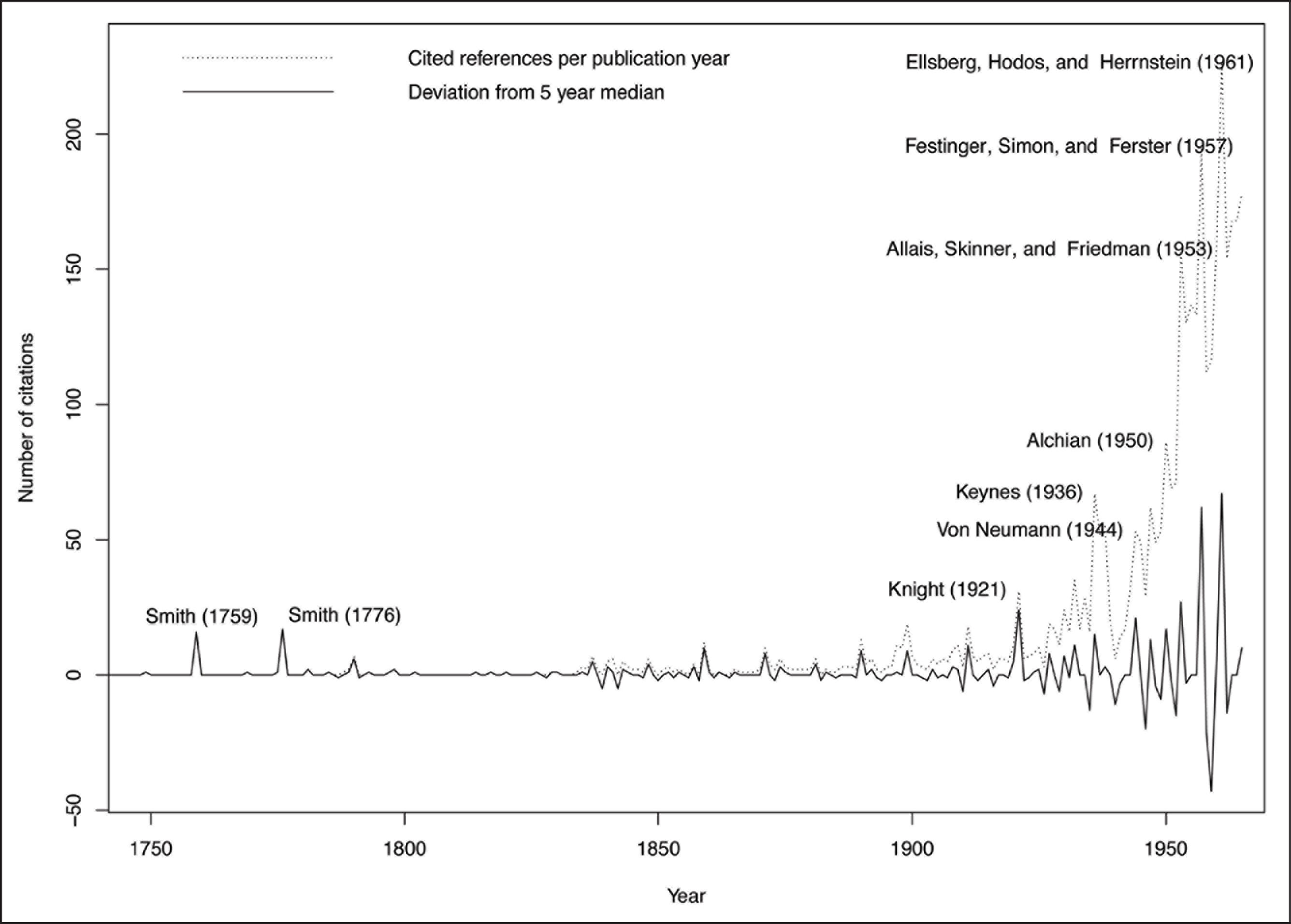
Two seminal books by Adam Smith (1776, 2002), who is considered the forefather of neoclassical economics, have been formative for behavioural economics: The Theory of Moral Sentiments from 1759 and An Inquiry into the Nature and Causes of the Wealth of Nations from 1776. Smith’s appearance is partly due to the fact that behavioural economics challenges some of his key ideas, like the ‘invisible hand’ and ‘rational self-interest’, as expressed in The Wealth of Nations. Smith has also pioneered key thoughts, however, like the constant fight within a person between ‘passions’ and the ‘impartial spectator’ in The Theory of Moral Sentiments (Ashraf, Camerer, & Loewenstein, 2005; Camerer & Loewenstein, 2004; Oliver, 2017; Thaler, 2015). This fight encapsulates ideas from behavioural economics, including ‘loss aversion, intertemporal choice and overconfidence’ (Ashraf et al., 2005: 132). The next influential author linked to behavioural economics is Frank Knight and his 1921 book, Risk, Uncertainty, and Profit. Knight is overlooked in the history of behavioural economics, although he introduced the important distinction between ‘risk’ and ‘uncertainty’. Making decisions in the face of risk and uncertainty is a mainstay of behavioural economics. The distinction was further developed by John Maynard Keynes in his 1936 book, General Theory of Employment, Interest and Money. Here, Keynes coined the term ‘animal spirits’ to describe the spontaneous behaviour of humans in economic situations who are driven more by emotional impulses than rational calculations. The final influential work from the early days is Theory of Games and Economic Behavior from 1944 by John von Neumann and Oskar Morgenstern, which develops the so-called expected utility theory, which mathematically describes the rational choices an actor should make to maximise utility. While prospect theory, developed by Kahneman and Tversky (1979), is sometimes seen as the rival of expected utility theory, this is not completely accurate. The former is a positive theory about how humans actually make choices, whereas the latter is a normative theory about how they should make choices to act like homo economicus, the personification of economic man (Thaler, 2015).
In the 1950s—the heyday of behaviourism—we find several texts explicitly challenging standard economic axioms. Armen A. Alchian’s article from 1950, ‘Uncertainty, evolution, and economic theory’, incorporates incomplete information and uncertain forecasts in the model of profit maximisation as a corrective to standard economic theory. The model challenges the assumption of reference independence, which was later confirmed by studies conducted by Amos Tversky and Daniel Kahneman. ‘Le comportement de l’homme rationnel devant le risque: Critique des postulats et axiomes de l’ecole Americaine’ from 1953 by Maurice Allais, acknowledged as a significant source of inspiration for Tversky and Kahneman, criticises the idea that humans make informed decisions based on an accurate calculation of probabilities. The psychologist B.F. Skinner’s book from 1953, Science and Human Behavior, develops some of the key concepts of behaviourism, including positive and negative reinforcement. The mechanisms of reinforcement provide the micro-foundation for incentives in behavioural economics. Milton Friedman’s Essays in Positive Economics, also from 1953, makes the powerful argument that rational humans might not follow standard economic assumptions, but that they, nevertheless, act in aggregate as if they do. He further states that economic models should not be judged in terms of their realism but rather their predictive power. The book is quoted in behavioural economics, where Friedman is criticised for his unrealistic ‘as if’ argument, which shielded the unrealistic axioms of rational choice theory for many years (Thaler, 2015). Leon Festinger’s 1957 book, A Theory of Cognitive Dissonance, applies various bridging approaches to illuminate the discrepancy between cognition and action. In the collective memory of behavioural economics, Festinger is primarily remembered for his physical presence in different contexts rather than his theory of cognitive dissonance per se (Heukelom, 2014; Thaler, 2015). Nevertheless, the theory, which states that when there is dissonance between an individual’s beliefs and behaviour, they will tend to alter the former rather than the latter or avoid situations or information provoking this dissonance, has been influential within behavioural economics. Herbert Simon’s formative book, Models of Man: Social and Rational: Mathematical Essays on Rational Human Behavior in a Social Setting, introduces the now-famous concept, ‘bounded rationality’. While Simon is now widely recognised as one of the progenitors of behavioural economics, this concept did not receive widespread attention at the time (Kahneman, 2003; Thaler, 2015, 2016). Kahneman and Tversky gradually changed the idea from a metaphor to a theoretical mechanism with a strong empirical micro-foundation by demonstrating how individuals suffer from systematic biases when making decisions. Schedules of Reinforcement, by Charles B. Ferster and B. F. Skinner from 1957, has, like Skinner’s earlier book, become formative for the study of behaviourism. By using experiments with pigeons, the two authors uncovered systematic reinforcing behavioural patterns measured in terms of response rate as an indicator of strength. These schedules of reinforcement are also applicable to humans and have been important for ideas like the automatic system and heuristics developed by Kahneman and Tversky.
Moving into the 1960s, we find three seminal texts published in 1961. ‘Risk, ambiguity, and the savage axioms’, by Daniel Ellsberg, who, inspired by the work of Frank Knight and John Maynard Keynes, proposes what is today known as the Ellsberg paradox. According to this paradox, most individuals violate the axioms of subjective expected utility by preferring poor known odds over favourable unknown odds. ‘Progressive ratio as a measure of reward strength’, by William Hodos, follows Ferster and Skinner by using experiments with animals—in this case studying reinforcement rates to uncover behaviour mechanisms. Hodos demonstrates that the smaller the reward, the less likely a behavioural pattern will be reinforced, and that at some point, the reward becomes so small that it is no longer worth the effort (i.e., the breakpoint). ‘Relative and absolute strength of response as a function of frequency of reinforcement’, by Richard J. Herrnstein, is the final formative text for the field of behavioural economics. Herrnstein, who was involved in the pigeon experiments conducted by Ferster and Skinner, proposes the matching law; put simply, the law states that the attention an organism gives to different options is proportional to the amount of reinforcement it receives from them.
The RPYS analysis concerning the formative authors of behavioural economics reveals that the field stands on the shoulders of giants in economics, including Adam Smith, Frank Knight and John Keynes. Their early works include the idea that humans are neither rational nor do they have complete information when making decisions. From the 1950s onwards, a strong influence from behaviourism and psychology can be traced. The focus of these studies is on how creatures actually behave and the underlying schedules behind their actions. Here, existing reviews of the history of behavioural economics seem slightly biased in favour of the economists and political scientist Herbert Simon, whereas they seem to disremember the contributions made by psychologists like B. F. Skinner, Leon Festinger, Charles Ferster, William Hodos and Richard J. Herrnstein.
Influential Authors and Texts
Having identified the authors and sources that stimulated behavioural economic thought, we can now turn to the heavyweights in the field and their most influential works. Table 1 presents the pantheon of behavioural economists and their most quoted texts (see online appendix for an extended version). In contrast to other studies, which focus on the most quoted scholars dealing with behavioural economics in general, the table presents the most quoted works within the studies that explicitly write under the label.
Influential Authors and Works in Behavioural Economics
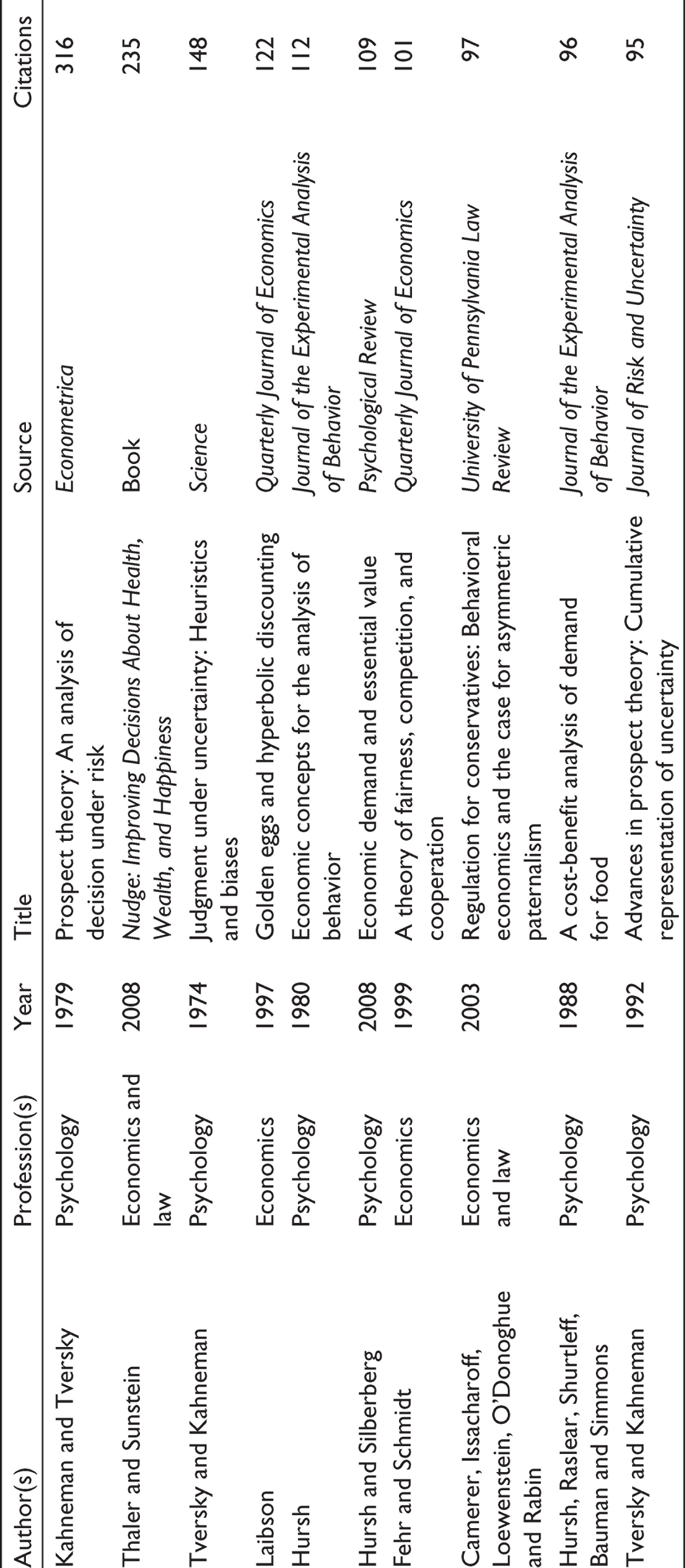
While the influence of early behavioural psychologists seems somewhat overlooked, the significance of psychologists Daniel Kahneman and Amos Tversky is widely recognised when telling the story of behavioural economics (Camerer & Loewenstein, 2004; Sent, 2004; Thaler, 2015). Next to the works of Kahneman and Tversky, the importance of Richard H. Thaler is also confirmed, together with legal scholar Cass R. Sunstein (especially when looking at Appendix 2). Thaler’s importance to behavioural economics is also reflected in the fact that a number of his students have been co-founders of the field and are among the most quoted in the pantheon (e.g., Colin F. Camerer and George Loewenstein).
‘Prospect theory: An analysis of decision under risk’, an article published in Econometrica in 1979, where Kahneman and Tversky introduce the aforementioned prospect theory as an alternative to Expected Utility Theory, resides at the top of the pantheon. The text demonstrates that actors are willing to take greater risks if they stand to lose, whereas they are risk-averse when they stand to win. In second place, we find Richard H. Thaler and Cass R. Sunstein’s popular science book, Nudge: Improving Decisions About Health, Wealth, and Happiness, which is rather remarkable, given that it was published only 10 years ago in 2008. While behavioural economics had already been on the rise academically, following the awarding of the Nobel Prize in Economics to Daniel Kahneman in 2002, the book paved the way for the awareness of the field in the broader public and how insights can be used to improve human well-being (Bogliacino, Codagnone, & Veltri, 2016). The book introduces the idea of a ‘nudge’, which is an attempt at utilising various heuristics and biases to influence people to make better choices. The third most influential text is ‘Judgment under uncertainty: Heuristics and biases’, by Amos Tversky and Daniel Kahneman from 1974, which elaborates the concepts of heuristics and bias that are the foundation of prospect theory and now considered the bedrock of behavioural economics. Through experimental studies, the text demonstrates various types of heuristics that actors use when making judgement under uncertainty. While heuristics may reduce complexity and save time, they lead to systematic biases in decision-making. An example is the availability heuristic whereby actors make decisions based on the last instances that they can recall, which might not be accurate and therefore lead to biases.
David Laibson’s ‘Golden eggs and hyperbolic discounting’, published in The Quarterly Journal of Economics in 1997, challenged the classic model of time-consistent preferences by developing an alternative model with time-inconsistent preferences. The model thus bridges the gap between the present irrational self that maximises utility to the detriment of its future self. While behavioural economics is sometimes characterised by incorporating empirical mechanisms from psychology into economics, ‘Economic concepts for the analysis of behavior, by Steven R. Hursh (1980), and ‘Economic demand and essential value’, by Steven R. Hursh and Alan Silberberg (2008), turn this upside down. These texts import ideas from economics into psychology and behavioural studies more generally, including whether the systems under investigation are open or closed, reinforcers’ level of elasticity, the interaction between reinforcers (complementary/substitution) and variation in choice rules. Ernst Fehr and Klaus M. Schmidt’s 1999 article, ‘A theory of fairness, competition, and cooperation’, provides a theoretical model, which can explain earlier findings by Kahneman, Knetsch and Thaler (1986), who had shown that customers are concerned with fairness, which explains why some companies do not maximise short-term profits, even though their market position would allow them to do so, for fear of being punished. The model also explains why the vast majority of individuals cooperate rather than act according to the prediction of the standard self-interest model in games like the ultimatum game, the public good game and the gift exchange game.
‘Regulation for conservatives: Behavioral economics and the case for asymmetric paternalism’, by Colin F. Camerer, Samuel Issacharoff, George Loewenstein, Ted O’Donoghue and Matthew Rabin (2003), is a part of the debate within behavioural economics on paternalism, with which two further texts in the extended pantheon by Richard H. Thaler and Cass R. Sunstein also take issue (see Appendix 3). This debate concerns how to balance between, on the one hand, using insights from behavioural economics in law to prevent citizens from doing harm to themselves, and respect for the individual freedom of choice on the other. The proponents of using behavioural insights argue that they are more efficient and targeted, whereas the opponents point out the difficulties in determining what constitutes irrational behaviour where it is justifiable to correct it. The specific notion of ‘asymmetric paternalism’ points to the fact that it is possible for authorities to act paternalistically towards people behaving with bounded rationality, while at the same time avoiding regulating people who act rationally.
Steven R. Hursh, Thomas G. Raslear, David Shurtleff, Richard Bauman and Laurence Simmons’ ‘A cost‒benefit analysis of demand for food’ from 1988 uses experiments with rats to further tease out the mechanisms of behavioural reinforcement as originally established by B.F. Skinner, Leon Festinger, Charles Ferster and William Hodos. Amos Tversky and Daniel Kahneman’s 1992 article, ‘Advances in prospect theory: Cumulative representation of uncertainty’, advances their prospect theory further by showing how behaviour varies according to the probability of gains and losses.
Looking beyond these different items, the knowledge base of the field comprises journal articles and a few books produced by psychologists, economists, a legal scholar and a political scientist (see online appendix). The field is strongly dominated by men.
Visualisation: Authors
Having looked at aggregated citations, the next step is to examine the relational character between authors in terms of who is being referenced together. Figure 2 traces the network of authors working in behavioural economics. The citation pattern of these authors crystallises the dual-core nature of the field, which combines economics and psychology. Interestingly, further sub-disciplines emerge from the network, depicted by different coloured nodes. Darker edges between nodes represent higher levels of similarity, while the relative size of author names reflects their share of total citations. Node size reflects the author’s betweenness centrality within the network.
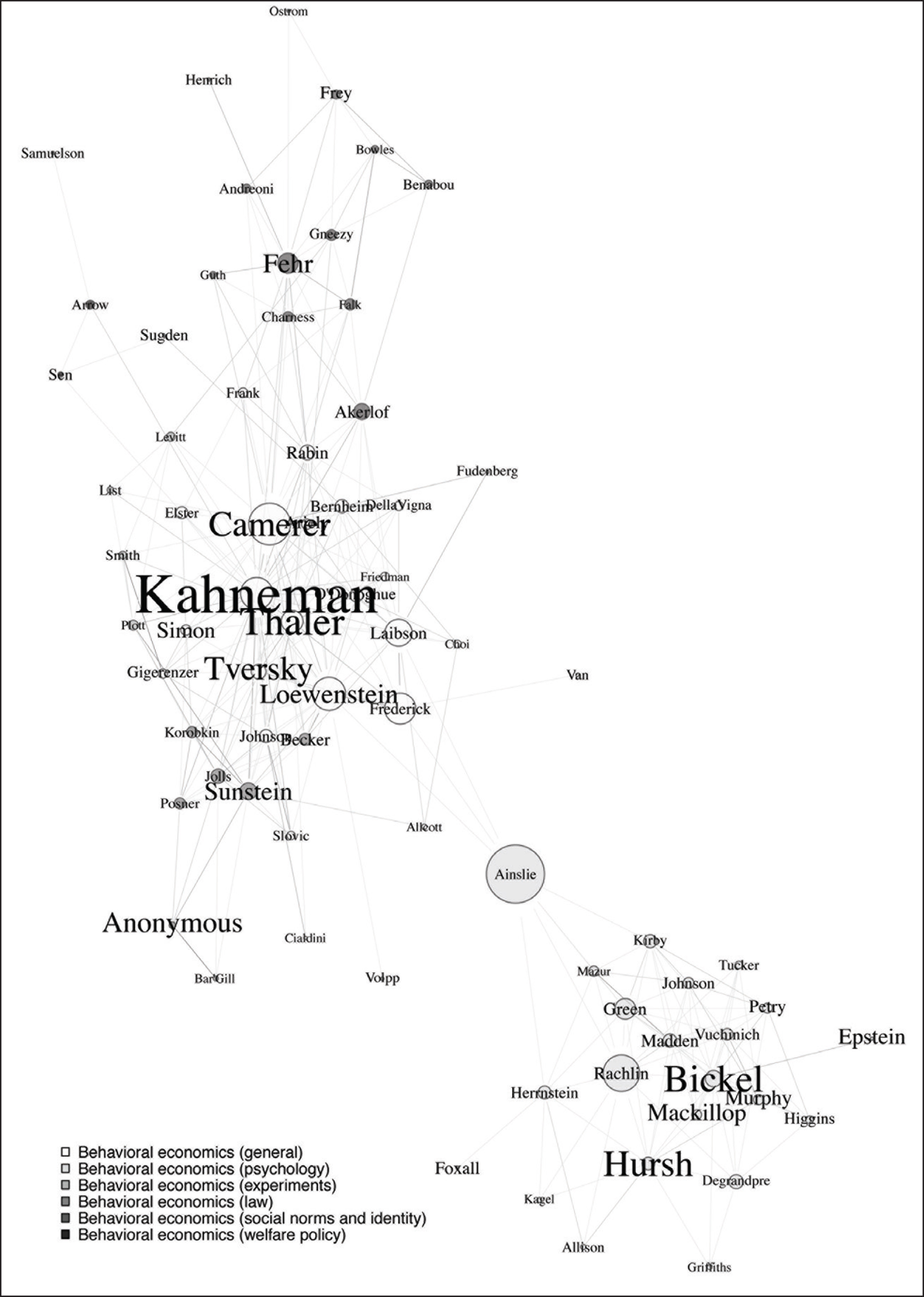
The largest cluster contains highly cited and central authors in the economic side of the network, including two of the early drivers of behavioural economics: Kahneman and Thaler. While their respective research partners, Tversky and Sunstein, are less central, this can partly be attributed to how the bibliometric algorithm constructs the network based on the first author of a given text. Surprisingly, these heavyweights are not the most central when considering the network as a whole. Younger behavioural economists serve as mediators bridging the gap between psychology and economics, with a common interest in time-inconsistent preferences. Loewenstein’s key works pertain to intertemporal choice within the utility models of economics (Loewenstein & Prelec, 1992) and more psychologically influenced research on self-control and visceral factors, like drug addiction (Loewenstein, 1996). We also find David Laibson, known for his work on hyperbolic demand curves (Laibson, 1997).
To the north of the main cluster is a group of authors predominantly known for weaving social norms into economics research. Key concepts applied by these researchers include identity (Akerlof & Kranton, 2000), institutions (Ostrom, 1990) and fairness (Fehr & Schmidt, 1999). Moving counterclockwise, we find researchers in welfare economics and policy, including well-known authors like Amartya Sen and Paul Samuelson. Arrow (1963) is the most central author in this cluster, known for showing how imperfect consumer information in healthcare may lead to market inefficiency, calling into question fundamental assumptions of market equilibrium. Next, we find a small group providing experimental evidence that raises questions regarding key concepts, like prospect theory (Plott & Zeiler, 2005), while others find that laboratory results may both overstate and underplay the importance of social preferences (Levitt & List, 2007). Legal scholars known for kick-starting the behavioural approach to law dwell to the south of the main cluster (Jolls, Thaler, & Sunstein, 1998; Korobkin & Ulen, 2000).
On the opposite side of the map is the second largest cluster, comprising mainly psychologists and psychiatrists. These authors largely incorporate behavioural economics into research on behavioural reinforcement and rewards, like hyperbolic discounting in gambling (Rachlin, Raineri, & Cross, 1991) and delay-discounting to investigate impulsivity in drug addicts (Bickel, Marsch, & Carroll, 2000; Kirby, Petry, & Bickel, 1999). While not the most cited author in the network, American psychologist George Ainslie is quite clearly the strongest binding agent in it, serving as the interface between the domains of psychology and economics. Ainslie’s (1975, 1992) work primarily concerns the impact of delayed rewards on choice among both human and non-human subjects, where more immediate rewards are preferred to future rewards, as implied by hyperbolic discounting. His conceptualisation of the intertemporal bargaining between these present and future ‘selves’ remains among his key contributions. The shared interest in this inner struggle appears to be the tie that binds psychologists and economists together in the field of behavioural economics.
Viewing behavioural economics scholars as a temporal network (see the animation in the online appendix) reveals the early influence of behavioural psychologists in developing the field, particularly Steven Hursh. The influence of Kahneman, Thaler and other heavyweights is first felt in the early 2000s. Distinct disciplinary sub-communities emerge among the economists in 2011, while the psychologists gradually shrink into one community. Meanwhile, the disciplinary boundary between the two cores of behavioural economics becomes more clearly etched over time as the field matures.
The Geography of Behavioural Economics
We can also use bibliometric tools to map out the spatial relations of behavioural economics (Leydesdorff & Persson, 2010). Figure 3 depicts the institutional co-occurrence among the corpus of texts. A dense web of connections interweaves the American universities, together with notable transatlantic connections to universities in Canada, the UK and the Netherlands. The network depicts the domination of American coastal universities, which create central pathways and generally have the largest share of publications.
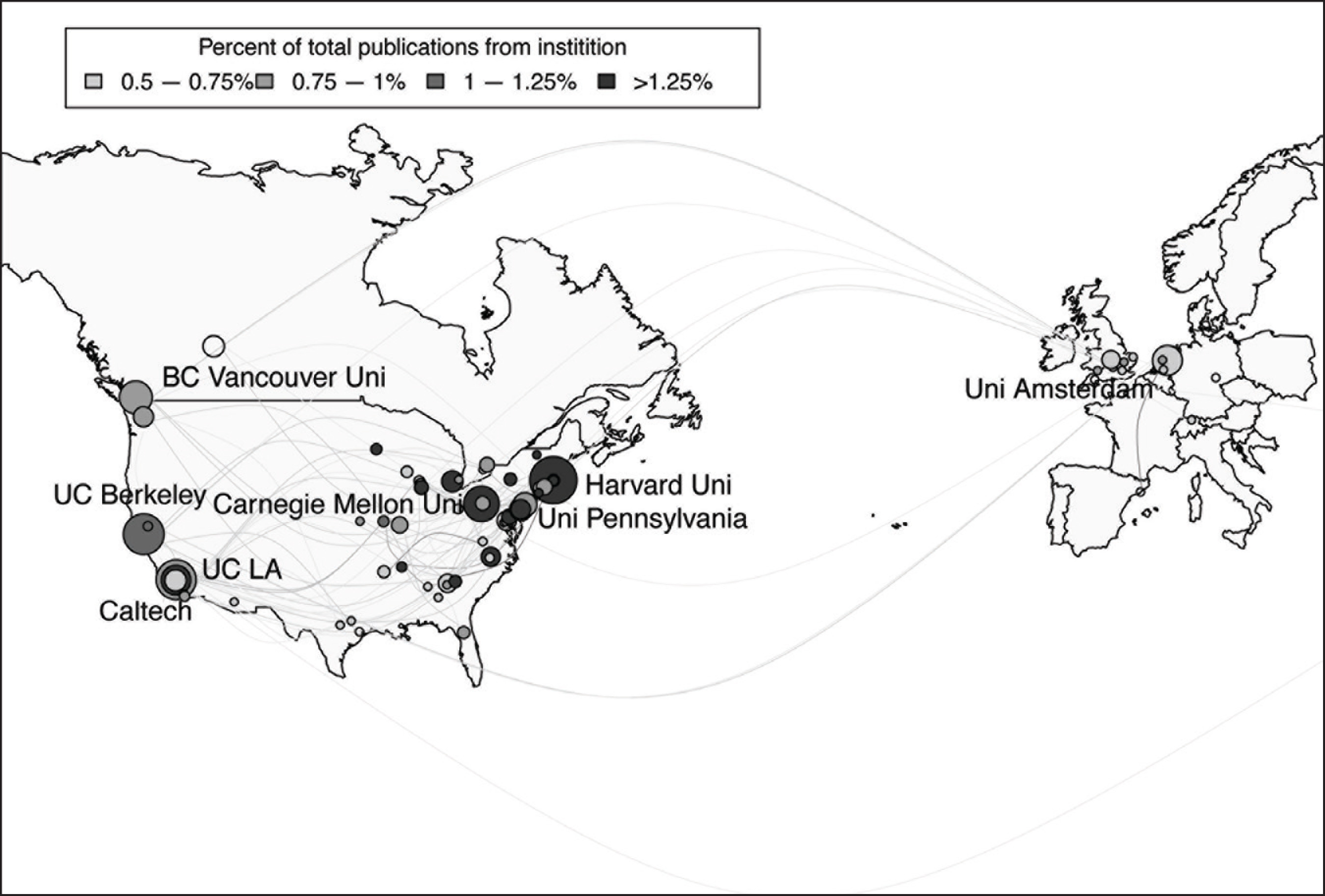
Several University of California campuses are among the top institutions in terms of the flow of information within behavioural economics. Most notably, the University of California, Berkeley, plays a gatekeeping role in the network and was pivotal in the proliferation of behavioural economics. In 1987, psychologist Daniel Kahneman and economist George Akerlof taught one of the first interdisciplinary courses on behavioural economics, both going on to win the Nobel Prize in Economics. Today, the university has a dedicated Initiative for Behavioral Economics and Finance, co-directed by Stefano DellaVigna, another key author and central economist in the network.
The University of Pennsylvania is similarly influential. Notably, the institution houses the Center for Health Incentives and Behavioral Economics (CHIBE), headed by Professor of Medicine Kevin Volpp. Professor of Economics and Psychology George Loewenstein is the director of the University’s Roybal Pilot Program under CHIBE, focusing on applying behavioural economics to real-world health problems. Loewenstein is also the co-director of the Center for Behavioral Decision Research at Carnegie Mellon University, another key institution seeking to design and test behavioural interventions to inform policymaking. Carnegie Mellon also has substantial historical significance, as it is Herbert Simon’s alma mater.
Unsurprisingly, several of the key institutions in the network are found in the city of Cambridge, Massachusetts. The Department of Behavioral Economics at Harvard is chaired by David Laibson, and further notable staff include Matthew Rabin and Sendhil Mullainathan, both professors of economics. Mullainathan’s absence from the network of top authors is curious, as he is considered a key scholar of ‘new’ behavioural economics (Sent, 2004). Massachusetts Institute of Technology (MIT) houses the Sloan Neuroeconomics Lab, a research centre studying anomalous decision-making through behavioural economics and neuroscience. MIT’s Drazan Prelec is also absent from the list of key authors, despite his contributions to neuroeconomics—a combination of behavioural economics and neuroscience.
The lack of central non-academic institutions is surprising, considering how institutions such as the World Bank, European Commission and Organisation for Economic Co-operation and Development (OECD) have published their own reports on the policy applications of behavioural economics (OECD, 2017; Sousa Lourenço, Ciriolo, Almeida, & Troussard, 2016; World Bank, 2015). For not to forget the establishment of dedicated units using behavioural economics, such as the UKs prolific Behavioural Insights Team. The sole exception is the National Bureau of Economic Research (NBER), a private research institution based out of Cambridge, Massachusetts. NBER played a formative role in behavioural economics in the 1980s, providing funding opportunities and workshops for young economists who were interested in drawing on psychology (Heukelom, 2007). The institution continues to host conferences on behavioural economics and publishes working papers by key authors in the field (Sent, 2004).
Visualisation: Publication Outlets
As the final step on the journey in behavioural economics, this section maps out the network of journals and books engaging with behavioural economics (Figure 4). We highlight the most important sources in each disciplinary cluster judged by their betweenness centrality. We then identify the main contributions of the most central publication outlets to behavioural economics in terms of their most cited works. The dual influence of economics and psychology also becomes evident in the visualisation of publication citation patterns, where these two research fronts can be clearly identified as the centre of the network, bridging together the more peripheral fields such as law, health and behavioural pharmacology.
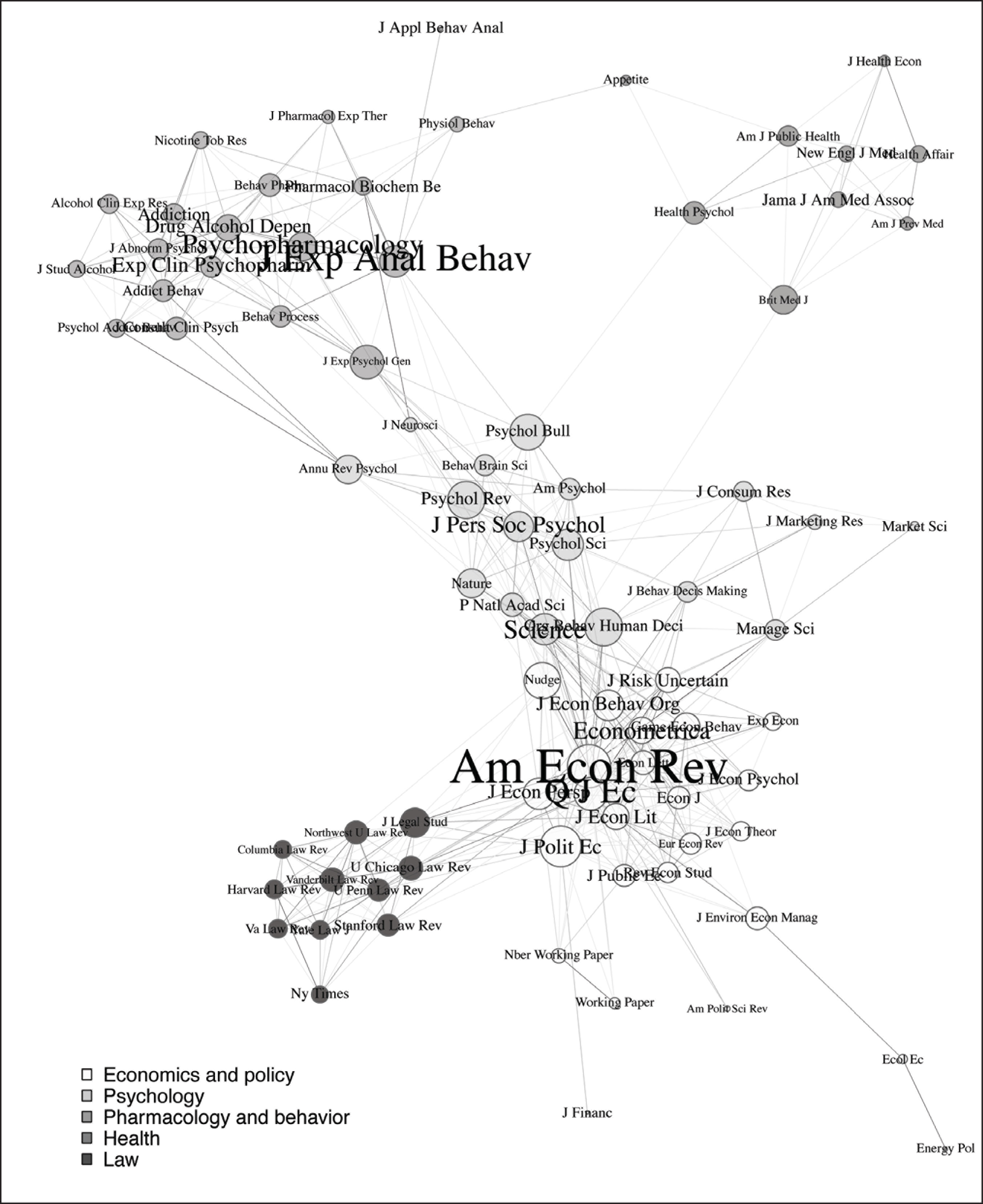
The largest cluster consists of traditional economics journals as well as political science journals and the book Nudge. Several journals within the cluster of journals are highly central to the network in terms of betweenness centrality. Highest is the American Economic Review, publishing the article based on Kahneman’s (2003) Nobel prize acceptance speech, O’Donoghue and Rabin’s (1999) work on present-biased preferences, and Thaler and Sunstein’s (2003) much-debated article on the paradoxical libertarian paternalism concept. Thaler and Sunstein’s (2008) highly accessible and successful behavioural economics bestseller Nudge also plays a central role, serving as gatekeeper between the fields of economics and policy and the medical journals in the network. Interestingly, Nudge establishes this connection through the British Medical Journal. Considering that the British were pioneers in the nudging movement with the establishment of the Behavioural Insights Unit, this is a logical connection, especially considering the widespread use of nudging in healthcare.
West of the economics and policy cluster, we find a tightly woven community of law journals. The legal cluster also includes The New York Times, known for publishing popular science articles on behavioural economics (Sent, 2004). The central system of economics journals serves as the communicative pathway for knowledge from the field of law to the rest of the network. If we removed these economics journals, law would become isolated, as there are no direct routes to other research fields. The dense connections between law journals indicate a strong level of bibliometric co-occurrence, suggesting that legal scholars in behavioural economics are highly specialised and tend to be cited alongside other works from within their field. The Journal of Legal Studies and the University of Chicago Law Review are most central within the legal community, adjoining the legal field with economics and policy journals. Journal of Legal Studies includes works such as Gneezy and Rustichini’s (2000) novel piece, demonstrating that fines have the opposite effect when aimed at reducing tardiness among parents picking up their children from day care, as well as Jolls and Sunstein’s (2006) proposal to address the limits of bounded rationality through legal strategies that can steer people towards more rational behaviour. The University of Chicago Law Review puts forth another of Sunstein and Thaler’s (2003) masterpieces on libertarian paternalism, as well as Glaeser’s (2006) follow-up rebuttal to the concept, arguing that systematic biases in human decision-making should make us more wary of government intervention rather than serving as a justification for paternalistic policies.
Moving north from the economics and policy community, we find an influential cluster consisting of psychology journals, as well as the high-impact general science journals Nature and Science. The central Psychological Bulletin publishes Lea’s (1978) examination of the relation between the traditional economic demand curve and behavioural reinforcement theory, Ainslie’s (1975) use of economics and social psychology to examine impulsiveness and a psychological study of the role of emotion in decision-making under risk by Loewenstein, Hsee, Weber, and Welch (2001). Psychological Review is the most central, publishing Hursh and Silberberg’s (2008) work utilising behavioural economics methods with non-human subjects to assign value to behavioural reinforcements, Gigerenzer and Goldstein’s (1996) usage of algorithms to investigate the limits of rationality, as well as further contributions from behavioural economics heavyweights like Simon, Kahneman and Tversky. Science is at the frontier between economics and psychology. Its central location is sensible due to its generally high impact factor and the fact that it does not focus on a specific research field but is a general interest journal, allowing it to publish contributions from psychology, economics and so forth. Notably, Science published two of Tversky and Kahneman’s (1974, 1981) classic works on heuristics, biases and framing, as well as Johnson and Goldstein’s (2003) influential piece, revealing how default settings (i.e., opt-in vs. opt-out) influence choice regarding organ donation. While Science is at the interface between the two core fields, the Psychological Bulletin and Psychological Review connect to research on behavioural pharmacology and addiction research, as well as medicine.
A community of journals within the fields of behavioural pharmacology and substance abuse research lies north of the central psychology cluster. The Journal of the Experimental Analysis of Behavior publishes several of Hursh’s (1980, 1984; Hursh, Raslear, Shurtleff, Bauman, & Simmons, 1988) early contributions to the field of behavioural economics, which borrow economic concepts to develop a more nuanced science of behavioural psychology. Additionally, Psychopharmacology publishes several works by Bickel, DeGrandpre, and Higgins (1995; Bickel, Odum, & Madden, 1999; Bickel et al., 2000) that incorporate behavioural economics concepts like hyperbolic discounting into pharmacological research, implying that the efficacy of drug reinforcement may be heterogeneous.
The final community consists of medical journals connecting to both the psychology and the economics and policy networks, with a weaker connection to the field of pharmacology. Health Psychology bridges the gap to the psychology cluster, publishing works, including behavioural economics analyses relating to childhood obesity and snacking behaviour (Epstein, Smith, Vara, & Rodefer, 1991; Goldfield & Epstein, 2002). In the British Medical Journal, key articles mainly concern policy aspects, including critical reflections and potential pitfalls regarding the use of nudging and behavioural economics to tackle health problems (Loewenstein, Asch, Friedman, Melichar, & Volpp, 2012; Marteau, Ogilvie, Roland, Suhrcke, & Kelly, 2011).
The temporal network of journals shows the early dominance of psychological journals, with the cluster of economic journals gradually growing in influence through the 2000s both in terms of the number of citations and network centrality (see online appendix). Initially, the network is largely amorphous in terms of disciplinary structure, but these divisions crystallise as time progresses.
Conclusion
This article systematically mapped the field of behavioural economics, by analysing citation data from the Web of Science, using advanced bibliometric methods. In so doing, it has provided empirical evidence on the authors, geography and publication outlets that together constitute the morphing field of behavioural economics.
The first part focused on the formative authors for the field, highlighting the importance of Adam Smith, Frank Knight, John Keynes and Herbert Simon. It also illuminated the somewhat forgotten ancestors from behavioural psychology, including B.F. Skinner, Leon Festinger, Charles Ferster, William Hodos and Richard J. Herrnstein. Looking at the cumulative knowledge base measured in terms of quotes, the study confirmed the well-known influence of Daniel Kahneman and Amos Tversky, as well as Richard H. Thaler, Cass R. Sunstein, Colin F. Camerer and George Loewenstein. As with the forerunners in the field of behavioural economics, however, there seems to be a blind spot regarding behavioural psychologists. The list of the most quoted works includes several texts by psychologist Steven R. Hursh, who wrote under the label ‘behavioural economics’ several decades before the term gained widespread attention. Behavioural economics is not merely a field where psychology has provided evidence-based axioms and theories for economics but also where reverse cross-pollination has taken place: Ideas from economics have consolidated studies of especially reinforcing schedules in psychology. This also becomes evident when moving beyond the basic citation frequencies to consider the relational aspects in terms of author networks. Here, two main clusters emerge: One comprising scholars writing within mainstream behavioural economics and another consisting of behavioural psychologists. The network analysis of authors also illuminated several subclusters of scholars dealing with issues, including social norms and identity, law, welfare policy and experiments relating to behavioural economics.
The second part addressed the geography of behavioural economics, demonstrating a strong Anglo-Saxon core. This might be unsurprising, given that behavioural economics had its epicentre in the USA, and most of the key scholars in the field work at Anglo-Saxon universities. In terms of institutions, the study revealed the key role of University of California, Berkeley; Harvard University; and University of Pennsylvania in terms of knowledge production and network centrality.
The third and final part of the article examined the means of communication in the field in terms of central journals and books. Compared to the more granular author-level analysis, the network of publication outlets demonstrated that the field is composed of and draws on five sub-areas: (a) Economics and policy, (b) psychology, (c) pharmacology and behaviour, (d) health and (e) law. It showed that journals, including American Economic Review, Journal of the Experimental Analysis of Behavior, Psychological Bulletin and Health Psychology are central for communication in the field. It also provided further evidence of the importance of Thaler and Sunstein’s (2008) blockbuster book, Nudge.
Having examined the past and present of the field, it is also possible to make some cautious remarks regarding the future. At the author level, we see a strong influence of male scholars educated in economics and psychology, but we hope to see a more heterogeneous composition of authors in terms of educational background and gender in the coming years. At the institutional level, there is currently a strong Anglo-Saxon dominance. The gospel of behavioural economics is becoming increasingly diffuse, however, so we can expect a more geographically diverse set of research hubs in the future. At the journal level, a varied knowledge base can be observed. Yet there is still potential for broadening the scope towards, for instance, neuroscience or sociology. Taken together, behavioural economics is expected to become further pluralised in the future, perhaps to the extent that it will fulfil Thalers’ (2016) prophecy and vanish because it has become the standard way of thinking.
Footnotes
Acknowledgements
This article has been presented at a research seminar at Copenhagen Business School. The authors would like to thank the participants for valuable feedback.
Declaration of Conflicting Interest
The authors declared the following potential conflicts of interest with respect to the research, authorship and/or publication of this article: The authors have no potential conflict of interest to report.
Funding
The authors disclosed receipt of the following financial support for the research, authorship and/or publication of this article: The author received no financial support for the research, authorship and/or publication of this article.