



Abstract
The formation of the Coalition government in 2010 has resulted in unprecedented spending cuts presented as necessary austerity, together with the promotion of the ‘Big Society’ as the panacea for social ills. This article argues that the cuts continue a thirty-year process of redistribution to the rich. Rather than being a necessary response to the economic crisis, they constitute a neo-liberal shock doctrine, forcing through punitive policies which undermine the collective provision against risk that constitutes the ‘just’s umbrella’. However, arguments for reduced consumption and self-organization in civil society have purchase partly because of real needs for sustainable development and human well-being. Reading austerity and the Big Society through a ‘hermeneutics of faith’ rather than a ‘hermeneutics of suspicion’ opens up the utopian possibility of thinking holistically about an alternative, equitable, sustainable future radically different from that offered by conventional politics.
The phrase ‘The Just’s Umbrella’ is taken from a quatrain attributed to Charles Synge Christopher Bowen, Baron Bowen, QC (1835–1894): The rain it raineth every day Upon the just and unjust fella, But more upon the just because The unjust stole the just’s umbrella
Bowen’s last public service was to preside over a commission set up in 1893 to inquire into the Featherstone Massacre. The price of coal was falling, and mine owners sought to impose pay cuts in order to restore their own profits, resulting in widespread industrial unrest. The ensuing lock-out was the largest industrial dispute to date. At one associated incident of violent disorder at Ackton Hall Colliery in Yorkshire, troops were mobilized because of a shortage of available police (some of whom were away policing the Doncaster races). The Riot Act was read and soldiers fired on the crowd. Several people were injured and two miners were killed: their names were James Gibbs and James Duggan (Neville, 1976). Duggan’s death was recorded as ‘justifiable homicide’, although a different jury refused to return the same verdict in relation to Gibbs. The Bowen Report both exonerated magistrates, officers and troops, and laid out the ‘respective duties of civil and military authorities at times of public disorder’ (Neville, 1976: 349). Its terms of reference prevented it from considering any facts other than those directly concerned with events at Featherstone on 7 September: ‘a wide ranging inquiry into the state of the coalfield and disturbances elsewhere was strictly prohibited’ (Neville, 1976: 349), let alone into the poverty and deprivation of the miners and their families.
On 4 August 2011, armed police in London shot and killed Mark Duggan, triggering four nights of civil disorder, looting and arson across British cities. The response across the political spectrum echoed John Major’s 1993 pronouncement that ‘society needs to condemn a little more and understand a little less’. 1 Condemnation of at least some aspects of the unrest is unavoidable: five more people died and hundreds were burned out of their homes; small businesses as well as large were ransacked and their owners attacked. This is, however, not an alternative to understanding, nor is it a justification for the effective suspension of sentencing guidelines and the unusually harsh punishment of those subsequently processed through the courts: had there been a public inquiry, either into the shooting of Mark Duggan or into the wider disorder, it too would undoubtedly have focused too narrowly on the events of those few days rather than on the wider questions of social conditions and government policies – not just those of the ConDem Coalition, but of Thatcher, Major, Blair and Brown before them. It was, insisted David Cameron, not poverty but criminality that was the cause of the riots. The blame was placed on gang culture. The Justice Secretary, Kenneth Clarke, described the participants in the disorder as a feral underclass, and the unrest itself ‘as an outburst of outrageous behaviour by the criminal classes – individuals and families familiar with the justice system, who haven’t been changed by their past punishments’ (Lewis et al., 2011). However, early analysis of the first 1100 people processed through the courts showed that the majority came from deprived areas, and two-thirds of these areas had got poorer between 2007 and 2010; 41 per cent of suspects lived in the 10 per cent most deprived places in England. 2 By October 2011, official data showed that those who took part were young, poor and poorly educated, and overwhelmingly from deprived areas, but only a minority were gang members. 3
Austerity: Stealing the just’s umbrella
Whatever Bowen meant by his verse, the thirty years from 1979 saw the open theft by the unjust of the just’s umbrella – that is, the progressive destruction of our collective provision against risk, the increasing concentration of wealth and power in the hands of what Neil Lawson and the Compass pressure group described as a feral elite, 4 and an intensely punitive attitude to the poor. This was accompanied by the sale of public assets, the destruction of public services, the redistribution of income and wealth from the poor to the rich, and the undermining of pension provision – a process that we should understand as theft. The discourse of cuts and austerity that accompanied this from 2010 is a neo-liberal shock doctrine providing an excuse for further appropriation of social resources by the rich (Klein, 2007). Talk of the ‘Big Society’ is, in the mouths of the Coalition, little more than an attempt to get necessary social labour done for nothing, disproportionately by women, by pushing work back across the market/non-market boundary. We’ll sack your librarians, but if you want you can keep your libraries open using volunteers. We’ll cut your care services, so if you don’t look after your relatives and neighbours they will be abandoned, or left unfed and untended even in hospitals. We’ll axe the programme for intensive social work with families with multiple problems, and replace it with untrained volunteers in the Working Families Everywhere programme, headed up by millionaire Emma Harrison (Gold, 2011).
‘Austerity’ became the justifying mantra for Coalition economic and social policy. The driving imperative of this policy is to force down public sector spending. Cuts in welfare spending impinge directly on the poor, the young, the sick and the disabled. Eligibility conditions for work-related benefits have been progressively tightened over the last thirty years, including requirements for job-search or ‘work-related activity’ by lone parents of progressively younger children. Labour’s last Welfare Reform Act was ‘informed’ by a report by Paul Gregg (2008) which suggested unconditional support should cease when the youngest child was a year old, making it equivalent to the maternity leave available in law to mothers in employment. The re-testing of all claimants of Incapacity Benefit has been grossly incompetent, in that 40 per cent of appeals have been successful, as well as brutal and cruel. Coalition policy added to this ongoing process caps on Housing Benefit, predicted to displace thousands of families and disrupt their children’s education, as well as a cap on total benefits related to the average incomes of those in work. The Educational Maintenance Allowance was abolished. The response to the 2011 disorder included attempts to evict entire families from social housing if a member of the household was involved in public disorder. Wandsworth Council did not even wait for the courts to convict before starting proceedings against a woman whose son had been charged in connection with the unrest. There were also repeated suggestions of withdrawing benefits from those convicted of participation, as an ‘extension’ of the current cessation of benefits during imprisonment, justified by the claim that benefits are a privilege, not a right. This is a discursive shift with huge implications for future restrictions of benefit entitlement of many kinds.
Many cuts were imposed indirectly through cuts in central and local government budgets. They include raising tuition fees at most higher education institutions to £9000, an increase forced on universities by an 80 per cent cut in overall funding for teaching, or a 100 per cent cut in the funding of Arts, Humanities and Social Science teaching. This is part of a wider philistinism. Cuts in Arts funding were also made both directly and through cuts in local authority budgets. Music education funding was cut by over 25 per cent, and removed altogether from local authorities to a tendering process through the Arts Council. The new English Baccalaureate championed by Michael Gove includes no element of art, drama or music. As the cuts fell on local authorities, they were exhorted by Eric Pickles to consider whether the assets they hold are ‘appropriate’, and to sell off those that are not. Besides land and property, this is likely to include works of art held in local museums and galleries, which will therefore disappear from public to private hands and thus be lost to public view. Even where such artefacts have been given to the public by recent or past benefactors, unless they were left in trust in perpetuity, there is nothing to prevent local authorities from selling them: some local authorities, including Birmingham, were considering this before the Coalition came to power.
There have been cuts in the availability of legal aid. The planned cuts in police budgets, which met with opposition in the wake of the events of August 2011 (including from Boris Johnson as Mayor of London) are predicted to mean significant cuts in frontline policing. All local authority services are now at risk of reduction or complete disappearance, including domiciliary care for the elderly and disabled, youth clubs and other leisure provision, and the frequency of rubbish collection. Planning laws have been relaxed to give priority to market returns, otherwise known as private profit. At the same time, they were rigidly maintained against the homes of travellers, built without planning permission but on their own land, at Dale Farm – notwithstanding the human cost and the financial cost of eviction, in which the settlement was stormed by riot police.
The State Pension is the primary collective provision against destitution in old age. The basic rate for 2011/12 was £102.15 per week, expected to rise in 2012/13 to £107.46 because of high levels of inflation. (Median household income in 2009/10 was £413 per week Before Housing Costs, £356 per week After Housing Costs; approximately 2 million pensioners had incomes below 60 per cent of the median, adjusted for household composition (DWP, 2011).) The Coalition restored the link between pensions and earnings, which was broken by Thatcher, and shamefully not restored by the incoming Labour government in 1997 despite pressure led by Barbara Castle and Peter Townsend. However, the ‘triple lock’ of increasing pensions in line with earnings, prices or 2.5 per cent, whichever is higher, is undercut by strong downward pressure on earnings. In 2011, the Institute for Fiscal Studies predicted a fall in median household income of 7 per cent between 2010 and 2013 owing to rising unemployment, falling real levels of benefits, rising prices and falling wages. Falling real levels of benefit were engineered through switching all pensions and benefit uprating from the Retail Prices Index to the Consumer Prices Index, which excludes a number of elements including Council Tax, and which is therefore generally lower. Uprating pensions by RPI rather than CPI would take them to £108.42 – so the apparent largesse actually represents uprating by less than inflation (King, 2011). Indeed, prices of basic goods and services, such as food and fuel rose particularly rapidly in 2010/11. The general secretary of the National Pensioners’ Convention pointed out that ‘all the research shows that the real level of inflation pensioners face is at least double the official figures, because older people spend a higher proportion of their income on those goods that are rising fastest’ (cited in King, 2011). Taken together with the freezing(!) of the winter fuel allowance and cold weather payments, this makes the fall in the real value of the State Pension even greater than it appears.
People will have to wait longer to qualify for the State Pension. In January 2011, deferral of the State Pension age was speeded up, to reach 66 by April 2020 – with the likelihood of further deferral to 68. The justification for this is that ‘everyone is living longer’. The average life expectancy for men in the UK aged 65 in 2006–8 was seventeen years, for women twenty years. But there are large variations in life expectancy by area and by social class. For the 2002–5 cohort, men and women in social class V had a life expectancy at 65 over four years less than those in social class I (ONS, 2008). Healthy life expectancy free from disability is only a little over half actual life expectancy, and is lower in Wales, Scotland and Ireland than in England. 5 Unsurprisingly, then, Age UK expressed concern that these changes ‘will hit the poorest hardest, as people on lower incomes are generally more reliant on their state pensions and have lower life expectancy’. 6 Those with occupational pensions, in both private and public sectors, also face cuts in their expected standard of living. Public sector workers face delay and reduction in their pensions, again in part through the use of the CPI, as well as redundancy and pay freezes; private sector workers have seen their pensions radically reduced by falls in share prices.
The largest and most catastrophic loss of pay comes from job losses. Unemployment rose inexorably in 2011. In the three months to June 2011, well before the full effects of public sector job losses were felt, unemployment in the UK reached 2.49 million, including 1.05 million women, the highest number of women since 1988; the increase in redundancies in that quarter was almost all among women. Youth unemployment reached over 20 per cent: there were nearly a million (949,000) unemployed 16 to 24 year olds. By October, figures were even higher, and youth unemployment was over a million. In times of recession, older workers (those over fifty) also find it increasingly difficult to find and retain jobs. Delaying pension age potentially widens the gap between employment and the security of a pension even for those capable of and wanting to work, leaving no safety net but the increasingly minimal and increasingly conditional Job Seeker’s Allowance. This itself is a hugely reduced protection against risk compared to Unemployment Benefit and Supplementary Benefit in the 1970s, even though these were inadequate at the time, and much less favourable in both level and conditionality than the State Pension.
Cuts to the incomes of families with children, whether in paid work or not, have been more draconian than pension cuts. Working tax credit has been eroded in several ways. These include a three year freeze on basic levels and an increase in the taper at which it is phased out for higher incomes; a reduction in the maximum childcare element; withdrawing entirely the entitlement of couples with children working 16–24 hours per week between them. Child Benefit has been frozen for three years from 2011, and withdrawn from higher-earners. Households with two earners just below the higher-rate threshold will retain their benefit, but those with one earner over a £50,000 threshold will lose theirs. Not only is this manifestly unjust, but in removing the universality of Child Benefit it opens the way for further means-testing. In October 2011, the Institute for Fiscal Studies modelled the outcome in terms of the probable numbers of children in poverty through to 2020. The rate of relative child poverty calculated before housing costs is predicted to rise from 19.7 per cent in 2009 to 24.4 per cent in 2020, representing an additional 700,000 children. The rate of absolute poverty, those worse off than in 2010, is predicted to rise from 19.3 per cent to 23.1 per cent – an additional 900,000 children (Brewer et al., 2011). The measures announced in the Chancellor’s 2011 Autumn Statement added another 100,000 to these figures.
Are cuts really necessary?
The mantra of the necessity of spending cuts met little challenge from politicians or the media. Across Europe, as Wolfgang Streeck (2011) notes, governments were essentially acting as debt collectors for international capital. In their first year of office, representatives of the Coalition repeated at every opportunity that the cause of financial austerity was the extravagance of the Labour government; by late 2011, they were insisting that the eurozone crisis was responsible for the state of the British economy. Some people still remembered that it was the irresponsibility of the financial sector and the bail-out of banks whose CEOs continued to walk away with vast bonuses and huge pension settlements. In September, the ‘Occupy Wall Street’ protests were launched. By mid-October 2011 there were widespread ‘Occupy’ demonstrations against austerity and inequity in 900 cities across the world under the banner headline ‘We are the 99%’. But in the dominant political discourse there was little disagreement over the necessity of cuts. The only question raised by Labour in opposition concerned their speed and depth, since from a Keynesian point of view, Coalition policies irresponsibly blocked rather than stimulated economic growth. To describe the decimation of social provision and imposed austerity as a neo-liberal shock doctrine is to say more than that. It is to indicate that the cuts were and are not necessary, and that the language of austerity merely constitutes an excuse to further concentrate power and wealth in a few private hands. This is an assault on every aspect of the welfare state in the interests of capital and in the interests of the wealthiest 1 per cent of the population. It is an opportunity to drive through precisely the kinds of reforms that neo-liberals have sought at least since Hayek wrote The Road to Serfdom in 1945.
Where is my supporting evidence that these cuts are unnecessary? Let us begin at the national level. From the election of the Thatcher government in 1979, inequalities in Britain began to widen, and the extent of this increase needs underlining. Table 1 shows the change in the distribution of income (After Housing Costs) from 1979 to 2010, with some earlier figures for comparison. Britain became, on these figures, more unequal than before the 1939–45 War. In the thirty years after 1979, the top 10 per cent increased their share of household income by 10 percentage points, while the bottom 10 per cent saw their share fall from 4 to 1 per cent, and the share of the bottom 30 per cent was reduced from 17 to 10 per cent. Indeed, if the share taken by the top 10 per cent were reduced to its 1979 levels, this would release enough money to lift every household, every child, every disabled person, every pensioner out of poverty, and leave some over. 7 Most of the gain accrued to the top 1 per cent. We are plainly not all in this together. Larry Elliott, writing in The Guardian, recorded that between mid 2009 and March 2010, national income grew by £27 billion; of this, over £24 billion went to profits, and only about £2 billion to wages (Elliott, 2010).
Percentage shares of total net income received by individuals in different deciles of the income distribution in the United Kingdom from 1938/9 to 2010

Notes: The 1938/9 and 1972/3 figures are not strictly comparable with the later series, and are merely indicative, hence italicized. The figures from 1979 are calculated after housing costs. Figures may not sum to 100 because of rounding.
Sources: 1938/9 and 1972/3: Report of the Royal Commission on the Distribution of Income and Wealth (1975); 1979, 1990/1: Joseph Rowntree Foundation (1995); 1996/7 onwards: Department for Work and Pensions, Households Below Average Income (Annual Series).
The distribution of wealth is even more unequal. Two-thirds of the UK’s 60 million acres is owned by one-third of one per cent of the population (Cahill, 2001). The Sunday Times Rich List for 2010 revealed an unprecedented rise in 2009 in the wealth of the richest 1000 individuals in Britain – an increase of £77 billion, or about 30 per cent. Their combined wealth holdings then totalled over £335 billion, more than one-third of the national debt. Half of this was held by the richest 100 individuals. If we had merely taxed the 2009 increase in wealth for the top 1000 individuals at 50 per cent, it would have generated £38 billion – more than six times the immediate cuts imposed by the Coalition’s Emergency Budget in 2010.
There was no sign of increased taxation of the rich in Britain. In the US, Warren Buffet complained that ‘My friends and I have been coddled long enough by a billionaire-friendly congress. It’s time for our government to get serious about shared sacrifice’ (cited in Coman, 2011). In France, 16 billionaires collectively called for higher taxes on the rich, leading President Sarkozy to raise an emergency 3 per cent tax levy on the rich. Here, the tax rate of 50 per cent on taxable incomes over £150,000 was reduced to 45 per cent in the 2012 Budget. Worse, the rich here were offered further opportunities to secrete money in Swiss bank accounts hidden from view and therefore from tax; and a bond scheme for social investment was launched which will in effect enable the wealthy to cream off profits of up to 13 per cent (Toynbee, 2011).
There is plenty of money; the question is who has it.
The coverage of the UK disorder in August 2011 did not completely eclipse the other major story of that week, a frenzy of selling on Stock Exchanges across the world in response to ‘fears’ about the security of government debt repayments in the eurozone and in the United States. Britain’s greatest socialist writer William Morris (whose life-span coincided almost exactly with that of Charles Bowen) once said that ‘individual men cannot shuffle off the business of life onto the shoulders of some abstraction called the State, but must deal with it in conscious association with each other’ (Morris, 1984b: 283). Were he writing today, he would doubtless observe that neither can we shuffle it off on to some abstraction called the market. For here too, even as ‘the markets’ are nervous and billions of pounds are wiped off share values in the virtual economy, there was profit to be made. In Europe, share values rallied when several countries banned short selling – that is, speculative selling of shares in order to buy them back at a lower price, and pocket a rather larger difference than an Asda customer. In the US, the refusal of the Republican Right to agree a necessary raising of the debt ceiling was the precipitating factor in the downgrading of credit status from AAA to AA+ by the rating agency Standard and Poor’s (we set the standard, you’re all poor). The normal consequence of reduced credit ratings is higher interest charges on debt. Someone, somewhere pockets the higher interest charges and profits from the increased burden on taxation and public finance. China, the largest foreign holder of US debt, declared they had ‘every right to demand the United States address its structural debt problems’ and slash its ‘gigantic military expenditure and bloated social welfare costs’ (Helms et al., 2011: 1, 4). Neo-liberal pressures come from unexpected places.
The Big Society and the Coalition
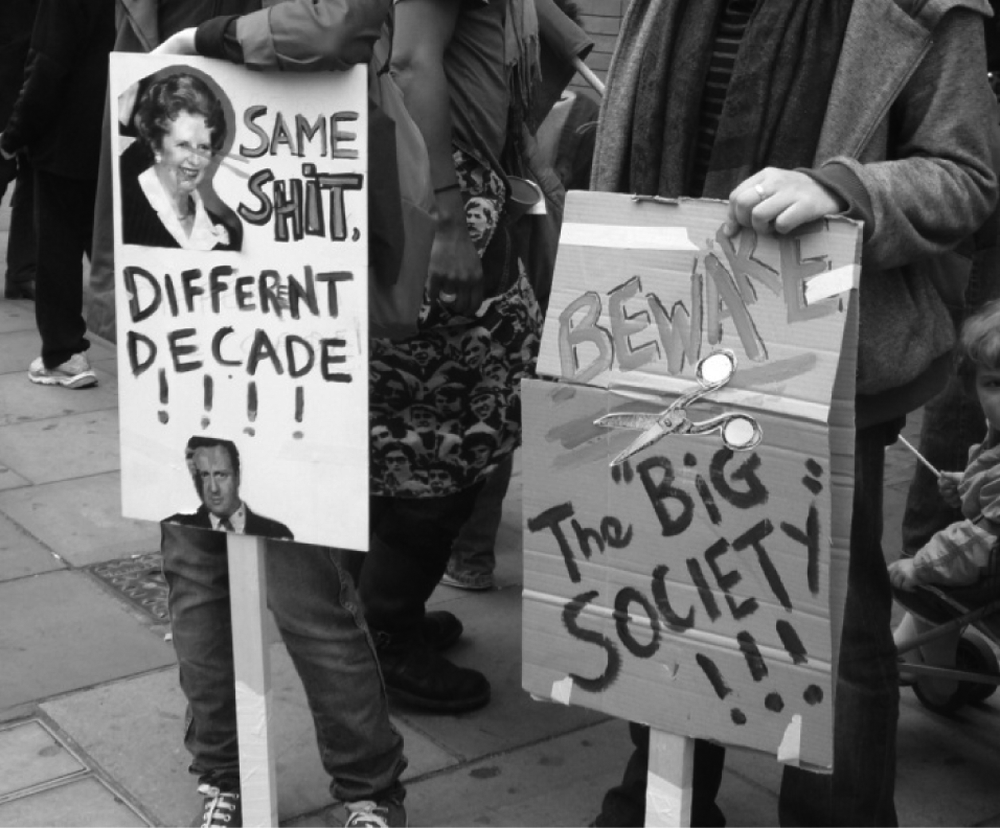
Against this background, talk of the ‘Big Society’ is easily seen as self- serving cant, again continuous with both Thatcherism and New Labour. On the March 2011 demonstration in London organized by the Trades Union Congress, home-made placards declared ‘Cameron there is no such thing as your “Big Society”’, ‘Beware the “Big Society”’ and ‘Same shit, different decade’.

Photograph by Ruth Levitas
Photograph by Ruth Levitas
The New Right of the 1980s promoted an amalgam of neo-liberal economics and conventional conservatism, in its combination of the free economy and the strong state. The strong state was necessary to police the failures of the market, notably in the riots of 1981, but also in legislation directed at trade union activity which reduced the right to free assembly and freedom of movement. The underpinning idea of the good society depended heavily on the invisible unpaid work, predominantly of women, in the domestic sphere and civil society, the latter articulated in Douglas Hurd’s promotion of ‘active citizens’ (see Levitas, 1986; Gamble, 1994). New Labour preserved the obsession with the free economy and was nonchalant about rising inequality, especially the runaway wealth at the top, which as we have seen continued through the 13 years of Labour governments. The counterbalance in New Labour discourse was ‘community’. But Blair’s notion of community owed less to his avowed inspiration John MacMurray (who was far more egalitarian), and much more to the highly conservative communitarianism of Amitai Etzioni. Here, the primary functions of the community are social control and the provision of services on an unpaid basis; hence New Labour’s promotion of the ‘third sector’ and volunteering (Levitas, 2005). The ‘Big Society’ is largely a continuation of this under another name, with extra emphasis on the claim that localism is more ‘responsive’ than state provision.
One of the bases of the ‘Big Society’ agenda is Phillip Blond’s Red Tory (2010). Blond revives the distributist ideas of G. K. Chesterton and Hilaire Belloc from the 1920s, not addressing the anti-Semitic attitudes of both writers. The problem is liberalism – both economic liberalism which has resulted in a grossly unequal distribution of assets, and social liberalism. The combination of these leads to a lethal combination of neo-liberal market and oppressive state. Blond’s argument recycles a familiar demonization of the 1960s; accuses the Left of ‘taking a delight in abortion and making a fetish out of the right to choose it’ (2010: 27); and makes values and behaviour the cause of contemporary ills (chief among which is welfare dependency). He asserts the need for intermediate organizations between the individual and the market and the individual and the state, therefore supporting co-operative production and social enterprises. He argues the need for a society based on virtue – what Colin Davis (1981) would have described as a Perfect Moral Commonwealth, rather than a Utopia in which social institutions are designed to encourage social equity and contain conflicts of interest. What is striking is that Blond does not endorse redistribution from the rich or from the private sector as a solution to building an asset base for the poor. Indeed, he endorses inequality, but argues that it must be justified in terms of virtue. For ‘Wealth accumulated into the hands of a small elite is not wealth stolen from the masses as the more enthusiastic revolutionaries would have us believe … Rather than attack even modes of valid wealth as if we want to level down to poverty, we need to open up the arena and manner in which wealth is presently accrued’ (Blond, 2010: 285). These are familiar right-wing arguments which talk of levelling down, blame the values of the poor for their poverty and justify inequality. But in so far as asset transfer is supported, it is asset transfer from the state, and especially the local state, to community groups. For this version of the Big Society is also – like so much right-wing rhetoric – utterly hostile not just to the state as regulator of the market, but to the welfare state, which is charged with responsibility for the passivity and destitution of the poor, and attacked for trying to set national standards for benefit levels and service delivery.
I want to make three points here. First, if we use Miriam Glucksmann’s (1995) idea of the Total Social Organization of Labour (TSOL), it is evident that socially necessary labour takes place as paid work in public and private labour, and as unpaid work, within the home and outside it. The growth of the public sector saw increasing numbers of women employed and paid, especially in caring and educational roles, for work that was previously non-marketized; contracting out local authority services led to a marked decline in the security and conditions of their employment, and the siphoning off of public funds into private profit. In the context of austerity and cuts, the inevitable reduction in local government services means job losses in both public and private sectors, predicted to fall most heavily on women. The Big Society can then only mean pushing necessary social labour back across the paid/unpaid boundary – a problem in itself, but also one which will exacerbate existing gender inequalities. ‘Big Society’ must mop up the consequences of the failures of the market and the dismantling of the national and local state. ‘Big Society’ means ‘work for free’.
Second, however appealing the idea of ‘localism’, it is deeply flawed. The state must be the guarantor of equal treatment in terms of benefits, services, and the administration of justice. It became customary under Labour to present social inequalities as inequalities between areas, thus deflecting responsibility for health outcomes, for example, on to local hospital trusts, and for educational outcomes on to schools and local authorities. Danny Dorling has graphically documented the extent of area inequalities in a series of publications (see for example Dorling, 2011a, b, c; Newman and Barford, 2010). Yet Dorling would be the first to agree that area inequalities are a manifestation of economic inequalities and of that now too underused term, social class. Put simply, localities vary greatly in the economic and cultural resources of the people who live in them, as well as their material character, and thus in the available resources for absorbing the additional labour implied by the Big Society. And if the state and the local state are not always easily called to democratic account, they remain more potentially accountable than self-styled community groups whose representative character is always questionable.
Third, the Big Society is not always benign. Besides the potential for repression and exclusion implied in conservative communitarianism in general, the disorder of 2011 illustrates some of the difficulties. The efforts of local people to clear up the mess in the following days have been hailed as the Big Society at its best. But the failure of the police to contain the disorder also led directly to the deaths of four members of the public seeking to prevent it, and the beginnings of vigilante organization on which the English Defence League sought to capitalize. The choice between this and heavier policing is not appealing. Police were assured of government support for the use of water cannon and baton rounds or plastic bullets. They dismissed this as inappropriate, partly because such tactics can be used only on static crowds, not relatively small, fast-moving, groups. However, commentary on the riots drew parallels with the student demonstrations in 2010 against rises in tuition fees: such political protests may be more likely to be the targets of such weaponry. Protestors at Dale Farm were tasered, with the BBC disgracefully ‘explaining’ to viewers that such weapons temporarily disable people with no lasting ill effects – when tasers have on some occasions caused death. As in 1981, policing the crisis is likely to become more brutal, the Big Society no substitute for the strong state. Indeed, this was the immediate effect of the August riots, in the imposition of extraordinarily frequent and high custodial sentences, and in Cameron’s suggestion (which was endorsed by China) that social networking sites could simply be closed down as a means of social control at times of actual or threatened disturbance.
To read Coalition policies and discourse in this way is, of course, to read them through what Paul Ricoeur called a ‘hermeneutics of suspicion’, an attempt at unmasking disguised meanings and practical implications (Ricoeur, 1981, 1987). It is to treat Coalition discourse as ideology in the most pejorative sense, disguising class inequalities and class interests behind generalizing populist rhetoric. Such unmasking is not hard. Several commentators have remarked on the hypocrisy of ex-members of the Bullingdon Club, including David Cameron, George Osborne and Boris Johnson, moralizing about criminal damage. 8 Obvious hypocrisy spreads wider: the looting – predominantly of sportswear and electronic gadgets – can be understood only in the context of a society which endorses grabbing what you can at every level, including bankers and (actually a small minority of) MPs, and in which you are what you have. Few are convinced by a Cabinet largely composed of Old Etonians and millionaires claiming we are all in this together. Other aspects of policy and discourse are harder to combat: the naturalization of markets and the distribution of resources that flows from them, or the necessity of cuts.
Rereadings
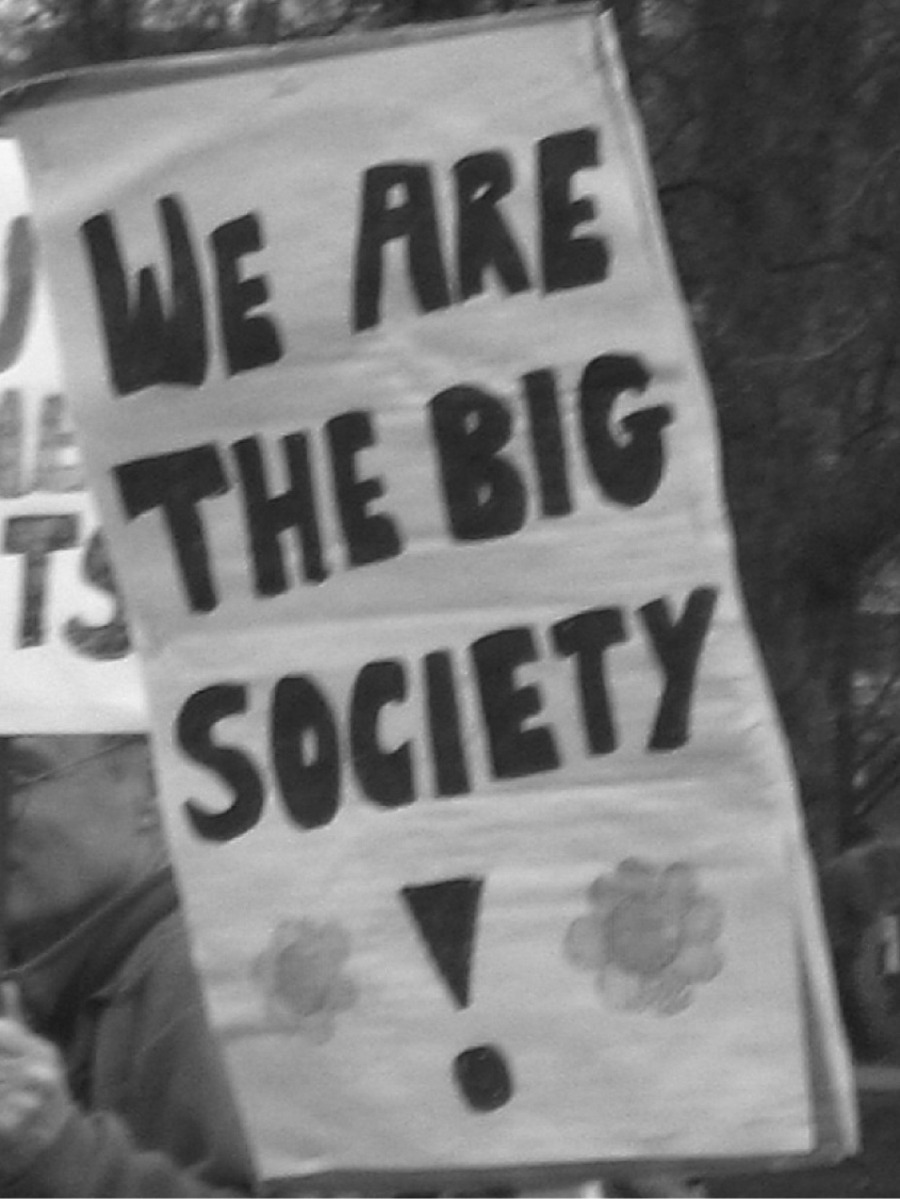
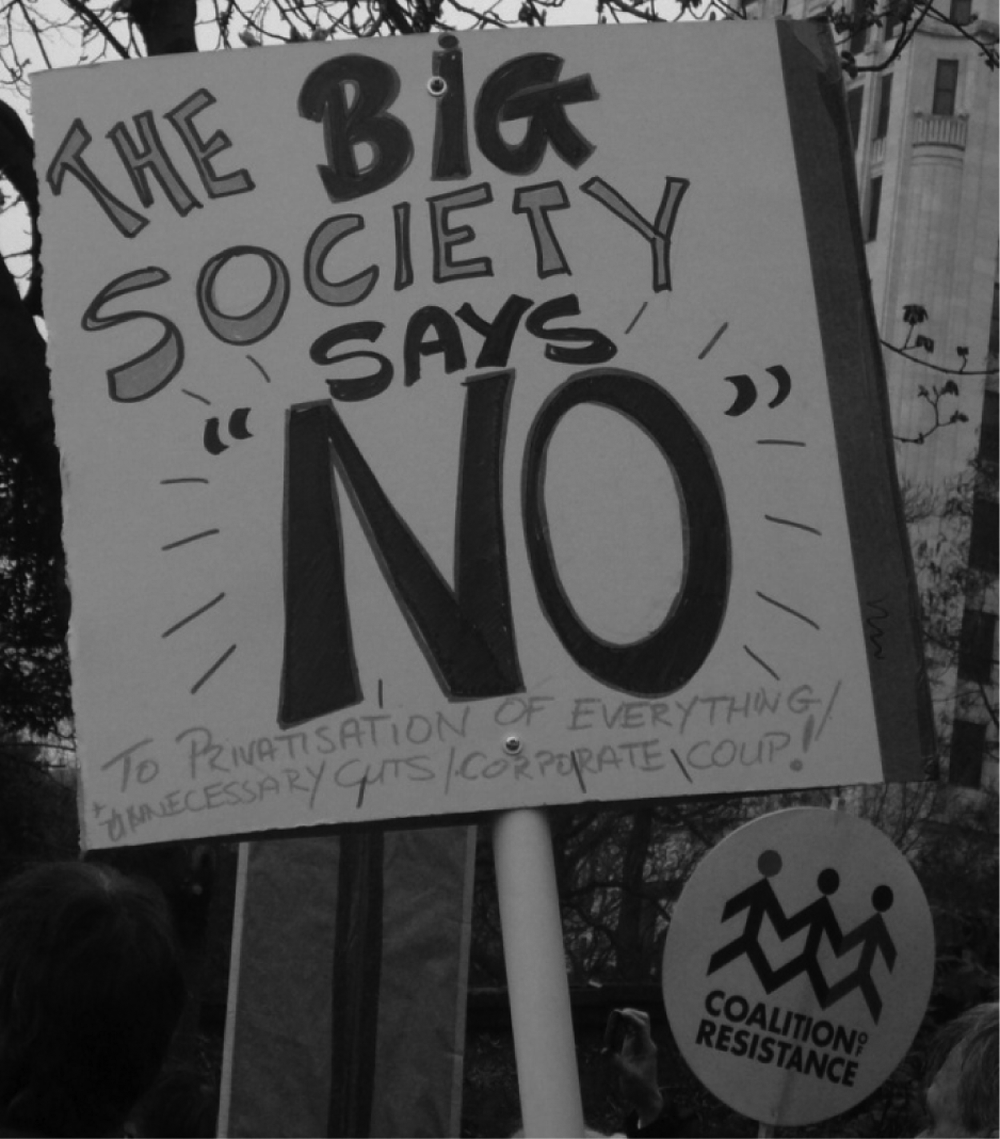
If such unmasking is necessary, it is not sufficient. Ricoeur contrasts the hermeneutics of suspicion with a ‘hermeneutics of faith’, an attempt to restore meaning to a narrative and its different voices and silences (Ricoeur, 1981). This also is essential, because only such an approach explains why discourses of austerity and the Big Society have purchase among some of those whose interests are not served by Coalition policies. The counter discourse on the TUC demonstration was ‘We are the Big Society’, reconstructed as agent in the declaration that ‘The Big Society says “no”’.
Photograph by Ruth Levitas
For the last two hundred years, working class self-organization has been a fundamental part of the collective provision against risk that forms the Just’s Umbrella. The Methodist Church was the institution within which the skills of local organization were often first fostered. The Trade Union Movement has always both worked for better pay and conditions and provided strike pay and hardship funds. Friendly Societies enabled working people to save and pay for their own and their too-frequent children’s funerals. Co-operative Societies guaranteed unadulterated food and returned profits to members in the form of a dividend on purchases. The Co-operative Women’s Guild was both a source of social support and sociability, and an educational and campaigning organization which fought for the payment of Family Allowances, now Child Benefit. Indeed, the Co-operative Movement, like Owenism before it, was in many areas the basis of local social and cultural life. Humphrey Jennings’ film Spare Time, made in the 1930s, shows a lot of music-making, including colliery brass bands and a millworkers’ kazoo jazz band. Allotment and gardening clubs were self-sustaining, and at the turn of the twentieth century Clarion Cycling Clubs were immensely popular.
Working class education, leisure and social support was sometimes facilitated by middle class involvement. In the mid-nineteenth century, Christian Socialist engagement with the co-operative movement supported co-operative workshops, or small businesses; campaigned successfully for legal changes permitting limited liability for Friendly Societies and similar organizations; and led to the founding of the Working Men’s College in London. Forty years later, the foundation of Toynbee Hall also provided the space and resources for local educational and social activities, including a library and art gallery, now the Whitechapel Gallery. The settlement movement, from Toynbee in the East End to Hampshire House in Hammersmith on the western fringe of London, was an important resource for working people – and, in the case of Toynbee, remains so. The Workers’ Educational Association was founded in 1903, and the Workers’ Music Association in 1936.
Photograph by Ruth Levitas
The forms of self-organization change, of course, with time and place, and contemporary society is also run through with self-help, charitable and voluntary organizations, from tenants’ associations to the Transition Towns movement or complementary currencies like the Brixton or Totnes pounds. And if the number of brass bands has dropped, the number of neighbourhood-based community orchestras and choirs has increased. Both ‘Red Toryism’ and ‘Blue Labour’ have located the panacea for social ills in a ‘revival’ of such collective participation. A hermeneutics of faith insists that there is something real here that is lost or buried, and this is why the rhetoric of the Big Society appeals. Yet neither faction wearing its opposition’s colours addresses the conditions of such a revival. Generally, many of the conditions of working class organization have been eroded. It depends on relatively stable work and relatively stable local or work-based communities: social policies from Thatcher on have undermined these material bases of self-organization, resilience and sociality.
Austerity, or at least reduced consumption, also needs to be read through a hermeneutics of faith. We are, after all, confronted with not just an economic crisis but an ecological one. This ecological crisis is about more than carbon emissions and global warming, including pollution of land, sky and sea; resource depletion and exhaustion; peak oil; water and land shortages. To put it bluntly, neo-liberal capitalism is likely not just to impoverish most, but to kill us all. There is a pressing need to move towards an ecologically and socially sustainable economy, and to give up our addiction to economic growth as measured by rises in GDP. Such growth is unsustainable: if everyone in the world consumed resources at the rate of the UK, we would need three planets instead of one; if at the rate of the United States, five planets rather than one. Environmental destruction is linked to inequality. In September 2009, George Monbiot commented in The Guardian on some of the ways in which the very rich and super rich contribute to global warming: year-round heating of outdoor swimming pools is relatively restrained compared to Monaco yachts such as the aptly-named WallyPower 118 which consumes 3400 litres of fuel per hour at a speed of 60 knots. The move to lower consumption is inevitable: the only question is whether this is unequally enforced through scarcity and impoverishment of most while the rich continue to take all, or whether a more fundamental change in global social and economic organization can be imagined and achieved.
An alternative future
Reading the Big Society and austerity through a hermeneutics of faith takes us in a quite different direction from critique of Coalition policy, and towards a more utopian method of considering an alternative future. Utopia here is not to be understood in the conventional terms of those who wish us to believe there is no alternative, that is, as something that is simultaneously an impossible dream and a malign totalitarian blueprint. The answer to any claim that an alternative will not work must, surely, invite the rejoinder that global capitalism does not work either, at least if by ‘work’ you mean meet the minimal conditions of being ecologically sustainable and delivering decent conditions of life to the vast majority of the world’s population. Utopia must be understood as the expression of a desire for a better way of living and being. At its broadest and most fundamental, it is a desire braided through human culture. As method, though, it involves the holistic and institutionally specific imagination of alternative societies, a kind of speculative sociology of the future, echoing H. G. Wells’s stricture that ‘the imagination of utopias, and their exhaustive criticism, is the distinctive and proper method of sociology’ (1906: 367). Utopia as method is the imaginary reconstitution of society. It is both critical and transformative. As André Gorz argued, ‘it is the function of utopias … to provide us with the distance from the existing state of affairs which allows us to judge what we are doing in the light of what we could or should do’ (1999: 113, emphasis in original). But utopias not only are regulative ideals as Gorz suggests; nor are they blueprints. They must be reflexive, provisional, and dialogic – images of possible futures that are embedded in processes of change, in what Roberto Unger describes as democratic experimentalism (1998). In the improvisation of social institutions, including those of the Big Society, collective practice creates and opens up new possibilities. To put it another way, Utopia is not a delusional insistence on the realization of a categorical other. It is a reasoned counterfactual critique of the present, intending change.
Utopia as method has three modes. The first is an archaeological mode, piecing together the images of the good society that are embedded in political programmes and social and economic policies, and may involve both a hermeneutics of suspicion and a hermeneutics of faith. The second is an ontological mode which addresses the question of what kind of people particular societies develop and encourage. What is understood as human flourishing, what capabilities are valued, encouraged and genuinely enabled, or blocked and suppressed by specific existing or potential social arrangements: we are concerned here with the historical and social determination of human nature. The third is an architectural mode – that is, the imagination of potential alternative scenarios for the future, acknowledging the assumptions about and consequences for the people who might inhabit them. These in turn must be subject to archaeological critique, addressing the silences and inconsistencies all such images must contain, as well as the political steps forward that they imply.
To read reduced consumption and the Big Society through a hermeneutics of faith is to create a narrative in which they cease to be an ideological cover for neo-liberal dispossession of the poor, and become positive attributes embedded in another potential society. The utopian approach asks the question, what are the economic and social conditions under which these ideas would cease to be repressive, moralizing claptrap? The answer involves seven key principles: rethinking what counts as production and wealth, and measuring what matters; making sustainability central; prioritizing human flourishing and well-being; promoting equality; addressing the quality of work; revaluing care, and thinking in terms of the Total Social Organization of Labour; universal child benefit and a guaranteed basic income or citizen’s income.
One of the extraordinary irrationalities of modern economic life is the panic that is induced when people shop less. From an ecological point of view, reduced consumption is a good thing. Moreover, as William Morris argued in 1884 in Useful Work versus Useless Toil, most of what is produced, and therefore consumed in capitalist society constitutes ‘illth’ rather than wealth. Wholly unnecessary luxury goods are produced for those with more money than sense, while vast quantities of inferior goods, which no-one would buy if they had a real choice, are produced for those who cannot afford anything better. The system is sustained by robbery and waste. Morris understood that production for profit could place no value on the beauty of the earth: its destruction was integral to the form economic development was taking, which masqueraded as progress. How I Became a Socialist (1894) summed up his frustration with nineteenth century society: What shall I say concerning its mastery of and its waste of mechanical power, its commonwealth so poor, its enemies of the commonwealth so rich, its stupendous organization – for the misery of life! Its contempt of simple pleasures which everyone could enjoy but for its folly? Its eyeless vulgarity which has destroyed art, the one certain solace of labour?
And is ‘it all to end in a counting-house on the top of a cinder-heap’ (Morris, 1984a: 244)?
The measure of economic health with which we are daily bombarded is economic growth. Growth is good, low growth or no growth potentially catastrophic. The function of economic growth is partly ideological. It enables monetary incomes to rise across the social spectrum while disguising a simultaneous growth in inequality as the rake-off by the very rich increases both absolutely and relatively. Growth in Gross Domestic Product (GDP) is simply a measure of activity in the market sector of ‘the economy’ (itself an abstraction from the totality of social practices). It includes activities that are positively harmful in themselves, such as the tobacco industry, and activities that are the consequence of other harms, such as environmental clean-ups. It excludes non-marketized necessary labour. There are already alternatives to GDP, such as the Index of Sustainable Economic Welfare and its successor the Measure of Domestic Progress. These include both unpaid work and negative social and environmental impacts of growth and inequality, and suggest that conventional economic growth and social progress have diverged dramatically since 1976 – which also happens to be the date when inequality in the UK was at its historic lowest. A shift away from GDP and economic growth, and from a flow to a stock economy, is essential to making sustainability central.
We must be careful here: the 2009 Stiglitz–Sen Report mainstreams the idea that we should focus on the well-being and happiness of populations rather than on GDP in measures of development (Stiglitz et al., 2009). There is a risk of diverting attention from distributive questions: preaching reduced consumption to those who have least may evoke the kind of responses expressed by Bruce Glasier in his 1891 verse We’ll Turn Things Upside Down (Glasier, c.1922: 53). Glasier says that ‘the world is overburdened with the idle and the rich’, and continues: Plain living may be wholesome, And wondrous virtues may Abound beneath ribs scant of flesh And pockets scant of pay. It may be poverty is best if rightly understood: But we’ll turn things upside down, my lads! We don’t want all the good!
The promotion of post-material values and well-being is utterly ideological unless they are intrinsically linked to distributive and gender justice and a reorientation of the economy to need rather than profit.
This entails breaking the link between market profitability and the distribution of the social product – in other words breaking both the wage and the profit relations. It means construing the whole of the social product as, simply, that, and thus challenging the property rights that support the current inequitable distribution of resources. Two elements of this are interlinked. One is the payment of a basic income or citizen’s income together with universal child benefit at a level which would provide a decent standard of living, rather than a plethora of conditional benefits, pensions and tax allowances which do not serve to keep people out of poverty. Such security would both acknowledge the socially necessary labour that takes place outside the market and put in place conditions in which the Big Society could flourish. It would also be a move towards the second element, the revaluation of care both financially and in terms of social regard, which needs to take place in both unpaid and market sectors of the economy, recognizing the care of vulnerable others as a skilled craft involving practical and emotional labour. This would radically alter the gender settlement in terms of both redistribution and recognition.
A version of a sustainable future, austerity understood through a hermeneutics of faith, needs to be articulated as something more positive than reduced consumption. There is a level at which many of us know that, as Wordsworth put it, ‘getting and spending we lay waste our powers’. 9 Prioritizing human flourishing and well-being depends on the reduction of inequality and the revaluing of the basic processes of daily life. The Big Society could be the big selling point here – the understanding that although there may be some loss, there will be enormous gains from a society that enables different kinds of social relationships, and that in a profound sense gives us more of each other. The appeal of austerity, reduced consumption, and the Big Society lies in the fact that they carry, at some level, the desire for an alternative society, an aspiration for a different, better, more solidaristic and convivial way of life. It is this that we need to imagine, improvise and create. Morris again: ‘Man must and does create the conditions under which he lives. Let him be conscious of that, and create them wisely’ (Morris, 1984c: 191).
Unfortunately, in Coalition policy austerity and the Big Society add up to little more than the words of another old song my mother used to sing, which dates from the 1914–18 War: It’s the same the whole world over It’s the poor wot gets the blame. It’s the rich wot gets the gravy, Ain’t it all a bleedin’ shame.
Or, as Coope, Boyes and Simpson put it, ‘We got fooled again’. 10 Or, as Ken Loach puts it, ‘It’s the ruling class cracking the whip, isn’t it? It’s disgusting. We’ve got to organise. In the words of the old American trade unionist Joe Hill: don’t mourn, organise’. 11