



Abstract
Migrants as a group are recognised as being at risk of receiving low retirement pensions. Income over a lifetime is the principle for calculating pension rights. We have interviewed a group of migrants about their retirement preparations. Our results show that there are obstacles that obstruct migrants from entering the Swedish labour market, which will greatly influence future pension rights. There are various lock-in effects that isolate migrants from the labour market and thus affect their present and future financial situation. Examples are labour market policy activities and that the minimum level pensions have mobility restrictions. These trajectories are set in perspective to Nancy Fraser’s reasoning on justice in a transnational setting and Yeheskel Hasenfeld’s reflections on people processing. An important implication from our findings is the need to explore ways to include a group that is currently excluded from the labour market, hence adequate retirement income protection.
Keywords
Sweden has for a long time been associated with progressive and inclusive welfare policies. These policies have seen radical changes and social solidarity has gradually and progressively received less priority. The process indicates a revision of the view that an egalitarian outlook together with de-commodification and individualisation are now the principal foundations of the Swedish Welfare State (Sunesson et al., 1998; Esping-Andersen, 1999). The restructuring of the welfare system in Sweden is proceeding and is reformulating fundamental principles of welfare responsibility. A pivotal change can be captured in the concept of individualisation. From a welfare perspective this is well illustrated by the shift in responsibility for social protection from collective to individual, from state to private, with increasing options for individual choice and personal control (e.g. Harrysson and O’Brien, 2004).
Sweden has like many other countries reformed its pension system over the past 20 years (Orenstein, 2005). This change was demanded by demographical transitions, anticipated global economic pressures and an introduction of neo-liberal reform ideologies (World Bank, 1994; Frericks, 2010). The reform has led to an increased market orientation, and it has made it harder for people to predict their future pension income. These changes make it more important for the individual to acquire and understand relatively complex information relating to the mechanisms of retirement savings and insurance systems. Many migrants who have arrived in Sweden form a vulnerable group owing to their having weaker economic positions and difficulty in acquiring and utilising the necessary information. Related questions are whether information is made available or not, and whether it allows people to gain the knowledge required. The new pension system introduced in 1999 was later criticised by politicians and experts (Harrysson and O’Brien, 2004; Scherman, 2014), for example because it creates uncertainties and undermines public trust in the system (Svallfors, 2011; Werner, 2012). The criticism argues that the new pension system affects the entire population, but has particularly negative effects for already vulnerable groups; groups that are marginalised from the redistribution system (the labour market), from recognition (in the social community based in citizenship) and from participation in the design of the new pension system, which according to Fraser (2005) constitutes a new form of social injustice.
The Swedish pension system is often presented as a pyramid, where the public pension is the foundation consisting of an income pension and a premium pension. The middle consists of occupational pensions, and the top of voluntary private pension insurances. The premium pension, parts of the occupational and the private pensions are funded systems, while the income pension is designed as a ‘pay-as-you-go’ (PAYG) system. A funded system is financially secured by the use of capital markets, while the PAYG system is secured by the ability of the current and future labour force to pay premiums balancing pension promises. The Swedish income pension system is a hybrid using imagined (notional) individual accounts. However, any system is basically based on the idea of shared risks in an insurance collective.
The introduction of a life-income principle as the basis for accrued pension rights in the public system is a critical change. The lifetime income is the basis for the income pension. Willingness and ability to make the right choices are central aspects, but the possibility and opportunity to make such choices varies considerably from person to person (Harrysson and Werner, 2014). The new principle applies to everyone, but still, the principle has a larger impact on the pension outcome for groups with less time in paid employment, e.g. part-time workers, the long-term sick and unemployed people without unemployment protection. For a migrant these tendencies are further amplified than in the former pension system design (Ekberg and Lindh, 2013). From a perspective of pension mobility, the new system reinforces categorical differentiation. The income and premium pensions are premium based and fully portable. The guaranteed pension, based on time in the system, and maintenance support for pensioners, which tops up the income pension to a minimum level for those with too short time in the system, are restricted to mobility within the EU/EEA and Switzerland up to one year. The maintenance support for those non-EU migrants who have not reached the required 40 years in Sweden for a full guaranteed pension is pivotal. Mobility is thus restricted to 3 months a year for occasional journeys, while the support stops immediately if one moves abroad (Swedish Pensions Agency, 2014). Clearly, the economic situation as a retiree is contingent upon the labour market and in this article we discuss how this has affected political migrants (refugees, reunification migrants and all migrants permitted to stay in Sweden for humanitarian reasons); more specifically, adults available for the workforce, arriving in Sweden in the 1990s and beyond.
Being part of the labour force or not strongly influences the level of future retirement income. In Sweden, and in many other countries, there are major differences between foreign- and native-born people in labour market participation. The data from the Statistics Sweden (SCB) Labour Force Survey (SCB, 2014) presented in Figure 1 is based on the population between the ages of 15 and 74 engaged in the labour force. At the time of collection there was a total of 5 096 000 individuals, of whom 915 000 are foreign-born. Children of foreign-born parents who are residents of Sweden become Swedish residents. Their children in the next generation will be formally (in a legal meaning) considered native-born.
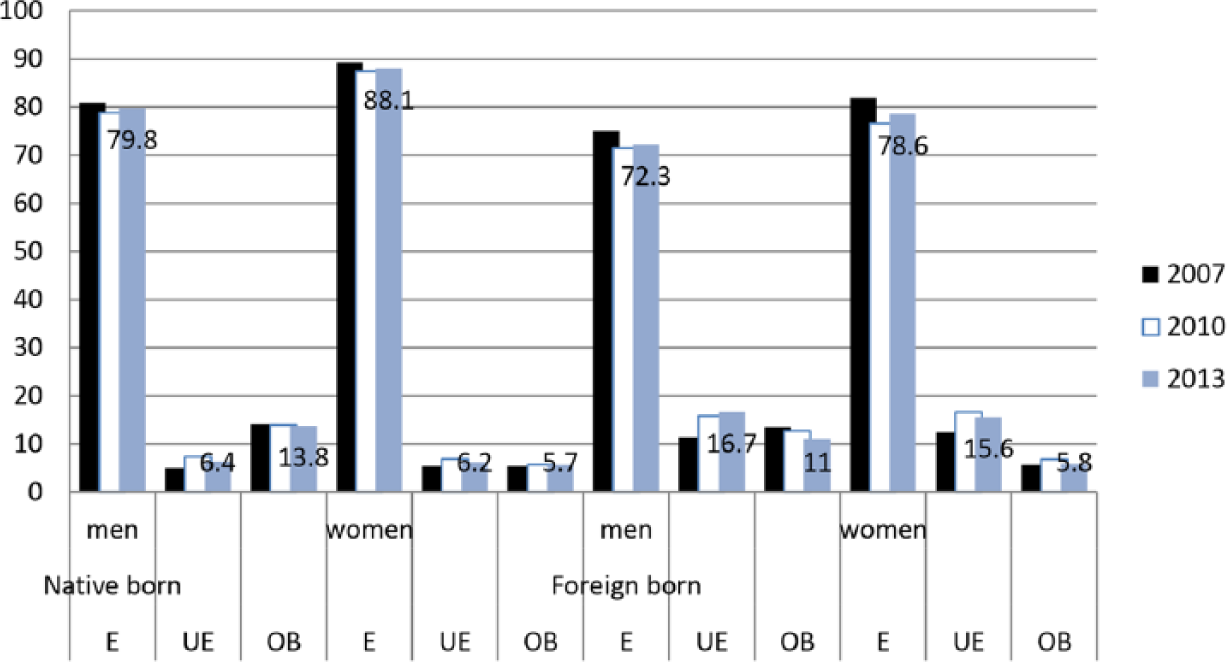
Per cent of Swedish labour force, aged 15–74, by labour market status, place of birth, gender and year.
Figure 1 provides us with a general picture of the labour market status in Sweden. A closer look at the statistics shows that the employment rate of migrants varies greatly. People from Africa, Asia and non-EU countries have the lowest employment rate. As an example, people from Somalia have an employment rate of 25 per cent, and for people from Iraq, the corresponding figure is 39 per cent. In comparison with other OECD countries, Sweden has the highest employment rate differences between native- and foreign-born people (OECD, 2014).
Migration is often described in dramatic terms, highlighting uprooting and losses that make migrants more vulnerable than settled groups. This is confirmed in our study, but the situation seems even more complicated when migrants settle in contexts where policies are in stark transformation, but still constructed within a frame of the nation state. The lives of migrants illustrate processes that ‘overflow territorial borders’ (Fraser, 2005: 2).
In this article we describe the pension system from the perspective of a group of migrants. Our discussion is limited to the question of personal preparations concerning their economic situation when they get closer to retirement. In this context it is important to highlight social consequences of how the systems work. The concept of financial retirement preparations is central in our research. Commonly, preparations are discussed in terms of individual choices, but choices are made in a context of preconditions. These are not met in the case of migrants since ‘their life courses and biographies do not fulfil the institutionalized expectations of normality’ (Bommes, 2000: 95). They deviate from the expected life course in three central dimensions: education, employment and retirement (Bommes, 2000). However, retirement preparations also include the other two dimensions, since education combined with employment ultimately has an impact on final retirement income. Thus preparation should be understood as a project that unfolds throughout life. Our life projects are structured by national welfare institutions, which claim to give protection to all their members. The pension system is designed so that people with limited opportunities to build up pension rights are forced to stay in Sweden to receive long-term payments. The forms of pensions paid as supplements, e.g. guaranteed pension and maintenance support for pensioners, are restricted by factual residency, whilst both the income and premium pensions are portable, which plays out as a clear adjustment for a more global setting. This attribute of the Swedish pension system reflects a historically well-established duality of the Swedish welfare state. The advantage of a relatively generous social insurance in terms of income maintenance with less individualised social control (Edebalk, 1996), is balanced by a tradition of poverty relief with quite harsh restrictions on mobility (Berge, 1995). The introduction of the income maintenance support, introduced with the intention of freeing people from the testing procedures of social assistance, has not altered its historical foundation. These historical traits of control are strong path-dependent stable institutions, thus reproducing restrictive welfare solutions without much conflict, debate or reflection. In the case of migrants of non-EU origin this presents an obvious lock-in effect (Sunesson, 2004).
This study focuses on processes of social exclusion in the context of the Swedish pension system. Using the concept of parity of participation developed by Nancy Fraser (2011), we analyse how institutions act in the managing of what are perceived as ‘unexpected biographies’ (Bommes, 2000) and how historically invented recognition policies prolong the process of entry (participation) of migrants. Policies, implemented by people processing organisations, with the aim of changing the unexpected (or deviant) into the institutionalised expected normality. In this context the redistributive category of disability that formerly legitimised social support and exemptions from certain obligations of citizenship (Stone, 1984: 4) plays an instructive role.
A framework
Nancy Fraser (2005) problematises the concept of justice in a globalised and transnational world emphasising the ‘need to change the way we argue about social justice’ (Fraser, 2005: 3). Fraser’s trailblazing work ‘rethinking the public sphere’ from the early 1990s (Fraser, 1990, 2007) allows us to question an existing norm of atomistic individualism for a more people-friendly concept of setting an agenda that would make people both aware and able (Fraser et al., 2009). She presents three fundamental dimensions – economic (redistribution), cultural (recognition) and political (representation) – and introduces an ‘all affected principle’ (Fraser, 2005: 13); all those affected by a structural change, irrespective of whether within a national territory or not, have a moral standing as subjects in relation to that change. Fraser uses the term participation as an expression for just inclusion. Being included means having a say and being able to influence one’s situation. She raises issues of mobility of not only people but also effects of decisions made elsewhere as well as how these can be dealt with (or not) by old order national boundary institutions. Citizenship, as national membership, in that manner plays out as an obstruction to the recognition, redistribution and participation of migrants. It is intrinsic to the conceptualisation of migration as a social problem. Political migrants (especially refugees) are perceived as people outside the ‘normal order of things’ (Malkki, 1995). Their societal incorporation is constructed as an adapting work because the expected normative standards are not fulfilled (Bommes, 2000). In the readapting work the new members are incorporated into the classificatory system invented for managing ‘social deviation’. In this context the disability category provided the institutional framework for their ‘adapting’ process, a category that had played a crucial role in the development and expansion of welfare policies.
In the early 1900s, disability became the administrative category that justified social aid and exemptions from certain obligations of citizenship (Stone, 1984: 4). After World War II social disability was the concept that covered some forms of accepted social deviance which permitted the acceptance of some strangers as part of the deserved national poor (Montesino, 2012). First unhealthy refugees (mainly tuberculosis), later refugees defined as socially disabled were admitted. This implied that the authorities at the end of World War II ‘pushed new “undeserving” to the side of “deserving poor”’ (Stone, 1984: 10). The process added new social and medical dimensions to categorising processes. Social disability relates to various criteria: age (children and elderly poor), family situation (families with several children, single mothers), education (illiteracy) and cultural belonging. Disability creates some space of recognition providing legitimacy to social redistribution for those in need of social support. However, the categorisation of refugees as disabled also confers a lack of recognition when they, as a group, are treated as if they lack the capability to manage their own lives. This gives rise to an administrative management of people. Categorisation of refugees and other migrants as disabled shapes a ‘normal life’ observable as a prolonged process of no change, and where different kinds of justified activities have been invented to facilitate an integration of new refugees into this process as well (Montesino and Ohlsson Al Fakir, 2015).
Yeheskel Hasenfeld’s theory of how the work of human service organisations (HSOs) has played a vital role in the understanding of welfare on a practical level considers both structures and client–worker relations. To those migrants who are in economically vulnerable positions, the alignment to HSO behaviour requirements, i.e. to live up to a morally constructed client model, is of prime importance to receive support (for cross-cultural interaction between care managers and elderly migrants, see Torres et al., 2015). Our focus is not to analyse organisations, but to reflect on how to understand the organisational context that people meet. For retired people the pension system is more or less a one-time application issue to get the pension, in its different forms, aligned to your accrued rights. In that respect it is not an issue of enough or not, nor of who deserves what, but merely one of what rights you have earned in the system prior to retirement. It is in this process the dilemma occurs for many migrants, and other poor people. Their struggles to enter the labour market entail not earning a wage, thus no earnings-related pension rights. Further, a growing number of jobs are without collective agreements, thus hindering people from earning any pension rights in the occupational systems as well. For these people to align and fit in entails their becoming a client in a people-changing organisation. The pension system in its newly reformed and privatised form, having invaded people’s lives with choices, is designed to allow an ideal employee to reach an adequate pension income. No person really fits this ideal type, particularly not poor migrants. In this respect it is clear that the policy in itself demands a change in people’s behaviour and that the typically processing character of the pension administration in its work has a people-changing task. That would be to make people aware of the responsibility handed over to them by the policymakers through the pension reform, namely that it is our responsibility to earn an income, thus pension rights, and in their prolongation our subsistence in old age.
Michael Bommes (2000) argues that people, as individuals, seek inclusion in various realms and that the risk of failure is high. Structured biographies are essential in this process and are a result of accumulated chances for participation within the welfare state sponsored realm. Being excluded from the agenda of the nation state puts migrants at risk of being structurally poor. Integration is, however, a capacity of functioning in various social situations in which full participation, and membership, can be managed. But integration is not a spontaneous process; it is conducted and managed in a national context, constructed according to the agendas of authorities and institutionalised practices. In the Swedish context this management has created a system that prolonged the entry process of migrants, a management that has reduced the possibilities of new members to form their own life projects.
Our perspective – a summary
Participation, organisation and people processing are terminologies of importance in our analysis. At the forefront lies the earning of pension rights, since it is in the opportunities for accumulating chances for a more complete participation most dilemmas reside. It is not so much citizenship, but a residence permit and a just inclusion in the labour market which are central aspects of creating and strengthening migrant participation.
Non-aligned biographies common to many migrants and discussed by Michael Bommes present an example of the status dilemma, not identity, which Nancy Fraser highlights. It is, they agree on, a structural phenomenon, not one of thought. With the help of Hasenfeld’s (2010a: 150) argument on an organisational context that illustrates the strata from policy design to professional–client relations leading us to policy outcomes, it is possible to illuminate how and where status conflicts occur. In our study we illustrate that to be a participant or to be excluded from a manifest norm reproduces itself through institutionalised routines at different levels of social life and how, in this context, institutionalised practices and representations of the poor develop into discriminatory practices. The old age pension system would be what Bommes (2000: 91) identifies as a differentiated system; a system where not social strata, but status is based on the accumulated chances of participation in the social realm of adequate retirement incomes.
Our research
In the southern Swedish city of Helsingborg we are carrying out an action research inspired project in which we invite migrants who arrived in Sweden in the 1990s and beyond to reflect upon how they navigate and form the retirement and pension contexts in which they live or soon will face. The long-term aim is to provide information to migrants about how current changes may affect their future lives as retirees.
Our study is based on interviews with migrants of mostly non-European origin. We have met and interviewed people individually and in groups, and we have received their general experiences of migration, work, family life, health and economy. We have been invited to a diversity of individual life stories and experiences of how welfare systems regulate, govern and shape people’s lives. Our study deals principally with migrants who had some work experience before moving to Sweden. The results indicate different types of vulnerability related to preconditions and conditions regarding inclusion in the Swedish pension system. Throughout, the research has complied with the Codex ethical guidelines (www.codex.vr.se).
Our empirical data shows migration complexity and heterogeneity through personal stories of arrival, work careers, social and economic situations, and more. Migrants’ descriptions of their retirement preparations provide information about what Hunter (2011) terms ‘non-standard’ biographies; how this data does not conveniently fit into institutionalised expectations of regulated welfare systems. The people we have met arrived in Sweden as adults of working age. The labour authorities placed them in a transitional category of job seekers where they often have remained for a very long time. This status makes them a group at risk of receiving low pensions in the future (Flood and Mitrut, 2010).
Territorial border crossings
People’s work and migration life stories illustrate social processes that overflow national borders: I grew up in the Middle East until I was 20 years old, then I went to Arabian Peninsula and worked there for 21 years until the war, the second Gulf War between Kuwait and Iraq in 1990. As guest workers we had to pay for it. They threw us out and I sought asylum in Sweden, I have lived here ever since.
Above we witness how someone made a decision to move in order to work abroad, leaving home in the late 1960s for the Arabian Peninsula. The geopolitical changes during the interviewee’s stay there caused a major shift in the pattern of migration from worker to forced refugee. For a stateless person, there was no such place as ‘home’ with their place of birth still at civil war. A worker thus reached Sweden as a refugee just before a major world economic crisis and the arrival of large flows of refugees from the Balkan war (1991–2001). The ex-Yugoslav refugees are another example of people having seen their life change dramatically; they left a stable existence with possibly occasional periods as labour migrants in Western Europe to become refugees. Geopolitical conflicts alter people’s chances of a stable and predictable situation very quickly. Mobility is a strategy to overcome these kinds of conflicts and political migrants are abandoned by national institutions. Immigration countries need to accommodate these changing conditions for people. This includes subsistence conditions in old age.
The two examples below illustrate how global economic and political forces give rise to migration, but also exclusion: I had a permanent job in a country in the Middle East. I have called them and asked the authorities there if I will get any pension for those years, because I haven’t lived here [in Sweden] long enough to get a decent pension. But they said that I left the country without telling them. I left because of my ex-husband, he was a political refugee. I had to do it because of my children. I had to leave my job … One day he just came and said that I had to stop work if I wanted to have my children. ‘You have to follow’. Otherwise, he would take the kids here and I would be alone there. I am from Latin America and have been married for 30 years. We travelled for more than ten years since my husband worked abroad as a specialist. He worked 45–50 years and I got my child after a few years … My husband said it is better that you stay in Sweden. […] And when I came to Sweden 20 years ago I started SFI [Swedish for immigrants]. I worked as a legal advisor in Latin America for quite some years and I had translated all my certificates into English. I sent it in for validation and they told me that the laws are different here and that I would have to start from scratch. I would never have been able to do that! I have fought all my life and then I thought okay I will study to become a care worker. It was great and I passed my Swedish tests and my education, but I never got any jobs, just practice or temporary positions.
Coming to Sweden highlights something other than fresh opportunities and a possibility to contribute to society. Former knowledge becomes obsolete, and migrant experiences point to the twofold consequences of the Westphalian nation state idea; the exit from one country and the entrance to another equals breaking the ‘institutional expectations of normality’ (Bommes, 2000) in each respective country, thus in the long run affecting economic security in retirement. However, the Swedish earnings-related pension system in contrast is fully portable and in most cases people receive their pensions even if living abroad. For many of those we have met this portability is not that relevant, as they do not earn enough during their time in Sweden to lift their guaranteed pension, which has stricter, but still quite generous, mobility rules. Perhaps the major problem is not the system as such, but the hardships connected to developing a stable participation in the labour market, if at all, and following a chance to accumulate pension rights, to be included in the social realm of well-off future retirees. Still it may be questioned whether it is unreasonable to consider the exclusionary effects the system produces. Does this reflect Sweden? Let us see what happens when people arrive in Sweden.
People processing
Labour participation is the main factor that affects a person’s retirement income; nevertheless the way people are categorised on arrival in Sweden (refugees, relatives, returners, marriage migration, etc.) reflects changing migration policies. Inclusion within a particular category has an impact on the degree of access to the various welfare systems (Sainsbury, 2012). For example, formal status as a refugee may give some benefits within the pension system, while migrants of another category risk falling through the cracks in the social protection web shown by Hennebry (2014) with the example of migrants in Canada. Categorisation is a tool pivotal to organisations focusing on people processing (Hasenfeld, 1972, 1983). Categorisation is moral work (Hasenfeld, 2010b: 9–32).
Historically the reception and incorporation of migrants in the Swedish national context has been processed in the welfare services. The administrative category used is ‘disability’, which then gives structure to the processing work of the welfare institutions (Montesino, 2012). As Holmqvist (2008) argues, this way of processing has also become the starting point for work within labour market administrations focusing on activation policies (also Hasenfeld, 2010b). The careers of the interviewees show a great diversity in relation to class, gender, education and age. However, a common characteristic is that of becoming ‘underdogs’ in the context of the Swedish labour market. They have, to different degrees, lost their former educational and professional status (lawyer, hairdresser, clerk, engineer, nurse, dentist, etc.). Many told us that their chances of joining the labour market have decreased over time and they have difficulty in acquiring accreditation for previous education and work experiences and that their experiences and expertise are not acknowledged.
This man here, he is from the Middle East. He’s a doctor, with his own clinic. He was a lecturer at a university. Now … what if he wants to work here? How much time will he need to start over again as a doctor you think? Four or five years! First he needs to learn Swedish, then he needs to revalidate his title. And then he has to find an internship. And there he just watches and listens, he may not work with the patients. Why? The people that he used to take care of, aren’t they human beings?
In an international perspective, the Swedish introduction programme is comprehensive, both lengthwise and in its scope of language studies (SOU, 2011), and prolongs the time it takes for migrants to become independent professionals. An education guarantees entry into a national context, but when coming to another country, former education is viewed as being no longer relevant. Prior accepted industry certification becomes invalid.
I’ve been working on the Arabian Peninsula, but here they don’t recognise my certificates … It is a certificate from Italy, from Holland, from Britain. I’ve worked here and there and done this and that. I have a certificate from the consultant that says Engineer X … But when I pick up my certificates – why don’t they recognise them?
These obstacles are part of the administrative landscape that makes the incorporation process for immigrants difficult. Within a frame of the additional rules of existing institutions, administrative routines and other measures develop which will function to block or delay the entry of migrants into the labour market. The mission of people processing organisations (e.g. employment services and welfare services) is to get people out of these domains, but instead they shape new activities in which migrants become confined.
We are placed in these programs and we’re working as hard as we can to show that we are as capable as the people working there, but then when the practice month is over, we get a ‘Sorry we can’t employ you…’. I work just as well as the employed staff, but it doesn’t help. We are like the handicapped – it’s the same thing. Employers get some money to activate the handicapped and they do the same with us.
Existing activities within people processing organisations, such as compulsory language training are often time consuming and can be described as confinement in a ‘merry-go-round’. In this landscape processing appears to open new opportunities for people (new education, new coaching etc.), but really what migrants meet, and others too, is categorisation (a diagnosis) as disabled.
How do we think? We who come from other countries? Why do we work until 70 years of age, still being strong? Why is it, that when we come here in our 40s, we are not seen as able to work. Why are we seen as sick? There must be a background to that!
These words reflect a common feeling of frustration shared by many of those interviewed; they express a disappointment in how they are handled by people processing organisations, how their capacities are subordinated and their situations are institutionalised as problems, which in turn has led to migrants becoming categorised as socially disabled (Montesino, 2012). It is hard to break out of this category once there (Holmqvist, 2005). They describe how various requirements and activities obstruct their inclusion into the labour market.
immigrants have been classified as disabled due to their language difficulties and not as a result of any biomedical impairments (see SOU 2003:56, p. 193). To this extent the inability of Swedish society to accommodate the competencies and capabilities of immigrants is attributed to personal problems among the immigrants. They are given the blame by implying that they are disabled, hence not fully fit for working in Swedish society. (Holmqvist, 2009: 410f.)
In this description we can identify how processing organisations work. Hasenfeld argues that the invisible moral assumptions are cloaked in service technology, taking on a rationale of clarifying eligibility, diagnosis and prognosis (2010b: 14). Torres et al. (2015) discuss how welfare institutions perceive cultural and ethnic differences as obstacles, other studies discuss how culture and ethnicity are subordinated into the established administrative category of socially disabled (Holmqvist, 2005, 2008; Eastmond, 2011). In the new general labour market policies (activation), a specific policy area has been created to deal with unemployed migrants. In these activities the same starting premise justifies administrative routines that continue to prolong migrants’ unemployment with serious financial consequences for their future lives as retired.
So I’m 44 years old and between 2006 and 2014 I have just applied for jobs. All the time. I want to work, but there are no jobs. My job is to look for a job. And when I turn 65 and get that low pension … income … It is not my fault.
Having an income is the crucial step to earning a pension. Even an unemployment benefit, which earns pension rights, is hard to obtain if you do not get work allowing you membership of the benefit scheme. The quick and very destructive changes to unemployment benefits made by the conservative government in 2007 made the conditions for those with loose connections to the labour market even weaker.
I have been in Sweden since 1990 and started to work in 1996. I needed one year to get a residence permit, and then one year for SFI, and then two years for education and then one year to find a job. That is at least five years!
And you’re lucky! There are many people who have waited much longer, all the courses … One course after another, it doesn’t work out, they have to start another course ‘baker wasn’t the job for you’. So, the years go by. That is worrying.
These comprehensive programmes often do not qualify for an income seen as a salary, thus not producing sufficient pension rights; but still, importantly, by moving people between different people processing organisations they are lifted out of the category of unemployed and direct poverty.
Delayed entry and earnings-related income protection
Time is often a crucial dimension of being included in nationally formed protection systems. In our study we find that institutionalised practices prolong the entry process into paid employment and that this increases people’s disadvantage within the pension systems.
The temporal demands for being included in the Swedish pension system have various impacts. People with low or no income, the case for the majority of the interviewees, are entitled to the guaranteed pension. However, they must have lived at least 40 years in Sweden to be fully entitled. People who have lived in Sweden for a shorter time will receive a reduced guaranteed pension (1/40 deducted for each missing year) and on application income maintenance support and a housing supplement.
The guaranteed pension is social assistance with another name [the other interviewees agree, saying ‘in every way’] … I don’t know … I can’t say in general, but it is true for me and the people I know. It is a social assistance, but under the title Pension.
Length of settlement and level of earnings are crucial components of the future pension income. Most of those interviewed migrated as adults from non-European countries and their earlier working life is excluded when time of residency is calculated for the guaranteed pension. Further, and in contrast to most of the European migrants, non-European migrants mainly come from countries without portable pension rights.
The worst thing is that if you have worked in another country, let’s say you come from Iraq and have worked there for 25 years. Then, when you come here, the years will be lost. But here in Sweden, working for five years at place A and three years at B and C. All the years will be added together and you will get a pension calculated accordingly.
It is obvious that those we have met realise the system is already established, but also that most of them do not fit the criteria. What we see is a landscape of major structural disadvantages, where a position as a migrant is pivotal to the understanding of it. Institutionalised responses to migrant status and processing of migrants reinforce these disadvantages. Instead of opening new inclusionary spaces and participatory opportunities, these responses increase social and economic inequality by extending the exclusion of migrants from the labour market and thus contributing to their future financial vulnerability in old age. How do these processes affect visions of a future as retired?
The future – security or uncertainty
Uncertainty is a well-established concept to describe contemporary views of the future (Beck, 2000; Castel, 2009). A study conducted on how much Swedish people know about pensions confirmed their feelings of insecurity in relation to their future retirement (Werner, 2012; Harrysson and Werner, 2014). However, and somewhat contrary to these earlier results, the interviewees in our study are clearly conscious of how their financial future as retirees will unfold. They see that even if they are employed they have a shorter time to contribute to the pension system and thus can foresee a future in financial poverty and personal need for social welfare support.
There is one thing for us migrants who come from other countries and work here … we think quite the contrary about the pension compared to those who have worked their whole life here in Sweden. We think like this; it looks dark for us when we reach the time when we retire. We will have to go back to the social services. Before 65 we might have a chance to work a little bit and get more money than the social assistance, but when we reach 65, that dream is over.
Migrants who have a job and a steady income, and are hence included in the welfare system, will still be unable to fulfil the institutionalised requirements for a reasonable future pension income. Instead they anticipate a return to a poor and less mobile existence as retirees. There is an implicit criticism directed towards the existing way in which information is provided: impersonally, through invisible servants and lacking in two-way communication. The majority of common information is written, which creates problems for people: Even if I don’t fully understand when I sit in front of someone, I can at least ask over and over again until I understand what I have to understand! But if I read a sentence and there is no one to explain the meaning of that sentence, I can’t understand it. […] I can’t ask a sentence ‘What do you mean?’
In our encounters with the central authority, the Swedish Pensions Agency (Pensionsmyndigheten), it is obvious that it has not taken on a ‘people-changing’ role, but has kept its people processing profile. Virtual rooms do not provide the necessary personal exchanges, and anonymous telephone voices create uncertainty in what is actually said, even when translated. Among the interviewees we have those who search for an arena in which they may participate actively in producing relevant and personalised information to help other migrants.
I think that people without beneficial interest should be educated in order to be able to inform those who need it. And in this case it is the whole society that needs it! SFI teachers could be trained. And the pensioners’ associations! They have knowledge, enthusiasm and commitment, and they’re directly involved! And then … the refugee centres and the Integration units in the municipalities [where the respondent works]. It would be a good thing to educate those of us who work with and meet these people every day. We could give information and guide migrants. But as it is now, I am nowhere near being able to guide anyone in these questions. Absolutely not.
The migrants we have met are eager to act and react in relation to the situation and ask for a dialogue with public authorities and other agents active in the area. They argue that information is needed and that they themselves are to be involved in the process. All have prior work experience in Sweden and/or other countries. These experiences give them perspectives on their personal situations. They are also political refugees (mostly men) with experience of public organisations and people processing, and they raise the importance of political representation. Furthermore, in contrast to others interviewed in our project, they are in a position to understand and negotiate their status. Where their own resources can influence people in vulnerable situations, they demand participation.
Processed people or recognised participants
At the beginning of our article we raise the issue of egalitarianism, de-commodification and individualisation as three basic components in the understanding of the Swedish welfare state (Esping-Andersen, 1999). It is clear that the de-commodifying and individualising elements are still strong within the welfare model. However, the egalitarian element has a harder time withstanding pressures from global changes as well as domestic privatisation ambitions and, as we argue, clear ambitions to uphold a Westphalian, nation state defined order of justice. This is done both in direct political rhetoric and activities, and in meta-political ambitions above nation states. Sweden, with its history as a world-leading welfare model, seemingly has a reputation to keep up and thus is a late starter in the transformation towards a more inclusive society reflecting the factual situation of who the Swedes are today.
From our study we can illustrate that to be a participant in or to be excluded from a manifest norm reproduces itself through continuous institutionalised routines at different levels of social life. By recognising the patterns visible in the experiences of the interviewees, using the concepts of representation, recognition and redistribution, we may be able to develop some clearer understanding on how to act in order to increase participation in the ruling and running of our lives. We can easily point to misrepresentation problems of a first order in which ‘who’ is decided without your participation, but also of a second order of mis-framing where those it concerns are not involved in producing the framework within which they are measured. Finally, in a third order, those concerned are not represented within the meta-political level where decisions are made on ‘how’ to adhere to the just representation, recognition and redistribution through which we are affected.
In this article we have presented the experiences of a group of migrants in relation to their future as retired. The choices, opportunities and difficulties, which face us today, affect both our preparations and the level of the future old age pension. The degree of participation in the labour market determines the compensation received when retired.
People arriving in Sweden as adults meet a labour market that rather efficiently locks them out by not recognising their prior work experiences, skills and education. The intended inclusionary work to support them in their incorporation into society (e.g. employment, education, care) fails and instead a classification of disability is introduced. People are considered and treated as deviant, a lower status of citizen. This is a powerful process of misrepresentation and a real obstacle, perhaps a complete blockage, to the participation of migrants in questions related to their present and future lives.
Our results point to two types of lock-in effects that migrants face. The first can be seen in a prolonged entry process into the workforce. Migrants become captives of people processing / ‘merry-go-round’ activities which do not provide a proper wage, and as a result pension rights. The second kind of mobility lock-in effect arises at retirement. The majority of the people we have met do not meet the criteria for an adequate income pension and instead look forward to being supported through public transfers, such as the guaranteed pension and housing support, and possibly maintenance support for pensioners. These allowances are based not on income, but on residence, hence restricting mobility over national borders.
The interviewees’ experiences of these lock-in effects make the concepts of justice and participation visible, by showing how existing institutional settings, rules and work opportunities affect people in different ways, both at present and in the future after retirement.
Non-standard biographies are strong forces in the establishment of a status as ‘others’ in the relationship with existing welfare arrangements. This includes old age pensions despite their ‘neutral’ design, with a strict connection to earnings and personal accounts, as no policies are in place to handle the dilemmas of being more or less excluded from the chances of actually earning pension rights.
To conclude, the changes in the pension system illustrate other changes that have been made in the Swedish welfare state, which undermine the general and established positive framing of the Swedish welfare system. We have studied people’s encounters with these institutions and methodologically we are illuminating people’s experiences of the social consequences of system reform. Migrants’ participation in their working life was earlier made complicated by institutionalised practices, but now these practices trap the migrants in an excluded status; an entrapment that becomes visible in their lives also by the consequences of the new pension system.
Footnotes
Funding
This work was supported by Helsingborg City/Plattformen (1340).