



Abstract
Unpaid work has long been used in nonprofit/voluntary social services to extend paid work. Drawing on three case studies of nonprofit social services in Canada, this article argues that due to austerity policies, the conditions for ‘pure’ gift relationships in unpaid social service work are increasingly rare. Instead, employers have found various ways to ‘fill the gaps’ in funding through the extraction of unpaid work in various forms. Precarious workers are highly vulnerable to expectations that they will ‘volunteer’ at their places of employment, while expectations that students will undertake unpaid internships is increasing the norm for degree completion and procurement of employment, and full-time workers often use unpaid work as a form of resistance. This article contributes to theory by advancing a spectrum of unpaid nonprofit social service work as compelled and coerced to varying degrees in the context of austerity policies and funding cutbacks.
Introduction
Though unpaid work is increasingly discussed in academic literature, it requires further theorisation to be understood in its complexity (Glucksman 2005; Taylor 2004). While most studies equate work with paid employment (Himmelweit, 1995), other models attempt to understand the many forms of unwaged labour people undertake, as well as its social organisation and the meaning it holds in the lives of those who undertake it (Taylor, 2004; Glucksmann, 1995, 2005; Williams and Nadin, 2012). As austerity policies continue to shape care work in the highly gendered nonprofit social services (NPSS) sector, recent studies of the sector in Canada found some employers actively organising unpaid work as a replacement for and supplement to paid care labour (Baines et al., 2014). Filling gaps left by funding cuts, unpaid work assumed a number of forms including: formal volunteer work; unpaid overtime; unpaid internships and student placements; and fundraising for one’s employer. Though the literature explores many of these forms of unpaid labour individually, often without a gendered lens (Frumkin, 2009; Handy et al., 2008; Prouteau and Wolff, 2008), further theorisation is needed to account for these multiple and gendered forms of unpaid labour and the ways they are extracted in the contemporary, under-funded, managerialised social service workplace.
Drawing on data collected as part of qualitative, organisation-based studies of precarity in Ontario, Canada, this article explores the social organisation of unpaid labour in nonprofit care work in the context of a simultaneous growing reliance on precarious labour: including contract, part-time, casual, zero hours and on-call positions, operating seamlessly alongside unpaid care work (Cunningham et al., 2016, see also McMullen and Brisbois, 2003). The data from this article shows that unpaid labour is not just supplementing paid care work. Indeed, one of the social service organisations studied made use of unpaid labour to undertake core functions; their clinical counselling program would have collapsed without it. The article further contributes theoretically by developing Baines’s concept of a coercion and compulsion continuum in unwaged care work (which originally included a dynamic with full-time but not precarious work). Drawing on concepts from Williams and Nadin (2012), the article also develops a theorisation of monetised/non-monetised and formal/informal labour, intersected by a coercion/compulsion/social responsibility vector. The main questions this article addresses are: (1) to what extent were unpaid and precarious work organised and extracted to fill gaps in the NPSS organisations studied, and, if so, what forms did they take; and (2) what does a multi-axes spectrum of unpaid labour in the nonprofit sector contribute to our understanding of these forms of work?
The article begins with short reviews of the literature on NPSS and on precarious work in the NPSS before briefly discussing theorisations of unpaid work. It moves on to a description of the study and research methods, followed by an analysis of the strongest themes in the data. The theoretical model is then developed, followed by a discussion of resistance within the workplace. The article concludes with discussion and recommendations for future research. This article argues that due to austerity policies, the conditions for ‘pure’ gift relationships in unpaid social service work are increasingly rare, though, as discussed later, resistance continues. Though the resistance practices of the research participants in this study were described as a seamless whole, for analytic purposes we distinguish between resistance to practices in the workplace and resistance to the larger oppressive conditions of society.
Restructuring the NPSS
The nonprofit sector developed prior to the welfare state in order to provide support to those requiring services and advocacy (Frumkin, 2009). Under the welfare state, the nonprofit sector continued to play a role, advocating for new services and providing particular services not included in the welfare state (Van Til, 2000). In the 1980s, neoliberal policy restructured and downsized the welfare state and the nonprofit sector was tasked with taking up a much greater share of the caring work and its costs (Maier et al., 2016). As such the sector has been continuously required to ‘do more with less’. Hence the necessity to squeeze ever more value out of labour to meet rising demand and threats to service quality (Davies, 2011). Flexibility and the pursuit of ongoing ‘efficiencies’ resulted in the spread of precarious work with part-time, contract, casual, on-call and zero hours contracts replacing full-time, permanent employees with pensions, benefits and stable career paths (Maier et al., 2016; Baines et al., 2014).
Pathways to exploited labour have been paved by lean funding models and a gendered ‘marketised duty of care ideology’ that have permeated the sector. The nonprofit sector has always relied on volunteers to extend services and to remain connected to the communities it served (Frumkin, 2009; Handy et al., 2008). This same reliance on ‘duty of care’ has influenced expectations of paid employees, generating tensions between those who feel that staff with professional skills should be entitled to higher wages and those who feel that all staff should be prepared to give as much or more than volunteers (Nickson et al., 2008). These tensions are part of the central dynamic of gendering in this sector: open-ended caring and sacrifice on behalf of others is assumed to be an inherent part of femininity and is widely expected of the majority-female staff and volunteers, and is an enduring part of the social organisation of this sector (Charlesworth, 2012; Themudo, 2009). These expectations set the stage for a norm of unpaid labour from all players in the predominantly female sector, and lend legitimacy to institutional practices that reinforce and benefit from cost-saving measures such as low wages and unpaid work (Handy et al., 2008). Volunteering is part of the DNA of the nonprofit sector but neoliberal funding models have embedded it even deeper into its core operations and altered its substance so that it is increasingly a requirement for staff to secure and retain paid employment rather than a gift offered free of coercion or compulsion (Rochester et al., 2012).
Precarious work
In Ontario, Canada, where the study took place, approximately 22% of jobs fit the definition of precarious work, namely they were low waged and had at least two other aspects of: no pension; no union; and/or small firm size (Law Commission of Ontario, 2016). This is slightly lower than the Canadian average of 30% in precarious employment and the OECD average of 33% (OCED, 2013). Lewchuk et al. (2015) argue that precarious employment has increased by nearly 50% in the last 20 years and includes people such as: ‘full-time employees without benefits, employees who work variable hours, and workers who feel they are unlikely to be employed by the same firm a year from now (Lewchuk et al. 2015: 5). Part-time workers in Ontario, the majority of whom are female, are also more likely to be precariously employed than full-time employees: 33% compared to 9% of full-time employees (Law Commission of Ontario, 2016). In tandem with the TD Bank in Canada (2015), Vosko (2009), Standing (2011) and Kalleberg (2011) assert that though precarious employment provides valuable flexibility to employers, overall its impacts are harmful in that it introduces instability and insecurity to individuals and the economy and, as the OECD (2013) notes, increases social inequality. Gender inequity is foremost among this inequality with women facing greater vulnerability to involuntary part-time employment and other forms of precarious work (OECD, 2013), as well as carrying what Lewchuk et al. (2015) call the triple burden of care in the home and community in addition to paid work hours.
Theories of unpaid work
Traditional theories of work have focused on waged employment and pivoted on dualisms such as production and reproduction, work and leisure, paid and unpaid, and private and public (Edgell, 2011; Gray, 2000). These dualisms under-valued unwaged work and left large swaths of unpaid labour, particularly that undertaken by women, under-theorised or un-theorised (Himmelweit, 1995).
Feminist theorising, from the 1970s onward, elevated the status of unpaid domestic labour, noting its social and economic contributions and importance to the functioning of other spheres (Armstrong and Armstrong, 1990; Beechy, 1982; Hartman, 1981; Luxton, 1981). While these contributions validated domestic work as important, the dualism remained more or less intact. This meant that unpaid labour outside the home remained largely outside of theory, such as: the care and support of non-family members; activist community and political work; union activism; fundraising for causes and organisations; occasional support to children’s organisations, sport teams, school projects; and work with civil society entities (Frumkin, 2009; Taylor, 2004).
Glucksmann (1995, 2000, 2005) captured this complexity in a concept she calls the total social organisation of labour. Glucksmann called upon researchers to explore ‘the manner by which all the labour in a particular society is divided up between and allocated to different structures, institutions and activities’ (2000: 67). Taylor further developed Glucksmann’s concept into a framework of parallel and overlapping continuums of public/formal, public informal and private informal labour (2004: 39). She then mapped the paid and unpaid labour of various individuals onto these continuums to highlight the social organisation of unpaid labour and its interconnections with paid labour, rather than the stark division of paid and unpaid labour into separate spheres. As Taylor notes, more work needs to be done to ‘understand the skills and resources required of those who work in unpaid positions and how they are rewarded for their work as well as the role that class and gender play in the organisation of this labour’ (2004: 45).
Though these models significantly advanced theory on unpaid labour, an additional set of social relations requires close attention in social services work and may be transferrable to other forms of care work. Baines (2004) has argued that unpaid care labour operates on a continuum from compelled to coerced labour. In this formulation, coercion is theorised as a threat to livelihood or education should workers fail to participate or to do a good job. In contrast, compulsion is conceptualised as little or no threat to one’s employment per se but may be a threat to one’s sense of self as a good or moral person (Baines, 2004). Compelled labour could be thought of as a form of social responsibility in its mildest form and overlaps with coercion in cases where it as it is not entirely voluntary, and the threat of harm lies in wait. Unpaid work can be offered free of coercion or compulsion as a gift (Cheal, 2015) or form of resistance to uncaring within the workplace and/or larger society (Baines, 2004; Ross, 2011).
Coercion and compulsion in unwaged care work require the coordination and complicity of numerous policies and institutions. For example, higher education programs often require volunteer references in order to gain admission. They also often require students to pay tuition for unpaid placements at various points in their programs. This is not an optional requirement, and students who refuse this unwaged labour are unable to complete their degrees. Employers agree to abide by these requirements when they accept student interns and evaluate students’ work performance as part of their agreement with the institutions of higher learning.
In a similar vein, nonprofit sector employers expect that workers will fill the gaps left by underfunding and increased client demand; normalising unpaid overtime as ‘just part of the job’ (Charlesworth, 2012). Employers also expect that precarious workers will uncomplainingly take on unpaid labour in order to position themselves competitively in the labour market for further contracts, more hours of work per day and/or the occasional full-time job that pops up (Handy et al., 2008; Perlin, 2012). Constituting a form of coercion, workers who fail to undertake additional unpaid hours may lose their employment or opportunity for further employment at a given agency.
Immigration and employment programs encourage unemployed people and immigrants, who need ‘Canadian’ experience, to work unpaid for a reference and possible chance at precarious work in the agency in which they volunteer. Unemployed people are thus compelled to work unwaged in the hope that future work may be paid (Frenette, 2015; Perlin, 2012).
As noted above, these developments move away from the idea ‘that volunteering is an activity that is freely chosen’ (Rochester, et al., 2012: 244) and towards market-based dynamics. In this dynamic, giving one’s ‘free’ labour is used as evidence of commitment to the work and the organisation (Frenette, 2015). Consequently, the expectation of volunteering is increasingly built into the unwritten job description and not voluntary (Rochester, et al., 2012: 244). Confirming this dynamic, Lewchuk et al. (2015) found that precarious workers volunteered more than all the other categories of workers in their survey of work in Ontario, Canada, precisely because they were so frequently asked for volunteer references when seeking employment.
This willingness to work unpaid and unflinchingly on behalf of others in the care sector, echoes naturalised notions of women as endlessly willing to care and sacrifice for others’ well-being, regardless of pay or working conditions (Charlesworth, 2012; Themudo, 2009). This gendered ethos of altruism undergirds care work, particularly NPSS work, making it difficult to increase the status, pay or conditions of this work (Themudo, 2009). Asserting greater complexity, Williams and Nadin (2012) developed a model combining multiple aspects of unpaid care labour, including informal economic activity such as unpaid household work, unpaid community and voluntary work, and undeclared paid work outside the formal labour market. Williams and Nadin (2012) envision a model involving ‘borderless and seamless fluidity of work practices on a spectrum from wholly formal to wholly informal cross-cut by a similar spectrum from a wholly monetized to wholly non-monetized exchanges’ (gift, in-kind) (p.7 & 6). Formal refers to work that is ‘paid work registered with the state for tax, social security and labour law purposes’ (Williams and Nadin, 2012: 2). In contrast, informal work encompasses labour in three categories: unpaid domestic work; unpaid community and voluntary work; and undeclared work or work that is waged or salaried but ‘unregistered by or hidden from the state for tax, social security and/or labour law purposes’ (Williams and Nadin, 2012: 2). By ‘monetized’, the authors are referring to work that is within the wage/salary system subject to employment and legal standards, while ‘non-monetized’ reflects labour that is not paid. Most of the work analysed in this article is non-monetised and informal though it takes place in a formal, monetised context.
This article adds new elements to William and Nadin’s (2012) gender-neutral, bi-axes spectrum and theorises it further. A later section of the article develops a four quadrant model of unpaid care work in the NPSS that highlights the gendered social organisation of formal/informal, non-monetised and coercion/compulsion/social responsibility relations in the NPSS care workplace.
Methods
For this article, data is drawn from three intensive case studies undertaken in similar size (+100 employees), multi-service, nonprofit agencies in Canada between 2012 and 2015. Ethics approval was received from the universities involved. Case studies included interviews and document reviews. The agencies were selected on the basis of similarity and difference (Patton, 2002). Each agency provided a range of voluntary social services (for children, youth, women, family and the elderly) and received funding through government contracts, private foundations and fund raising. Two agencies were never unionised and one had been unionised for over 25 years (in the Canadian model all workers join or do not join the union; individual membership is not possible).
The data analysed in this article includes a total of 56 interviews with a range of players in the agency including executive directors (3), managers and supervisors (11), frontline workers (40), and union representatives where they existed (2). Like the sector, the sample was predominantly female (~80%). In-depth, semi-structured interviews were conducted at a location of the participant’s choice, audio recorded and transcribed verbatim. Participants were asked about changes they had experienced in the last few years, reasons for working and staying in the voluntary sector, changes they would like to see, advice they would give to others and their experience of working in this environment.
Data analysis took place through a constant comparison method until themes were identified and patterns discerned (Kirby et al., 2005). These became the major themes discussed below. Limitations of the data include its qualitative frame, which means the findings may be transferrable but are not generalisable, and the study’s focus on one country.
The settings
The nonprofit agencies involved in this study all made use of precarious and unpaid labour. However, the unionised agency (Union House) made less use of both, provided more benefits to precarious workers and limited volunteers to extending the work of care agencies, rather than replacing paid workers. Much of this was due to the formal resistance of the unionised workforce, which will be analysed in the section on resistance.
One of the non-union agencies (Volunteer House) encouraged the large recent-immigrant population in their catchment area to volunteer at the agency and receive a Canadian reference that could be used in future job applications. With the exception of fundraising (informal volunteering), which everyone at the agency undertook, volunteers had formal assignments that supplemented core functions but were not used in core functions. The transition from service user to volunteer to precarious worker was encouraged at the agency, and thought to be a virtuous and helpful strategy for those with limited employment opportunities. Many of the newcomers had high levels of education from their countries-of-origin and reported that they could easily do many of the jobs at the agency.
The third agency (Counselling House) made extensive use of precarious workers, interns and student placements. In terms of the former, staff turnover at the agency was very high as multiple funding contracts began and ended, and staff came and went. Counselling House had a large clinical counselling program, and provided long-term counselling for trauma and domestic violence, as well as short-term crisis counselling. Counselling requires a high level of education and counsellors are often able to demand higher wages. In the context of tight finances, agencies have an incentive to try to reduce the costs associated with higher skill workers, and Counselling House was innovative in this respect.
The majority of the counselling provided in the large clinical service at Counselling House was provided by students in Master of Social Work or Master of Clinical Psychology degrees. These degrees require students to undertake a placement or internship of between 550 and 720 supervised hours of clinical work, or 20 to 30 hours per week, for eight months. These students worked Monday to Friday, September to April, five to six hours per day, counselling clients. There were usually 12 such students each year and they formed the backbone of counselling in this agency.
This unpaid labour was supplemented by more students. Intake assessments and crisis counselling were undertaken by Bachelor of Social Work or pastoral students. These students worked significant hours while paying tuition fees to universities for the ‘privilege’ of receiving clinical supervision and credits towards their degrees.
Findings and themes
Full-time, permanent work and unpaid labour
Full-time, permanent care workers are subject to the same gendered expectation of altruism and ‘extra’ unpaid labour (non-monetised, mostly informal) on behalf of those in need. As one Executive Director told us, ‘We all work more than our hours and we (the organisation) couldn’t survive if we didn’t.’ Most permanent workers expect this unpaid labour of themselves for reasons of faith, personal values and/or political convictions. It is a form of social responsibility, and combines resistance to injustices inside and outside the workplace. Our data showed us that full-time workers undertook unpaid hours in order to: undertake social justice or altruistic projects as a volunteer (formal or informal) for the agency in which they were employed; as an extension of their work assignment after other work is completed (informal); or to participate in the fundraising activities that most agencies undertake (informal). As one worker told us, ‘I work late for the same reasons as everyone else, we want to help.’
In a coercion/compulsion spectrum, the full-time workers would be found near a compulsion point, as they are generally motivated by a need to resist uncaring, unjust relations and/or by a sense of social responsibility. One worker told us that she does unpaid advocacy for service users noting that, ‘We have to be their voice because they quite frankly don’t have one.’
Analysis
Baines observed that ‘Workers can feel compelled to perform unwaged work because they cannot feel comfortable with themselves if they do not try to assist those who are suffering, or because they are outraged at the inadequacy of service levels, or a combination of both sets of reasons’ (2004: 287). Musick et al. argued similarly that for some people, to volunteer is ‘part of their identity. They believe they have no choice but to help’ (2000: 1542). Though employers expect all workers to do more than their required hours, there is no direct incentive for full-time, permanent workers to undertake unpaid labour other than their own sense of themselves as moral actors, caring for vulnerable clients and communities, and perhaps their desire to provide greater stability to their underfunded organisation. Summing up this widely held sentiment that dovetails with naturalised notions of the female propensity to undertake care endlessly, a long-time worker explained to us that she and her co-workers do unpaid work in order, ‘to give back’.
Unpaid, high skill workers
As noted above, formal, non-monetised workers in the form of postgraduate-level clinical interns undertook the majority of counselling in one of the agencies. In Counselling House, paid clinical staff became supervisors, often only doing a shift or two of counselling per week while students did back-to-back counselling sessions from September to April in order to complete requirements for degrees (putting in 20 to 30 unpaid hours/week). Referring to the intensity of this work, the administrator assigned to the counselling program, noted that the interns ‘never get a break, it is just one service user after another all day, all week’.
Undergraduates, enrolled in care degree programs, undertook the majority of intake and assessment work in this same agency and performed some of the crisis counselling (putting in 10 to 20 hours of unpaid work/week). Two managers confirmed that students and interns ‘do the majority of the counselling and intake’, an administrative staff member provided statistical evidence, and numerous research participants commented on it. Many workers worried that it was not ethical. For example, one front-line worker told us, workers ‘muse about whether student interns doing this level and volume of work was appropriate’ adding, ‘we joke all the time about whether it is even legal’.
Analysis
The use of this form of non-monetised, formal unpaid labour solved two problems for the cash strapped agency. A central problem of unpaid labour has been that volunteers are unreliable and may lack the right kind of skills (Frumkin, 2009). This generally mitigates using them for core functions (Handy et al., 2008; Hoogervorst et al., 2015). However, our data shows that the students were somewhere between compelled and coerced to complete all hours in a professional manner or lose their placement, jeopardise future opportunities for better employment, and risk losing some or all of the substantial costs already paid in tuition fees towards their education (in this case upwards of $9000 per year for a four year undergraduate or one year for a Master’s degree).
The second problem this form of unpaid labour deftly solved for the agency was substantial savings in clinical workers’ salaries, as the workers were replaced by unpaid students were higher credential and higher pay staff. Both students and clinical workers have to be supervised so roughly the same costs would be spent regardless of who was undertaking the work. Literature confirms that agencies derive substantial benefits from taking placement students, rather than experiencing any losses (Mallory et al., 2012). However, this literature assumes that students are doing additional assignments that the agency would otherwise not undertake, rather than undertaking core functions. The use of students as replacement labour at Counselling House operated in a grey zone, outside the close scrutiny of universities, who may raise concerns about it.
Arguably, students accepted the opportunity to develop clinical skills under the supervision of qualified clinical supervisors. However, this does not mean that coercion was not part of this unpaid, gendered labour dynamic. We noted earlier that coercion in unpaid labour is characterised by a threat posed to livelihood or education should workers fail to participate or do a good job (Baines, 2004: 286). If students objected to replacing paid workers, they could be discharged from their placement, losing the opportunity to gain credit for their placement and tuition paid for that course or term. These explicit threats act as a backdrop of coercion, cloaked in the swaths of a putatively caring and feminised sector and the opportunity to improve clinical skills. These claims hide the paid workers displaced in this process as well as the question of the quality of services provided to survivors of trauma and domestic violence by well-intentioned and educated, but un-credentialed and under-experienced students.
As mentioned earlier, compulsion is a threat to one’s sense of self as a good or moral person. Both coercion and compulsion are active here with students wanting to comport themselves professionally and morally, at the same time as educational, professional, nonprofit and funding institutions set up conditions under which students can gain much-valued clinical experience in return for undertaking unpaid work for which the agency would otherwise have to pay relatively high wage rates for skilled professionals.
Precarious and unpaid work
Precarious workers in the three organisations studied also undertook unpaid work (non-monetised or unwaged, and informal, namely unpaid community and voluntary work) in addition to their paid hours. However, precarious workers’ unpaid labour was, simultaneously, subtly and explicitly coerced as they undertook unpaid labour in order to position themselves favourably to retain their current employment and/or to have a better chance for additional hours or the occasional full-time job that might become available. As one manager noted in response to whether she thought front-line staff could refuse extra hours of unpaid work, ‘the front-line have no ability to say no to the coordinators’. Viewing unpaid labour as a normalised investment in one’s future, another manager told us, ‘I started here part-time, five years ago, but put in full-time hours. Everybody does. Now, I have a full-time position. It finally paid off for me.’
As noted earlier, at Counselling House turnover was high in the agency, and both managers and workers told us that, in the words of one manager, ‘morale was low’. One of the managers informed us that in the last three years there had been ‘over 50 staff’ (out of just over 100) come and leave as a result of changing funding contracts. Managers acknowledged that precarious positions were used as a screening mechanism with promising staff rehired in new contracts and/or for additional hours of paid work, and less promising staff let go. One manager noted, ‘we can’t help but think well of people who put in extra hours. Most of the staff are great but some … well, it is best for all if they move on’ (pause in the original).
As the quote above shows, managers told us that they assessed precarious workers in terms of their commitment to the agency as well as their skill level during these unpaid hours of work. Workers were very aware that unpaid labour served as a screening device by management and told us they felt they had to position themselves competitively or risk losing their current and potential employment. As one worker noted in reference to feeling scrutinised by management during her paid and unpaid hours of work, ‘We are always under the microscope; walking on eggshells and we always feel that fear that we may be let go or someone else will get our hours.’ In response to a question as to whether she felt required to do unpaid work, another worker added, ‘We are all being asked to work way too much for very few hours we are paid for.’
Counselling House was openly anti-union with one manager telling us that we needed to leave the room, spit over our shoulders and turn around twice to diffuse the curse we sparked by merely asking her if the agency was unionised. Volunteer House was also anti-union but less aggressively hostile. Both these agencies had higher levels of unpaid and precarious work than in Union House suggesting, as will be discussed later in the article, that union resistance is a useful tool against precarity.
Analysis
In the forms of unpaid labour discussed above, the incentive or compulsion is the possibility to position one’s self positively for increased hours or to retain one’s current level of precarious employment. Coercion can be found in the lack of power precarious workers have to refuse to work for free. Coercion also takes the form of the policy context of the work in which labour market policies contribute to intense competition for jobs and New Public Management and contracting-out policies result in constantly changing government funding contracts, creating the subtle or real threat at the level of the agency that paid hours may be cut or contracts may suddenly end. Open hostility to unions is a further form of coercion, as it provides explicit and implicit warnings to those who may contemplate formal resistance through collective union action.
Though this unpaid work epitomises the highly gendered form of self-exploitation under-girding the NPSS, as well as a once-removed form of wage theft and coercion, it may have simultaneously been meaningful care work and may have provided the opportunity to resist larger agendas of cutbacks and uncaring. This meaningful content adds complexity but does not remove the work from the coercion–compulsion spectrum as even satisfying interactions can operate within an overall context of compulsion or coercion.
Formal volunteer work
Non-monetised, formal volunteer work was undertaken by mostly by female newcomers and unemployed or under-employed people in the communities located around the three agencies studied. This volunteering was particularly prevalent in Volunteer House, which was situated in a large community of new Canadians. As noted above, many of the overwhelmingly female volunteers had once been clients of the agency and hoped that volunteering would provide them with, as one worker observed, ‘the all-important Canadian reference’ so that they might gain employment. One worker told us that she had started as a client at the agency, started volunteering, returned to school and worked part-time (she already had two degrees from her country of origin). The agency then, ‘hired me on a contract when I finished my degree’.
Analysis
While this sounds like a success story, compulsion and coercion are also part of the equation. The compulsion lies in the extraction of unpaid labour from newcomers trying to get a good reference and ‘Canadian experience’. Coercion lies in the fact that volunteer work is used as a way to evaluate unpaid workers for good references and confirmation that they have Canadian experience, as well as to evaluate volunteers for future employment in the agency. All these aspects constitute threats to future employment and thus are aspects of the social organisation of and coercion in the highly gendered unpaid labour dynamic saturating the NPSS. These threats are made real through the operation and coordination of institutions such as workplaces, austerity policies, labour markets, immigration and settlement services and policies, and larger global migrations of peoples and markets.
Constituting a form of wage theft in which employers have no intention to provide wages for these expected hours of work (Bobo, 2011), these unpaid hours were non-monetised and somewhere between formal and informal, in that they may be an extension of the same work the workers do for pay (making it a semi-formal and supervised work assignment), or may involve other kinds of work, such as pitching in to assist other workers, fundraising or filling gaps in the special projects and activities (informal assignments).
A model of unpaid care labour
Williams and Nadin (2012), quoted earlier, argue that a spectrum or broad set of concepts grouped together under a single theme more effectively captures the variety and changing nature of unpaid (and precarious) care work. Rather than a dichotomy or single line continuum, we suggest four quadrant model involving an intersecting vertical and horizontal continuum (see Figure 1) with formal work at the top end of the vertical continuum and informal at the bottom, and compelled on the left pole of the horizontal continuum and coercion on the right. As the unpaid work we analysed was all non-monetised (unwaged care work, internships, etc.), it forms the backdrop to the model but is not represented.
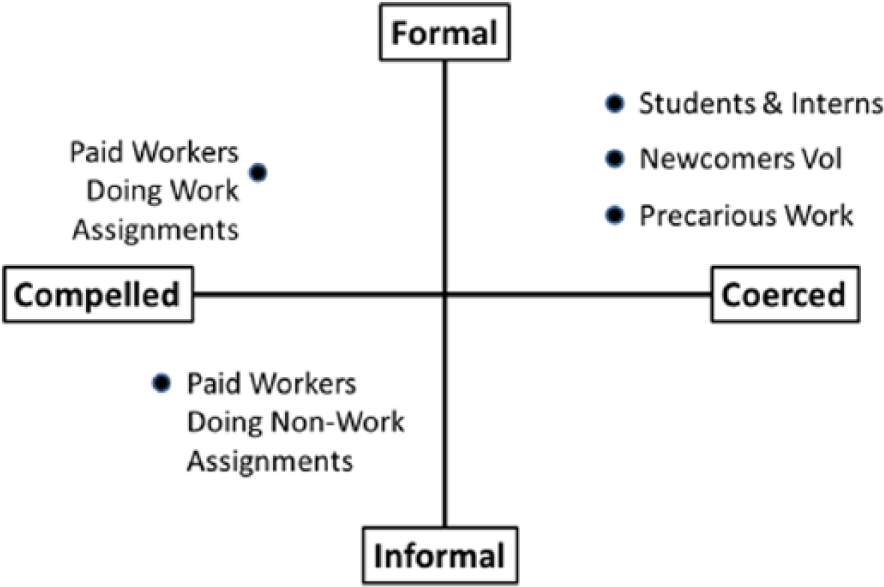
Model of unpaid care work.
Going from the top clockwise, the first quadrant, formal/coerced unpaid work, is the most populated with examples from our data. It includes: unpaid students; precarious workers, who may jeopardise their paid employment if they do not undertake unpaid work; and newcomer volunteers. These groups of workers share a space of normalised coercion where the unpaid workers may feel coerced, compelled or just lucky to have the opportunity to work for free. At the same time the threat of job loss, or loss of existing and future paid hours, a positive Canadian reference and/or a crucial component of an educational degree underlie the social organisation of this work. These dynamics highlight the social relations and clusters of policies reinforcing the vulnerability of these unpaid workers and the strong and deliberate control of the unpaid labour process exerted by management. This workplace control is bolstered by other institutions such as governments and their immigration policies, universities, professional organisations and labour markets that increasingly normalise the unpaid work as an expectation for gaining and retaining employment. The examples in this quadrant highlight the commonalities that students and precarious workers share in the social organisation and coercion/compulsion of unpaid work in the organisations studied.
These position points are highly gendered since the demand for unpaid work is a well-accepted norm in this sector in which notions of women’s caring nature and perceived willingness to self-exploit interweave with long-term under-funding and high demand for services, culminating in the institutionalisation of unpaid care work. As noted earlier, a further aspect of the gendering process is the requirement in women’s care professions that students pay tuition to undertake long hours of unpaid work in order to qualify for professional status in jobs that are often precarious, with pay and conditions at the lower end of the professional scale.
The examples in this quadrant point also highlight the way that the social organisation of unpaid work is racialised. In this case, recent immigrants, largely from racialised populations, are introduced to Canadian experience and provided with a volunteer ‘job’ reference under conditions in which there are implicit promises of paid work if volunteers are evaluated positively by management and clearly understood labour market norms that there will be not be opportunities for paid work without Canadian experience and positive volunteer references.
Continuing clockwise, the lower right quadrant (coerced, informal work) is not populated with examples from our data. This suggests that where unpaid work is sufficiently informal, coercion may not play a significant role (for example, tidying up after an event one happens to attend).
The next quadrant (lower left) includes examples of informal, compelled work such as paid workers undertaking unpaid work tasks that are well outside their regular paid duties such as fundraising for the agency or assisting other workers complete their workloads. This unpaid overtime is normalised, generally undocumented and, thus, made invisible. It pivots on the paid workers’ sense of themselves as moral actors and good professionals. It is the closest example of a purely voluntary undertaking of unpaid care work in our study, though it is muddied by gendered expectations, norms of feminine self-sacrifice and cynical, chronic underfunding of the sector.
The upper left quadrant involves formal, compelled unpaid work and includes examples from our data such as paid workers undertaking unpaid overtime to complete their regular work tasks. This non-monetised work is a formalised and normalised expectation in many nonprofit agencies and workers are aware that their performance of this work will be folded into their overall performance evaluation. As such, this unpaid labour is part of formal work relations with its extraction operating at the level of compulsion. However, negative reports and evaluations will obviously make paid employment less secure, meaning that this unpaid work also contains elements of coercion.
The points in these quadrants are not tightly fixed categories. Rather, they will shift as social relations and policies change in larger society. Examples of forces that may change the social organisation of unpaid care labour include: new developments in local and global labour market; more or less restrictive migration policies and more or less resettlement supports; social policies redistributing care work in the home from women to men or to the state (such as required parental leaves for men rather than exclusively for women); or the erosion of male breadwinner jobs and high male unemployment compelling men to enter female-majority job categories (Baines & Cunningham, 2015). Another significant force propelling shifting dynamics in the care workplace is resistance and it is to this factor that we now turn.
Additional resistance and the unevenness of precarity and unpaid work
Our data revealed a number of additional ways that workers resisted aspects of the austere workplace, particularly issues of precarity. The labour put into this resistance was, ironically, unpaid but constituted a form of gift in which the giver contributes to the social good and expects no thanks (Bolton, 2001). Formal resistance in the form of union strategies was only apparent in Union House. As noted earlier, Counselling House had fairly recently experienced a drive to unionise that ended when staff members initiating the drive were terminated. Unpaid and precarious work were less prevalent at Union House and more prevalent at the other two, non-union agencies. The national union, of which Union House was a member, had a policy opposed to precarious work, arguing that all workers deserved full hours, fair wages and full benefits. This theme was important to the local union where one of the key demands of their first strike in 25 years was for benefits and improved conditions for part-time workers. Though the workers went on a ten-day strike, they did not win this demand (they won one additional paid vacation day for part-time workers). However, the union local made it clear that they disagreed with precarious workers being disadvantaged and, moreover, they were willing to take serious job action. These findings suggest a correspondence between formal resistance on the part of unions and lower precarity and unpaid labour in the workplace.
Workers also resisted in the non-union agencies where unpaid and precarious work was more prevalent, although resistance was largely restricted to individual acts of time reclamation such as taking long smoking or coffee breaks, making non-work related phone calls and texts, doing non-work tasks during work time, and job leaving (Ackroyd and Thompson, 1999). 1 In terms of job leaving, some workers quit their jobs when they felt management did not have sufficient regard for them. Two reported that they were leaving because they felt their work had been treated without dignity. One worker reported being ‘deeply disrespected’ by her supervisor. Another worker, who had plans to leave her job, told us, she was ‘fed up with not being appreciated and fed up with the workload’.
Collective oppositional narratives, providing shared analysis and oppositional identities were evident in all three workplaces and represented both a workplace-based and larger social practice of resistance. For example, workers at Counselling House developed oppositional storylines about the agency’s heavy reliance on unpaid interns and their sense that ‘using students is wrong’. Another especially strong counter narrative against management’s uncaring actions was, as one worker put it, that ‘staff cry regularly at individual and group supervisions. Plus, there is always someone openly in tears at staff meetings. That’s not right in an agency that claims to care.’ These oppositional storylines gave workers shared understanding of their work situations and a way to attribute responsibilities to management rather than to blame themselves. However, according to our data, these oppositional narratives did not result in notable changes.
Collective and individual acts of resistance contribute to changing relations of paid and unpaid work as do the factors discussed in the spectrum and analysed throughout this article.
Conclusions
The model developed above underscores that the unpaid labour of newcomer volunteer labour, students, interns and precarious workers was relied on intensively in order to fill gaps and sustain core services in the context of austerity policies. Austerity policies have meant that a lean production model is part the political economy of the NPSS which almost necessitates the use of low pay and unpaid labour. Representing a shift in what Glucksmann (2005) calls the total social organisation of labour, these developments constituted a changing aspect of labour process in the NPSS in which a number of strategies explicitly or implicitly compelled or coerced unpaid (non-monetised) labour from existing (full-time and precarious) and future care workers (students), and in the process extracted disciplined, reliable and skilled, free labour. As the discussion above shows, this unpaid work is complex, for while it constitutes exploitation, it is simultaneously a way for workers to contribute to the social good and push back on the harmful and uncaring impacts of austerity policies.
Further research is required to explore the relationships between precarious and unpaid work and the gendered forms of care and resistance operating in the restructured NPSS workplace. This sample was too small and locally based to do more than suggest that these dynamics are active within management’s attempts to manage the crisis of austere funding. Further research is also required to explore how unpaid work is classed, as well as gendered and racialised. For example, the literature on internships shows that richer students are the ones able to undertake lengthy and better internships (Perlin, 2012; Frenette, 2015). Though internships are an expectation of female-majority care occupations, how does class play into specialisation in clinical work, as opposed to lower status specialisations such as community development or child welfare? Clinicians are the elite of social work and psychology, generally working in private practice, hospitals and specialised clinics rather than in skin-of-the-teeth community organisations such as the ones studied here. Therefore, it seems likely that many of the students undertaking clinical placements will not seek employment in the voluntary sector, or if they do they may not remain long.
Finally, the links to larger social processes require further investigation, particularly, the operation and coordination of institutions such as workplaces, labour markets, immigration and settlement services and policies, and larger global migrations of peoples and markets.
Footnotes
Funding
Funding was provided by the Social Sciences and Humanities Research Council, Canada (CURA – PI Wayne Lewchuk).